
India Urban Logistics Market Size and Share
Market Overview
| Study Period | 2020 - 2031 |
|---|---|
| Forecast Data Period | 2026 - 2031 |
| Base Year Market Size (2025) | USD 75.06 Billion |
| Market Size (2026) | USD 85.18 Billion |
| Market Size (2031) | USD 155.85 Billion |
| Growth Rate (2026 - 2031) | 12.84 % |
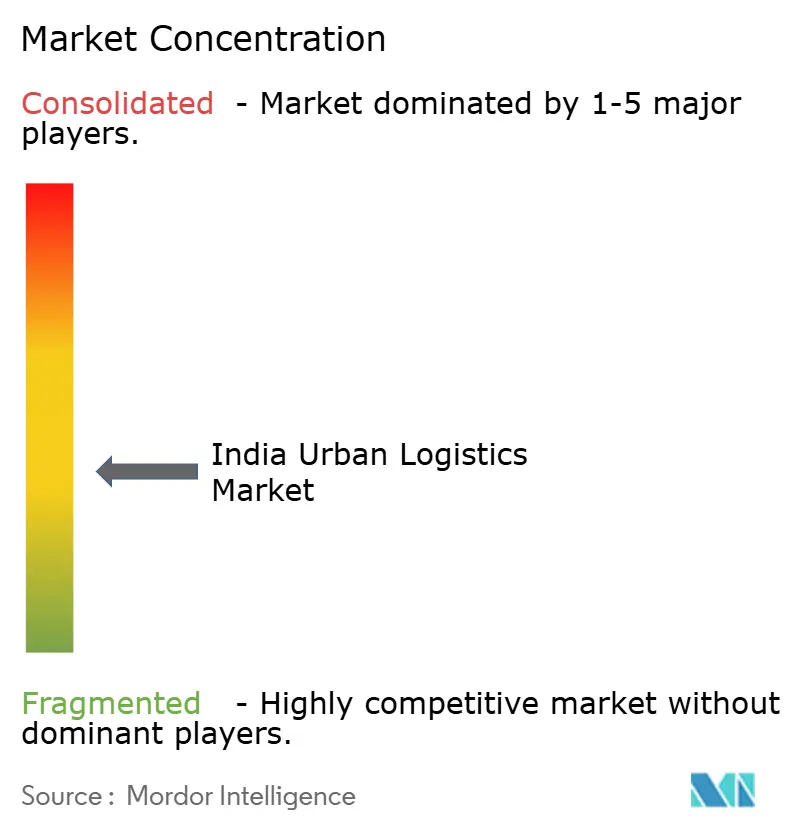
| Market Concentration | Medium |
Major Players *Disclaimer: Major Players sorted in no particular order Image © Mordor Intelligence. Reuse requires attribution under CC BY 4.0. | |
India Urban Logistics Market Analysis by Mordor Intelligence
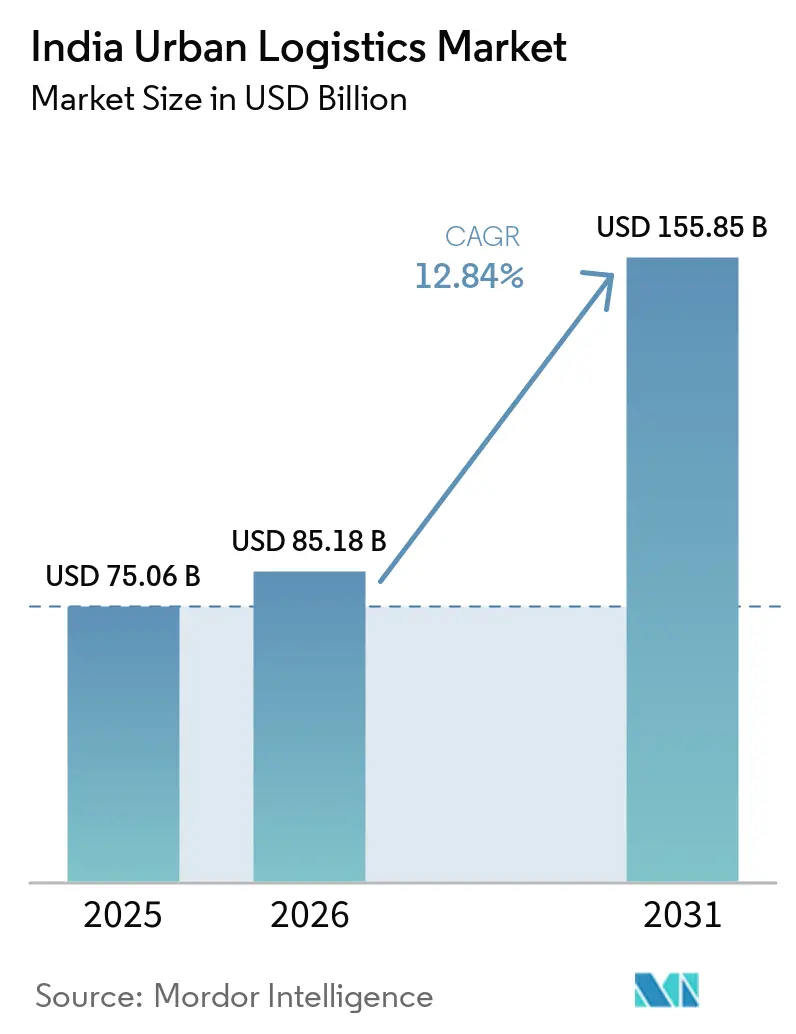
The India urban logistics market size was valued at USD 75.06 billion in 2025 and is estimated to grow from USD 85.18 billion in 2026 to reach USD 155.85 billion by 2031, at a CAGR of 12.84% during the forecast period (2026-2031).
The India urban logistics market is being reshaped by formal freight networks, digital retail demand, and the need for faster delivery in dense cities where consumers and businesses expect greater reliability from every shipment. Goods and Services Tax reforms and the PM GatiShakti framework support more integrated route and facility planning, which can improve the coordination of warehouses, urban hubs, vehicle movements, and digital information across logistics networks. Quick commerce is increasing the need for local inventory, frequent replenishment, and dependable last-mile capacity because providers must deliver daily essentials within much shorter time windows than conventional parcel networks were designed to meet. Competitive conditions favor providers that can combine network density, technology, and operating discipline, since these capabilities help them manage variable order demand while maintaining a consistent service level across diverse urban neighborhoods. Fuel costs, congestion, and local land-use rules can still limit the economics of urban delivery, especially when fleets must travel long distances between inventory locations and high-density consumer or commercial delivery zones.
Key Report Takeaways
- By service type, transportation services held 55.73% of the India urban logistics market share in 2025, while fulfillment services are projected to grow at a 14.76% CAGR through 2031.
- By delivery speed, standard delivery held 68.27% of the India urban logistics market size in 2025, while instant and same-day delivery is projected to grow at a 13.93% CAGR through 2031.
- By customer type, B2C logistics held 58.36% of the India urban logistics market share in 2025, while C2C logistics is projected to grow at a 15.71% CAGR through 2031.
- By end-use industry, e-commerce and retail held 46.62% of the India urban logistics market size in 2025 and is projected to grow at a 15.48% CAGR through 2031.
- By city, Delhi (NCR Region) held 8.23% of the revenue in 2025, while Pune is forecast to grow at a 14.31% CAGR through 2031.
Note: Market size and forecast figures in this report are generated using Mordor Intelligence’s proprietary estimation framework, updated with the latest available data and insights as of January 2026.
India Urban Logistics Market Trends and Insights
Drivers Impact Analysis*
| Driver | (~) % Impact on CAGR Forecast | Geographic Relevance | Impact Timeline |
|---|---|---|---|
| E-Commerce and Digital Retail Expansion | +3.2% | Pan-India, concentrated in Tier 1 metros with rapid Tier 2 and Tier 3 expansion | Short term (≤ 2 years) |
| Quick Commerce and Dark-Store Proliferation | +2.5% | Bengaluru, Delhi NCR, Mumbai MMR, Pune, Hyderabad, with rapid Tier 2 entry | Short term (≤ 2 years) |
| National Logistics Policy, PM GatiShakti and GST-Led Network Formalization | +1.8% | National, with early infrastructure gains in DFC corridors and MMLP hubs | Medium term (2-4 years) |
| Tier 2 and Tier 3 Digital Commerce Expansion | +1.5% | Surat, Ahmedabad, Pune, Indore, Lucknow, with expansion into Tier 3 towns | Medium term (2-4 years) |
| Micro-Market Density Economics Enabled by Interoperable Logistics Networks | +1.2% | Metropolitan clusters and ONDC-active cities | Medium term (2-4 years) |
| Electric Two-Wheeler and Battery-Swapping Economics | +0.8% | Delhi NCR, Bengaluru, Mumbai MMR, Pune, and Hyderabad | Long term (≥ 4 years) |
| Source: Mordor Intelligence | |||
E-Commerce and Digital Retail Expansion
The India urban logistics market receives a major demand signal from digital retail. B2C and C2C shipments together represented more than 55% of India’s express logistics activity in 2025. Digital retail broadens the addressable volume for parcel transport, fulfillment, and returns, while also increasing the importance of accurate order handling and reliable delivery coordination for sellers that serve consumers across multiple cities. India Brand Equity Foundation reported e-commerce gross merchandise value of USD 80 billion in FY 2026, with 21% year-over-year growth[1]. This expansion places greater value on urban hubs that can serve both high-volume consumer orders and variable return flows. Providers with adaptable hub-and-spoke operations can extend coverage as demand expands beyond established metropolitan catchments.
Quick Commerce and Dark-Store Proliferation
Quick commerce is shifting urban logistics from scheduled batches toward continuous replenishment. Blinkit reached 1,816 dark stores after adding 272 locations in the September quarter of FY2026 and plans to reach 3,000 locations by March 2027[2]. Swiggy Instamart crossed 1,100 stores and expanded to 100 cities during the period. These networks require inventory to be positioned close to consumers and replenished throughout the day, creating a more continuous operating pattern for local facilities, delivery fleets, and suppliers that support dark-store replenishment. The India urban logistics market, therefore, needs denser local capacity, including short-haul fleets and micro-fulfillment support. Providers that control reliable city capacity can support service commitments that are difficult to meet through intermittent subcontracting.
National Logistics Policy, PM GatiShakti and GST-Led Network Formalization
The India urban logistics market benefits from national programs that seek to reduce planning and documentation frictions. The PM GatiShakti Network Planning Group had assessed 396 infrastructure projects by mid-2026, with 256 projects sanctioned and 198 under implementation[3]. These projects carried a total estimated cost of INR 18.66 lakh crore (USD 207.68 billion). The Unified Logistics Interface Platform had recorded more than 160 crore digital transactions by August 2025. The platform supports more connected information flows for route and facility planning, allowing logistics participants to make decisions using a clearer view of infrastructure, shipment activity, and the location of relevant operational assets. City Logistics Plan guidelines can also encourage formal operators to align their networks with state and urban planning priorities.
Electric Two-Wheeler and Battery-Swapping Economics
Electric two-wheelers can improve the operating model for short urban delivery routes. Battery swapping addresses vehicle downtime, which can otherwise limit fleet utilization during intensive delivery schedules, and it can help operators keep vehicles active when demand peaks during lunch, evening, and other high-demand periods. Honda Motorcycle and Scooter India and Honda Power Pack Energy India partnered with Bhago Mobility in February 2026 on a subscription model for delivery workers that combined EV access, battery swapping, and compliance services. The model lowers the entry barrier for gig workers who need access to delivery vehicles. The India urban logistics market can benefit where operators combine electric fleets with routes that are dense enough to maintain high daily utilization. Adoption will be strongest where swapping access, vehicle availability, and delivery demand are present in the same urban zone.
Restraints Impact Analysis*
| Restraint | (~) % Impact on CAGR Forecast | Geographic Relevance | Impact Timeline |
|---|---|---|---|
| Urban Congestion and Limited Curb Access | -1.5% | Mumbai MMR, Delhi NCR, Bengaluru, Chennai, with increasing pressure in Tier 2 cities | Short term (≤ 2 years) |
| Fuel and Operating Cost Volatility | -1.2% | National, particularly road-freight-dependent non-metro corridors | Short term (≤ 2 years) |
| Dark-Store Land-Use Constraints and Neighborhood Friction | -0.8% | Bengaluru, Delhi NCR, Pune, Chennai, Lucknow, and RERA-zoned cities | Medium term (2-4 years) |
| Low Platform Trust and Fragmented Informal Fleet Operations | -0.6% | Tier 2 and Tier 3 cities and semi-urban corridors | Medium term (2-4 years) |
| Source: Mordor Intelligence | |||
Urban Congestion and Limited Curb Access
Congestion limits the number of delivery stops that a rider or vehicle can complete in a shift. It also reduces the predictability needed for same-day and scheduled delivery commitments, because the same traffic conditions can affect routes differently across urban districts and at different times of the working day. The constraint is most significant in Mumbai MMR, Delhi NCR, Bengaluru, and Chennai, where dense traffic and limited loading space affect commercial vehicle movements. Providers need local spokes and dark stores close to delivery endpoints to reduce exposure to long urban trips. The India urban logistics market faces higher per-delivery costs when vehicles cannot access curbs efficiently. Network design, local inventory placement, and delivery-slot discipline remain important responses to this constraint for organized providers serving congested city centers.
Fuel and Operating Cost Volatility
Fuel remains a major variable cost for road-based logistics operations. Price movements can pressure the margins of fleet operators that cannot revise shipper rates quickly, particularly where service agreements do not provide a clear process for passing fuel changes through to customers. The All India Transporters Welfare Association introduced a Fuel Adjustment Factor mechanism in May 2026 to link freight charges to diesel movements. The mechanism could shift some volatility from operators to shippers and consumers where contracts adopt it. Smaller informal fleets may remain more exposed because they have limited pricing leverage with enterprise customers. Electric fleet adoption and long-term fuel arrangements can reduce exposure over time for organized providers.
*Our forecasts treat driver/restraint impacts as directional, not additive. The impact forecasts reflect baseline growth, mix effects, and variable interactions.
Segment Analysis
By Service Type: Transportation Holds the Largest Share While Fulfillment Expands
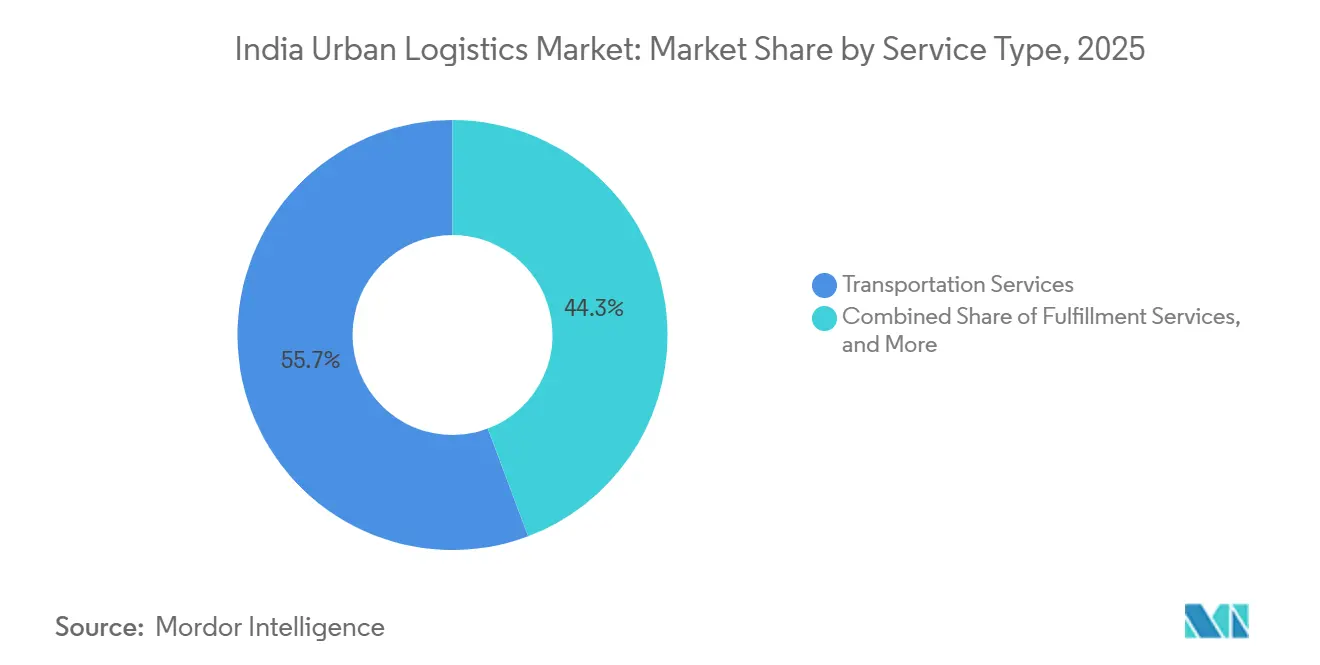
Transportation services held 55.73% of the India urban logistics market share in 2025. The segment remains anchored by the scale of road-based parcel and freight movement across metropolitan areas. Large surface networks and existing fleet capacity support its current position, particularly where operators move high volumes through established hubs before distributing shipments into individual urban delivery zones. The segment also reflects the continuing need to move goods between city gateways, local hubs, and final delivery zones. Transportation providers need to improve urban routing and local capacity to protect service quality as demand shifts toward shorter delivery windows.
Fulfillment services are forecast to expand at a 14.76% CAGR through 2031, the fastest pace among service types. This part of the India urban logistics market size includes warehousing, pick-and-pack operations, order management, and last-mile coordination. E-commerce platforms increasingly seek a single accountable provider across these linked activities. Urban storage is growing alongside the quick-commerce dark-store model. Reverse logistics remains relevant for fashion and electronics returns, while value-added logistics supports requirements such as kitting, temperature control, and time-definite urban distribution.

By Delivery Speed: Standard Delivery Retains Volume While Faster Services Grow
Standard delivery held 68.27% of the India urban logistics market size by delivery speed in 2025. Its position reflects price sensitivity among online shoppers, especially in Tier 2 and Tier 3 cities. Many orders can be served within a 48-72-hour delivery window at a lower cost. Standard delivery is not static because faster options are changing customer expectations in dense urban areas. Scheduled delivery also improves the use of routes where recipient availability can be planned in advance.
Instant and same-day delivery is forecast to grow at a 13.93% CAGR through 2031. Quick commerce, on-demand food delivery, and same-day fashion services are driving this pace. These services require close inventory placement and dependable rider availability, because a short delivery promise depends on the coordinated availability of stock, vehicle capacity, dispatch capability, and access to the final address. Next-day delivery remains important for premium consumer electronics and B2B shipments where the delivery promise matters more than immediate arrival. Better dispatch systems and denser electric two-wheeler fleets can narrow the cost difference between standard and faster services in urban pin codes.
By Customer Type: B2C Leads Volumes While C2C Gains Momentum
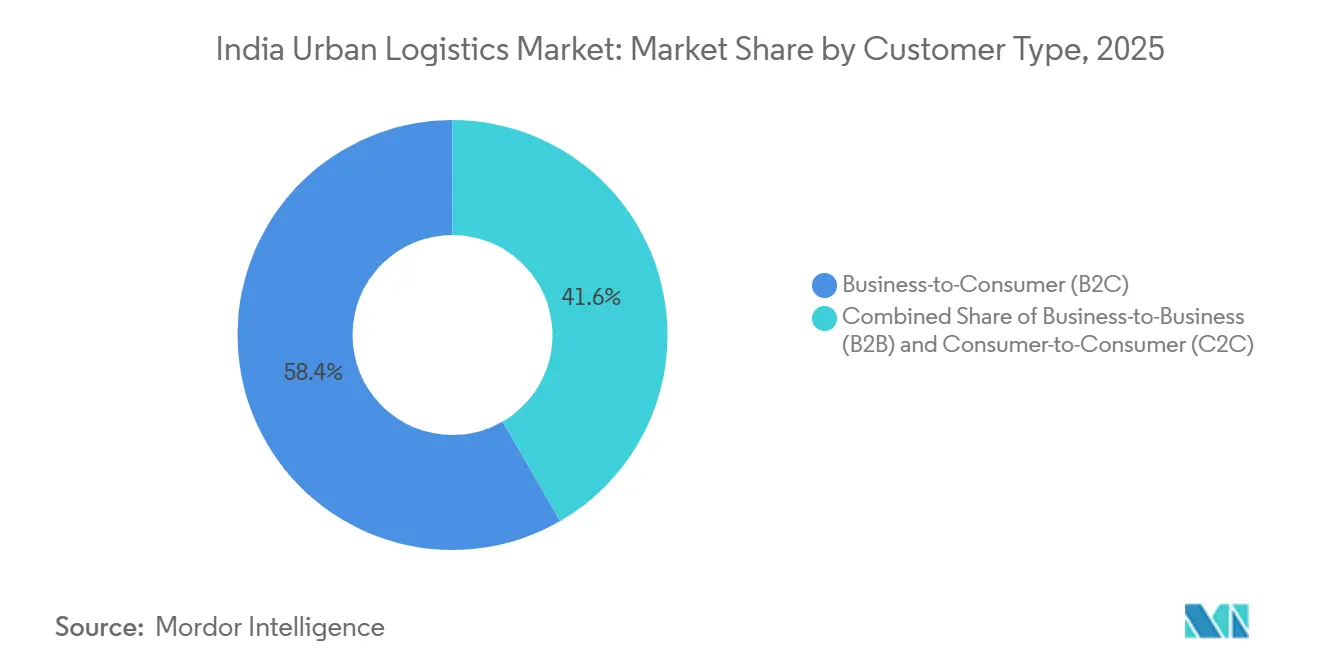
B2C logistics held 58.36% of the India urban logistics market share by customer type in 2025. The segment is the main demand base for transportation, fulfillment, and reverse logistics. Its performance is tied to digital retail volumes and the continuing expansion of online purchasing. Consumer shipments provide repeat order flows that support route density in large cities, allowing providers to plan recurring collections, sortation activity, and local delivery routes around predictable demand patterns. B2C providers also need to manage delivery quality, returns, and changing consumer expectations across varied city locations.
C2C logistics is projected to grow at a 15.71% CAGR through 2031. Resale platforms, peer-to-peer marketplaces, and social commerce require flexible pickup and delivery services that are accessible to individual users. Resale platforms, peer-to-peer marketplaces, and social commerce are creating demand for accessible pickup and delivery services. These shipments need flexible entry points instead of the enterprise onboarding process common in B2C contracts. Providers with hyperlocal pickup capability can use infrastructure originally developed for returns. B2B urban logistics remains strategically important because enterprise customers value dependable intracity movement. LetsTransport Group serves enterprise clients including Amazon, Flipkart, Coca-Cola, and Nestlé across more than 30 cities.
By End-Use Industry: E-Commerce and Retail Lead Demand
E-commerce and retail held 46.62% of the India urban logistics market share by end-use industry in 2025. The same segment is forecast to grow at a 15.48% CAGR through 2031. This dual position reflects the scale of digital retail and the continued room for online commerce expansion. It creates demand across transportation, fulfillment, local storage, and returns. Retail volumes also make route density more viable in major cities.
Healthcare and pharmaceuticals require cold-chain capabilities, same-day prescription fulfillment, and time-definite distribution. Food and beverage demand is closely tied to quick commerce because grocery and daily essentials move through dark-store networks. Industrial and manufacturing flows include intra-city movement of components, maintenance parts, and intermediate goods. Automotive parts require time-definite urban distribution to workshops and dealerships. Fashion and consumer electronics returns also support demand for reverse logistics services. These different end uses reward providers that can combine specialized handling with a dependable urban network.
Geography Analysis
Delhi NCR was the largest city with a market share of 8.23% in the India urban logistics market in 2025. Warehouse capacity on the eastern and northern periphery supports inventory placement for fast, scheduled, and conventional delivery. Consumption in the core produces the order volumes that help operators create dense and repeatable routes. Mumbai MMR has a comparable density advantage, although its islands and peninsulas make facility expansion and vehicle movement more difficult.
Pune is forecast to grow at a 14.31% CAGR through 2031, the fastest city rate in the India urban logistics market. Moreover, Bengaluru, Hyderabad, and Pune form a fast-growing southern and western cluster for the India urban logistics market. Technology-sector employment, consumer spending, and quick-commerce adoption support sustained urban delivery activity across these cities. Delhivery deployed 200 Bajaj RIKI eCarts across its last-mile network in June 2026, with a later phase targeting 1,500 electric three-wheelers[4]. The deployment was flagged off from Pune, supporting the city’s role in urban fleet electrification.
Ahmedabad and Surat are becoming regional distribution anchors because Gujarat’s industrial base supports a broader logistics role. Surat’s textile ecosystem creates high-SKU freight, B2B movement between factories and showrooms, and D2C export needs. Kolkata anchors the eastern corridor and supports national platforms that are extending coverage toward West Bengal and the northeast. DTDC launched the Bharat One Hub in Haryana in August 2026 with a processing capacity of 2,500 tons per day. Tier 2 and Tier 3 cities can broaden the geographic reach of urban logistics as urban infrastructure and formal delivery capacity improve.
Competitive Landscape
The India urban logistics market has a medium concentration at the national level. Large technology-enabled platforms compete with many regional and local providers that operate with varying levels of formalization. Delhivery’s acquisition of Ecom Express was cleared by the Competition Commission of India in June 2025. The transaction illustrates the value of shipment scale in a network business with substantial fixed operating costs. Larger providers can distribute infrastructure costs across higher volumes and can offer broader service coverage.
Technology and automation are central to competitive positioning. Delhivery’s Naksha LLM Suite uses 7 fine-tuned smaller language models for location intelligence, voice, vision, and logistics workflows. The company also deployed autonomous mobile robots at Mumbai mega gateways for heavy-load movement. These investments can improve service reliability and operational control in high-volume facilities. Smaller firms may find it difficult to match the capital needs and shipment data required for comparable systems.
Competition remains active in specialized urban delivery models. DHL Group announced a EUR 1 billion (USD 1.17 billion) commitment in India through 2030 for e-commerce logistics, life sciences, healthcare, and digitalization. Porter closed a USD 200 million Series F funding round in May 2025 and expanded into 8 new cities. Organized B2B intracity freight and cold-chain micro-fulfillment remain areas where providers can differentiate services and build local network capability.
India Urban Logistics Industry Leaders
-
SmartShift Logistics Solutions Pvt. Ltd. (Porter)
-
Delhivery Limited
-
Shadowfax Technologies Limited
-
Busybees Logistics Solutions Pvt. Ltd. (Xpressbees)
-
Blue Dart Express Limited
- *Disclaimer: Major Players sorted in no particular order
Recent Industry Developments
- June 2026: Delhivery and Bajaj Auto announced the deployment of 200 Bajaj RIKI eCarts across Delhivery’s last-mile network, representing phase one of a partnership targeting 1,500 electric three-wheelers and extending electrification to Tier 2 and Tier 3 cities.
- May 2026: Shadowfax announced plans to establish 100 dark stores in FY27 for vertical quick commerce, marking a shift from third-party logistics (3PL) delivery to fulfillment infrastructure ownership.
- November 2025: DHL Group announced a EUR 1 billion (USD 1.17 billion) investment commitment in India by 2030, spanning e-commerce logistics, life sciences, healthcare, and digitalization.
- May 2025: Porter closed a Series F funding round of USD 200 million led by Kedaara Capital and Wellington Management, valuing the intracity logistics platform at USD 1.2 billion. The company subsequently expanded into 8 new cities, including Mysore, Madurai, and Gwalior, and targeted 50 cities by 2030.
India Urban Logistics Market Report Scope
| Transportation Services |
| Warehousing and Urban Storage Services |
| Fulfillment Services |
| Reverse Logistics Services |
| Value-Added Logistics (VAL) Services |
| Instant and Same-Day Delivery |
| Next-Day Delivery |
| Scheduled Delivery |
| Standard Delivery |
| Business-to-Business (B2B) |
| Business-to-Consumer (B2C) |
| Consumer-to-Consumer (C2C) |
| E-commerce and Retail |
| Food and Beverage |
| Healthcare and Pharmaceuticals |
| Consumer Electronics |
| Fashion and Apparel |
| Automotive Parts |
| Industrial and Manufacturing |
| Others |
| Delhi (NCR Region) |
| Mumbai (MMR Region) |
| Kolkata |
| Bengaluru |
| Chennai |
| Hyderabad |
| Ahmedabad |
| Surat |
| Pune |
| Rest of Cities |
| By Service Type | Transportation Services |
| Warehousing and Urban Storage Services | |
| Fulfillment Services | |
| Reverse Logistics Services | |
| Value-Added Logistics (VAL) Services | |
| By Delivery Speed | Instant and Same-Day Delivery |
| Next-Day Delivery | |
| Scheduled Delivery | |
| Standard Delivery | |
| By Customer Type | Business-to-Business (B2B) |
| Business-to-Consumer (B2C) | |
| Consumer-to-Consumer (C2C) | |
| By End-Use Industry | E-commerce and Retail |
| Food and Beverage | |
| Healthcare and Pharmaceuticals | |
| Consumer Electronics | |
| Fashion and Apparel | |
| Automotive Parts | |
| Industrial and Manufacturing | |
| Others | |
| By City | Delhi (NCR Region) |
| Mumbai (MMR Region) | |
| Kolkata | |
| Bengaluru | |
| Chennai | |
| Hyderabad | |
| Ahmedabad | |
| Surat | |
| Pune | |
| Rest of Cities |
Key Questions Answered in the Report
What is the projected value of India’s urban logistics sector by 2031?
The India urban logistics market is projected to reach USD 155.85 billion by 2031. It is estimated at USD 85.18 billion in 2026 and is forecast to expand at a 12.84% CAGR through 2031.
What is driving urban logistics demand in India?
Digital retail expands the volume of consumer parcels, while quick commerce increases the need for local inventory and frequent replenishment. Formal logistics planning also supports more coordinated route and facility decisions.
Which service type is largest in India’s urban logistics sector?
Transportation services were the largest service type, with 55.73% share in 2025. Their position reflects the continuing volume of road-based parcel and freight movement between gateways, local hubs, and final delivery locations.
Which delivery speed is growing fastest in urban logistics?
Instant and same-day delivery is projected to grow at a 13.93% CAGR through 2031. Quick commerce, food delivery, and time-sensitive consumer purchases are increasing demand for these faster service levels.
Which customer type is expanding fastest in this sector?
C2C logistics is projected to grow at a 15.71% CAGR through 2031. Resale platforms, peer-to-peer marketplaces, and social commerce require flexible pickup and delivery services that are accessible to individual users.
How concentrated is India’s urban logistics sector?
The market concentration score is 4 out of 10 because large platforms are gaining scale through network investment, automation, and selected acquisitions. Regional and local operators still form a substantial fragmented tail across city and corridor-level operations.