
India Technical Textile Manufacturing Market Size and Share
Market Overview
| Study Period | 2021 - 2032 |
|---|---|
| Forecast Data Period | 2027 - 2032 |
| Base Year Market Size (2026) | USD 22.90 Billion |
| Market Size (2027) | USD 24.65 Billion |
| Market Size (2032) | USD 35.62 Billion |
| Growth Rate (2027 - 2032) | 7.64 % |
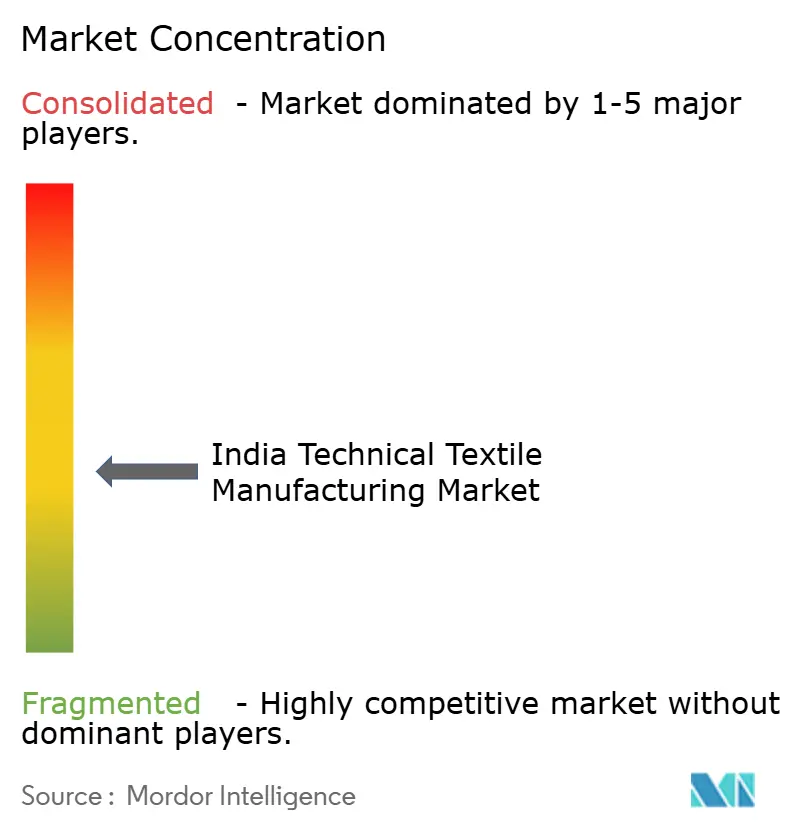
| Market Concentration | Medium |
Major Players *Disclaimer: Major Players sorted in no particular order Image © Mordor Intelligence. Reuse requires attribution under CC BY 4.0. | |
India Technical Textile Manufacturing Market Analysis by Mordor Intelligence
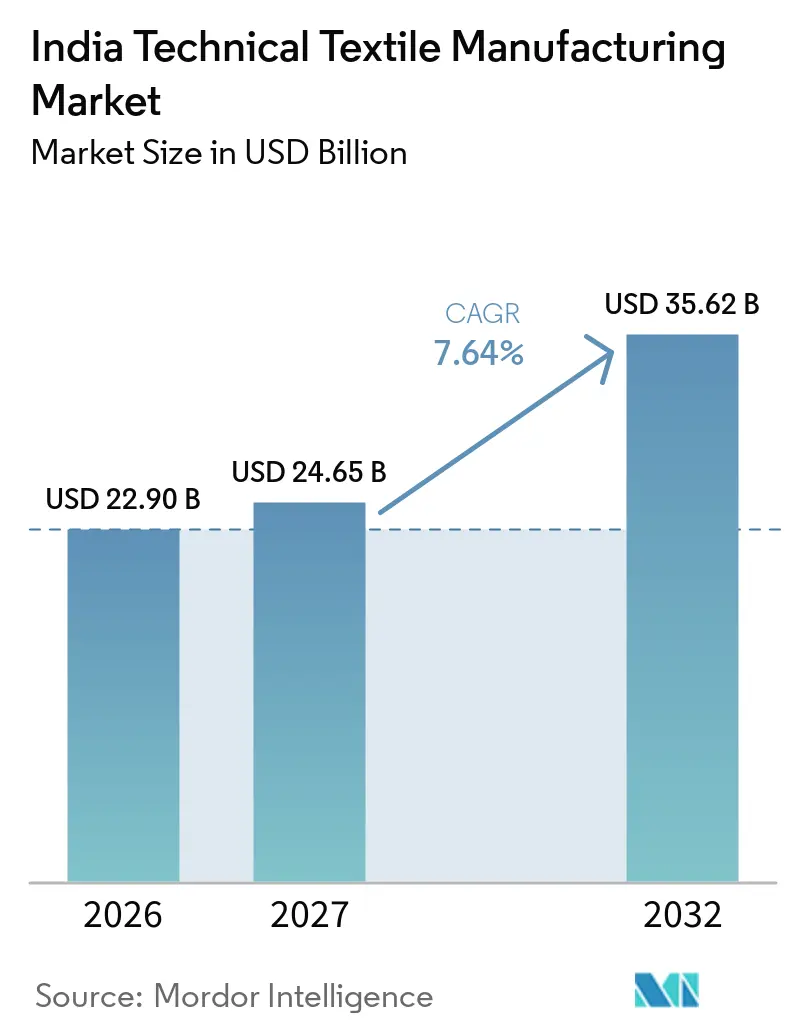
The India Technical Textile Manufacturing Market size is expected to increase from USD 22.90 billion in 2026 to USD 24.65 billion in 2027 and reach USD 35.62 billion by 2032, growing at a CAGR of 7.64% over 2027-2032.
Infrastructure procurement, government-backed manufacturing programs, and higher industrial production support demand across several technical textile uses. India’s technical textile penetration remains 5% to 10% of domestic consumption, compared with 30% to 70% in developed economies, leaving substantial room for substitution in domestic end uses. The National Technical Textiles Mission, extended through March 2026 with an approved INR 1,480 crore (USD 164.7 million) outlay, supports research, mandatory-use notifications, and startup development. Procurement standards are making certified materials more important in public infrastructure, healthcare, and protective applications. Export access also depends more heavily on traceability and documented product compliance, which favors manufacturers able to invest in testing and product records.
Key Report Takeaways
- By material type, synthetic fiber held 69% of the India technical textile manufacturing market share in 2026, while regenerated and other fibers are forecast to grow at an 8.5% CAGR through 2032.
- By form and structure, nonwovens held 35% of the India technical textile manufacturing market size in 2026 and are forecast to grow at 7.9% CAGR through 2032.
- By application, Indutech held a 25% share in 2026, while Medtech is forecast to grow at an 8.1% CAGR through 2032.
Note: Market numbers in this report are based on Mordor Intelligence's proprietary estimation framework, which combines nine months of actuals with Q4 projections for base year 2026.
India Technical Textile Manufacturing Market Trends and Insights
Drivers Impact Analysis*
| Driver | (~) % Impact on CAGR Forecast | Geographic Relevance | Impact Timeline |
|---|---|---|---|
| Infrastructure and Geosynthetic Adoption | +2.1% | National, concentrated in Bharatmala corridor states, including Tamil Nadu, Madhya Pradesh, Gujarat, Rajasthan, and the Northeast connectivity projects. | Long term (≥ 4 years) |
| Government-Mandated Use and National Technical Textiles Mission | +1.8% | National, with early gains in Karnataka, Maharashtra, and Tamil Nadu | Medium term (2-4 years) |
| Industrialization, Automotive Output, and Mobility Demand | +1.4% | National, concentrated in Gujarat, Maharashtra, Tamil Nadu, and Telangana, automotive clusters. | Medium term (2-4 years) |
| Import Substitution in Specialty Fibers and High-Performance Products | +1.1% | National technology clusters, with spillover to defense-adjacent corridors in Maharashtra and Karnataka | Long term (≥ 4 years) |
| Export Market Expansion and Global Supply Chain Realignment | +0.9% | National, with early gains in Tamil Nadu, Gujarat, and Uttar Pradesh | Medium term (2-4 years) |
| Specification-Led Procurement and Digital Traceability | +0.6% | National, especially export-oriented clusters and defense procurement zones | Short term (≤ 2 years) |
| Source: Mordor Intelligence | |||
Infrastructure and Geosynthetic Adoption
India’s Union Budget for 2025-26 allocated INR 11.21 lakh crore (USD 124.8 billion) for capital expenditure, including INR 2.65 lakh crore (USD 29.5 billion) for railways and INR 3.9 lakh crore (USD 43.4 billion) for the road program.[1] These allocations sustain demand for geotextiles used in subgrade stabilization, drainage, and mechanically stabilized earth structures. The Ministry of Textiles coordinated with road and water agencies on codal provisions for geocells, geocomposites, and geogrids used in highway construction.[2] Such provisions make project specifications more influential than short-term changes in raw-material prices. The India technical textile manufacturing market benefits when highway, rail, airport, and port projects require certified materials at the design stage. Product approval and installation records can also increase the advantage of suppliers with application-engineering capabilities.
Government-Mandated Use and National Technical Textiles Mission
The National Technical Textiles Mission had approved 168 research projects and sanctioned 16 further projects in February 2026. The additional projects cover high-performance fibers, smart textiles, and composite systems for infrastructure and defense. During the first 9 months of FY2025-26, technical textile exports reached INR 21,970 crore (USD 2,445.2 million) and imports totaled INR 18,953 crore (USD 2,109.4 million), producing an INR 3,017 crore (USD 335.8 million) trade surplus. The GREAT scheme approved 31 technical textile startups, each receiving INR 50 lakh (USD 0.06 million) for product development. Mandatory-use notifications for geotextiles and procurement preferences for certified medical nonwovens provide recurring demand support for the India technical textile manufacturing market. As of 2026, 96 companies had been approved in the PLI Scheme Round 3, with INR 12,822.67 crore (USD 1,427.1 million) in committed investment.
Industrialization, Automotive Output, and Mobility Demand
India produced 53.8 lakh passenger vehicles, 11.1 lakh commercial vehicles, and 255 lakh two-wheelers during the calendar year 2025.[3] This output supports demand for airbag yarns, seat fabrics, headliners, and filtration media. Automotive safety requirements raise the importance of consistent performance for fabrics used in vehicle interiors and restraint systems. India exported 5.3 million vehicles in FY2024-25, creating further demand for materials meeting export-market specifications. Electric vehicle production also requires materials for battery thermal management, cabin insulation, and composite structures. The India technical textile manufacturing market, therefore, has scope to move toward higher-value mobility applications as suppliers qualify materials for these uses.
Import Substitution in Specialty Fibers and High-Performance Products
India remains dependent on imported carbon fiber, para-aramid, and several high-performance inputs used in advanced applications. The Ministry of Textiles approved a CSIR-National Aerospace Laboratories project for indigenous intermediate-modulus carbon fiber development in February 2026. NTTM Component-I allocated INR 1,000 crore (USD 111.3 million) to research, innovation, and development, with 79 specialty-fiber projects approved at INR 247 crore (USD 27.5 million). Domestic production of a viable carbon fiber grade would reduce supply risk for defense and civil-engineering composites. It would also create a more secure base for converters developing certified high-performance fabric products. The India technical textile manufacturing market can capture more value when domestic fiber capability and specialized processing capacity expand together.
Restraints Impact Analysis*
| Restraint | (~) % Impact on CAGR Forecast | Geographic Relevance | Impact Timeline |
|---|---|---|---|
| Fragmented Supplier Base and Uneven Standards Enforcement | -1.5% | National, most acute in MSME-dominated clusters, including Surat, Ichalkaranji, Bhiwandi, and Panipat | Medium term (2-4 years) |
| Specialty Fiber, Machinery, and Testing Capability Gaps | -1.2% | National, especially states without technology parks or accredited testing infrastructure | Long term (≥ 4 years) |
| Skilled Workforce Shortage and Technical Talent Gap in High-Performance Manufacturing | -0.8% | National, most pronounced in Madhya Pradesh, Telangana, and Uttar Pradesh | Long term (≥ 4 years) |
| Tender Price Pressure and Low Value Capture in Commodity Categories | -0.5% | National, most acute in high-MSME-density states and budget-procurement contracts | Short term (≤ 2 years) |
| Source: Mordor Intelligence | |||
Fragmented Supplier Base and Uneven Standards Enforcement
India has many technical textile manufacturers, but a large proportion are MSMEs with limited access to certification, testing, and long-term capital. Quality control orders establish a common compliance framework for technical materials used in regulated procurement. Field verification remains difficult where suppliers are dispersed, and product performance is assessed after installation or purchase. The withdrawal of quality control orders on selected polymer and fiber intermediates during November 2025 improved raw-material access for downstream manufacturers. Differing procurement practices can still make it harder for certified suppliers to earn consistent premiums. The India technical textile manufacturing market remains constrained, where informal pricing competes directly with compliant products.
Specialty Fiber, Machinery, and Testing Capability Gaps
Domestic textile machinery output was INR 10,461 crore (USD 1,164.3 million) in FY2024-25, while machinery imports were INR 16,417 crore (USD 1,827.2 million). Advanced weaving, spunmelt, and composite-formation equipment remain important gaps for technical textile production. The Ministry of Textiles reported that more than 60% of the machinery used to manufacture technical textiles is imported. Testing capacity for geosynthetic, medical, and protective materials is concentrated in a limited number of locations. NTTM support for educational institutions and laboratory upgrades addresses the gap, but trained workers and commercially accessible testing require time to develop. These limitations slow the ability of smaller companies to develop, certify, and commercialize advanced products.
*Our forecasts treat driver/restraint impacts as directional, not additive. The impact forecasts reflect baseline growth, mix effects, and variable interactions.
Segment Analysis
By Material Type: Synthetic Fibers Lead Scale, While Regenerated Fibers Grow Faster
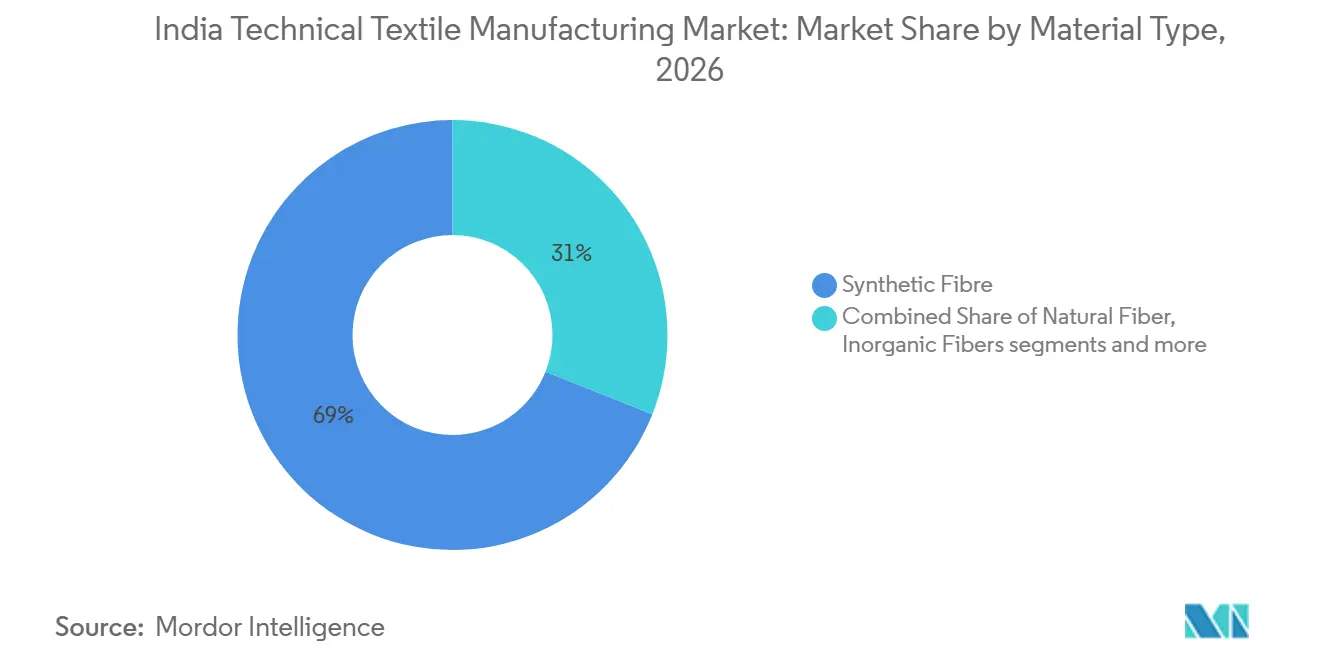
Synthetic fiber commanded 69% of the India technical textile manufacturing market size in 2026, while regenerated and other fibers are forecast to expand at 8.5% CAGR through 2032. Polyester, polypropylene, and nylon continue to support large-volume applications in infrastructure, automotive, and industrial uses. Their established supply chains support converters producing geotextiles, agricultural nets, and tyre-cord materials. Domestic polyester and nylon availability supports local processing of these products. The India technical textile manufacturing market depends on these materials because they combine established processing routes with broad end-use acceptance.
Regenerated fiber growth reflects rising use of lyocell and modal constructions in Medtech and Clothtech applications, where buyers seek biobased inputs and verifiable sustainability credentials. Inorganic fibers such as glass, carbon, and basalt remain supply-constrained because critical inputs and specialist processing remain import-dependent. The approved CSIR-NAL carbon fiber project is a domestic capability-building step for this group. Natural fibers such as jute and cotton retain demand in Agrotech and Packtech, where biodegradability and cost remain procurement considerations. August 2025 PLI eligibility reforms can bring more entrants into synthetic conversion, increasing competition in commodity products.

By Form And Structure: Nonwovens Combine Scale with the Fastest Growth
Nonwovens held 35% of the India technical textile manufacturing market share in 2026 and are forecast to grow at a 7.9% CAGR through 2032. Their broad use in medical hygiene, filtration, agriculture, and geosynthetics supports this position. The format is well-suited to products where absorbency, barrier performance, or filtration efficiency matters. Capacity additions planned by manufacturers point to continued demand for spunlace nonwovens. The category also benefits from public-health procurement that values documented performance and hygiene standards.
Woven technical textiles retain a role in tyre cord, belting, and architectural fabrics, but imported belting fabrics can pressure margins in standardized products. Knitted structures are gaining relevance in Clothtech and sportswear-adjacent uses requiring stretch, recovery, or compression performance. Braided products serve selected mooring, offshore, and defense uses where material qualification and design performance carry greater weight than volume. The India technical textile manufacturing market can add value by focusing on specification-led products rather than commodity applications.
By Application: Indutech Provides Scale While Medtech Expands Fastest
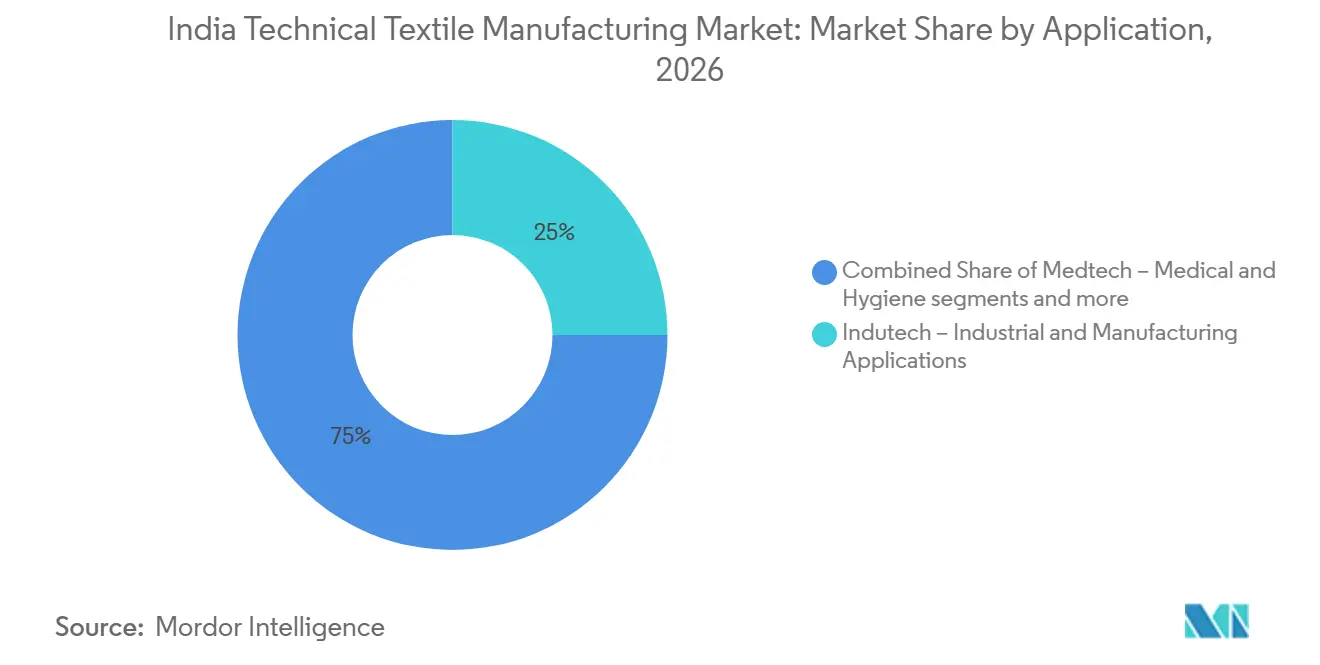
Indutech held 25% of the India technical textile manufacturing market size in 2026, while Medtech is forecast to record 8.1% CAGR through 2032. Indutech demand is anchored in filtration fabrics, conveyor belts, industrial protective clothing, and waste-containment geosynthetics. These applications depend on industrial activity and infrastructure maintenance, creating a substantial established demand base. Medtech demand comes from surgical drapes, isolation gowns, wound-care fabrics, and other healthcare consumables. Hospital-network expansion and higher infection-control procurement standards support its faster projected growth.
Geotech and Buildtech benefit from the INR 11.21 lakh crore (USD 124.8 billion) capital expenditure program for 2025-26. Mobiltech benefits from 332.1 lakh vehicles produced during the calendar year 2025. Electric vehicle platforms increase requirements for thermal management, insulation, and selected composite components in the India technical textile manufacturing market. At the same time, Agrotech supports volume through shade nets, crop covers, and fishing nets. Protech grows with defense procurement and demand for certified protective equipment. Packtech, Oekotech, Hometech, Clothtech, and Sporttech remain smaller application areas, but they provide product-development opportunities in recycled materials and functional textile constructions.
Geography Analysis
Gujarat leads synthetic fiber-based technical textile production, with Surat and Ahmedabad forming major centres for polyester, polypropylene, and artificial fiber output. The state’s automotive clusters in Sanand, Mandal-Becharaji, and Hansalpur-Vithalpur support demand for seat fabrics, airbag yarns, and filtration media, while the 1,142-acre Navsari PM MITRA Park is intended to integrate the synthetic-fiber-to-finished-textile value chain. Gujarat’s textile policy also prioritizes technical textiles, artificial fiber, and environmentally responsible production. Domestic feedstock availability gives local converters an advantage when input availability and logistics determine delivered material costs.
Tamil Nadu has a separate but important base across Tirupur, Coimbatore, and Chennai. Tirupur’s knitwear ecosystem is adding functional fabric constructions, while Coimbatore serves industrial textile and filtration applications. Chennai’s OEM base supports Mobiltech sourcing near vehicle assembly operations. The Virudhunagar PM MITRA Park involves INR 1,894 crore (USD 210.8 million) of development expenditure across 1,052 acres and targets medical and automotive technical textile investment. Port access and export-oriented capacity make Tamil Nadu relevant to the India technical textile manufacturing market for buyers requiring documented product compliance.
Maharashtra, Telangana, and Uttar Pradesh are developing as additional production locations in the India technical textile manufacturing market. Maharashtra clusters in Ichalkaranji and Bhiwandi are moving into value-added technical fabrics. PM MITRA parks at Amravati, Warangal, and Lucknow are at early infrastructure-development stages. Seven PM MITRA parks together represent INR 4,445 crore (USD 494.7 million) in committed investment. These projects can spread production beyond its existing western and southern concentration, although their effect will depend on operating infrastructure, supplier development, testing access, and links to end-user demand.
Competitive Landscape
The India technical textile manufacturing market exhibits a medium level of market concentration. SRF Limited, Garware Technical Fibers, Reliance Industries, Welspun Living, and Ginni Filaments have differentiated positions across product categories. Hundreds of smaller firms compete in standardized geosynthetics, nonwovens, and filtration materials, creating moderate concentration at the top and price competition in volume categories. Competition differs by application because design support, certification, and reliable supply matter more in specialized technical products.
Leading companies are pursuing capacity additions, product specialization, and international portfolio expansion. Garware Technical Fibers completed an offshore and aquaculture portfolio acquisition through its UK subsidiary in July 2025. Ginni Filaments approved a multisegment expansion that includes spunlace nonwoven and medical-product capacity in May 2026. Sanathan Textiles expanded its technical yarn capacity at Silvassa during 2026. These actions indicate that suppliers are seeking higher-value applications while adding domestic processing capability.
High-barrier opportunities include indigenous carbon-fiber conversion, certified Medtech nonwovens, and recycled-fiber composites with traceability. The India technical textile manufacturing market will favor suppliers able to document material performance and product origin. Other domestic suppliers can compete through niche certification, product design, and end-use engineering. International participants retain an advantage in selected proprietary fiber and engineering technologies. The India technical textile manufacturing market has room for new specialists where local manufacturing is matched with testing, technical service, and documented compliance.
India Technical Textile Manufacturing Industry Leaders
-
SRF Limited
-
Garware Technical Fibres Limited
-
Techfab India Industries Limited
-
Welspun Living Limited
-
Ahlstrom India Private Limited
- *Disclaimer: Major Players sorted in no particular order
Recent Industry Developments
- June 2026: PLI Scheme Round 3 approved 96 companies with committed investments of INR 12,822.67 crore (USD 1,427.1 million) and projected turnover of INR 58,294.18 crore (USD 6,488.0 million), while 89 of 170 total PLI-approved companies were in technical textiles, generating INR 11,241 crore (USD 1,251.1 million) in turnover and 33,427 jobs as of March 2026.
- February 2026: Ministry of Textiles approved 16 new R&D projects under NTTM, including indigenous carbon fiber development at CSIR-NAL and composite systems for infrastructure and defense.
India Technical Textile Manufacturing Market Report Scope
The India Technical Textile Manufacturing Market Report is Segmented by Material Type (Natural Fiber, Synthetic Fiber, Inorganic Fibers, and More), by Form and Structure (Woven Technical Textiles, Nonwoven Technical Textiles, and More), and by Application (Mobiltech – Automotive, Transportation, and Mobility, Indutech – Industrial and Manufacturing Applications, and More). The Market Forecasts are Provided in Terms of Value (USD).
| Natural Fiber | Cotton |
| Jute | |
| Others - Flex, Wool, Hemp, Coir, etc. | |
| Synthetic Fiber | Polyester |
| Polyamide / Nylon | |
| Polypropylene | |
| Polyethylene / UHMWPE | |
| Aramid and Other Specialty Synthetic Fibers | |
| Regenerated Fiber - Viscose, Lyocell, and Modal | |
| Inorganic Fibers (Glass, Carbon, Basalt, etc.) | |
| Others (Metallic, Conductive, and Other Specialty Fibers) |
| Woven Technical Textiles |
| Nonwoven Technical Textiles |
| Knitted Technical Textiles |
| Braided Technical Textiles |
| Other Engineered Textile Structures (Technical Yarns, Cords, Rovings, etc.) |
| Mobiltech - Automotive, Transportation, and Mobility |
| Indutech - Industrial and Manufacturing Applications |
| Buildtech - Building and Construction |
| Medtech - Medical and Hygiene |
| Protech - Personal and Property Protection |
| Agrotech - Agriculture, Horticulture, Forestry, and Fishing |
| Geotech - Geotextiles and Civil Engineering |
| Packtech - Packaging and Containment |
| Oekotech - Environmental Protection |
| Hometech - Furniture, Floor Coverings, and Domestic Technical Applications |
| Clothtech - Functional Components for Clothing and Footwear |
| Sporttech - Sports and Leisure Applications |
| By Material Type | Natural Fiber | Cotton |
| Jute | ||
| Others - Flex, Wool, Hemp, Coir, etc. | ||
| Synthetic Fiber | Polyester | |
| Polyamide / Nylon | ||
| Polypropylene | ||
| Polyethylene / UHMWPE | ||
| Aramid and Other Specialty Synthetic Fibers | ||
| Regenerated Fiber - Viscose, Lyocell, and Modal | ||
| Inorganic Fibers (Glass, Carbon, Basalt, etc.) | ||
| Others (Metallic, Conductive, and Other Specialty Fibers) | ||
| By Form and Structure | Woven Technical Textiles | |
| Nonwoven Technical Textiles | ||
| Knitted Technical Textiles | ||
| Braided Technical Textiles | ||
| Other Engineered Textile Structures (Technical Yarns, Cords, Rovings, etc.) | ||
| By Application | Mobiltech - Automotive, Transportation, and Mobility | |
| Indutech - Industrial and Manufacturing Applications | ||
| Buildtech - Building and Construction | ||
| Medtech - Medical and Hygiene | ||
| Protech - Personal and Property Protection | ||
| Agrotech - Agriculture, Horticulture, Forestry, and Fishing | ||
| Geotech - Geotextiles and Civil Engineering | ||
| Packtech - Packaging and Containment | ||
| Oekotech - Environmental Protection | ||
| Hometech - Furniture, Floor Coverings, and Domestic Technical Applications | ||
| Clothtech - Functional Components for Clothing and Footwear | ||
| Sporttech - Sports and Leisure Applications | ||
Key Questions Answered in the Report
What is the projected value of India technical textile manufacturing market by 2032?
The market is projected to reach USD 35.62 billion by 2032, from USD 22.9 billion in 2026. The forecast growth rate is 7.64% CAGR for 2027 to 2032, supported by infrastructure demand, industrial output, and procurement requirements.
Which material type leads technical textile manufacturing in India?
Synthetic fibre leads with 69% share in 2026. Polyester, polypropylene, and nylon support established applications in infrastructure, vehicle production, industrial uses, and agricultural products, while regenerated fibres are expected to grow faster.
Which product form is growing fastest in India’s technical textile manufacturing sector?
Nonwovens are forecast to grow at 7.9% CAGR through 2032. Their role in medical hygiene, filtration, agriculture, and geosynthetics supports demand across both public procurement and private industrial uses.
Which application is expected to grow fastest through 2032?
Medtech is expected to grow at 8.1% CAGR. Hospital expansion, higher surgical activity outside major cities, and rising infection-control requirements support demand for nonwoven medical products.
What factors support domestic technical textile production?
NTTM research support, mandatory-use provisions, PLI reforms, infrastructure procurement, and automotive output support production demand. PM MITRA parks can also improve access to integrated manufacturing infrastructure and supplier networks.
What limits expansion in advanced technical textiles?
Dependence on imported specialty fibers and machinery, limited testing access, uneven standards enforcement, and skill gaps constrain advanced production. These factors make qualification and scale-up more difficult for smaller suppliers and emerging regional clusters.