
India Tankless Water Heater Market Size and Share
Market Overview
| Study Period | 2021 - 2032 |
|---|---|
| Forecast Data Period | 2027 - 2032 |
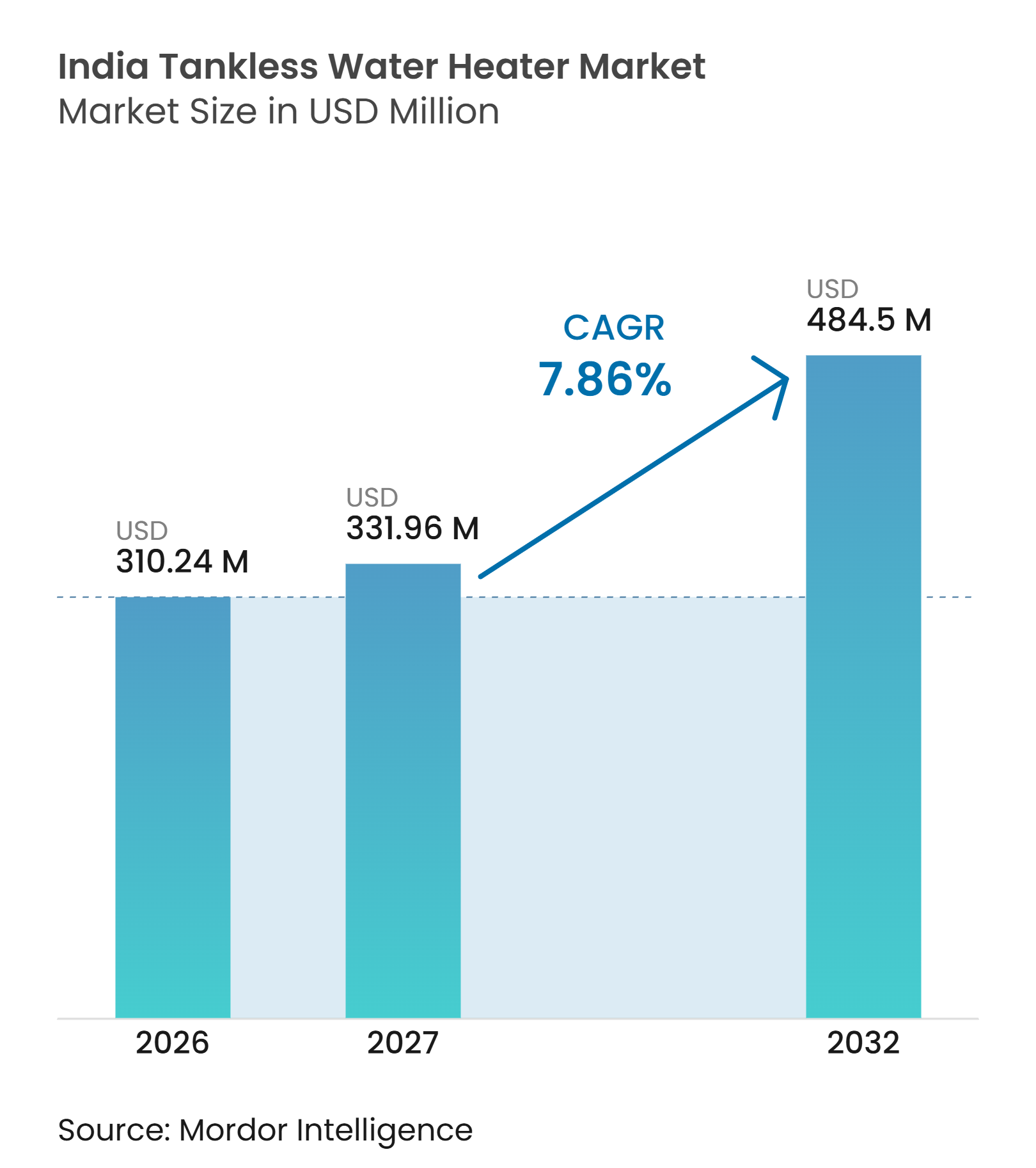
| Base Year Market Size (2026) | USD 310.24 Million |
| Market Size (2027) | USD 331.96 Million |
| Market Size (2032) | USD 484.5 Million |
| Growth Rate (2027 - 2032) | 7.86 % |
| Market Concentration | Medium |
Major Players *Disclaimer: Major Players sorted in no particular order Image © Mordor Intelligence. Reuse requires attribution under CC BY 4.0. | |
India Tankless Water Heater Market Analysis by Mordor Intelligence
The India tankless water heater market size was valued at USD 310.24 million in 2026 and is estimated to grow to USD 331.96 million in 2027, and is forecast to reach USD 484.50 million by 2032, growing at a 7.86% CAGR during 2027–2032. Urban household formation, commercial construction, and wider access to piped natural gas support demand for compact water-heating equipment. The India tankless water heater market also benefits from product upgrades as buyers move from basic heating devices to certified, energy-rated appliances. The Electrical Appliances for domestic water heating (Quality Control) Order, 2023, which saw mandatory implementation in September 2024, raises the minimum compliance standard for electric instantaneous heaters and improves the position of certified brands[1]. North India remains central to the India tankless water heater market because winter temperatures make hot water a household necessity, while commercial projects expand demand for higher-capacity systems. Supply reliability, voltage stability, hard-water resistance, and local installation networks shape purchase decisions as the category reaches more secondary cities.
Key Report Takeaways
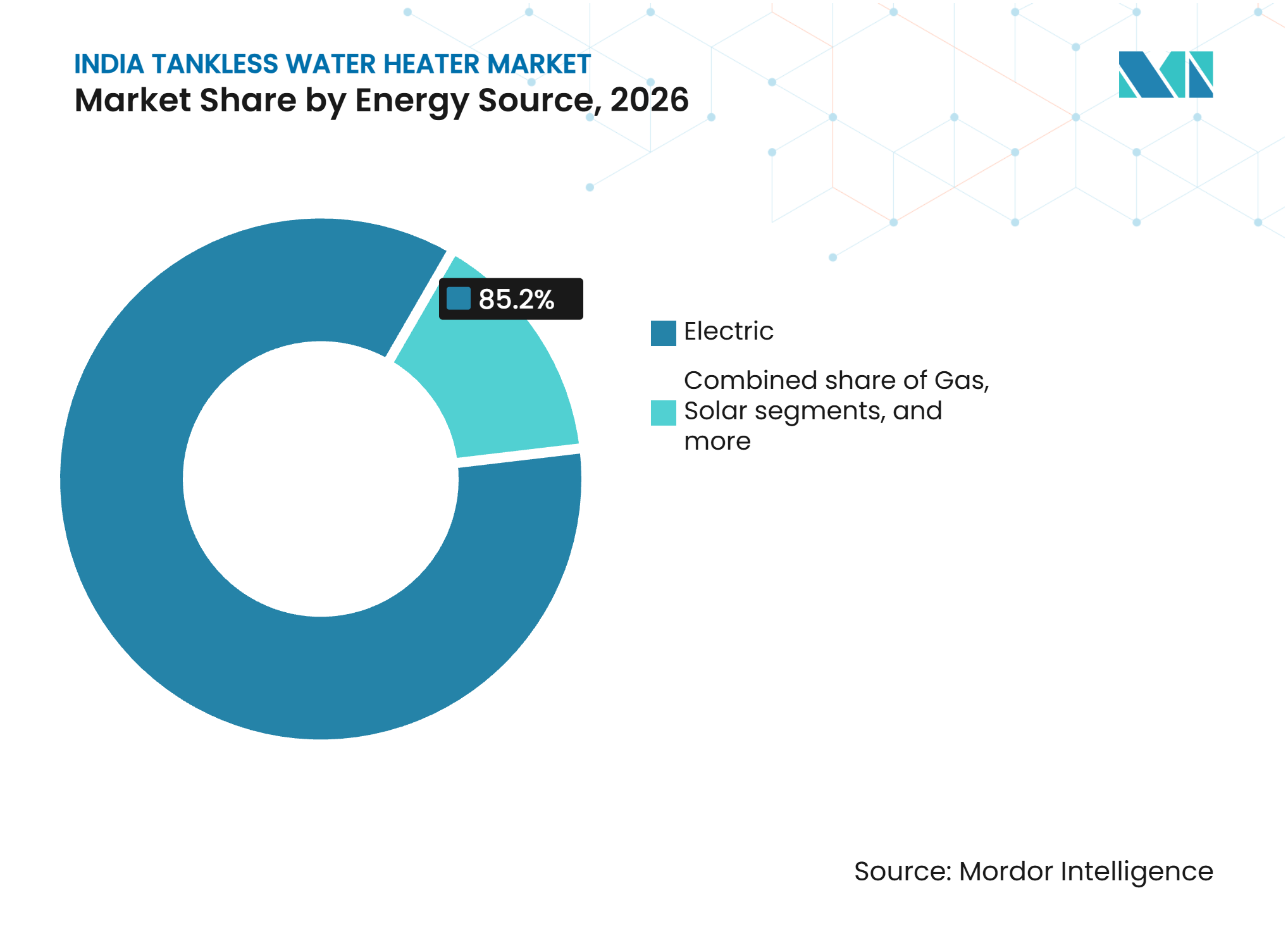
- By energy source, electric water heaters accounted for the largest value share of the India tankless water heater market, at 85.20% in 2026, while gas water heaters are projected to grow at the fastest CAGR of 9.04% between 2027 and 2032.
- By end user, residential water heaters accounted for the largest value share of the India tankless water heater market, 83.90% in 2026, while commercial water heaters are projected to grow at the fastest CAGR of 8.83% between 2027 and 2032.
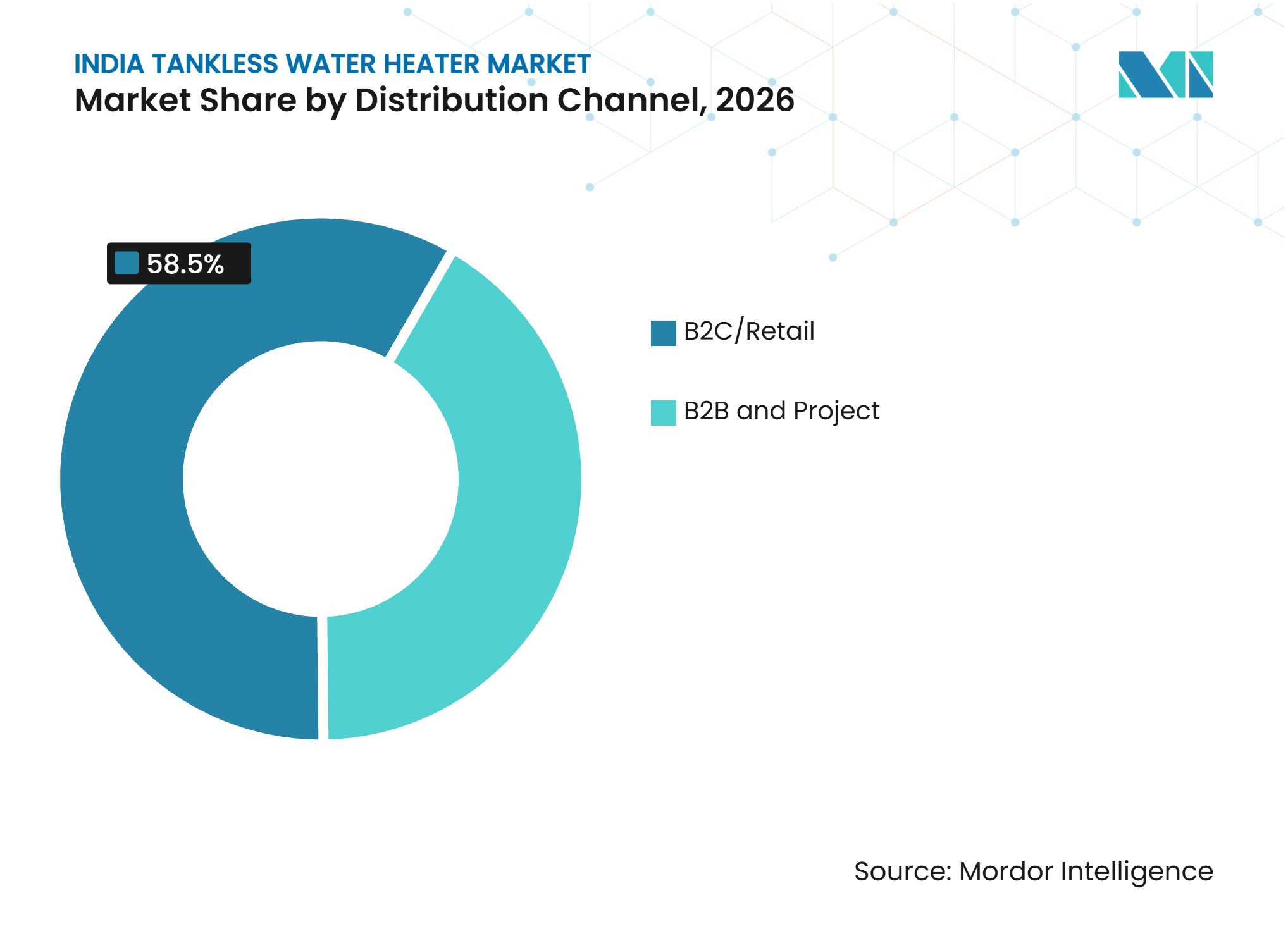
- By distribution channel, B2C/Retail accounted for 58.50% of the India tankless water heater market share in 2026 and is projected to grow at the fastest CAGR of 9.10% between 2027 and 2032.
- By geography, North India accounted for 36.40% of the India tankless water heater market share in 2026 and is projected to grow at the fastest CAGR of 8.55% between 2027 and 2032.
Note: Market numbers in this report are based on Mordor Intelligence's proprietary estimation framework, which combines nine months of actuals with Q4 projections for base year 2026.
Market Trends and Insights
Drivers Impact Analysis of India Tankless Water Heater Market*
| Driver | (~) % Impact on CAGR Forecast | Geographic Relevance | Impact Timeline |
|---|---|---|---|
| Urbanization and New Household Formation | +1.5% | National, with early gains in Delhi NCR, Mumbai, Bengaluru, Pune, Hyderabad | Long term (≥ 4 years) |
| Rising Disposable Incomes and Appliance Upgrades | +1.4% | National, led by top-100 cities | Medium term (2-4 years) |
| Seasonal Demand in North and Central India | +1.2% | North and Central India, including Uttar Pradesh, Punjab, Haryana, Madhya Pradesh, Rajasthan | Short term (≤ 2 years) |
| Expansion of Hospitality and Commercial Construction | +1.1% | National, led by Tier 2 and Tier 3 cities | Medium term (2-4 years) |
| Smart, Safe and Energy-Efficient Appliance Adoption | +0.9% | Urban metros and Tier 1 cities | Medium term (2-4 years) |
| Rural Electrification and Tier 2 and Tier 3 Market Expansion | +0.8% | North, East, and Central India | Long term (≥ 4 years) |
| Source: Mordor Intelligence | |||
Urbanization and New Household Formation
According to a Ministry of Health and Family Welfare technical group projection, 35.8% of Indians lived in urban areas, a figure forecast to reach 39.58% by 2036.[2]. New housing demand creates direct demand for bathroom fixtures, including compact water heaters that fit smaller apartments. The India tankless water heater market is therefore supported by a wider base of first-time appliance purchases in metropolitan and secondary cities. Smaller households often prefer wall-mounted products because they need less space and can supply hot water when required. This shift favors manufacturers with products across entry and mid-price ranges. It also increases the importance of reliable installation and service coverage outside major cities.
Rising Disposable Incomes and Appliance Upgrades
The Economic Advisory Council to the Prime Minister reported that spending on cooking and household appliances increased in both urban and rural households between 2011-12 and 2023-24[2]. This spending pattern supports replacement of immersion rods and low-cost heaters with rated instant models. Buyers with higher disposable income can place greater value on safety systems, energy labels, and product warranties. The India tankless water heater market can benefit as consumers treat these features as part of a durable appliance purchase rather than an emergency winter expense. Online financing and installation bundles may lower the barrier for customers considering a branded product. Manufacturers also need clear communication on operating costs because upfront price remains important.
Seasonal Demand in North and Central India
Demand increases sharply from October through February in states where winter temperatures fall to single digits. Heating appliance sales rose 15% year over year at the start of the winter season. In December 2025 and January 2026, manufacturers saw growth of up to 20%[3]. This seasonal demand pattern supports the India tankless water heater market because on-demand units reduce standby heat loss. However, the limited selling period increases pressure on inventory availability, installation teams, and customer service operations. Regional warehouses and local service partners help address demand during cold spells. Variability in the timing and duration of winter also requires flexible supply planning.
Expansion of Hospitality and Commercial Construction
India's hotel construction pipeline reached a record high of 906 projects and 118,334 rooms in the fourth quarter of 2025, representing a 31% increase in projects and a 35% increase in rooms year-over-year. A newer figure indicated the pipeline stood at 1,033 projects and 137,601 rooms, up 36% by project count and 39% by rooms compared to the second quarter of 2025. Nearly three-quarters of all hotel signings by room count occurred in secondary cities, providing a clear source of commercial demand. The India tankless water heater market gains value when suppliers meet commercial project specifications requiring higher flow rates and more durable equipment than households. This creates a role for technical sales teams and certified installer networks. Growth in smaller cities may increase the need for local project distribution partners.
Restraints Impact Analysis of India Tankless Water Heater Market*
| Restraint | (~) % Impact on CAGR Forecast | Geographic Relevance | Impact Timeline |
|---|---|---|---|
| High Upfront Cost and Price-Sensitive Consumer Demand | -1.0% | National, most acute in Tier 2 to Tier 4 cities and rural markets | Medium term (2-4 years) |
| Power Consumption and Voltage-Quality Constraints | -0.6% | North and East India, including Uttar Pradesh, Bihar, Assam, Odisha | Short term (≤ 2 years) |
| Hard-Water Scaling and Maintenance Burden | -0.5% | North India and parts of West and Central India | Long term (≥ 4 years) |
| Seasonality and Fragmented After-Sales Service | -0.4% | Non-metro markets, Tier 3 and Tier 4 cities, and rural clusters | Long term (≥ 4 years) |
| Source: Mordor Intelligence | |||
High Upfront Cost and Price-Sensitive Consumer Demand
The price difference limits adoption in smaller cities where unbranded products may cost less. Spending on durable goods has grown, but many households still judge a purchase primarily by initial cost. Mandatory certification can add compliance costs for manufacturers while reducing the availability of uncertified alternatives. The India tankless water heater market needs affordable certified products and transparent financing options. Explaining the energy and service benefits of a branded unit can help buyers assess long-term value.
Power Consumption and Voltage-Quality Constraints
Residential instant water heaters typically require 3 kW to 4.5 kW inputs, with whole-house tankless models requiring up to about 13 kW, making wiring quality and voltage stability important. A Prayas Energy Group survey conducted in February-March 2019 found voltage fluctuations were reported by 50-60% of respondents in Uttar Pradesh, compared with 24-26% in Maharashtra. Fluctuations can shorten heating element life and increase maintenance needs. The India tankless water heater market needs wider input-voltage tolerance and automatic protection systems in affected areas. Distribution upgrades through the Revamped Distribution Sector Scheme may improve conditions over time. Suppliers that combine voltage-tolerant products with installation guidance can reduce avoidable failures
*Our forecasts treat driver/restraint impacts as directional, not additive. The impact forecasts reflect baseline growth, mix effects, and variable interactions.
India Tankless Water Heater Market Segment Analysis
By Energy Source:
Electric Leads, Gas Expands Through Network AccessElectric water heaters held 85.20% of the India tankless water heater market share in 2026. Their position reflects widespread household electricity access, consumer familiarity, and a wide range of branded products. BIS certification for electric instantaneous water heaters under IS 302 Part 2 Section 35 became mandatory under the 2025 Quality Control Order. This requirement improves the compliance threshold for products sold in the country. It can also help established suppliers distinguish certified products from low-quality alternatives.
Gas water heaters are projected to grow at a 9.04% CAGR between 2027 and 2032. The Petroleum and Natural Gas Regulatory Board authorized city gas distribution entities across 307 geographical areas and set a target of 12.63 crore domestic PNG connections by 2034. Gas access broadens the customer base for on-demand systems that may have lower running costs in locations with competitive PNG tariffs. The segment is especially relevant to homes and commercial sites with dependable gas connections. Solar and other sources remain more limited for instant heating because passive solar collection does not always match immediate flow demand.



By End User:
Residential Demand Supports Volume, Commercial Projects Add ValueResidential users accounted for 83.90% of the India tankless water heater market share in 2026. Apartment construction and smaller bathroom sizes favor compact wall-mounted products. Household spending on appliances has increased across income groups, which supports replacement and upgrade purchases. Residential demand also includes replacement of units installed during earlier periods of urban housing growth. Smart controls and rated products have greater relevance as consumers seek safer and more efficient equipment.
Commercial water heaters are forecast to grow at an 8.83% CAGR between 2027 and 2032. Hotel construction provides a clear source of demand because projects require multiple hot-water points and reliable equipment. Healthcare, education, and institutional buildings create additional project demand. Commercial customers often prioritize system capacity, installation quality, and service response over the lowest purchase price.
By Distribution Channel:
B2C/Retail Combines Reach and GrowthB2C/Retail held 58.50% of the India tankless water heater market share in 2026. The channel gives households access to physical stores, brand outlets, and online marketplaces. Retail demand becomes particularly active at the beginning of winter, when replacement needs and urgent purchases increase. Branded sellers can use this channel to offer installation, financing, and warranty support. These services matter when a buyer has limited technical knowledge. They can also reduce the appeal of low-cost, uncertified alternatives.
B2C/Retail is projected to grow at a 9.10% CAGR between 2027 and 2032. Online marketplaces extend reach into cities that have fewer specialist appliance stores. Digital shopping can help customers compare ratings, capacity, and product features before selecting a heater. However, product discovery alone is not sufficient because installation quality affects customer experience. Manufacturers need coordinated online fulfillment and reliable local service partners. B2B and Project sales remain important for developers, hotels, and institutions that buy in larger volumes and need technical support.

Geography Analysis
North India
North India accounted for 36.40% of the India tankless water heater market size in 2026 and is projected to grow at an 8.55% CAGR through 2032. Cold weather makes water heating essential in many households, supporting demand in urban centers and smaller cities. Growth in Lucknow, Agra, Kanpur, Jalandhar, and Jaipur broadens the customer base beyond major metropolitan areas. The 2025 BIS Quality Control Order creates a uniform regulatory influence for manufacturers and importers of electrical instantaneous products. Piped natural gas expansion can support demand for gas-fired systems in connected cities. Local manufacturing and regional distribution can reduce delays during the winter selling period. Dealers also need sufficient trained installers to meet short, intense peaks in demand. Products that manage voltage variation and offer accessible repairs are likely to be more competitive in smaller northern cities.
South India
South India has a more even demand pattern, supported by urban growth in Bengaluru, Chennai, and Hyderabad and by cooler highland areas in Karnataka, Tamil Nadu, and Kerala. Premium product adoption is more visible in large southern cities, where buyers show interest in connected appliances and energy-efficient systems. Karnataka’s solar-water-heating requirements for urban residential buildings support broader attention to energy-saving hot-water solutions. Hospitality activity in resort and hill-station corridors adds commercial demand. Ariston Water Heating Products India Private Limited completed the acquisition of a manufacturing facility near Hyderabad, Telangana, from Hintastica Private Limited. The plant boasts a fully integrated production process dedicated to electric storage water heaters, spanning 23,100 square meters, and has an annual production capacity of about 500,000 units. Although it manufactures storage units, this investment strengthens the company's localized supply chain and distribution for its broader portfolio in the South.
West and Central India, East and Northeast India
West and Central India benefit from real estate activity in Pune, Ahmedabad, Nashik, Vadodara, and Surat. Hard-water conditions encourage demand for anti-scale products and create an opportunity for clear product positioning around maintenance needs. East and Northeast India have lower appliance penetration but can develop over a longer period as electricity access and incomes improve. RDSS investment in Bihar included INR 301 crore (USD 33.5 million) for electrification of 42,621 households in the latest tranche. City gas authorization in Jharkhand and Bihar could extend the addressable base for gas heaters. Companies serving these regions need durable products, accessible service, and locally relevant pricing. The opportunity is uneven because household purchasing power and service infrastructure differ widely across cities and rural districts. Manufacturers can reduce ownership concerns by pairing resilient products with clear maintenance information and local repair capacity. In western cities, hard-water resistance can be a direct product-selection factor for households replacing failed heating elements. In eastern and northeastern areas, distribution expansion needs to follow the pace of new electricity and gas connections rather than relying only on seasonal sales patterns.
Competitive Landscape
Market Concentration
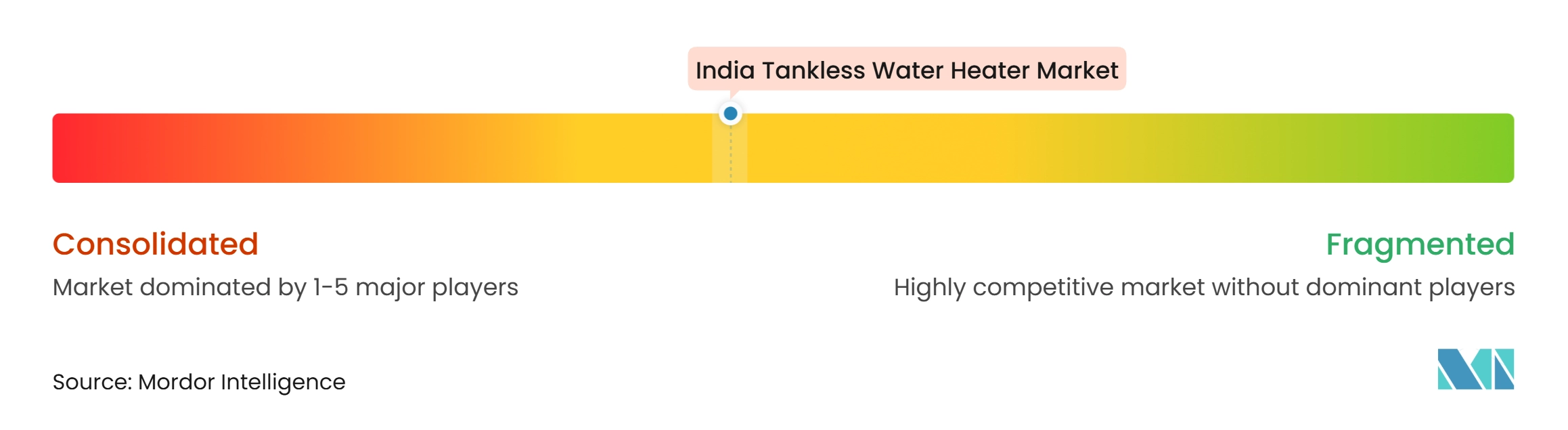
The India tankless water heater market includes Racold, Bajaj Electricals, Havells India, V-Guard Industries, Crompton Greaves Consumer Electricals, A.O. Smith, and BSH Home Appliances. Certified brands compete through product range, price points, distribution, safety features, and service access. The 2025 Quality Control Order prevents manufacturers without valid BIS licenses from legally selling covered electric instantaneous water heaters. This compliance requirement can favor established suppliers with certification capacity. Regional and unbranded sellers still compete where low initial price and local availability drive purchase decisions.
Manufacturing localization is a central competitive response. Ariston Group’s acquisition of the Hyderabad-area facility provides Racold with domestic production capacity and supports its Made-in-India product strategy. V-Guard introduced the Luxecube series in 2025 with connected features, real-time energy tracking, and advanced thermocline technology. Crompton introduced products with anti-scale heating elements tested for high total dissolved solids conditions. These moves show that suppliers are addressing design, connected features, and water-quality conditions.
A.O. Smith reported 13% organic India business sales growth in 2025. This extends its position from water heating into water-quality management. Opportunities remain in certified entry-level heaters, hard-water-resistant units, and commercial systems for hotels and institutions. Competitive success will depend on reliable product performance and service delivery, rather than features alone. The India tankless water heater market is moderately concentrated among national brands, while smaller suppliers continue to compete in local price-sensitive segments. Retailers and installers have an important role because their recommendations can influence product choice at the point of purchase. Suppliers that maintain consistent availability during winter and deliver timely repairs can strengthen retention without relying on discounting alone.
India Tankless Water Heater Industry Leaders
-
Racold, an Ariston Group company
-
Bajaj Electricals Limited
-
Havells India Limited
-
V-Guard Industries Limited
-
Crompton Greaves Consumer Electricals Limited
- *Disclaimer: Major Players sorted in no particular order
India Tankless Water Heater Market Companies Covered in this Report
- Racold, an Ariston Group company
- Bajaj Electricals Limited
- Havells India Limited
- V-Guard Industries Limited
- Crompton Greaves Consumer Electricals Limited
- A. O. Smith India Water Products Private Limited
- Jaquar India
- Hindware Home Innovation Limited (Hintastica Private Limited)
- Venus Home Appliances Private Limited
- Usha International Limited
- Orient Electric Limited
- Voltas Limited
- Midea Group Co., Ltd.
- GM Modular Pvt. Ltd.
- Ken Lifestyles Private Limited
- Polycab India Limited
- Stiebel Eltron India Private Limited
- BSH Household Appliances Manufacturing Private Limited
- Rinnai India
- Rheem India
Recent Industry Developments in India Tankless Water Heater Market
- November 2026: Signify launched the EcoLink ThermoGo series of instant water heaters in India. The product line includes 1 L, 3 L, and 5 L models with thermal cut-off safety controls and an 8 bar pressure rating for high-rise building installations.
- October 2026: Crompton Greaves Consumer Electricals Limited launched a 5.9 L instant water heater range. The units feature anti-scale technology for hard-water conditions of up to 1000 parts per million, along with a 3 kW heating element and a 6.5 bar pressure rating.
- September 2026: Racold launched the Pronto Dark 5L, a design-forward variant in the Pronto instant water heater range featuring a contemporary dark aesthetic, targeting consumers who prioritize bathroom style alongside functionality. The launch extends the brand's instant water heater portfolio in the compact urban segment.
- October 2025: Ariston Group signed an agreement to acquire a brand-new manufacturing facility near Hyderabad, Telangana, formerly owned by the Hintastica Private Limited joint venture between Groupe Atlantic and Hindware Home Innovation. The 23,100-square-meter plant has an annual capacity of 500,000 water heater units and enables Racold to offer Made-in-India premium products.
India Tankless Water Heater Market Report Scope
Tankless water heaters provide hot water instantly upon demand, eliminating the standby energy losses associated with traditional heating methods. In the context of the Indian market, compact instant geysers featuring 1- to 6-liter internal containers are used interchangeably with tankless systems, as they serve the on-demand water heating function. The India tankless water heater market is segmented by energy source, end user, distribution channel, and geography. By energy source, the market is segmented into electric (further segmented by heating capacity into below 6 kW, 6–12 kW, and above 12 kW), gas, including natural gas and LPG (further segmented by flow rate into below 8 Liters per Minute, 8–15 Liters per Minute, and above 15 Liters per Minute), solar, and other energy sources. By end user, the market is segmented into residential and commercial (further segmented into hospitality, healthcare, education and institutional, offices and retail, and rest of commercial end users). By distribution channel, the market is segmented into B2C/retail (further segmented into multi-brand stores, exclusive brand outlets, online, local hardware stores, and other B2C/retail) and B2B and project (further segmented into wholesale and plumbing-HVAC distributors, and direct from manufacturers). By geography, the market is segmented into North India, South India, West and Central India, and East and Northeast India. The report offers the market size in value terms in USD for all the above-mentioned segments.
Segmentation Overview
| Electric | By Heating Capacity | Below 6 kW |
| 6–12 kW | ||
| Above 12 kW | ||
| Gas, Including Natural Gas and LPG | By Flow Rate | Below 8 Liters per Minute |
| 8–15 Liters per Minute | ||
| Above 15 Liters per Minute | ||
| Solar | ||
| Other Energy Sources | ||
| Residential | |
| Commercial | Hospitality |
| Healthcare | |
| Education and Institutional | |
| Offices and Retail | |
| Rest of Commercial End Users |
| B2C/Retail | Multi-Brand Stores |
| Exclusive Brand Outlets | |
| Online | |
| Local Hardware Stores | |
| Other B2C/Retail | |
| B2B and Project | Wholesale and Plumbing-HVAC Distributors |
| Direct from Manufacturers |
| North India |
| South India |
| West and Central India |
| East and Northeast India |
| By Energy Source | Electric | By Heating Capacity | Below 6 kW |
| 6–12 kW | |||
| Above 12 kW | |||
| Gas, Including Natural Gas and LPG | By Flow Rate | Below 8 Liters per Minute | |
| 8–15 Liters per Minute | |||
| Above 15 Liters per Minute | |||
| Solar | |||
| Other Energy Sources | |||
| By End User | Residential | ||
| Commercial | Hospitality | ||
| Healthcare | |||
| Education and Institutional | |||
| Offices and Retail | |||
| Rest of Commercial End Users | |||
| By Distribution Channel | B2C/Retail | Multi-Brand Stores | |
| Exclusive Brand Outlets | |||
| Online | |||
| Local Hardware Stores | |||
| Other B2C/Retail | |||
| B2B and Project | Wholesale and Plumbing-HVAC Distributors | ||
| Direct from Manufacturers | |||
| By Geography | North India | ||
| South India | |||
| West and Central India | |||
| East and Northeast India | |||
Key Questions Answered in the Report
What is driving demand for tankless water heaters in India?
Urban household formation, winter demand in the north, commercial construction, and stronger access to electricity and PNG connections support demand.
How large is the India tankless water heater market?
The category is estimated at USD 331.96 million in 2027 and is forecast to reach USD 484.50 million by 2032 at a 7.86% CAGR.
Which energy source leads water heater sales in India?
Electrical products held an 85.20% share in 2026 because of broad electricity access and a wide selection of certified products.
Which customer group is growing fastest for water heaters in India?
Commercial users are projected to grow at an 8.83% CAGR between 2027 and 2032, supported by hotels and institutional projects.
Why is North India important for instant water heater suppliers?
North India held a 36.40% share in 2026 and is forecast to grow at an 8.55% CAGR because winter conditions make hot water essential.
What regulations apply to electric instantaneous water heaters in India?
The 2025 Quality Control Order requires BIS certification for covered electric instantaneous water heaters, improving the compliance standard for products sold in India.