
India Quick Commerce Logistics Market Size and Share
Market Overview
| Study Period | 2020 - 2031 |
|---|---|
| Forecast Data Period | 2026 - 2031 |
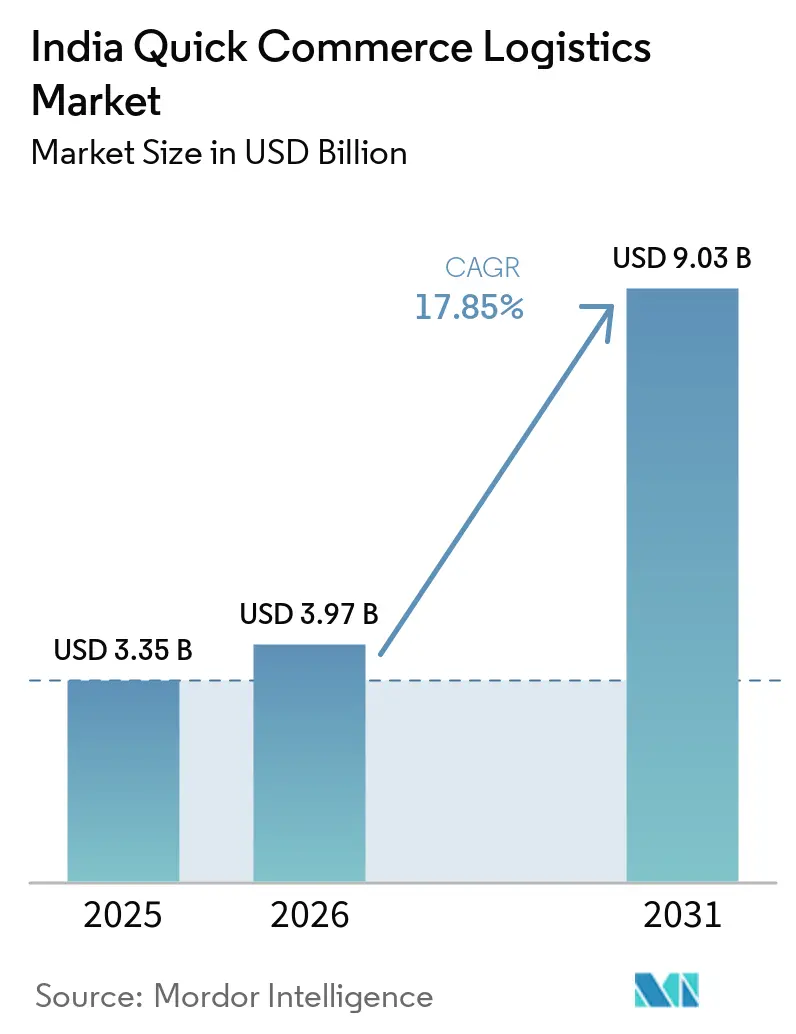
| Base Year Market Size (2025) | USD 3.35 Billion |
| Market Size (2026) | USD 3.97 Billion |
| Market Size (2031) | USD 9.03 Billion |
| Growth Rate (2026 - 2031) | 17.85 % |
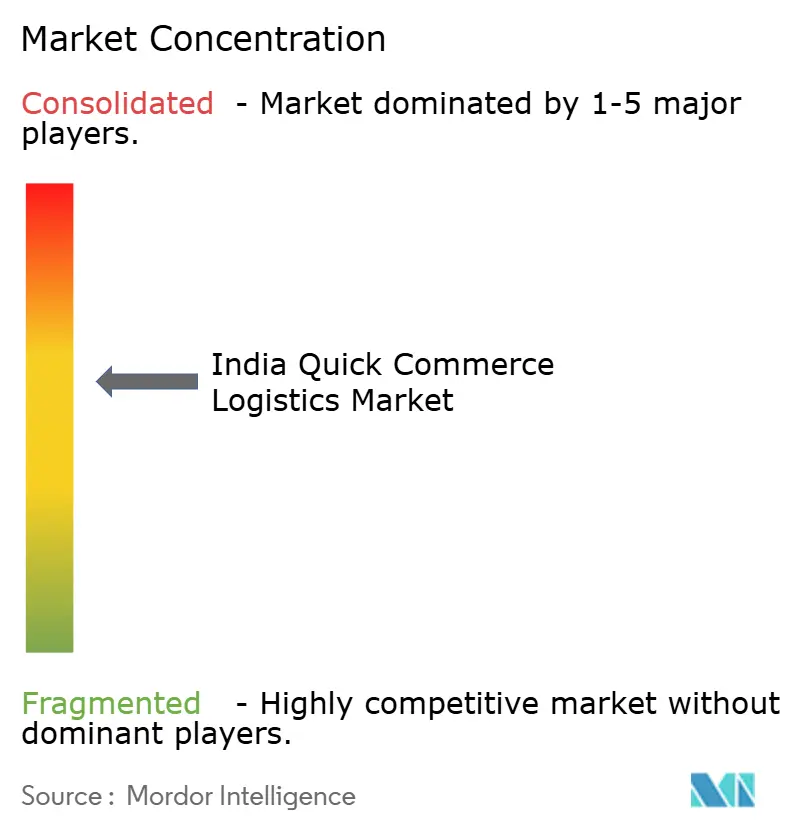
| Market Concentration | Medium |
Major Players *Disclaimer: Major Players sorted in no particular order Image © Mordor Intelligence. Reuse requires attribution under CC BY 4.0. | |
India Quick Commerce Logistics Market Analysis by Mordor Intelligence
The India quick commerce logistics market size was valued at USD 3.35 billion in 2025 and is forecast to reach USD 3.97 billion in 2026 and USD 9.03 billion by 2031, advancing at a CAGR of 17.85% during 2026 to 2031.
Growth depends on a denser network of dark stores, micro-fulfillment locations, and hyperlocal rider capacity. Platform expansion is also changing the role of third-party logistics providers, which increasingly support fulfillment rather than only consumer delivery. The India quick commerce logistics market is shaped by high order density in major cities and expanding coverage in smaller cities. The India quick commerce logistics market also depends on coordinated fulfillment capacity between platforms and their service providers. Profitability will depend on store utilization, basket value, advertising income, and the ability to manage labor and delivery costs. Regulatory requirements for personal data and delivery-partner classification may also affect nationwide operating structures.
Key Report Takeaways
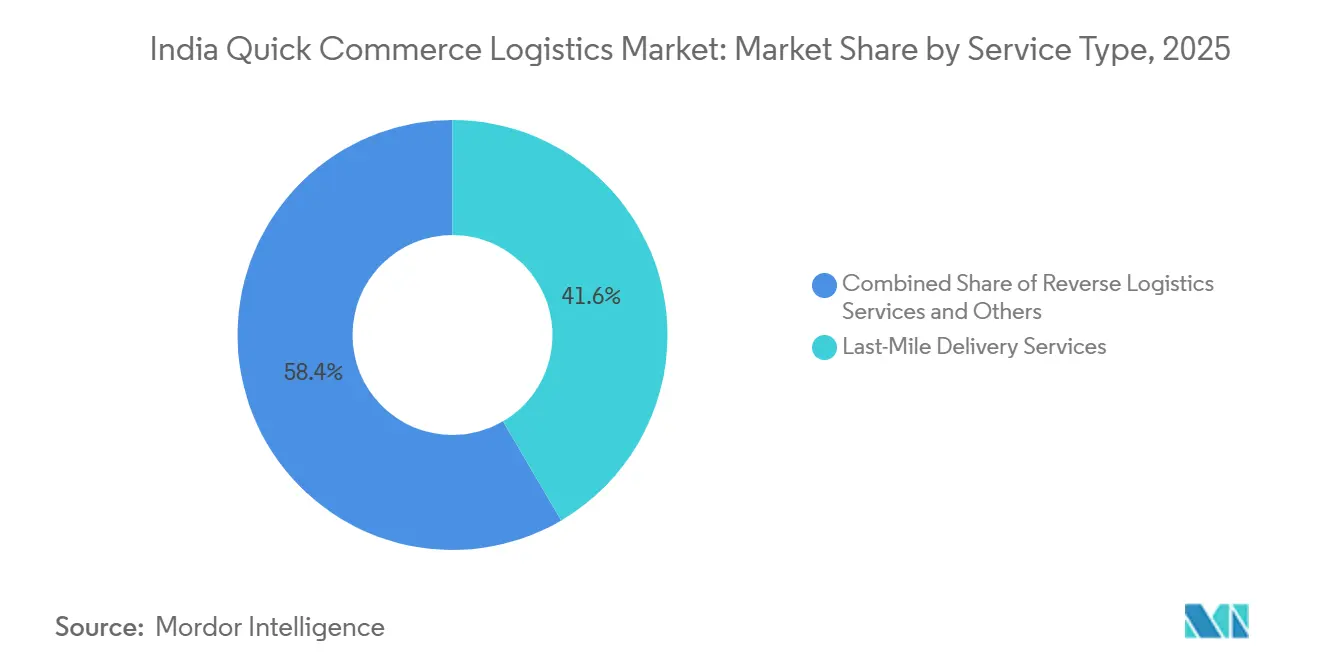
- By service type, last-mile delivery services accounted for 41.57% of the India quick commerce logistics market share in 2025, while reverse logistics services are forecast to grow at a 22.21% CAGR through 2031.
- By fulfillment model, dark-store-based fulfillment accounted for 46.90% of the India quick commerce logistics market size in 2025, while micro-fulfillment center-based fulfillment is forecast to expand at a 21.79% CAGR through 2031.
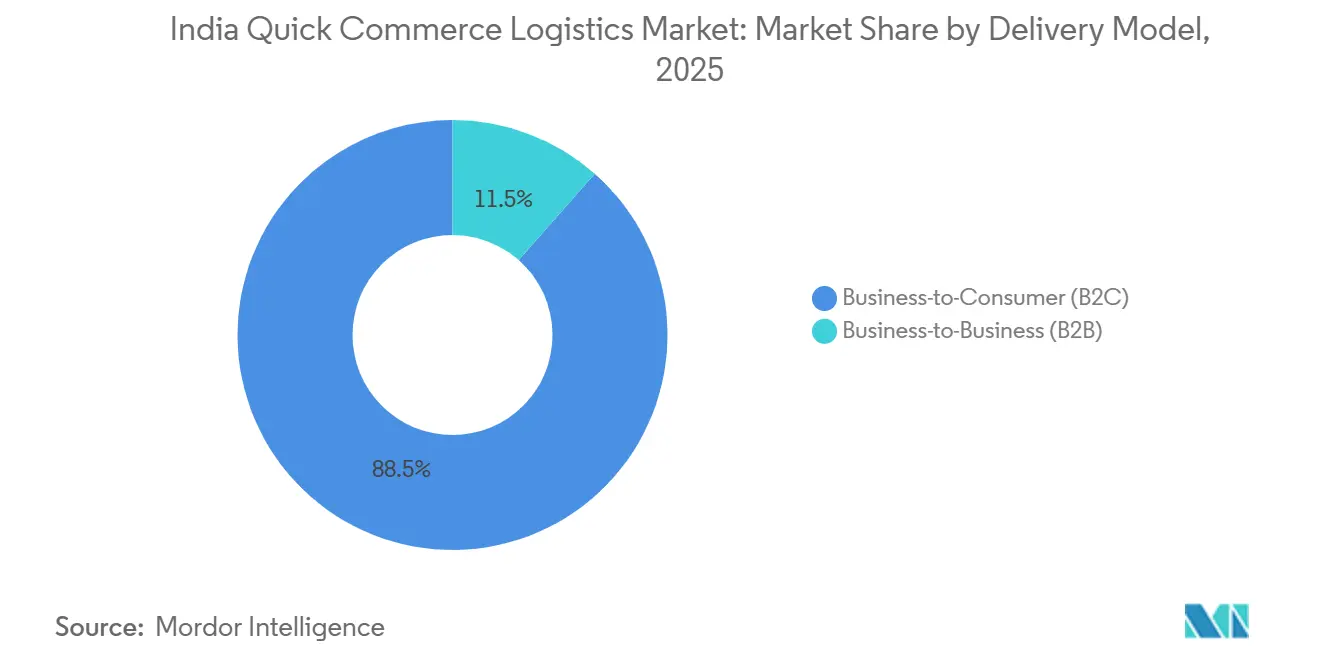
- By delivery model, B2C delivery held 88.50% of the India quick commerce logistics market share in 2025, while B2B delivery is forecast to grow at a 24.95% CAGR through 2031.
- By city tier, Tier 1 cities accounted for 64.02% of the India quick commerce logistics market size in 2025, while Tier 3 and below are forecast to grow at a 27.80% CAGR through 2031.
- By geography, West held 29.11% of India quick commerce logistics market share in 2025, while East is forecast to grow at a 24.81% CAGR through 2031.
Note: Market size and forecast figures in this report are generated using Mordor Intelligence’s proprietary estimation framework, updated with the latest available data and insights as of January 2026.
India Quick Commerce Logistics Market Trends and Insights
Drivers Impact Analysis*
| Driver | (~) % Impact on CAGR Forecast | Geographic Relevance | Impact Timeline |
|---|---|---|---|
| Rapid Expansion of Hyperlocal Fulfillment Density Across Tier 1 Cities | +2.8% | Tier 1 metros, including Mumbai, Delhi NCR, Bengaluru, Hyderabad, Chennai, and Kolkata | Short term (≤ 2 years) |
| Rising Basket Penetration Through Scheduled and Instant Delivery Hybridization | +2.4% | National, strongest in Tier 1 and emerging Tier 2 cities | Medium term (2-4 years) |
| Retailer and Brand Demand for Asset-Light Urban Reach | +2.1% | Tier 1 and Tier 2 urban centers | Medium term (2-4 years) |
| Dense Store Network Conversion Into Micro-Fulfillment Nodes | +3.5% | National, concentrated in 50+ major cities | Short term (≤ 2 years) |
| Margin Improvement From Route Orchestration, Slotting, and Batch Planning | +2.3% | National, with an early advantage in Tier 1 metro corridors | Long term (≥ 4 years) |
| UPI-Enabled Low-Friction Checkout and Repeat Ordering Behavior | +2.1% | National, across all city tiers | Short term (≤ 2 years) |
| Source: Mordor Intelligence | |||
Rapid Expansion of Hyperlocal Fulfillment Density Across Tier 1 Cities
Hyperlocal fulfillment density expanded rapidly across India’s Tier 1 cities, which remained the primary testing grounds for high-density network models. By July 2026, the five leading platforms collectively operated approximately 6,650–6,750 dark stores after adding around 900 locations over the preceding three months. During the same period, the number of unique PIN codes served increased by only 152, indicating greater overlap within existing service areas rather than geographic expansion. More than 80% of new stores were located in areas already served by at least one competing platform, reinforcing competitive clustering. Approximately 3,600 metro dark stores could operate profitably, while around 4,300 stores were already operational, signaling potential overcapacity in key urban markets. Higher store density improved rider utilization and increased orders per hour, but also intensified price competition among nearby logistics providers, pressuring margins. This dynamic is likely to accelerate investment reallocation toward Tier 2 cities, despite their relatively underdeveloped delivery ecosystems.
Rising Basket Penetration Through Scheduled and Instant Delivery Hybridization
Quick commerce platforms are combining immediate consumer delivery with scheduled inbound supply movements. This approach gives brands another way to replenish dark stores at planned times. It can reduce uncertainty around receiving slots at platform warehouses. It can also connect consumer-facing activity with more formal upstream logistics services. The resulting operating model supports both rapid orders and planned inventory movements. Shiprocket launched Appointment-Based Delivery in May 2026 for D2C and MSME brands sending inventory to dark stores[1]. The service was designed around pre-scheduled bulk dispatch windows. The rollout reported 98% on-time delivery adherence. It also reported logistics cost reductions of up to 27% for participating brands. This service demonstrates how scheduled movement can complement instant-delivery networks.
Retailer and Brand Demand for Asset-Light Urban Reach
Brands need urban delivery reach without having to build a separate dark store network in every city. This need supports aggregator models that combine fulfillment sites, transport partners, and software. Such models allow a brand to use existing capacity under a single operating arrangement. They may also reduce the capital commitment required for local coverage. The Indian quick-commerce logistics industry, therefore, has room for providers that organize shared capacity. Prozo launched a hyperlocal grid of 40 dark stores in July 2025[2]. The network covered more than 500 PIN codes across Delhi NCR, Mumbai, Bengaluru, Hyderabad, and Chennai. It combined the capacities of Shadowfax, ElasticRun, Pidge, Blitz, and Shiplog into 1 technology stack. The model directed orders to the closest stocked location and rerouted orders during stockouts. This approach made both physical reach and software coordination equally important in the Indian quick-commerce logistics market.
Margin Improvement From Route Orchestration, Slotting, and Batch Planning
Logistics providers are using route orchestration, slot planning, and batch movements to improve delivery execution. These tools can replace reactive dispatch choices with planned operating decisions. They are especially relevant when platforms need frequent replenishment across dense store networks. Better sequencing can support more predictable labor planning and vehicle use. It can also help providers meet service-level requirements for large platform contracts. Emiza reduced return-to-origin rates by up to 30% through data-led interventions. It also described dashboards that track inventory and dark store fill rates in real time. These functions move providers toward a broader role in commerce operations. Smaller providers may face a higher competitive threshold if they lack comparable technology. The India quick commerce logistics market is consequently placing greater value on measurable execution quality. This shift affects how the Indian quick commerce logistics market evaluates providers.
Restraints Impact Analysis*
| Restraint | (~) % Impact on CAGR Forecast | Geographic Relevance | Impact Timeline |
|---|---|---|---|
| High Cost of Dark Store Rent, Labor, and Peak Hour Delivery Capacity | -1.5% | All metros, most acute in Mumbai, Bengaluru, and Delhi NCR | Short term (≤ 2 years) |
| Shrinking Unit Economics In Low-Density Micro-Markets | -0.9% | Tier 2 and Tier 3 cities, with national spillover risk | Medium term (2-4 years) |
| Local Compliance Friction for Warehousing, Labor, and Urban Mobility | -0.6% | National, with state-specific labor and zoning requirements | Medium term (2-4 years) |
| Slot Cannibalization Risk From Overlapping Quick Commerce and E-Grocery Networks | -0.7% | Urban metro markets, concentrated in the top 15 cities | Short term (≤ 2 years) |
| Source: Mordor Intelligence | |||
High Cost of Dark Store Rent, Labor, and Peak Hour Delivery Capacity
Dark-store economics involve fixed costs that do not fall quickly when order volumes soften, so rent, core staffing, and inventory capital remain necessary to preserve service availability. A premium Mumbai dark store reportedly costs about 4 times as much as an equivalent facility in Indore, creating a much higher cost base for providers in major metro corridors and making order density essential for economic viability. Metro pickers and packers earned roughly INR 16,000 to INR 20,000 per month in 2025 (USD 171 to USD 214). Tier 2 wages ranged from INR 12,000 to INR 16,000 per month (USD 128 to USD 171), roughly 20% to 25% lower than metro pay levels. Delivery costs were reported at INR 116 to INR 118 per order before optimization (USD 1.24 to USD 1.26), with the lower optimized range estimated at INR 98 to INR 100 (USD 1.05 to USD 1.07). Profitability, therefore, depends on basket value, advertising income, category mix, and last-mile efficiency.
Local Compliance Friction for Warehousing, Labor, and Urban Mobility
Warehousing, labor, and urban mobility requirements differ across Indian states and cities. These requirements can affect how quickly a provider can open or operate a local fulfillment location. They can also change the documentation and labor processes needed for delivery networks. The personal data framework underscores the importance of handling customer and order data appropriately. Compliance capabilities are therefore part of the operating requirements for national expansion. Food safety requirements also matter when logistics providers handle perishable goods. These requirements can favor professional providers with established process controls. They can also raise the barrier for smaller operators serving food, pharmaceutical, and high-compliance categories. Local rules may therefore shape competition even where demand is strong.
*Our forecasts treat driver/restraint impacts as directional, not additive. The impact forecasts reflect baseline growth, mix effects, and variable interactions.
Segment Analysis
By Service Type: Last-Mile Delivery Holds the Largest Revenue Position While Returns Gain Importance
Last-mile delivery services held 41.57% of the India quick commerce logistics market share in 2025. Their position reflects the direct delivery volume created whenever a new dark store becomes active. Every additional local node requires riders, dispatch systems, and fast consumer delivery capacity. Fulfillment and dark store operations also contribute to service demand by positioning inventory close to customers.
Reverse logistics services are forecast to grow at a 22.21% CAGR from 2026 to 2031. Electronics, fashion, and personal care create more return activity than grocery categories. These categories have return rates 2 to 3 times higher than grocery. This change gives providers a reason to develop separate returns-management services. Value-added logistics can also include cold chain handling, pharmaceutical compliance, inventory intelligence, fill-rate tracking, and return-to-origin analytics.

By Fulfillment Model: Dark Stores Lead Current Activity While Micro-Fulfillment Centers Expand
Dark-store-based fulfillment accounted for 46.90% of the India quick-commerce logistics market size in 2025. The share reflects aggressive infrastructure investment by major quick-commerce platforms. Dark stores give platforms dedicated stock points near consumer demand. They also create a large and recurring need for inbound replenishment, local picking, packing, and delivery coordination.
Micro-fulfillment center-based fulfillment is forecast to grow at a 21.79% CAGR from 2026 to 2031. These sites can convert retail backrooms into compact, technology-enabled nodes without the full commitment required for a standalone dark store. Retail store-based fulfillment and hybrid models remain relevant for legacy retailers and FMCG companies testing quick commerce channels. Prozo's 2025 grid illustrated an asset-light model that pooled facilities and carrier capacity. Its operating design also used automated routing to select nearby stocked locations and reroute orders during stockouts.
By Delivery Model: B2C Provides Scale While B2B Replenishment Grows Faster
B2C delivery accounted for 88.50% of the India quick commerce logistics market share in 2025. This result follows the consumer-facing origins of quick commerce. The segment depends on immediate delivery from local dark stores to homes. It also requires dense rider pools and accurate inventory availability in each service area.
B2B delivery is forecast to grow at a 24.95% CAGR from 2026 to 2031. This segment includes planned replenishment from brand distribution centers to dark stores. As dark store counts reach the thousands, these inbound movements become a meaningful logistics requirement separate from consumer delivery. Shiprocket's Appointment-Based Delivery service addresses this need by scheduling bulk shipments to platform facilities. The service reported 98% on-time adherence and cost reductions of up to 27% for participating brands.
By City Tier: Tier 1 Leads Current Demand, While Tier 3 and Below Grow Fastest
Tier 1 cities accounted for 64.02% of the Indian quick-commerce logistics market in 2025. This concentration reflects the early focus of platform investment and dark store deployment in metropolitan areas. Major cities offer stronger order density and larger rider pools. They also carry higher rent and labor costs that require sustained utilization.
Tier 3 and below is forecast to grow at a 27.80% CAGR from 2026 to 2031. Flipkart Minutes reported a 42-fold year-on-year increase in Tier 2 and Tier 3 activity by mid-2026. Zepto disclosed plans to invest INR 1,629 crore (USD 192.8 million) in dark store expansion from FY 2027 to FY 2030. Non-metro locations can offer lower wages and real estate costs. Still, they tend to have lower daily order volumes than mature metro stores, making early-stage unit economics more challenging even as they open a new growth runway. Flipkart Minutes is expanding into Tier-2 and Tier-3 markets for exactly this reason, with one report noting that the company is expanding beyond metros while using larger dark stores in non-metro locations and smaller stores in metros to increase density.
Geography Analysis
West held 29.11% of the India quick commerce logistics market share in 2025. Mumbai, Pune, and Ahmedabad provide the region with high order density and broad consumer adoption. Maharashtra led the country in dark store counts. Proximity to FMCG manufacturing clusters in Gujarat and Maharashtra can shorten inbound inventory replenishment cycles.
East is forecast to grow at a 24.81% CAGR from 2026 to 2031. Kolkata's expanding digital consumer base supports the regional opportunity. Bhubaneswar, Patna, and Guwahati are entering the early stages of quick commerce expansion. Zepto disclosed expansion spending of INR 1,629 crore (USD 192.8 million), across FY 2027 to FY 2030.
North is anchored by Delhi-NCR, Jaipur, and Lucknow, where the 5 major platforms maintain significant dark-store footprints. Delhi NCR accounts for a large share of national quick-commerce order volume, making rider availability and warehouse density especially important. Central cities, including Indore, Bhopal, and Nagpur, offer lower dark-store rents and may achieve breakeven faster once coverage is established. South is led by Bengaluru, Hyderabad, and Chennai, where technology-sector consumers support higher basket values and ordering frequency. DTDC launched a Bengaluru dark store pilot in 2025 for sub-2-hour and same-day delivery, underscoring the city's role as a testbed for logistics services.
Competitive Landscape
The India quick commerce logistics market is moderately consolidated. Shadowfax disclosed that Flipkart, Zepto, and Zomato together accounted for 74% of its revenue in its January 2026 IPO coverage. This concentration shows the importance of a small group of large platform customers. It also creates exposure for providers when a major client changes its logistics mix. Delhivery completed its acquisition of Ecom Express for INR 1,407 crore (USD 167.5 million) in July 2025[3]. The company acquired 99.87% of Ecom Express on a fully diluted basis. The transaction was announced in April 2025 and received approval from the Competition Commission of India in June 2025. Integration costs were revised from INR 300 crore to INR 110 crore (USD 32.1 million to USD 11.8 million). The company also retained 7 Ecom Express facilities after network rationalization.
Technology-led differentiation is becoming more important than geographic expansion alone[4]. Prozo's multi-operator grid combined several logistics providers under 1 technology layer. Shiprocket launched Fastrr in June 2026 as an AI-powered checkout platform for D2C brands. The company also launched Appointment-Based Delivery, a scheduled delivery service for quick commerce platforms. Providers that improve service-level adherence, fill-rate visibility, and return management can offer a clearer value proposition.
Compliance with food safety and state warehousing requirements can also distinguish providers serving perishable and pharmaceutical categories. This favors providers that can manage traceability and documented operating processes. Smaller providers may face margin pressure when platforms can compare several delivery suppliers. The India quick commerce logistics industry remains open to specialist providers, but large networks have a cost and capability advantage. The India quick commerce logistics market still requires specialist support for defined fulfillment needs. Competition is therefore centered on network density, technology, compliance, and the ability to handle both consumer delivery and inbound replenishment.
India Quick Commerce Logistics Industry Leaders
-
Shadowfax Technologies
-
Delhivery
-
Porter
-
LoadShare Networks
-
XpressBees
- *Disclaimer: Major Players sorted in no particular order
Recent Industry Developments
- July 2026: Shiprocket launched Fastrr, an AI-powered checkout platform for D2C brands selling through quick commerce channels. The product extended its commerce enablement offering beyond logistics into pre-purchase conversion.
- May 2026: Shiprocket activated structured supply-chain partnerships with Zepto, Blinkit, Flipkart Minutes, Myntra, Swiggy Instamart, and Amazon through its Appointment-Based Delivery service. The service created a formal logistics bridge between D2C brands and platform dark stores, achieving a 98% on-time delivery benchmark.
- July 2025: Prozo formalized a multi-operator delivery partnership with Shadowfax, ElasticRun, Pidge, Blitz, and Shiplog to power its hyperlocal dark store aggregator grid. The arrangement enabled brands to access multi-3PL capacity under 1 contract and technology stack across more than 500 PIN codes in 5 metros.
- July 2025: Delhivery completed the acquisition of Ecom Express Limited for INR 1,407 crore (USD 167.5 million), acquiring 99.87% of the company on a fully diluted basis.
India Quick Commerce Logistics Market Report Scope
| Fulfillment and Dark Store Operations |
| Last-Mile Delivery Services |
| Reverse Logistics Services |
| Value-Added Logistics Services |
| Dark Store-Based Fulfillment |
| Micro-Fulfillment Center (MFC)-Based Fulfillment |
| Retail Store-Based Fulfillment |
| Hybrid Fulfillment Model |
| Business-to-Consumer (B2C) |
| Business-to-Business (B2B) |
| Tier 1 |
| Tier 2 |
| Tier 3 and Below |
| North |
| Central |
| West |
| East |
| South |
| By Service Type | Fulfillment and Dark Store Operations |
| Last-Mile Delivery Services | |
| Reverse Logistics Services | |
| Value-Added Logistics Services | |
| By Fulfillment Model | Dark Store-Based Fulfillment |
| Micro-Fulfillment Center (MFC)-Based Fulfillment | |
| Retail Store-Based Fulfillment | |
| Hybrid Fulfillment Model | |
| By Delivery Model | Business-to-Consumer (B2C) |
| Business-to-Business (B2B) | |
| By City Tier | Tier 1 |
| Tier 2 | |
| Tier 3 and Below | |
| By Region | North |
| Central | |
| West | |
| East | |
| South |
Key Questions Answered in the Report
What is the projected value of India's quick commerce logistics in 2031?
The value is forecast to reach USD 9.03 billion by 2031, from USD 3.35 billion in 2025, at a 17.85% CAGR.
Which service plays the largest role in India's quick-commerce logistics?
Last-mile delivery was the largest service type, accounting for 41.57% of the market in 2025.
Which service type is growing fastest?
Reverse logistics is forecast to grow at a 22.21% CAGR through 2031 as electronics, fashion, and personal care generate more returns.
Why are dark stores important for quick commerce operations?
Dark stores position inventory near customers and support rapid picking, packing, replenishment, and delivery.
Which city tier is expected to grow fastest?
Tier 3 and below is forecast to grow at a 27.80% CAGR from 2026 to 2031.
What are the main risks for logistics providers serving quick commerce?
Major risks include dark-store rent, labor costs, low early-stage order density, local compliance requirements, and overlapping urban networks.