
India E-Commerce Last-Mile Delivery Market Size and Share
Market Overview
| Study Period | 2020 - 2031 |
|---|---|
| Forecast Data Period | 2026 - 2031 |
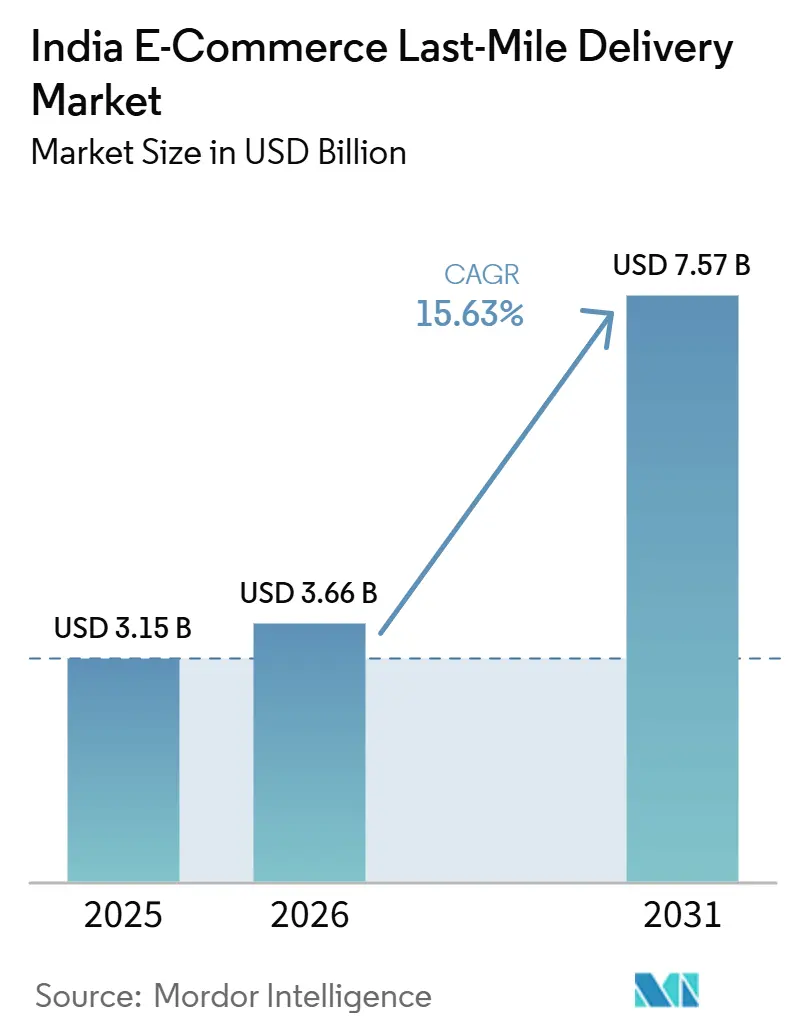
| Base Year Market Size (2025) | USD 3.15 Billion |
| Market Size (2026) | USD 3.66 Billion |
| Market Size (2031) | USD 7.57 Billion |
| Growth Rate (2026 - 2031) | 15.63 % |
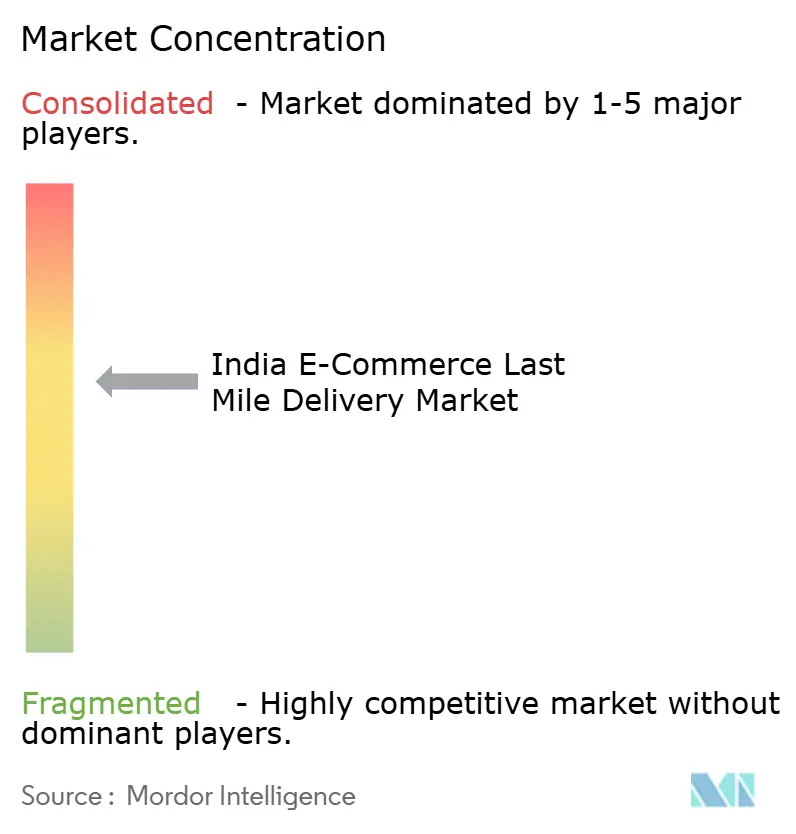
| Market Concentration | Medium |
Major Players *Disclaimer: Major Players sorted in no particular order Image © Mordor Intelligence. Reuse requires attribution under CC BY 4.0. | |
India E-Commerce Last-Mile Delivery Market Analysis by Mordor Intelligence
The India e-commerce last-mile delivery market size was valued at USD 3.15 billion in 2025 and is estimated to grow from USD 3.66 billion in 2026 to reach USD 7.57 billion by 2031, at a CAGR of 15.63% during the forecast period 2026-2031.
The India e-commerce last-mile delivery market is expanding on the back of stronger order density beyond the largest metros, where carriers are adding coverage, improving delivery speed, and building more viable route economics in smaller cities. Competitive behavior is also changing as large platform-linked networks and listed parcel operators use network expansion, pricing pressure, and targeted partnerships to gain greater control over fulfillment flows in urban and semi-urban corridors. Profitability remains under pressure because cash-on-delivery still accounts for close to half of online orders, and return-to-origin rates are materially higher for COD shipments than for prepaid orders. The operating model of the Indian e-commerce last-mile delivery market is also shifting, as e-goods carrier sales rose to 14,803 units in FY 25-26, lowering fuel costs on dense urban routes and making fleet electrification more practical for daily drop-and-drop deliveries[1] “14,803 e-goods carrier units in FY25-26.” 2026, Ministry of Road Transport and Highways / Vahan Dashboard, vahan.parivahan.gov.in. At the same time, same-day infrastructure, AI-led address intelligence, and automated sortation are raising service expectations and pushing the India e-commerce last mile delivery market toward faster, more technology-led competition through 2031.
Key Report Takeaways
- By delivery type, standard delivery led with 58.19% of the India e-commerce last-mile delivery market share in 2025, while same-day delivery is projected to expand at a 19.08% CAGR through 2031.
- By delivery model, B2C held 69.88% of the India e-commerce last-mile delivery market share in 2025, while C2C recorded the highest projected CAGR at 21.75% through 2031.
- By city tier, Tier 1 accounted for 54.6% of the India e-commerce last-mile delivery market size in 2025, while Tier 3 and below are advancing at an 18.68% CAGR through 2031.
- By product type, fashion and lifestyle accounted for 26.34% of the India e-commerce last-mile delivery market size in 2025, while personal and household care is forecast to grow at a 17.88% CAGR through 2031.
- By geography, West India held 28.71% of the India e-commerce last-mile delivery market share in 2025, while Central India is projected to grow at a 16.71% CAGR through 2031.
Note: Market size and forecast figures in this report are generated using Mordor Intelligence’s proprietary estimation framework, updated with the latest available data and insights as of January 2026.
India E-Commerce Last-Mile Delivery Market Trends and Insights
Drivers Impact Analysis*
| Driver | (~) % Impact on CAGR Forecast | Geographic Relevance | Impact Timeline |
|---|---|---|---|
| Rapid Expansion of E-Commerce Order Density in Tier 2 and Tier 3 Cities | +2.5% | National, concentrated gains in Tier 2 and Tier 3 cities across North, East, and Central regions | Medium term (2-4 years) |
| Shift Toward Faster Delivery Expectations in Metro Corridors | +2.0% | Metro corridors, Mumbai, Delhi-NCR, Bengaluru, Hyderabad, Chennai, Kolkata | Short term (≤ 2 years) |
| Rising Platform-Led Control Over Captive Delivery Networks | +1.8% | National, strongest impact in Tier 1 and major Tier 2 cities | Medium term (2-4 years) |
| Parcel Route Optimization Through AI-Enabled Sortation and Dispatching | +1.5% | National, early gains in NCR, Mumbai, and Bengaluru logistics corridors | Short term (≤ 2 years) |
| Growing Use of EV Fleets for High-Frequency Urban Drop Density | +1.2% | Urban clusters in Maharashtra, Karnataka, Delhi-NCR, and Tamil Nadu | Medium term (2-4 years) |
| Increasing Demand for Returns Handling and Reverse Logistics Visibility | +1.0% | National, highest impact in Tier 2 and Tier 3 geographies and COD-heavy product categories | Long term (≥ 4 years) |
| Source: Mordor Intelligence | |||
Rapid Expansion of E-Commerce Order Density in Tier 2 and Tier 3 Cities
Demand outside the largest metros is no longer a secondary layer for the India e-commerce last-mile delivery market, because these cities are now shaping the next phase of parcel volume growth. Tier II and Tier III cities accounted for 66% of new D2C orders in FY 26 and contributed 60% of incremental GMV over FY 25, indicating that new order creation is increasingly led by non-metro consumers rather than by mature urban clusters. This changes the operating logic for carriers because network depth, route planning, and local delivery consistency matter more when demand is rising across many smaller catchments rather than in a few dense city cores. It also means the addressable shopper base is becoming more distributed, which favors carriers that can build service reliability in lower-density lanes before those lanes become crowded. The India e-commerce last-mile delivery market is therefore seeing greater value in pincode expansion, staffing for semi-urban deliveries, and standardizing last-mile processes across smaller cities. That pattern also suggests that future competitive gains will come from building density early in new demand clusters rather than only defending positions on metro routes.
Shift Toward Faster Delivery Expectations in Metro Corridors
Delivery expectations in the largest metros are tightening because quick commerce has changed what many urban shoppers now consider acceptable for everyday purchases in the India e-commerce last-mile delivery market. Flipkart Minutes had already scaled to 1,000 micro-fulfillment centers by June 2026, was processing 820,000 daily orders, and planned to reach 1,500 centers by the end of 2026, which shows the pace at which fast-fulfillment infrastructure is being added. Amazon also expanded Amazon Now to more than 300 Indian cities and stated that orders on the service had doubled every quarter since launch, which further reset the expected delivery window for many urban use cases. The result is that platform-controlled express operations are setting a delivery speed benchmark that third-party carriers cannot ignore if they want to retain higher-frequency urban accounts. This is forcing more investment into route density, automated sortation, and dispatch precision, because delivery speed can no longer be improved only by adding riders. In practical terms, the India e-commerce last-mile delivery market is moving toward a model where service speed is becoming a basic competitive requirement in large metro corridors.
Rising Platform-Led Control Over Captive Delivery Networks
Platform-led logistics control is becoming more visible in the India e-commerce last-mile delivery market as large e-commerce companies open their delivery arms to external merchants and enterprise clients. Ekart’s logistics partnership with IKEA first launched in Delhi-NCR in March 2025 and expanded to Chennai in March 2026, demonstrating how captive networks are moving into more specialized delivery categories, such as large-format home goods. Amazon’s broader fast-delivery expansion also shows how platform-owned logistics infrastructure can scale quickly when it is tied to the traffic and economics of a large marketplace. This creates an uneven pricing environment because captive networks can absorb logistics costs through the wider economics of their commerce platforms, while pure-play carriers depend more directly on logistics margins. Shadowfax’s official investor material also noted that its third-party logistics market share rose from 8% to 27-29% over the last 4 years, suggesting there is still room for independent operators to position themselves well in the spaces left open by captive networks. The India e-commerce last-mile delivery market is therefore becoming harder for undifferentiated operators, but it still offers opportunities for companies serving D2C brands, mid-market sellers, and more complex delivery categories.
Parcel Route Optimization Through AI-Enabled Sortation and Dispatching
Technology is becoming more central in the India e-commerce last-mile delivery market because gains in route precision and sortation speed directly affect cost per parcel and service consistency. Shadowfax commissioned OneNCR in February 2026 with a primary sorter capacity of 48,000 shipments per hour and peak throughput of up to 1 million parcels per day, which materially improves direct manifesting and reduces intermediate handling. India Post also announced in May 2026 that it was preparing to deploy an AI-based parcel sorting system across its 155,000+ post office network, which shows that automation is not limited to private operators alone[2]“Modernization and Digitization of India Post System.” 2025, India Post, indiapost.gov.in. Delhivery launched Delhivery Maps in June 2026 as an AI-native geospatial platform for address disambiguation, predictive delivery sequencing, and vehicle-aware routing across India’s non-standardized address environment. These systems matter because the India e-commerce last-mile delivery market still operates in an environment where address inconsistency, manual sorting, and reattempts can quickly raise delivery costs. Operators that cut those frictions through better data, faster sorting, and stronger dispatch logic are likely to defend margins more effectively than carriers that rely mainly on volume scale.
Restraints Impact Analysis*
| Restraint | (~) % Impact on CAGR Forecast | Geographic Relevance | Impact Timeline |
|---|---|---|---|
| High Cost per Successful Delivery in Low-Density Pin Codes | -1.5% | Tier 2, Tier 3, and rural or semi-urban pin codes across Central, East, and North India | Long term (≥ 4 years) |
| Driver and Rider Attrition, Compliance, and Peak-Hour Capacity Gaps | -0.9% | National, most acute in metro cities during festive seasons and high-volume delivery windows | Medium term (2-4 years) |
| Margin Pressure from Cash on Delivery, Returns, and Reattempts | -1.2% | National, concentrated in Tier 2 and Tier 3 cities and COD-reliant categories such as fashion and electronics | Medium term (2-4 years) |
| Fragmented Infrastructure for Same-Day and Hyperlocal Service Beyond Top Cities | -0.8% | Tier 2 and Tier 3 cities and markets in East, Central, and North India | Long term (≥ 4 years) |
| Source: Mordor Intelligence | |||
High Cost per Successful Delivery in Low-Density Pin Codes
The India e-commerce last-mile delivery market still faces a hard cost challenge in lower-density pin codes because route spreads are wider, drop density is lower, and successful delivery is less predictable. Standard delivery can remain the only viable service level in many of these lanes because the economics of faster delivery deteriorate when routes cannot support enough stops per run. Carriers also face weaker address quality, longer inter-stop distances, and more uneven infrastructure in many semi-urban and rural corridors, which limits the benefit of digital tools when physical delivery conditions remain difficult. This is why service expansion into smaller cities does not automatically yield healthy margins, even as parcel demand rises. Operators that lack adequate density in these lanes often rely more on subcontracting and partnership networks, reducing direct control over delivery data and future route optimization. The India e-commerce last-mile delivery market will therefore continue to reward carriers that can combine pincode expansion with better order clustering and cost discipline, rather than pursuing reach without density.
Margin Pressure from Cash on Delivery, Returns, and Reattempts
Cash on delivery remains one of the clearest profitability constraints in the India e-commerce last-mile delivery market because it raises failure risk, handling cost, and working capital pressure at the same time. Industry reporting in June 2026 indicated that close to half of India’s online orders were still paid in cash at delivery, while COD return-to-origin rates were 25-30%, versus 2-3% for prepaid orders. This cost burden is magnified in smaller cities and lower-density routes, where failed attempts and reverse movement consume more time and incur higher transport expenses per parcel. The pressure is not limited to the forward shipment because every failed COD order can also create extra handling, remittance, and reattempt cycles that carry little or no revenue recovery. It is also harder to solve this issue only through delivery optimization, because product data quality, customer confirmation, and payment behavior all affect whether the final delivery actually succeeds. The India e-commerce last-mile delivery market is therefore likely to remain exposed to COD-linked margin drag, even as digital payments continue to expand[3]“National Logistics Policy.” Department for Promotion of Industry and Internal Trade (DPIIT). pib.gov.in.
*Our forecasts treat driver/restraint impacts as directional, not additive. The impact forecasts reflect baseline growth, mix effects, and variable interactions.
Segment Analysis
By Delivery Type: Same-Day Speed Resets Expectations Across All City Tiers
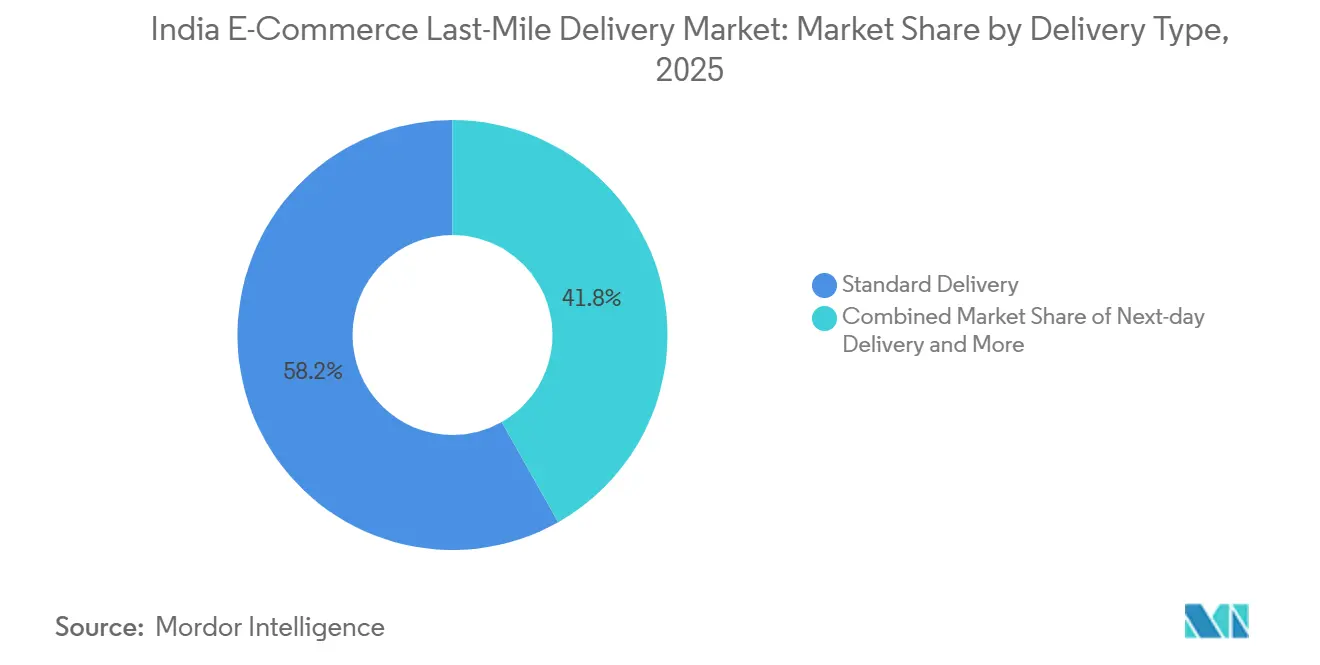
Standard delivery held 58.19% of the India e-commerce last-mile delivery market share in 2025, which shows that multi-day fulfillment still dominates when affordability and broad geographic reach matter more than speed. This split is important because it shows that the India e-commerce last-mile delivery market still depends on standard networks for scale, even while fast-delivery formats are shaping shopper expectations and carrier investment priorities. Flipkart Minutes had reached 1,000 micro-fulfillment centers by June 2026 and was already processing 820,000 daily orders, underscoring how dense the infrastructure is being built to support same-day and near-instant fulfillment. Amazon stated that Amazon Now had expanded to more than 300 cities and that orders had doubled every quarter since launch, suggesting the rapid spread of rapid-delivery behavior.
Same-day delivery is the fastest-growing sub-segment, with a projected 19.08% CAGR from 2026 to 2031, reflecting how rapidly rapid-fulfillment models are moving from a metro-led proposition toward a broader operational benchmark. Next-Day Delivery is becoming a useful middle layer because it balances speed with cost and fits categories that need more control than hyperlocal fulfillment usually provides. Electronics and home appliances are especially suited to that middle tier because order verification, packaging, and handling often require more structured delivery windows. As same-day networks scale, they are also tightening customer expectations in places where ultra-fast delivery is not yet economically viable, which can weaken pricing power for standard-only operators. That means the India e-commerce last mile delivery market is not simply adding a faster service tier, but is also reshaping how every delivery promise is valued by both shoppers and merchants.



By Delivery Model: C2C Platforms Drive the Next Wave Beyond B2C Consolidation
B2C accounted for 69.88% of the India e-commerce last-mile delivery market share in 2025, which confirms that organized parcel networks in India are still anchored by marketplace and brand-to-consumer shipment flows. C2C is projected to grow at a 21.75% CAGR through 2031, making it the fastest-expanding delivery model as resale platforms, social commerce, and peer-to-peer transactions gain wider acceptance. That mix shows how the Indian e-commerce last-mile delivery industry is broadening beyond conventional retail delivery into more fragmented and behavior-driven order flows. B2B remains smaller in this market, but it is benefiting from dark-store replenishment and organized inventory movement, linked to the growth of quick commerce. Delhivery reported that its part-truckload freight tonnage grew 15% year on year in the first quarter, after integrating Ecom Express, partly supported by dark-store restocking demand across quick-commerce operators.
The growth of C2C creates a more difficult operating environment because parcel values are often lower, addresses are less standardized, and order behavior can be less predictable than in regular B2C flows. These shipments also underscore the importance of route intelligence and address verification, since small errors can quickly erode margins on low-value parcels. In that sense, the India e-commerce last mile delivery industry is being pushed toward more data-led execution because traditional weight-based pricing and route planning are less effective in C2C-heavy traffic. Carriers that adapt to this shift early are likely to benefit as C2C volume becomes a more visible contributor to national parcel flows through 2031.
By City Tier: Tier 3 Outpaces Peers as Networks Catch Up to Demand
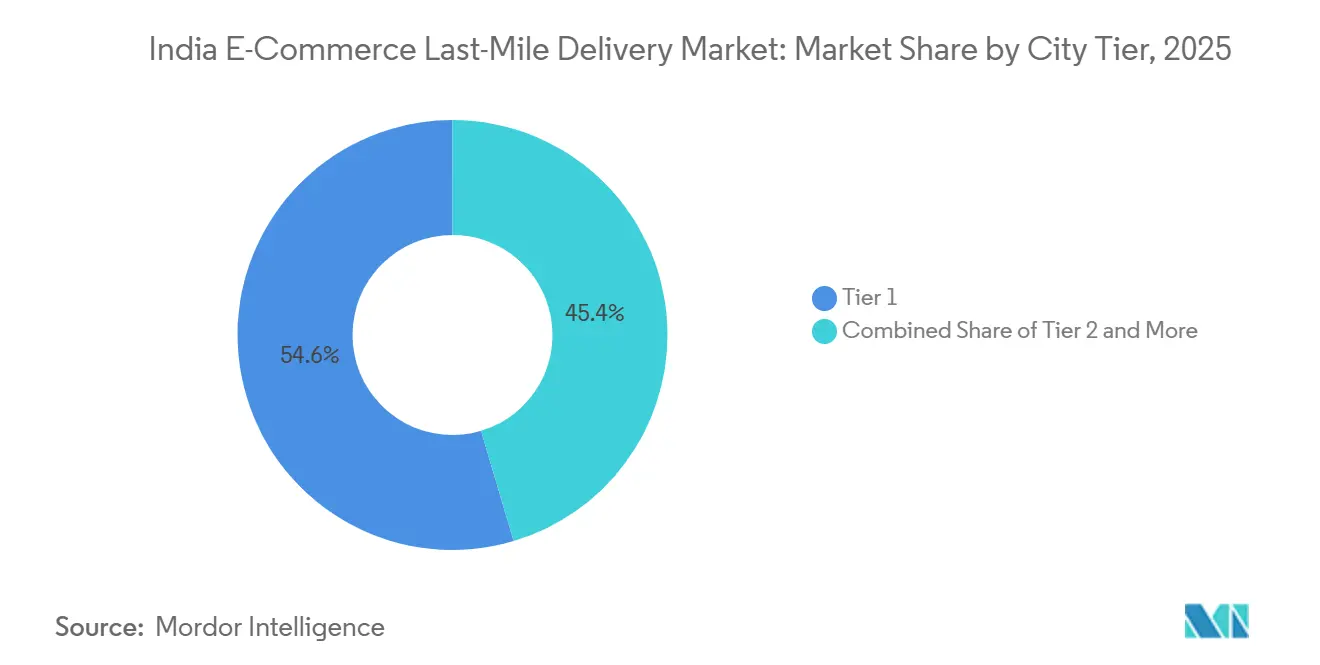
Tier 1 cities accounted for 54.6% of the India e-commerce last-mile delivery market size in 2025, reflecting their higher logistics density, higher order frequency, and deeper quick commerce penetration. Tier 3 and Below is projected to expand at a 18.68% CAGR through 2031, indicating that the fastest growth in the India e-commerce last-mile delivery market is now coming from geographies where physical infrastructure is still catching up with online demand. This combination means volume leadership still rests with large cities, but incremental expansion is shifting toward smaller locations where new shoppers are entering digital commerce in greater numbers. Mid-year sale volumes in 2025 grew by 21% in Tier 2 cities and 22% in Tier 3 cities, supporting the view that purchase intent in these markets is already well established. The delivery challenge is now less about attracting buyers and more about serving a widening pincode network efficiently.
That shift matters because smaller cities do not reward generic scale in the same way metros do. Higher COD exposure and greater address unpredictability can raise the cost of every failed delivery if carriers do not use stronger order verification and better scheduling tools. The India e-commerce last-mile delivery industry is therefore moving into a phase where operational learning in Tier 2 and Tier 3 corridors can create a sharper edge than incremental gains in already mature urban markets. This is also why pincode expansion, routing discipline, and local service consistency are becoming central to how carriers compete outside the biggest cities.
By Product Type: Fashion Leads by Value, Personal Care Accelerates by Frequency
Fashion and lifestyle accounted for 26.34% of the India e-commerce last-mile delivery market share in 2025, making it the largest product segment by value. Personal and household care is projected to grow at a 17.88% CAGR through 2031, reflecting the rising frequency of repeat purchases and the growing role of fast-delivery channels for everyday essentials. The category mix matters because it shapes both shipment economics and service design across the India e-commerce last-mile delivery industry. Consumer electronics and household ppliances often generate fewer shipments than fashion, but they usually carry higher ticket values and require stricter handling. Blue Dart announced in June 2026 that it planned to expand cargo operations into 5 emerging industrial hubs, which supports its ability to serve high-value freight and e-commerce flows linked to electronics and related categories.
Personal care is growing quickly because frequent replenishment is more compatible with same-day and rapid-fulfillment models than many discretionary categories. Shadowfax also highlighted stronger demand across baby care, gourmet food, and personal care D2C brands, suggesting the operational relevance of high-frequency, smaller-basket shipments in this segment. Ekart’s partnership with IKEA shows a different product-side trend, where large-format deliveries are creating room for more specialized scheduling, handling, and final-mile capabilities. Foods and beverages is also advancing through quick commerce, but the last-mile requirement is different because service quality depends more heavily on temperature control, cold-chain availability, and compliance in the final delivery leg.
Geography Analysis
West India accounted for 28.71% of the India e-commerce last-mile delivery market share in 2025, which kept it in the leading regional position. Maharashtra and Gujarat support this lead because they combine dense fulfillment infrastructure, large consumption centers, and strong warehousing links with major freight corridors. Blue Dart stated in its FY 26 disclosures that its network spanned 63 ground hubs, 144 network hubs, and 1,813 service centers serving more than 56,400 locations across over 19,000 pin codes, and this scale is especially relevant in western urban and semi-urban corridors. Mumbai and Pune also remain important quick commerce hubs, which strengthen demand for same-day and sub-hour delivery services. The region, therefore, benefits from both large parcel volumes and a delivery mix that increasingly favors faster fulfillment.
South India holds the second-largest regional position and remains important both as a demand center and as a technology-led logistics corridor. Bengaluru led city-level electric two-wheeler registrations with 98,892 units in FY 25-26, which shows how urban fleet electrification is progressing in one of the country’s deepest digital commerce markets. Zepto’s disclosed dark-store expansion plans through FY 30 also point to Chennai and Bengaluru as major growth locations for rapid-delivery infrastructure. North India remains the highest-volume express corridor by parcel count because Delhi-NCR and Uttar Pradesh combine population scale with strong e-commerce throughput[4]“Delhi EV Policy 2026.” 2026, Government of NCT of Delhi, Transport Department, transport.delhi.gov.in. Shadowfax’s OneNCR hub was designed for that density and can process up to 1 million shipments per day, which underlines the importance of the North in the national network structure.
Central India is projected to expand at a 16.71% CAGR through 2031, making it the fastest-growing regional slice of the India e-commerce last mile delivery market size. Cities such as Indore and Bhopal are benefiting from higher e-commerce penetration and rising fulfillment activity, which is gradually strengthening the region’s relevance in national parcel flows. East India remains less penetrated by organized operators, but it is gaining importance as online shopper density improves across West Bengal, Odisha, and Bihar. Taken together, Central and East India look set to contribute a larger share of incremental deliveries through 2031 because incumbent density is still lower while demand is building from a smaller installed base.
Competitive Landscape
The India e-commerce last-mile delivery market is moderately consolidated at the top and fragmented beneath that layer, with Delhivery, Blue Dart Express, and Shadowfax forming the most visible organized operator group. Delhivery’s completion of the Ecom Express acquisition in July 2025 for INR 1,407 crore (USD 167 million) was the clearest consolidation move in the recent period and reduced the pool of independent express parcel competitors. The integration also strengthened Delhivery’s B2C parcel network at a time when national scale still matters for route balance and cost absorption. Shadowfax then listed in January 2026 and raised INR 1,907 crore (USD 227 million), which gave it additional capital to expand dark stores, expand pincode coverage, and automate operations. These moves show that leadership in the India e-commerce last-mile delivery market is being shaped by a mix of scale consolidation and capital access rather than by parcel volume growth alone.
Platform-captive networks remain the most disruptive competitive force because their parent marketplaces can support logistics expansion with broader commerce economics. Amazon’s rollout of Amazon Now to more than 300 cities and Flipkart’s fast scale-up of Minutes show how platform-owned fulfillment is raising the pressure on independent carriers in urban, high-frequency categories. Ekart’s IKEA partnership adds another dimension because it shows that captive networks are also moving into scheduled heavy-goods delivery, not only fast-moving small parcels. That makes competition harder for carriers that lack either strong specialization or sufficient route density. It also means the India e-commerce last mile delivery market is seeing pressure from both horizontal expansion into new parcel volumes and vertical moves into more specialized service categories.
Technology is becoming the clearest differentiator between serious scaled operators and weaker regional players. Delhivery Maps, Shadowfax’s OneNCR facility, and Safexpress’s AI-first logistics backbone all point to a competitive environment where software, sortation, and route intelligence are increasingly tied to cost control and customer retention. Blue Dart’s planned capex focus on automation, material handling equipment, and IT infrastructure supports the same direction of travel among incumbents. White-space opportunity still remains in Tier 3 and rural delivery, reverse logistics technology, temperature-controlled final-mile operations, and large-item e-commerce logistics where national leadership is not yet fully settled. The India e-commerce last mile delivery market is therefore consolidating at the top, but it is not closed to new gains in segments where service complexity remains high.
India E-Commerce Last-Mile Delivery Industry Leaders
Delhivery Limited
Blue Dart Express Private Limited
Shadowfax Technologies Limited
Busybees Logistics Solutions Private Limited
Flipkart
- *Disclaimer: Major Players sorted in no particular order

Recent Industry Developments
- July 2026: Amazon India announced the expansion of Amazon Now, its ultra-fast delivery service, to over 300 cities nationwide. The service, which has doubled orders every quarter since launch, becomes India's largest "delivery in minutes" network, adding tens of thousands of SKUs available within minutes alongside a selection of over 1 million items for same-day delivery. Amazon simultaneously launched its "Sammaan" program to improve the welfare of delivery associates.
- June 2026: Delhivery launched "Delhivery Maps," an AI-native geospatial platform co-developed with NVIDIA, and opened for commercial API integration. Powered by Naksha LLM, an in-house geospatial reasoning model, the platform offers address disambiguation, predictive delivery sequencing, and vehicle-aware routing to address India's non-standardized address problem at scale.
- May 2026: Flipkart's Minutes service reached 1,000 micro-fulfillment centers and announced scale-up to 1,500 centers by year-end 2026. Processing 820,000 daily orders and expanding at 75-100 new centers per month, Flipkart directly challenges established quick commerce platforms, including Blinkit, Zepto, and Swiggy Instamart, in India's USD 10-11 billion quick commerce segment.
- May 2026: Shadowfax announced plans to expand its dark store footprint to 100 locations during FY 27 and extend pincode coverage to 17,000 by Q4 FY 27. The company disclosed that pilot dark store locations delivered gross margins above 20% and achieved profitability within 3 to 4 months. It simultaneously announced "Prime Large" for heavy-appliance logistics, targeting a high-yield, low-competition segment.


India E-Commerce Last-Mile Delivery Market Report Scope
| Standard Delivery |
| Same-Day Delivery |
| Next-Day Delivery |
| Business-to-Consumer (B2C) |
| Business-to-Business (B2B) |
| Consumer-to-Consumer (C2C) |
| Tier 1 |
| Tier 2 |
| Tier 3 and Below |
| Foods and Beverages |
| Personal and Household Care |
| Fashion and Lifestyle (Accessories, Apparel, Footwear) |
| Furniture |
| Consumer Electronics and Household Appliances |
| Other Products |
| North |
| Central |
| West |
| East |
| South |
| By Delivery Type | Standard Delivery |
| Same-Day Delivery | |
| Next-Day Delivery | |
| By Delivery Model | Business-to-Consumer (B2C) |
| Business-to-Business (B2B) | |
| Consumer-to-Consumer (C2C) | |
| By City Tier | Tier 1 |
| Tier 2 | |
| Tier 3 and Below | |
| By Product Type | Foods and Beverages |
| Personal and Household Care | |
| Fashion and Lifestyle (Accessories, Apparel, Footwear) | |
| Furniture | |
| Consumer Electronics and Household Appliances | |
| Other Products | |
| By Region | North |
| Central | |
| West | |
| East | |
| South |


Key Questions Answered in the Report
What is the current size of the India e-commerce last mile delivery space?
The India e-commerce last mile delivery market size stood at USD 3.15 billion in 2025 and is valued at USD 3.66 billion in 2026, with forecasts reaching USD 7.57 billion by 2031.
How fast is India’s e-commerce last mile delivery ecosystem expected to grow?
The market is projected to grow at a 15.63% CAGR from 2026 to 2031, supported by stronger order density outside metros, fast-delivery infrastructure, and wider use of automation.
Which delivery type leads in India right now?
Standard delivery led with 58.19% in 2025, but same-day delivery is the fastest-growing format with a projected 19.08% CAGR through 2031.
Which customer model is expanding the fastest?
B2C remains the largest model with 69.88% share in 2025, while C2C is growing the fastest at a projected 21.75% CAGR through 2031 as resale and peer-to-peer commerce expand.
Which parts of India are creating the next wave of parcel growth?
Tier 3 and Below cities are forecast to grow at a 18.68% CAGR, and Central India is the fastest-growing region at 16.71% CAGR, underscoring the growing importance of smaller cities and underpenetrated regions.
What is putting the most pressure on carrier margins in India?
Cash on delivery remains a major issue because close to half of online orders still use COD, and COD return-to-origin rates of 25-30% remain far above the 2-3% seen in prepaid orders.
Page last updated on:





