
Implant Monitoring Software Market Size and Share
Market Overview
| Study Period | 2020 - 2031 |
|---|---|
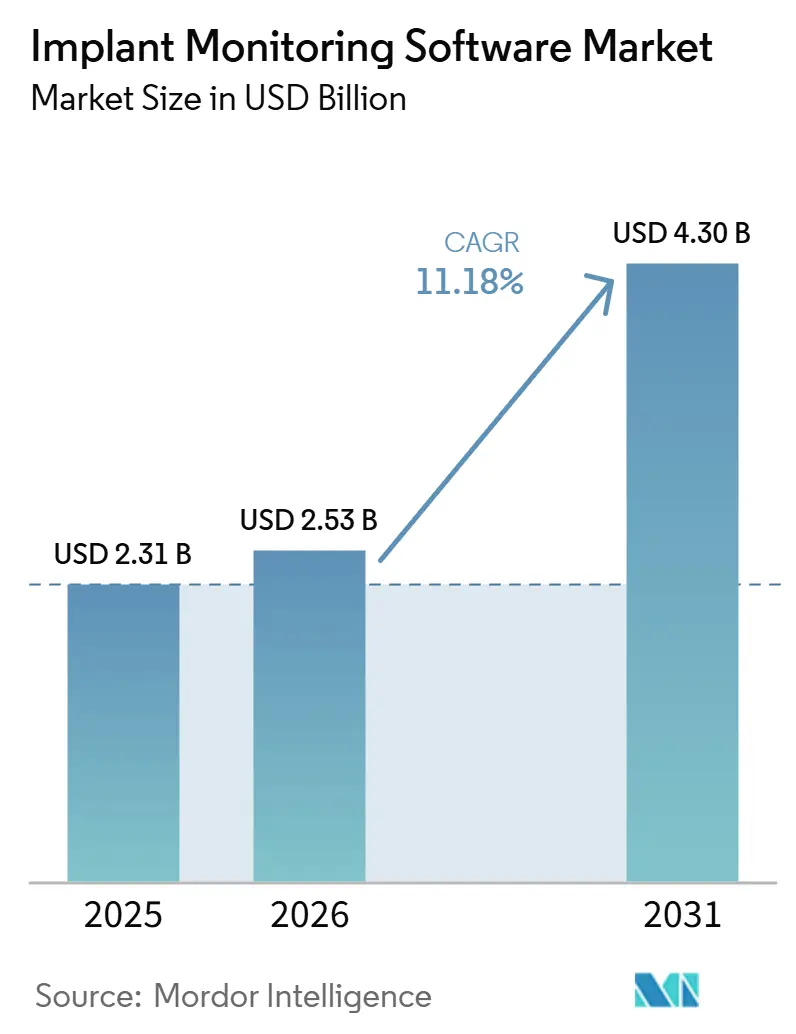
| Market Size (2026) | USD 2.53 Billion |
| Market Size (2031) | USD 4.30 Billion |
| Growth Rate (2026 - 2031) | 11.18 % |
| Fastest Growing Market | Asia-Pacific |
| Largest Market | North America |
| Market Concentration | Medium |
Major Players *Disclaimer: Major Players sorted in no particular order Image © Mordor Intelligence. Reuse requires attribution under CC BY 4.0. | |
Implant Monitoring Software Market Analysis by Mordor Intelligence
The Implant Monitoring Software Market size is projected to expand from USD 2.31 billion in 2025 and USD 2.53 billion in 2026 to USD 4.30 billion by 2031, registering a CAGR of 11.18% between 2026 to 2031.
The implant monitoring software market is expanding because remote follow-up has become central to the care of patients with implanted devices. Cardiac implants generate recurring transmissions throughout the device life cycle, which makes software capacity increasingly important for clinical teams. The value of these platforms lies in separating clinically meaningful alerts from routine transmissions, rather than simply collecting more data. Providers are also looking for systems that can support remote care without adding matching staff requirements. This creates room for platforms that combine secure connectivity, clinical workflow tools, and useful alert prioritization.
Key Report Takeaways
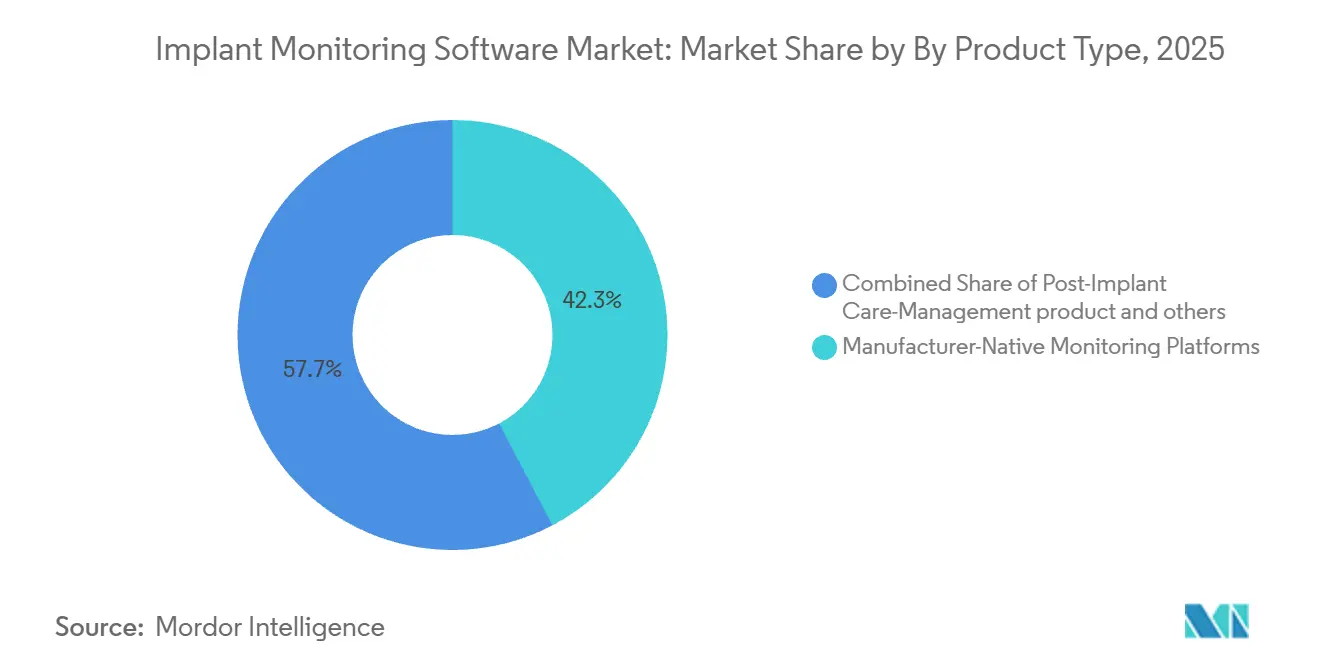
By product type, manufacturer-native monitoring platforms held 42.3% share in 2025, while post-implant care-management and real-world-evidence platforms are forecast to expand at a 12.5% CAGR through 2031.
By monitoring modality, implantable cardiac electronic devices held 58.4% share in 2025, while implantable hemodynamic sensors are forecast to expand at a 12.1% CAGR through 2031.
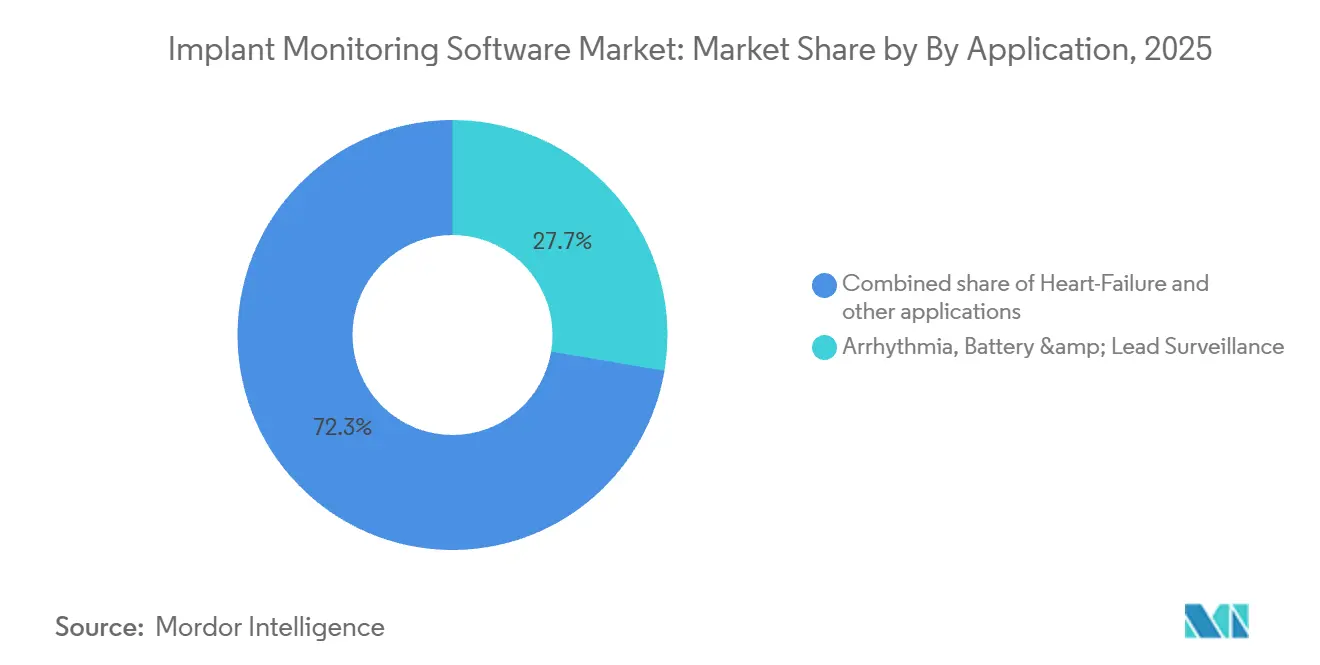
By application, arrhythmia, battery, and lead surveillance held 27.7% share in 2025, while heart failure and hemodynamic monitoring is forecast to expand at a 12.8% CAGR through 2031.
By end user, hospitals and academic medical centers held 46.9% share in 2025, while home healthcare providers are forecast to expand at a 12.2% CAGR through 2031.
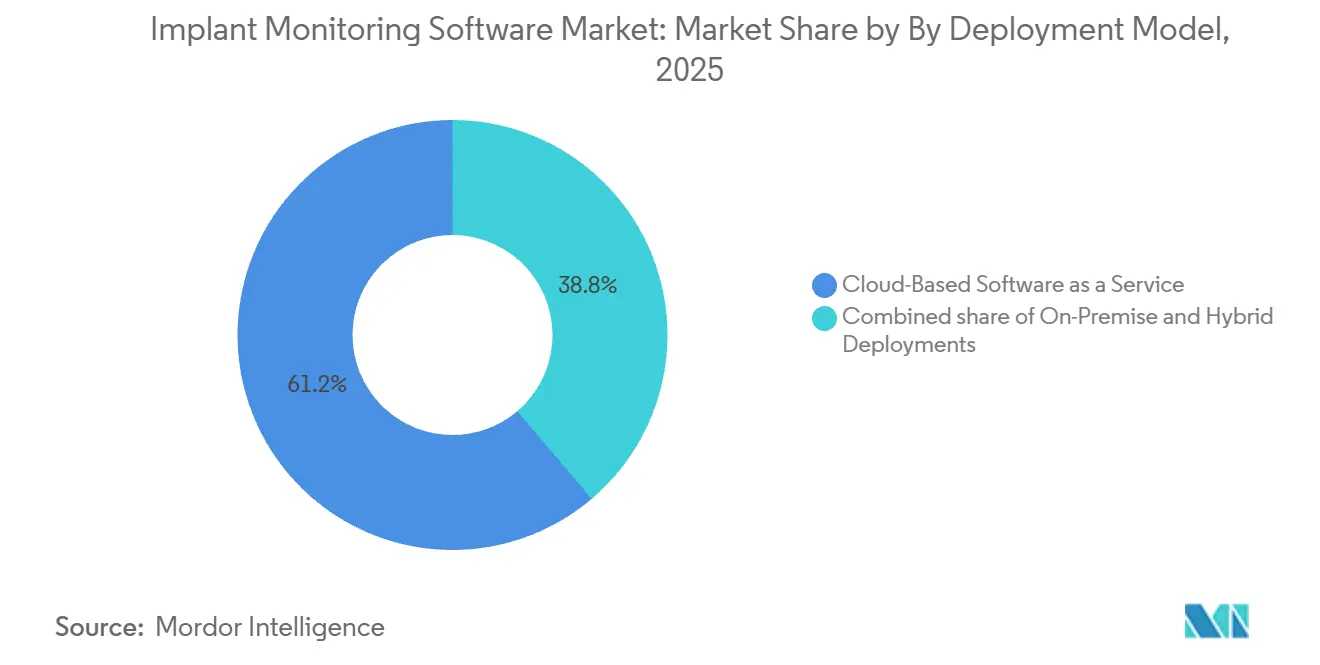
By deployment model, cloud-based software as a service held 61.2% share in 2025 and is forecast to expand at a 12.4% CAGR through 2031.
Note: Market size and forecast figures in this report are generated using Mordor Intelligence’s proprietary estimation framework, updated with the latest available data and insights as of January 2026.
Market Trends and Insights
Drivers Impact Analysis of Implant Monitoring Software Market*
| Driver | (~) % Impact on CAGR Forecast | Geographic Relevance | Impact Timeline |
|---|---|---|---|
| Expansion of the Implanted Cardiac Device Base | +2.8% | Global | Long term (≥ 4 years) |
| Rising Chronic Disease and Aging-Patient Monitoring Needs | +2.2% | Global, with concentration in North America, EU, and East Asia | Long term (≥ 4 years) |
| Shift From In-Person Follow-Up to Remote Care and Reimbursement-Linked Monitoring | +2.4% | North America and EU, with spillover to APAC and MEA | Medium term (2-4 years) |
| AI-Based Alert Triage and Workflow Automation | +1.9% | Global, with early gains in North America and Western Europe | Short term (≤ 2 years) |
| Vendor-Neutral Interoperability for Multi-Brand Implant Clinics | +0.8% | North America and EU core markets | Medium term (2-4 years) |
| Objective Recovery Metrics From Sensorized Orthopedic Implants | +0.7% | North America, with early spillover to EU and APAC | Long term (≥ 4 years) |
| Source: Mordor Intelligence | |||
Expansion of the Implanted Cardiac Device Base
The growing base of implanted cardiac devices creates recurring demand for the implant monitoring software market. More than 2.5 million cardiac implantable electronic devices are implanted each year globally. Implantable cardioverter-defibrillators and cardiac resynchronization therapy devices have also been growing by 5-6% annually in unit terms, supported partly by broader preventive use in heart failure patients with reduced ejection fraction[1]Andrea Frontera et al., “Integrating Remote CIED Monitoring Into Heart Failure Care: Evidence, Challenges, and Opportunities,” Frontiers in Cardiovascular Medicine. Each implant requires years of follow-up transmissions, so the active monitoring population builds more quickly than annual procedure totals suggest. Device replacements from aging battery cohorts add to the workload while newer implants enter their own monitoring schedules. The 2023 HRS, EHRA, APHRS, and LAHRS consensus allows stable patients on continuous remote monitoring to have in-person visits as far as 24 months apart, extending the period in which software supports routine follow-up.
Rising Chronic Disease and Aging-Patient Monitoring Needs
Aging populations are increasing the number of patients who may need cardiac or neuromodulation implants and continuing follow-up. Adults with implanted cardiac devices often have diabetes, hypertension, atrial fibrillation, or several of these conditions at the same time. This raises the value of platforms that can bring together cardiac, activity, and other patient signals for the care team. The implant monitoring software market therefore benefits when providers need a fuller view of changing patient status rather than a single device reading. HeartLogic is an example of a multiparametric tool used in this setting, with reported sensitivity of 70% for impending heart failure events within a 34-day detection window. Such tools can help clinicians recognize changes earlier, although their usefulness in the implant monitoring software market still depends on clinical review and clear care pathways.
Shift From In-Person Follow-Up to Remote Care and Reimbursement-Linked Monitoring
Remote monitoring is moving from an optional service to a regular part of post-implant care in many settings. Remote systems can identify relevant events a mean of 26 days after the last clinic visit and can notify care teams 64-154 days earlier than a typical 3-6 month in-person schedule. This earlier visibility supports a stronger operational case for the implant monitoring software market, especially where clinics manage large patient panels. Medicare paid more than USD 500 million for remote patient monitoring services in 2024. In Germany[2]Bundesverband Medizintechnologie, “Beschluss des Bewertungsausschusses zu Telemonitoring und Telemedizinischen Funktionsanalysen: Transmitter Werden Endlich Vergütet,” BVMed, billing code GOP 40909, introduced in July 2025, covers transmitters used for outpatient heart failure telemonitoring. These payment pathways make it easier for providers to justify the staff and software needed for remote follow-up in the implant monitoring software market.
AI-based alert triage is becoming a practical response to the high volume of device transmissions. Medtronic reported that AccuRhythm AI reduced staffing hours and costs by 58% across 19,320 patients at 140 device clinics. BIOTRONIK reported that SmartECG identified 42.8% of transmitted ECGs as false positives with 97.9% sensitivity, which was associated with a 42% annual workload reduction per patient. A 2026 Implicity study reported 98.3% sensitivity for clinically meaningful arrhythmias and filtered 61.6% of non-actionable false alerts in AI-equipped devices. The implant monitoring software market can benefit when clinics move from reviewing every alert to handling safe, caution, and critical cases through different workflows. PASTEC, published in 2026, provides an open clinical infrastructure for prospective validation of AI in cardiac remote monitoring, which may strengthen the evidence base for newer tools in the implant monitoring software market.
Restraints Impact Analysis of Implant Monitoring Software Market*
| Restraint | (~) % Impact on CAGR Forecast | Geographic Relevance | Impact Timeline |
|---|---|---|---|
| Cybersecurity, Privacy, and Connected-Device Liability | -1.5% | Global, most acute in North America and EU under FDA and MDR or AI Act requirements | Short term (≤ 2 years) |
| Uneven Reimbursement and Budget Ownership Across Care Settings | -1.2% | EU, MEA, South America, and pockets in APAC excluding Japan | Medium term (2-4 years) |
| False Positives, Alert Fatigue, and Clinical Capacity Constraints | -0.9% | Global | Short term (≤ 2 years) |
| Implant-Specific Data Silos and Limited Evidence for Non-Cardiac Workflows | -0.6% | Global, with early resolution underway in North America | Medium term (2-4 years) |
| Source: Mordor Intelligence | |||
Cybersecurity, Privacy, and Connected-Device Liability
Wireless connectivity allows remote follow-up, but it also increases cybersecurity and privacy responsibilities. The FDA’s June 2025 guidance on medical-device cybersecurity describes the quality-system considerations and premarket submission content expected for relevant devices. The February 2026 Quality Management System Regulation transition aligned U.S. device quality requirements with ISO 13485:2016, increasing the documentation work for software suppliers. European deployments must also address patient consent, data residency, and cross-border handling of transmitted information. These requirements can place a heavier burden on smaller vendor-neutral providers that do not have the compliance resources of large device manufacturers. The implant monitoring software market must therefore compete on reliable security practices as well as workflow and analytics features.
Uneven Reimbursement and Budget Ownership Across Care Settings
Uneven reimbursement remains a material constraint outside the most established remote-monitoring systems. Up to 73% of Italian cardiac centers reported inadequate reimbursement in 2026, while Bulgaria, Poland, and Slovakia did not provide a tariff for remote device management. In many settings, clinics must absorb monitoring costs within fixed diagnosis-related group payments. This can limit adoption to larger tertiary centers with the staff and budget to sustain the service. Budget ownership can also be unclear in ambulatory and home-care models, where the cardiologist, home health provider, and manufacturer services team may have separate responsibilities. Wider adoption in the implant monitoring software market will depend on clearer national payment structures and clearer accountability for remote follow-up costs.
*Our forecasts treat driver/restraint impacts as directional, not additive. The impact forecasts reflect baseline growth, mix effects, and variable interactions.
Implant Monitoring Software Market Segment Analysis
By Product Type:
OEM Platforms Maintain a Strong Base While Care-Management Platforms GrowManufacturer-native monitoring platforms held 42.3% of the implant monitoring software market share in 2025. Their position reflects direct access to device telemetry, established clinician relationships, and integration with proprietary programming workflows. Many clinics have built their processes around these platforms over years of use. Replacing a familiar system can create training, workflow, and contractual costs for providers. This installed base gives manufacturer-native platforms a durable advantage in the implant monitoring software market. It also explains why device connectivity alone remains a meaningful competitive feature for large manufacturers.
Post-implant care-management and real-world evidence platforms are projected to grow at a 12.5% CAGR through 2031. These platforms address demand for structured evidence after implantation and for data that supports patient follow-up. CMS coverage for implantable pulmonary artery pressure sensors requires participation in approved evidence-development studies, making organized data collection part of the coverage pathway. Vendor-neutral systems can also reduce the burden on multi-manufacturer clinics that otherwise use separate portals from Abbott, Boston Scientific, Medtronic, and BIOTRONIK. Post-market surveillance tools gain relevance as regulators and providers pay closer attention to device performance after approval. Orthopedic recovery platforms are also emerging as sensorized implants begin producing long-term data on gait, step count, and range of motion.



By Monitoring Modality:
CIEDs Provide the Largest Base and Hemodynamic Sensors ExpandImplantable cardiac electronic devices accounted for 58.4% of the implant monitoring software market size by monitoring modality in 2025. Pacemakers, ICDs, and cardiac resynchronization devices have a large established base and require regular interrogation and alert management. Their software ecosystem includes rhythm detection, battery tracking, lead monitoring, and multiparametric heart failure indices. In the United States, established billing pathways for remote cardiac-device services support continuing software use. CIEDs remain the core modality because their clinical and administrative workflows have had time to mature. The wide range of device data also encourages continued development of analytic and triage features in the implant monitoring software market.
Implantable hemodynamic sensors are forecast to grow at a 12.1% CAGR through 2031. Evidence from CardioMEMS data has linked early pulmonary artery pressure reduction within 90 days of implantation with improved long-term survival among Medicare beneficiaries with heart failure. The CMS[3]Centers for Medicare & Medicaid Services, “National Coverage Determination 20.36: Implantable Pulmonary Artery Pressure Sensors for Heart Failure Management,” Centers for Medicare & Medicaid Services coverage determination effective January 13, 2025, links coverage for implantable pulmonary artery pressure sensors with CMS-approved evidence development. This makes software that captures and organizes monitoring information important to the care and coverage process. Loop recorders continue to gain use as atrial fibrillation detection expands. Neuromodulation devices present a newer opportunity, as BIOTRONIK’s spinal cord stimulation platform collects more than 200 patient data points each day.
By Application:
Surveillance Leads While Heart Failure Monitoring Has the Highest GrowthArrhythmia, battery, and lead surveillance held 27.7% of the application segment in 2025. This use case is fundamental to CIED follow-up because clinicians must recognize rhythm changes, battery status, and lead issues promptly. It also benefits from established remote-monitoring guidance and regular clinic workflows. The HRS, EHRA, APHRS, and LAHRS consensus identifies remote monitoring as a standard part of care for patients with CIEDs. Its established role makes surveillance a stable part of demand for the implant monitoring software market. Patient reconnection functions are important because a 118,132-patient analysis found noncompliance of 21% among ICD and CRT-D users.
Heart failure and hemodynamic monitoring is expected to record a 12.8% CAGR through 2031. The MANAGE-HF study reported a 67% reduction in heart failure hospitalizations when HeartLogic alerts led to early clinical intervention, compared with pre-study hospitalization rates. This supports provider and payer interest in the implant monitoring software market, especially for software that helps teams act on pressure and multiparametric data. Remote programming and follow-up tools also support the application mix. A BIOTRONIK LiveSupport study found that more than 60 minutes per patient were saved in 78% of remote sessions. Safety, recall, and performance applications add another layer of demand as post-market vigilance becomes more important.
By End User:
Hospitals Hold the Largest Position and Home Healthcare GrowsHospitals and academic medical centers held 46.9% of the end-user segment in 2025. They are commonly the primary implanting sites and already operate device clinics with trained staff. Large centers may manage thousands of enrolled patients, which supports enterprise subscriptions and dedicated monitoring teams. Their scale also lets them use workflow tools across electrophysiology, heart failure, and follow-up services. This makes hospitals an important source of recurring demand for the implant monitoring software market. Academic centers also have a role in evidence development and clinical studies involving connected implants.
Home healthcare providers are forecast to grow at a 12.2% CAGR through 2031. This reflects the move toward care models that reduce the need for routine in-person visits. CMS materials describe remote patient monitoring as a covered service when billing and clinical requirements are met. Home-based programs can use remote data to support follow-up between hospital visits, although their success depends on clear responsibility for responding to alerts. Specialty and device clinics are relevant users of vendor-neutral systems because they often manage devices from several manufacturers. Research organizations and contract research organizations need structured data tools for post-market studies. Implant manufacturers also use these systems as real-world evidence becomes tied more closely to coverage and product management.
By Deployment Model:
Cloud SaaS Leads Both Adoption and GrowthCloud-based software as a service held 61.2% share in 2025 and is projected to grow at a 12.4% CAGR through 2031. It is the only deployment model that leads both current share and projected growth in the supplied segment data. Cloud platforms support regular updates, long-term storage, and dashboard access across facilities. They can also place more of the security and maintenance work with the provider. These features fit the needs of care teams that oversee large remote patient populations. Cloud SaaS therefore remains central to the implant monitoring software market as providers extend monitoring beyond one location.
On-premise and private-cloud systems remain relevant where health systems have strict data sovereignty requirements. Some providers need patient information to remain within national or internal infrastructure. Germany’s HIIS-VZ framework under Section 374a of the Social Code requires standards for implant interfaces through a portal scheduled for activation in summer 2026. Such requirements favor platforms that can support interoperability and local compliance. Hybrid models address both needs by pairing cloud-based analytics with local data-residency controls. This model can appeal to large hospital groups in the implant monitoring software market that need rapid analytics without fully moving protected data outside their own environment.
Geography Analysis
North America Implant Monitoring Software Market
North America held 41.1% of the implant monitoring software market share in 2025. The region benefits from a mature cardiac implant base, established remote-monitoring workflows, and a concentration of manufacturer-native and vendor-neutral platform providers. U.S. providers have well-developed pathways for remote CIED follow-up, which supports regular use of monitoring software. The region is also important for sensorized orthopedic implants. Zimmer Biomet’s Persona IQ smart knee uses Canary Medical sensing technology and the mymobility Care Management platform to provide postoperative kinematic information. Canada and Mexico are smaller within the regional total, although concern about avoidable heart failure readmissions is encouraging attention to remote care models.
Europe Implant Monitoring Software Market
Europe is the second-largest geography in the supplied analysis. Germany has a comparatively advanced framework for remote CIED management, reinforced by the July 2025 GOP 40909 code for outpatient telemonitoring transmitters. The United Kingdom, France, and Nordic countries have functional tariff structures for remote CIED management. Italy reimburses remote management in 10 of 20 regions, while Poland and Bulgaria do not have a tariff. This uneven funding means software vendors must support different implementation and payment conditions across European markets. EU requirements for medical-device software and personal data can also raise entry requirements for AI-enabled solutions.
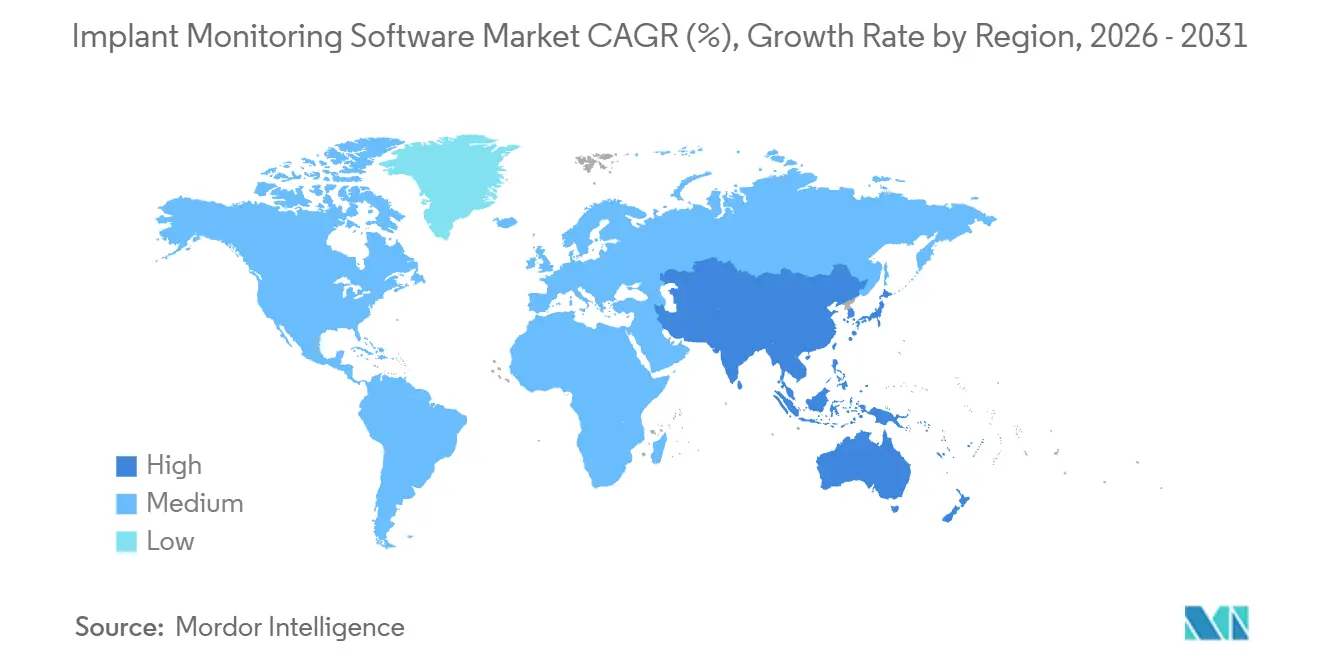
APAC, MEA and South America Implant Monitoring Software Market
Asia-Pacific is forecast to grow at a 12.7% CAGR through 2031. China has a large aging cardiovascular population and public hospitals are increasing their use of digital health infrastructure. India is identified in the supplied material as the fastest-growing country in the region for heart failure software adoption, supported by healthcare infrastructure, private hospital investment, and telehealth policy. Japan’s regulatory environment is relevant to software updates for medical devices, while South Korea and Australia are comparatively mature regional settings. The Middle East, South America, and Africa remain earlier-stage adoption areas in the implant monitoring software market. Brazil and Argentina have institutional capacity for CIED monitoring, but public reimbursement remains limited. GCC states are investing in tertiary cardiac centers, creating an emerging customer base for enterprise CIED platforms.

Competitive Landscape
The implant monitoring software market is moderately concentrated at the platform level. Device manufacturers hold a large combined position through their own monitoring portals, while vendor-neutral specialists are gaining ground in multi-manufacturer care settings. Manufacturer-affiliated platforms retain an advantage because they have direct access to device telemetry and established programming workflows. Independent providers compete by giving clinics one workflow across several device brands. Vector Remote Care states that its unified platform can reduce transmission review time by 92%. Implicity’s EVIDENCE-RM study used France’s national health data system and reported improved outcomes and cost results for its universal monitoring approach compared with manufacturer-specific systems.
Incumbents are adding AI features to established monitoring systems. BIOTRONIK’s 2025 LiveSupport clinical publication reported 38,943 remote programming sessions involving 555 unique users. The company launched Embrace One Proactive Intelligence for spinal cord stimulation patients in July 2026, extending its data-driven approach beyond cardiac devices. In June 2026, Medtronic introduced the GAiTEWAY platform to connect AI-supported surgical planning, clinical insights, and postoperative analytics across its AiBLE spine ecosystem. These moves show that implant monitoring is extending into surgical and non-cardiac workflows. They also indicate that larger companies are using their installed device bases to introduce software across several care stages.
Non-cardiac monitoring remains an area with room for further development. Canary Medical and NanoHive Medical announced a partnership in April 2026 to develop AI-enabled smart spinal cages, extending Canary’s sensing approach beyond knee replacement. Neuromodulation, metabolic, and spinal workflows do not yet have the same mature software coverage as CIEDs. The competitive opportunity is therefore not limited to adding features within cardiac monitoring. It also involves connecting data across implant types and supporting care teams with different workflows. This supports a competitive environment in which manufacturers have scale advantages, but specialized providers can still differentiate through interoperability, clinical workflow, and alert management.
Recent Industry Developments in Implant Monitoring Software Market
- July 2026: : BIOTRONIK Neuro launched Embrace One Proactive Intelligence, an AI capability for its Prospera Spinal Cord Stimulation system that analyses over 200 daily patient data points to proactively identify patients requiring therapy optimization.
- May 2026: Octagos launched Ask Atlas, the first AI tool designed to allow cardiac device clinics to query their own remote monitoring data in natural language, converting static transmission reports into real-time population-level clinical intelligence.
- March 2026: CVRx presented outcomes from the REBALANCE Registry at THT 2026, showing improvements in left ventricular ejection fraction from a mean 26.8% to 29.9% at six months in Barostim-implanted HFrEF patients.
- February 2026: Abbott received FDA approval for the CardioMEMS HERO Device, a next-generation pulmonary artery pressure reader with simplified patient setup, designed to improve consistency of daily hemodynamic data collection for heart failure management.


Global Implant Monitoring Software Market Report Scope
| Manufacturer-Native Monitoring Platforms |
| Vendor-Neutral CIED Management Platforms |
| Orthopedic Implant Recovery and Activity Analytics Platforms |
| Implantable Hemodynamic and Specialty-Monitoring Platforms |
| Post-Implant Care-Management and Real-World-Evidence Platforms |
| Post-Market Surveillance and Implant-Vigilance Software |
| Implantable Cardiac Electronic Devices |
| Insertable and Implantable Loop Recorders |
| Implantable Hemodynamic Sensors |
| Sensorized Orthopedic Implants |
| Implantable Glucose and Metabolic Monitors |
| Implantable Neuromodulation and Neuromonitoring Devices |
| Arrhythmia, Battery, and Lead Surveillance |
| Heart-Failure and Hemodynamic Monitoring |
| Post-Implant Recovery and Functional-Mobility Monitoring |
| Chronic Disease and Physiologic Monitoring |
| Remote Programming, Interrogation, and Follow-Up |
| Patient Connectivity, Engagement, and Adherence |
| Billing, Reimbursement, and Clinic Workflow Management |
| Post-Market Safety, Recall, and Performance Surveillance |
| Hospitals and Academic Medical Centers |
| Specialty and Device Clinics |
| Ambulatory Surgery Centers |
| Home Healthcare Providers |
| Implant Manufacturers and Clinical-Operations Teams |
| Research Organizations and Contract Research Organizations |
| Cloud-Based Software as a Service |
| On-Premise and Private-Cloud Deployments |
| Hybrid Deployments |
| North America | United States |
| Canada | |
| Mexico | |
| Europe | Germany |
| United Kingdom | |
| France | |
| Italy | |
| Spain | |
| Rest of Europe | |
| Asia-Pacific | China |
| Japan | |
| India | |
| Australia | |
| South Korea | |
| Rest of Asia-Pacific | |
| Middle East | GCC |
| South Africa | |
| Rest of Middle East and Africa | |
| South America | Brazil |
| Argentina | |
| Rest of South America |
| By Product Type | Manufacturer-Native Monitoring Platforms | |
| Vendor-Neutral CIED Management Platforms | ||
| Orthopedic Implant Recovery and Activity Analytics Platforms | ||
| Implantable Hemodynamic and Specialty-Monitoring Platforms | ||
| Post-Implant Care-Management and Real-World-Evidence Platforms | ||
| Post-Market Surveillance and Implant-Vigilance Software | ||
| By Monitoring Modality | Implantable Cardiac Electronic Devices | |
| Insertable and Implantable Loop Recorders | ||
| Implantable Hemodynamic Sensors | ||
| Sensorized Orthopedic Implants | ||
| Implantable Glucose and Metabolic Monitors | ||
| Implantable Neuromodulation and Neuromonitoring Devices | ||
| By Application | Arrhythmia, Battery, and Lead Surveillance | |
| Heart-Failure and Hemodynamic Monitoring | ||
| Post-Implant Recovery and Functional-Mobility Monitoring | ||
| Chronic Disease and Physiologic Monitoring | ||
| Remote Programming, Interrogation, and Follow-Up | ||
| Patient Connectivity, Engagement, and Adherence | ||
| Billing, Reimbursement, and Clinic Workflow Management | ||
| Post-Market Safety, Recall, and Performance Surveillance | ||
| By End User | Hospitals and Academic Medical Centers | |
| Specialty and Device Clinics | ||
| Ambulatory Surgery Centers | ||
| Home Healthcare Providers | ||
| Implant Manufacturers and Clinical-Operations Teams | ||
| Research Organizations and Contract Research Organizations | ||
| By Deployment Model | Cloud-Based Software as a Service | |
| On-Premise and Private-Cloud Deployments | ||
| Hybrid Deployments | ||
| By Geography | North America | United States |
| Canada | ||
| Mexico | ||
| Europe | Germany | |
| United Kingdom | ||
| France | ||
| Italy | ||
| Spain | ||
| Rest of Europe | ||
| Asia-Pacific | China | |
| Japan | ||
| India | ||
| Australia | ||
| South Korea | ||
| Rest of Asia-Pacific | ||
| Middle East | GCC | |
| South Africa | ||
| Rest of Middle East and Africa | ||
| South America | Brazil | |
| Argentina | ||
| Rest of South America | ||


Key Questions Answered in the Report
What is driving demand for implant monitoring software?
Growing cardiac implant volumes, remote follow-up needs, and the need to manage large volumes of device data are driving demand. The category is forecast to grow at an 11.1% CAGR from 2026 to 2031.
Which product category held the largest position in 2025?
Manufacturer-native monitoring platforms led product types with 42.3% share in 2025, supported by direct telemetry access and established clinical workflows.
Which monitoring modality is growing fastest?
Implantable hemodynamic sensors are forecast to grow at a 12.1% CAGR through 2031, supported by pressure-guided heart failure management and evidence-development requirements.
Why is heart failure monitoring important for connected implants?
Heart failure and hemodynamic monitoring is the fastest-growing application, with a 12.8% forecast CAGR through 2031. It supports earlier action on pressure and multiparametric data.
Which end users are expanding use most quickly?
Home healthcare providers are projected to grow at a 12.2% CAGR through 2031 as care shifts toward monitoring patients between in-person visits.
What challenges affect adoption of implant monitoring platforms?
Cybersecurity obligations, data privacy requirements, alert fatigue, and uneven reimbursement can slow adoption, particularly outside established remote-care funding systems.
Page last updated on:





