
Immersive OTT Market Size and Share
Market Overview
| Study Period | 2020 - 2031 |
|---|---|
| Market Size (2026) | USD 6.90 Billion |
| Market Size (2031) | USD 15.01 Billion |
| Growth Rate (2026 - 2031) | 16.81 % |
| Fastest Growing Market | Asia-Pacific |
| Largest Market | North America |
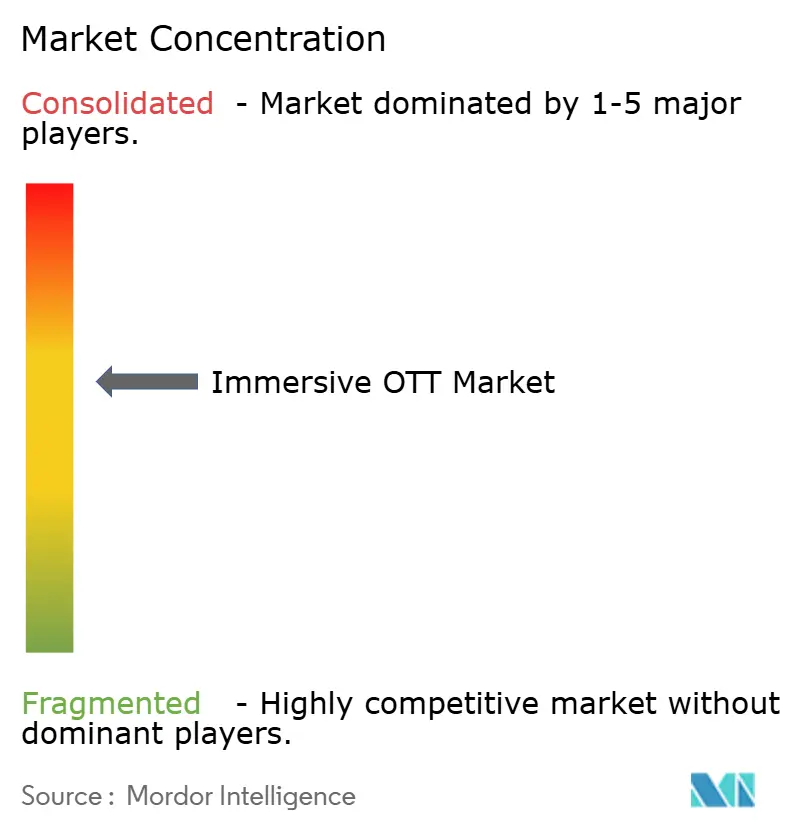
| Market Concentration | Medium |
Major Players *Disclaimer: Major Players sorted in no particular order Image © Mordor Intelligence. Reuse requires attribution under CC BY 4.0. | |
Immersive OTT Market Analysis by Mordor Intelligence
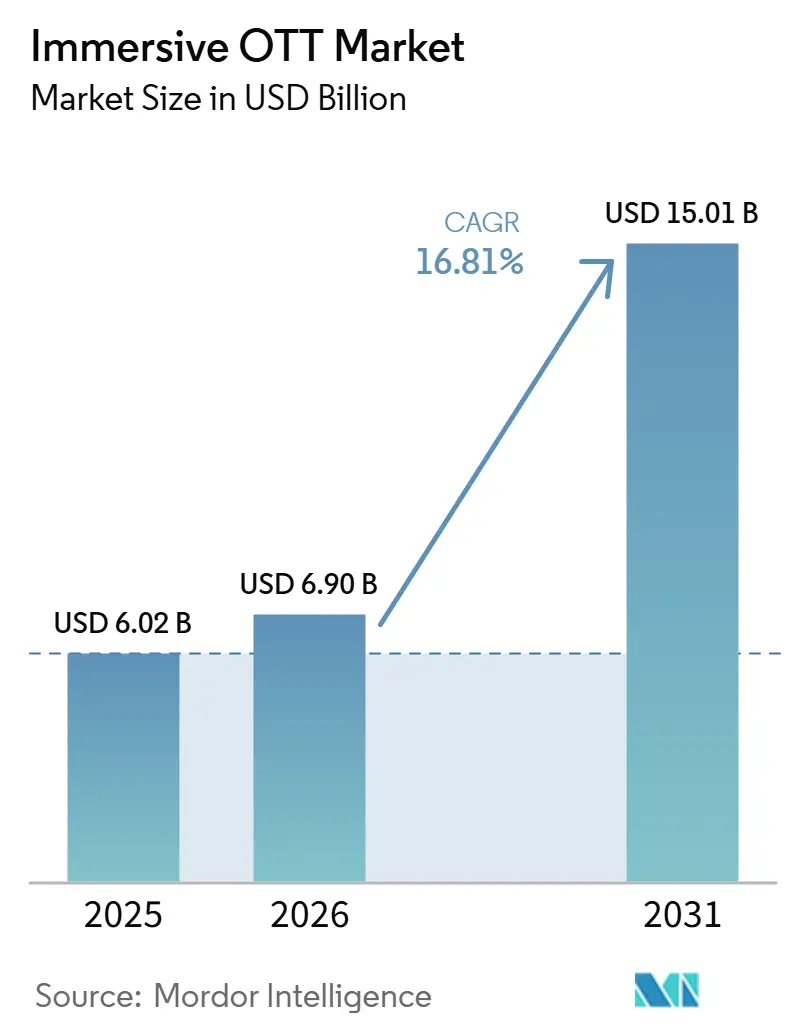
The immersive OTT market size is expected to increase from USD 6.02 billion in 2025 to USD 6.90 billion in 2026 and reach USD 15.01 billion by 2031, growing at a CAGR of 16.81% over 2026-2031. Growth is being shaped by a steady move away from passive flat-screen viewing toward spatial and presence-based entertainment that gives audiences more control over how they watch. Live sports, concerts, and other event-led formats are pulling the category forward because they give platforms a clear reason to package premium access in a format that feels different from conventional streaming. Better 5G and fiber performance, along with more capable adaptive streaming tools, are also making high-bitrate immersive delivery more practical across major markets. Hybrid monetization is becoming more important as subscription models remain the base while ad-supported and event-based options broaden reach and improve conversion paths. The market still faces limits from mainstream viewing habits, fragmented playback environments, and the cost of immersive production, yet competition remains active because platforms, device ecosystems, and infrastructure providers all see room to build durable positions.
Key Report Takeaways
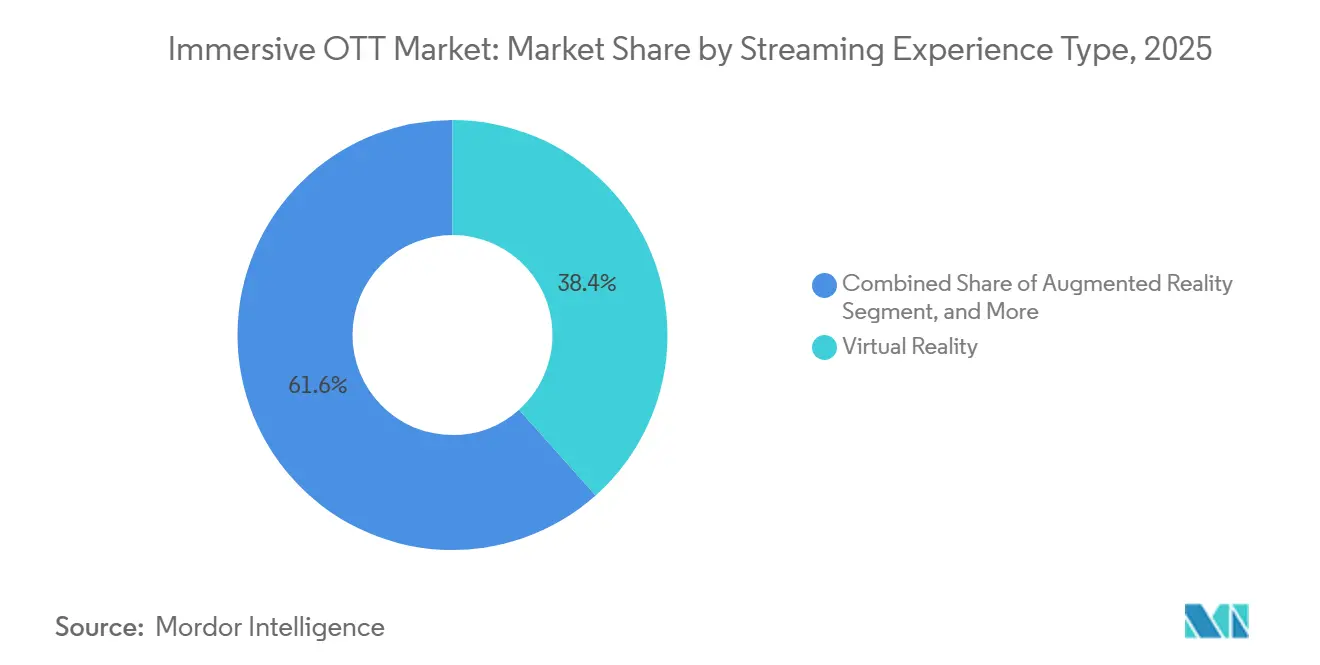
- By streaming experience type, virtual reality held 38.41% of the total share of the immersive OTT market in 2025, while mixed reality is projected to expand at a CAGR of 17.55% through 2031.
- By revenue model, Subscription Video on Demand (SVOD) held 43.73% of the share in 2025, while Advertising Supported Streaming (AVOD) is projected to expand at a CAGR of 17.32% through 2031.
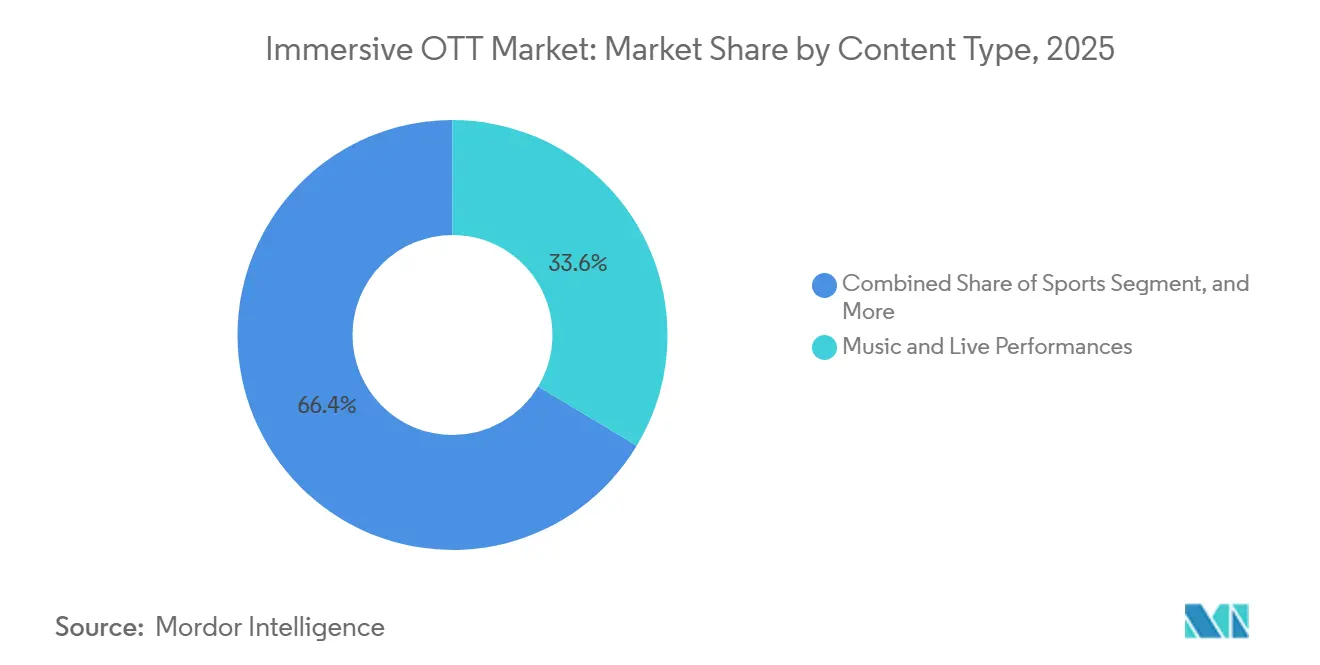
- By content type, Music and Live Performances accounted for 33.62% of the share in 2025, while Sports is projected to expand at a CAGR of 17.48% through 2031.
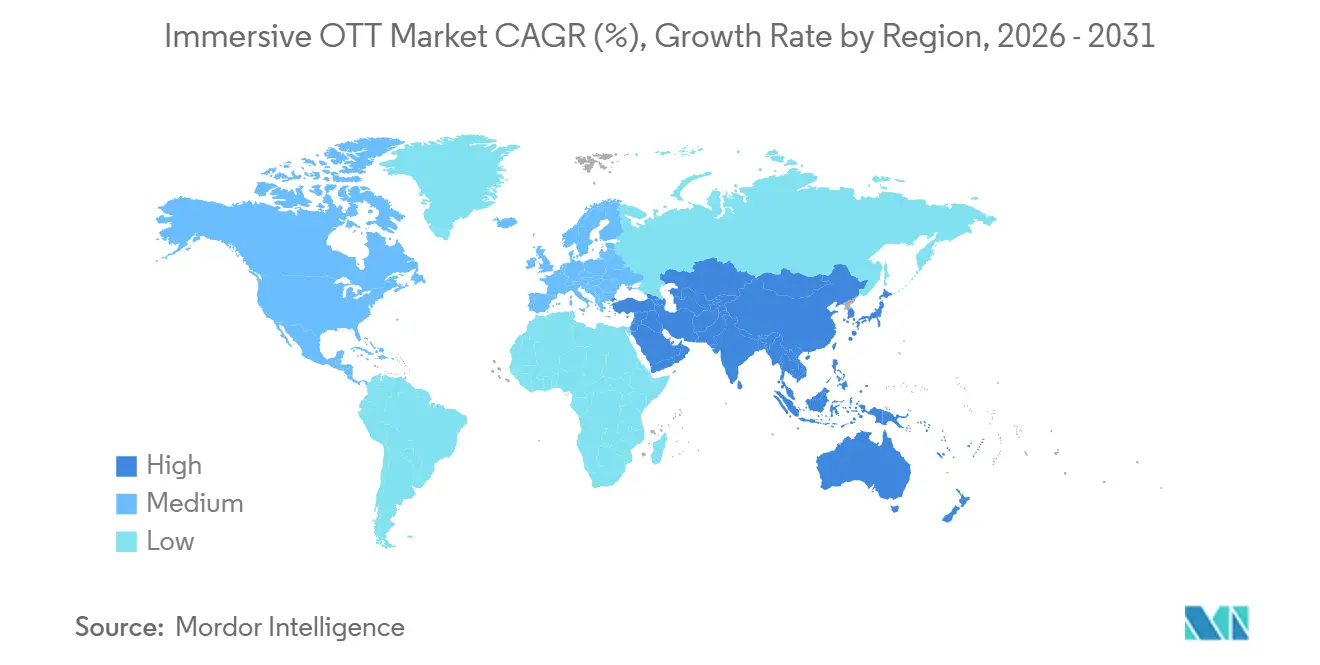
- By geography, North America held 37.49% share of the immersive over-the-top (OTT) market in 2025, while the Asia-Pacific is projected to expand at a CAGR of 17.61% through 2031.
Note: Market size and forecast figures in this report are generated using Mordor Intelligence’s proprietary estimation framework, updated with the latest available data and insights as of January 2026.
Global Immersive OTT Market Trends and Insights
Drivers Impact Analysis*
| Driver | (~) % Impact on CAGR Forecast | Geographic Relevance | Impact Timeline |
|---|---|---|---|
| Growth in VR-Ready Devices and Head-Mounted Displays | +3.2% | Global, led by North America and Asia-Pacific | Medium term (2-4 years) |
| Rising Demand for Sports and Live Event Immersion | +2.5% | Global, with North America and Asia-Pacific leading | Medium term (2-4 years) |
| Expansion of Spatial Audio and Multi-Angle Playback Features | +1.8% | Global, early gains in North America and Europe | Short term (≤ 2 years) |
| Improved 5G and Fiber Latency for High-Bitrate Immersive Streams | +2.3% | Asia-Pacific and Europe, spill-over to Middle East and South America | Medium term (2-4 years) |
| Premium Monetization Through Interactive and Immersive Ad Formats | +2.0% | North America and Europe, with Asia-Pacific expanding | Short term (≤ 2 years) |
| Rising Creator and Studio Adoption of 360-Degree Production Pipelines | +1.5% | North America, spill-over to Europe and Asia-Pacific | Long term (≥ 4 years) |
| Source: Mordor Intelligence | |||
Growth of VR-Ready Connected Devices and Head-Mounted Displays
Device availability remains a basic adoption gate for the immersive OTT market. The January 2026 launch of Spectrum Front Row on Apple Vision Pro showed that major distributors were ready to treat spatial computing hardware as a direct entertainment endpoint rather than a side experiment. Dolby also announced broader premium playback support across Peacock’s live sports portfolio in 2026, which reinforced the link between advanced devices and higher-value immersive viewing environments.[1]Dolby Laboratories, “Dolby Vision and Dolby Atmos to Power Telemundo’s FIFA World Cup 2026 Coverage on Peacock, a Streaming First,” Dolby Newsroom, dolby.com In the immersive OTT market, the key point is that content services and device ecosystems are now moving in the same direction, reducing hesitation on both sides of the value chain. Platforms that adapt experiences for full headsets and lighter spatial-viewing formats should be better positioned to expand reach without sacrificing premium positioning.
Rising Demand for Sports and Live Event Immersion
Live sports have become one of the clearest demand catalysts in the immersive OTT market. Spectrum and Apple launched live Los Angeles Lakers games on Apple Immersive in January 2026, featuring a seven-angle feed and spatial audio, demonstrating how premium rights can be packaged as a differentiated viewing product rather than a simple screen extension. Dolby and NBCUniversal then announced that Peacock would carry all 104 FIFA World Cup 2026 matches in Dolby Vision and Dolby Atmos using Dolby AC-4, which confirmed that major global events were becoming proving grounds for high-end immersive delivery. In the immersive OTT market, those moves matter because appointment viewing is more likely to convert users when access feels exclusive, technically superior, and tied to content that fans already follow closely. The same logic also creates room for broader rights packaging, branded integrations, and premium replays that extend revenue beyond the live window.
Improved 5G and Fiber Latency for High-Bitrate Immersive Streams
Network quality is no longer the same bottleneck it was in earlier immersive streaming pilots, which supports the immersive OTT market. Academic research on low-latency immersive delivery found that modern 5G environments can operate well below the latency levels that make headset viewing uncomfortable, strengthening the practical case for real-time spatial video sessions. A 2026 study from the University of Strathclyde showed that AI foundation model frameworks for 360-degree adaptive streaming reduced the mean angular viewport prediction error by 34% and lowered bandwidth violation rates from 8.3% to 3.1%, indicating that software gains reinforce network gains. Ericsson also completed a live 6G pre-standard trial in Texas in February 2026 and linked the effort directly to real-time video streaming, while Ericsson, Nokia, and Fraunhofer HHI had already moved on to immersive video coding work in late 2025. In the immersive OTT market, this creates a useful window in which delivery capability is improving fast enough to support more ambitious content and monetization choices before immersive libraries fully scale.
Premium Monetization Through Interactive and Immersive Ad Formats
Monetization is expanding beyond subscription-only models, which is important for the immersive OTT market. Spectrum Front Row used multiple camera angles and spatial audio in a premium sports setting, demonstrating how immersive interfaces can support sponsorship, commerce prompts, and branded moments without replicating flat-screen ad design. Dolby’s work on premium live sports delivery also supports this shift, as better picture and audio quality create a stronger environment for premium placements and event-based partnerships. In the immersive OTT market, which expands revenue options at a time when audiences are more selective about adding subscriptions. Platforms that build immersive inventory around user comfort, clear attribution, and event relevance are likely to convert brand demand more steadily than platforms that simply transplant standard video units into spatial screens.
Restraints Impact Analysis*
| Restraint | (~) % Impact on CAGR Forecast | Geographic Relevance | Impact Timeline |
|---|---|---|---|
| Limited Mainstream Consumer Willingness to Use Headsets for Long Viewing Sessions | -2.2% | Global, most acute in emerging markets | Medium term (2-4 years) |
| High Bandwidth, Encoding, and Content Production Costs | -1.8% | Africa and South America most affected, Global | Long term (≥ 4 years) |
| Fragmented Device and Player Compatibility Across Immersive Formats | -1.3% | Global | Short term (≤ 2 years) |
| Unclear Measurement Standards for Immersive Engagement and Ad Attribution | -0.9% | North America and Europe | Medium term (2-4 years) |
| Source: Mordor Intelligence | |||
Limited Mainstream Consumer Willingness to Use Headsets for Long Viewing Sessions
Long viewing comfort remains a real ceiling for the immersive OTT market. The strongest commercial launches in 2026 were still concentrated around premium events and devices, suggesting that mainstream viewing habits have not yet shifted fully toward extended headset-based sessions. Content companies are also testing shared and location-based formats, and iQIYI’s 2026 launch of an immersive indoor theme park shows that part of the demand is being built outside traditional at-home long-form headset use. For the immersive OTT market, that means the path to scale is still tied to how comfortably platforms can blend short-form engagement, social features, and lighter-touch viewing modes. Providers that assume consumers will immediately replace standard long-form streaming with fully enclosed sessions may find audience growth slower than expected.
High Bandwidth, Encoding, and Content Production Costs
The immersive OTT market still carries a heavier technical cost burden than conventional streaming. Research published in the IEEE Transactions on Broadcasting in 2026 found that tile-based 360-degree transmission systems can still waste up to 30% of available bandwidth on pre-fetched tiles outside the active viewport, underscoring the ongoing challenge of distribution efficiency.[2]“NSGR: A Tile-Free 360-Degree Video LIVE System With Edge Servers Enhancing Viewport Quality,” IEEE Transactions on Broadcasting, doi.org The University of Strathclyde research also showed that better viewport prediction materially reduces streaming inefficiency, but the need for those gains confirms that high-quality immersive delivery still demands more careful optimization than flat video. Ericsson, Nokia, and Fraunhofer HHI moved into 6G-era coding standardization in 2025 for the same reason, since compression efficiency is becoming central to the economics of future immersive media delivery. In the immersive OTT market, these cost and efficiency issues still favor well-capitalized operators and can slow content diversity, as network quality and edge distribution remain less mature.
*Our forecasts treat driver/restraint impacts as directional, not additive. The impact forecasts reflect baseline growth, mix effects, and variable interactions.
Segment Analysis
By Streaming Experience Type: VR Leads While MR Builds Scale
Virtual Reality held 38.41% of the immersive OTT market share within the streaming experience type in 2025, reflecting the deepest content library and the most established user behavior among immersive formats. In the immersive OTT market, VR remained the clearest fit for concerts, sports highlights, and short-form narrative experiences because producers already understand how to build around fully enclosed viewing sessions. Augmented Reality maintained a smaller footprint while continuing to support overlay-led use cases that connect immersive elements with more familiar video behavior. Other formats, including browser-based 360-degree video, still mattered because they lowered entry barriers for viewers who did not own dedicated hardware.
Mixed Reality is projected to grow at a CAGR of 17.55%, the fastest pace in the immersive OTT market size outlook for streaming experience formats through 2031. In the immersive OTT market, MR stands out because it does not rely on replacing the physical environment entirely; instead, it supports overlays, co-viewing, and interactive touchpoints that fit longer entertainment sessions more naturally. Apple and Spectrum’s immersive Lakers service showed how live viewing can be enriched with more dynamic presentation layers, camera choice, and spatial context rather than simple passive playback. iQIYI’s immersive indoor theme park launch also showed that content companies are building audience familiarity with mixed physical-digital entertainment, which should help the segment scale over time



By Revenue Model: SVOD Anchors While AVOD Broadens Access
Subscription Video on Demand accounted for 43.73% of revenue in 2025, making it the primary revenue driver for the immersive OTT market across closed device ecosystems and premium content libraries. In the immersive OTT market, SVOD works well because users who buy into a hardware ecosystem are more likely to accept recurring payment when content access, playback quality, and app distribution are tightly linked. Transactional and pay-per-view options also remained relevant for special events where a single experience can justify a separate purchase. Freemium and hybrid structures gained attention because platforms need more ways to reduce acquisition friction as immersive viewing expands beyond early adopters.
Advertising-supported streaming is projected to grow at a 17.32% CAGR, making it the fastest-growing immersive over-the-top (OTT) market segment by revenue through 2031. The immersive OTT industry is moving in that direction because audiences are becoming more selective about stacked subscriptions while platforms still need a scalable entry layer for new users. Premium sports launches on Apple Vision Pro and broader premium playback support on Peacock show that platforms can package high-value experiences in ways that support both paid access and richer sponsorship opportunities. That matters in the immersive OTT market because ad-supported growth is more likely to hold when immersive placements feel native to the experience rather than borrowed from standard video interfaces.
By Content Type: Music Leads While Sports Gains Speed
Music and Live Performances accounted for 33.62% of the market share in 2025, keeping them at the center of the immersive OTT market, as spatial audio and performance viewing work together naturally. In the immersive OTT market, music is easier to adapt to immersive formats than many scripted categories, because sound design alone can elevate the experience even when visual complexity remains manageable. Dolby and QQ Music announced enhancements to Dolby AC-4 for music streaming in March 2026, which showed that immersive audio delivery at scale is still advancing across mainstream listening platforms. Education and training, branded experiences, and social events also remained important because they diversify revenue and reduce dependence on a single entertainment use case.
Sports is projected to grow at a CAGR of 17.48%, placing it at the forefront of the immersive OTT market size outlook for content categories through 2031. The immersive OTT industry is especially responsive to sports because rights holders can leverage immersive access to add value without relying on additional physical seating capacity. Peacock’s FIFA World Cup 2026 coverage in Dolby Vision and Dolby Atmos using Dolby AC-4, along with Spectrum Front Row’s live Lakers deployment, showed that leading events are already being used to test premium immersive distribution at scale. In the immersive OTT market, sports offer a stronger growth path than most categories because fans already accept time-sensitive viewing, premium packaging, and multi-angle engagement.
Geography Analysis
North America held 37.49% of the immersive OTT market share in 2025, making it the largest regional base. The region benefited from a strong mix of device access, premium broadband, and content owners willing to turn sports rights into technology-led viewing experiences. Spectrum and Apple’s January 2026 launch of immersive Lakers coverage showed how North American operators were converting premium local rights into a differentiated spatial streaming proposition. Dolby and NBCUniversal’s World Cup 2026 announcement also reinforced the region’s role as a commercial testbed for picture, sound, and codec upgrades that support the immersive OTT market at scale.
Asia-Pacific is projected to expand at a CAGR of 17.61%, making it the fastest-growing immersive OTT market among all regions through 2031. China Daily reported that China had 280 million VR film users in 2025, with domestic viewers accounting for 42% of the global total, indicating a very large audience base for the immersive OTT market. China’s National Film Administration also issued the first national guideline for VR film production and screening in 2026, which matters because clearer production rules can support broader content pipelines. iQIYI’s launch of an immersive indoor theme park in February 2026 showed that large Asian streaming companies are extending IP into spatial formats beyond app-based viewing alone. Europe remained important to the immersive OTT market for a different reason, since Ericsson, Nokia, and Fraunhofer HHI were helping shape the coding and standards work that future immersive video delivery will depend on.
The Middle East, Africa, and South America still form the emerging edge of the immersive OTT market, where growth depends more on access models and network readiness than on deep existing libraries. Comcast Technology Solutions reported that the Middle East and North Africa streaming market surpassed USD 1.5 billion in 2025, which supports the broader case for premium digital video expansion across the region.[3]Comcast Technology Solutions, “SVOD Growth to Take MENA Streaming Market Past USD 1.5 Billion in 2025,” Comcast Technology Solutions, comcasttechnologysolutions.com In South America, the immersive OTT market is likely to expand first through selective urban corridors and event-led formats where network quality can support higher-value use cases. In Africa, lower-bitrate, mobile-first immersive pathways are more likely to drive adoption than hardware-heavy models, suggesting regional progress will likely come from careful format adaptation rather than direct replication of North American launches.

Competitive Landscape
The immersive OTT market remains moderately concentrated because no single company controls hardware, rights, delivery, and monetization across the full chain. The strongest positions sit with companies that can connect premium content access to a defined playback environment, which is why Apple, leading streaming services, and enabling technology vendors all influence outcomes in the immersive OTT market in different ways. Spectrum and Apple’s immersive Lakers launch was a clear strategic move because it tied regional sports rights to a proprietary device experience and turned playback quality into a competitive feature. Dolby and NBCUniversal made a similar move at a different layer of the stack by linking premium live sports coverage to Dolby Vision, Dolby Atmos, and Dolby AC-4, thereby strengthening standards-led differentiation in the immersive OTT market.
Competition in the immersive OTT market is also being shaped by who can reduce technical friction without weakening the experience. The University of Strathclyde's research on AI-based adaptive streaming showed that better viewport prediction can meaningfully reduce inefficiency, turning delivery intelligence into a practical competitive lever rather than a background engineering issue.[4]S. Watthage and A. S. Fernando, “ImmerseFM-3D: A Foundation Model Framework for Generalizable 360-Degree Video Streaming With Cross-Modal Scene Understanding,” University of Strathclyde, strathprints.strath.ac.uk IEEE research on bandwidth waste in tile-based 360-degree systems reaches the same conclusion; platforms that manage cost and quality more efficiently should defend margins better as the immersive OTT market scales. iQIYI’s 2026 theme park launch added another strategic pattern by extending a streaming company’s IP into spatial entertainment spaces that can build habit, brand familiarity, and future content demand. That kind of move matters in the immersive OTT market because audience development is still being shaped by experience design as much as by catalog depth.
The next layer of rivalry in the immersive over-the-top (OTT) market will depend on standards, interoperability, and the ability to support multiple viewing paths from the same content base. Ericsson, Nokia, and Fraunhofer HHI’s work on 6G-era video coding shows that infrastructure players continue to shape the economic rules under which immersive platforms will compete. Dolby’s licensing position in premium audio and video formats also gives it a structural role because high-end immersive playback depends on more than content ownership alone. As a result, the immersive OTT market is likely to reward companies that combine rights strategy, standards compliance, and delivery efficiency more consistently than companies that rely on any single advantage.
Immersive OTT Industry Leaders
Netflix, Inc.
The Walt Disney Company
Amazon.com, Inc.
Alphabet Inc.
Meta Platforms, Inc.
- *Disclaimer: Major Players sorted in no particular order

Recent Industry Developments
- June 2026: Dolby Laboratories and NBCUniversal announced that Peacock would stream all 104 FIFA World Cup 2026 matches in Dolby Vision and Dolby Atmos using Dolby AC-4, marking the first commercial deployment of the next-generation audio codec by a video streaming platform. Dolby AC-4 delivers Dolby Atmos at 50% greater coding efficiency than traditional codecs, a development with significant implications for immersive streaming bandwidth economics.
- March 2026: Dolby Laboratories and QQ Music (Tencent Music Entertainment) announced an enhancement to Dolby AC-4 on the QQ Music mobile app, making it the first major music streaming platform to support the latest Dolby AC-4 advancements for immersive audio delivery at scale.
- February 2026: iQIYI opened iQIYI LAND, China’s first immersive indoor theme park developed by a streaming platform, in Yangzhou, covering approximately 10,000 square meters and integrating VR, AR, and AI with Chinese IP. Two additional parks in Kaifeng and Beijing are in development for the remainder of 2026.
- February 2026: Ericsson completed the world’s first 6G pre-standard over-the-air session in Texas, targeting real-time video streaming as a primary application. The trial demonstrated the low-latency, high-uplink capacity characteristics required for commercial-scale immersive streaming in the post-5G era.


Global Immersive OTT Market Report Scope
The Immersive OTT Market comprises over-the-top (OTT) streaming platforms, technologies, and services that deliver interactive, immersive digital experiences over the internet, leveraging virtual reality (VR), augmented reality (AR), and mixed reality (MR). These platforms enable users to engage with immersive video, live events, educational content, branded experiences, and interactive entertainment via internet-connected devices, providing enhanced presence, interactivity, and user engagement beyond conventional video streaming.
The Immersive OTT Market Report is Segmented by Streaming Experience Type (Virtual Reality, Augmented Reality, Mixed Reality, Other Streaming Experience Type), Revenue Model (Subscription Video on Demand (SVOD), Advertising Supported Streaming (AVOD), Transactional and Pay-Per-View (TVOD), Hybrid Monetization, and Freemium), Content Type (Music and Live Performances, Sports, Education and Training, Branded Experiences, and Advertising, and Other Content Types), and Geography (North America, Europe, Asia-Pacific, Middle East, Africa, and South America). The Market Forecasts are Provided in Terms of Value (USD).
| Virtual Reality |
| Augmented Reality |
| Mixed Reality |
| Other Streaming Experience Type |
| Subscription Video on Demand (SVOD) |
| Advertising Supported Streaming (AVOD) |
| Transactional and Pay-Per-View (TVOD) |
| Hybrid Monetization |
| Freemium |
| Music and Live Performances |
| Sports |
| Education and Training |
| Branded Experiences, brand events and Advertising |
| Social and Community Events |
| Other Content Types |
| North America | United States |
| Canada | |
| Mexico | |
| Europe | Germany |
| United Kingdom | |
| France | |
| Russia | |
| Rest of Europe | |
| Asia-Pacific | China |
| Japan | |
| India | |
| South Korea | |
| Australia | |
| Rest of Asia-Pacific | |
| Middle East | Saudi Arabia |
| United Arab Emirates | |
| Turkey | |
| Rest of Middle East | |
| Africa | South Africa |
| Egypt | |
| Nigeria | |
| Rest of Africa | |
| South America | Brazil |
| Argentina | |
| Rest of South America |
| By Streaming Experience Type | Virtual Reality | |
| Augmented Reality | ||
| Mixed Reality | ||
| Other Streaming Experience Type | ||
| By Revenue Model | Subscription Video on Demand (SVOD) | |
| Advertising Supported Streaming (AVOD) | ||
| Transactional and Pay-Per-View (TVOD) | ||
| Hybrid Monetization | ||
| Freemium | ||
| By Content Type | Music and Live Performances | |
| Sports | ||
| Education and Training | ||
| Branded Experiences, brand events and Advertising | ||
| Social and Community Events | ||
| Other Content Types | ||
| By Geography | North America | United States |
| Canada | ||
| Mexico | ||
| Europe | Germany | |
| United Kingdom | ||
| France | ||
| Russia | ||
| Rest of Europe | ||
| Asia-Pacific | China | |
| Japan | ||
| India | ||
| South Korea | ||
| Australia | ||
| Rest of Asia-Pacific | ||
| Middle East | Saudi Arabia | |
| United Arab Emirates | ||
| Turkey | ||
| Rest of Middle East | ||
| Africa | South Africa | |
| Egypt | ||
| Nigeria | ||
| Rest of Africa | ||
| South America | Brazil | |
| Argentina | ||
| Rest of South America | ||


Key Questions Answered in the Report
What is the current and forecast value of the immersive OTT space?
The immersive OTT market was valued at USD 6.02 billion in 2025, is estimated at USD 6.90 billion in 2026, and is projected to reach USD 15.01 billion by 2031 at a 16.81% CAGR.
Which region currently leads immersive OTT adoption?
North America led in 2025 with a 37.49% share, supported by premium broadband, device availability, and early immersive sports deployments.
Which region is expected to expand the fastest through 2031?
Asia-Pacific is projected to grow at a 17.61% CAGR through 2031, helped by regulatory support, large viewer bases, and expanding spatial entertainment formats.
Which streaming experience format is growing the fastest?
Mixed Reality is projected to record the fastest growth at a 17.55% CAGR, as it supports overlays, co-viewing, and interactive entertainment more naturally than fully enclosed formats alone.
Which revenue model is gaining momentum fastest?
Advertising Supported Streaming is projected to grow at a 17.32% CAGR, as platforms use lower-friction entry tiers and richer immersive placements to broaden reach.
Why is sports becoming so important for immersive streaming platforms?
Sports is projected to grow at a 17.48% CAGR because premium rights, live viewing urgency, and multi-angle presentation make immersive access easier to monetize than many other content formats.
Page last updated on:





