
Hyper-Personalization Marketing Services Market Size and Share
Market Overview
| Study Period | 2020 - 2031 |
|---|---|
| Market Size (2026) | USD 87.30 Billion |
| Market Size (2031) | USD 152.80 Billion |
| Growth Rate (2026 - 2031) | 11.85 % |
| Fastest Growing Market | Asia-Pacific |
| Largest Market | North America |
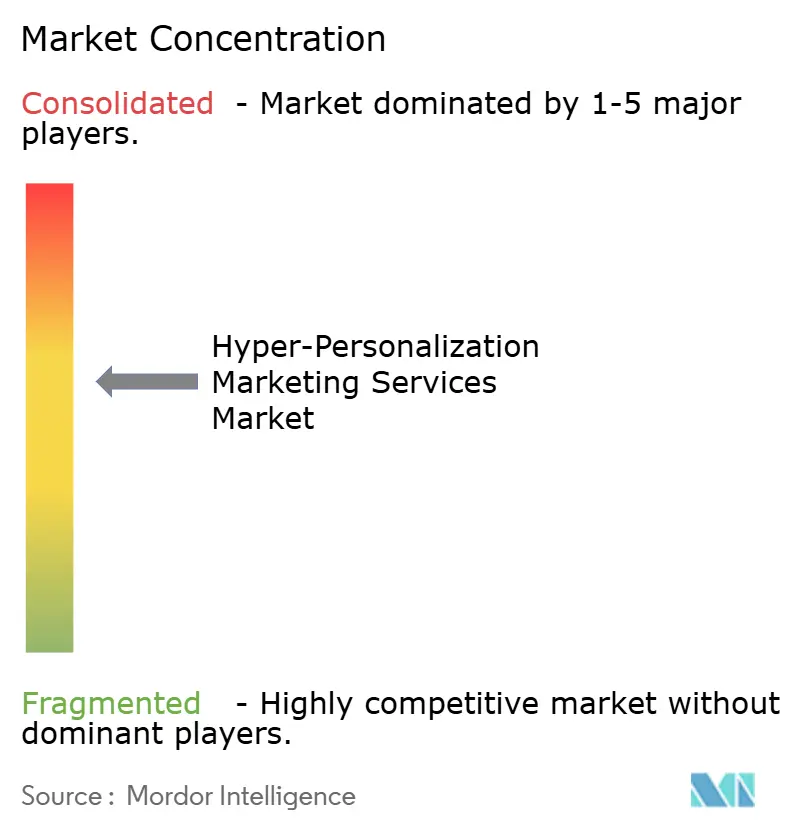
| Market Concentration | Medium |
Major Players *Disclaimer: Major Players sorted in no particular order Image © Mordor Intelligence. Reuse requires attribution under CC BY 4.0. | |
Hyper-Personalization Marketing Services Market Analysis by Mordor Intelligence
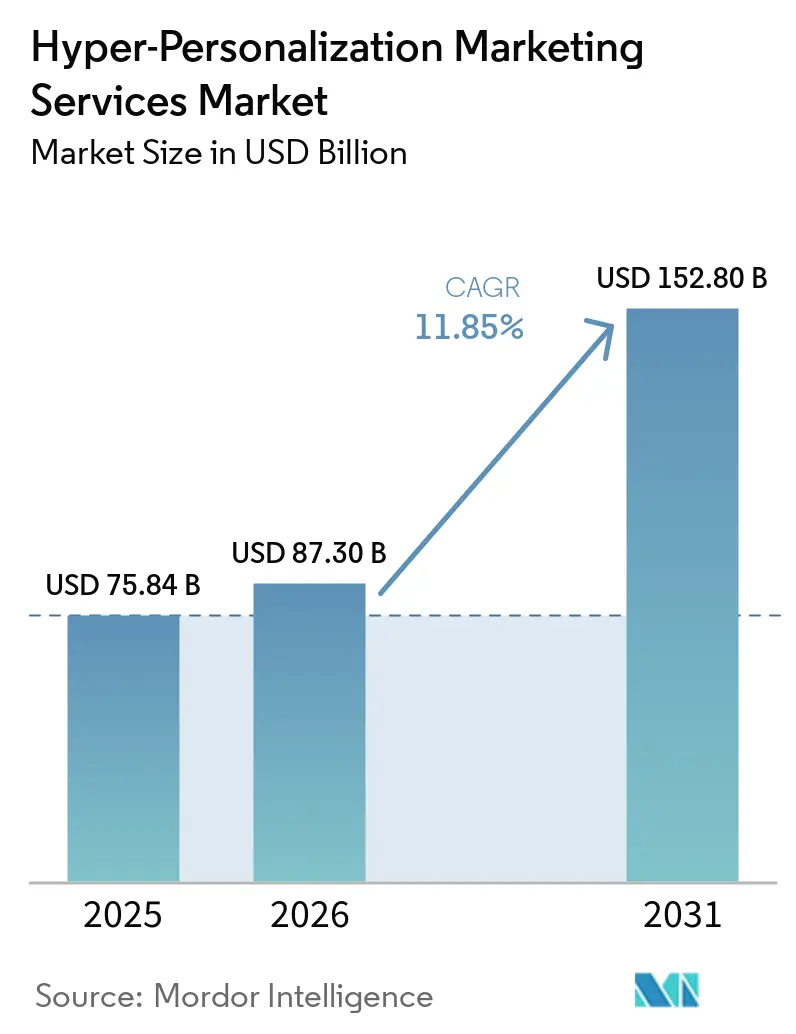
The hyper-personalization marketing services market size is expected to increase from USD 75.84 billion in 2025 to USD 87.30 billion in 2026 and reach USD 152.80 billion by 2031, registering a CAGR of 11.85% over 2026-2031. The hyper-personalization marketing services market is shifting from scheduled campaigns toward systems that select actions and messages from current customer signals. AI-driven personalization is making customer data, content, and channel delivery operate as a connected process rather than separate marketing tasks. Buyers are placing more value on governed data foundations because these systems support relevant engagement while meeting consent and residency requirements. Large platform providers are adding agent-based functions to established suites, while specialist vendors focus on flexible data connections and specific execution layers. Regulatory requirements in California and Europe are also making privacy controls, documentation, and risk reviews part of the service purchase decision.
Key Report Takeaways
- By service type, AI-Driven Recommendations and Decisioning held 24.54% share of the hyper-personalization marketing services market size in 2025 and is projected to expand at a 13.24% CAGR through 2031.
- By organization size, Large Enterprises held 69.71% share in 2025, while Small and Medium Enterprises are projected to expand at a 12.26% CAGR through 2031.
- By end-user industry, Retail and E-commerce held 29.39% share of the hyper-personalization marketing services market size in 2025, while Healthcare and Life Sciences is projected to expand at a 13.42% CAGR through 2031.
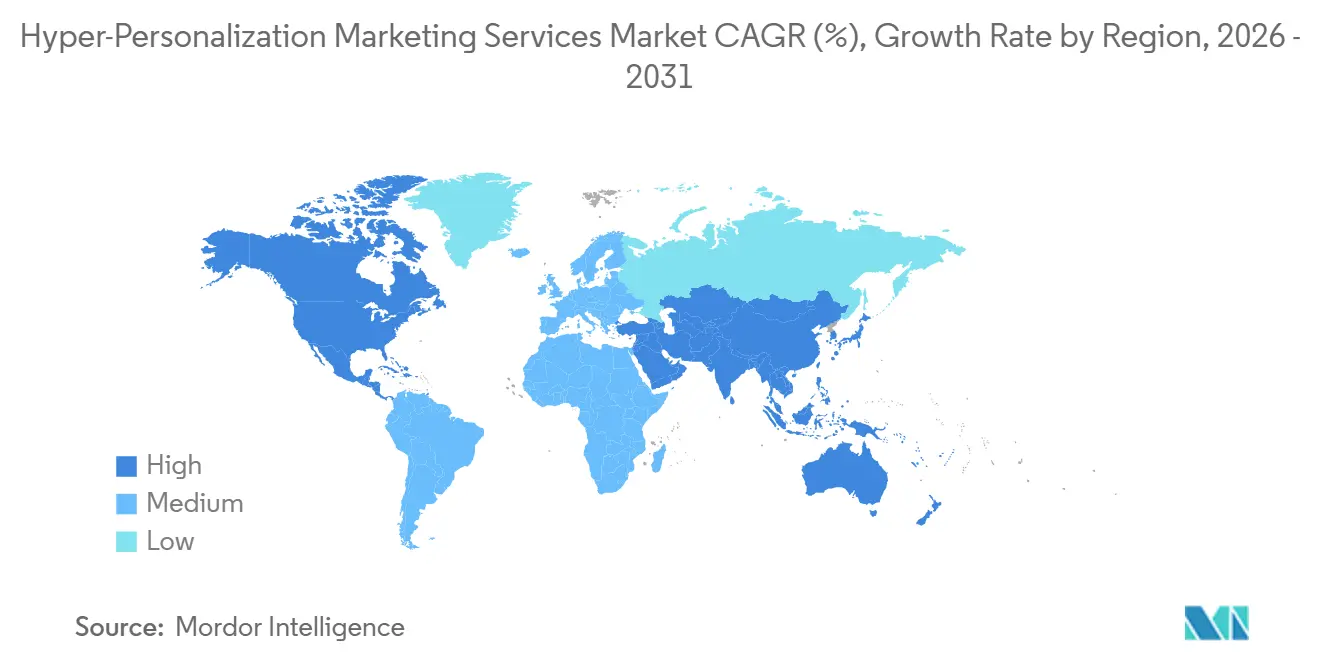
- By geography, North America held 38.53% share in 2025, while Asia-Pacific is projected to expand at a 12.87% CAGR through 2031.
Note: Market size and forecast figures in this report are generated using Mordor Intelligence’s proprietary estimation framework, updated with the latest available data and insights as of January 2026.
Market Trends and Insights
Drivers Impact Analysis of Hyper-Personalization Marketing Services Market*
| Driver | (~) % Impact on CAGR Forecast | Geographic Relevance | Impact Timeline |
|---|---|---|---|
| AI and Machine Learning Decisioning Adoption | +2.8% | Global, highest intensity in North America and Western Europe | Short term (≤ 2 years) |
| Rising Demand for Real-Time Personalization | +2.2% | Global, with North America and Asia-Pacific leading adoption | Short term (≤ 2 years) |
| First-Party Data Activation After Cookie Loss | +1.8% | North America and Europe, with spillover to Asia-Pacific | Medium term (2-4 years) |
| Omnichannel Journey Orchestration Priority | +1.5% | Global, strongest in retail-focused markets across North America, Europe, and Asia-Pacific | Medium term (2-4 years) |
| Composable Martech Integration Demand | +1.0% | North America and Europe, with early gains in Singapore and Japan | Medium term (2-4 years) |
| ROI-Led Experimentation and Measurement Pressure | +0.8% | Global, concentrated among large enterprises in North America | Long term (≥ 4 years) |
| Source: Mordor Intelligence | |||
AI and Machine Learning Decisioning Adoption
The hyper-personalization marketing services market is moving from rules-based workflows toward machine learning systems that choose the next action for each customer. Salesforce reported in 2026 that 75% of marketers had adopted AI, although many still used it for one-way and generic campaigns.[1] Teams with unified customer data were 42% more likely to respond in real time and 60% more likely to deploy AI agents at scale. This makes data unification a practical requirement for AI-driven personalization rather than a separate information technology project. Each customer interaction also supplies feedback that can improve later recommendations, which can widen the operating gap between firms with mature models and firms using isolated campaigns. The hyper-personalization marketing services industry therefore depends on both model capability and the quality of the customer data supporting it.
Rising Demand for Real-Time Personalization
The hyper-personalization marketing services market is supported by customer expectations for offers and recommendations that change during an active session. Amperity found in 2026 that 53% of surveyed U.S. consumers expected retailers to personalize experiences in real time, while 69% said they were more likely to purchase when offers or recommendations adjusted while they browsed.[2] MoEngage reported that personalized messages delivered a 37.6x conversion lift in 2026, compared with 2.4x in 2024. These results increase the value of decisioning tools that can use immediate behavior rather than periodic audience lists. They also shorten the business case for investments in connected data, content, and delivery systems. Providers that can make real-time functions easier to deploy can address buyers that lack extensive internal engineering resources.
First-Party Data Activation After Cookie Loss
The hyper-personalization marketing services market is increasingly built on first-party data because customer identification and consent have become central to service delivery. Safari and Firefox had already restricted third-party cookies, making direct customer relationships more important for digital engagement. The IAB described first-party data as the regulatory baseline in its 2025 framework, reinforcing the need for consented data collection and activation. Amperity stated that AI personalization based on unified first-party data can produce 2 to 3 times the incremental lift of AI applied to fragmented data. This increases demand for consent management, server-side tagging, customer data platforms, and identity resolution tools. It also makes the hyper-personalization marketing services market more dependent on durable customer records than on rented audience signals.
Omnichannel Journey Orchestration Priority
The hyper-personalization marketing services market benefits when businesses coordinate customer interactions across web, mobile, email, social, and service channels. CVS Health and Google Cloud announced Health100 in June 2026 to connect pharmacy, care management, and digital engagement within an AI-based consumer experience.[3] Pega introduced Customer Engagement Studio in June 2026 to help marketing teams move from campaign planning to personalized next-best-action delivery with AI decisioning. These actions show that the requirement extends beyond delivering a better message in a single channel. The same customer context must remain usable as people move between touchpoints and business functions. Vendors that connect orchestration with privacy controls and existing data systems can make multi-channel deployment less fragmented.
Restraints Impact Analysis of Hyper-Personalization Marketing Services Market*
| Restraint | (~) % Impact on CAGR Forecast | Geographic Relevance | Impact Timeline |
|---|---|---|---|
| Data Privacy and Consent Complexity | -1.8% | North America and Europe, with rising compliance pressure in India and Southeast Asia | Short term (≤ 2 years) |
| High Implementation and Integration Cost | -1.5% | Global, most acute for mid-market enterprises and SMEs in developing markets | Medium term (2-4 years) |
| Real-Time Identity Resolution Gaps | -1.0% | Global, concentrated in markets with fragmented digital identity infrastructure | Medium term (2-4 years) |
| Model Drift and Creative Fatigue | -0.7% | Global, concentrated among high-volume personalization deployments | Long term (≥ 4 years) |
| Source: Mordor Intelligence | |||
Data Privacy and Consent Complexity
The hyper-personalization marketing services market faces longer deployment cycles when customer data rules vary across jurisdictions. California regulations effective January 1, 2026, introduced requirements covering automated decision-making technology disclosures, cybersecurity audits, and risk assessments for high-risk processing. The European Data Protection Board stated in April 2026 that valid consent requires clear affirmative action and cannot be inferred from silence, pre-ticked boxes, or passive navigation. Organizations working across the European Union, California, India, and Brazil must adapt consent practices to more than one legal framework. This adds coordination work for legal, marketing, and data engineering teams. It can also delay platform deployment by 3 to 6 months when teams do not share a clear approach to consent and data use.
High Implementation and Integration Cost
The hyper-personalization marketing services market remains difficult to enter for mid-market buyers without established customer data infrastructure. Enterprise platforms were typically priced from USD 40,000 to more than USD 200,000 annually before customization and integration costs. Many enterprises operate 3 to 5 tools related to personalization, so connecting signals across channels can become the main implementation constraint. A composable stack can require identity resolution, reverse extract-transform-load processes, and consent management, which can take 9 to 12 months to establish. SaaS platforms and consumption-based pricing have lowered entry costs since 2024, but total ownership costs remain material for organizations without dedicated data engineering teams. This cost pressure can delay purchasing and reduce vendor margins during the first contract period.
*Our forecasts treat driver/restraint impacts as directional, not additive. The impact forecasts reflect baseline growth, mix effects, and variable interactions.
Hyper-Personalization Marketing Services Market Segment Analysis
By Service Type:
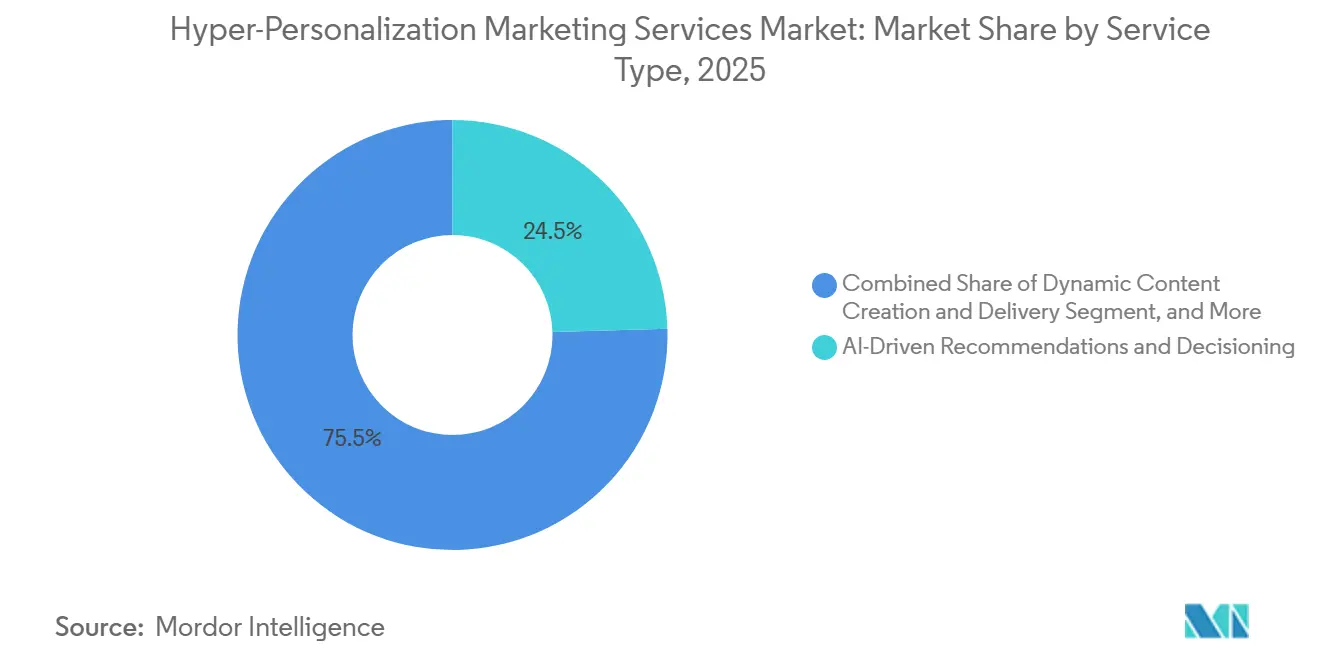
AI Decisioning Leads Current Share and Forecast ExpansionAI-Driven Recommendations and Decisioning held 24.54% of the hyper-personalization marketing services market share in 2025 and is projected to expand at a 13.24% CAGR from 2026 to 2031. Its position reflects the shift from isolated content delivery toward systems that select offers, messages, and next actions from customer context. The service has moved from trial use to a core operating layer, and its customer feedback can improve later recommendations and raise switching costs. Adobe introduced CX Enterprise Coworker in April 2026 as an agent-enabled workflow layer for customer experience orchestration. Adobe stated that its Experience Platform supports more than 1 trillion personalized experiences each year for over 20,000 global brands.
Within the hyper-personalization marketing services market, Real-Time Personalization Services and Customer Journey Orchestration form the next group of expansion areas because they use the same data assets that support AI decisioning. They address the need to coordinate engagement around current behavior instead of optimizing each channel independently. Dynamic Content Creation and Delivery and Predictive Targeting and Segmentation are increasingly used as parts of multi-service deployments rather than separate purchases, even as their usage volumes increase. Omnichannel Personalization Strategies are gaining demand as firms connect earlier channel-specific investments into integrated customer experiences. Security frameworks such as ISO/IEC 27001 can shape vendor reviews when providers manage behavioral data across several channels.

By Organization Size:
SME Adoption Broadens the Customer BaseLarge Enterprises held 69.71% share in 2025 because they had greater data maturity, budgets, and capacity for complex multi-vendor integrations. Small and Medium Enterprises are projected to expand at a 12.26% CAGR from 2026 to 2031 as SaaS pricing and modular designs reduce earlier data engineering barriers. Salesforce found that 78% of small-business marketers trusted AI to respond to customer inquiries autonomously. The same research indicated that more than half viewed their existing tools as inadequate for two-way conversational personalization at scale. This gap gives simpler, integrated platforms a clear position with smaller teams.
The hyper-personalization marketing services market is expanding among small businesses in India, Southeast Asia, and Brazil, where mobile commerce produces substantial customer interaction data. These businesses can have customer experience expectations similar to larger firms even when their internal teams are smaller. Customer.io reported that 50% of small marketing teams made significant AI changes in the prior year, compared with 65% of enterprise teams. Smaller buyers usually need outcomes that do not require extensive data engineering or long integration programs. That requirement favors products that combine data management, decisioning, and execution in a more direct deployment model.
By End-User Industry:
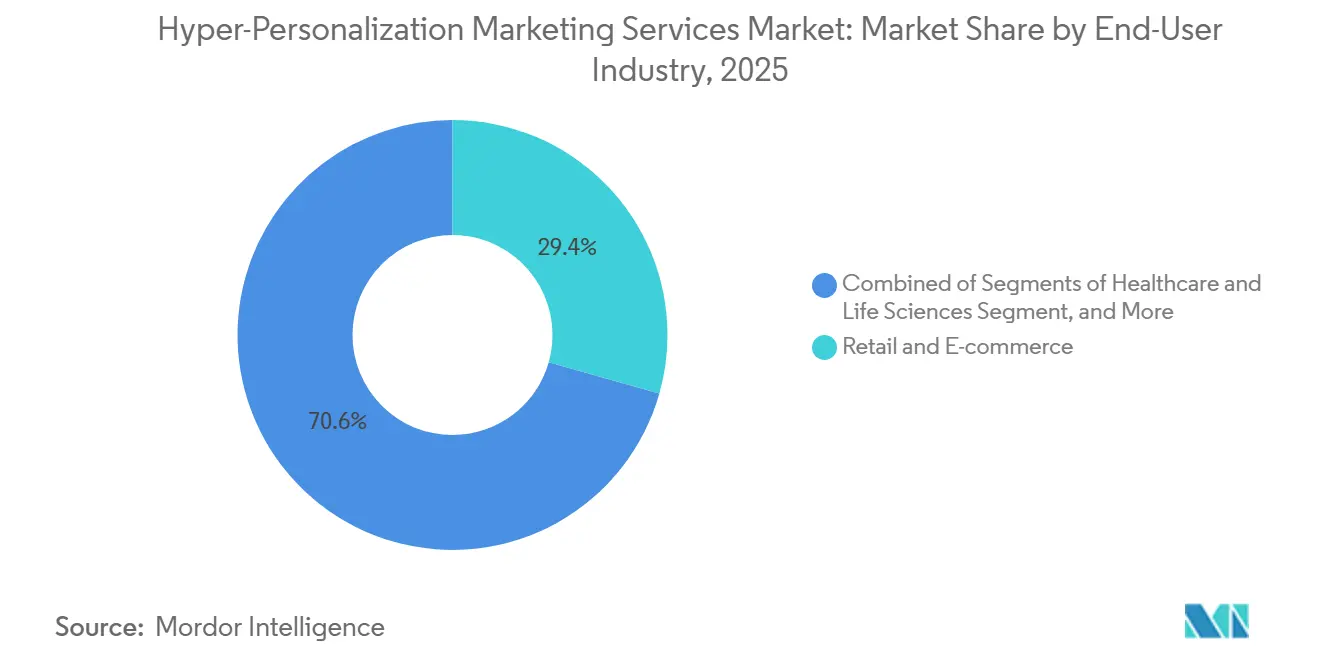
Healthcare Expansion Exceeds Retail's Current ScaleRetail and E-commerce accounted for 29.39% of the hyper-personalization marketing services market size in 2025, supported by mature digital commerce systems and direct links between personalization and revenue. Amperity found in January 2026 that 57% of retail consumers still considered shopping experiences generic. The same research found that 79% had received irrelevant or poorly timed messages. These gaps leave room for providers to improve performance within existing retail users, while BFSI, IT and Telecom, and Media and Entertainment have established personalization systems. In these sectors, competitive differentiation increasingly depends on how effectively the systems improve conversion and customer lifetime value.
Within the hyper-personalization marketing services market, Healthcare and Life Sciences is projected to expand at a 13.42% CAGR from 2026 to 2031, the fastest rate among the end-user industries covered. The segment combines patient engagement needs with requirements for care gap reduction and compliant data use. Aetna reported that its AI-powered Care Paths raised digital engagement by 38% among enrolled members. CVS Health's Health100 initiative also places AI-based personalization within pharmacy, care management, and digital interactions. Consumer Goods, Beauty, Fashion, and Luxury use personalization heavily for creative variants and customer cohort testing, including hundreds of simultaneous experiments that rules-based systems cannot sustain as easily as AI decisioning tools.
Geography Analysis
North America Hyper-Personalization Marketing Services Market
North America held 38.53% of the hyper-personalization marketing services market share in 2025, supported by vendor concentration, high enterprise data maturity, and broad use of personalization in commerce and digital services. The regional opportunity lies more in deeper deployment than in first-time platform adoption, as organizations extend personalization to shared decisioning across marketing, commerce, service, and sales. Salesforce found that teams with fully unified customer data were 42% more likely to respond in real time and 60% more likely to deploy AI agents at scale. Adobe, Salesforce, Braze, Klaviyo, and MoEngage contribute to a dense vendor environment in the region. This concentration supports frequent product releases and experimentation with new delivery models.
APAC Hyper-Personalization Marketing Services Market
Asia-Pacific is projected to expand at a 12.87% CAGR from 2026 to 2031, making it the fastest-expanding geography in the hyper-personalization marketing services market. Its demand comes from mobile-first commerce, enterprise AI adoption, and developing first-party data systems. Salesforce reported in June 2026 that 81% of Indian marketers had adopted AI and 88% believed generative AI would help their teams identify consumer signals and act in near real time. China adds scale through high-volume digital commerce, while India and Southeast Asia add adoption momentum through data infrastructure development. India’s Digital Personal Data Protection Rules entered phased implementation in 2025, increasing the focus on consented customer information and encouraging platforms that combine real-time engagement with governed data management.
EMEA and South America Hyper-Personalization Marketing Services Market
Europe is the second-largest geography, where GDPR-based governance has created both a compliance requirement and a quality standard for providers. The emphasis on first-party data has pushed many European enterprises to develop customer data foundations that can remain useful as third-party signals weaken. Braze launched European Union hosting for BrazeAI Decisioning Studio in April 2026 with regional data residency controls. South America, the Middle East, and Africa remain earlier-stage markets, with Brazil, Saudi Arabia, the United Arab Emirates, South Africa, and Nigeria representing the largest near-term opportunities as digital and mobile commerce infrastructure advances.
Competitive Landscape
The hyper-personalization marketing services market is moderately concentrated, with Adobe, Salesforce, SAP, Oracle, and Microsoft holding strong positions through broad marketing and enterprise software suites. Their installed customer bases, integrated data products, and ability to add AI functions support their scale. Competition is moving away from basic channel personalization because this capability is becoming more widely available. Open data standards, including Model Context Protocol and Agent2Agent protocols, are encouraging connections between platforms and specialist services. Customer data is also moving from proprietary customer data platform stores toward warehouses such as Snowflake, BigQuery, and Databricks, increasing the value of orchestration without copying sensitive records into a closed system.
Adobe launched CX Enterprise Coworker in April 2026 as an open, agent-enabled orchestration layer that can work across several cloud environments. SAP renamed SAP Emarsys as SAP Engagement Cloud in February 2026 and introduced an enterprise edition with real-time decisioning across its wider portfolio. These moves position personalization as a business-wide capability rather than a standalone campaign tool. Research and development focuses on multimodal content generation, real-time identity resolution without persistent third-party identifiers, and governance for automated decision-making. Large providers remain strong where buyers seek a single broad vendor relationship, but can face competition where buyers need specialized compliance, data architecture, or vertical capabilities.
Healthcare personalization under HIPAA requirements, compliance-focused decisioning for BFSI, and warehouse-native deployment are areas where challengers can compete outside incumbent contracts. Bloomreach partnered with Databricks CustomerLake in June 2026 to enable 1:1 personalization from governed enterprise data without copying sensitive information into a separate platform. Zeta Global made Athena by Zeta generally available in March 2026 and positioned the product around its proprietary SuperGraph data infrastructure. Amperity, Optimizely, and Tealium offer specialized functions within composable deployments, allowing enterprises to diversify technology sourcing while retaining control over governed customer data.
Hyper-Personalization Marketing Services Industry Leaders
-
Adobe Inc.
-
Salesforce, Inc.
-
Oracle Corporation
-
SAP SE
-
Microsoft Corporation
- *Disclaimer: Major Players sorted in no particular order
Hyper-Personalization Marketing Services Market Companies Covered in this Report
- Adobe Inc.
- Salesforce, Inc.
- Oracle Corporation
- SAP SE
- Microsoft Corporation
- Amazon Web Services, Inc.
- Google LLC
- SAS Institute Inc.
- Braze, Inc.
- MoEngage, Inc.
- Optimizely, Inc.
- Twilio Inc.
- Criteo S.A.
- Klaviyo, Inc.
- Tealium, Inc.
- Bloomreach, Inc.
- Amperity, Inc.
- Treasure Data, Inc.
- HubSpot, Inc.
- Zeta Global Holdings Corp.
Recent Industry Developments in Hyper-Personalization Marketing Services Market
- July 2026: Airship released a commissioned Total Economic Impact study demonstrating 476% ROI with a payback period of under 6 months across enterprise deployments of its AI-powered customer experience platform. Airship simultaneously announced an Airship Results Guarantee, a corporate commitment to achieve predetermined business outcomes for new customers, marking a shift toward outcome-based SaaS contracting in hyper-personalization services.
- June 2026: Klaviyo moved its Composer AI marketing agent to public beta and released major advancements to Customer Agent. Composer autonomously plans and launches cross-channel campaigns drawing on 14 years of customer context and data from nearly 200,000 brands, while the coordinated agent architecture enables marketing and service to operate from a shared real-time data layer, collapsing a historically siloed organizational divide.
- June 2026: Bloomreach announced the general availability of its Loomi marketing agent alongside a launch partnership with Databricks CustomerLake. The integration enables 1:1 personalization to execute directly from governed enterprise data in Databricks Lakehouse without duplicating sensitive customer information into a separate CDP, a significant architectural advance for data-mature enterprises with existing warehouse commitments.
- June 2026: MoEngage launched Merlin AI Custom Agents with marketer-defined guardrails and an open MCP architecture, enabling lifecycle marketers to build workflow agents on top of MoEngage data and connect external AI tools including Claude and ChatGPT through a native MCP server. The launch positions MoEngage as a composable node within multi-vendor enterprise AI ecosystems rather than a closed engagement platform.
Global Hyper-Personalization Marketing Services Market Report Scope
The Hyper-Personalization Marketing Services Market refers to the industry encompassing professional services, platforms, and solutions that enable businesses to deliver highly individualized marketing experiences to consumers by leveraging advanced technologies such as artificial intelligence (AI), machine learning (ML), predictive analytics, customer data platforms (CDPs), big data, and real-time behavioral insights.
The Hyper-Personalization Marketing Services Market Report is Segmented by Service Type (Real-Time Personalization Services, AI-Driven Recommendations and Decisioning, Dynamic Content Creation and Delivery, Customer Journey Orchestration, Predictive Targeting and Segmentation, Omnichannel Personalization Strategies, and Other Service Types), Organization Size (Large Enterprises and Small and Medium Enterprises), End User Industry (Retail and E-commerce, Consumer Goods and Beauty, Media and Entertainment, IT and Telecom, BFSI, Healthcare and Life Sciences, Fashion and Luxury, and Other End User Industries), and Geography (North America, South America, Europe, Asia-Pacific, Middle East, and Africa). The Market Forecasts are Provided in Terms of Value (USD).
| Real-Time Personalization Services |
| AI-Driven Recommendations and Decisioning |
| Dynamic Content Creation and Delivery |
| Customer Journey Orchestration |
| Predictive Targeting and Segmentation |
| Omnichannel Personalization Strategies |
| Other Service Types |
| Large Enterprises |
| Small and Medium Enterprises |
| Retail and E-commerce |
| Consumer Goods and Beauty |
| Media and Entertainment |
| IT and Telecom |
| BFSI |
| Healthcare and Life Sciences |
| Fashion and Luxury |
| Other End User Industries |
| North America | United States |
| Canada | |
| Mexico | |
| South America | Brazil |
| Argentina | |
| Chile | |
| Rest of South America | |
| Europe | Germany |
| United Kingdom | |
| France | |
| Italy | |
| Spain | |
| Rest of Europe | |
| Asia-Pacific | China |
| Japan | |
| India | |
| South Korea | |
| Australia | |
| Rest of Asia-Pacific | |
| Middle East | United Arab Emirates |
| Saudi Arabia | |
| Qatar | |
| Rest of Middle East | |
| Africa | South Africa |
| Egypt | |
| Nigeria | |
| Rest of Africa |
| Service Type | Real-Time Personalization Services | |
| AI-Driven Recommendations and Decisioning | ||
| Dynamic Content Creation and Delivery | ||
| Customer Journey Orchestration | ||
| Predictive Targeting and Segmentation | ||
| Omnichannel Personalization Strategies | ||
| Other Service Types | ||
| Organization Size | Large Enterprises | |
| Small and Medium Enterprises | ||
| End User Industry | Retail and E-commerce | |
| Consumer Goods and Beauty | ||
| Media and Entertainment | ||
| IT and Telecom | ||
| BFSI | ||
| Healthcare and Life Sciences | ||
| Fashion and Luxury | ||
| Other End User Industries | ||
| By Geography | North America | United States |
| Canada | ||
| Mexico | ||
| South America | Brazil | |
| Argentina | ||
| Chile | ||
| Rest of South America | ||
| Europe | Germany | |
| United Kingdom | ||
| France | ||
| Italy | ||
| Spain | ||
| Rest of Europe | ||
| Asia-Pacific | China | |
| Japan | ||
| India | ||
| South Korea | ||
| Australia | ||
| Rest of Asia-Pacific | ||
| Middle East | United Arab Emirates | |
| Saudi Arabia | ||
| Qatar | ||
| Rest of Middle East | ||
| Africa | South Africa | |
| Egypt | ||
| Nigeria | ||
| Rest of Africa | ||
Key Questions Answered in the Report
What is the 2026 size of the hyper-personalization marketing services market?
The hyper-personalization marketing services market size is USD 87.30 billion in 2026 and is forecast to reach USD 152.80 billion by 2031 at an 11.85% CAGR.
Which service type leads hyper-personalization marketing services?
AI-Driven Recommendations and Decisioning led with 24.54% share in 2025 and is forecast to expand at a 13.24% CAGR through 2031.
Why are first-party data capabilities important for personalization providers?
Within the hyper-personalization marketing services market, first-party data supports consented engagement and stronger decisioning. AI personalization on unified first-party data can deliver 2 to 3 times the incremental lift of fragmented-data approaches.
Which organization size is adopting these services fastest?
Small and Medium Enterprises (SMEs) are forecast to expand at a 12.26% CAGR through 2031 as SaaS pricing and simpler deployment models reduce adoption barriers.
Which end-user sector has the fastest forecast expansion?
Healthcare and Life Sciences is forecast to expand at a 13.42% CAGR through 2031, driven by patient engagement, care gap reduction, and compliant data use.
Which region has the fastest outlook for these services?
Asia-Pacific is forecast to expand at a 12.87% CAGR through 2031, supported by mobile commerce, enterprise AI adoption, and first-party data development.