
Hydroxyapatite Chromatography Market Size and Share
Market Overview
| Study Period | 2020 - 2031 |
|---|---|
| Market Size (2026) | USD 317.39 Million |
| Market Size (2031) | USD 426.39 Million |
| Growth Rate (2026 - 2031) | 6.08 % |
| Fastest Growing Market | Asia-Pacific |
| Largest Market | North America |
| Market Concentration | Medium |
Major Players
*Disclaimer: Major Players sorted in no particular order Image © Mordor Intelligence. Reuse requires attribution under CC BY 4.0. |
|
Hydroxyapatite Chromatography Market Analysis by Mordor Intelligence
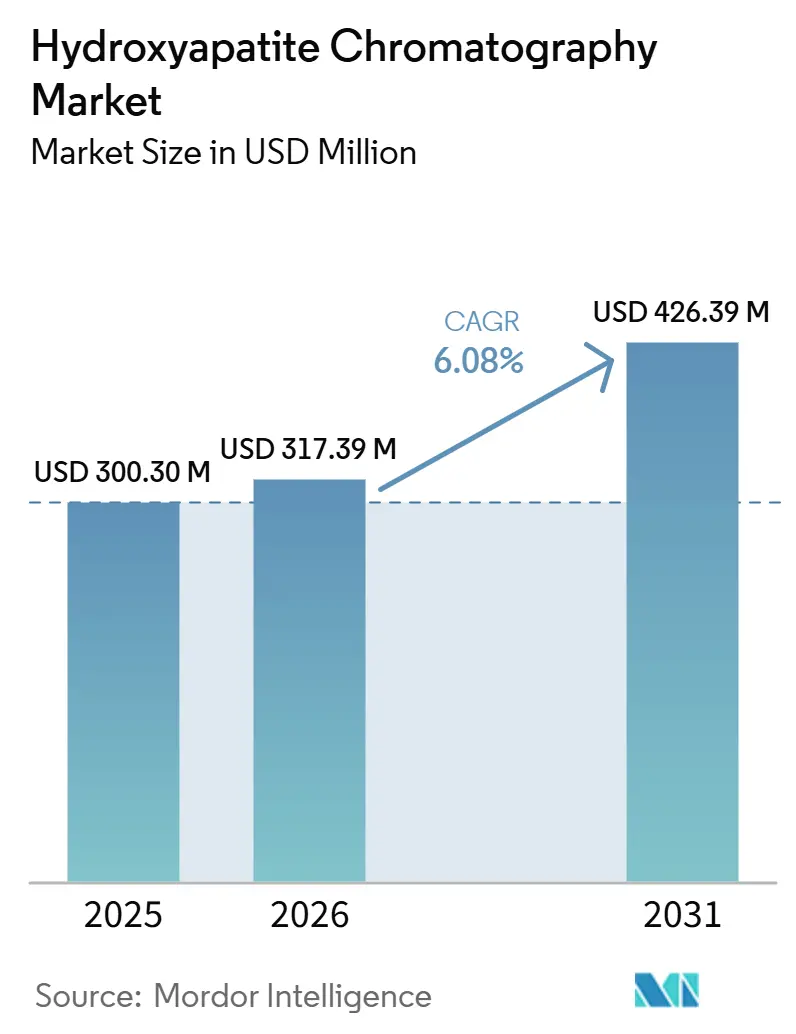
The hydroxyapatite chromatography market is expected to increase from USD 300.30 million in 2025 to USD 317.39 million in 2026 and reach USD 426.39 million by 2031, growing at a CAGR of 6.08% over 2026-2031. The hydroxyapatite chromatography market is tied closely to downstream biologics processing, where higher CHO cell culture titers have raised the burden on purification steps and pushed manufacturers to focus more sharply on host cell proteins, aggregates, and leaked affinity ligands in commercial production. Regulatory review has also become more exacting after the publication of the USP General Chapter in late 2024, which increased attention on species-level host cell protein measurement and made polishing step performance more important during process development and validation. The hydroxyapatite chromatography market is also shaped by a clear regional pattern, with North America holding the largest base because of its concentration of biologics manufacturing sites, while Asia-Pacific is expanding faster as new capacity comes online in major bioclusters. Demand remains supported by the ability of hydroxyapatite media to remove several impurity classes in a single step, which helps protect product quality where aggregate failure or incomplete impurity clearance can delay batch release. Competitive activity is moving along two paths, with established suppliers defending validated GMP-grade offerings and newer Asian suppliers competing on price, local availability, and improving technical performance, even as cost and cleaning sensitivity continue to slow wider use in some programs.
Key Report Takeaways
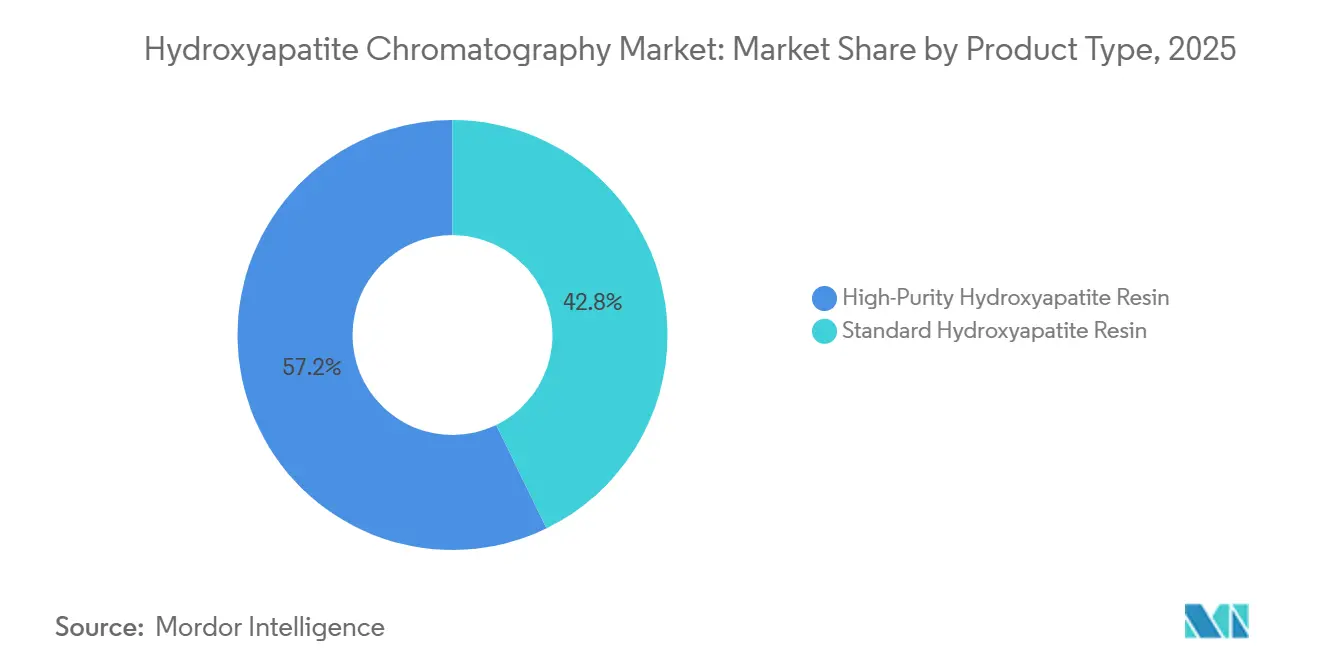
- By product type, high-purity hydroxyapatite resin held 57.23% of the hydroxyapatite chromatography market share in 2025, while standard hydroxyapatite resin is projected to expand at a 6.24% CAGR through 2031.
- By application, protein purification accounted for 41.31% of the hydroxyapatite chromatography market in 2025, while chromatography and filtration recorded the highest projected CAGR at 6.67% through 2031.
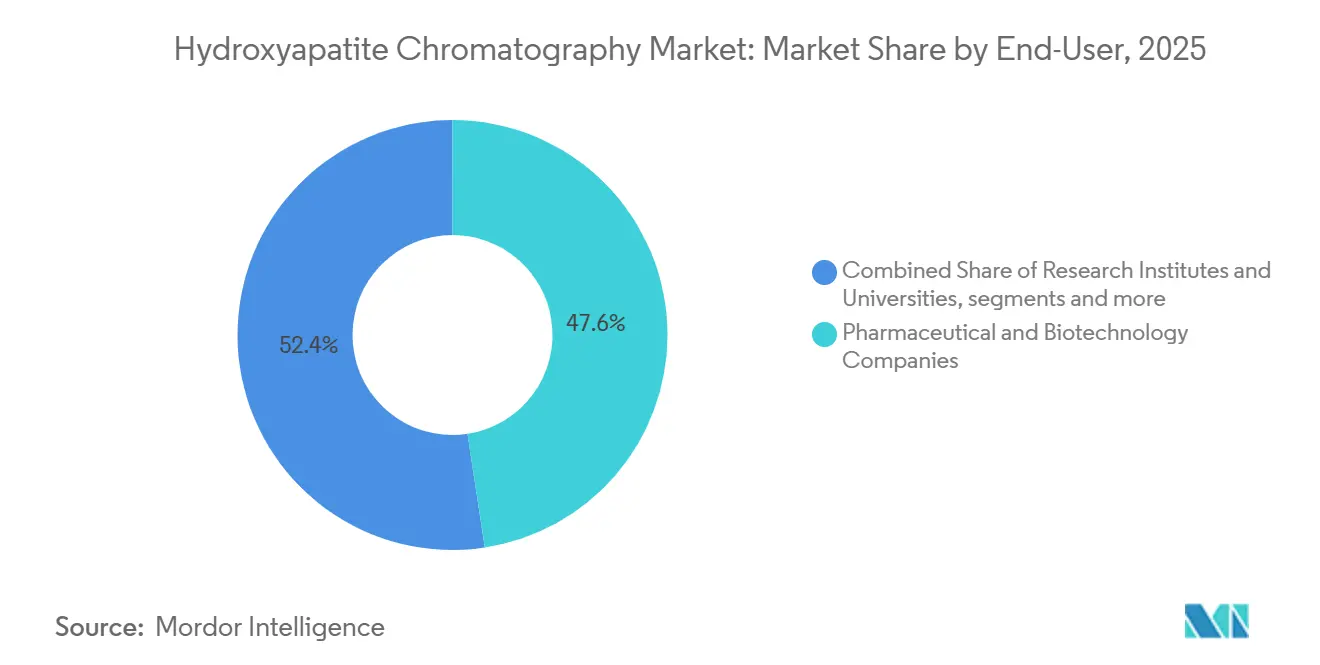
- By end-user, pharmaceutical and biotechnology companies represented 47.62% share in 2025, while contract development and manufacturing organizations are forecasted to grow at the fastest pace with a 7.18% CAGR through 2031.
- By geography, North America led with 49.13% share in 2025, while Asia-Pacific is expected to advance at the highest CAGR of 8.06% through 2031.
Note: Market size and forecast figures in this report are generated using Mordor Intelligence’s proprietary estimation framework, updated with the latest available data and insights as of January 2026.
Global Hydroxyapatite Chromatography Market Trends and Insights
Drivers Impact Analysis*
| Driver | (~) % Impact on CAGR Forecast | Geographic Relevance | Impact Timeline |
|---|---|---|---|
| Rising Demand for High-Resolution Polishing in Biologics | +1.8% | Global, concentrated in North America and Europe | Long term (≥ 4 years) |
| Expanding Use in mAbs, ADCs, and Viral Vectors | +1.3% | Global, accelerating in Asia-Pacific | Long term (≥ 4 years) |
| Shift Toward Single-Use and GMP-Ready Downstream Workflows | +0.9% | Global | Long term (≥ 4 years) |
| Increased Need for Aggregates, HCP, and Endotoxin Removal | +0.7% | North America and EU | Medium term (2-4 years) |
| Rising Outsourcing of Purification to CDMOs and Specialized Suppliers | +0.5% | APAC core, spill-over to MEA | Medium term (2-4 years) |
| Adoption of Hydroxyapatite as a High-Selectivity Alternative to Conventional Resins | +0.4% | Global, with early gains in North America, Japan, and China | Long term (≥ 4 years) |
| Source: Mordor Intelligence | |||
Rising Demand for High-Resolution Polishing in Biologics
The hydroxyapatite chromatography market is benefiting from a shift in biologics pipelines toward harder-to-purify formats, including bispecific antibodies, fusion proteins, and ADCs, where downstream steps must separate closely related species rather than only remove bulk contaminants. Ceramic hydroxyapatite stands apart because it combines calcium affinity and cation exchange behavior, which gives it a broader selectivity range than standard single-mode polishing media in these settings. A 2025 peer-reviewed study showed that ceramic hydroxyapatite polishing lifted bispecific antibody purity to at least 97% and cut high-molecular-weight impurities to 0.5%, which materially outperformed cation exchange chromatography in direct comparison.[1]N. Ingavat, X. Wang, J.M. Liew, et al., “Harnessing Ceramic Hydroxyapatite as an Effective Polishing Strategy to Remove Product- and Process-Related Impurities in Bispecific Antibody Purification,” Bioresources and Bioprocessing, journal.hep.com.cnAs product structures become more complex, the value of a polishing medium that suppresses chromatography-induced aggregation while improving impurity discrimination becomes harder for process teams to ignore.
Expanding Use in mAbs, ADCs, and Viral Vectors
The hydroxyapatite chromatography market is also being supported by wider use across antibody products, conjugates, recombinant proteins, and nucleic acid-related workflows, which broadens demand beyond one therapeutic format. The user-supplied draft notes that the antibody segment exceeded USD 300 billion in 2025, and each additional approval tends to reinforce purification platforms where hydroxyapatite can serve as an established polishing step.[2]MDPI, “Antibody Aggregate Removal by Multimodal Chromatography,” Molecules, mdpi.com In ADC production, higher hydrophobicity and a greater tendency toward over-conjugated aggregates create a separation problem that fits hydroxyapatite media well because they can discriminate among product-related variants that often co-elute on conventional alternatives. The same hydroxyapatite chromatography market is extending into recombinant protein and gene therapy manufacturing because hydroxyapatite can bind protein, DNA, and endotoxin together and reduce the number of downstream steps required in some processes. Work on nickel-ion substituted hydroxyapatite matrices also shows that material design is still evolving, which suggests future product cycles may support additional use cases beyond current antibody and vaccine purification programs.
Increased Need for Aggregates, HCP, and Endotoxin Removal
The hydroxyapatite chromatography market is gaining support from tighter impurity expectations, especially where manufacturers must prove clearance of specific host cell proteins rather than only demonstrate lower total protein load. USP General Chapter, published in December 2024, pushed process developers toward more detailed LC-MS and LC-MS/MS-based impurity measurement and made species-level assessment more relevant during purification design. [3]USP-NF, “General Chapter <1132.1> Residual Host Cell Protein Measurement in Biopharmaceuticals by Liquid Chromatography-Mass Spectrometry,” USP-NF, uspnf.com That change matters because hydroxyapatite offers multi-modal interactions that help remove problematic impurities such as aggregates, DNA-associated contaminants, and certain host cell proteins that can remain difficult for single-mode resins to resolve. In the hydroxyapatite chromatography market, this raises the practical value of polishing media that can support stronger impurity claims when products move through IND, BLA, and comparable regulatory filings.
Rising Outsourcing of Purification to CDMOs and Specialized Suppliers
The hydroxyapatite chromatography market is also being shaped by outsourcing, because more innovator companies now rely on CDMOs not only for manufacturing execution but also for process decisions that affect resin qualification and long-term purchasing. Once CDMOs adopt a validated polishing platform, the same resin choice often carries across several client programs because changing media midstream creates documentation, comparability, and regulatory burdens. Bio-Rad’s January 2025 extension of its Foresight Pro prepacked chromatography columns reflects this shift, because the company linked hardware, GMP documentation, and a single lot of ceramic hydroxyapatite media in a format that simplifies procurement and qualification for outsourced manufacturing environments. As outsourcing expands across the hydroxyapatite chromatography market, suppliers with proven documentation and installed process history are likely to hold an advantage because CDMOs tend to favor media choices that reduce execution risk across multiple customer programs.
Restraints Impact Analysis*
| Restraint | (~) % Impact on CAGR Forecast | Geographic Relevance | Impact Timeline |
|---|---|---|---|
| Higher Cost Versus Commodity Ion Exchange Resins | -1.2% | Global, most acute in emerging APAC markets | Short term (≤ 2 years) |
| Narrower Process Familiarity Among End Users | -0.8% | Global, concentrated strain on North America and Europe | Medium term (2-4 years) |
| Limited Supply Base for High-Grade Ceramic Media | -0.6% | Global | Medium term (2-4 years) |
| Cleaning and Validation Sensitivity in Regulated Manufacturing | -0.5% | Global | Long term (≥ 4 years) |
| Source: Mordor Intelligence | |||
Higher Cost Versus Commodity Ion Exchange Resins
The hydroxyapatite chromatography market continues to face a cost hurdle because GMP-grade ceramic hydroxyapatite still carries a clear premium over standard ion exchange media in commercial buying decisions. That premium forces many manufacturers to justify hydroxyapatite on technical need, regulatory fit, or long-term process stability rather than on initial consumables cost alone. The challenge is most visible in biosimilar and large-volume production settings, where cost of goods remains under constant pressure and lower-priced alternatives are often preferred unless hydroxyapatite is already embedded in a filed process. At the same time, Chinese suppliers are narrowing the gap by offering lower-priced ceramic hydroxyapatite products, which supports adoption in early-phase and cost-sensitive CDMO programs even if it also compresses margins for incumbent suppliers. This means the hydroxyapatite chromatography market is not being held back by lack of technical relevance, but by a purchasing equation that still rewards cheaper media when impurity demands are less severe.
Cleaning and Validation Sensitivity in Regulated Manufacturing
The hydroxyapatite chromatography market also faces slower adoption where manufacturers need flexible multi-product operations and want cleaning regimes that fit established column handling practices. Ceramic hydroxyapatite requires more careful cleaning and validation control than many agarose-based resins, which adds work for facilities that already manage tight campaign schedules and shared equipment. That burden is heavier for smaller CDMOs and mid-sized operators because added validation effort, extra buffer management, and more cautious reuse strategies can raise the operational cost of choosing hydroxyapatite. Longer qualification attention can also discourage facilities from adopting it as a default platform resin when multiple customer programs must move through the same asset base. As a result, the hydroxyapatite chromatography market can advance strongly in technically demanding programs while still seeing slower penetration in sites that prioritize simplicity and rapid turnover.
*Our forecasts treat driver/restraint impacts as directional, not additive. The impact forecasts reflect baseline growth, mix effects, and variable interactions.
Segment Analysis
By Product Type: High-Purity Grades Anchor Commercial Platforms
High-purity hydroxyapatite resin accounted for 57.23% of the hydroxyapatite chromatography market share in 2025, which shows how strongly commercial biologics manufacturing still depends on documented purity, traceability, and batch-ready quality systems. This segment benefits from the fact that approved manufacturing processes rarely tolerate uncertainty around resin provenance or lot-level quality documentation once a product reaches licensed production. In the hydroxyapatite chromatography market, this keeps high-purity grades closely tied to late-stage and commercial platforms where substitution risk is high and approval filings have already fixed the process framework.
Standard hydroxyapatite resin is expected to grow at a 6.24% CAGR through 2031, which points to stronger uptake in research, pilot, and early clinical programs where full GMP traceability is not always required at the same level. This part of the hydroxyapatite chromatography market is helped by lower entry cost and by a broader willingness among academic labs, smaller developers, and regional manufacturers to test hydroxyapatite in new workflows before moving to premium grades. As the product range expands across pore structures and throughput profiles, buyers in the hydroxyapatite chromatography market gain more freedom to match grade selection with program stage, regulatory burden, and cost limits.


By Application: Protein Purification Leads, Filtration Integration Supports New Use Cases
Protein purification held 41.31% of the hydroxyapatite chromatography market size in 2025, which reflects hydroxyapatite’s established place in antibody and related biologics workflows where several impurity classes must be cleared in one polishing step. Within the hydroxyapatite chromatography market, this makes protein purification the most established demand base because it sits closest to high-value licensed biologics production.
Chromatography and filtration are forecasted to expand at a 6.67% CAGR through 2031, showing that hydroxyapatite is increasingly being integrated into broader continuous and hybrid purification trains rather than being treated only as a standalone polishing medium. This use pattern is gaining ground in nucleic acid and mRNA-related workflows, where pore structure and mixed-mode selectivity can support separation of large target molecules from dsRNA, DNA template residues, and free nucleotides in more compact process designs. Because the application base spans monoclonal antibodies, ADCs, vaccine components, and nucleic acid workflows, the hydroxyapatite chromatography market is not dependent on a single therapeutic class for growth.
By End-User: Pharma Holds the Base, CDMOs Raise the Growth Rate
Pharmaceutical and biotechnology companies held 47.62% share of the hydroxyapatite chromatography market in 2025, which reflects their role as owners of validated platform processes and long-lived commercial production lines. Once hydroxyapatite is written into a BLA, MAA, or similar filing, it usually becomes a fixed part of the approved process, which supports recurring resin demand over the product’s commercial life. This part of the hydroxyapatite chromatography market is therefore steady because replacement decisions are constrained by comparability work, internal validation demands, and regulatory expectations.
Contract development and manufacturing organizations are projected to grow at a 7.18% CAGR through 2031, making them the fastest-moving end-user group in the hydroxyapatite chromatography market as outsourcing continues to shift technical authority toward external manufacturing partners. This growth matters beyond volume because CDMO scientists increasingly influence column choice, supplier qualification, and platform standardization decisions that once sat mainly inside large innovator organizations. As more outsourced facilities standardize around one or two trusted media suppliers, the hydroxyapatite chromatography market may see stronger account-level stickiness even if overall supplier competition remains active.

Geography Analysis
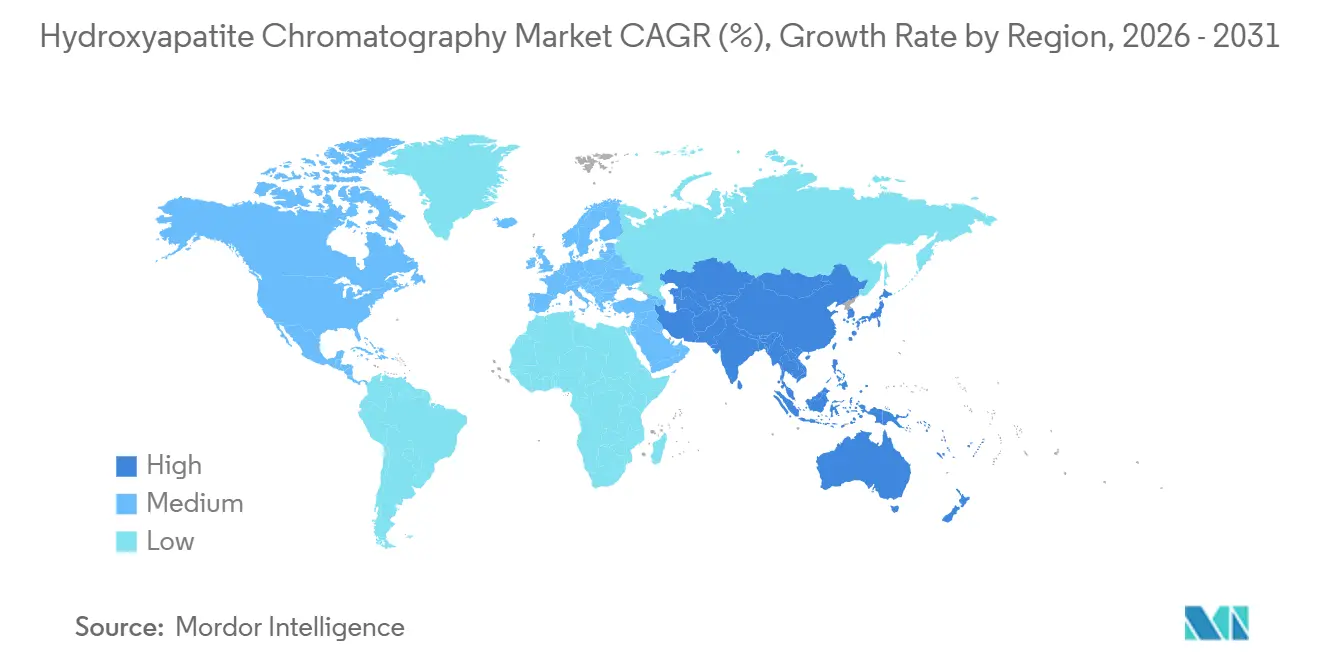
North America accounted for 49.13% of the hydroxyapatite chromatography market size in 2025, which kept it well ahead of other regions in installed demand. The region’s lead is tied to the United States’ role as the main approval and commercial manufacturing center for biologics, where purification consistency and impurity control carry direct regulatory weight. USP General Chapter <1132.1> added another layer of scrutiny by emphasizing detailed host cell protein measurement, which supports demand for polishing steps that can show strong impurity clearance performance. Canada and Mexico contribute smaller volumes, but they still add to regional demand through research programs, contract manufacturing activity, and links to the broader North American biologics supply base.
Europe remained the second-largest regional block in the hydroxyapatite chromatography market, supported by an established biologics manufacturing base in countries such as Germany, the United Kingdom, and France. Demand in the region is supported by licensed biologics production, a steady biosimilar pipeline, and continued process development work across both commercial and clinical manufacturing environments. The hydroxyapatite chromatography market in Europe also benefits from a long-standing chromatography culture, where buyers are familiar with specialized polishing steps when impurity profiles justify the added cost. Smaller demand pools across the rest of Europe, the Middle East and Africa, and South America remain limited in absolute terms, yet they continue to expand as domestic biologics capabilities widen.
Asia-Pacific is projected to grow at an 8.06% CAGR through 2031, which makes it the fastest-growing geography in the hydroxyapatite chromatography market. China is the main driver, with the Shanghai and Yangtze River Delta corridors continuing to add biologics manufacturing depth, and WuXi Biologics’ 18th drug product facility reaching GMP release in May 2026 reinforced that momentum. Japan remains important on the supply side because HOYA’s ceramic hydroxyapatite media has a long role in antibody and vaccine purification, which gives the region both demand and technology relevance. South Korea and Australia add smaller but rising demand through biosimilar, mRNA, and advanced biologics activity, which helps broaden the regional base of the hydroxyapatite chromatography market beyond one country cluster.

Competitive Landscape
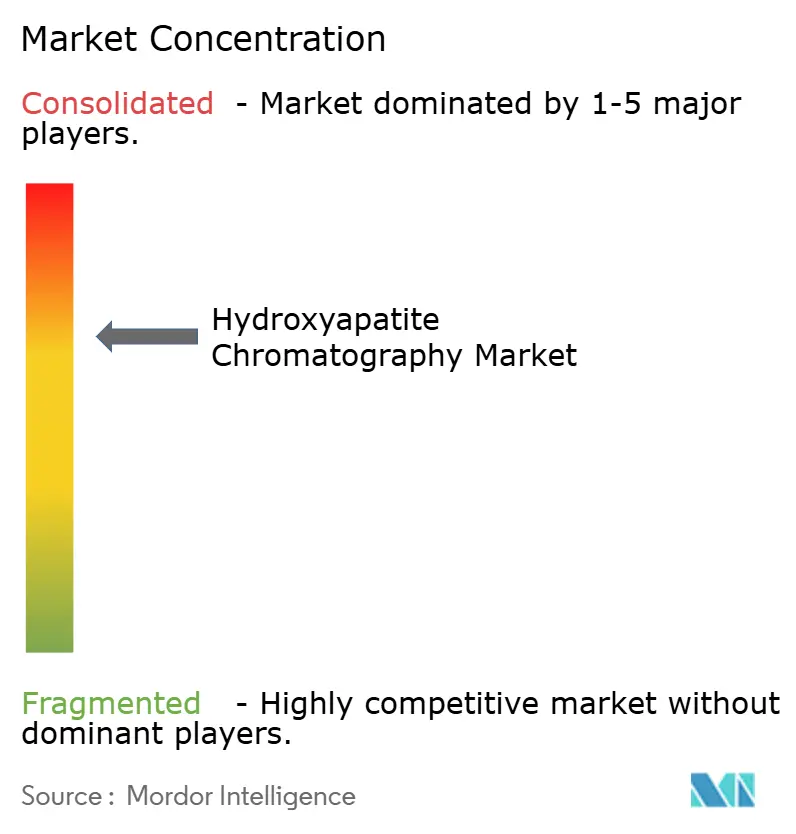
The hydroxyapatite chromatography market shows moderate concentration, with a limited group of established suppliers controlling much of the validated GMP-grade ceramic hydroxyapatite supply while a broader set of regional companies competes in narrower price-sensitive positions. Bio-Rad remains a key technical reference in the hydroxyapatite chromatography market because its CHT media family is tied closely to commercial downstream workflows and long-standing process familiarity across large biologics manufacturers. Thermo Fisher Scientific, Sartorius AG, and Tosoh Corporation also remain relevant because hydroxyapatite functions as part of wider purification portfolios rather than as a standalone purchase in many accounts. This keeps competition in the hydroxyapatite chromatography market centered on validation history, technical support, product breadth, and customer confidence rather than price alone.
A second competitive force comes from Chinese suppliers that are moving toward stronger technical credibility while maintaining a cost advantage in domestic and regional accounts. Bio-Link’s Phase II expansion to 120,000 liters of annual production capacity, combined with reported performance that approaches incumbent grades in antibody purification, shows how local suppliers are trying to challenge the quality gap as well as the price gap. This matters in the hydroxyapatite chromatography market because procurement decisions in Asia increasingly weigh supply chain security and local service support alongside documentation and binding performance.
Broader downstream bioprocessing consolidation is also relevant because large life science companies are building wider chromatography portfolios that can challenge hydroxyapatite with adjacent mixed-mode solutions. Repligen’s move to acquire Tantti in 2024 also signaled stronger interest in purification media and adjacent bead technologies for newer modality workflows. Even with these moves, white space remains open in single-use formats and modified hydroxyapatite variants, so the hydroxyapatite chromatography market still offers room for focused entrants that can solve unmet process needs with credible validation support.
Hydroxyapatite Chromatography Industry Leaders
-
Bio-Rad Laboratories, Inc.
-
Sartorius AG
-
Merck KGaA
-
Danaher Corporation
-
Tosoh Corporation
- *Disclaimer: Major Players sorted in no particular order

Recent Industry Developments
- May 2026: WuXi Biologics achieved GMP release of its 18th drug product facility (DP15) at the Fengxian site in Shanghai, integrating end-to-end Drug Substance to Drug Product CDMO capabilities. The operational expansion directly raises recurring demand for downstream polishing media, including hydroxyapatite chromatography at commercial campaign scale.
- March 2026: AsymBio (a subsidiary of Asymchem Group) completed its "Golden Triangle" dual-site CDMO network in Shanghai, integrating Zhangjiang, Jinshan, and Fengxian sites for end-to-end commercial biologics manufacturing from IND through BLA; the expanded downstream processing footprint creates sustained validated HA column demand across multiple concurrent client programs.
- December 2025: Repligen Corporation introduced next-generation chromatography resins designed for new modality workflows encompassing gene therapy vectors, viral vaccines, and nucleic acid biotherapeutics, categories where hydroxyapatite’s nucleic acid and HCP binding selectivity serves as a complementary polishing option in multi-step purification trains.


Global Hydroxyapatite Chromatography Market Report Scope
According to the report’s scope, the hydroxyapatite chromatography market refers to the industry focused on the development, production, and commercialization of hydroxyapatite-based chromatography media, columns, and related products used for the purification and separation of biomolecules. These solutions are widely employed in biopharmaceutical manufacturing, vaccine production, monoclonal antibody purification, and life science research due to their unique mixed-mode separation capabilities based on calcium affinity and cation-exchange interactions.
The hydroxyapatite chromatography market is segmented into product type, application, end-user, and geography. By product type, the market is segmented into high-purity hydroxyapatite resin and standard hydroxyapatite resin. By application, the market is segmented into protein purification, nucleic acid isolation, vaccine production, biotherapeutic polishing, chromatography and filtration, and other applications. By end-user, the market is segmented into pharmaceutical and biotechnology companies, contract development and manufacturing organizations, and research institutes and universities. By geography, the market is segmented into North America, Europe, Asia-Pacific, the Middle East and Africa, and South America. The report also covers the estimated market sizes and trends for 17 countries across major regions globally. The report offers values (USD) for all the above segments.
| High-Purity Hydroxyapatite Resin |
| Standard Hydroxyapatite Resin |
| Protein Purification |
| Nucleic Acid Isolation |
| Vaccine Production |
| Biotherapeutic Polishing |
| Chromatography and Filtration |
| Other Applications |
| Pharmaceutical and Biotechnology Companies |
| Contract Development and Manufacturing Organizations |
| Research Institutes and Universities |
| North America | United States |
| Canada | |
| Mexico | |
| Europe | Germany |
| United Kingdom | |
| France | |
| Italy | |
| Spain | |
| Rest of Europe | |
| Asia-Pacific | China |
| Japan | |
| India | |
| Australia | |
| South Korea | |
| Rest of Asia-Pacific | |
| Middle East and Africa | GCC |
| South Africa | |
| Rest of Middle East and Africa | |
| South America | Brazil |
| Argentina | |
| Rest of South America |
| By Product Type | High-Purity Hydroxyapatite Resin | |
| Standard Hydroxyapatite Resin | ||
| By Application | Protein Purification | |
| Nucleic Acid Isolation | ||
| Vaccine Production | ||
| Biotherapeutic Polishing | ||
| Chromatography and Filtration | ||
| Other Applications | ||
| By End-User | Pharmaceutical and Biotechnology Companies | |
| Contract Development and Manufacturing Organizations | ||
| Research Institutes and Universities | ||
| By Geography | North America | United States |
| Canada | ||
| Mexico | ||
| Europe | Germany | |
| United Kingdom | ||
| France | ||
| Italy | ||
| Spain | ||
| Rest of Europe | ||
| Asia-Pacific | China | |
| Japan | ||
| India | ||
| Australia | ||
| South Korea | ||
| Rest of Asia-Pacific | ||
| Middle East and Africa | GCC | |
| South Africa | ||
| Rest of Middle East and Africa | ||
| South America | Brazil | |
| Argentina | ||
| Rest of South America | ||


Key Questions Answered in the Report
What is the projected value of the hydroxyapatite chromatography space by 2031?
The market is projected to reach USD 426.39 million by 2031, rising from USD 300.30 million in 2025 to USD 317.39 million in 2026 at a 6.08% CAGR over 2026-2031.
Which application currently leads demand for hydroxyapatite chromatography media?
Protein purification leads with 41.31% share in 2025 because it remains central to antibody and biologics polishing workflows.
Which region is expanding the fastest for hydroxyapatite chromatography adoption?
Asia-Pacific is growing the fastest, with an expected 8.06% CAGR through 2031, supported by capacity additions in major biologics manufacturing clusters.
Why are CDMOs becoming more important buyers of hydroxyapatite chromatography products?
CDMOs are expected to be the fastest-growing end-user group at 7.18% CAGR because they now influence resin selection, validation strategy, and platform standardization for multiple client programs.
Page last updated on:





