
Hydrotherapy Equipment Market Size and Share
Market Overview
| Study Period | 2020 - 2031 |
|---|---|
| Market Size (2026) | USD 691.52 Million |
| Market Size (2031) | USD 862.78 Million |
| Growth Rate (2026 - 2031) | 4.52 % |
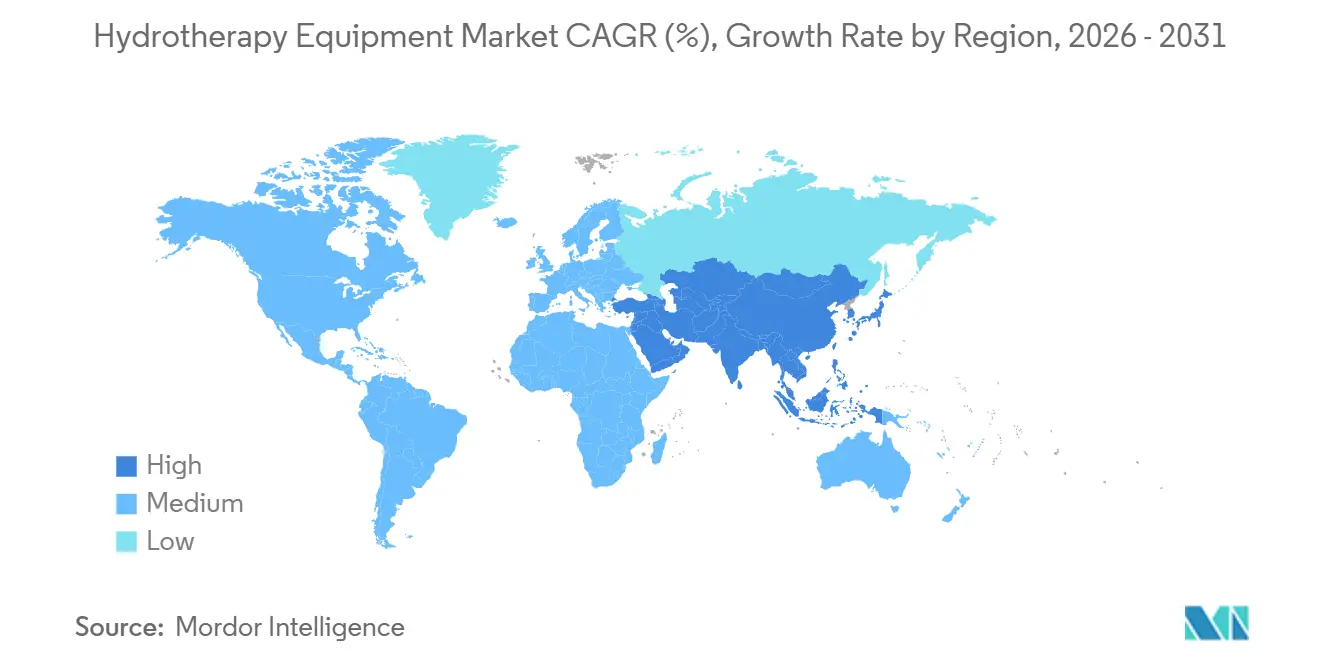
| Fastest Growing Market | Asia Pacific |
| Largest Market | North America |
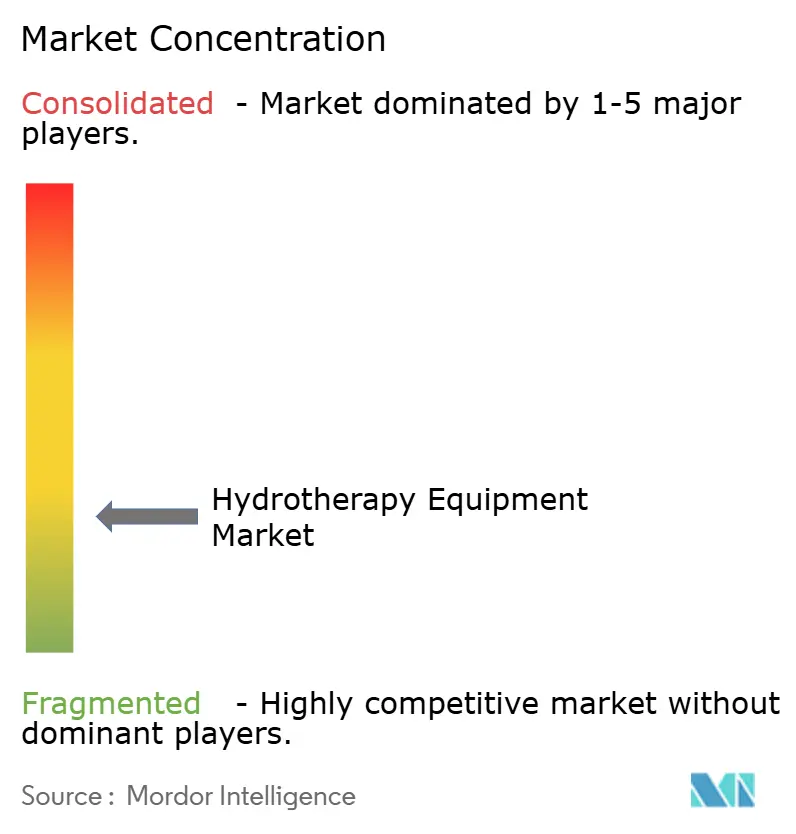
| Market Concentration | Low |
Major Players *Disclaimer: Major Players sorted in no particular order Image © Mordor Intelligence. Reuse requires attribution under CC BY 4.0. | |
Hydrotherapy Equipment Market Analysis by Mordor Intelligence
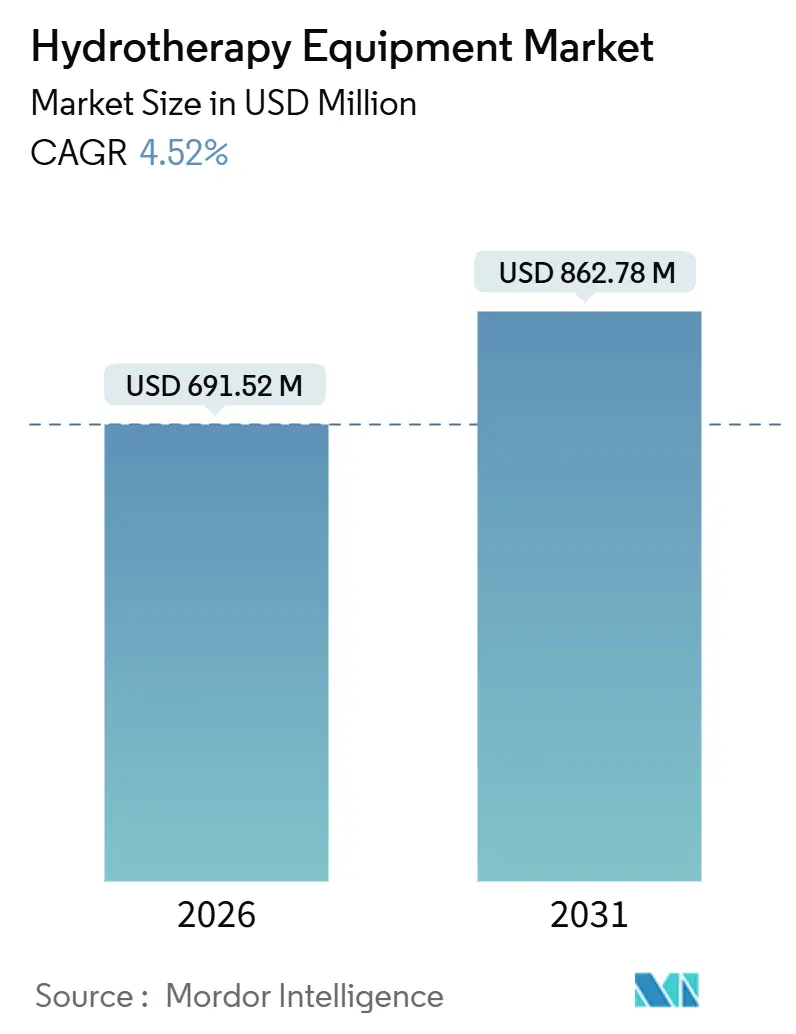
The Hydrotherapy Equipment Market size is estimated at USD 691.52 million in 2026, and is expected to reach USD 862.78 million by 2031, at a CAGR of 4.52% during the forecast period (2026-2031).
Escalating chronic-pain prevalence, rapid population aging, and growing home-care preferences underpin this growth trajectory. A latent rehabilitation gap exists because only around half of the 2.41 billion people who need rehabilitation actually receive it, creating a sizable addressable base for buoyancy-based therapy. Product uptake is also accelerating as sports franchises and corporate wellness programs embrace aquatic recovery to cut downtime and improve performance. Technology advances, notably smart monitoring and low-water designs, mitigate operating costs while satisfying drought-related regulations, thus widening adoption in water-stressed regions. Meanwhile, the competitive field is shifting toward connected platforms that monetize data, service bundles, and consumables rather than stand-alone tubs.
Key Report Takeaways
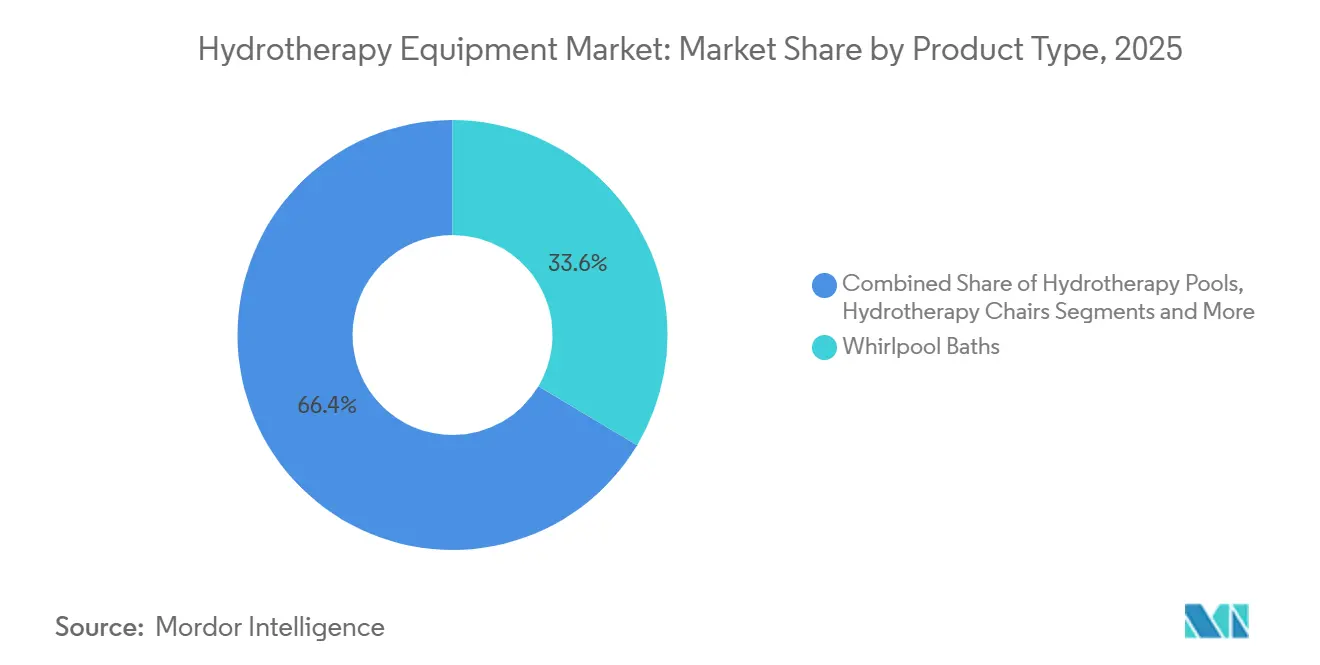
- By product type, Whirlpool baths led with a 33.56% revenue share in 2025 while cold-plunge and contrast baths posted the fastest growth at 6.14% CAGR through 2031.
- By technology, Smart and IoT-enabled systems captured 36.26% of 2025 revenue; however, VR and AR-assisted therapy modules are forecast to expand at 8.14% CAGR to 2031.
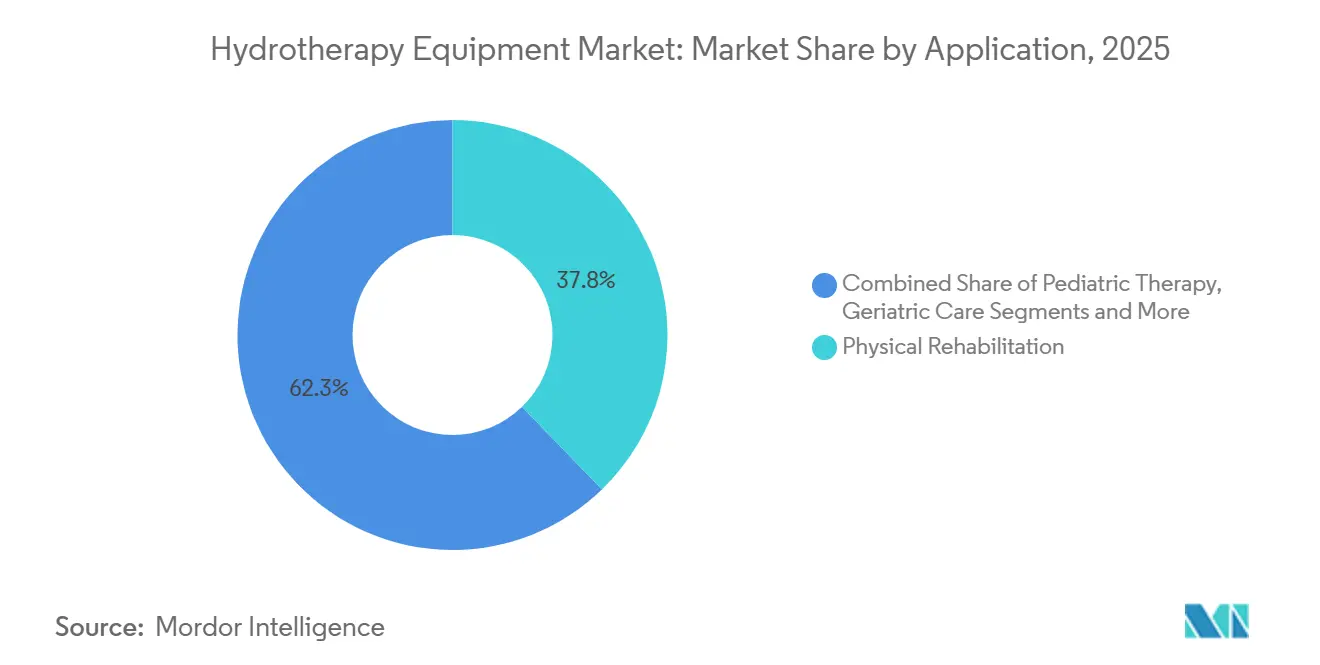
- By Application, Physical rehabilitation accounted for 37.75% of revenue in 2025, whereas sports conditioning and recovery is advancing at 7.23% CAGR to 2031.
- By End user, Hospitals and clinics retained 44.86% share in 2025, yet the home segment is rising fastest at 8.24% CAGR through 2031 as consumers retrofit bathrooms with compact whirlpools.
- By region, North America garnered 34.66% of revenue in 2025, but Asia-Pacific is the quickest-growing region at 6.42% CAGR, propelled by wellness-center build-outs and rising incomes.
Note: Market size and forecast figures in this report are generated using Mordor Intelligence’s proprietary estimation framework, updated with the latest available data and insights as of January 2026.
Market Trends and Insights
Drivers Impact Analysis of Hydrotherapy Equipment Market*
| Driver | (~) % Impact on CAGR Forecast | Geographic Relevance | Impact Timeline |
|---|---|---|---|
| Aging Population & Musculoskeletal Disorder Surge | +0.8% | North America, Europe, East Asia | Long term (≥ 4 years) |
| Growing Demand for Non-Invasive Rehab & Pain Management | +0.7% | North America, Western Europe | Medium term (2–4 years) |
| Wellness-Tourism & Luxury-Hospitality Build-Outs | +0.5% | China, Thailand, Indonesia, Middle East | Medium term (2–4 years) |
| Smart, Energy-Efficient System Innovations | +0.6% | North America, Europe, Australia | Short term (≤ 2 years) |
| Rise of Compact Home & Portable Units | +0.7% | North America, Europe, Urban Asia-Pacific | Short term (≤ 2 years) |
| Esports/Sedentary-Workforce Wellness Adoption | +0.4% | United States, South Korea, China, Northern Europe | Medium term (2–4 years) |
| Source: Mordor Intelligence | |||
Aging Population & Musculoskeletal Disorder Surge
The population aged 60 and above will reach 1.4 billion by 2030 and 2.1 billion by 2050, while musculoskeletal conditions are expected to exceed 1.06 billion patients by 2050.[1] Aquatic therapy lowers joint load, reduces fall risk, and offers drug-free pain relief, which appeals to fiscally pressured health systems. Home retrofits, especially walk-in whirlpools, allow seniors to self-administer therapy without institutional care. Japan and South Korea are trialing subsidies that offset installation costs and could serve as templates for other high-income markets.
Growing Demand for Non-Invasive Rehab & Pain Management
Systematic reviews show water-based exercise relieves knee-osteoarthritis pain and improves quality of life. Underwater treadmills enable graded weight-bearing, helping stroke survivors regain gait and balance. Coverage under CPT 97113 exists, but documentation burdens limit throughput in outpatient clinics.[2] Oncology centers deploy warm-water pools to ease chemotherapy-induced neuropathy, widening the clinical footprint. The limiting factor remains therapist availability, with only 5,000 certified aquatic therapists practicing in the United States.
Wellness-Tourism & Luxury-Hospitality Build-Outs
Thermal- and mineral-spring operators generated high revenue in 2024, and spa facilities also added a billion in revenue. Resorts in China, Thailand, and Indonesia bundle herbal infusions, contrast circuits, and hydro-massage beds as core guest enticements. Gulf mega-projects embed hydrotherapy suites, leveraging desalination while positioning wellness as a headline amenity. Alpine resorts in Switzerland and Austria are adding contrast pools to sustain competitive differentiation
Smart, Energy-Efficient System Innovations
With pool operating costs running up to 20 kWh daily, manufacturers are embedding sensors and predictive algorithms. Jacuzzi’s SmartTub analyzes usage patterns to cut standby heat loss, while Starpool’s controls claim 20% energy savings. A 2024 peer-reviewed study recorded 15.1% gas and 11% electricity reductions versus conventional timers.[3] Such gains accelerate payback, easing procurement decisions in drought-prone California and Australia
Restraints Impact Analysis of Hydrotherapy Equipment Market*
| Restraint | (~) % Impact on CAGR Forecast | Geographic Relevance | Impact Timeline |
|---|---|---|---|
| High Capital & Maintenance Costs | -0.6% | Global, acute in emerging markets | Long term (≥ 4 years) |
| Limited Insurance & Reimbursement Coverage | -0.5% | North America, Europe | Medium term (2–4 years) |
| Water-Scarcity Regulations Increasing OPEX | -0.4% | Western U.S., Australia, Middle East, Southern Europe | Short term (≤ 2 years) |
| Shortage of Certified Aquatic Therapists | -0.3% | APAC, Latin America, Sub-Saharan Africa | Long term (≥ 4 years) |
| Source: Mordor Intelligence | |||
High Capital & Maintenance Costs
Commercial pools cost USD 50,000–200,000 upfront, while residential whirlpools range from USD 10,000–40,000. Annual heating, filtration, and chemical expenses can top USD 5,000 for clinics, squeezing margins. Financing is scarce in developing nations where equipment resale value is uncertain. Leasing eases cash flow yet still challenges small practices. Quality-system compliance adds overhead because most devices fall under FDA Class I or II regulations.
Limited Insurance & Reimbursement Coverage
Medicare reimburses aquatic therapy, but the USD 30–50 per 15-minute session barely covers labor and overhead. Private payers vary, many impose visit caps, and wellness uses receive no coverage. European reimbursement is patchy, with Germany more inclusive than the United Kingdom. Out-of-pocket costs deter price-sensitive patients, stalling volume growth even where therapeutic benefit is clear
*Our forecasts treat driver/restraint impacts as directional, not additive. The impact forecasts reflect baseline growth, mix effects, and variable interactions.
Hydrotherapy Equipment Market Segment Analysis
By Product Type:
Whirlpool Baths Maintain Lead as Cold Therapy Gains SpeedWhirlpool baths held 33.56% of 2025 revenue and remain the largest single category. Cold-plunge and contrast baths, propelled by evidence-based recovery protocols, are growing at 6.14% CAGR, the fastest in this segment. Elite sports teams source portable units for on-the-road recovery, and esports franchises are replicating the model, supporting recurring accessory sales such as water-treatment tablets. Hydrotherapy equipment market share for whirlpool baths is expected to moderate marginally as cold-therapy units climb but will still command a notable portion in 2031.
Hydrotherapy pools and swim-spa systems integrate adjustable currents and underwater treadmills, creating higher-ticket sales especially to rehabilitation clinics. Dry hydro-massage beds serve spas where undressing time is a bottleneck. Accessories and consumables—filters, aromatherapy pods, jets—offer stable recurring revenue, and vendors increasingly design proprietary cartridges to lock in future spend.

By Technology:
VR-Enabled Rehabilitation Sets the Next Growth CurveSmart systems took 36.26% of 2025 revenue, leveraging IoT sensors for predictive maintenance and lower utilities. The hydrotherapy equipment market size tied to VR and AR modules is projected to grow at 8.14% CAGR, outpacing all legacy categories as immersive environments enhance adherence. Clinical trials indicate VR overlays improve balance and pain distraction, justifying integration costs.
Energy-efficient designs mitigate drought and utility headwinds. Intelligent controls shaved 15.1% gas and 11% electricity use in monitored pools, directly boosting facility profitability. Robotic exoskeletons for underwater gait coaching are still prototypes but underscore an R&D pivot toward outcomes-based reimbursement documentation.
By Application:
Sports Recovery Expands Beyond Post-Injury CarePhysical rehabilitation led with 37.75% revenue in 2025; however, sports conditioning and recovery is projected to be the quickest-expanding slice at 7.23% CAGR. Professional sports and corporate wellness now apply hydrotherapy proactively to manage workload and reduce sick days. The hydrotherapy equipment market size in sports recovery is expected to broaden as portable cold plunges penetrate college athletics.
Pain management intersects both rehabilitation and wellness, addressing fibromyalgia and rheumatoid arthritis with warm-water immersion. Oncology supportive care is an emerging sub-segment where pools alleviate chemotherapy-induced neuropathy, highlighting the diversification of indications beyond musculoskeletal disorders.
By End User:
Home Installations Challenge Institutional PrimacyHospitals and clinics commanded 44.86% share in 2025, yet home users will post the highest growth at 8.24% CAGR. Compact whirlpools that plug into 120-volt outlets and portable cold plunges democratize access, accelerating the hydrotherapy equipment market’s shift toward direct-to-consumer channels. Financing plans that bundle equipment, installation, and extended warranties further reduce barriers.
Rehabilitation centers sustain demand for clinical-grade pools with data interfaces for electronic health records. Sports medicine facilities integrate hydrotherapy alongside cryotherapy chambers to form holistic recovery suites, while spas capitalize on Vichy showers and hydro-massage beds to elevate guest experience and pricing power. Veterinary use, although niche, is gaining attention as pet obesity and post-surgical rehab cases rise.
Geography Analysis
North America Hydrotherapy Equipment Market
North America held 34.66% revenue in 2025, buoyed by Medicare coverage and a vast elder population. Yet water-scarcity constraints in states such as California raise operating costs, steering investments to smart, low-water systems. Corporate wellness uptake in U.S. technology hubs drives incremental unit sales, whereas Canada’s mixed provincial reimbursement creates patchy clinical penetration.
APAC Hydrotherapy Equipment Market
Asia-Pacific is forecast to deliver 6.42% CAGR through 2031, the fastest among regions. China’s Healthy China 2030 policy nudges resorts and clinics toward integrated hydrotherapy offerings. Japan and South Korea subsidize home installations for seniors, while Thailand and Indonesia cultivate medical-tourism ecosystems around spa recovery stays. India’s shortage of aquatic therapists dampens institutional demand, but premium urban hospitals adopt pools as differentiators.
EMEA and South America Hydrotherapy Equipment Market
Europe shows mature but fragmented dynamics. Germany and the Netherlands reimburse aquatic therapy broadly, supporting public-sector pools, while the United Kingdom skews self-pay. Southern Europe faces drought regulations that pressure operators to adopt closed-loop filtration. Alpine luxury resorts step up investment in contrast circuits to entice high-spend travelers. In the Middle East, desalination sustains mega-resort pools despite high water costs; Africa lags due to limited therapist supply and capital scarcity. South America’s activity concentrates in Brazilian and Argentinian spa destinations, tempered by macroeconomic volatility.
Competitive Landscape
The market remains moderately fragmented. Fixture stalwarts such as Jacuzzi, Kohler, TOTO, and LIXIL leverage brand equity and distributor networks, whereas specialists HydroWorx, SwimEx, and Arjo compete on clinical validation and integration with electronic health records. Kohler’s 2025 purchase of KLAFS widens its wellness portfolio and cross-selling reach into luxury hospitality. Jacuzzi’s subscription-based SmartTub illustrates the pivot from one-off sales to recurring data and service revenues.
Dry hydrotherapy devices, classified as Class I massagers, bypass 510(k) hurdles, enabling nimble entrants. Portable cold-plunge companies exploit influencer marketing to circumvent traditional showrooms. Venture funding flows into VR-based rehab software that partners with pool makers, foreshadowing platform ecosystems. Incumbents must balance R&D outlays for energy efficiency and connected features against margin protection because utility regulations drive demand but can squeeze payback timelines.
Hydrotherapy Equipment Industry Leaders
-
Jacuzzi Brands LLC
-
Kohler Co.
-
Endless Pools (Masco)
-
HydroWorx International Inc.
-
SwimEx Inc.
- *Disclaimer: Major Players sorted in no particular order
Hydrotherapy Equipment Market Companies Covered in this Report
- Aqua Product Corporation
- Arjo AB
- BTL
- Duravit AG
- Endless Pools (Masco)
- EWAC Medical
- Hansgrohe SE
- Hudson Aquatic Systems LLC
- Hydro Systems Inc.
- HydroWorx International Inc.
- Jacuzzi Brands LLC
- Kohler Co.
- LIXIL Corp.
- MTI Baths
- Natare Corporation
- Reval Group
- Roca Sanitario S.A.
- Sidmar Manufacturing Inc.
- SwimEx Inc.
- Technomex
- TOTO Ltd.
- Villeroy & Boch
Recent Industry Developments in Hydrotherapy Equipment Market
- August 2025: Calvary John James Hospital opened a new hydrotherapy pool in Tuggeranong, expanding regional rehabilitation capacity.
- July 2025: Kohler introduced premium indoor and outdoor KOHLER Saunas, extending its at-home wellness lineup.
- March 2025: Bathline Acquaviva Group launched HydroLuxe Spa Tubs in India.
Global Hydrotherapy Equipment Market Report Scope
Hydrotherapy equipment refers to tools, tanks, and devices used in aquatic rehabilitation to aid exercises, pain relief, and healing by utilizing water’s buoyancy, temperature, and pressure.
The Hydrotherapy Equipment Market Report is segmented by Product Type, Technology, Application, End User, and Geography. By Product Type, the market is segmented into Hydrotherapy Pools, Whirlpool Baths, Underwater Treadmills, Hydro-Massage Beds & Tables, Vichy & Specialized Showers, Cold-Plunge & Contrast Baths, Hydrotherapy Chairs, and Accessories & Consumables. By Technology, the market is segmented into Smart/IoT-Enabled Systems, Energy-Efficient/Low-Water Designs, Integrated Underwater Treadmills, VR/AR-Assisted Therapy Modules, and Robotic & Sensor-Based Automation. By Application, the market is segmented into Pain Management, Physical Rehabilitation, Sports Conditioning & Recovery, Wellness & Relaxation, Dermatology & Aesthetic, Oncology Supportive Care, Pediatric Therapy, and Geriatric Care. By End User, the market is segmented into Hospitals & Clinics, Rehabilitation Centers, Sports Medicine & Athletic Facilities, Spas & Wellness Centers, Home Users, and Veterinary Facilities. By Geography, the market is segmented into North America, Europe, Asia-Pacific, Middle East & Africa, and South America. The market report also covers the estimated market sizes and trends across major regions globally. Market Forecasts are Provided in Terms of Value (USD).
Segmentation Overview
| Hydrotherapy Pools |
| Whirlpool Baths |
| Underwater Treadmills |
| Hydro-Massage Beds & Tables |
| Vichy & Specialized Showers |
| Cold-Plunge & Contrast Baths |
| Hydrotherapy Chairs |
| Accessories & Consumables |
| Smart/IoT-Enabled Systems |
| Energy-Efficient/Low-Water Designs |
| Integrated Underwater Treadmills |
| VR/AR-Assisted Therapy Modules |
| Robotic & Sensor-Based Automation |
| Pain Management |
| Physical Rehabilitation |
| Sports Conditioning & Recovery |
| Wellness & Relaxation |
| Dermatology & Aesthetic |
| Oncology Supportive Care |
| Pediatric Therapy |
| Geriatric Care |
| Hospitals & Clinics |
| Rehabilitation Centers |
| Sports Medicine & Athletic Facilities |
| Spas & Wellness Centers |
| Home Users |
| Veterinary Facilities |
| North America | United States |
| Canada | |
| Mexico | |
| Europe | Germany |
| France | |
| United Kingdom | |
| Italy | |
| Spain | |
| Rest of Europe | |
| Asia-Pacific | China |
| Japan | |
| India | |
| South Korea | |
| Australia | |
| Rest of Asia-Pacific | |
| Middle East & Africa | GCC |
| South Africa | |
| Rest of Middle East & Africa | |
| South America | Brazil |
| Argentina | |
| Rest of South America |
| By Product Type | Hydrotherapy Pools | |
| Whirlpool Baths | ||
| Underwater Treadmills | ||
| Hydro-Massage Beds & Tables | ||
| Vichy & Specialized Showers | ||
| Cold-Plunge & Contrast Baths | ||
| Hydrotherapy Chairs | ||
| Accessories & Consumables | ||
| By Technology | Smart/IoT-Enabled Systems | |
| Energy-Efficient/Low-Water Designs | ||
| Integrated Underwater Treadmills | ||
| VR/AR-Assisted Therapy Modules | ||
| Robotic & Sensor-Based Automation | ||
| By Application | Pain Management | |
| Physical Rehabilitation | ||
| Sports Conditioning & Recovery | ||
| Wellness & Relaxation | ||
| Dermatology & Aesthetic | ||
| Oncology Supportive Care | ||
| Pediatric Therapy | ||
| Geriatric Care | ||
| By End User | Hospitals & Clinics | |
| Rehabilitation Centers | ||
| Sports Medicine & Athletic Facilities | ||
| Spas & Wellness Centers | ||
| Home Users | ||
| Veterinary Facilities | ||
| By Geography | North America | United States |
| Canada | ||
| Mexico | ||
| Europe | Germany | |
| France | ||
| United Kingdom | ||
| Italy | ||
| Spain | ||
| Rest of Europe | ||
| Asia-Pacific | China | |
| Japan | ||
| India | ||
| South Korea | ||
| Australia | ||
| Rest of Asia-Pacific | ||
| Middle East & Africa | GCC | |
| South Africa | ||
| Rest of Middle East & Africa | ||
| South America | Brazil | |
| Argentina | ||
| Rest of South America | ||
Key Questions Answered in the Report
How large is the hydrotherapy equipment market in 2026?
The hydrotherapy equipment market size is USD 691.52 million in 2026 and is forecast to reach USD 862.78 million by 2031.
Which product type currently leads sales?
Whirlpool baths hold the top position with a 33.56% revenue share in 2025.
Which application is growing fastest?
Sports conditioning and recovery shows the highest CAGR at 7.23% through 2031.
Why are home installations accelerating?
Compact designs, financing options, and aging-in-place preferences drive an 8.24% CAGR for the home segment.
Which region will deliver the quickest growth?
Asia-Pacific is projected to expand at 6.42% CAGR, outpacing all other regions.