
Hydraulic Presses Market Size and Share
Market Overview
| Study Period | 2020 - 2031 |
|---|---|
| Market Size (2026) | USD 3.13 Billion |
| Market Size (2031) | USD 4.03 Billion |
| Growth Rate (2026 - 2031) | 5.18 % |
| Fastest Growing Market | Asia-Pacific |
| Largest Market | Middle East and Africa |
| Market Concentration | Low |
Major Players *Disclaimer: Major Players sorted in no particular order Image © Mordor Intelligence. Reuse requires attribution under CC BY 4.0. | |
Hydraulic Presses Market Analysis by Mordor Intelligence
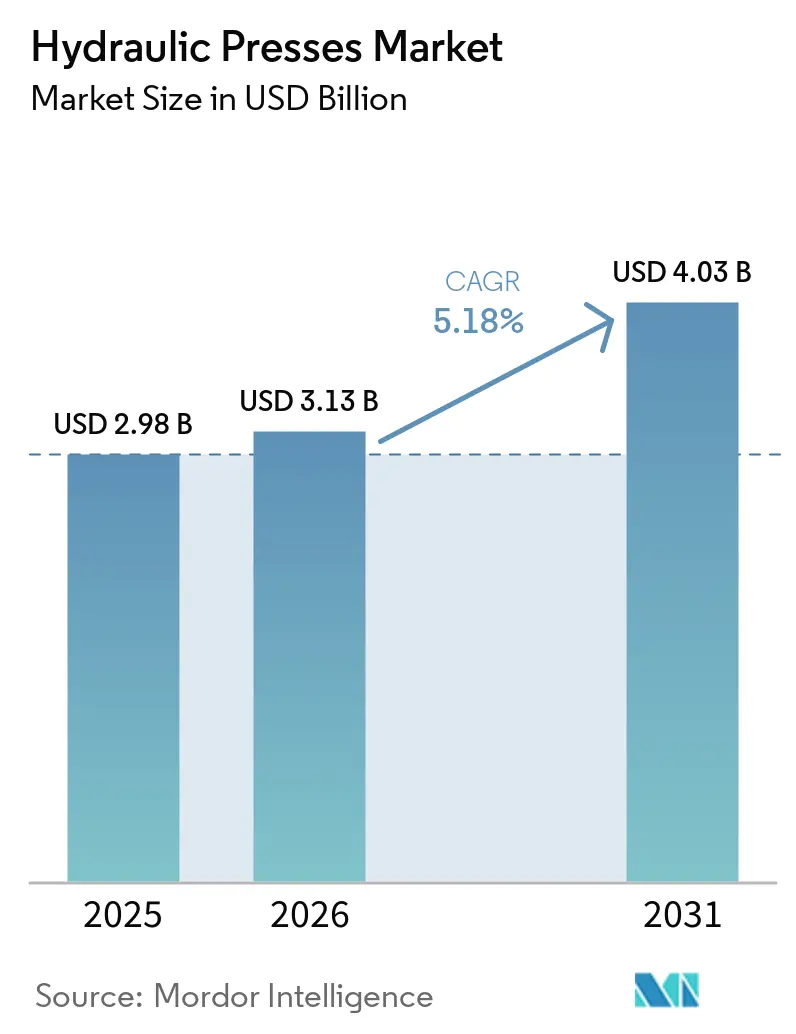
The Hydraulic Presses Market size is expected to increase from USD 2.98 billion in 2025 to USD 3.13 billion in 2026 and reach USD 4.03 billion by 2031, growing at a CAGR of 5.18% over 2026-2031.
Demand for engineered/configured systems is increasing in complex applications, while standard tonnage ranges remain highly price competitive. Electric vehicle production is changing the mix of automotive forming work, with more demand for aluminum structures, motor housing, battery enclosures, high-strength steel crash parts, and components that need greater control than standard high-volume stamping operations. Aerospace and defense programs are also supported by orders for large forging and composite-forming systems, such as aircraft engines, airframes, defense platforms, and national manufacturing programs that need titanium, superalloy, and structural parts produced within qualified supply chains. Automation, connected controls, energy management, and retrofit capability are becoming important parts of equipment purchasing decisions because manufacturers seek stronger traceability, better throughput, lower energy use, improved maintenance planning, and more life from installed assets. The hydraulic presses market remains price competitive in standard tonnage ranges, while established European and Chinese suppliers compete more strongly in engineered systems, creating openings for specialists in controls, service, tooling, refurbishment, application-specific machinery, and long-term support across the hydraulic presses market.
Key Report Takeaways
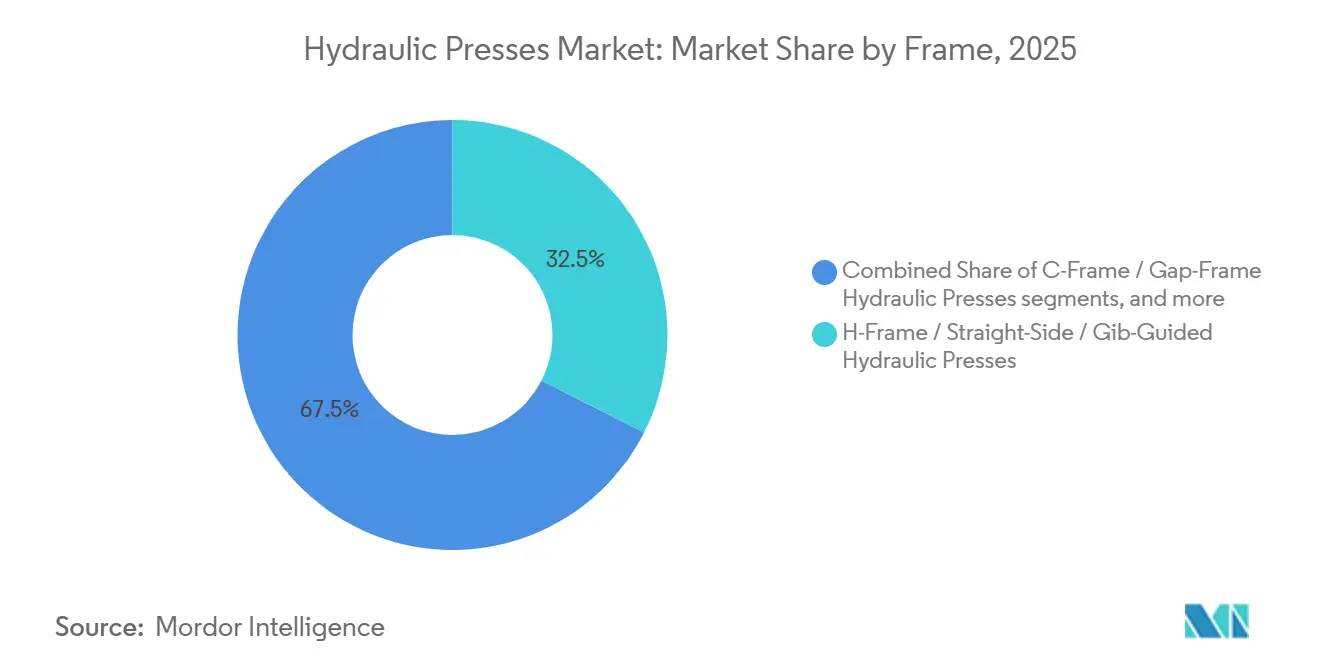
- By frame/structural configuration, H-frame/straight-side/gib-guided hydraulic presses accounted for 32.50% of the hydraulic presses market share in 2025, while four-post/four-column hydraulic presses are projected to be the fastest-growing, with a 5.90% CAGR through 2031.
- By tonnage/press force, 101–500 tons accounted for 42.00% of the hydraulic presses market size in 2025, while above 2,000 tons presses are projected to be the fastest-growing, with a 6.10% CAGR through 2031.
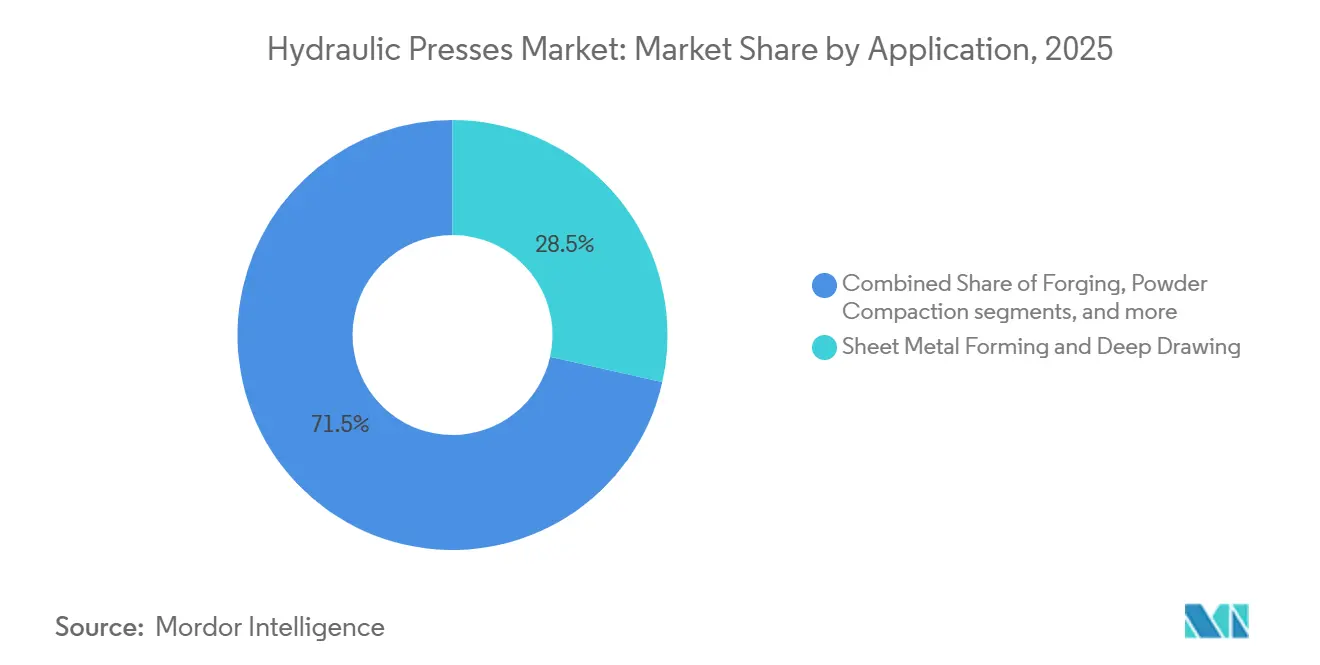
- By application/forming process, sheet metal forming and deep drawing accounted for 28.50% of the hydraulic presses market share in 2025, while forging is projected to be the fastest-growing, with a 5.80% CAGR through 2031.
- By end-use industry, automotive and transportation accounted for 34.00% of the hydraulic presses market share in 2025, while the aerospace and defense industry is projected to be the fastest-growing, with a 6.30% CAGR through 2031.
- By geography, Asia-Pacific accounted for 48.00% of the hydraulic presses market share in 2025, while the Middle East and Africa region is projected to be the fastest-growing, with a 6.40% CAGR through 2031.
Note: Market size and forecast figures in this report are generated using Mordor Intelligence’s proprietary estimation framework, updated with the latest available data and insights as of January 2026.
Global Hydraulic Presses Market Trends and Insights
Drivers Impact Analysis*
| Driver | (~) % Impact on CAGR Forecast | Geographic Relevance | Impact Timeline |
|---|---|---|---|
| Automotive Electrification and Lightweight Component Forming | +1.2% | Global, strongest in Asia-Pacific, North America, and Western Europe | Short term (≤ 2 years) |
| Increasing Use of High-Strength and Advanced Materials | +1% | Global, led by Europe, Japan, and South Korea | Medium term (2-4 years) |
| Automation of Forming and Manufacturing Processes | +0.8% | Global, strongest in China, Germany, and the United States | Medium term (2-4 years) |
| Expansion of Aerospace, Defense, and Heavy Manufacturing Capacity | +0.7% | North America, Europe, and India | Long term (≥ 4 years) |
| Industrial Modernization and Replacement of Aging Press Equipment | +0.6% | North America, Europe, and Japan | Medium term (2-4 years) |
| Demand for Energy-Efficient Hydraulic Systems | +0.5% | Global, with a policy focus on the European Union, Japan, and China | Medium term (2-4 years) |
| Source: Mordor Intelligence | |||
Automotive Electrification and Lightweight Component Forming
Electric vehicle programs are changing the type of work performed by press shops, including the materials, part dimensions, quality controls, and production sequences used in vehicle structures. Battery-electric vehicle structures use fewer conventional stampings in some areas. Still, they need more large aluminum sections, battery enclosure parts, and motor-related components that must fit within closely controlled assemblies. These parts often need deep drawing or control forming over a longer stroke, particularly where dimensional consistency affects joining, sealing, and later assembly work. Hydraulic equipment can provide programmable force and travel profiles for that work, allowing the process to be set for a particular part rather than a standard production cycle. According to an industry association, published in 2026 study examined 1,500 MPa-class cold-forming steel applications where controlled forming conditions matter for spring back and formability. The hydraulic presses market is therefore shifting toward machines with higher tonnage, closer position control, longer stroke capability, repeatable force delivery, and application-specific specifications.
Increasing Use of High-Strength and Advanced Materials
Advanced high-strength steel, aluminum, titanium, composites, and advanced ceramics place different demands on forming equipment because they respond differently to pressure, temperature, ram movement, and time under load. Generic press systems may not provide the staged compression, ram control, or hold-pressure cycles needed for these materials without additional engineering. Dual-phase steel requires careful control of ram velocity, while composite processing requires consistent pressure through the forming cycle and across the working surface. The University of Ljubljana reported in 2025 that a servo-hydraulic press expanded incremental sheet-forming capability for dual-phase DP590 steel. These requirements support investment in isothermal titanium forging, composite hot pressing, and powder compaction equipment, where conventional process settings are not sufficient. They also support higher equipment value, more specialized engineering work, longer replacement cycles, and demand for tailored systems in the hydraulic presses market.
Automation of Forming and Manufacturing Processes
Manufacturers are replacing stand-alone equipment with press systems connected to plant data and production management tools. This approach supports traceability, condition monitoring, faster process adjustments, a clearer record of how individual parts were made, and better visibility into equipment performance. Fraunhofer IWU reported in 2026 that its high-pressure sheet-metal-forming approach increased throughput from 8 to 60 cycles per minute through changes to the tool sequence and process design. Controls upgrades can also extend the useful life of existing machinery, reduce the need for full equipment replacement, and improve performance from assets already on the factory floor. This gives control providers and retrofit specialists a larger role in the hydraulic presses market, particularly where replacement budgets remain limited. It also makes service capability, software integration, diagnostics, and the ability to maintain upgraded equipment important considerations for press builders.[1]Fraunhofer IWU, “Fraunhofer IWU Puts Hydraulic Forming on the Fast Track,” Fraunhofer IWU, iwu.fraunhofer.de.
Expansion of Aerospace, Defense, and Heavy Manufacturing Capacity
Aerospace, defense, and heavy manufacturing programs require presses that can form large and difficult materials under controlled conditions over demanding qualification cycles. These projects often involve high capital spending because the equipment is tied to safety, quality, material, and production requirements that cannot be readily met with standard equipment. Safran Aircraft Engines announced in April 2026 that it is investing EUR 150 million (USD 163 million) in a 30,000-metric-ton hydraulic press at Gennevilliers. The press is intended to produce 14,000 forged parts annually for CFM LEAP, M88, GE90, and future civil engine programs, linking the investment to established and future engine supply needs. Such installations can support parts programs for many years after the original machine was purchased, since the equipment becomes part of the production route for qualified parts and future maintenance work. This gives suppliers in the hydraulic presses market continuing opportunities for tooling, maintenance, upgrades, spare parts, engineering changes, and technical support.
Restraints Impact Analysis*
| Restraint | (~) % Impact on CAGR Forecast | Geographic Relevance | Impact Timeline |
|---|---|---|---|
| High Capital Cost of Large and Engineered Hydraulic Press Systems | -1.2% | Global, most acute in cost-sensitive markets in South and Southeast Asia and South America | Short term (≤ 2 years) |
| Skilled Maintenance and Controls Engineering Requirements | -0.8% | Global, strongest in North America, Europe, and industrial Asia-Pacific | Medium term (2-4 years) |
| Long Investment and Replacement Cycles | -0.6% | Global, especially in North America, Western Europe, and Japan | Long term (≥ 4 years) |
| Hydraulic Fluid, Noise, and Energy-Efficiency Compliance | -0.4% | European Union, North America, and export markets with CE and EPA requirements | Medium term (2-4 years) |
| Source: Mordor Intelligence | |||
High Capital Cost of Large and Engineered Hydraulic Press Systems
Large hydraulic press systems require substantial upfront spending, especially when buyers need custom tooling, advanced controls, installation, training, validation, site-specific engineering, and performance testing. The purchase decision becomes more difficult when a machine must be imported or built for a single production program with a defined volume, quality standard, and delivery schedule. Equipment above 2,000 tons can require a multiyear capital plan, specialized site preparation, and coordination with the supplier before production can begin. Long delivery times for hydraulic and servo-drive components can add planning risk for buyers and make the timing of a project more difficult to manage. These conditions limit investment among smaller manufacturers and affect demand in cost-sensitive parts of Southeast Asia and South America, where financing can constrain equipment decisions. The hydraulic presses market also faces slower replacement decisions when a buyer can maintain an existing press, add a retrofit, or defer a large capacity addition.
Skilled Maintenance and Controls Engineering Requirements
Hydraulic presses need technicians who can manage mechanical, hydraulic, electrical, and controls issues across the full operating life of a machine. This need is increasing as servo-hydraulic systems, connected monitoring tools, digital production records, and more sophisticated control functions become common in press operations. Eaton reported in 2025 that 79% of surveyed machine-building experts identified the skills shortage as having a significant or very significant effect on operations. The United States Bureau of Labor Statistics projection cited by Texas State Technical College showed demand for more than 611,000 industrial machinery mechanics, maintenance workers, and millwrights by 2033. Limited technical staffing can lead to deferred maintenance, higher repair costs, slower fault resolution, extended downtime, and slower adoption of advanced machinery. It can also reduce the value buyers obtain from equipment in the hydraulic presses market when available machine capability cannot be supported on-site.[2]Texas State Technical College, “Skilled Maintenance Technicians Needed to Help Keep Texas Producing,” Texas State Technical College, tstc.edu.
*Our forecasts treat driver/restraint impacts as directional, not additive. The impact forecasts reflect baseline growth, mix effects, and variable interactions.
Segment Analysis
By Frame/Structural Configuration: H-Frame Leadership and Four-Post Growth
H-frame/straight-side/gib-guided equipment held 32.50% of the 2025 hydraulic presses market share. Their installed base reflects long-standing automotive and metal-fabrication investment in designs that provide ram guidance and structural rigidity. These presses are well-suited to precision deep drawing and transfer-line applications. Tight ram parallelism remains important for body-in-white and structural-component production. This configuration consequently remains central to established press lines and replacement demand.
Four-post/four-column machines are the fastest-growing configurations, registering a 5.90% CAGR through 2031. Their uniform platen loading supports composite hot pressing, large rubber molding, and aerospace laminate bonding. These operations need consistent loading over wide die areas. Rhodes Interform secured a November 2025 contract for three four-column hot-platen presses for aerospace composite structures. C-Frame equipment remains important for workshops and general manufacturing because it provides access and a compact footprint. Two-post, benchtop, tie-rod, and monoblock designs serve light assembly, laboratory, powder compaction, and other specialized tasks in the hydraulic presses industry.



By Tonnage/Press Force: Broad Demand for 101–500 Ton Systems
The 101–500 ton class accounted for 42% of the hydraulic presses market size in 2025. It fits the needs of mid-complexity structural stamping, aluminum forming, and powder compaction. Automotive suppliers, appliance manufacturers, and general fabricators use this capacity range across many production settings. This broad application base supports consistent replenishment demand. It also makes the class a core part of standard equipment portfolios.
The above-2,000-ton category is projected to grow fastest, registering a 6.10% CAGR through 2031. Demand comes from titanium forging for aero engines, heavy forming for defense platforms, and closed-die forging for trucks and agricultural equipment. Safran's 30,000-metric-ton press project shows the scale of investment in this capacity range. The Up-to-100-ton category continues to serve benchtop, assembly, and light-forming applications. The 501–1,000 ton and 1,001–2,000 ton groups serve automotive structural components and larger composite tooling. Their demand is tied to vehicle platform changes and aerospace composite-bonding investment across the hydraulic presses market.
By Application/Forming Process: Deep Drawing Leads, Forging Expands Fastest
Sheet metal forming and deep drawing held 28.5% of the hydraulic presses market share in 2025. The application supports automotive panels, appliance casings, kitchen products, sanitary components, and tin-plate packaging. These are high-volume and repeatable production processes. Their scale supports a large installed base of presses across manufacturing locations. The application remains the revenue anchor for the hydraulic presses market.
Forging is expected to be the fastest-growing application, registering a 5.80% CAGR through 2031. Aerospace titanium programs and near-net-shape forging for electric vehicle powertrains and structural parts support this position. ANDRITZ Schuler reported that Maxiforja began production with a 6,500-ton GLK 6500 forging press in July 2025. The installation includes a kinetic energy recovering system that can reduce power demand by up to 40% compared with conventional presses of equivalent scale. Bending and straightening, punching, blanking, coining, and compression molding remain mature applications. Hydroforming, powder compaction, assembly, and press fitting continue to serve specialized roles and fragmented installed bases.
By End-Use Industry: Automotive Volume and Aerospace Value
Automotive and Transportation accounted for 34.00% of the hydraulic presses market size in 2025. The sector uses presses for body-in-white parts, frame rails, exhaust systems, battery structures, and motor-housing forgings. Programmable force profiles support deep-draw and transfer-die operations. Automotive production, therefore, provides a large and steady base for equipment demand. The move to electric vehicles changes component requirements without removing the need for precision forming.
Aerospace and Defense is expected to grow fastest, registering a 6.30% CAGR through 2031. Fighter aircraft, turbofan engines, titanium airframe structures, and defense equipment require specialized forging and forming capacity with tightly managed process conditions. Safran's current Gennevilliers investment illustrates the scale and long service life of aerospace press programs. Industrial machinery, general manufacturing, electrical and electronics, and plastics, rubber, and composites create substantial installed-base demand across diverse operating environments. Energy and power equipment support transformer-lamination demand, while rail and marine applications support plate-forming demand for large components. These uses spread demand across the broader hydraulic presses market and reduce reliance on a single end-use sector.
Geography Analysis
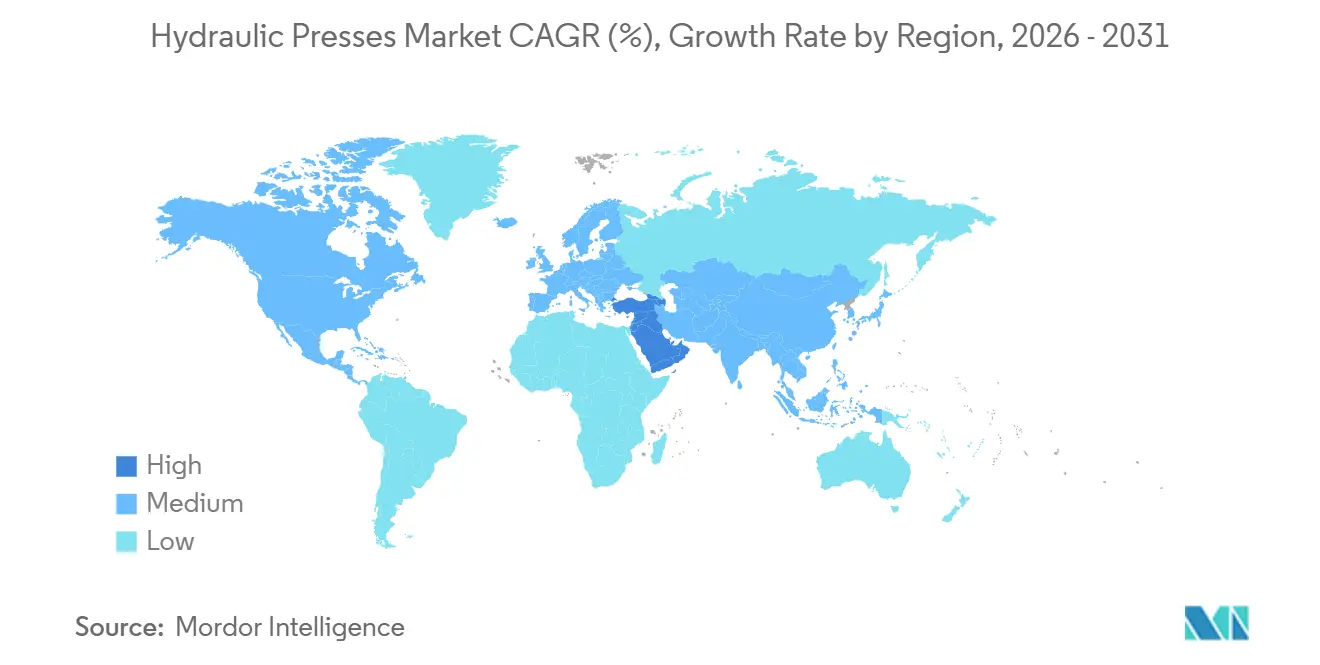
Asia-Pacific accounted for 48% of the global hydraulic presses market share in 2025. China is both a large producer and consumer of press equipment. Its domestic supplier base serves local manufacturing demand and exports at competitive prices. India is adding automotive and defense manufacturing capacity, including demand for higher-end forging equipment. South Korea remains important for precision equipment used in electronics and automotive stamping. Vietnam, Thailand, and Indonesia are receiving more press-intensive manufacturing as supply chains diversify beyond China. India’s Make in India policy and Production Linked Incentive programs support procurement in automotive and electronics production.
North America and Europe remain technology-intensive regions with demand for servo-hydraulic systems, connected production lines, and aerospace forging capacity. Germany and Italy remain important centers for European equipment manufacturing. The European Union Machinery Regulation 2023/1230 becomes fully applicable in January 2027 and replaces Directive 2006/42/EC. This rule increases the engineering requirements for safety-critical control systems and requires suppliers serving Europe to account for compliance in equipment design.[3]European Union Agency for Safety and Health at Work, “Regulation (EU) 2023/1230 on Machinery,” European Union Agency for Safety and Health at Work, osha.europa.eu.
The Middle East and Africa region is the fastest-growing region in the hydraulic presses market, registering a 6.40% CAGR through 2031. Manufacturing diversification in Gulf states and automotive assembly investment in Morocco and South Africa support demand for forming equipment. South America remains linked to agricultural equipment and heavy-truck production cycles, with Brazilian forging investment showing a higher level of capability in selected applications and a contrast with the region’s generally conservative capital-spending posture.

Competitive Landscape
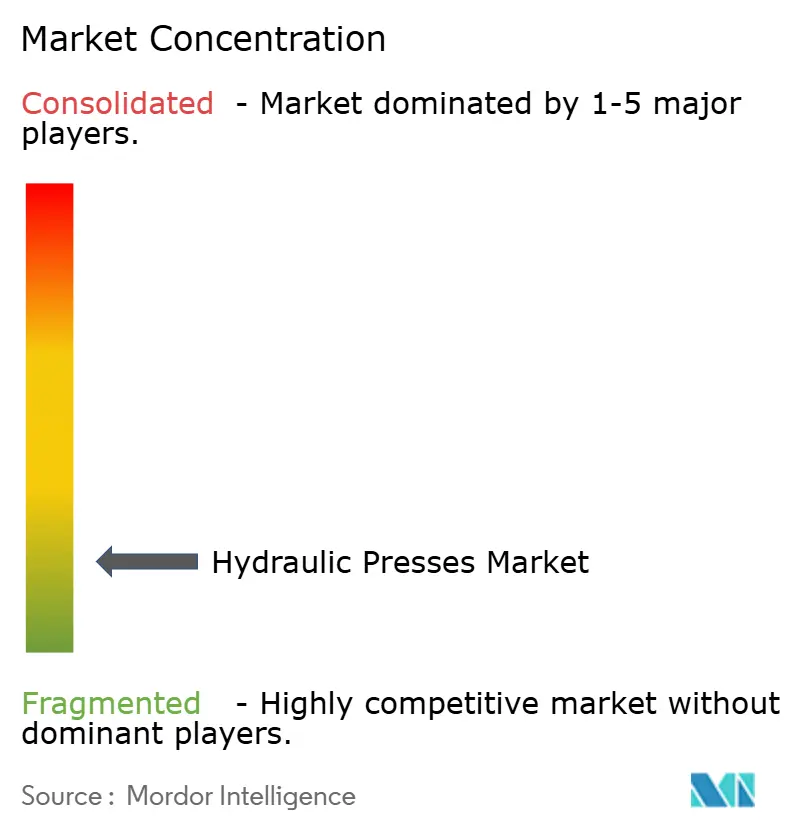
The hydraulic presses market is fragmented and has a divided competitive structure, with different buying criteria in premium projects and standard production equipment. A smaller set of suppliers serves high-tonnage and engineered-to-order systems where process knowledge, project execution, and installed support are important. A larger group of regional builders competes in mid-tier and lower-tonner industries where price, delivery time, and the ability to meet basic operating requirements shape the purchase decision. ANDRITZ Schuler, SMS group, Siempelkamp, and LASCO have positions in large systems through servo-hydraulic technology, energy recovery, and turnkey engineering. Their long customer relationships, customized specifications, and technical requirements can make supplier changes difficult after a production line is installed. Chinese suppliers, including Yangli Group, JIER Machine-Tool Group, Hefei Metalforming, and GENERTEC Tianduan, compete for mid-tonnage volume through pricing, acceptable technical standards, and expanding exports into ASEAN, South Asia, and Africa.
ANDRITZ Schuler launched the HFA plus+ fineblanking press series in January 2026. The series uses servo-controlled hydraulic pump drives and covers press forces from 3,200 to 15,500 kN. The company stated that the systems improve energy efficiency by a double-digit percentage while increasing stroke rates. The product line also includes Industry 4.0 interface capability. In July 2025, ANDRITZ Schuler delivered the 6,500-ton GLK 6500 press to Maxiforja in Brazil. These moves show how press builders are competing through performance, energy use, and production integration.
Retrofit and modernization work is a meaningful opportunity across older installed equipment, especially presses placed in service during the 1990s and 2000s. Controls and servo-drive upgrades can reduce energy use by 40% to 70% without replacing the press structure, which can be valuable where the mechanical frame remains suitable for production. Beckwood, Greenerd, and Macrodyne can benefit from this work in North America through service, rebuild, and upgrade projects. Connected controls vendors may also separate the digital layer of the machine from the press hardware, changing which suppliers influence operating performance. This could narrow differentiation to frame design, hydraulic engineering, service, and project execution in parts of the hydraulic presses market.
Hydraulic Presses Industry Leaders
ANDRITZ Schuler
SMS group GmbH
Siempelkamp Maschinen- und Anlagenbau GmbH
Jiangsu Yangli Group
Beckwood Press Company
- *Disclaimer: Major Players sorted in no particular order

Recent Industry Developments
- April 2026: Safran Aircraft Engines announced a EUR 150 million (USD 163 million) investment to acquire a 30,000-metric-ton hydraulic press at its Gennevilliers site near Paris. At full production rate, the press will manufacture 14,000 forged parts annually for CFM LEAP, M88, GE90, and future civil engine programs, and is expected to nearly double site output by 2035. The project will create 130 jobs from 2026, and the press will become operational in 2029.
- January 2026: ANDRITZ Schuler launched the HFA plus+ fineblanking press series, covering press forces from 3,200 to 15,500 kN with output up to 85 strokes per minute. Servo-controlled hydraulic pump drives improve energy efficiency by a double-digit percentage versus conventional fixed-speed systems while increasing stroke rates. The series also carries Industry 4.0 interface capability. ANDRITZ Schuler now operates this turnkey fineblanking system line directly, with Feintool AG contributing process and tooling expertise.
- July 2025: Maxiforja started production on a 6,500-ton GLK 6500 forging press from ANDRITZ Schuler at its Canoas, Brazil, facility. The press is the world’s largest forging press featuring a Kinetic Energy Recovering System. The system reduces power demand by up to 40% versus conventional presses of equivalent scale, and the Scotch Yoke drive mechanism improves component accuracy and reduces footprint. Maxiforja supplies heavy-duty truck and agricultural components across Latin America.


Global Hydraulic Presses Market Report Scope
The Hydraulic Presses Market Report is Segmented by Frame (C-Frame, H-Frame, Four-post, and More), by Tonnage (Up to 100 Tons, 101–500 Tons, and More), by Application (Forging, Powder Compaction, Bending and Straightening, and More), by End-User Industry (Automotive and Transportation, and More), and by Geography (Asia-Pacific, Europe, and More). The Report Offers Market Size and Forecasts in Value (USD) for all the Above Segments.
| C-Frame / Gap-Frame Hydraulic Presses |
| H-Frame / Straight-Side / Gib-Guided Hydraulic Presses |
| Four-Post / Four-Column Hydraulic Presses |
| Two-Post / Column Hydraulic Presses |
| Benchtop / Workshop Hydraulic Presses |
| Other Specialized Hydraulic Press Configurations |
| Up to 100 Tons |
| 101-500 Tons |
| 501-1,000 Tons |
| 1,001-2,000 Tons |
| Above 2,000 Tons |
| Sheet Metal Forming and Deep Drawing |
| Forging |
| Bending and Straightening |
| Punching, Blanking and Coining |
| Compression Molding |
| Powder Compaction |
| Hydroforming |
| Assembly, Press-Fitting and General Pressing |
| Other Specialized Applications |
| Automotive and Transportation |
| Aerospace and Defense |
| Industrial Machinery and General Manufacturing |
| Electrical and Electronics |
| Plastics, Rubber and Composites |
| Construction and Heavy Equipment |
| Energy and Power Equipment |
| Rail and Marine |
| Powder Metallurgy, Ceramics and Advanced Materials |
| Other End-Use Industries |
| North America | United States |
| Canada | |
| Mexico | |
| South America | Brazil |
| Argentina | |
| Rest of South America | |
| Europe | Germany |
| Italy | |
| France | |
| United Kingdom | |
| Spain | |
| Russia | |
| Rest of Europe | |
| Asia-Pacific | China |
| Japan | |
| India | |
| South Korea | |
| ASEAN(Singapore, Malaysia, Indonesia, Thailand, Vietnam, Philippines, Myanmar, Cambodia, Laos, Brunei) | |
| Australia | |
| Rest of Asia-Pacific | |
| Middle East and Africa | Saudi Arabia |
| United Arab Emirates | |
| Turkey | |
| South Africa | |
| Rest of Middle East and Africa |
| By Frame / Structural Configuration | C-Frame / Gap-Frame Hydraulic Presses | |
| H-Frame / Straight-Side / Gib-Guided Hydraulic Presses | ||
| Four-Post / Four-Column Hydraulic Presses | ||
| Two-Post / Column Hydraulic Presses | ||
| Benchtop / Workshop Hydraulic Presses | ||
| Other Specialized Hydraulic Press Configurations | ||
| By Tonnage / Press Force | Up to 100 Tons | |
| 101-500 Tons | ||
| 501-1,000 Tons | ||
| 1,001-2,000 Tons | ||
| Above 2,000 Tons | ||
| By Application / Forming Process | Sheet Metal Forming and Deep Drawing | |
| Forging | ||
| Bending and Straightening | ||
| Punching, Blanking and Coining | ||
| Compression Molding | ||
| Powder Compaction | ||
| Hydroforming | ||
| Assembly, Press-Fitting and General Pressing | ||
| Other Specialized Applications | ||
| By End-Use Industry | Automotive and Transportation | |
| Aerospace and Defense | ||
| Industrial Machinery and General Manufacturing | ||
| Electrical and Electronics | ||
| Plastics, Rubber and Composites | ||
| Construction and Heavy Equipment | ||
| Energy and Power Equipment | ||
| Rail and Marine | ||
| Powder Metallurgy, Ceramics and Advanced Materials | ||
| Other End-Use Industries | ||
| By Geography | North America | United States |
| Canada | ||
| Mexico | ||
| South America | Brazil | |
| Argentina | ||
| Rest of South America | ||
| Europe | Germany | |
| Italy | ||
| France | ||
| United Kingdom | ||
| Spain | ||
| Russia | ||
| Rest of Europe | ||
| Asia-Pacific | China | |
| Japan | ||
| India | ||
| South Korea | ||
| ASEAN(Singapore, Malaysia, Indonesia, Thailand, Vietnam, Philippines, Myanmar, Cambodia, Laos, Brunei) | ||
| Australia | ||
| Rest of Asia-Pacific | ||
| Middle East and Africa | Saudi Arabia | |
| United Arab Emirates | ||
| Turkey | ||
| South Africa | ||
| Rest of Middle East and Africa | ||


Key Questions Answered in the Report
What is driving demand for hydraulic presses through 2031?
Electric vehicle components, advanced materials, automation, and aerospace and defense capacity are supporting demand for specialized forming equipment.
How large is the hydraulic press market in 2026?
The hydraulic presses market size is USD 3.1 billion in 2026 and is forecast to reach USD 4.0 billion by 2031 at a 5.2% CAGR.
Which hydraulic press tonnage range has the greatest demand?
The 101–500 Ton category held 42% of revenue in 2025. This range has the greatest demand because it serves a broad range of applications, including automotive components, aluminum forming, and powder compaction.
Which application has the largest share of hydraulic press demand?
Sheet Metal Forming and Deep Drawing held 28.5% of revenue in 2025. This application leads because it is widely used for high-volume production of automotive panels, appliance casings, kitchen products, and other formed components.
Which region leads the hydraulic press demand?
Asia-Pacific held 48% of global revenue in 2025, while the Middle East and Africa region is forecast to grow fastest, registering a 6.40% CAGR through 2031.
Why are press retrofits important for manufacturers?
Controls and servo-drive upgrades can reduce energy use by 40% to 70% while extending the useful life of an existing press structure. This option can improve controls, monitoring, process consistency, and operating efficiency without requiring the capital commitment, site work, delivery planning, and commissioning associated with a complete equipment replacement.
Page last updated on:





