
Hybrid Quantum-Classical Computing Software Market Size and Share
Market Overview
| Study Period | 2020 - 2031 |
|---|---|
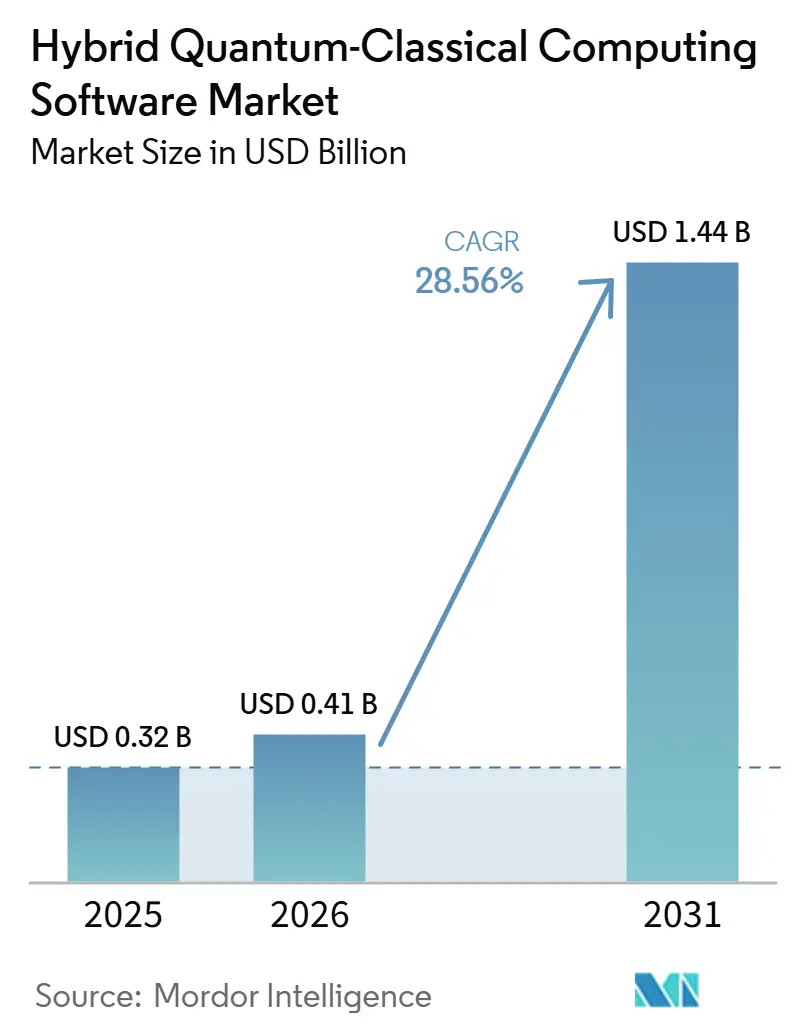
| Market Size (2026) | USD 0.41 Billion |
| Market Size (2031) | USD 1.44 Billion |
| Growth Rate (2026 - 2031) | 28.56% CAGR |
| Fastest Growing Market | Asia-Pacific |
| Largest Market | North America |
| Market Concentration | Medium |
Major Players *Disclaimer: Major Players sorted in no particular order Image © Mordor Intelligence. Reuse requires attribution under CC BY 4.0. | |
Hybrid Quantum-Classical Computing Software Market Analysis by Mordor Intelligence
The hybrid quantum-classical computing software market size is expected to increase from USD 0.32 billion in 2025 to USD 0.41 billion in 2026 and reach USD 1.44 billion by 2031, growing at a CAGR of 28.56% over 2026-2031. Growth is being shaped by broader cloud access to quantum systems, steady progress in error mitigation, and stronger enterprise demand for optimization and simulation workloads that do not fit neatly into classical computing environments. Buyers are also favoring software layers that can route jobs across several backend types, because that reduces dependence on any single hardware roadmap and makes pilot work easier to scale. This has made orchestration, compilation, and workflow management more central to vendor positioning than pure hardware claims in the current adoption cycle. At the same time, recurring demand is still constrained by fragmented toolchains, a limited pool of quantum-ready software talent, and the narrow set of workloads that can show production-grade advantage over classical alternatives. Even with these limits, the hybrid quantum-classical computing software market is creating room for vendors that combine cloud reach, usable development tools, and clear proof of value in enterprise pilots.
Key Report Takeaways
- By component, software led with a 76.82% revenue share in 2025, while services is projected to expand at a 30.54% CAGR through 2031.
- By deployment mode, cloud held a 72.14% revenue share in 2025, while cloud is also expected to record the highest CAGR at 29.82% through 2031.
- By technology, superconducting qubits accounted for a 46.63% revenue share of the hybrid quantum-classical computing software market in 2025, while trapped ions is forecast to grow at a 31.74% CAGR through 2031.
- By application, optimization captured 35.28% of revenue in 2025, while simulation and modeling is projected to expand at a 30.98% CAGR through 2031.
- By end-user industry, BFSI held 22.46% of the hybrid quantum-classical computing software market in 2025, while healthcare and life sciences is expected to grow at a 31.46% CAGR through 2031.
- By geography, North America accounted for 42.88% of revenue in 2025, while Asia-Pacific is projected to advance at a 31.92% CAGR through 2031.
Note: Market size and forecast figures in this report are generated using Mordor Intelligence’s proprietary estimation framework, updated with the latest available data and insights as of January 2026.
Global Hybrid Quantum-Classical Computing Software Market Trends and Insights
Drivers Impact Analysis*
| Driver | (~) % Impact on CAGR Forecast | Geographic Relevance | Impact Timeline |
|---|---|---|---|
| Rising Enterprise Demand for Hardware-Agnostic Hybrid Workflow Orchestration | +8.2% | Global, with early concentration in North America and Western Europe | Medium term (2-4 years) |
| Expanding Cloud Access to Quantum Development Environments | +7.1% | Global, with fast scale-up across Asia-Pacific | Short term (≤ 2 years) |
| Growth of Quantum Error Mitigation and Error Correction Toolchains | +5.4% | North America and Europe core, spill-over to Asia-Pacific | Medium term (2-4 years) |
| Increasing Use of Quantum Software in Optimization and Simulation Workloads | +3.8% | Global, led by North America, Japan, Germany | Short term (≤ 2 years) |
| Quantum-Ready Talent Shortage Accelerating Managed Software Adoption | +2.3% | Global, most acute in Europe and Asia-Pacific | Medium term (2-4 years) |
| Emerging Need for Quantum Intermediate Representation and Compiler Standardization | +1.6% | Global, driven by multi-backend enterprise deployments | Long term (≥ 4 years) |
| Source: Mordor Intelligence | |||
Rising Enterprise Demand for Hardware-Agnostic Hybrid Workflow Orchestration
Enterprises are organizing quantum work around portability, and that has made orchestration a central buying criterion in the hybrid quantum-classical computing software market. Buyers increasingly want applications that can run across superconducting, trapped-ion, and annealing environments without major rewrites to the surrounding business logic. This preference weakens tightly coupled software stacks and raises the value of compilers, schedulers, and workflow layers that sit above the hardware. IBM stated in June 2026 that its quantum network included more than 340 organizations and tied its more than USD 10 billion roadmap commitment to the software and ecosystem layers needed for broader adoption. That matters because recurring software revenue becomes less dependent on the release timing of specific processors when orchestration is hardware-agnostic. It also means the hybrid quantum-classical computing software market is rewarding vendors that make portability and workflow continuity easier inside existing enterprise environments.
Expanding Cloud Access to Quantum Development Environments
Cloud access has shortened the path from research interest to enterprise pilot activity in the hybrid quantum-classical computing software market. Companies no longer need to fund cryogenic hardware, specialist operating teams, or dedicated in-house infrastructure before they can test a workflow. IBM noted that its quantum cloud offering has expanded from a 5-qubit starting point to systems with more than 100 qubits, including the 120-qubit Nighthawk processor. AWS also deepened its collaboration with QuEra in June 2026 to bring a Megaquop-scale device roadmap to Amazon Braket, with the goal of one million quantum operations across hundreds of logical qubits by 2028.[1]AWS Quantum Technologies, “AWS Deepens Strategic Collaboration with QuEra to Bring Fault-Tolerant Quantum Computing to Amazon Braket,” AWS Quantum Technologies Blog, aws.amazon.com Wider cloud access is broadening demand not only among end users, but also among system integrators and software vendors that want to embed quantum calls inside classical enterprise applications. That pattern supports the hybrid quantum-classical computing software market because software adoption can grow before direct enterprise ownership of hardware becomes practical.
Growth Of Quantum Error Mitigation and Error Correction Toolchains
Error mitigation has moved closer to a commercial requirement in the hybrid quantum-classical computing software market. Buyers still accept near-term hardware limits, but they increasingly expect software that improves usable output quality and reduces the cost of extracting results. IBM reported in November 2025 that its updated Qiskit execution model and HPC-accelerated error mitigation reduced the cost of extracting accurate results by more than 100 times. The broader ecosystem is also maturing, with Unitary Foundation releasing Mitiq v1.0.0 in March 2026 as a stable open-source toolkit for zero-noise extrapolation, probabilistic error cancellation, and related techniques across near-term hardware backends. Better mitigation expands the set of workloads that can return useful outputs even before fault-tolerant hardware arrives at scale. As a result, the hybrid quantum-classical computing software market is gaining practical value from software improvements that sit above the physical qubit layer.
Increasing Use of Quantum Software in Optimization and Simulation Workloads
Optimization and simulation are giving the hybrid quantum-classical computing software market its clearest commercial use cases. These workloads already fit hybrid execution models, because classical solvers can handle large parts of the process while quantum routines target the hardest sections. IonQ and Einride reported in April 2026 that a hybrid quantum-classical freight dispatch workflow improved shipments delivered by a mean 1.7% against classical baselines, with best-case gains of 12.1% on individual schedules. IBM also highlighted a broader push toward commercially usable hybrid workflows through software, processor, and algorithm updates tied to larger problem handling. Measurable outcomes matter because procurement teams are more likely to approve multi-year engagements when software can be tied to a specific operational gain. That is why the hybrid quantum-classical computing software market is seeing demand build first around targeted business cases rather than broad enterprise-wide deployment.
Restraints Impact Analysis*
| Restraint | (~) % Impact on CAGR Forecast | Geographic Relevance | Impact Timeline |
|---|---|---|---|
| Limited Production-Grade Advantage Across Most Workloads | -4.8% | Global | Medium term (2-4 years) |
| Fragmented Toolchain Interoperability Across Backends | -3.2% | Global, most acute in multi-cloud enterprise environments | Short term (≤ 2 years) |
| High Integration Burden With Classical HPC and Enterprise IT Stacks | -2.6% | North America and Europe | Medium term (2-4 years) |
| Procurement Delays Driven by Unclear ROI and Vendor Lock-In Risk | -1.9% | Global, most acute among non-technology enterprises | Long term (≥ 4 years) |
| Source: Mordor Intelligence | |||
Limited Production-Grade Advantage Across Most Workloads
The largest restraint in the hybrid quantum-classical computing software market is still the narrow range of workloads that can prove a consistent production-grade advantage over optimized classical methods. Many pilots show technical promise, but that does not always translate into a procurement case that a business unit can defend over several budget cycles. The issue is not only performance, but also attribution, because hybrid workflows often rely on classical systems for most of the computational burden. That makes it harder for buyers to isolate the direct contribution of the quantum software layer when they assess value. This credibility gap slows the movement from pilot contracts to recurring licenses and managed service commitments. It also means the hybrid quantum-classical computing software market must sustain commercial interest for several years before fault-tolerant systems can support broader claims of dependable advantage.
Fragmented Toolchain Interoperability Across Backends
Interoperability remains a material constraint on the hybrid quantum-classical computing software market because each backend family has different execution, compilation, and calibration requirements. Enterprise engineering teams face extra work when they try to connect quantum routines to existing HPC, cloud, and internal application stacks. The QIR Alliance is developing Quantum Intermediate Representation on the LLVM framework to support hardware-agnostic program portability across vendors. A peer-reviewed study in The Journal of Supercomputing described a cross-platform execution engine for QIR, which shows that academic and commercial work is moving toward a more portable model.[2]Springer Nature, “A Cross-Platform Execution Engine for the Quantum Intermediate Representation,” The Journal of Supercomputing, springer.com Even so, specification progress does not remove the practical gap between a standard and consistent vendor implementation. Until that gap narrows, the hybrid quantum-classical computing software market will continue to absorb higher integration costs and slower deployment cycles.
*Our forecasts treat driver/restraint impacts as directional, not additive. The impact forecasts reflect baseline growth, mix effects, and variable interactions.
Segment Analysis
By Component: Software Dominance Masks a Services Inflection Point
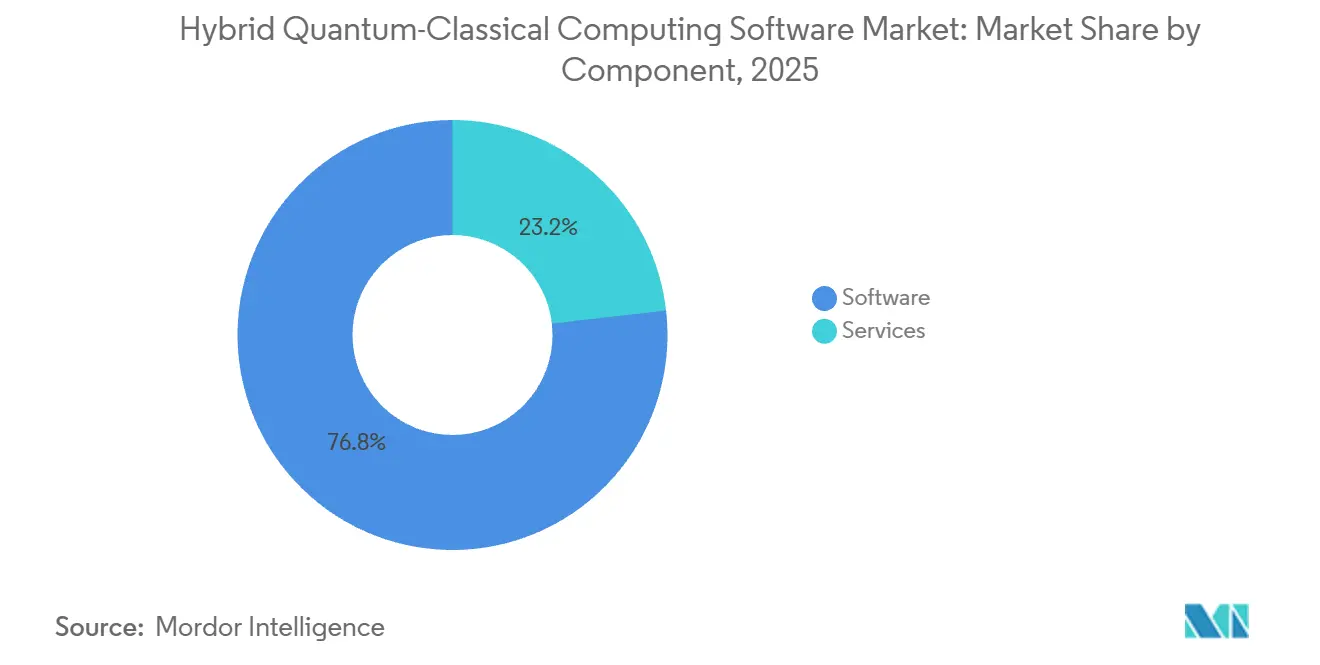
Software accounted for 76.82% of revenue in 2025, which gave it the largest share of the hybrid quantum-classical computing software market. In the current cycle, enterprise customers are still investing first in development frameworks, compilers, workflow layers, and orchestration platforms rather than fully outsourced execution models. That preference reflects a market stage where many buyers are building internal familiarity and testing how quantum workflows fit within broader digital and analytics programs. IBM's Qiskit ecosystem has been used by around 70% of quantum developers globally, which shows how software familiarity can become a durable advantage before broad hardware standardization takes shape. In practice, the vendors with strong software communities have had an easier time expanding training, tooling, and workflow libraries around early pilots.
The hybrid quantum-classical computing software market size for services is projected to expand at a 30.54% CAGR through 2031, making services the fastest-growing component segment. This shift reflects a simple commercial reality, because many enterprises can sponsor quantum work but cannot yet staff it with specialized in-house teams. Managed delivery, integration support, workflow tuning, and application design are therefore becoming more important to contract structure and vendor revenue mix. The hybrid quantum-classical computing software industry is starting to reward vendors that can standardize these services into repeatable delivery models rather than relying only on custom consulting-style engagements. That change matters because recurring managed support can lift adoption even when direct software self-service remains difficult for first-time buyers. Over time, the hybrid quantum-classical computing software market is likely to show a broader mix between platform revenue and service-led execution than it did in the earliest adoption phase.


By Deployment Mode: Cloud Entrenches as the Default Access Paradigm
Cloud delivery captured 72.14% of revenue in 2025, giving it the leading position in the hybrid quantum-classical computing software market share by deployment mode. Enterprises have favored pay-as-you-go access because hardware quality, uptime, and long-term architecture choices are still evolving across vendors. Cloud platforms also reduce internal friction by combining access, development tools, workflow controls, and error mitigation functions within one commercial path. IBM highlighted the scaling of cloud-accessible systems over the last decade, while AWS continued to deepen managed quantum access through Amazon Braket and its expanded QuEra roadmap. This structure supports faster pilot initiation and gives buyers a way to experiment across backend types without committing to a single ownership model.
Cloud is also the faster-growing deployment path, with a 29.82% CAGR projected for 2026-2031 in the hybrid quantum-classical computing software market. The commercial advantage of cloud is not limited to access alone, because it also supports hybrid architectures where HPC, AI tools, and quantum routines can be coordinated within broader enterprise environments. On-premises deployment remains a smaller channel today, but it is expected to gain relevance later in the forecast period where sovereignty, defense, and strict data handling rules outweigh cost efficiency. Even as on-premises demand grows, the hybrid quantum-classical computing software market is likely to remain cloud-led because cloud is still the easiest route to experimentation, scaling, and multi-backend portability.
By Technology: Trapped Ions Challenge Superconducting Incumbency
Superconducting qubits held 46.63% of revenue in 2025, which kept them in the leading position across the hybrid quantum-classical computing software market by technology. That lead reflects the scale of ecosystem development around incumbent platforms and the maturity of associated tooling available to developers and enterprise users. Superconducting environments benefit from installed base, training familiarity, and the depth of software libraries that have grown around major cloud-accessible systems. IBM's continued processor rollouts and software upgrades have supported that position by keeping the architecture visible and usable for enterprise experimentation. This is why incumbent strength in the hybrid quantum-classical computing software market remains tied not only to hardware scale, but also to the installed habits of developers.
Trapped ions are projected to grow at a 31.74% CAGR through 2031, making them the fastest-growing technology segment in the hybrid quantum-classical computing software market. Their momentum comes from stronger gate fidelity in certain use cases and from rising enterprise visibility through vendors such as IonQ and Quantinuum. IonQ's recent application-focused positioning has emphasized business-relevant benchmarking and workload outcomes rather than simple hardware claims, which fits current buyer behavior well. Quantum annealing continues to occupy a separate niche in combinatorial optimization, while other technologies remain earlier in ecosystem development and commercial standardization. D-Wave's January 2026 update on scalable on-chip cryogenic control also showed that alternative technical paths are still working to improve the practicality of larger systems.[3]D-Wave Quantum, “D-Wave Demonstrates First Scalable, On-Chip Cryogenic Control of Gate-Model Qubits,” D-Wave Investor Relations, ir.dwavequantum.com
By Application: Simulation and Modeling Moves Into the Commercial Spotlight
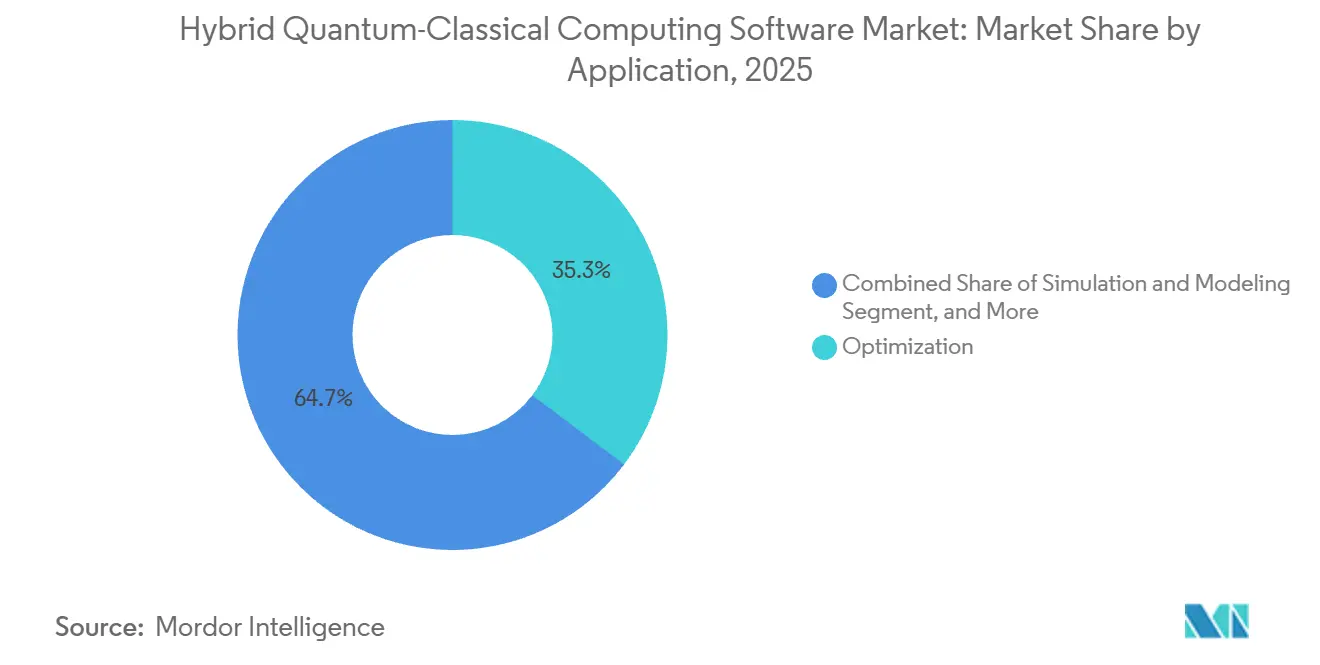
Optimization accounted for 35.28% of revenue in 2025, making it the largest application area in the hybrid quantum-classical computing software market. This lead reflects stronger commercial readiness in logistics, portfolio management, supply chain scheduling, and related use cases where hybrid solvers can be tested against clear performance baselines. Buyers have been more willing to fund these workloads because they can usually define a target outcome, compare it with current methods, and estimate business value with less ambiguity. IonQ and Einride's freight dispatch results added to that pattern by showing measurable improvement against classical baselines in a practical operational workflow. For vendors, optimization therefore remains the most direct path to proving that quantum software can matter in day-to-day enterprise decision environments.
The hybrid quantum-classical computing software market size for simulation and modeling is projected to expand at a 30.98% CAGR through 2031, making it the fastest-growing application segment. This rise is closely tied to drug discovery, materials science, and quantum chemistry problems where computational complexity rises quickly, and classical approximations can become limiting. IBM has continued to frame hybrid workflows as a practical route for larger scientific and industrial computing problems by linking software advances to more accurate and more scalable execution. Cryptography and security remain smaller today, but urgency is building as organizations prepare for future cryptographic transition work. Data analytics and financial modeling are also gaining attention, although they still require clearer production evidence before adoption becomes broad across the hybrid quantum-classical computing software industry.

By End-User Industry: Healthcare Emerges as the Structural Demand Driver
BFSI held 22.46% of revenue in 2025, which gave it the leading position in the hybrid quantum-classical computing software market by end-user industry. Financial institutions have been early users because optimization and risk modeling already fit structured decision problems that can justify pilot budgets and specialized experimentation. These buyers are also more familiar with advanced modeling environments, which lowers the organizational barrier to testing hybrid workflows. The commercial case is clearer when a bank or insurer can tie a workflow to allocation, routing, hedging, or portfolio design decisions. For that reason, BFSI has remained the anchor commercial segment in the hybrid quantum-classical computing software market even while many other industries are still evaluating their first practical use cases.
Healthcare and life sciences is forecast to grow at a 31.46% CAGR through 2031, making it the fastest-growing end-user segment. Demand here is aligned with molecular simulation, drug discovery, protein analysis, and broader scientific computing tasks that are hard to scale efficiently with classical methods alone. This area also benefits from a higher tolerance for approximate or staged progress when the scientific upside is significant and the long-term value of improved modeling is large. IBM's continued push around hybrid software, processor, and algorithm improvements supports this demand direction because life sciences users need usable software environments as much as they need better hardware. IT and telecom, industrial manufacturing, energy and utilities, government and public administration, retail and e-commerce, and media and entertainment remain relevant demand pools, but their commercial pacing is still more uneven across the hybrid quantum-classical computing software market.
Geography Analysis
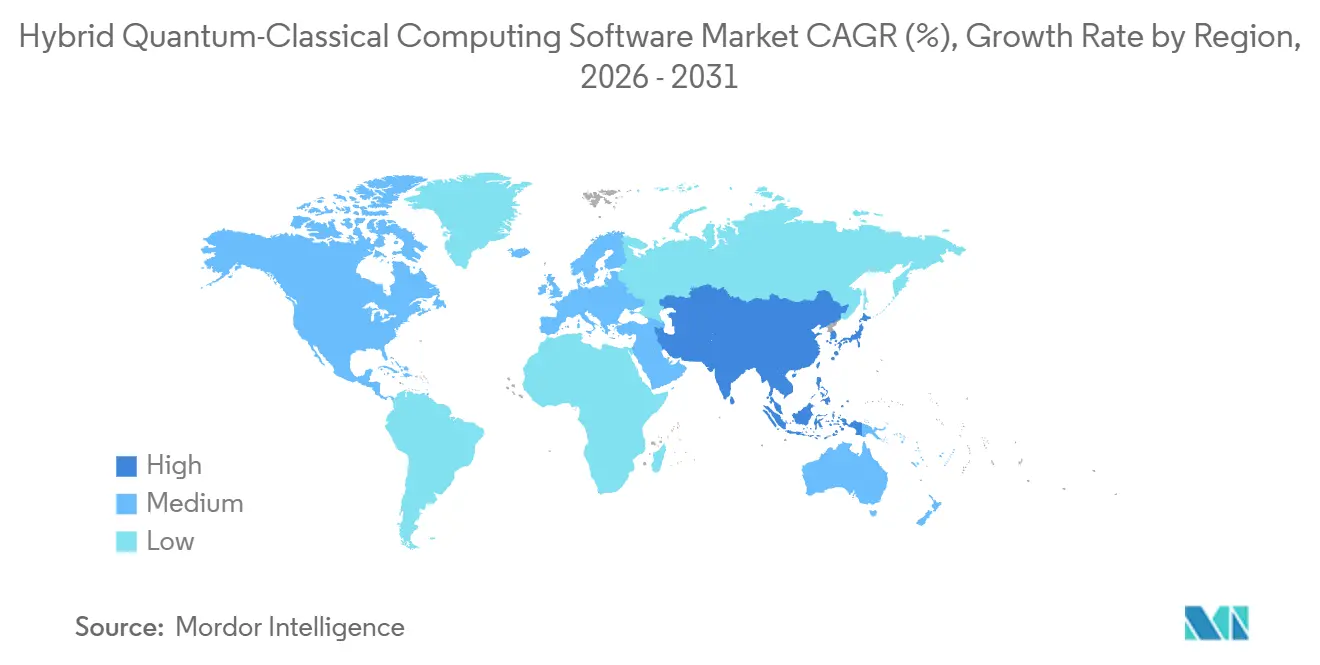
North America accounted for 42.88% of 2025 revenue, which gave it the largest hybrid quantum-classical computing software market share by region. The United States drove most of that demand through its concentration of quantum cloud infrastructure, enterprise early adopters, and software development talent. IBM's June 2026 roadmap commitment included manufacturing expansion at the Albany NanoTech Complex and new system deployments in Chicago and Amaravati, which reinforced the region's supply-side depth and ecosystem visibility. Canada added to this profile through its photonic ecosystem, while South America remained earlier in commercial adoption and relied more on cloud-based experimentation than on local hardware ownership.
Europe held a competitive position in 2025 and remained one of the most active regions for policy-backed commercial development in the hybrid quantum-classical computing software market. The United Kingdom, Germany, and France continued to shape regional activity through a mix of deep-tech vendors, pilot programs, and public support mechanisms. Germany still showed a meaningful implementation gap, with Bitkom reporting in 2026 that 69% of firms sought financial support for pilot projects and 67% wanted simplified cloud platform access. This pattern suggests that awareness has moved faster than operational readiness across large parts of the region. Europe also continued to place weight on open ecosystems, portability, and sovereignty considerations when buyers evaluated vendors and deployment models.
Asia-Pacific is projected to expand at a 31.92% CAGR through 2031, giving it the fastest regional growth profile in the hybrid quantum-classical computing software market. Japan has been a major regional anchor, with RIKEN operating IBM Quantum System Two and advancing quantum-centric supercomputing work that links quantum processors with HPC infrastructure. June 2026, Fujitsu and Daiichi Life Group launched joint research on asset allocation optimization using Fujitsu's 1,024-node quantum simulator cluster and quantum hardware.[4]Fujitsu Global, “Fujitsu and Daiichi Life Group Launch Joint Research to Advance Asset Management with Quantum Technology,” Fujitsu Press Release, global.fujitsu China and South Korea also continued to build domestic software capability through national quantum programs. The Middle East remained earlier in adoption but moved forward through partnership-led development and a stronger interest in locally controlled digital infrastructure. Africa was still nascent, yet lower barriers to cloud access can gradually widen future participation as regional digital programs mature.

Competitive Landscape
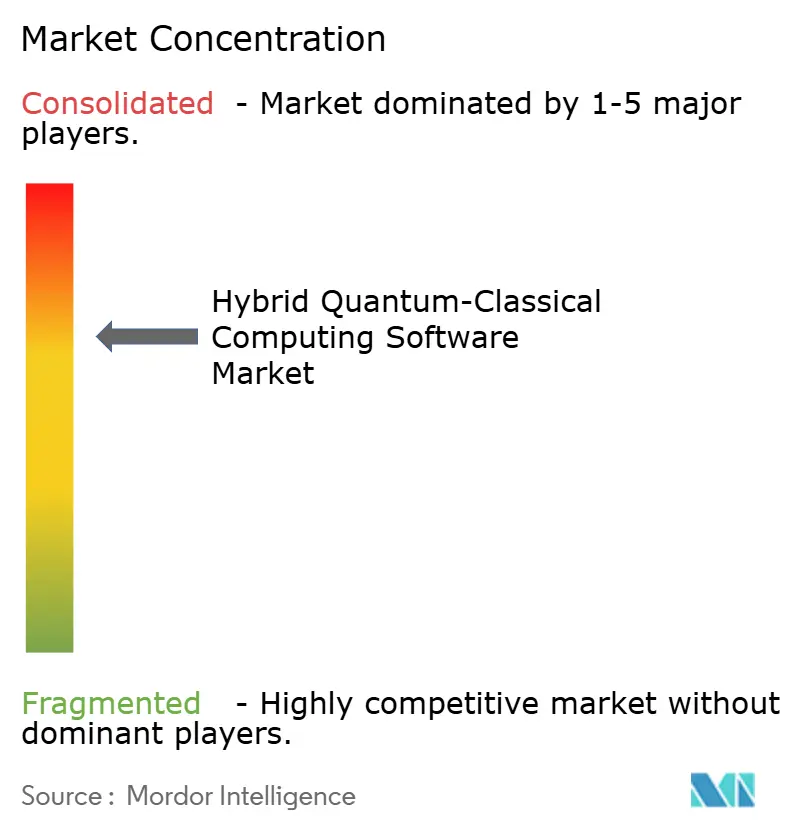
The hybrid quantum-classical computing software market is moderately consolidated at the platform layer, but it remains fragmented across specialized toolchains and application categories. IBM, Microsoft, and Amazon hold strong distribution advantages because their quantum access is tied to broader enterprise cloud relationships and development environments. IBM's scale is especially visible through its more than 90 deployed systems, and Qiskit's use by around 70% of quantum developers globally. That installed base creates a feedback loop around training, workflow familiarity, and software improvement that is difficult for smaller vendors to match quickly. The hybrid quantum-classical computing software market, therefore, still gives a clear advantage to providers that can combine hardware access, software tooling, and commercial reach in one ecosystem.
At the same time, meaningful whitespace remains in hardware-agnostic compilation, domain-focused application layers, and managed service delivery for enterprises that cannot build internal quantum teams. The QIR Alliance's work on Quantum Intermediate Representation and the related academic effort around cross-platform execution show why portability has become a real competitive theme rather than a technical side issue. Vendors that simplify circuit synthesis, backend switching, and integration with classical environments can reduce the operational burden on enterprise engineering teams. That is important because many buyers do not want to commit to one hardware path while the technology stack is still evolving. This part of the hybrid quantum-classical computing software market is likely to favor vendors that hide backend complexity and fit more naturally into existing cloud and HPC workflows.
Several strategic moves in 2025 and 2026 show how competition is being shaped. IBM's June 2026 funding plan and wafer foundry initiative linked software leadership to manufacturing scale and a longer roadmap toward fault-tolerant systems. AWS and QuEra expanded Amazon Braket toward a Megaquop-scale roadmap, which supports a broader long-term software ecosystem around chemistry, physics, and materials workloads. IonQ used both freight dispatch validation and an application-centric benchmarking framework to position its offering around measurable enterprise outcomes rather than abstract hardware claims.[5]IonQ, “Beyond Qubit Counts, Introducing IonQ’s Application-Centric Benchmarking Framework,” IonQ Blog, ionq.com As a result, the hybrid quantum-classical computing software market is still competitive, but leadership is moving toward vendors that combine accessible tools, credible workload evidence, and broad distribution.
Hybrid Quantum-Classical Computing Software Industry Leaders
IBM Corporation
IonQ, Inc.
Microsoft Corporation
Amazon.com, Inc.
D-Wave Quantum Inc.
- *Disclaimer: Major Players sorted in no particular order

Recent Industry Developments
- June 2026: IBM announced a commitment of more than USD 10 billion to quantum computing over 5 years, spanning R&D, capital expenditure, manufacturing, and ecosystem partnerships. The announcement included the launch of Anderon, described as the world's first pure-play quantum wafer foundry, established in collaboration with the U.S. Department of Commerce, positioning IBM to scale processor manufacturing for fault-tolerant systems beyond 2029.
- June 2026: AWS and QuEra Computing announced the expansion of their strategic collaboration to bring fault-tolerant quantum computing to Amazon Braket, targeting delivery of Libra, a Megaquop-scale device capable of 1 million quantum operations across hundreds of logical qubits by 2028, with initial applications in quantum chemistry, high-energy physics, and materials simulation.
- June 2026: Fujitsu and Daiichi Life Group launched a joint research initiative to advance quantum-based asset allocation optimization, leveraging Fujitsu's 1,024-node quantum simulator cluster and quantum hardware to validate quantum algorithm performance across real-world asset management scenarios, a model expected to inform institutional adoption roadmaps across Japan's financial sector.
- April 2026: IonQ and Einride published validated results of a hybrid quantum-classical optimization workflow for electric and autonomous freight dispatch, achieving a mean improvement of 1.7% in shipments delivered relative to classical baselines and best-case gains of 12.1% on individual schedules, representing one of the first peer-validated hybrid quantum advantages in industrial logistics.


Global Hybrid Quantum-Classical Computing Software Market Report Scope
The hybrid quantum-classical computing software market comprises software platforms, middleware, workflow orchestration engines, runtime environments, compilers, APIs, and development frameworks that enable seamless integration and coordinated execution of quantum processors with classical computing infrastructure, including CPUs, GPUs, and high-performance computing (HPC) systems. These solutions support hybrid algorithms, workload scheduling, circuit execution, optimization, simulation, data exchange, and resource management across heterogeneous computing environments. The market includes commercial software licenses, cloud-native platforms, and related implementation and support services, while excluding standalone quantum hardware, general-purpose HPC software, and quantum software used solely for simulation or programming without hybrid execution capabilities.
The Hybrid Quantum-Classical Computing Software Market Report is Segmented by Component (Software, and Services), Deployment Mode (Cloud, and On-Premises), Technology (Superconducting Qubits, Trapped Ions, Quantum Annealing, and Other Technologies), Application (Optimization, Simulation and Modeling, Cryptography and Security, Data Analytics and Financial Modeling, and Other Applications), End-User Industry (BFSI, Healthcare and Life Sciences, Retail and E-Commerce, IT and Telecom, Media and Entertainment, Industrial Manufacturing, Energy and Utilities, Government and Public Administration, and Other End-User Industries), and Geography (North America, South America, Europe, Asia-Pacific, Middle East, and Africa). The Market Forecasts are Provided in Terms of Value (USD).
| Software |
| Services |
| Cloud |
| On-Premises |
| Superconducting Qubits |
| Trapped Ions |
| Quantum Annealing |
| Other Technologies |
| Optimization |
| Simulation and Modeling |
| Cryptography and Security |
| Data Analytics and Financial Modeling |
| Other Applications |
| BFSI |
| Healthcare and Life Sciences |
| Retail and E-Commerce |
| IT and Telecom |
| Media and Entertainment |
| Industrial Manufacturing |
| Energy and Utilities |
| Government and Public Administration |
| Other End-User Industries |
| North America | United States |
| Canada | |
| Mexico | |
| South America | Brazil |
| Argentina | |
| Rest of South America | |
| Europe | Germany |
| United Kingdom | |
| France | |
| Spain | |
| Italy | |
| Russia | |
| Rest of Europe | |
| Asia-Pacific | China |
| India | |
| Japan | |
| South Korea | |
| Australia and New Zealand | |
| Rest of Asia-Pacific | |
| Middle East | Saudi Arabia |
| United Arab Emirates | |
| Turkey | |
| Rest of Middle East | |
| Africa | South Africa |
| Nigeria | |
| Egypt | |
| Rest of Africa |
| By Component | Software | |
| Services | ||
| By Deployment Mode | Cloud | |
| On-Premises | ||
| By Technology | Superconducting Qubits | |
| Trapped Ions | ||
| Quantum Annealing | ||
| Other Technologies | ||
| By Application | Optimization | |
| Simulation and Modeling | ||
| Cryptography and Security | ||
| Data Analytics and Financial Modeling | ||
| Other Applications | ||
| By End-User Industry | BFSI | |
| Healthcare and Life Sciences | ||
| Retail and E-Commerce | ||
| IT and Telecom | ||
| Media and Entertainment | ||
| Industrial Manufacturing | ||
| Energy and Utilities | ||
| Government and Public Administration | ||
| Other End-User Industries | ||
| By Geography | North America | United States |
| Canada | ||
| Mexico | ||
| South America | Brazil | |
| Argentina | ||
| Rest of South America | ||
| Europe | Germany | |
| United Kingdom | ||
| France | ||
| Spain | ||
| Italy | ||
| Russia | ||
| Rest of Europe | ||
| Asia-Pacific | China | |
| India | ||
| Japan | ||
| South Korea | ||
| Australia and New Zealand | ||
| Rest of Asia-Pacific | ||
| Middle East | Saudi Arabia | |
| United Arab Emirates | ||
| Turkey | ||
| Rest of Middle East | ||
| Africa | South Africa | |
| Nigeria | ||
| Egypt | ||
| Rest of Africa | ||


Key Questions Answered in the Report
What is the current and forecast value of hybrid quantum-classical computing software?
The hybrid quantum-classical computing software market was valued at USD 0.32 billion in 2025, stands at USD 0.41 billion in 2026, and is forecast to reach USD 1.44 billion by 2031 at a 28.56% CAGR.
Which deployment model leads to adoption in this space?
Cloud led with a 72.14% revenue share in 2025 and is also projected to post the fastest 29.82% CAGR through 2031, reflecting strong buyer preference for flexible access.
Which application area is attracting the most revenue today?
Optimization held the largest 2025 share at 35.28%, supported by portfolio management, logistics routing, supply chain scheduling, and related decision workflows.
Which end-user group is growing the fastest?
Healthcare and life sciences is projected to expand at a 31.46% CAGR through 2031, driven by stronger interest in molecular simulation, drug discovery, and scientific computing use cases.
Which region is expected to grow the fastest through 2031?
Asia-Pacific is forecast to grow at a 31.92% CAGR through 2031, supported by government-backed quantum programs and growing enterprise experimentation across major economies.
What is the main adoption barrier for enterprise buyers?
The main barrier is the limited number of workloads that can show clear production-grade advantage over classical methods, which slows budget approval and long-term software contracting.
Page last updated on:






