
Hybrid CRO Models and Tech-Enabled CRO Market Size and Share
Market Overview
| Study Period | 2020 - 2031 |
|---|---|
| Market Size (2026) | USD 17.82 Billion |
| Market Size (2031) | USD 28.56 Billion |
| Growth Rate (2026 - 2031) | 9.89 % |
| Fastest Growing Market | Asia Pacific |
| Largest Market | North America |
| Market Concentration | Medium |
Major Players *Disclaimer: Major Players sorted in no particular order Image © Mordor Intelligence. Reuse requires attribution under CC BY 4.0. | |
Hybrid CRO Models and Tech-Enabled CRO Market Analysis by Mordor Intelligence
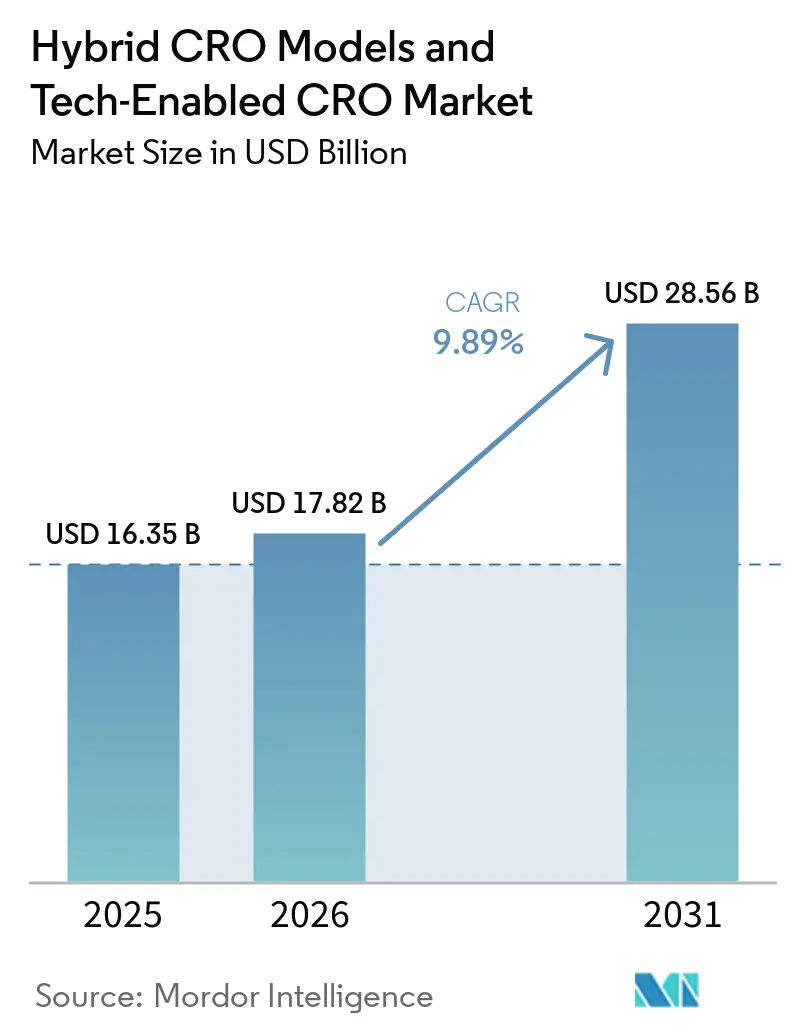
The Hybrid CRO Models And Tech-Enabled CRO Market size is projected to expand from USD 16.35 billion in 2025 and USD 17.82 billion in 2026 to USD 28.56 billion by 2031, registering a CAGR of 9.89% between 2026 and 2031.
The hybrid CRO models and tech-enabled CRO market are being shaped by trial designs that require broader operational, scientific, and data-management capabilities. Biologic, cell, and gene therapy programs add demanding logistics, specialist testing, and longer safety follow-up requirements. Sponsors are also using flexible delivery structures when they need outside support while retaining oversight of sensitive functions. The hybrid CRO models and tech-enabled CRO market are consequently moving toward delivery models that can allocate responsibility by function without obscuring sponsor accountability. Digital tools for patient matching, remote activities, and continuous data collection have become important in vendor selection. These conditions favor providers that combine therapeutic knowledge, integrated technology, and reliable governance across complex programs.
Key Report Takeaways
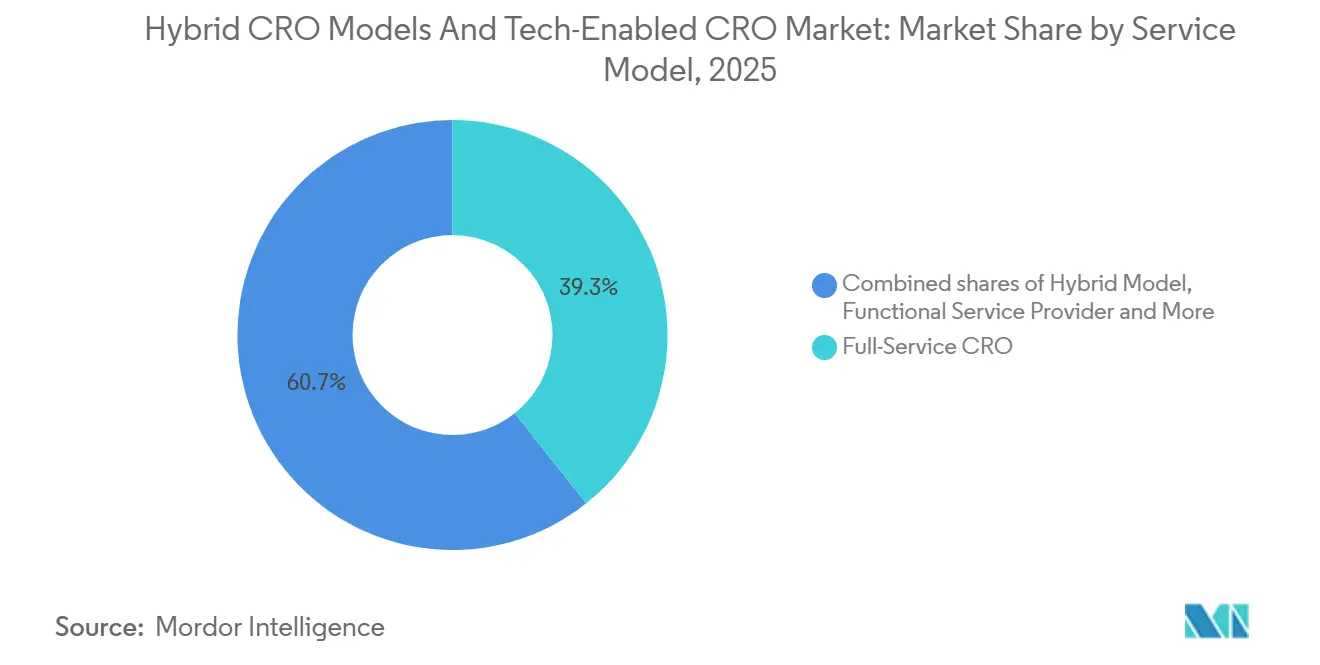
- By service model, Full-Service CRO held 39.31% of the hybrid CRO models and tech-enabled CRO market share in 2025, while the Hybrid Model is expected to record the highest CAGR at 10.65% through 2031.
- By service type, Clinical Trial Management accounted for 54.24% of the hybrid CRO models and tech-enabled CRO market size in 2025, while Data Management and Biostatistics are expected to advance at a 10.62% CAGR through 2031.
- By therapeutic area, Oncology held 35.14% of the hybrid CRO models and tech-enabled CRO market share in 2025, while Neuroscience is forecast to grow at a 10.42% CAGR through 2031.
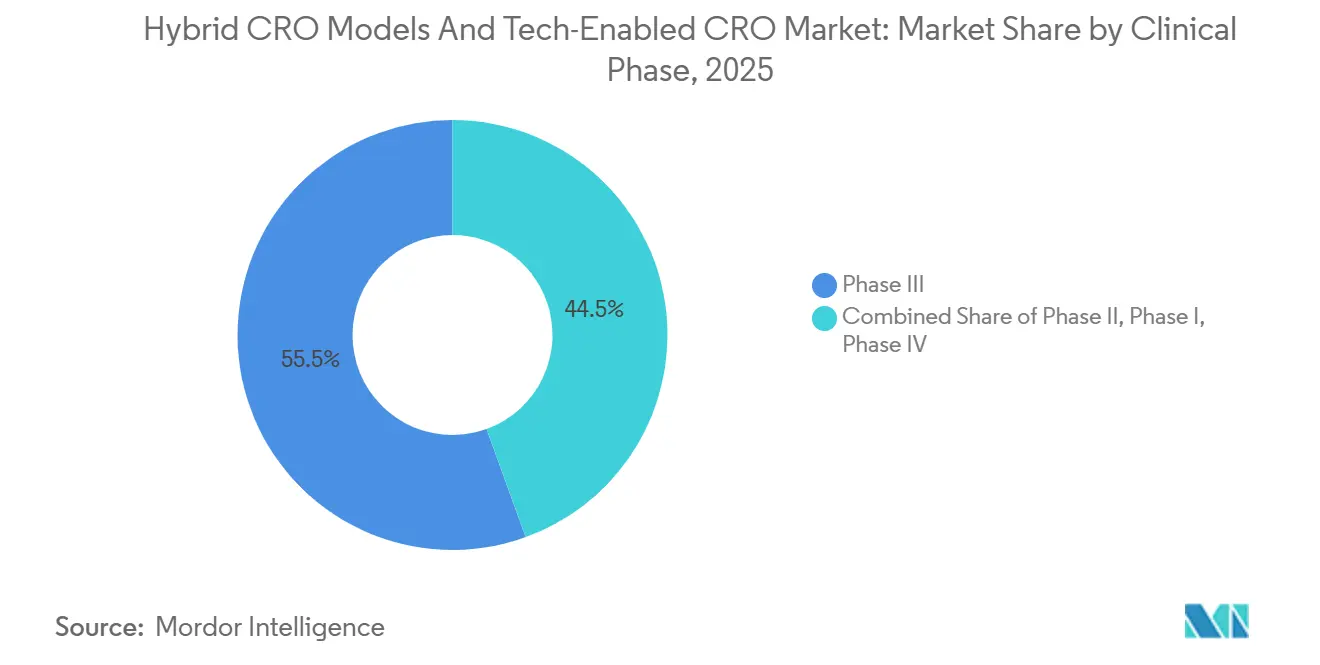
- By clinical phase, Phase III accounted for 55.54% of the hybrid CRO models and tech-enabled CRO market size in 2025, while Phase I is forecast to expand at a 10.33% CAGR through 2031.
- By end user, Pharmaceutical and Biopharmaceutical Companies commanded 71.61% of the segment in 2025, while Non-Profit and Government Sponsors are forecast to grow at a 10.85% CAGR through 2031.
- By geography, North America held 46.52% revenue share in 2025, while Asia-Pacific is expected to record the highest CAGR at 10.55% through 2031.
Note: Market size and forecast figures in this report are generated using Mordor Intelligence’s proprietary estimation framework, updated with the latest available data and insights as of January 2026.
Global Hybrid CRO Models and Tech-Enabled CRO Market Trends and Insights
Drivers Impact Analysis*
| Driver | (~) % Impact on CAGR Forecast | Geographic Relevance | Impact Timeline |
|---|---|---|---|
| Rising Clinical-Trial Complexity and Protocol Burden | +2.2% | Global | Long term (≥ 4 years) |
| Expansion of Biologic, Cell, and Gene Therapy Pipelines | +1.8% | Global, concentrated in North America and the Asia-Pacific | Long term (≥ 4 years) |
| Sponsor Demand for Flexible FSP, FSO, and Hybrid Delivery Models | +1.6% | Global | Medium term (2-4 years) |
| Increasing Adoption of Decentralized and Patient-Centric Trials | +1.4% | North America and the EU | Medium term (2-4 years) |
| AI-Enabled Patient Matching and Recruitment Optimization | +1.1% | Global | Short term (≤ 2 years) |
| Proprietary Real-World Data and Home-Health Networks as Differentiators | +0.8% | North America and the EU, with spillover to the Asia-Pacific | Medium term (2-4 years) |
| Source: Mordor Intelligence | |||
Rising Clinical-Trial Complexity and Protocol Burden
Median enrollment duration exceeded 16 months in 2025 as sponsors widened eligibility criteria and added biomarker-stratified endpoints that needed longer observation windows. The burden was not distributed evenly across programs because adaptive dosing, novel modalities, and multi-arm basket designs placed particular demands on Phase I studies. Oncology represented 38% of Phase I to Phase III industry-sponsored trial starts in 2025, and 1-third of those starts involved novel modalities. These programs require teams experienced in immunogenicity assessment, vector characterization, and long-term safety monitoring.
For the hybrid CRO models and tech-enabled CRO market, this raises the importance of teams that can apply the same operating discipline across specialist procedures, site training, product handling, and patient follow-up. ACRO members conducted or supported 7,634 studies involving 1.4 million patients in 2025, which shows the operational breadth available through established CRO platforms. Sponsors running 3 or more complex studies increasingly divide specialist functions among qualified providers rather than ask 1 full-service provider to duplicate every capability.
Expansion of Biologic, Cell, and Gene Therapy Pipelines
ASGCT-Citeline tracked 4,469 therapies across the development continuum in mid-2025, including 679 clinical-stage asset indications. The clinical-stage figure increased 5.3% from the first quarter of 2025, indicating continued development activity rather than a short-lived increase. The sector recorded USD 5 billion in investment during the first half of 2025 across 1,905 ongoing trials worldwide. North America, Europe, and the Asia-Pacific hosted 844, 453, and 750 active programs, respectively[1]American Society of Gene and Cell Therapy and Citeline, “Advances in Cell and Gene Therapy and the Evolving AAV Landscape in 2025 H1,” PackGene, packgene.com..
These studies require coordination among clinical operations, vector manufacturing, apheresis scheduling, and long-term patient follow-up. This need supports hybrid arrangements in which clinical providers work with specialist manufacturing partners and retain clear responsibility for each activity. The hybrid CRO models and tech-enabled CRO market benefit when those arrangements make complex work easier to coordinate without separating clinical decisions from manufacturing readiness.
Flexible FSP, FSO, and Hybrid Delivery Models
The hybrid CRO models and tech-enabled CRO market are benefiting from sponsor demand for delivery models that can change with program needs. PPD stated that 2-thirds of drug developers use FSP or hybrid FSP and FSO arrangements. These arrangements allow sponsors to retain control of data management and statistical analysis while assigning monitoring and other labor-intensive activities to service partners. Large pharmaceutical companies can use FSP support for recurring work and full-service support where internal experience or geographic reach is limited.
Mid-sized biotechnology companies often select a hybrid structure from 1 CRO because they do not have standing FSP governance capabilities. The approach gives sponsors flexibility, but it also places greater importance on transparent change management and defined decision rights. The hybrid CRO models and tech-enabled CRO market, therefore, favors organizations that document escalation routes, review performance together, and maintain visibility across every assigned function.
Decentralized and Patient-Centric Trial Adoption
The FDA finalized its guidance on decentralized trial elements in September 2024 and confirmed that existing requirements apply to both decentralized and traditional studies. The guidance addresses remote activities, digital health technologies, and off-site handling of investigational products[2]U.S. Food and Drug Administration, “Conducting Clinical Trials with Decentralized Elements, Guidance for Industry, Investigators, and Other Interested Parties,” Federal Register, govinfo.gov.. Patient-centered designs can use wearable data and telehealth visits, but they also require dependable device logistics, data aggregation, and local healthcare coordination. AI-enabled patient matching and recruitment tools are increasingly important because they can help providers identify appropriate sites and participants earlier.
Home-health networks and real-world data assets can strengthen an integrated provider’s position when remote services are part of the protocol. The hybrid CRO models and tech-enabled CRO market, therefore, rewards platforms that can connect digital processes with accountable clinical delivery. The value of these systems rests on their ability to work within established trial responsibilities rather than add a disconnected layer of technology.
Restraints Impact Analysis*
| Restraint | (~) % Impact on CAGR Forecast | Geographic Relevance | Impact Timeline |
|---|---|---|---|
| Cross-Platform Data Interoperability Gaps | -1.4% | Global | Medium term (2-4 years) |
| Fragmented Privacy and Cross-Border Data-Transfer Requirements | -0.9% | EU, North America, and cross-border programs in the Asia-Pacific | Long term (≥ 4 years) |
| Shortage of Digital Clinical-Operations Talent | -0.6% | Global | Short term (≤ 2 years) |
| Vendor-Integration Risk in Multi-Provider Hybrid Programs | -0.5% | Global | Medium term (2-4 years) |
| Source: Mordor Intelligence | |||
Cross-Platform Data Interoperability Gaps and Digital Talent Constraints
Cloud-native EDC systems, wearable platforms, eCOA tools, laboratory systems, and risk-based monitoring applications can create difficult integration work in multi-provider programs. ACRO reported that 71% of member CROs used AI for data management in 2025, the highest adoption rate across the CRO operational lifecycle. These systems still depend on clean, structured, standardized inputs, which fragmented platform designs do not always provide without manual preparation. The handoff between CRO-led site monitoring and sponsor-managed EDC systems is especially sensitive because it often marks the boundary of a hybrid contract.
A shortage of digital clinical operations talent can prolong reconciliation and limit the speed at which organizations deploy more advanced tools. The hybrid CRO models and tech-enabled CRO market will continue to face vendor-integration risks when roles, data ownership, and system interfaces are not established at program launch. Clear specifications, defined data standards, and early testing of handoffs can reduce the operational disruption that develops when several organizations use separate platforms.
Fragmented Privacy and Cross-Border Data-Transfer Requirements
The European Health Data Space Regulation entered into force in March 2025, and the EU Clinical Trials Information System became mandatory for all trials in January 2025. These measures add common procedures, but they also require providers to manage detailed governance obligations across multi-country programs. The GDPR provides special protections for health data, including Transfer Impact Assessments when data moves outside the EEA. German data protection authorities issued further guidelines on international health data transfers in medical research during September 2025.
Sponsors in Asia-Pacific also face China’s data localization requirements and India’s Digital Personal Data Protection Act. These requirements favor CROs that have country-level privacy expertise and can manage legal responsibilities across the full program. In the hybrid CRO models and tech-enabled CRO market, this can make privacy planning a core delivery consideration instead of a final review before data transfer or analysis.
*Our forecasts treat driver/restraint impacts as directional, not additive. The impact forecasts reflect baseline growth, mix effects, and variable interactions.
Segment Analysis
By Service Model: Hybrid Arrangements Challenge Full-Service Incumbency
Full-Service CRO held 39.31% of the service model segment in 2025. This established base gave large providers a significant operating role in programs that need one accountable partner across countries, functions, and study stages. Its position reflected the need among small and mid-sized biotechnology companies for accountable support from Phase I through Phase III. Emerging biopharma companies drove 68% of clinical trial starts in 2025, and many relied on outside providers for end-to-end development support. The Hybrid Model is forecast to record a 10.65% CAGR from 2026 to 2031. Large pharmaceutical companies use it to combine full-service delivery in complex settings with embedded FSP teams for recurring analytical work.
Virtual CRO and Functional Service Provider offerings remain smaller, but they appeal to biotechnology companies seeking rapid deployment without building fixed internal capacity. Hybrid contracts often give each function a separate governance and pricing structure. That approach allows sponsors to adjust work packages as programs change. It can also support lasting relationships when a provider earns a broader scope as a program progresses. Providers must have disciplined change-order processes and integrated oversight if they are to manage those arrangements effectively. The hybrid CRO models and tech-enabled CRO market benefits from this discipline because each function can change at a different pace as study protocols, enrollment conditions, or data needs evolve.



By Service Type: Data Management and Biostatistics Gain Importance
Clinical Trial Management commanded 54.24% of the service type segment in 2025. Its scale reflected the continued need to organize site activation, investigator support, monitoring plans, patient visits, and the practical flow of information from sites to sponsors. The segment remains central because Phase II and Phase III programs need site activation, monitoring, and coordinated data collection. Data Management and Biostatistics is expected to grow at a 10.62% CAGR from 2026 to 2031. Drug Development Strategy, Regulatory and Consulting, and Other Service Types also have meaningful roles where sponsors need scientific depth. These functions can become important elements within a hybrid program, especially when a specialized provider supports a defined activity.
Adaptive trial designs require ongoing interim analysis, rather than a traditional model focused mainly on final database lock. Bayesian adaptive frameworks and real-time safety monitoring can require biostatistics support throughout the trial. ACRO reported that 71% of member CROs used AI in data management during 2025. This pattern places data services at the center of technology competition among CROs. It also makes the hybrid CRO models and tech-enabled CRO market more dependent on systems that can collect, clean, review, and present trial information in forms that support sponsor decisions. The hybrid CRO models and tech-enabled CRO industry is therefore directing more attention to analytical infrastructure that supports reliable submissions and timely decisions.
By Therapeutic Area: Oncology Leads While Neuroscience Expands
Oncology held 35.14% of the therapeutic area segment in 2025. The hybrid CRO models and tech-enabled CRO market continued to depend on oncology programs because their operational demands extend from eligibility screening and specialist sites to careful safety follow-up. Its position reflected extensive pipeline activity and demanding protocols. Oncology represented 38% of Phase I to Phase III industry-sponsored trial starts in 2025. A large share of those studies involved novel modalities that need specialist monitoring and safety support. Immunology and Inflammation, Infectious Diseases, and Metabolic Diseases remained important areas for R&D activity.
Neuroscience is forecast to grow at a 10.42% CAGR from 2026 to 2031. Programs in neurodegeneration, psychiatric conditions, and rare neurological diseases require specialized outcome measures. Cognitive scales, imaging biomarkers, and eCOA or PRO instruments require trained staff and consistent trial operations. Cardiovascular and Ophthalmology remain smaller but stable therapeutic areas. Ophthalmology also benefits from advancing gene therapy approaches for inherited retinal diseases. These therapeutic differences require providers to combine common clinical processes with specialist training, which is why the hybrid CRO models and tech-enabled CRO market cannot rely only on generalized operating scale.
By Clinical Phase: Phase I Becomes a Technology Test Case
Phase III retained 55.54% of the clinical phase segment in 2025. Its continuing scale reflected the number of patients, countries, investigators, monitoring activities, and data checks needed to support studies intended for regulatory submissions. Large late-stage studies continue to require extensive enrollment, site management, and regulatory coordination. Hybrid arrangements are particularly relevant to Phase III studies that use different specialist partners across countries. Phase I is forecast to grow at a 10.33% CAGR from 2026 to 2031. The growth follows an increasing number of first-in-human programs involving cell and gene therapies and bispecific antibodies.
Pre-Clinical and Phase I activities can establish the sponsor relationship earlier in development. Providers that offer early safety assessment, feasibility work, and specialized Phase I operations can create a more connected development path. AI-supported site selection can be especially useful when an early study needs to identify appropriate investigators quickly. Phase IV and Post-Marketing services are also receiving attention as real-world data becomes more important to lifecycle management and reimbursement discussions. These requirements extend the demand for specialized data and operational support beyond pivotal trials. The hybrid CRO models and tech-enabled CRO market can consequently develop relationships that continue from early feasibility through evidence generation after product approval.
By End User: Government Sponsors Expand Their Role
Pharmaceutical and Biopharmaceutical Companies commanded 71.61% of end-user spending in 2025. Their position reflected high R&D spending and continued dependence on CRO infrastructure as clinical teams did not expand in line with pipeline volume. Medical Device Companies form a separate customer group with operational needs that differ from drug trials. Non-Profit and Government Sponsors are forecast to expand at a 10.85% CAGR from 2026 to 2031. This growth reflects clinical research procurement for medical countermeasures, vaccines, infectious disease response, and related programs.
Government-sponsored studies can require specialized compliance systems and documented experience with public procurement. Providers with active BARDA, NIH, and DoD engagement capabilities have made deliberate investments in these requirements. Providers without established contract vehicles and relevant performance records can face material barriers to entry. The hybrid CRO models and tech-enabled CRO market give added weight to those capabilities because digital delivery alone does not address procurement eligibility. Demand across commercial and public sponsors is also moving toward partners that can sustain adaptive clinical operations teams. This direction broadens the hybrid CRO models and tech-enabled CRO market beyond the traditional focus on monitoring capacity and places more value on repeatable coordination across functions.
Geography Analysis
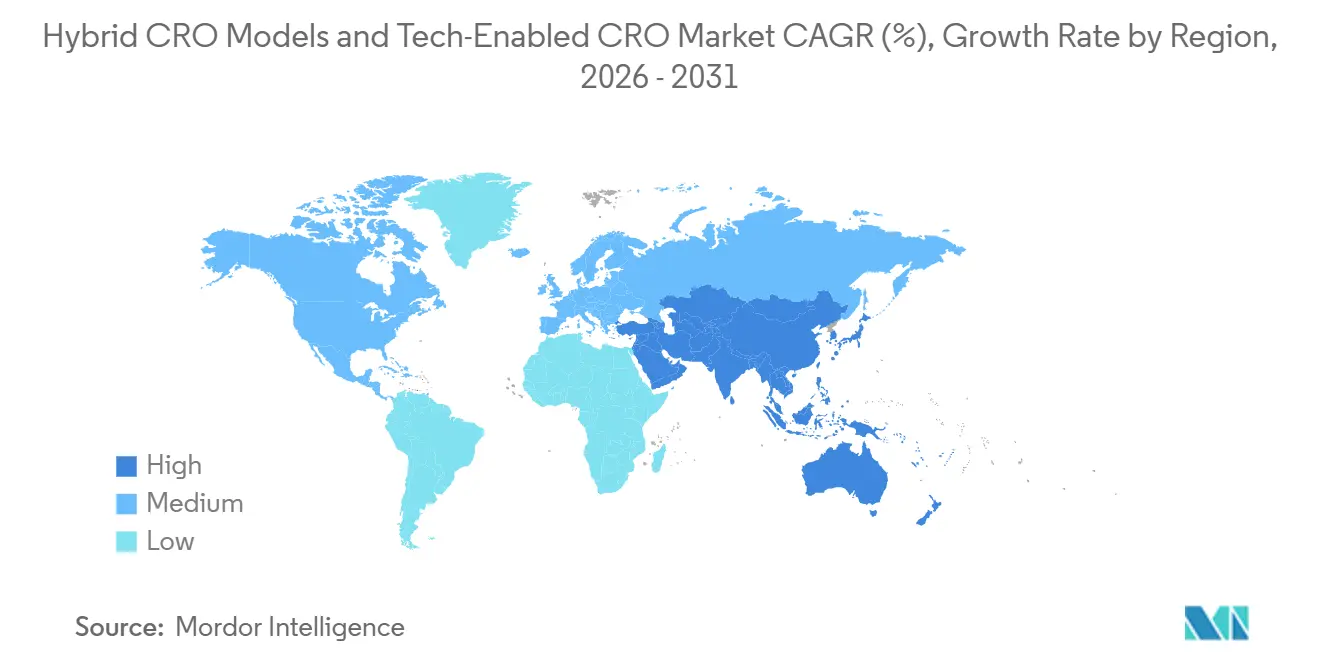
North America held 46.52% of the geographic segment in 2025. The close presence of sponsors, research sites, specialized laboratories, and experienced development teams supported the hybrid CRO models and tech-enabled CRO market size in North America. The region benefited from a dense concentration of pharmaceutical and biotechnology sponsors, global CRO headquarters, and Phase I clinical units. Emerging biopharma companies drove 68% of clinical trial starts in 2025 and relied on CRO partnerships for end-to-end development capability. Canada and Mexico add regulatory pathways that support multinational protocols requiring regional data. The United States employed 125,498 CRO workers in 2025, reflecting substantial clinical operations, data management, and regulatory capacity[3]Association of Clinical Research Organizations, “State of the Industry Report,” Association of Clinical Research Organizations, acrohealth.org..
Europe was the second-largest region, with Germany, the United Kingdom, France, Italy, and Spain as key site activation locations. These countries support oncology, neuroscience, immunology, cardiovascular, and other late-stage programs. The United Kingdom’s MHRA framework continued to support early-phase research after Brexit. Germany and France retained strong academic medical center networks for large programs. Mandatory use of the EU Clinical Trials Information System and the European Health Data Space Regulation increased governance demands for multi-country studies. For the hybrid CRO models and tech-enabled CRO market, this can increase the advantage of providers that can apply common operating procedures while adapting to local requirements.
Asia-Pacific is forecast to grow at a 10.55% CAGR from 2026 to 2031. China led Phase I activity globally in 2025, while India employed 48,794 CRO workers and expanded first-in-human capacity. China’s local patient participation requirements for pivotal Phase III programs support demand for established NMPA expertise and site networks. Japan, South Korea, and Australia offer different patient populations and regulatory pathways for regional program design. The hybrid CRO models and tech-enabled CRO market can use these differences to create multi-country programs that give sponsors wider regional evidence while keeping practical execution close to local sites. Middle East and Africa, particularly GCC countries and South Africa, and South America, led by Brazil and Argentina, remain smaller locations where investment in local networks and regulatory consulting supports oncology, infectious disease, and vaccine research.

Competitive Landscape
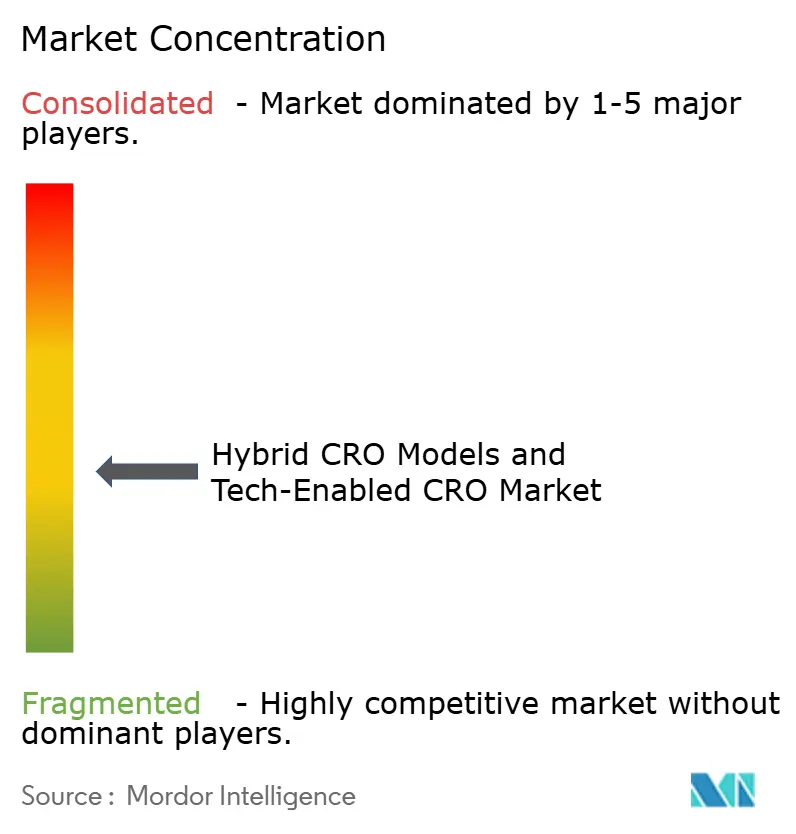
The hybrid CRO models and tech-enabled CRO market is moderately concentrated, with the 5 largest providers holding a significant share of broader clinical trials services revenue. Large CROs are combining technology acquisitions with investments in enterprise platforms that strengthen analytical capabilities. This approach supports a broader role across the development process rather than a narrow clinical delivery mandate. It also makes technology integration more central to the way providers compete for complex programs. The remaining providers compete through therapeutic specialization, regional delivery, and proprietary digital assets. The hybrid CRO models and tech-enabled CRO market remain open to focused providers when they can deliver a narrow capability with greater consistency or speed than a broader organization.
PSI CRO introduced its SYNETIC platform in January 2026 to support site identification, start-up, and enrollment through AI-enabled workflows. The platform demonstrates how targeted technology can support feasibility and Phase I activities where speed and appropriate site selection are important. Mid-tier and specialist CROs can gain share when they offer strong therapeutic knowledge, faster governance decisions, and modular delivery structures. Medpace and Novotech are developing differentiated cell and gene therapy and Asia-Pacific expertise, respectively. Their positions show that specialized knowledge can be decisive where a broad scale does not directly resolve program complexity. The hybrid CRO models and tech-enabled CRO market also recognize that an effective program must connect specialized expertise with sponsor governance and practical site-level delivery.
Integrated cell and gene therapy delivery remains an area where clinical operations, manufacturing coordination, regulatory requirements, and patient registries must work together. This creates room for providers that can coordinate specialist partners without weakening accountability. Science 37’s virtual-first model shows how remote execution can compete with site-based approaches when the protocol is suited to that structure. Providers that remain dependent on separate technology suppliers can face pricing pressure and difficult system handoffs. The provider landscape still leaves room for specialists who can deliver consistently in demanding therapeutic areas, selected regions, or defined digital functions.
Hybrid CRO Models and Tech-Enabled CRO Industry Leaders
IQVIA Inc.
ICON plc
Thermo Fisher Scientific Inc.
Laboratory Corporation of America Holdings
Parexel International Corporation
- *Disclaimer: Major Players sorted in no particular order

Recent Industry Developments
- August 2026: Curavit Clinical Research acquired the CRO assets of Lindus Health. The acquisition expanded Curavit's presence in Europe, enabling the company to provide life science sponsors with integrated, end-to-end solutions for decentralized, hybrid, and traditional clinical trials across North America and Europe.
- March 2025: Jeeva Clinical Trials, a provider of decentralized and hybrid clinical trial technology, launched its Contract Research Organization (CRO) Partnership Program. The program invited forward-thinking CROs to adopt real-time collaboration, AI-driven trial management, and seamless site-sponsor connectivity through the company’s unified Clinical Trial Management System (CTMS).


Global Hybrid CRO Models and Tech-Enabled CRO Market Report Scope
As per the scope of the report, hybrid CRO models combine in-house and outsourced clinical research services to provide flexible, collaborative trial management. Tech-enabled CROs leverage advanced digital technologies like AI and automation to improve efficiency, accuracy, and speed in drug development.
The hybrid CRO models and tech-enabled CRO market is segmented by service model into full-service CROs, functional service providers, hybrid models, and virtual CROs; by service type into drug development strategy, clinical trial management, data management and biostatistics, regulatory affairs and consulting, and other service types; by therapeutic area into oncology, cardiovascular diseases, neuroscience, ophthalmology, metabolic diseases, immunology and inflammation, infectious diseases, and other therapeutic areas; by clinical phase into preclinical, Phase I, Phase II, Phase III, and Phase IV and post-marketing; by end user into pharmaceutical and biopharmaceutical companies, medical device companies, nonprofit and government sponsors, and other end users; and by geography into North America, Europe, Asia-Pacific, the Middle East and Africa, and South America. The market report also covers the estimated market sizes and trends for 17 countries across major regions globally. For each segment, the market size and forecast are provided in terms of value (USD).
| Full-Service CRO |
| Functional Service Provider |
| Hybrid Model |
| Virtual CRO |
| Drug Development Strategy |
| Clinical Trial Management |
| Data Management and Biostatistics |
| Regulatory and Consulting |
| Other Service Types |
| Oncology |
| Cardiovascular Diseases |
| Neuroscience |
| Ophthalmology |
| Metabolic Diseases |
| Immunology and Inflammation |
| Infectious Diseases |
| Other Therapeutic Areas |
| Pre-Clinical |
| Phase I |
| Phase II |
| Phase III |
| Phase IV and Post-Marketing |
| Pharmaceutical and Biopharmaceutical Companies |
| Medical Device Companies |
| Non-Profit and Government Sponsors |
| Other End Users |
| North America | United States |
| Canada | |
| Mexico | |
| Europe | Germany |
| United Kingdom | |
| France | |
| Italy | |
| Spain | |
| Rest of Europe | |
| Asia-Pacific | China |
| Japan | |
| India | |
| Australia | |
| South Korea | |
| Rest of Asia-Pacific | |
| Middle East and Africa | GCC |
| South Africa | |
| Rest of Middle East and Africa | |
| South America | Brazil |
| Argentina | |
| Rest of South America |
| By Service Model | Full-Service CRO | |
| Functional Service Provider | ||
| Hybrid Model | ||
| Virtual CRO | ||
| By Service Type | Drug Development Strategy | |
| Clinical Trial Management | ||
| Data Management and Biostatistics | ||
| Regulatory and Consulting | ||
| Other Service Types | ||
| By Therapeutic Area | Oncology | |
| Cardiovascular Diseases | ||
| Neuroscience | ||
| Ophthalmology | ||
| Metabolic Diseases | ||
| Immunology and Inflammation | ||
| Infectious Diseases | ||
| Other Therapeutic Areas | ||
| By Clinical Phase | Pre-Clinical | |
| Phase I | ||
| Phase II | ||
| Phase III | ||
| Phase IV and Post-Marketing | ||
| By End User | Pharmaceutical and Biopharmaceutical Companies | |
| Medical Device Companies | ||
| Non-Profit and Government Sponsors | ||
| Other End Users | ||
| By Geography | North America | United States |
| Canada | ||
| Mexico | ||
| Europe | Germany | |
| United Kingdom | ||
| France | ||
| Italy | ||
| Spain | ||
| Rest of Europe | ||
| Asia-Pacific | China | |
| Japan | ||
| India | ||
| Australia | ||
| South Korea | ||
| Rest of Asia-Pacific | ||
| Middle East and Africa | GCC | |
| South Africa | ||
| Rest of Middle East and Africa | ||
| South America | Brazil | |
| Argentina | ||
| Rest of South America | ||


Key Questions Answered in the Report
How large is the hybrid CRO models and tech-enabled CRO market in 2026?
The hybrid CRO models and tech-enabled CRO market size is USD 17.82 billion in 2026 and is forecast to reach USD 28.56 billion by 2031 at a 9.89% CAGR.
Which service model has the largest share?
Full-Service CRO held 39.31% in 2025, supported by biotechnology companies that need accountable end-to-end development support.
Which service type is growing most quickly?
Data Management and Biostatistics is forecast to grow at a 10.62% CAGR through 2031 as sponsors prioritize analytical infrastructure and submission quality.
Which therapeutic area leads clinical research outsourcing?
Oncology led with 35.14% of the therapeutic area segment in 2025 and represented 38% of Phase I to Phase III industry-sponsored trial starts.
Which region is expected to grow most quickly?
Asia-Pacific is forecast to grow at a 10.55% CAGR through 2031, supported by China's Phase I activity and India's expanding clinical operations base.
Page last updated on:





