
Hospital Consumables Market Size and Share
Market Overview
| Study Period | 2020 - 2031 |
|---|---|
| Market Size (2026) | USD 442.84 Billion |
| Market Size (2031) | USD 519.63 Billion |
| Growth Rate (2026 - 2031) | 3.25 % |
| Fastest Growing Market | Asia-Pacific |
| Largest Market | North America |
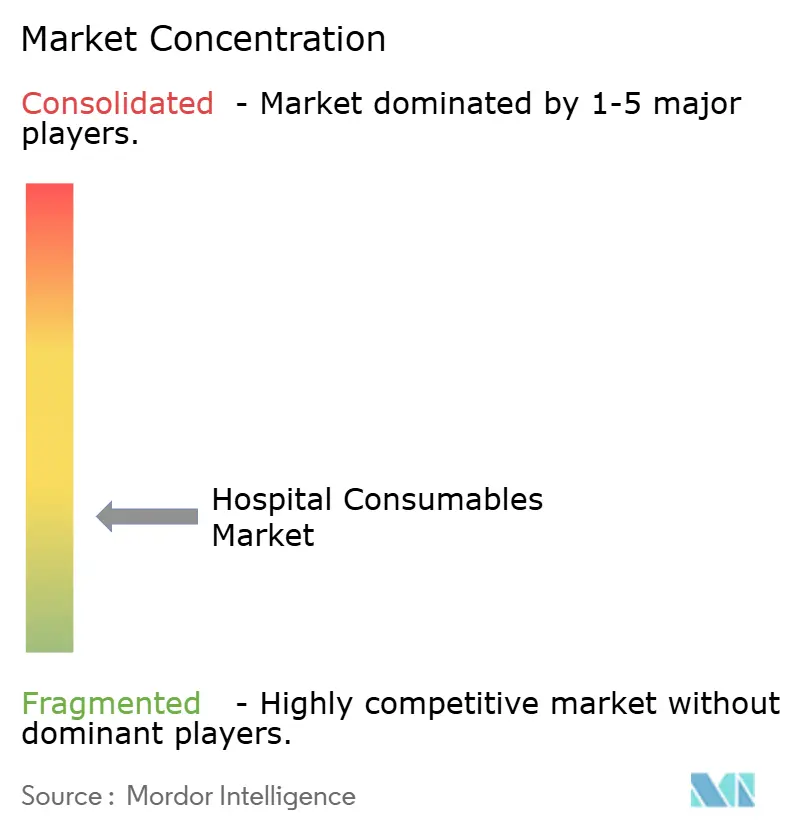
| Market Concentration | Low |
Major Players *Disclaimer: Major Players sorted in no particular order Image © Mordor Intelligence. Reuse requires attribution under CC BY 4.0. | |
Hospital Consumables Market Analysis by Mordor Intelligence
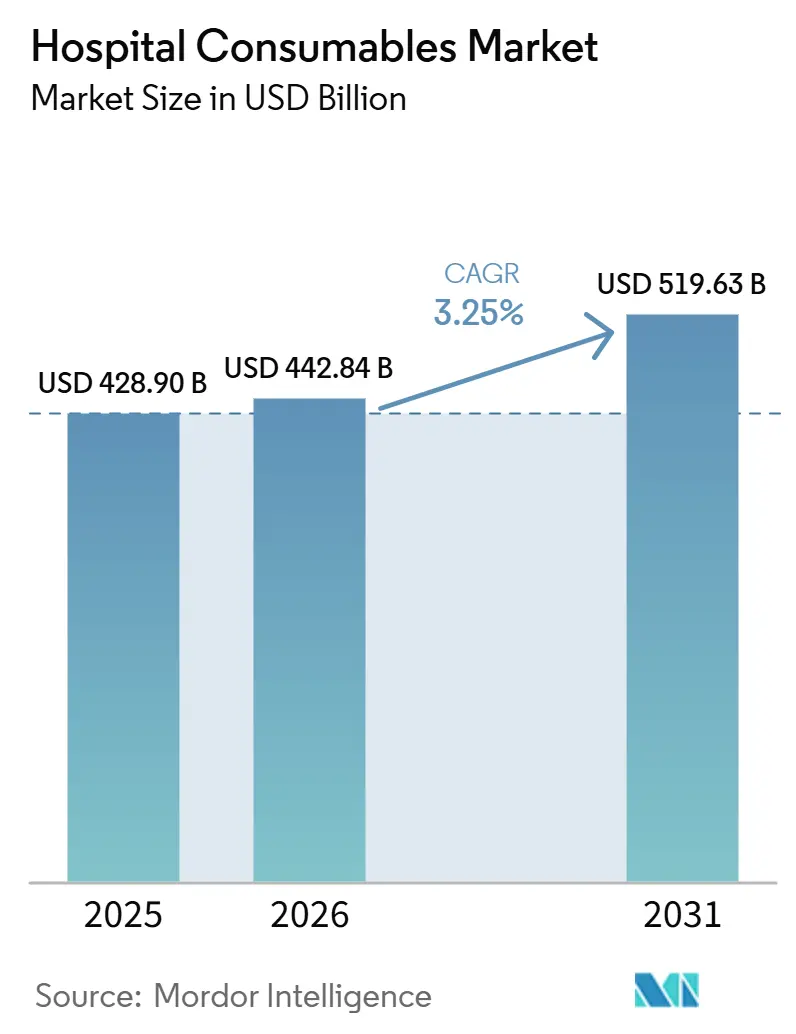
The Hospital Consumables Market size is projected to be USD 428.90 billion in 2025, USD 442.84 billion in 2026, and reach USD 519.63 billion by 2031, growing at a CAGR of 3.25% from 2026 to 2031.
The hospital consumables market benefits from higher surgical volumes, the broader adoption of single-use clinical products, and hospital expansion across developing healthcare systems. Minimally invasive and robotic procedures require more sterile products, including drapes, irrigation systems, disposable instruments, and procedure trays, increasing consumable use per procedure. Evolving infection prevention standards are also reshaping hospital purchasing priorities, particularly for products that help reduce surgical site infections and device-related infections. Suppliers are responding with procedure-specific kits, safety-focused products, and supply models that improve product availability for hospitals and outpatient facilities. However, centralized purchasing, price-focused contracts, and uncertainty around ethylene oxide sterilization continue to limit revenue growth in the hospital consumables market.
Key Report Takeaways
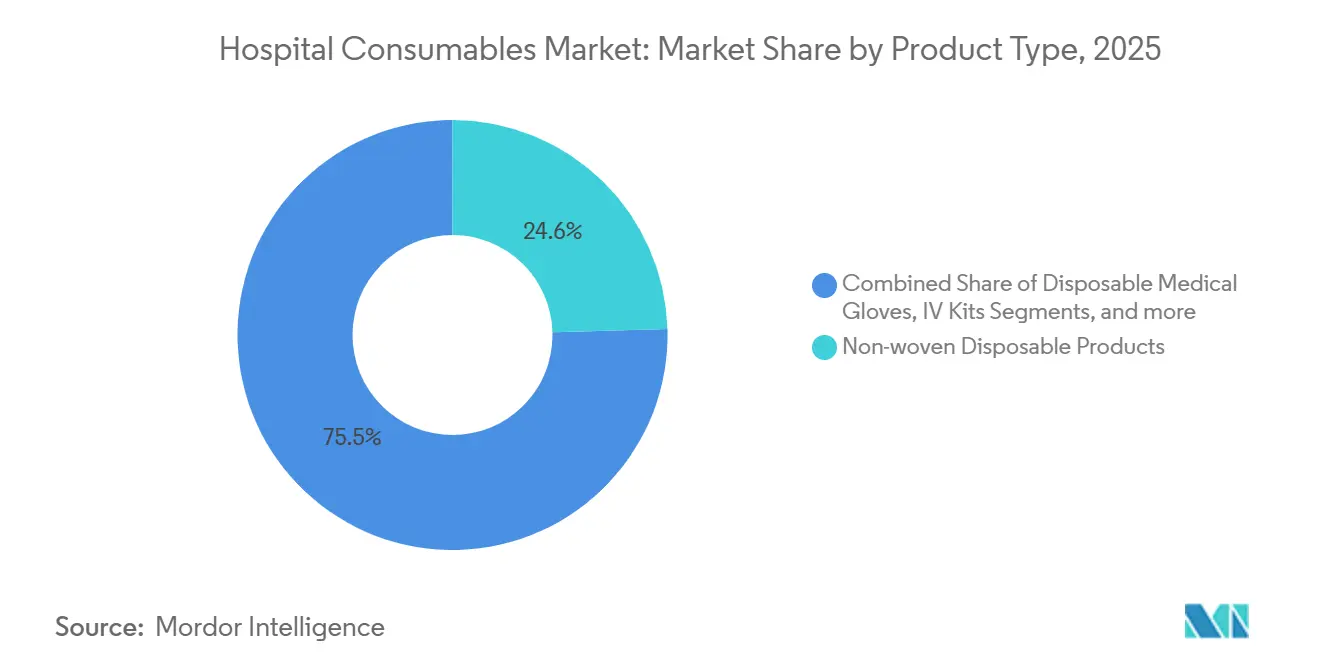
- By product type, non-woven disposable products held 24.55% of hospital consumables market share in 2025, while disposable syringes are projected to grow at a CAGR of 7.15% through 2031.
- By application area, general surgery and operating rooms accounted for 33.56% of revenue in 2025, while intensive care and critical care are projected to expand at a CAGR of 5.80% through 2031.
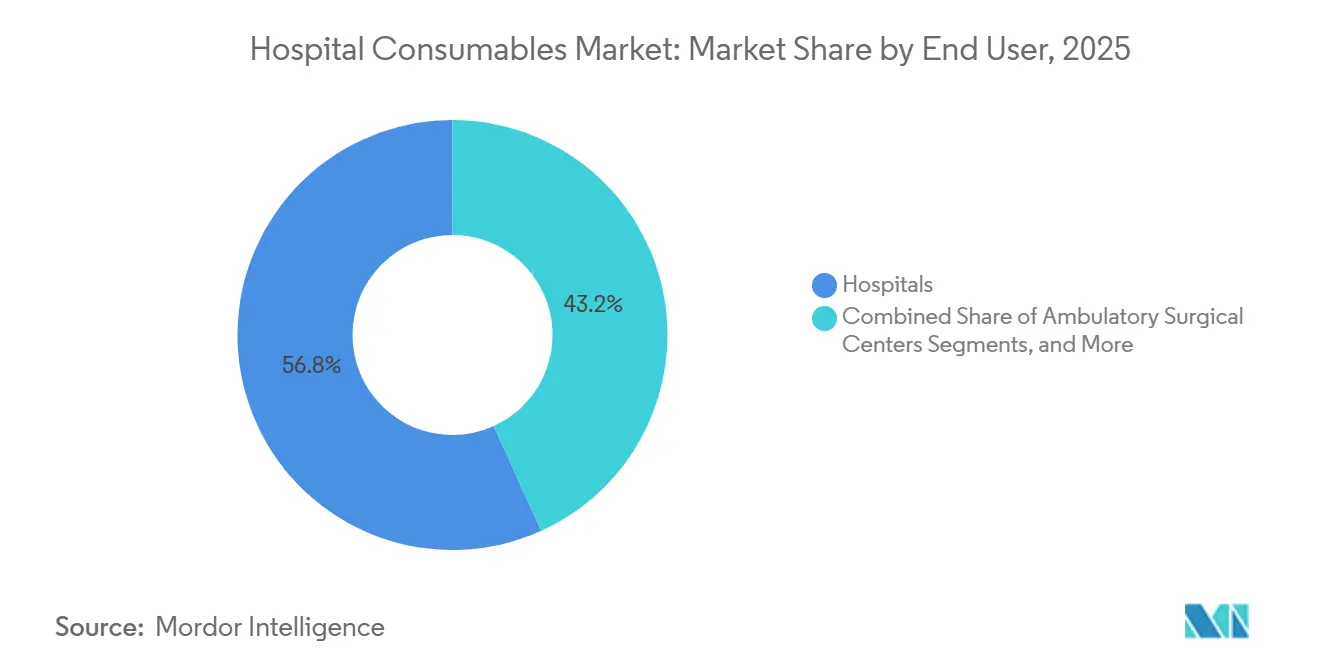
- By end user, hospitals held 56.77% of revenue in 2025, while ambulatory surgical centers are expected to record the highest CAGR of 6.45% through 2031.
- By distribution channel, direct manufacturer contracts held 39.88% of revenue in 2025, while medical distributors and prime vendors are projected to grow at a CAGR of 7.56% through 2031.
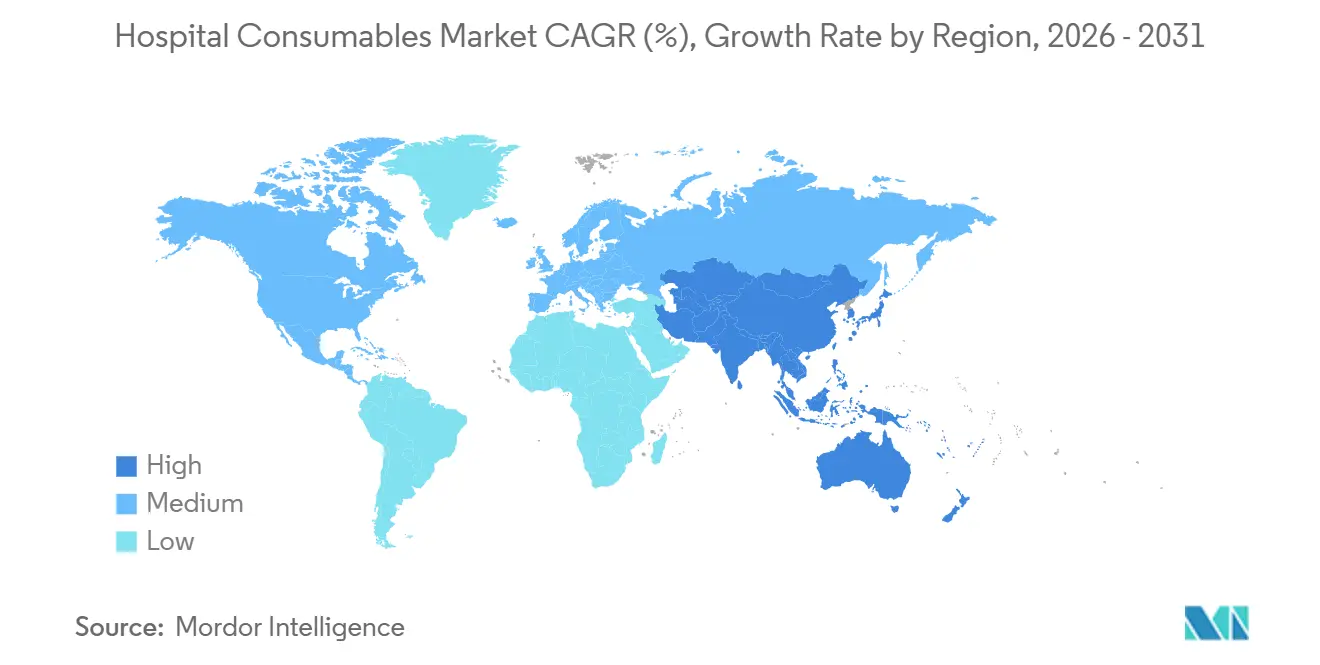
- By geography, North America held 40.86% of the share in 2025, while Asia-Pacific is projected to grow at an 6.88% CAGR through 2031.
Note: Market size and forecast figures in this report are generated using Mordor Intelligence’s proprietary estimation framework, updated with the latest available data and insights as of January 2026.
Market Trends and Insights
Drivers Impact Analysis of Hospital Consumables Market*
| DRIVER | (~) % IMPACT ON CAGR FORECAST | GEOGRAPHIC RELEVANCE | IMPACT TIMELINE |
|---|---|---|---|
| Rising surgical and minimally invasive procedure volumes | +0.7% | Global, led by North America, Europe, and East Asia | Short term (≤ 2 years) |
| Healthcare-associated infection prevention requirements | +0.6% | Global, with the strongest effect in North America and Europe | Medium term (2-4 years) |
| Aging populations and chronic-disease treatment intensity | +0.8% | North America, Western Europe, Japan, and South Korea | Long term (≥ 4 years) |
| Hospital capacity expansion and ICU penetration | +0.5% | Asia-Pacific, Middle East and Africa, and South America | Medium term (2-4 years) |
| Standardized procedure kits and point-of-care availability | +0.4% | North America and Europe, with expansion into Asia-Pacific and Middle East and Africa | Medium term (2-4 years) |
| Safer single-use designs for infection reduction | +0.3% | Global, led by North America and Europe | Medium term (2-4 years) |
| Source: Mordor Intelligence | |||
Rising Surgical and Minimally Invasive Procedure Volumes
Surgical volumes continued to recover in 2026, while minimally invasive and robotic procedures remained among the faster-growing procedure categories. Each procedure required sterile drapes, gowns, cannulae, irrigation products, and disposable instruments, increasing the clinical use of hospital consumables. In U.S. ambulatory settings, total knee arthroplasty volume grew by 27.6% in 2024, while total hip arthroplasty volume grew by 28.7%. England set a target of 500,000 robotic surgeries annually by 2035, supporting future demand for robotic-compatible single-use products in European acute care settings. The hospital consumables market benefits when suppliers align portfolios with orthopedics, urology, laparoscopic surgery, and other high-growth procedure areas.
Intensifying Healthcare-Associated Infection Prevention Requirements
Healthcare-associated infections remain a major concern for hospitals and public health systems. The World Health Organization reported that 7 in every 100 patients in high-income countries acquired at least 1 healthcare-associated infection during hospitalization, compared with 15 in every 100 patients in lower-middle-income settings. The Centers for Disease Control and Prevention reported 518,000 healthcare-associated infections in U.S. hospitals during 2023, with 61% of reported infections not linked to a specific medical device or procedure.[1]Centers for Disease Control and Prevention, “New CDC Data Shows Decline in Healthcare-Associated Infections,” Centers for Disease Control and Prevention, cdc.gov. BD received FDA 510(k) clearance for Surgiphor™ 1000mL in March 2026, strengthening the role of infection-reduction features in procurement decisions across wound care, vascular access, and surgical applications.
Aging Populations and Chronic-Disease Treatment Intensity
Aging populations and the rising chronic disease burden create recurring demand for hospital consumables across acute and outpatient care settings. Diabetes treatment requires insulin syringes, glucometer strips, and intravenous access supplies, while kidney disease treatment depends on dialysis tubing, catheters, and blood circuit materials. Oncology care also requires frequent use of intravenous kits, protective equipment, procedure trays, and infusion-related products. Disease-specific bundles, including diabetes care kits and oncology administration packs, help suppliers address recurring clinical requirements and build a stable replenishment base.
Hospital Capacity Expansion and ICU Penetration in Emerging Markets
New hospital construction creates first-fill purchasing demand that differs from routine replacement demand in mature markets. New facilities require initial stocks of syringes, intravenous kits, catheters, wound care products, and infection-control supplies before patient services begin. Critical care units use high volumes of central venous catheters, arterial lines, ventilator circuits, urinary catheters, infusion sets, and monitoring products. The hospital consumables market can benefit from this activity across Asia-Pacific, the Middle East and Africa, and South America, where healthcare infrastructure investment is expanding.
Restraints Impact Analysis of Hospital Consumables Market*
| RESTRAINT | (~) % IMPACT ON CAGR FORECAST | GEOGRAPHIC RELEVANCE | IMPACT TIMELINE |
|---|---|---|---|
| GPO and centralized-tender price compression | -0.5% | North America and Europe | Long term (≥ 4 years) |
| Medical-waste, polymer, and extended-producer-responsibility costs | -0.3% | Europe, North America, and parts of Asia-Pacific | Medium term (2-4 years) |
| Ethylene-oxide sterilization capacity and emissions constraints | -0.4% | North America, with effects on global supply chains | Medium term (2-4 years) |
| Product liability, recall, and quality-system exposure | -0.2% | Global, with the highest litigation exposure in North America | Short term (≤ 2 years) |
| Source: Mordor Intelligence | |||
GPO and Centralized-Tender Price Compression
Group purchasing organizations are embedded in the procurement cycle of 97% of US hospitals. Large purchasing organizations use their scale to negotiate lower prices and secure preferred supplier arrangements across hospital networks. The Healthcare Group Purchasing Industry Initiative reported that its members managed more than USD 100 billion in annual purchasing activity while addressing tariff pressure and provider cost constraints. Manufacturers may need to accept lower unit prices to retain contracts, especially in limited-differentiation products such as basic syringes, gloves, gauze, and standard intravenous supplies. This pressure may also push smaller suppliers to exit commodity categories or partner with distributors that support private-label programs.
Ethylene-Oxide Sterilization Capacity and Emissions Constraints
Ethylene oxide sterilizes nearly 50% of medical devices used in the United States, representing almost 20 billion devices each year. The process is critical for catheters, intravenous kits, procedure trays, and surgical drapes that cannot withstand steam or radiation sterilization. The 2024 National Emission Standards for Hazardous Air Pollutants rule created supply concerns and led to a presidential exemption process in January 2025. The Environmental Protection Agency proposed reconsideration of the 2024 rule in March 2026 while maintaining plans for new emissions standards at larger facilities. Uncertainty over future requirements can delay sterilization capacity investments and affect supply planning for manufacturers that rely on third-party sterilization providers. Medical waste rules, polymer disposal costs, product recalls, and quality system obligations add further cost and operational pressure across the hospital consumables market.
*Our forecasts treat driver/restraint impacts as directional, not additive. The impact forecasts reflect baseline growth, mix effects, and variable interactions.
Hospital Consumables Market Segment Analysis
By Product Type:
Non-Woven Products Lead While Disposable Syringes Grow FastestNon-woven disposable products held 24.55% of the hospital consumables market size in 2025, making them the largest product category. Their leadership reflected broad use in surgical drapes, gowns, face masks, sterile wraps, caps, wound management products, and incontinence care across multiple care settings. Polypropylene spunbond remained widely used due to its cost efficiency and suitability for high-volume manufacturing. European waste regulations and extended producer responsibility frameworks increased attention on biodegradable and bio-based alternatives.
Disposable syringes are forecast to grow at a CAGR of 7.15% between 2026 and 2031. Hospitals and public health programs increasingly used safety-engineered formats, including retractable, auto-disable, and passive-mechanism syringes, supported by occupational safety and sharps injury prevention requirements in North America and Europe. Higher use of GLP-1 receptor agonists for type 2 diabetes and obesity also expanded demand for prefilled and self-injection products. Catheters, intravenous kits, intravenous solutions, guidewires, cannulae, and procedure trays supported recurring revenue through continuous purchasing and bundled contracts.



By Application Area:
Operating Rooms Lead While Intensive Care ExpandsGeneral surgery and operating rooms accounted for 33.56% of the hospital consumables market share in 2025. Operating rooms used a broad range of consumables in each surgical case, including drapes, gowns, gloves, sutures, blade holders, irrigation systems, specimen containers, and sterile packaging. Complex procedures can require more than USD 300 in consumables per case. The World Health Organization estimated that more than 313 million surgical procedures are performed globally each year, supporting recurring demand for surgical consumables.
Intensive care and critical care are forecast to grow at a CAGR of 5.80% between 2026 and 2031. Intensive care units required continuous supplies of central venous catheters, arterial lines, ventilator circuits, urinary catheters, infusion sets, and glucose monitoring products, driven by expanding critical care capacity in developing healthcare systems. BD launched the CentroVena One™ Insertion System in April 2026 for central line placement in acute care settings. Oncology, chemotherapy administration, urology, nephrology, and wound care also supported demand through specialized products and differentiated clinical requirements.
By End User:
Hospitals Remain the Core Customer Base While ASCs Gain MomentumHospitals represented 56.77% of end-user revenue in 2025. They remained the primary setting for major surgery, intensive care, emergency treatment, inpatient management, and other high-acuity care episodes. Large hospital systems centralized purchasing and used vendor-managed inventory arrangements to control supply levels across multiple facilities. These systems favored suppliers that could support consistent product specifications and delivery schedules across several locations.
Ambulatory surgical centers are forecast to grow at a CAGR of 6.45% from 2026 to 2031. U.S. ambulatory surgical center procedure volumes per Medicare beneficiary increased 3.5% in 2024. The 2026 phase-out of the inpatient-only list added 285 new HCPCS codes to the ambulatory surgical center Covered Procedure List, including total hip arthroplasty revisions and complex spinal procedures. Medical supply product sales to ambulatory surgical centers through distribution reached nearly USD 2.7 billion in 2025, up 4% from the previous year, while surgical instrument sets and sutures grew 9.2% and 8.6%, respectively.
By Distribution Channel:
Direct Contracts Lead While Prime Vendors Gain GroundDirect manufacturer contracts held 39.88% of revenue in 2025. Large integrated delivery networks used these contracts to secure volume commitments, pricing visibility, and standardized supplies across facilities. This model was especially common for intravenous solutions, procedure trays, non-woven products, and other high-spend categories. Group purchasing organizations remained involved in negotiations, although hospitals often managed preferred supplier relationships directly.
Medical distributors and prime vendors are forecast to grow at a CAGR of 7.56% from 2026 to 2031. The prime vendor model allowed a single distributor to manage sourcing, logistics, replenishment, and product availability for a broad range of medical and surgical products. Medline signed its first prime vendor agreement outside the United States with Mohawk Medbuy in May 2026 to support hospitals in Southwestern Ontario, including daily distribution from Medline’s Guelph, Ontario, facility. Digital procurement also gained traction among specialty clinics, diagnostic laboratories, and home healthcare providers by improving ordering visibility and inventory planning.
Geography Analysis
North America Hospital Consumables Market
North America held 40.86% of the hospital consumables market size in 2025. High consumable use per procedure, established safety-device requirements, and a large ambulatory surgical center base supported the region’s position. The United States accounted for most regional revenue due to its high volume of complex procedures and detailed product quality requirements. FDA clearance pathways and Joint Commission accreditation standards encouraged the use of products meeting established safety and performance specifications, while Canada moved toward centralized procurement through Medline’s May 2026 prime vendor agreement with Mohawk Medbuy. Mexico remained an underpenetrated opportunity as public and private hospital networks continued to expand.
Europe Hospital Consumables Market
Europe remained the second-largest regional area in the hospital consumables market. Germany, France, the United Kingdom, and Italy formed the core of regional demand. The European Union Medical Device Regulation raised clinical evidence and post-market surveillance requirements, increasing compliance demands for smaller manufacturers and favoring suppliers with established regulatory capabilities and local manufacturing capacity. Convatec completed an expansion of more than GBP 24 million at its United Kingdom advanced wound care manufacturing site during 2026 and also announced research and development investment of more than GBP 500 million, including a Manchester hub planned from 2028.
APAC Hospital Consumables Market
Asia-Pacific is forecast to grow at a CAGR of 6.88% from 2026 to 2031, making it the fastest-growing regional area. Hospital construction, a growing middle-income population, increasing chronic disease treatment, and broader access to surgery and critical care support demand. India is adding specialty and higher-acuity capacity, increasing demand for operating room, infusion, wound care, and intensive care products, while China remains a major destination due to its extensive healthcare infrastructure and local manufacturing base.

Competitive Landscape
The hospital consumables market has fragmented across specialty categories. BD, Medline, Cardinal Health, B. Braun, Baxter, Mölnlycke, and Teleflex hold strong positions through broad product portfolios and distribution networks. Specialist companies compete in stoma management, wound care, vascular access, and interventional consumables. Standard gloves, basic syringes, gauze, and generic intravenous bags remain price-sensitive, with suppliers competing on cost, supply reliability, and group purchasing organization contracts.
Differentiated products support stronger pricing when they address infection prevention, procedural complexity, or clinician safety. Safety-engineered devices, antimicrobial materials, and advanced catheter systems are harder to replace with basic alternatives. BD launched the CentroVena One Insertion System in April 2026 as an all-in-one central venous catheter insertion system for acute care settings. BD also received FDA 510(k) clearance for Surgiphor 1000mL in March 2026, expanding its wound irrigation offering for surgical settings.
Distribution-led companies are strengthening their positions through supply chain services and digital tools. Medline launched Mpower in May 2026, a cloud-based platform designed to identify and address supply chain disruptions before they affect patient care. Owens & Minor launched Halyard Kitting in May 2026 to support standardized custom medical procedure trays for acute and non-acute care settings. Customized procedure kits and home healthcare products for chronic disease management remain key opportunities as care expands beyond clinical facilities.
Hospital Consumables Industry Leaders
Becton, Dickinson and Company
Cardinal Health, Inc.
Baxter International Inc.
Medtronic plc
Solventum Corporation
- *Disclaimer: Major Players sorted in no particular order
Hospital Consumables Market Companies Covered in this Report
- Ansell
- B. Braun
- Baxter
- Beckton Dickinson
- Boston Scientific
- Cardinal Health
- Coloplast
- Convatec
- Getinge
- ICU Medical
- Mckesson
- Medline Inc.
- Medtronic
- Merit Medical Systems
- Molnlycke Health Care
- Nipro
- Owens & Minor, Inc.
- Hartmann Group
- Smiths Group
- Solventum Corporation
- STERIS
- Stryker
- Teleflex
- Terumo

Recent Industry Developments in Hospital Consumables Market
- July 2026: Otsuka ICU Medical LLC announced a USD 500 million-plus expansion of its IV solutions manufacturing in Austin, Texas, adding a new facility and upgrading operations to strengthen non-DEHP development and North American supply resilience.
- July 2026: Cardinal Health announced two definitive cash agreements totaling USD 360 million to acquire AdaptHealth Corp.’s Diabetes Health business for USD 235 million and Strive Medical, a urology-focused multi-specialty supply provider.
- July 2026: Mölnlycke Health Care launched three wound care products in the United States: Granudacyn Wound Wash Solution, Tortoise Lite Turning and Positioning System, and Mepi Press 2 & Lite Compression System.
- May 2026: Owens & Minor launched Halyard Kitting for customized medical procedure trays to help health systems standardize operating room supplies and reduce clinical staff preparation work.


Global Hospital Consumables Market Report Scope
As per the scope of the report, hospital consumables are single-use or short-lived medical supplies like gloves, syringes, and bandages that are used during patient care and thrown away to stop the spread of germs.
The hospital consumables market is segmented by product type, application area, end user, distribution channel, and geography. By product type, the market includes disposable medical gloves, IV kits, medical gauze and tapes, disposable syringes, sharps disposal containers, catheters, nonwoven disposable products, surgical blades, medicine cups, cannulas, guidewires, thermometers, stethoscopes, glucometer strips, IV solutions, BP monitors, procedure trays, and others. By application area, the market is segmented into general surgery and operating room, intensive care and critical care, emergency and trauma care, cardiology and vascular intervention, urology and nephrology, wound care and tissue management, respiratory and anesthesia care, oncology and chemotherapy administration, diagnostic and laboratory care, and diabetes and chronic disease monitoring. By end user, the market is segmented into hospitals, ambulatory surgical centers, specialty clinics and physician offices, diagnostic laboratories and blood banks, long-term care and rehabilitation facilities, home healthcare providers, and others. By distribution channel, the market is segmented into direct manufacturer contracts, group purchasing organizations, medical distributors and prime vendors, public tenders and framework agreements, e-commerce and digital procurement, and contract logistics and vendor-managed inventory. By geography, the market is analyzed across North America, Europe, Asia-Pacific, the Middle East and Africa, and South America. The report also covers the estimated market sizes and trends for 17 countries across major regions globally. The report offers the market sizes and forecasts in terms of value (USD) for the above segments.
| Disposable Medical Gloves |
| IV Kits |
| Medical Gauze & Tapes |
| Disposable Syringes |
| Sharps Disposable Containers |
| Catheter's |
| Non-woven Disposable Products |
| Surgical Blades |
| Medicine Cups |
| Cannula |
| Guidewire's |
| Thermometer |
| Stethoscope |
| Glucometer Strips |
| IV Solutions |
| BP Monitors |
| Procedure Trays |
| Others |
| General Surgery and Operating Room |
| Intensive Care and Critical Care |
| Emergency and Trauma Care |
| Cardiology and Vascular Intervention |
| Urology and Nephrology |
| Wound Care and Tissue Management |
| Respiratory and Anesthesia Care |
| Oncology and Chemotherapy Administration |
| Diagnostic and Laboratory Care |
| Diabetes and Chronic-Disease Monitoring |
| Hospitals |
| Ambulatory Surgical Centers |
| Specialty Clinics and Physician Offices |
| Diagnostic Laboratories and Blood Banks |
| Long-Term Care and Rehabilitation Facilities |
| Home Healthcare Providers |
| Others |
| Direct Manufacturer Contracts |
| Group Purchasing Organizations |
| Medical Distributors and Prime Vendors |
| Public Tenders and Framework Agreements |
| E-Commerce and Digital Procurement |
| Contract Logistics and Vendor-Managed Inventory |
| North America | United States |
| Canada | |
| Mexico | |
| Europe | Germany |
| United Kingdom | |
| France | |
| Italy | |
| Spain | |
| Rest of Europe | |
| Asia-Pacific | China |
| India | |
| Japan | |
| Australia | |
| South Korea | |
| Rest of Asia-Pacific | |
| Middle East and Africa | GCC |
| South Africa | |
| Rest of Middle East and Africa | |
| South America | Brazil |
| Argentina | |
| Rest of South America |
| By Product Type | Disposable Medical Gloves | |
| IV Kits | ||
| Medical Gauze & Tapes | ||
| Disposable Syringes | ||
| Sharps Disposable Containers | ||
| Catheter's | ||
| Non-woven Disposable Products | ||
| Surgical Blades | ||
| Medicine Cups | ||
| Cannula | ||
| Guidewire's | ||
| Thermometer | ||
| Stethoscope | ||
| Glucometer Strips | ||
| IV Solutions | ||
| BP Monitors | ||
| Procedure Trays | ||
| Others | ||
| By Application Area | General Surgery and Operating Room | |
| Intensive Care and Critical Care | ||
| Emergency and Trauma Care | ||
| Cardiology and Vascular Intervention | ||
| Urology and Nephrology | ||
| Wound Care and Tissue Management | ||
| Respiratory and Anesthesia Care | ||
| Oncology and Chemotherapy Administration | ||
| Diagnostic and Laboratory Care | ||
| Diabetes and Chronic-Disease Monitoring | ||
| By End User | Hospitals | |
| Ambulatory Surgical Centers | ||
| Specialty Clinics and Physician Offices | ||
| Diagnostic Laboratories and Blood Banks | ||
| Long-Term Care and Rehabilitation Facilities | ||
| Home Healthcare Providers | ||
| Others | ||
| By Distribution Channel | Direct Manufacturer Contracts | |
| Group Purchasing Organizations | ||
| Medical Distributors and Prime Vendors | ||
| Public Tenders and Framework Agreements | ||
| E-Commerce and Digital Procurement | ||
| Contract Logistics and Vendor-Managed Inventory | ||
| By Geography | North America | United States |
| Canada | ||
| Mexico | ||
| Europe | Germany | |
| United Kingdom | ||
| France | ||
| Italy | ||
| Spain | ||
| Rest of Europe | ||
| Asia-Pacific | China | |
| India | ||
| Japan | ||
| Australia | ||
| South Korea | ||
| Rest of Asia-Pacific | ||
| Middle East and Africa | GCC | |
| South Africa | ||
| Rest of Middle East and Africa | ||
| South America | Brazil | |
| Argentina | ||
| Rest of South America | ||


Key Questions Answered in the Report
What is the projected value of hospital consumables by 2031?
The sector is forecast to reach USD 519.63 billion by 2031, growing from USD 442.84 billion in 2026 at a CAGR of 3.25%.
Which hospital consumable product category held the largest share in 2025?
Non-woven disposable products led product demand with a 24.55% revenue share in 2025, supported by their use in drapes, gowns, masks, wraps, and wound care.
Which hospital consumable product category is growing fastest?
Disposable syringes are projected to grow at a CAGR of 7.15% through 2031 because of safety-device requirements, immunization needs, and rising self-injection use.
Why are ambulatory surgical centers increasing demand for consumables?
Ambulatory surgical centers are projected to grow at a CAGR of 6.45% through 2031 as more orthopedic and complex procedures move from inpatient settings to outpatient facilities.
What is the largest application area for hospital consumables?
General surgery and operating rooms led application demand with a 33.56% share in 2025 because every procedure requires multiple sterile and disposable products.
What limits growth for hospital consumable suppliers?
Group purchasing organization pricing pressure, medical-waste costs, product quality requirements, and ethylene oxide sterilization uncertainty can limit supplier margins and product availability.
Page last updated on:





