
Hollow Glass Microsphere Coatings Market Size and Share
Market Overview
| Study Period | 2021 - 2031 |
|---|---|
| Market Size (2026) | USD 354.04 Million |
| Market Size (2031) | USD 442.68 Million |
| Growth Rate (2026 - 2031) | 4.57 % |
| Fastest Growing Market | Asia-Pacific |
| Largest Market | Asia-Pacific |
| Market Concentration | Medium |
Major Players *Disclaimer: Major Players sorted in no particular order Image © Mordor Intelligence. Reuse requires attribution under CC BY 4.0. | |
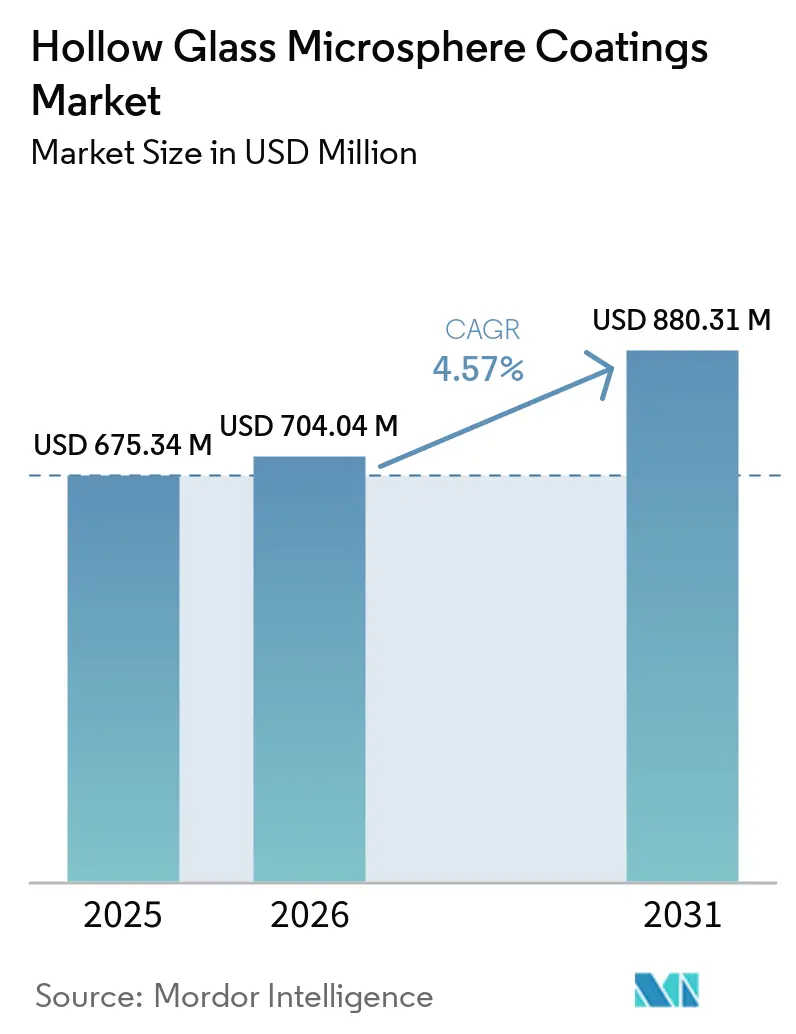
Hollow Glass Microsphere Coatings Market Analysis by Mordor Intelligence
The Hollow Glass Microsphere Coatings Market size is expected to increase from USD 340.42 million in 2025 to USD 354.04 million in 2026 and reach USD 442.68 million by 2031, at a CAGR of 4.57% over 2026-2031. Demand is driven by environmental compliance requirements, weight-reduction needs, and building energy codes across various coating applications. These diverse demand sources limit exposure to a single end-use cycle and support steadier demand in the hollow glass microsphere coatings market. Suppliers respond to growing demand for waterborne and high-solids formulations, where microspheres help manage density and coating performance. Energy costs for glass furnaces and trade barriers affecting cross-border supplies remain key operating risks, particularly for suppliers without long-term feedstock arrangements. Companies with reliable glass supply, application support, and regional distribution are better positioned to address these conditions in the hollow glass microsphere coatings market.
Key Report Takeaways
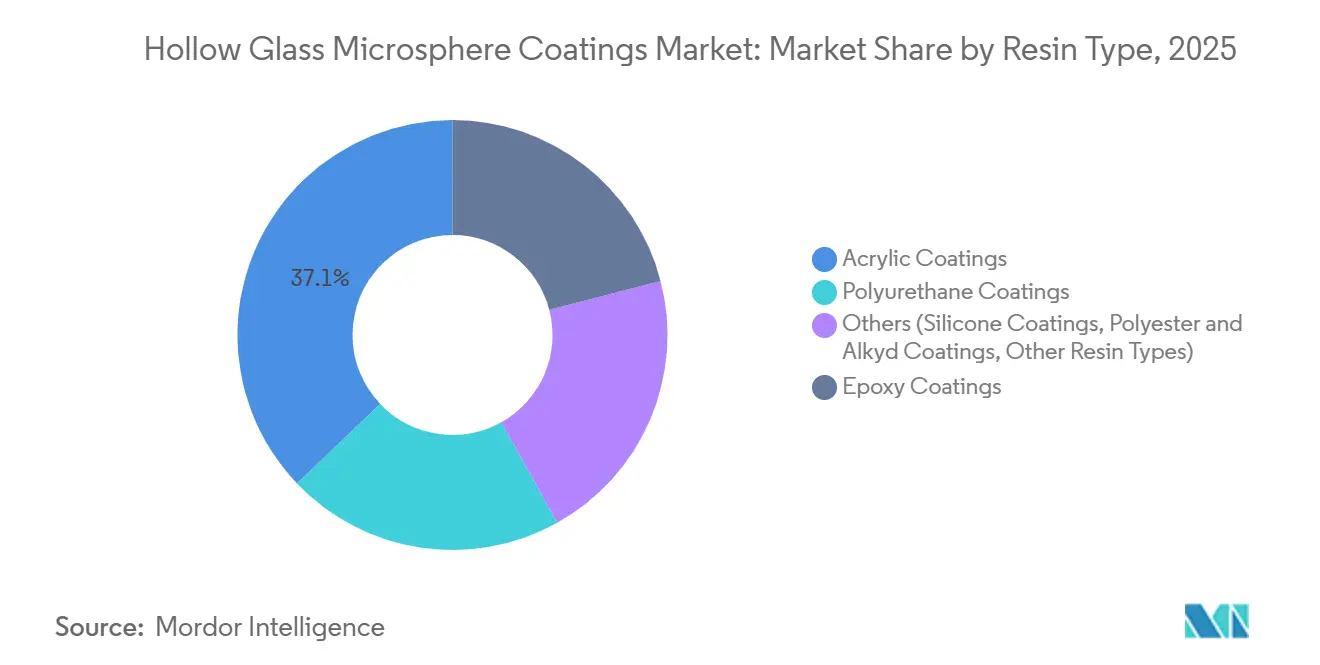
- By resin type, acrylic coatings held 37.13% of the hollow glass microsphere coatings market share in 2025, while polyurethane coatings are forecast to expand at a CAGR of 5.74% through 2031.
- By hollow glass microsphere type, high-strength grades accounted for 41.45% of the hollow glass microsphere coatings market share in 2025 and are forecast to expand at a 5.36% CAGR through 2031.
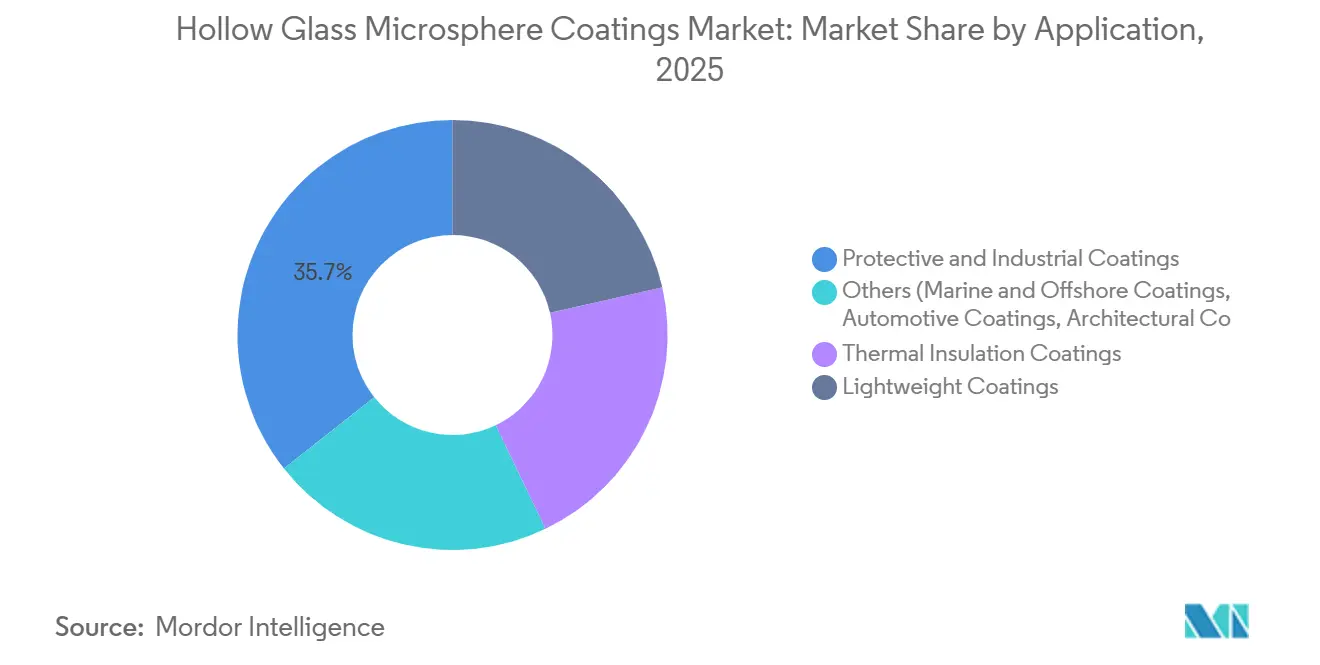
- By application, protective and industrial coatings captured 35.67% of the hollow glass microsphere coatings market share in 2025, while thermal insulation coatings are forecast to grow at a 6.13% CAGR through 2031.
- By geography, Asia-Pacific accounted for 38.45% of the hollow glass microsphere coatings market share in 2025 and is forecast to expand at a CAGR of 5.95% through 2031.
Note: Market size and forecast figures in this report are generated using Mordor Intelligence’s proprietary estimation framework, updated with the latest available data and insights as of January 2026.
Market Trends and Insights
Drivers Impact Analysis of Hollow Glass Microsphere Coatings Market*
| Drivers | (~) % Impact on CAGR Forecast | Geographic Relevance | Impact Timeline |
|---|---|---|---|
| Low-VOC and High-Solids Formulation Adoption | +1.0% | Global, with intensity in the EU and North America | Short term (≤ 2 years) |
| Lightweighting Requirements in Automotive and Aerospace Coatings | +0.8% | Global, with concentration in APAC, North America, and the EU | Medium term (2-4 years) |
| Building Energy-Efficiency and Cool-Roof Requirements | +0.7% | North America, APAC urban corridors, EU | Short term (≤ 2 years) |
| Corrosion-Protection Demand in Marine, Offshore, and Industrial Assets | +0.6% | MEA, North America offshore, APAC port infrastructure | Medium term (2-4 years) |
| Microsphere-Enabled Thermal Management for Battery and Electronics Coatings | +0.4% | APAC, North America, EU | Medium term (2-4 years) |
| Recycled-Glass Feedstock and Circular-Filler Positioning | +0.3% | EU, North America | Long term (≥ 4 years) |
| Source: Mordor Intelligence | |||
Low-VOC and High-Solids Formulation Adoption
VOC regulations have made formulation choices more important for coatings producers in North America and Europe. Hollow glass microspheres can displace part of the liquid binder, helping formulators increase solids content without increasing VOC emissions or applied-film density. In January 2025, the U.S. Environmental Protection Agency finalized updated VOC limits for aerosol coatings under 40 Code of Federal Regulations (CFR) Part 59, Subpart O, reducing the scope for solvent-reliant products in North America[1]. This regulatory environment has supported more frequent reformulation activity in the hollow glass microsphere coatings market, as coatings producers must keep performance, application behavior, and compliance aligned. In two-component (2K) epoxy systems, higher microsphere loading can maintain workable application viscosity while reducing shipping weight and material use per square meter applied. Inorganic glass and ceramic microspheres also avoid product-design issues that can arise with polymer alternatives under microplastics requirements, giving formulators an additional reason to consider mineral-based fillers.
Lightweighting Requirements in Automotive and Aerospace Coatings
Automotive and aerospace customers seek lower mass in coatings, sealants, and composite systems without compromising physical performance. A 2025 review reported that hollow glass microsphere-modified carbon fiber laminates achieved up to 12% higher damping and 25% lower mass. A 2026 study of waterborne epoxy zinc-rich primers found that a 2 wt% microsphere loading reduced porosity from 12.3% to 1.2%, showing that lower weight can accompany changes in coating structure, zinc distribution, and corrosion performance. The U.S. Corporate Average Fuel Economy standard, which requires 40.4 miles per gallon by 2026, supports efforts to reduce passive material weight in vehicle systems. Electric vehicle platforms increase this need, as weight removed from interior and underbody systems can extend range without changes to battery chemistry, cell architecture, or core powertrain design.
Building Energy-Efficiency and Cool-Roof Requirements
Building codes have raised performance expectations for roof and wall coatings across major construction markets. California's Title 24, Part 6 standards, which took effect on January 1, 2026, require a minimum aged solar reflectance of 0.63 and thermal emittance of 0.75 for low-sloped nonresidential roofs in designated climate zones. These requirements create a use case for liquid-applied insulation coatings in the hollow glass microsphere coatings market, where a formulation must balance reflectance, application properties, and long-term weathering performance. The ANSI/Cool Roof Rating Council (CRRC) S100-2025 standard, approved by ANSI on December 5, 2024, expanded its scope to include exterior wall materials, providing suppliers with a testable route into reflective wall-coating applications. Research on cool building cladding materials notes that buildings account for 40% of total energy consumption in the European Union, underscoring the importance of envelope performance.
Corrosion-Protection Demand in Marine, Offshore, and Industrial Assets
Corrosion protection is a material requirement for marine, offshore, and industrial assets continuously exposed to moisture, salt, or chemicals. A 2026 peer-reviewed study reported that waterborne epoxy zinc-rich primers with 2 wt% hollow glass microspheres achieved a corrosion rate of 5.71×10⁻⁶ mm/year, a protection efficiency of 99.98%, and 720 hours of salt spray resistance under GB/T 1771-2007. Microspheres create a longer path for ion transport and can improve zinc particle dispersion in the primer film, enabling protection at lower zinc content while reducing coating density. Asset owners in high-salinity environments can evaluate weight reduction, material efficiency, and barrier performance together in maintenance specifications. These requirements continue to support protective applications in the hollow glass microsphere coatings market, particularly where recoating work must meet demanding service conditions.
Restraints Impact Analysis of Hollow Glass Microsphere Coatings Market*
| Restraints | (~) % Impact on CAGR Forecast | Geographic Relevance | Impact Timeline |
|---|---|---|---|
| Raw-Material Price and Energy-Intensity Volatility | -0.8% | Global, with acute pressure in the EU and North America | Short term (≤ 2 years) |
| Dispersion, Crush-Resistance, and Application-Process Sensitivity | -0.5% | Global | Medium term (2-4 years) |
| Limited Standardization of Performance Testing Across Coating Systems | -0.4% | Global, with fragmentation across Asia-Pacific (APAC), the EU, and North America | Long term (≥ 4 years) |
| Qualification Cycles and Formulation Switching Costs | -0.3% | Aerospace and defense markets, global, and automotive in North America and the EU | Long term (≥ 4 years) |
| Source: Mordor Intelligence | |||
Raw-Material Price and Energy-Intensity Volatility
Borosilicate glass production depends on silica sand, boron compounds, and natural gas, each with its own price cycle and supply conditions. These cost pressures can narrow margins for microsphere producers and coatings formulators, even when end-market demand remains stable. European producers face elevated energy tariffs, while regional boron supply conditions create cost differences between Western and Asian suppliers. Early 2026 disruptions in global liquefied natural gas supply added pressure to glass furnace operating costs, increasing the importance of long-term energy and feedstock arrangements. Tariffs applied to hollow glass and ceramic microspheres during the 2025-2026 trade policy review cycle have made cross-border purchasing more difficult. Buyers shifting toward local suppliers may face higher unit costs and reduced price flexibility in the hollow glass microsphere coatings market.
Dispersion, Crush-Resistance, and Application-Process Sensitivity
Microsphere performance depends on mixing and application practices that vary among coating producers, plants, and field contractors. High-shear dispersion can fracture the shells of hollow glass microspheres, converting a lightweight functional filler into dense glass powder that no longer delivers the intended density or thermal performance. Wall thickness, particle diameter, mixing energy, spray pressure, and nozzle design each affect shell integrity and coating consistency. Formulators often add microspheres after high-shear pigment dispersion, thereby increasing process time and requiring consistent operator practice. Application variability is difficult to manage in infrastructure work involving multiple contractors and varying spraying conditions, slowing specification decisions when engineering teams require on-site trials before approving microsphere-containing coatings for large or long-life assets.
*Our forecasts treat driver/restraint impacts as directional, not additive. The impact forecasts reflect baseline growth, mix effects, and variable interactions.
Hollow Glass Microsphere Coatings Market Segment Analysis
By Resin Type:
Acrylic Dominance with Polyurethane Gaining GroundAcrylic coatings accounted for 37.13% of the hollow glass microsphere coatings market in 2025. Their broad compatibility with standard hollow glass microsphere grades supports use across architectural, industrial, and cool-roof coating systems. Water-thinnable acrylic chemistry enables microsphere integration without primer-adhesion complications that arise in solvent-heavy systems. Strong ultraviolet resistance makes acrylics suitable carrier resins for outdoor insulation coatings exposed to extended weathering. Acrylic systems retain a broad role where coating producers require established application behavior, outdoor durability, and density reduction.
Polyurethane coatings are the fastest-growing resin type, projected to grow at a 5.74% CAGR through 2031. Their abrasion resistance and chemical barrier performance support marine maintenance and industrial floor-coating applications where lower weight and corrosion protection are both required. Epoxy remains important in protective primers for marine steel and offshore infrastructure, although slower new-construction demand relative to maintenance demand limits its growth. Silicone, polyester, alkyd, and specialty systems make up the remaining category, with silicone suited to exhaust coatings and high-temperature process settings. A 2026 study reported more than 90% improvement in anticorrosion performance for hollow glass microspheres in waterborne polyurethane and polyester matrices, indicating that compatibility across resin systems remains an important feature of the market.

By Hollow Glass Microsphere Type:
High-Strength Grades at the ForefrontHigh-strength grades accounted for 41.45% of the hollow glass microsphere coatings market in 2025 and are forecast to expand at a 5.36% CAGR through 2031. Their leading position reflects the need for thicker coating builds, higher processing pressure, and more demanding mixing conditions. High-strength grades remain intact during processing, whereas lower-strength grades can fracture. 3M states that its iM30K Glass Bubbles have an isostatic crush strength of 27,000 psi and a density of 0.60 g/cm³, which are relevant to automotive compounding and aerospace syntactic systems that require materials to retain low density under load.
Battery thermal management, offshore anticorrosion, and signal-transparent aerospace coatings provide additional uses for high-performance grades. Low-strength and medium-strength grades remain useful in architectural insulation coatings, construction adhesives, and putty formulations, where processing shear is lower, and material cost is more important. The other category includes surface-treated and specialty grades, such as silver-coated variants for electromagnetic interference shielding and aluminum-oxide-coated grades for high reflectance. Suppliers use silane coupling agents, silver coatings, and titanium dioxide coatings to tailor adhesion, electrical behavior, or reflectivity for specific formulations. These differentiated grades serve the premium segment and can support higher margins and longer customer relationships than standard materials.
By Application:
Industrial Protection as Foundation, Thermal Coatings as Growth EngineProtective and industrial coatings accounted for 35.67% of the hollow glass microsphere coatings market in 2025. Aging bridges, pipelines, storage tanks, and offshore platforms require recurring maintenance, sustaining demand for systems with established protective performance. Hollow glass microspheres improve zinc efficiency, reduce weight, and create a barrier that slows the movement of corrosive ions through the applied film. These attributes help suppliers address maintenance contracts where applied-film weight must be reduced without compromising specified protection or service-life expectations.
Thermal insulation coatings are forecast to grow at a 6.13% CAGR through 2031, driven by building energy codes and broader industrial insulation requirements. Lightweight coatings benefit battery-electric vehicle platforms, where weight removed from cabin coatings and underbody systems supports measurable vehicle-range improvements. Marine and offshore coatings are supported by deepwater infrastructure activity in West Africa and Southeast Asia, while automotive refinish and architectural coatings provide wider but slower-growing demand. Company documentation identifies viscosity control, surface quality, and weight reduction as combined benefits of hollow glass beads in paints and varnishes, supporting adoption when multiple coating requirements must be met simultaneously[2].
Geography Analysis
APAC Hollow Glass Microsphere Coatings Market
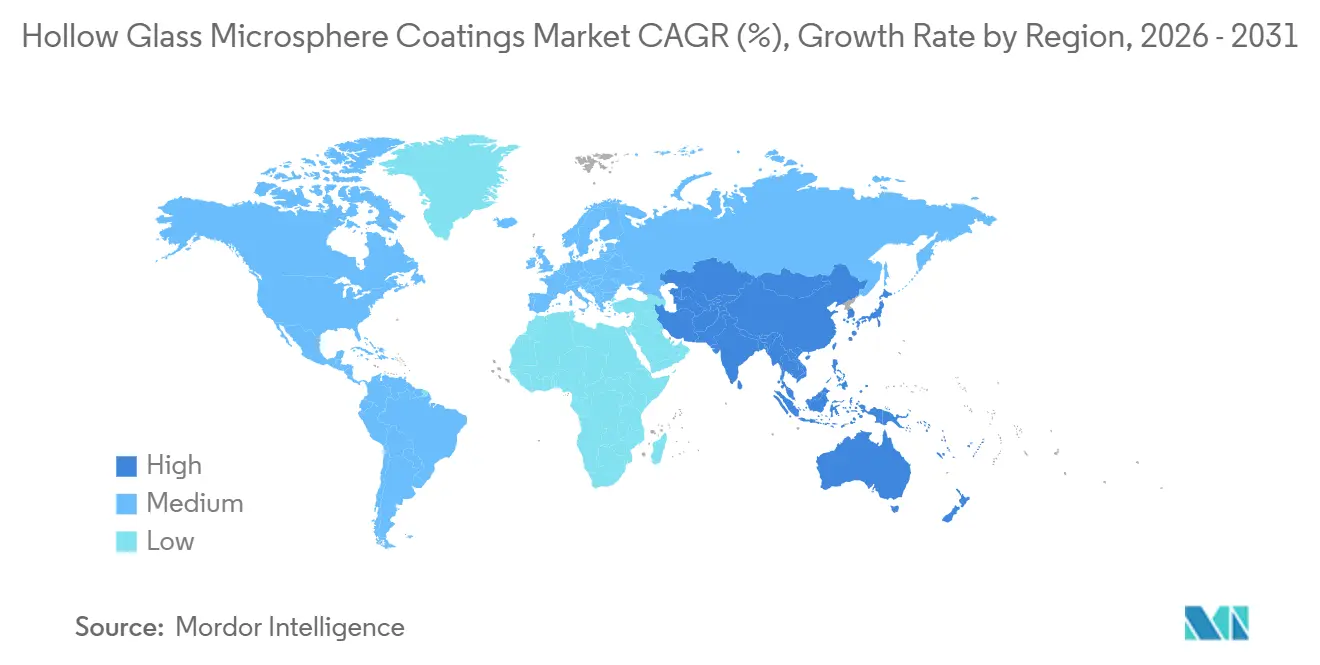
Asia-Pacific held 38.45% of the hollow glass microsphere coatings market share in 2025 and is forecast to grow at a 5.95% CAGR through 2031. China accounts for much of the region's manufacturing capacity for construction and automotive applications, giving local formulators access to a broad supply base and enabling producers to serve domestic demand and regional export channels. Its production base supports export flows to India and Southeast Asia, where coating consumption is tied to construction activity, industrial investment, and vehicle production. India's rising imports reflect growing demand from aerospace maintenance, construction insulation, and automotive coatings, though its supply base remains less developed than China's. Japan and South Korea represent demand for high-purity silica grades in electronics coatings and advanced composites, while South Korea's defense-linked composites work and Malaysia's aerospace maintenance sector contribute specialized demand.
North America and Europe Hollow Glass Microsphere Coatings Market
North America is the second-largest regional demand center for the hollow glass microsphere coatings market. The United States is supported by offshore maintenance activity in the Gulf of Mexico, use in automotive body putties and underbody coatings, and coating specifications in aerospace and marine applications. California's Title 24, Part 6 requirements, in effect since January 1, 2026, support the use of coatings designed for roof energy performance. Canada and Mexico contribute to construction and industrial maintenance demand, while cross-border supply channels connect these end uses with U.S. producers and distributors. Europe is led by Germany, the United Kingdom, France, and Italy, where industrial maintenance cycles and automotive lightweighting specifications support regional consumption.
South America and MEA Hollow Glass Microsphere Coatings Market
South America and the Middle-East and Africa represent smaller demand areas for the hollow glass microsphere coatings market. Brazil supports South American consumption through offshore oil and gas assets, including coatings for FPSO hulls and subsea structures, where low weight and barrier performance are both valued. Argentina adds modest industrial demand, while Saudi Arabia supports demand through infrastructure and industrial projects requiring protective coatings in hot, saline conditions. South Africa adds a mining maintenance niche for chemical-resistant systems. Limited local supply means these regions depend on imports, sustaining price premiums and constraining broader adoption compared with Asia-Pacific.
Competitive Landscape
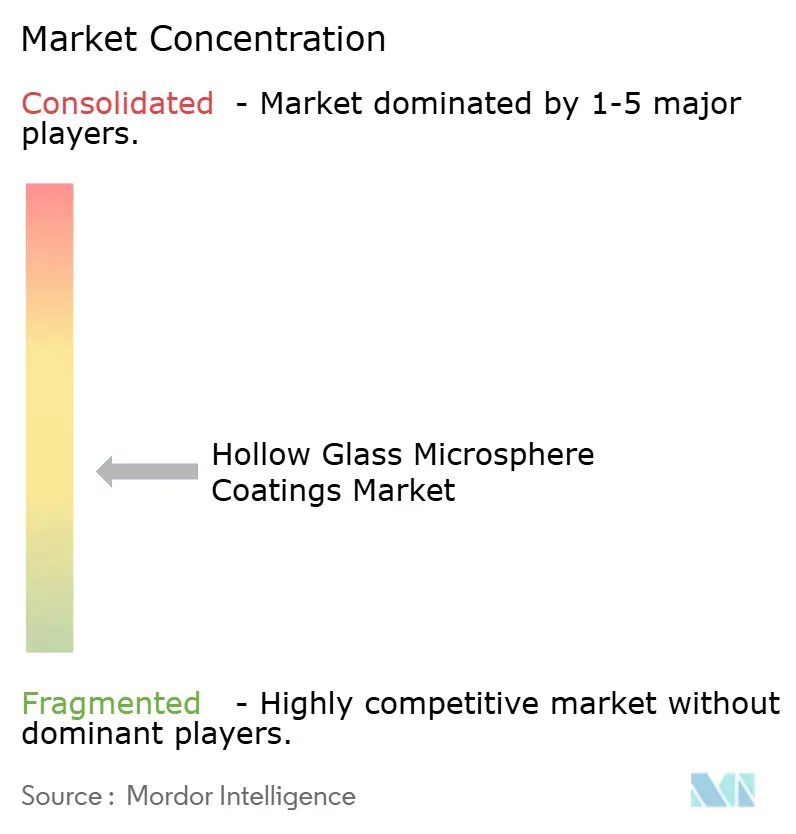
The hollow glass microsphere coatings market is moderately fragmented, with 3M, Potters Industries LLC, and SINOSTEEL MAANSHAN NEW MATERIAL TECHNOLOGY positioned in the upper supply tier. No single supplier holds a dominant share, and competition varies among technology leaders with proprietary grades, vertically integrated producers with captive glass capacity, and precision-grade specialists serving qualification-dependent applications. Technology leaders compete through product range, materials expertise, application support, and distribution reach, while vertically integrated producers benefit from a more stable glass supply and lower exposure to external sourcing risks. Precision-grade specialists focus on applications where qualification history, material consistency, and product certification are as important as core microsphere performance. This structure leaves standard grades exposed to price competition, while technically differentiated materials have more room to compete on specification and service.
3M offers S32HSN and iM30K grades for syntactic foams, coatings, and automotive applications. This cross-application product reach is difficult for smaller producers to match, as it requires a portfolio capable of serving multiple end uses while maintaining a recognized technical position. Potters Industries LLC uses captive soda-lime glass manufacturing to support supply continuity for aerospace buoyancy and marine protection applications, where product reliability and qualification history are central to customer decisions. Mid-tier manufacturers compete on formulation compatibility, regional availability, and price, keeping pricing pressure elevated in standard-grade segments. The market combines established global suppliers with smaller producers that remain competitive where they offer application fit or local supply advantages.
Distribution and technical service are important competitive tools in the hollow glass microsphere coatings market. In December 2024, Brenntag expanded its exclusive 3M Glass Bubbles distribution agreement from the United Kingdom into France and Iberia, broadening market access through specialty chemical distribution rather than direct field sales in secondary markets. Suppliers identify opportunities in surface-functionalized grades for waterborne polyurethane and polyester systems, where resin compatibility is a deciding factor for formulators. Thermal management coatings for lithium-ion battery enclosures represent another area with limited product standardization, and MO-SCI identifies glass-based composite materials as a means to optimize battery applications.
Hollow Glass Microsphere Coatings Industry Leaders
-
3M
-
Trelleborg AB
-
Potters Industries LLC
-
Cenostar
-
MO SCI, LLC
- *Disclaimer: Major Players sorted in no particular order
Hollow Glass Microsphere Coatings Market Companies Covered in this Report
- 3M
- Anhui Liwei Chemical Co., Limited
- Cenostar
- Cospheric LLC
- Geocon Products
- Matsumoto Yushi-Seiyaku Co.,Ltd
- MO SCI, LLC
- PETRA INDUSTRIES PVT. LTD.
- Polysciences
- Potters Industries LLC
- Sigmund Lindner GmbH
- SINOSTEEL MAANSHAN NEW MATERIAL TECHNOLOGY
- Sovitec
- The Kish Company, LLC
- Trelleborg AB
Recent Industry Developments in Hollow Glass Microsphere Coatings Market
- July 2025: 3M invested USD 45 million to expand glass-based hollow microsphere production at its Minnesota facility, targeting aerospace, automotive, and renewable energy applications that require lightweight composites. The investment increased US production capacity and reduced domestic formulators' import dependence.
- May 2025: Trelleborg Applied Technologies introduced a thermoplastic-based hollow microsphere filler for 3D printing filaments, reducing part weight by 30% while improving thermal insulation properties. The product extended the company's Eccospheres hollow glass microsphere technology into additive manufacturing applications for automotive and aerospace prototyping.
Global Hollow Glass Microsphere Coatings Market Report Scope
Hollow glass microsphere coatings are specialized paints or surface finishes that incorporate tiny, air-filled glass bubbles. These microscopic spheres reduce the weight of the coating, limit heat transfer, reflect sunlight, and improve durability in applications ranging from buildings and industrial plants to marine equipment.
The hollow glass microsphere coatings market is segmented by resin type, hollow glass microsphere type, application, and geography. By resin type, the market is segmented into acrylic coatings, epoxy coatings, polyurethane coatings, and others (silicone coatings, polyester and alkyd coatings, other resin types). By hollow glass microsphere type, the market is segmented into low-strength hollow glass microspheres, medium-strength hollow glass microspheres, high-strength hollow glass microspheres, and others (surface-treated hollow glass microspheres, specialty grades). By application, the market is segmented into protective and industrial coatings, thermal insulation coatings, lightweight coatings, and others (marine and offshore coatings, automotive coatings, architectural coatings, specialty coatings). The report also covers market size and forecasts for hollow glass microsphere coatings across 15 countries in major regions. The market sizes and forecasts are provided in terms of value (USD).
Segmentation Overview
| Acrylic Coatings |
| Epoxy Coatings |
| Polyurethane Coatings |
| Others (Silicone Coatings, Polyester and Alkyd Coatings, Other Resin Types) |
| Low-Strength Hollow Glass Microspheres |
| Medium-Strength Hollow Glass Microspheres |
| High-Strength Hollow Glass Microspheres |
| Others (Surface-Treated Hollow Glass Microspheres, Specialty Grades) |
| Protective and Industrial Coatings |
| Thermal Insulation Coatings |
| Lightweight Coatings |
| Others (Marine and Offshore Coatings, Automotive Coatings, Architectural Coatings, Specialty Coatings) |
| Asia-Pacific | China |
| India | |
| Japan | |
| South Korea | |
| Rest of Asia-Pacific | |
| North America | United States |
| Canada | |
| Mexico | |
| Europe | Germany |
| United Kingdom | |
| France | |
| Italy | |
| Rest of Europe | |
| South America | Brazil |
| Argentina | |
| Rest of South America | |
| Middle-East and Africa | Saudi Arabia |
| South Africa | |
| Rest of Middle-East and Africa |
| By Resin Type | Acrylic Coatings | |
| Epoxy Coatings | ||
| Polyurethane Coatings | ||
| Others (Silicone Coatings, Polyester and Alkyd Coatings, Other Resin Types) | ||
| By Hollow Glass Microsphere Type | Low-Strength Hollow Glass Microspheres | |
| Medium-Strength Hollow Glass Microspheres | ||
| High-Strength Hollow Glass Microspheres | ||
| Others (Surface-Treated Hollow Glass Microspheres, Specialty Grades) | ||
| By Application | Protective and Industrial Coatings | |
| Thermal Insulation Coatings | ||
| Lightweight Coatings | ||
| Others (Marine and Offshore Coatings, Automotive Coatings, Architectural Coatings, Specialty Coatings) | ||
| By Geography | Asia-Pacific | China |
| India | ||
| Japan | ||
| South Korea | ||
| Rest of Asia-Pacific | ||
| North America | United States | |
| Canada | ||
| Mexico | ||
| Europe | Germany | |
| United Kingdom | ||
| France | ||
| Italy | ||
| Rest of Europe | ||
| South America | Brazil | |
| Argentina | ||
| Rest of South America | ||
| Middle-East and Africa | Saudi Arabia | |
| South Africa | ||
| Rest of Middle-East and Africa | ||
Key Questions Answered in the Report
What is current market size of Hollow Glass Microsphere Coatings Market?
The Hollow Glass Microsphere Coatings Market size is expected to increase from USD 340.42 million in 2025 to USD 354.04 million in 2026 and reach USD 442.68 million by 2031, at a CAGR of 4.57% over 2026-2031.
Which type of resin leads to coating demand?
Acrylic coating led resin demand with a 37.13% share in 2025, while polyurethane coatings are forecast to grow fastest at a 5.74% CAGR.
Which microsphere grade is growing fastest?
High-strength grades held a 41.45% share in 2025 and are forecast to grow at a 5.36% CAGR through 2031. These grades are better suited to thicker coating builds and demanding mixing conditions because they can retain shell integrity under higher processing stress.
Which application has the strongest growth outlook?
Thermal insulation coatings are forecast to record the highest application CAGR, at 6.13%, through 2031. Building energy codes, cool-roof requirements, and industrial process insulation lend support to this outlook.