
High-Temperature Printing Materials Market Size and Share
Market Overview
| Study Period | 2021 - 2031 |
|---|---|
| Market Size (2026) | USD 0.94 Billion |
| Market Size (2031) | USD 1.81 Billion |
| Growth Rate (2026 - 2031) | 14.07 % |
| Fastest Growing Market | Asia-Pacific |
| Largest Market | Asia-Pacific |
| Market Concentration | Medium |
Major Players *Disclaimer: Major Players sorted in no particular order Image © Mordor Intelligence. Reuse requires attribution under CC BY 4.0. | |
High-Temperature Printing Materials Market Analysis by Mordor Intelligence
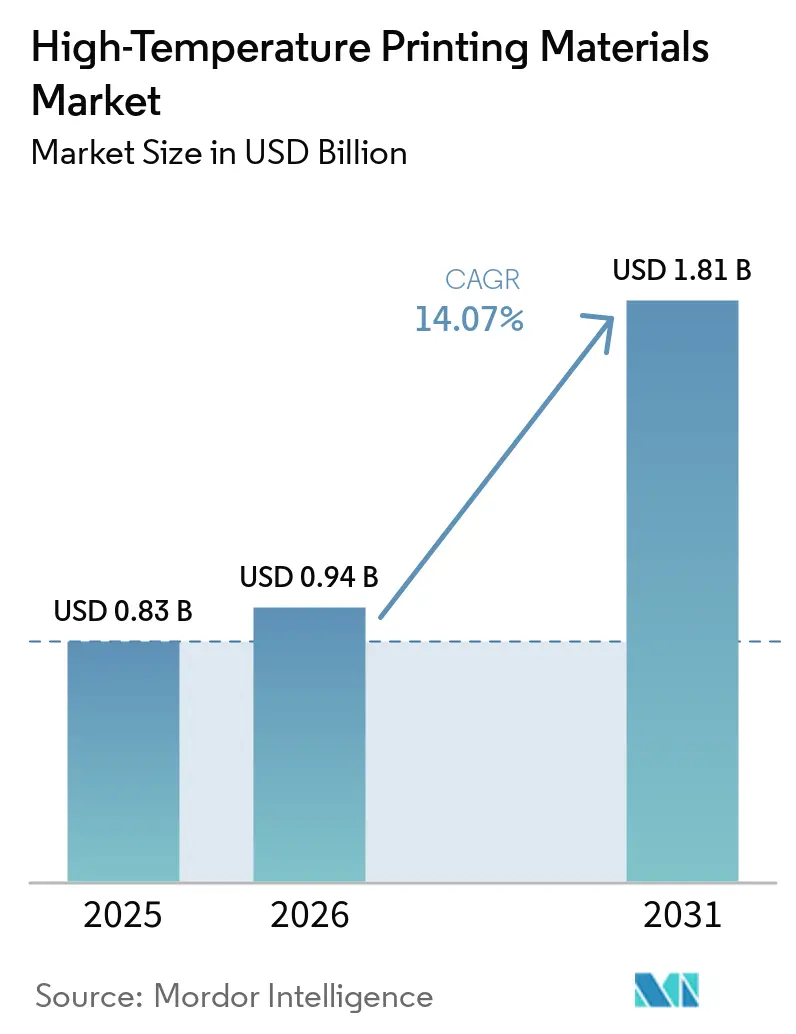
The high-temperature printing materials market size was estimated at USD 0.83 billion in 2025 and is estimated to grow from USD 0.94 billion in 2026 to USD 1.81 billion by 2031, at a CAGR of 14.07% during the forecast period (2026-2031). The high-temperature printing materials market is shifting from prototype use toward certified end-use production, where polyaryletherketone (PAEK) polymers, polyetherimide (PEI), and polyphenylsulfone (PPSU) can replace machined metal or injection-molded thermoplastics. Aerospace qualifications, patient-specific medical devices, and electric-vehicle motor insulation represent separate demand sources for the market. This broader base reduces reliance on prototyping, which shaped adoption during the first half of the 2020s. Material suppliers are increasingly pairing resin development with qualification support and locally tailored formulations. Printer suppliers are also improving chamber control, throughput, and repeatability, although the cost of certified hardware remains a barrier for smaller manufacturers.
Key Report Takeaways
- By material type, PEEK held 44.34% of the high-temperature printing materials market share in 2025, while PEKK is forecast to grow at a 15.34% CAGR through 2031.
- By end-user industry, Aerospace and Defense accounted for 38.12% of the high-temperature printing materials market share in 2025, while Healthcare is forecast to grow at 16.19% CAGR through 2031.
- By geography, Asia-Pacific held 41.45% of the high-temperature printing materials market share in 2025 and is forecast to grow at a CAGR of 15.78% through 2031.
Note: Market size and forecast figures in this report are generated using Mordor Intelligence’s proprietary estimation framework, updated with the latest available data and insights as of January 2026.
Market Trends and Insights
Drivers Impact Analysis of High-Temperature Printing Materials Market*
| Drivers | (~) % Impact on CAGR Forecast | Geographic Relevance | Impact Timeline |
|---|---|---|---|
| Certified Lightweighting of Aerospace and Defense Parts | +3.0% | Global, concentrated in North America and Europe | Medium term (2-4 years) |
| Patient-Specific PEEK and PEKK Medical Devices | +2.5% | North America and Europe, expanding to the Asia-Pacific | Medium term (2-4 years) |
| EV Thermal Management and Under-the-Hood Metal Replacement | +2.0% | Asia-Pacific core, with spillover to Europe | Short term (≤ 2 years) |
| Semiconductor and Electronics Miniaturization | +1.5% | Asia-Pacific core and North America | Short term (≤ 2 years) |
| Expansion of Industrial FDM, SLS, and Large-Format Additive Manufacturing | +2.0% | Global | Long term (≥ 4 years) |
| Source: Mordor Intelligence | |||
Certified Lightweighting of Aerospace and Defense Parts
Aerospace programs are expanding the use of thermoplastics beyond interior panels into structurally significant assemblies, which is supporting demand for high-temperature printing materials. Victrex, Daher, and the Luxembourg Institute of Science and Technology received the JEC Composites Innovation Award in January 2026 for a carbon-fiber-reinforced Low Melt Polyaryletherketone (LMPAEK) wing rib. The component delivered a 22% weight reduction relative to aluminum, a 15% assembly-cost reduction relative to a bolted assembly, and 12.5 tons of carbon dioxide savings per rib over an aircraft lifetime[1]. Rivet-free infrared welding also removes fastener-related fatigue points in the assembly. The 64-ply demonstration indicates that thermoplastic structures can support higher production rates without the cure cycles associated with thermoset composites. FAA FAR 25.853 and EASA CS-25 requirements for flammability, smoke, and toxicity continue to make qualification performance central to aerospace adoption.
Patient-Specific PEEK and PEKK Medical Devices
A more established regulatory pathway for patient-specific PEEK and PEKK devices is supporting the high-temperature printing materials market. ISO 10993 provides the biocompatibility framework for implantable devices, while ASTM F2820-24 defines the recognized specification for PEKK polymers used in surgical implants. The FDA has recognized ASTM F2820-24, providing medical device developers with a clearer basis for selecting and testing PEKK materials. Earlier clearances for patient-specific PEEK cranial implants and PEKK spinal devices demonstrated that additively manufactured devices can progress through the established regulatory review process. Each subsequent clearance can serve as a predicate for a later 510(k) submission based on substantial equivalence, thereby shortening the pathway for spinal, orthopedic, and cranial applications when the material, process controls, and clinical purpose are appropriately supported.
EV Thermal Management and Under-the-Hood Metal Replacement
Electric-drive systems are creating a demand channel for the high-temperature printing materials market that is separate from aerospace and medical applications. Syensqo stated that Mavel Powertrain selected KetaSpire PEEK magnet-wire insulation and Ajedium PEEK slot liners for a high-voltage electric motor used by a premium sports-car manufacturer. The materials support operation above 800 volts while improving copper fill factor, efficiency, and thermal management. PEEK has a continuous-use temperature near 260°C and a glass transition temperature near 143°C, which supports dielectric stability under sustained motor heat. In April 2026, Evonik opened a PEEK Rectangular Magnet Wire Lab in Shanghai to test VESTAKEEP formulations for NEV electric-drive systems. The facility performs breakdown-voltage, partial-discharge inception-voltage, and corona-resistance testing, supporting qualification by regional motor supply chains.
Expansion of Industrial FDM, SLS, and Large-Format Additive Manufacturing
The high-temperature printing materials market is expanding as industrial FDM, SLS, and large-format systems improve part consistency for PEEK, PEKK, and PEI. INTAMSYS introduced the FUNMAT PRO 310 APOLLO at Formnext 2025 with a 450°C nozzle, a 100°C heated chamber, a 160°C build plate, and active filament drying. The platform is designed to maintain PAEK processing conditions during week-long production runs. Formlabs introduced the Fuse X1 large-format SLS ecosystem in June 2026 for USD 84,999, claiming it delivers 50% lower cost per part and three times the throughput of comparable powder-bed systems. This addresses a cost barrier that has limited SLS-based PEKK production to major aerospace and defense contractors. Wider use of open platforms also makes material traceability and cross-platform qualification more important in regulated production.
Restraints Impact Analysis of High-Temperature Printing Materials Market*
| Restraints | (~) % Impact on CAGR Forecast | Geographic Relevance | Impact Timeline |
|---|---|---|---|
| High-Temperature Printer and Chamber CAPEX | -1.5% | Global | Short term (≤ 2 years) |
| Premium Feedstock and Processing Cost | -1.2% | Global | Medium term (2-4 years) |
| Limited Cross-Platform Qualification and Material Traceability | -0.8% | North America and Europe | Medium term (2-4 years) to long term (≥ 4 years) |
| Source: Mordor Intelligence | |||
High-Temperature Printer and Chamber CAPEX
The high-temperature printing materials market is constrained by the cost of industrial equipment capable of processing PEEK and ULTEM. Qualified FDM systems require an actively heated chamber above 100°C, a nozzle rated at 450°C to 500°C, and external motor mounting to protect drive electronics from heat. These features increase equipment costs and can push certified systems beyond the budgets of mid-market manufacturers. The initial purchase is often accompanied by heated dry boxes, medical-grade cleanroom protocols, and PAEK-specific post-processing equipment. Lower-cost systems can reduce the entry price, but they have not always completed aerospace and medical qualification cycles. Until qualification parity improves, adoption will remain concentrated among aerospace primes, medical OEMs, and established service bureaus.
Premium Feedstock and Processing Cost
Premium resin and processing costs limit the high-temperature printing materials market in price-sensitive applications. PEEK and PEKK feedstocks remain materially more expensive than commodity FDM polymers because precursor supply is concentrated among a limited group of producers. This structure slows the price decline that occurs when broader competition reaches commodity polymer grades. Arkema reported 15% year-over-year growth in 3D printing within its Specialty Materials segment in its first-quarter 2026 results presentation[2]. This reflects expanding activity in the segment and continued pricing strength in high-performance feedstocks. Material costs will remain a factor until PAEK feedstock supply broadens or powder reclamation and recycling reach industrial scale.
*Our forecasts treat driver/restraint impacts as directional, not additive. The impact forecasts reflect baseline growth, mix effects, and variable interactions.
High-Temperature Printing Materials Market Segment Analysis
By Material Type:
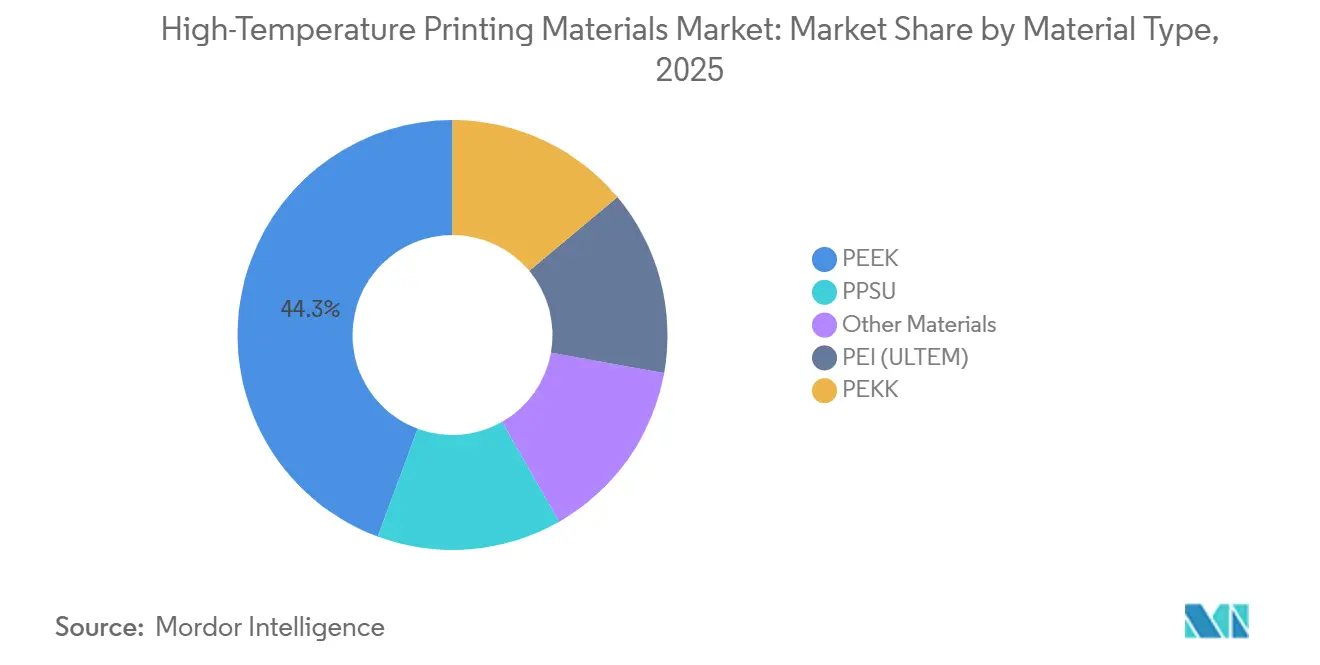
PEEK Leads by Share as PEKK Gains Ground in PrintabilityPEKK is projected to grow at a 15.34% CAGR through 2031, making it the fastest-growing material type in the high-temperature printing materials market. Its slower crystallization rate compared to PEEK reduces warping during Fused Deposition Modeling (FDM) builds and supports more predictable Selective Laser Sintering (SLS) sintering, which reduces some of the demanding chamber-control conditions associated with PEEK. This processing profile makes PEKK suitable for manufacturers seeking production-scale Polyaryletherketone (PAEK) parts with more consistent results. PEI, commonly sold as ULTEM, remains important for aerospace interior FDM applications because it complies with FAA FAR 25.853 requirements for flammability, smoke, and toxicity. In April 2026, Stratasys released ULTEM 1010 for its F3300 printer, stating that the material had the lowest coefficient of thermal expansion in its FDM portfolio. Polyphenylsulfone (PPSU) retains a distinct role in reusable surgical instruments and hospital devices, where resistance to repeated 134°C steam sterilization is a functional requirement.
PEEK captured 44.34% of the high-temperature printing materials market in 2025, reflecting established qualification histories in aerospace brackets, spinal cages, semiconductor wafer-handling fixtures, and chemical-processing components. Its tensile strength is approximately 115 MPa, its continuous-use temperature is approximately 260°C, and its established biocompatibility supports applications with demanding mechanical, thermal, and regulatory requirements. This record makes PEEK the default material on many aerospace- and medical-qualified parts lists, even where alternatives offer easier processing. Other materials include carbon-fiber-reinforced PAEK composites and PAEK-PEI blends that adjust mechanical and dielectric performance for specific applications. A 2026 study found that PEEK/PEI 80/20 blends retained 35% crystallinity and achieved an ultimate tensile strength of 75.6 MPa, indicating better printability than neat PEEK while retaining important structural and thermal characteristics. Specialty grades for laser-direct-structuring circuit boards, per- and polyfluoroalkyl substances (PFAS)-substitute dielectric substrates, and flame-retardant compounds further expand material choices in the high-temperature printing materials market.

By End-User Industry:
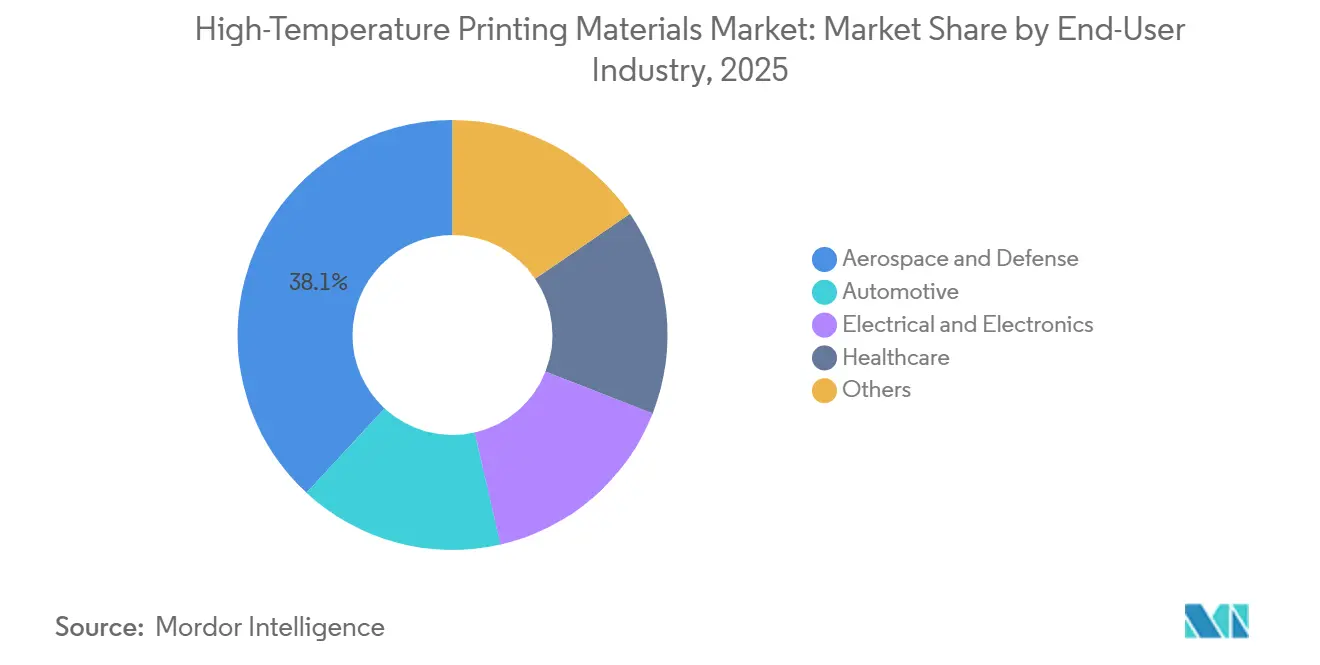
Aerospace Dominates, Healthcare Compounds FastestAerospace and defense accounted for 38.12% of the high-temperature printing materials market in 2025, supported by qualified commercial aircraft parts such as brackets, ducting, and interior clips. The segment also benefits from the premium pricing associated with aerospace-grade PEEK and ULTEM, the recurring need for flame-resistant components, and the use of qualified production tooling. Automotive demand is increasing as PEEK replaces polyamide-imide enamel in high-voltage motor wiring for 800-volt drivetrain architectures. Electrical and electronics applications use PEEK-based laser-direct-structuring substrates for high-frequency circuit boards and semiconductor fabrication fixtures that must resist aggressive process chemicals. Aerospace remains the largest end-user segment because its qualification cycles, production requirements, and material values are already well established.
Healthcare is expected to expand at a 16.19% CAGR through 2031, the strongest rate among end-user industries in the high-temperature printing materials market. Patient-specific PEEK cranial implants and PEKK spinal devices have supported a clearer regulatory route for additively manufactured medical products. Additive manufacturing also enables geometry-optimized implants and lattice structures that support bone ingrowth and long-term stability in spinal, cranial, and orthopedic applications. FDA recognition of ASTM F2820-24 and the applicability of 21 CFR 820 quality-system requirements support the process controls required for medical production. Oil and gas, rail, and biopharma equipment remain smaller but stable applications for PPSU and PPS materials in fluid-handling components, corrosion-resistant connectors, and reusable process equipment exposed to sterilization cycles and chemicals.
Geography Analysis
APAC High-Temperature Printing Materials Market
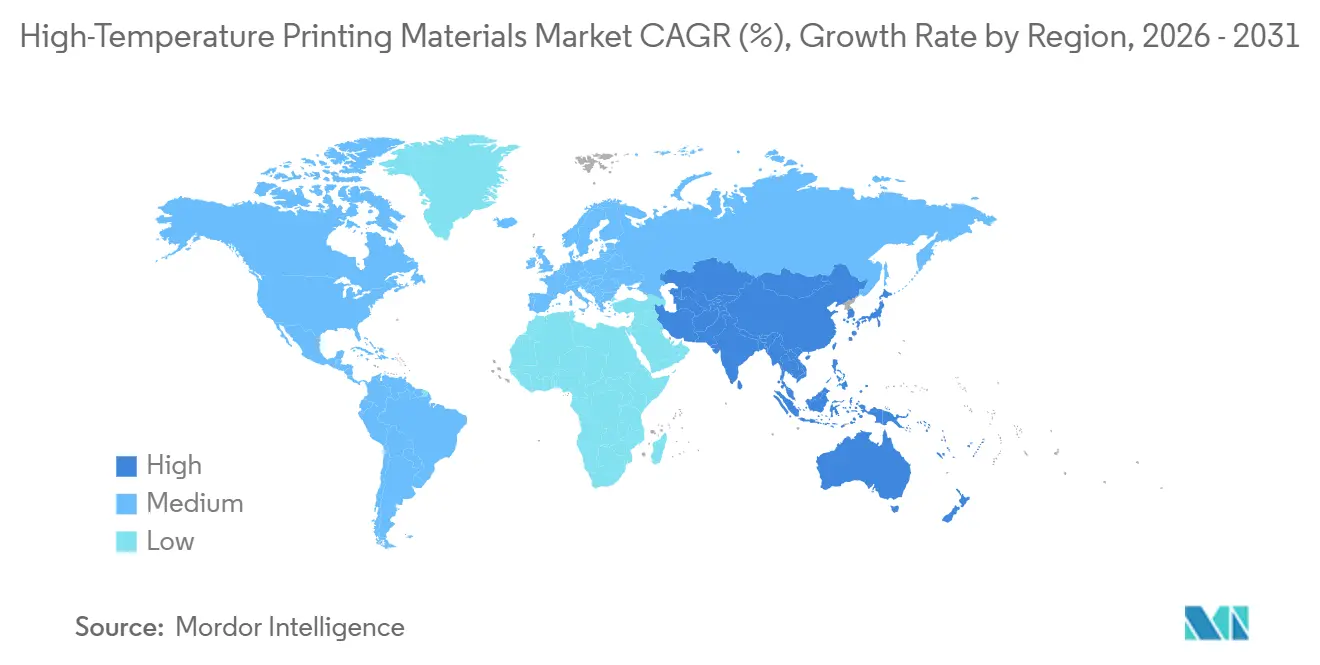
Asia-Pacific held 41.45% of the high-temperature printing materials market share in 2025 and is forecast to grow at a 15.78% CAGR through 2031. China underpins this position through NEV supply chains and semiconductor fabrication activity, which represent two independent sources of demand for high-performance polymers. In 2025, INTAMSYS and JLC3DP introduced a mass-production-ready PEEK and PEKK printing service using dozens of FUNMAT PRO 610HT systems in a single facility. The service combines high-temperature production capacity with instant quoting and intelligent production scheduling. Evonik's Shanghai magnet-wire laboratory reflects the region's localized approach to NEV motor insulation formulations.
India, Japan and South Korea High-Temperature Printing Materials Market
India contributes to demand through aerospace localization efforts and the development of its domestic medical-device market. Japan and South Korea contribute through precision semiconductor, automotive, and railway applications. These applications require PEEK to maintain dimensional stability during thermal cycling and to resist process fluids. This combination positions Asia-Pacific as both a major end market and a center for materials development.
The Americas and EMEA High-Temperature Printing Materials Market
North America was the second-largest regional market in 2025, supported by aerospace and defense prime contractors, U.S. medical-device manufacturers, and energy-sector demand for certified nonmetallic components. Europe remains a significant contributor, particularly in Germany and the Nordic countries, where Airbus programs and premium automotive production require flame-resistant ULTEM and high-performance PEEK components. South America, the Middle-East, and Africa remain early-stage markets for high-temperature printing materials. Their growth depends on qualification work and application development before production quantities increase. These regions offer a first-mover opportunity for suppliers that invest in qualification and application development ahead of wider demand.
Competitive Landscape
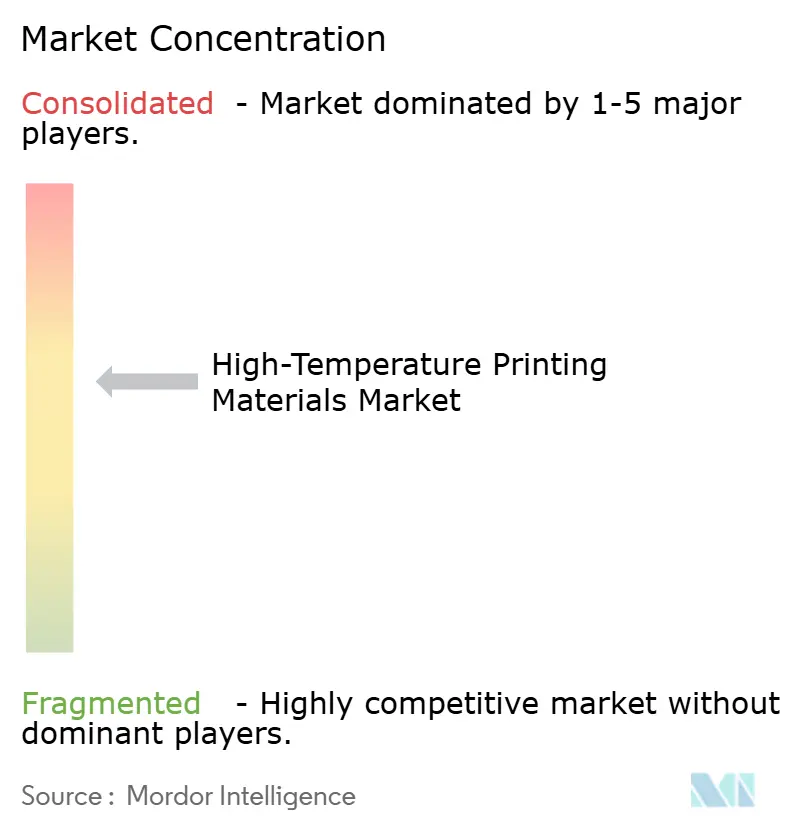
The high-temperature printing materials market is moderately consolidated. Victrex, Syensqo, Arkema, and Evonik supply much of the commercially available PAEK polymer base. Arkema uses the Kepstan PEKK licensing model to support compounders and printer OEMs. Syensqo offers KetaSpire PEEK and Radel PPSU for additive applications. Evonik links VESTAKEEP grades to new energy vehicle (NEV) supply chains through its Shanghai magnet-wire laboratory.
SABIC holds a distinct position in the ULTEM (PEI) portfolio. Certifications developed by Stratasys and Roboze make approved polymer-printer combinations difficult to replace, as OEMs require continued traceability and qualification continuity. Production-scale SLS for PEKK powders remains an open area, as only a limited number of system providers support PAEK processing at scale. FDM hardware below USD 20,000 that can consistently process PEEK is another less-developed category.
Roboze uses a distributed manufacturing network that links qualified partners through standardized digital workflows for PEEK and ULTEM production. This model supports certified production at distributed sites without incurring the full qualification overhead at each location. Suppliers compete on material performance, printer compatibility, application development, and distributed production support. Resin suppliers retain influence because PAEK precursor supply and qualification data remain difficult to reproduce. This structure supports concentrated upstream supply alongside a diverse equipment and service base.
High-Temperature Printing Materials Industry Leaders
-
Arkema
-
Evonik Industries AG
-
Ensinger
-
Syensqo
-
Victrex plc
- *Disclaimer: Major Players sorted in no particular order
High-Temperature Printing Materials Market Companies Covered in this Report
- 3D Systems, Inc.
- Apium 3D Technologies GmbH
- Arkema
- BASF
- Ensinger
- EOS GmbH
- Evonik Industries AG
- INTAMSYS Technology Co. Ltd.
- Lehmann&Voss&Co.
- Mitsubishi Chemical Corporation
- Oxford Performance Materials
- Roboze
- SABIC
- Stratasys
- Syensqo
- Toray Industries, Inc.
- Victrex plc
Recent Industry Developments in High-Temperature Printing Materials Market
- July 2026: Airbus qualified Roboze's Argo 500 HyperSpeed 3D printing platform using ULTEM 9085 filament for flight-ready secondary structural parts. The qualification met Airbus requirements for mechanical performance, flame retardancy, repeatability, and traceability, validating distributed polymer additive manufacturing as a certified aerospace production architecture.
- April 2026: Evonik opened a PEEK Rectangular Magnet Wire Lab in Shanghai, China, dedicated to VESTAKEEP® PEEK formulations for NEV electric-drive systems. Announced at CHINAPLAS, the facility includes a pilot extrusion line that covers the full process chain, from copper pretreatment and PEEK coating to in-line dimensional inspection and final winding.
Global High-Temperature Printing Materials Market Report Scope
High-temperature printing materials are specialized thermoplastics or resins engineered to retain their mechanical strength, structural integrity, and chemical resistance under continuous thermal stress above 150°C, unlike standard plastics such as PLA or PETG, which soften or warp at elevated temperatures.
The high-temperature printing materials market is segmented by material type, end-user industry, and geography. By material type, the market is segmented into PEEK, PEI (ULTEM), PEKK, PPSU, and other materials. By material type, the market is segmented into aerospace and defense, automotive, electrical and electronics, healthcare, and others. The report also covers market size and forecasts for high-temperature printing materials across 15 countries in major regions. The market sizes and forecasts are provided in terms of value (USD).
Segmentation Overview
| PEEK |
| PEI (ULTEM) |
| PEKK |
| PPSU |
| Other Materials |
| Aerospace and Defense |
| Automotive |
| Electrical and Electronics |
| Healthcare |
| Others |
| Asia-Pacific | China |
| India | |
| Japan | |
| South Korea | |
| ASEAN Countries | |
| Rest of Asia-Pacific | |
| North America | United States |
| Canada | |
| Mexico | |
| Europe | Germany |
| United Kingdom | |
| France | |
| Italy | |
| NORDIC Countries | |
| Rest of Europe | |
| South America | Brazil |
| Argentina | |
| Rest of South America | |
| Middle East and Africa | Saudi Arabia |
| South Africa | |
| Rest of Middle East and Africa |
| By Material Type | PEEK | |
| PEI (ULTEM) | ||
| PEKK | ||
| PPSU | ||
| Other Materials | ||
| By End-User Industry | Aerospace and Defense | |
| Automotive | ||
| Electrical and Electronics | ||
| Healthcare | ||
| Others | ||
| By Geography | Asia-Pacific | China |
| India | ||
| Japan | ||
| South Korea | ||
| ASEAN Countries | ||
| Rest of Asia-Pacific | ||
| North America | United States | |
| Canada | ||
| Mexico | ||
| Europe | Germany | |
| United Kingdom | ||
| France | ||
| Italy | ||
| NORDIC Countries | ||
| Rest of Europe | ||
| South America | Brazil | |
| Argentina | ||
| Rest of South America | ||
| Middle East and Africa | Saudi Arabia | |
| South Africa | ||
| Rest of Middle East and Africa | ||
Key Questions Answered in the Report
What is current market size of High-Temperature Printing Materials Market?
The high-temperature printing materials market size was estimated at USD 0.83 billion in 2025 and is estimated to grow from USD 0.94 billion in 2026 to USD 1.81 billion by 2031, at a CAGR of 14.07% during the forecast period (2026-2031).
Which material leads to high-temperature additive manufacturing?
PEEK held 44.34% of revenue in 2025 because of its established aerospace, medical, semiconductor, and chemical-processing qualifications.
Why are medical applications expanding?
Healthcare is expected to grow at a 16.19% CAGR as patient-specific PEEK and PEKK implants gain clearer quality and regulatory pathways.
Which region has the strongest position?
Asia-Pacific held 41.45% in 2025 and is forecast to grow at a 15.78% CAGR, supported by New Energy Vehicle (NEV), semiconductor, and aerospace activity.