
High-Temperature Molten-Salt Pumps Market Size and Share
Market Overview
| Study Period | 2021 - 2031 |
|---|---|
| Market Size (2026) | USD 171.67 Million |
| Market Size (2031) | USD 257.89 Million |
| Growth Rate (2026 - 2031) | 8.48 % |
| Fastest Growing Market | Asia-Pacific |
| Largest Market | Asia-Pacific |
| Market Concentration | Low |
Major Players *Disclaimer: Major Players sorted in no particular order Image © Mordor Intelligence. Reuse requires attribution under CC BY 4.0. | |
High-Temperature Molten-Salt Pumps Market Analysis by Mordor Intelligence
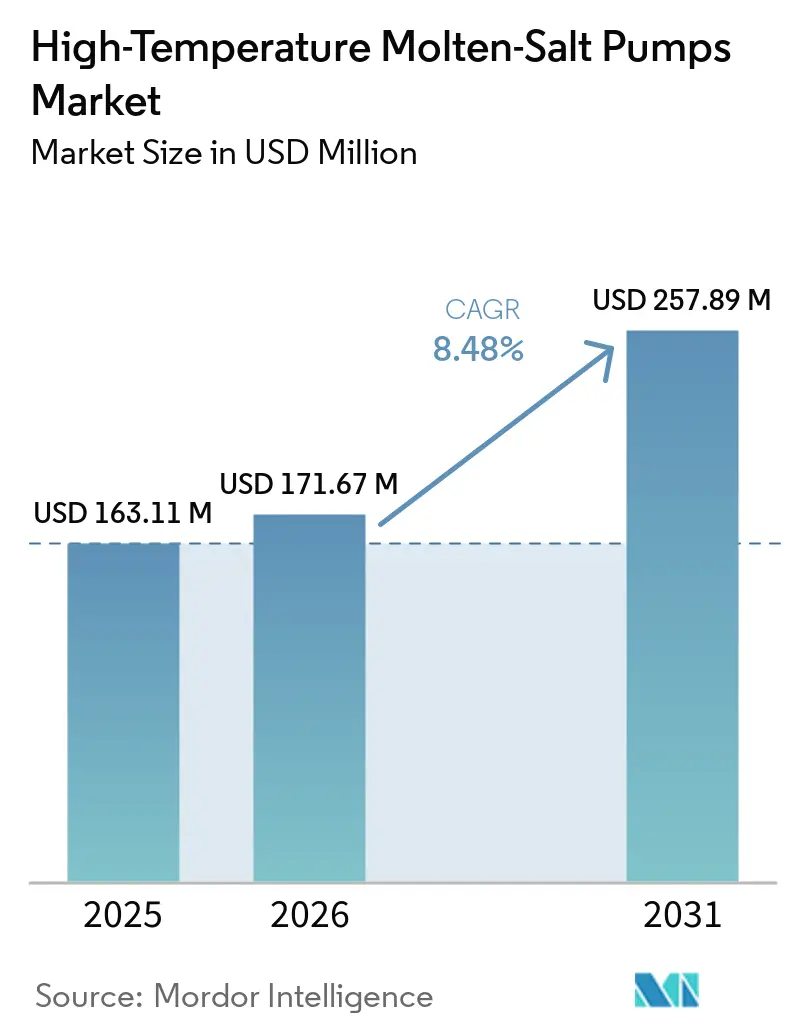
The High-Temperature Molten-Salt Pumps Market size is expected to increase from USD 163.11 million in 2025 to USD 171.67 million in 2026 and reach USD 257.89 million by 2031, at a CAGR of 8.48% over 2026-2031. The high-temperature molten salt pumps market is shaped by concentrated solar power construction in China and by wider use of thermal storage in grid and industrial applications. Tower-based solar thermal projects require more pump units than trough and Fresnel designs because they use separate hot and cold salt circuits. This makes equipment demand rise faster than installed capacity in projects that favor tower configurations. The high-temperature molten salt pumps market also benefits when storage systems are used independently of solar generation, especially where operators need flexible power or industrial heat. Qualified suppliers retain an advantage because alloy traceability, operating references, and long test records remain important in solar and nuclear procurement.
Key Report Takeaways
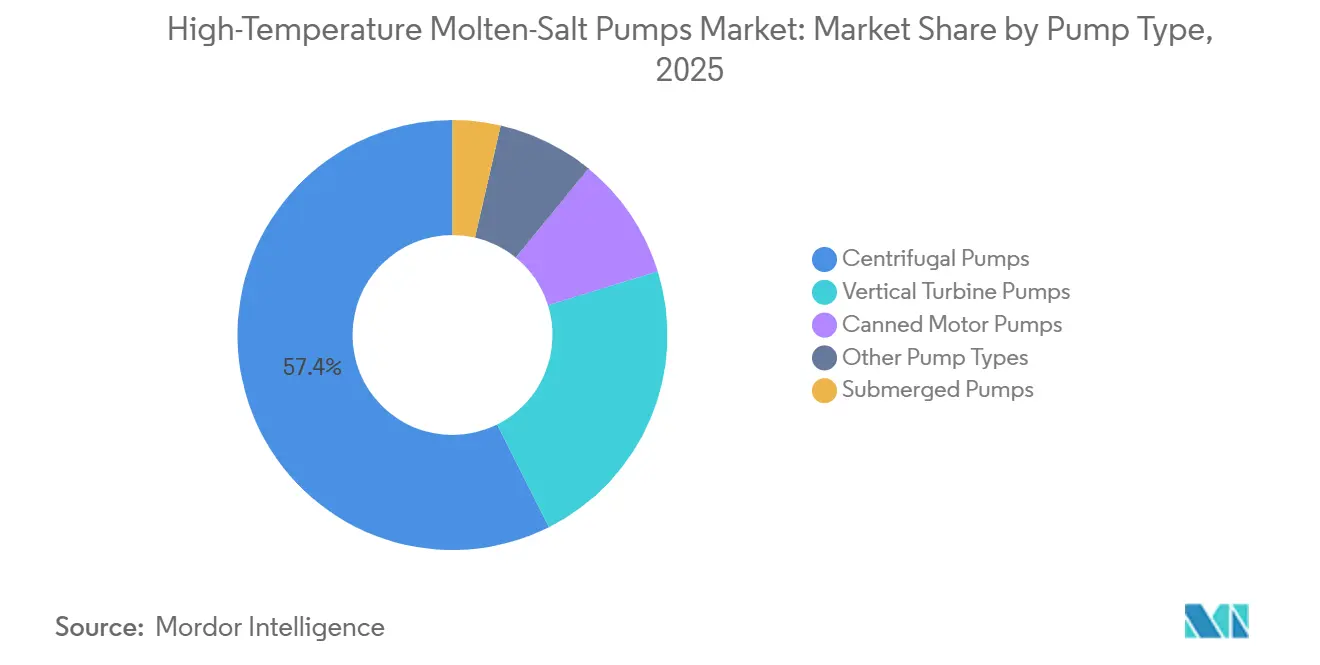
- By pump type, centrifugal pumps held 57.4% of the high-temperature molten salt pumps market share in 2025, while vertical turbine pumps are projected to grow at a 10.2% CAGR through 2031.
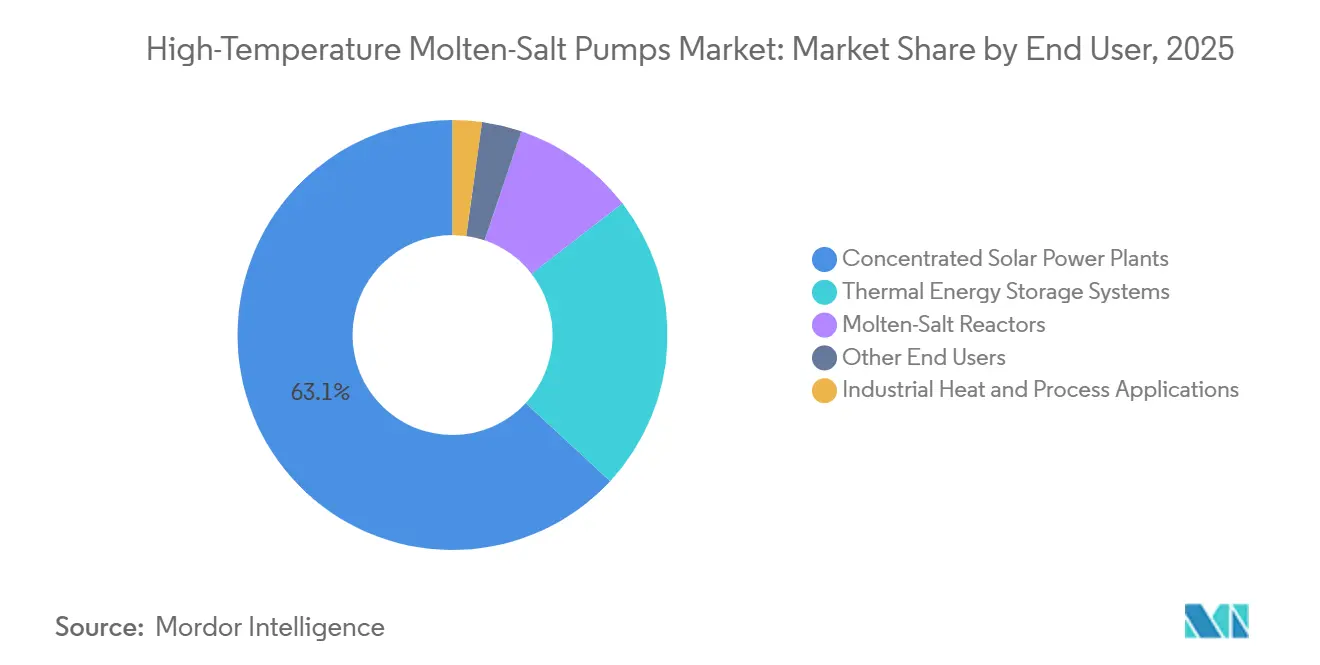
- By end user, concentrated solar power plants held 63.1% of the high-temperature molten salt pumps market share in 2025, while thermal energy storage systems are projected to grow at an 11.4% CAGR through 2031.
- By geography, Asia-Pacific held 42.6% in 2025 and is projected to grow at a 10.5% CAGR through 2031.
Note: Market size and forecast figures in this report are generated using Mordor Intelligence’s proprietary estimation framework, updated with the latest available data and insights as of January 2026.
Market Trends and Insights
Drivers Impact Analysis of High-Temperature Molten-Salt Pumps Market*
| Driver | (~) % Impact on CAGR Forecast | Geographic Relevance | Impact Timeline |
|---|---|---|---|
| CSP and Thermal-Storage Capacity Additions | +2.30% | Asia-Pacific (China dominant), MEA, South America | Short term (≤ 2 years) |
| Dispatchable Renewable Power and Grid Flexibility Requirements | +1.50% | Global, with early gains in China, EU, Middle East | Medium term (2–4 years) |
| Expansion of High-Temperature Industrial Heat Applications | +0.90% | Europe, North America, APAC core | Medium term (2–4 years) |
| Advanced Reactor Demonstration Programs | +0.60% | North America, EU (Denmark, France, Czech Republic), China | Long term (≥ 4 years) |
| Demand for Sealless and Leak-Prevention Pump Designs | +0.50% | Global, with early gains in Germany, Japan, United States | Medium term (2–4 years) |
| Regional Localization of Molten-Salt Pump Manufacturing | +0.40% | China, India | Short term (≤ 2 years) |
| Source: Mordor Intelligence | |||
CSP And Thermal Storage Capacity Additions Pull Pump Procurement Forward
China connected 9 concentrated solar power projects totaling 900 MW in 2025, taking cumulative installed capacity to 1,738.2 MW, while 25 projects totaling 3,000 MW remained under construction at year-end. This construction pipeline provides the clearest near-term demand base for the high-temperature molten salt pumps market. Tower projects represented 71% of China’s technology mix and require separate hot and cold pump sets. Their equipment needs can therefore exceed those of trough projects with similar power capacity. China’s 2030 target of 15,000 MW implies 13,300 MW of additions beyond the 2025 base. Two standalone 350 MW solar thermal plants also began construction at the end of 2025. These additions give the high-temperature molten salt pumps market a visible pipeline for equipment and service demand. The 350 MW CGN Qinghai project, commissioned in June 2026, includes 15 hours and 11,747 MWh of molten salt storage, making it a major current procurement reference for pump systems.
Dispatchable Renewable Power Requirements Extend Pump Demand Beyond Solar
Grid operators use thermal storage to absorb surplus electricity and release energy when demand is higher. This broadens the high-temperature molten salt pumps market beyond solar generation equipment. Pump systems with earlier concentrated solar power references can be adapted for standalone grid balancing and industrial heat installations. The same installed design knowledge can reduce the work required to specify pumps for new storage configurations. This gives suppliers in the high-temperature molten salt pumps market a route to adjacent applications without replacing their core hydraulic platforms. Sulzer and Hyme Energy announced a partnership in April 2025 to develop 600°C molten hydroxide storage, using vertical turbine pumps for salt movement within existing industrial infrastructure[1]. China commissioned a steam-extraction molten salt thermal storage facility in July 2026 that retrofits a 600 MW coal unit and provides 100 MW of peak-shaving capacity with more than 6 hours of support. These uses place molten salt circulation equipment within broader power-system flexibility projects.
Industrial Heat Decarbonization Opens A New Demand Channel
Industrial heat projects create demand for high-temperature molten salt pumps, where concentrated solar power was previously not used. The DLR NEILOS project is developing molten salt heat systems operating between 600°C and 650°C for ammonia cracking and green hydrogen production. Those conditions exceed the 560°C limit of current commercial pump designs and require further alloy qualification. A 2025 scientific review reported that advanced molten salt heat-exchanger configurations can improve industrial power-cycle efficiency by 15% to 20%. Kyoto Group inaugurated a 56 MWh Heatcube at KALL Ingredients in Hungary in October 2025, using molten salt above 400°C in corn processing. This project shows how the high-temperature molten salt pumps market can reach food and chemical manufacturing through modular industrial storage systems.
Advanced Reactor Programs Create A High Value Pump Niche
Molten salt reactors require continuous circulation of corrosive fluids at temperatures above 600°C. This gives nuclear applications high unit values but also places strict demands on materials and qualifications. The U.S. Department of Energy created the Reactor Pilot Program in May 2025 to accelerate advanced reactor testing and authorization[2]. The Department of Energy also provided up to USD 303 million in risk-reduction funding for Kairos Power’s Hermes fluoride salt-cooled reactor. The University of Michigan conducted a 2,300-hour molten salt pump-shaft seal experiment in 2025, adding evidence for future reactor qualification work. KSB is designing primary pumps for Terrestrial Energy’s Integral Molten Salt Reactor, showing how reactor programs can create long supplier relationships.
Restraints Impact Analysis of High-Temperature Molten-Salt Pumps Market*
| Restraint | (~) % Impact on CAGR Forecast | Geographic Relevance | Impact Timeline |
|---|---|---|---|
| Corrosion and Erosion in Chloride-Salt Service | -1.30% | Global - most acute in Gen 3 CSP and MSR programs in North America, EU | Long term (≥ 4 years) |
| Freeze-Protection and Thermal-Cycling Complexity | -0.70% | Cold-climate markets: Northeast China, Northern Europe, North America | Medium term (2–4 years) |
| Specialty-Alloy and Ceramic-Bearing Supply Constraints | -0.60% | Global - sharpest where Haynes 244 and Hastelloy C-276 dominate specifications | Medium term (2–4 years) |
| Long Qualification Cycles for Nuclear and CSP Projects | -0.80% | North America, EU - markets with stringent nuclear regulatory frameworks | Long term (≥ 4 years) |
| Source: Mordor Intelligence | |||
Corrosion In Chloride Salt Service Limits Next Generation Performance
Chloride salts are needed for pump service above 600°C in Generation 3 concentrated solar power and advanced reactor applications. Their corrosive effect is much greater than that of the nitrate salts used in most operating commercial systems. A Department of Energy and Oak Ridge National Laboratory project reported in 2024 that commercially available bearing materials could not be used in chloride-salt pumps without redesign. The project developed test infrastructure using Haynes 244 and yttria partially stabilized zirconia, but it ended before full-scale bearing tests were completed. Separate Department of Energy research reported corrosion of IN625 in chloride salts at 800°C at rates exceeding 1.1 inches per year. These unresolved material issues limit the near-term portion of the high-temperature molten salt pumps market that can serve the most demanding thermal applications. They also shift attention toward proprietary coatings and cermet composites, which introduce their own supply constraints. Commercially validated chloride-salt solutions may therefore take 3 to 5 years to reach project-ready scale.
Long Qualification Cycles Delay Access To High Value Projects
Nuclear and large concentrated solar power pump projects can take 3 to 7 years from early design work to revenue recognition. This timing limits the addressable high-temperature molten salt pumps market within a standard forecast period. Long operating trials are needed to demonstrate corrosion performance, seal reliability, and stable hydraulic operation. Chinese concentrated solar power procurement also requires technical appraisals and product certification under national standards. These procedures favor suppliers with existing reference plants and complete qualification records. They require repeated evidence on materials, thermal cycling, and operational stability before final project acceptance. That process limits rapid supplier substitution in the high-temperature molten salt pumps market. The resulting delay can preserve incumbent positions in higher-margin projects even as competition increases in nitrate-salt applications.
*Our forecasts treat driver/restraint impacts as directional, not additive. The impact forecasts reflect baseline growth, mix effects, and variable interactions.
High-Temperature Molten-Salt Pumps Market Segment Analysis
By Pump Type:
Centrifugal Pumps Lead While Vertical Turbine Designs Gain GroundCentrifugal pumps accounted for 57.4% of the high-temperature molten salt pumps market size in 2025. Their lead reflects established use in hot and cold salt loops at parabolic trough and early tower projects across North Africa, the Middle East, and China. Mature hydraulic designs and broad ISO 13709 and API 610 alignment make these pumps familiar to procurement teams at commercial nitrate-salt plants. They are used where project operators value established casting materials and maintenance practices, and this installed base supports replacement demand and service work through long plant operating lives.
Vertical turbine pumps are forecast to grow at a 10.2% CAGR through 2031, the highest rate among pump types. They fit two-tank storage systems where deep submergence supports stable suction and reduces freeze risk in the suction column. These configurations can require the pump to sit 12 to 20 meters below the salt surface. Sulzer supplied 18-meter vertical turbine units for the hot and cold circuits of a 100 MW Chinese tower project in 2024[3]. Canned motor pumps serve a smaller premium niche in molten salt reactors because zero-leakage design requirements can exclude conventional shaft seals. Submerged, magnetic-drive, and canned motor designs also gain relevance where industrial users prioritize leak prevention and simpler maintenance access in the high-temperature molten salt pumps industry.

By End User:
Thermal Energy Storage Systems Form The Fastest Growing ApplicationConcentrated solar power plants represented 63.1% of end-user demand in 2025. Commercial solar thermal plants need pumps across hot, cold, and temperature-adjustment circuits, creating initial equipment demand and later service work. A 100 MW tower project can use 5 to 10 pump units across these functions. CGN’s 350 MW Qinghai project was commissioned in June 2026 with 15 hours and 11,747 MWh of storage. CGN’s 100 MW Jixi project began generation in July 2026 and showed high-temperature pump operation at 45.36 degrees north latitude.
Thermal energy storage systems are forecast to grow at an 11.4% CAGR through 2031. These systems increasingly operate without a direct solar generation link and support grid flexibility and industrial heat applications. China’s 2026 steam-extraction heat-storage project demonstrates use in coal-unit flexibility as well as renewable integration. Molten salt reactors offer the highest unit value but have lower near-term volume because qualification remains lengthy, while industrial heat uses in petrochemicals, alumina refining, and green hydrogen form a middle demand area for the high-temperature molten salt pumps market. The ASME TES-1-2023 safety standard is increasingly referenced in non-solar thermal storage specifications, supporting suppliers with internationally recognized engineering credentials.
Geography Analysis
APAC High-Temperature Molten-Salt Pumps Market
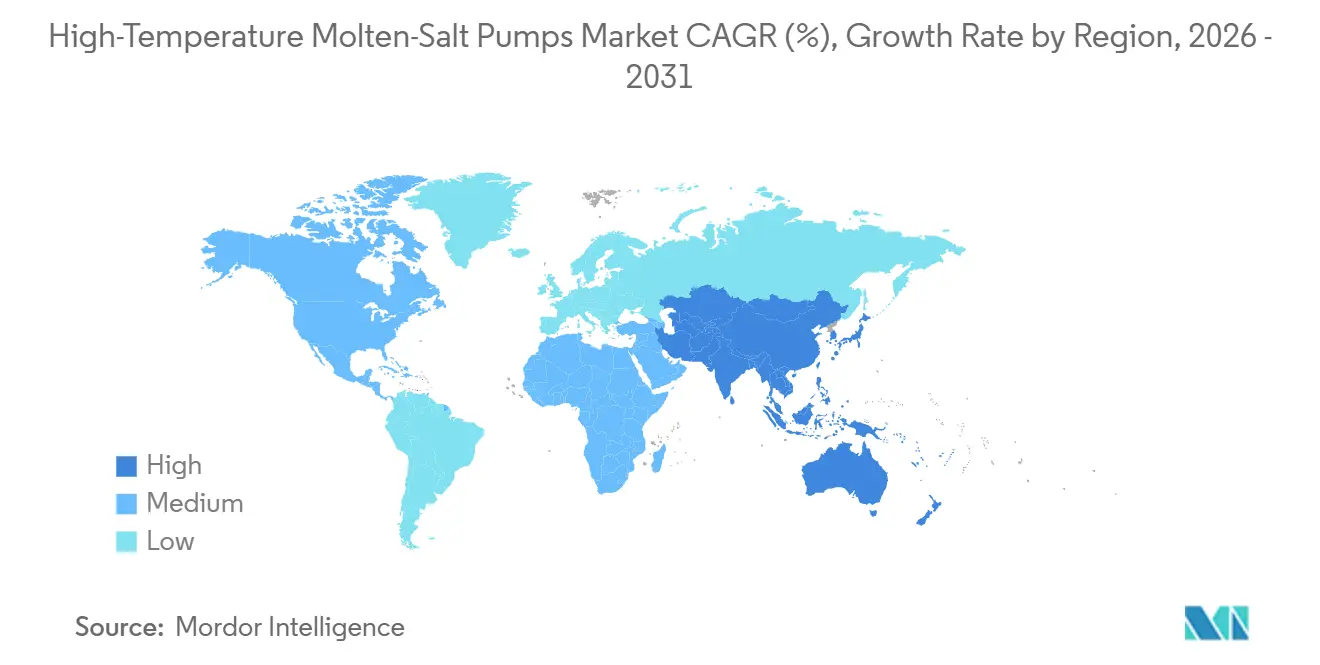
Asia-Pacific held 42.6% of the high-temperature molten salt pumps market in 2025 and is forecast to grow at a 10.5% CAGR through 2031. China connected 900 MW across 9 concentrated solar power projects in 2025, taking cumulative capacity to 1,738.2 MW, while its 2030 target of 15,000 MW signals large additions from the 2025 base. China’s procurement pattern is also shifting toward qualified domestic suppliers. Jiangsu Shuangda’s RY(L) series received a China General Machinery Industry Association appraisal in July 2025 after 24 months of operation at a Qinghai plant[4]. Kaiquan received association certification in March 2025 after demonstrating hot, cold, and temperature-adjustment pump operation at the Shou Hang Dunhuang project. India, Japan, and South Korea add demand through industrial thermal storage and small modular reactor preparation, although their combined 2025 share was below 10% of regional volume.
North America and Europe High-Temperature Molten-Salt Pumps Market
North America and Europe are driven more by reactor demonstrations, operating concentrated solar power fleets, and industrial decarbonization than by new solar thermal capacity. The U.S. Department of Energy is supporting Kairos Power’s Hermes reactor and has established the Reactor Pilot Program to advance authorization pathways. Europe combines solar thermal service work in Spain and Morocco with new industrial storage projects, including Kyoto Group’s 56 MWh Heatcube that began operating in Hungary in October 2025. Sulzer is supplying 8 molten salt pumps for Highview Power’s Carrington liquid air energy storage project, which is expected to operate in March 2027. These projects widen the high-temperature molten salt pumps market beyond conventional solar thermal equipment.
South America and MEA High-Temperature Molten-Salt Pumps Market
South America and the Middle East and Africa contribute smaller but distinct demand pools. Saudi Arabia and the United Arab Emirates use concentrated solar power within wider energy diversification plans, while Chile’s Atacama region supports concentrated solar power and thermal storage development because of its high direct solar resource. Morocco is upgrading the hot molten salt storage tank at Noor Ouarzazate III, and South Africa connected the Redstone concentrated solar power project to the grid in 2024. REN21 reported that no new concentrated solar power projects began construction outside China and a limited group of established markets in 2024. This keeps procurement in the high-temperature molten salt pumps market concentrated in a limited number of active locations.
Competitive Landscape
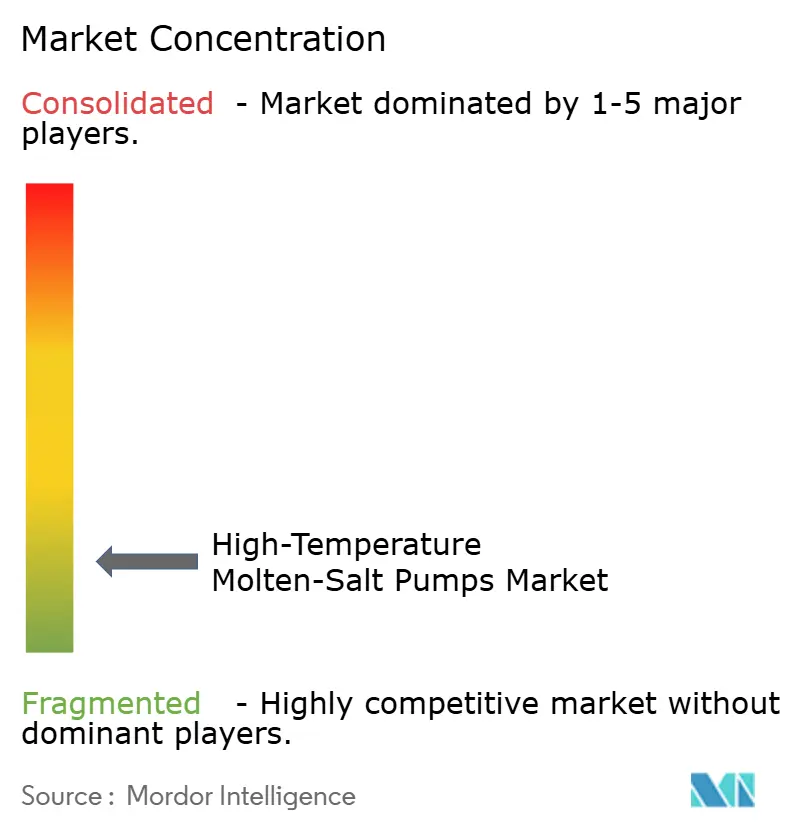
The high-temperature molten salt pumps market is fragmented around suppliers with operating references in demanding solar thermal and nuclear projects. Sulzer, Flowserve, KSB, Ebara, Hayward Tyler, Teikoku, and The Weir Group are the major players in the market. Their positions rely on plant operating records, alloy traceability, and nuclear engineering experience, as well as hydraulic performance. Chinese producers are building comparable records in commercial nitrate-salt applications, especially in China, where domestic technical appraisals support access to state-backed projects. Above 600°C, documented operating evidence remains more limited for newer suppliers. This distinction protects established suppliers in chloride-salt and reactor work.
KSB’s work with Terrestrial Energy on primary recirculation pumps shows a strategy of participating early in reactor design programs. Sulzer’s 2025 partnership with Hyme Energy combines the supply of vertical turbine pumps with work on longer operating life for industrial storage systems. Flowserve has demonstrated molten halide salt valve systems at 750°C and 11 bar in Department of Energy Generation 3 work. These actions position suppliers inside energy technology platforms and create reference data that can influence later specifications. In the high-temperature molten salt pumps market, long qualification pathways make those references commercially valuable.
A potential opening remains for modular, skid-mounted packages for industrial thermal storage systems below 10 MW. This demand favors suppliers that can offer customized packages and shorter delivery times. Large international suppliers retain an advantage where alloy performance and project references dominate selection, while Chinese manufacturers can exert greater pricing pressure in proven nitrate-salt concentrated solar power projects as their operating histories grow. Jiangsu Shuangda and Kaiquan show this transition through their 2025 technical appraisals. The high-temperature molten salt pumps market is likely to remain more protected in reactor and chloride-salt applications than in established commercial solar thermal service. Competitive differentiation will continue to rest on qualification, materials capability, and verified field performance.
High-Temperature Molten-Salt Pumps Industry Leaders
-
Hayward Tyler
-
AURO PUMPS Pvt. Ltd.
-
WEM Pumps, LLC
-
Magnatex Pumps, Inc.
-
Teikoku Electric Mfg. Co., Ltd.
- *Disclaimer: Major Players sorted in no particular order
High-Temperature Molten-Salt Pumps Market Companies Covered in this Report
- Arvind Corrotech Ltd.
- AURO PUMPS Pvt. Ltd.
- Ebara Corporation
- Flowrox Oy
- Flowserve Corporation
- Hayward Tyler
- Hebei Tobee Pump Co., Ltd.
- ITT Inc. / Goulds Pumps
- Jinan Huayang New Material Co., Ltd.
- Jinan Warwick Pump Co., Ltd.
- KSB SE & Co. KGaA
- Magnatex Pumps, Inc.
- Nagle Pumps, Inc.
- Process Pumps Corporation
- Pump-Aid Corporation
- Sulzer Ltd.
- Teikoku Electric Mfg. Co., Ltd.
- The Weir Group PLC
- WEM Pumps, LLC
- Wenesco, Inc.
Recent Industry Developments in High-Temperature Molten-Salt Pumps Market
- July 2026: China Three Gorges Corporation’s 1 GW CSP and photovoltaic complex at Hami entered trial commercial operation. It includes a 100 MW linear Fresnel molten salt unit with 8 hours of thermal energy storage and 260,000 tracking reflectors.
- June 2026: CGN commissioned the first 100 MW concentrated solar power plant in Northeast China at Jixi. The project uses single-tower molten salt technology with 8 hours of thermal energy storage at 45.36 degrees north latitude.
- June 2026: China General Nuclear Power Corporation commissioned the 350 MW Qinghai facility with a 15-hour, 11,747 MWh molten salt thermal energy storage system.
- April 2025: Sulzer and Hyme Energy announced a commercialization partnership for molten hydroxide salt energy storage. The arrangement uses Sulzer vertical turbine pumps as the core fluid movement system for industrial heat electrification at temperatures up to 600°C.
Global High-Temperature Molten-Salt Pumps Market Report Scope
High-temperature molten-salt pumps are specialized pumps designed to circulate and transport molten salts at very high temperatures, typically ranging from 300°C to 600°C or higher, while maintaining reliable flow and mechanical integrity. These pumps are built with high-temperature-resistant materials, seals, bearings, and components to withstand the corrosive and thermally demanding properties of molten salts. They are commonly used in concentrated solar power (CSP) plants, thermal energy storage systems, nuclear reactors, chemical processing, and high-temperature heat-transfer systems.
The High-Temperature Molten-Salt Pumps Market is segmented by pump type, end user, and geography. By pump type, the market is segmented into centrifugal, vertical turbine, canned motor, submerged, and other pump types. By end user, the market is segmented into concentrated solar power (CSP) plants, thermal energy storage, molten-salt reactors, industrial heat, and other end users. The report also covers the market size and forecasts for the global high-temperature molten-salt pumps market across 26 countries in key regions. For each segment, the market sizing and forecasts have been provided on the basis of value (USD).
Segmentation Overview
| Centrifugal Pumps |
| Vertical Turbine Pumps |
| Canned Motor Pumps |
| Submerged Pumps |
| Other Pump Types |
| Concentrated Solar Power Plants |
| Thermal Energy Storage Systems |
| Molten-Salt Reactors |
| Industrial Heat and Process Applications |
| Other End Users |
| North America | United States |
| Canada | |
| Mexico | |
| Europe | Germany |
| France | |
| Italy | |
| Spain | |
| United Kingdom | |
| Poland | |
| Russia | |
| Rest of Europe | |
| Asia-Pacific | China |
| India | |
| Japan | |
| South Korea | |
| Australia | |
| Indonesia | |
| Vietnam | |
| Thailand | |
| Rest of Asia-Pacific | |
| South America | Brazil |
| Argentina | |
| Chile | |
| Rest of South America | |
| Middle East and Africa | Saudi Arabia |
| United Arab Emirates | |
| Egypt | |
| South Africa | |
| Morocco | |
| Rest of Middle East and Africa |
| By Pump Type | Centrifugal Pumps | |
| Vertical Turbine Pumps | ||
| Canned Motor Pumps | ||
| Submerged Pumps | ||
| Other Pump Types | ||
| By End User | Concentrated Solar Power Plants | |
| Thermal Energy Storage Systems | ||
| Molten-Salt Reactors | ||
| Industrial Heat and Process Applications | ||
| Other End Users | ||
| By Geography | North America | United States |
| Canada | ||
| Mexico | ||
| Europe | Germany | |
| France | ||
| Italy | ||
| Spain | ||
| United Kingdom | ||
| Poland | ||
| Russia | ||
| Rest of Europe | ||
| Asia-Pacific | China | |
| India | ||
| Japan | ||
| South Korea | ||
| Australia | ||
| Indonesia | ||
| Vietnam | ||
| Thailand | ||
| Rest of Asia-Pacific | ||
| South America | Brazil | |
| Argentina | ||
| Chile | ||
| Rest of South America | ||
| Middle East and Africa | Saudi Arabia | |
| United Arab Emirates | ||
| Egypt | ||
| South Africa | ||
| Morocco | ||
| Rest of Middle East and Africa | ||
Key Questions Answered in the Report
What is the projected value of high-temperature molten salt pumps by 2031?
The high-temperature molten salt pumps market is forecast to reach USD 257.89 million by 2031, from USD 171.67 million in 2026, at an 8.48% CAGR. The estimate reflects continued concentrated solar power construction and broader thermal storage deployment.
Which pump type is growing fastest for molten salt applications?
Vertical turbine pumps are forecast to grow at a 10.2% CAGR through 2031 because deep tank designs need stable submerged pumping. Their geometry supports two-tank systems that need reliable suction conditions and freeze-risk control.
Why are thermal energy storage systems important for pump suppliers?
Thermal energy storage systems are forecast to grow at an 11.4% CAGR through 2031 as storage moves into grid flexibility and industrial heat uses. This use extends demand beyond solar generation plants and their established storage loops.
Which region leads demand for high-temperature molten salt pumps?
Asia-Pacific held 42.6% in 2025 and is forecast to grow at a 10.5% CAGR through 2031, driven primarily by China’s concentrated solar power construction. China’s operating projects, active construction base, and domestic qualification activity support this regional position.
What limits use in advanced molten salt reactors?
Chloride-salt corrosion and long qualification periods remain key constraints, particularly for equipment operating above 600°C. Bearing materials, specialty alloys, coatings, and evidence from continuous operation remain central limits on commercial deployment.