
High-Risk (IMDRF Category III-IV) Software As A Medical Device (SaMD) Market Size and Share
Market Overview
| Study Period | 2020 - 2031 |
|---|---|
| Market Size (2026) | USD 25.03 Billion |
| Market Size (2031) | USD 45.41 Billion |
| Growth Rate (2026 - 2031) | 12.65 % |
| Fastest Growing Market | Asia-Pacific |
| Largest Market | North America |
| Market Concentration | Medium |
Major Players *Disclaimer: Major Players sorted in no particular order Image © Mordor Intelligence. Reuse requires attribution under CC BY 4.0. | |
High-Risk (IMDRF Category III-IV) Software As A Medical Device (SaMD) Market Analysis by Mordor Intelligence
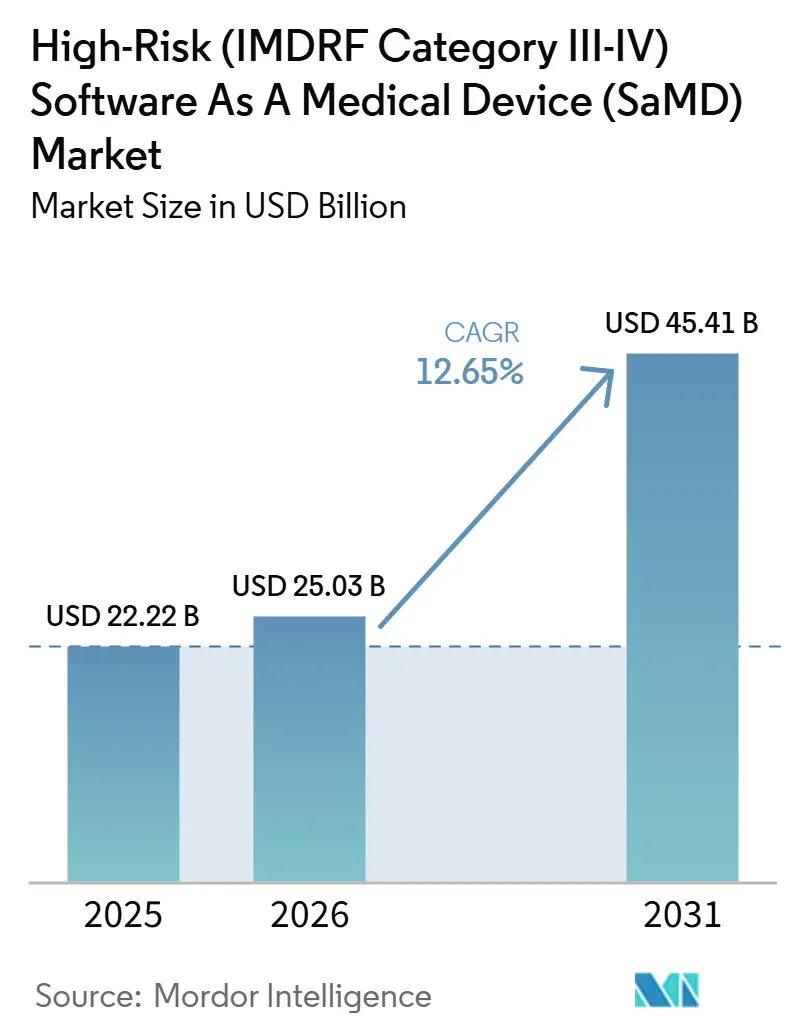
The High-Risk Software As A Medical Device Market size is projected to be USD 22.22 billion in 2025, USD 25.03 billion in 2026, and reach USD 45.41 billion by 2031, growing at a CAGR of 12.65% from 2026 to 2031.
The high-risk Software as a Medical Device (SaMD) market is expanding further into routine care as hospitals and specialist providers use software to support diagnosis, monitoring, and treatment decisions across more specialties. Adoption remains strongest in IMDRF Category III and IV products, as these tools address serious and life-threatening conditions where software outputs can alter clinical pathways. More structured regulatory lifecycle management and improving reimbursement are strengthening the commercial outlook for clinically validated platforms, especially in high-value cardiac and imaging workflows. These factors are making the market more favorable for platform vendors with regulatory reach, workflow integration, and durable clinical evidence.
Key Report Takeaways
- By deployment, cloud-Based SaMD held 52.56% share in 2025, while hybrid SaMD is forecast to expand at 14.93% CAGR through 2031.
- By functionality, diagnosis Support held 38.23% share in 2025, while treatment guidance is projected to grow at 14.67% CAGR through 2031.
- By clinical application, radiology accounted for 34.67% of 2025 demand, while neurology is projected to advance at 15.35% CAGR through 2031.
- By end user, hospitals and health systems held 42.88% share in 2025, while diagnostic imaging centers are projected to grow at 16.78% CAGR through 2031.
- By IMDRF risk class, category III held 55.45% share in 2025, while category IV is projected to expand at 16.35% CAGR through 2031.
- By geography, North America held 39.88% share in 2025, while Asia-Pacific is projected to record 17.56% CAGR through 2031.
Note: Market size and forecast figures in this report are generated using Mordor Intelligence’s proprietary estimation framework, updated with the latest available data and insights as of January 2026.
Global High-Risk (IMDRF Category III-IV) Software As A Medical Device (SaMD) Market Trends and Insights
Drivers Impact Analysis*
| DRIVER | (~) % IMPACT ON CAGR FORECAST | GEOGRAPHIC RELEVANCE | IMPACT TIMELINE |
|---|---|---|---|
| Rising demand for clinically validated AI diagnostics | +3.2% | Global, with early concentration in North America and Western Europe academic medical centers | Long term (≥ 4 years) |
| Expanding reimbursement support for digital diagnostics | +2.8% | North America and Western Europe, with early-stage movement in Japan and South Korea | Medium term (2-4 years) |
| Shortage of specialist clinicians in imaging and monitoring workflows | +2.1% | Global, with acute pressure in South and Southeast Asia, Sub-Saharan Africa, and rural North America | Long term (≥ 4 years) |
| Faster regulatory pathways for predetermined change control plans | +1.5% | North America, Japan, and Europe | Short term (≤ 2 years) |
| Hospital digital transformation and HER integration pressure | +1.4% | Global, concentrated among large health systems in North America, Europe, and Gulf states | Medium term (2-4 years) |
| Cross-border scaling through platform-based evidence reuse | +0.9% | Global, with initial strength in large urban hospital networks across North America and Europe | Medium term (2-4 years) |
| Source: Mordor Intelligence | |||
Rising Demand for Clinically Validated AI Diagnostics
Clinical validation now carries more weight than standalone performance claims in procurement across the high-risk Software as a Medical Device (SaMD) market. Buyers require evidence that software performs across real patient populations, multiple sites, and established care pathways after launch. This shift favors vendors that can demonstrate durable outcomes, repeat use, and continuous evidence maintenance, rather than relying on a single authorization milestone. HeartFlow's continued evidence expansion and payer traction show how a validated platform can move from specialized use into broader clinical deployment.
Expanding Reimbursement Support for Digital Diagnostics
Reimbursement support is becoming a more visible growth lever in the high-risk Software as a Medical Device (SaMD) market. Coverage decisions convert clinical interest into repeat purchasing, formal budgeting, and wider provider rollout. HeartFlow Plaque Analysis gained coverage for Aetna plans in January 2026, strengthening the case for AI-supported cardiac assessment in routine care. AdvaMed also urged U.S. policymakers in February 2026 to create a clearer payment pathway for SaMD, showing that reimbursement policy is central to commercialization strategy.
Shortage of Specialist Clinicians in Imaging and Monitoring Workflows
Specialist shortages continue to support demand in the high-risk Software as a Medical Device (SaMD) market, particularly in imaging, neurology, and intensive monitoring workflows. Health systems are adopting software to manage rising case volumes, reduce reading delays, and support clinicians handling time-sensitive decisions. The pressure is strongest in outpatient imaging networks and hospital groups that cannot expand specialist staffing at the same pace as diagnostic demand. Vendors that integrate outputs into existing clinical routines hold a stronger commercial position.
Faster Regulatory Pathways for Predetermined Change Control Plans
Faster change control pathways are starting to reshape competitive behavior in the high-risk Software as a Medical Device (SaMD) market. Developers can plan updates more confidently when regulators accept structured lifecycle documentation for future algorithm changes. This approach supports iterative improvement in software categories where clinical performance depends on regular refinement and post-market learning. Over time, structured change control is likely to widen the gap between enterprise platforms and limited-scope products.
Restraints Impact Analysis*
| RESTRAINT | (~) % IMPACT ON CAGR FORECAST | GEOGRAPHIC RELEVANCE | IMPACT TIMELINE |
|---|---|---|---|
| Evidence burden for category III and IV clinical validation | -1.8% | Global, with disproportionate pressure in markets without established clinical trial infrastructure | Long term (≥ 4 years) |
| Cybersecurity and software update liability exposure | -1.2% | Global, with heightened relevance in cloud-dependent and cross-border deployment architectures | Medium term (2-4 years) |
| Data access fragmentation across health systems | -1.8% | Global, with disproportionate pressure in markets without established clinical trial infrastructure | Long term (≥ 4 years) |
| Low interoperability with legacy clinical IT infrastructure | -1.2% | Global, with heightened relevance in cloud-dependent and cross-border deployment architectures | Medium term (2-4 years) |
| Source: Mordor Intelligence | |||
Evidence Burden for Category III and IV Clinical Validation
Evidence requirements remain a key entry barrier in the high-risk Software as a Medical Device (SaMD) market. Category III and IV software requires stronger clinical validation than lower-risk digital tools, especially when outputs influence diagnosis or treatment decisions for serious conditions. NeuroPace’s May 2026 FDA approval for ECoG Assistant showed how advanced clinical software remained closely linked to regulated therapeutic ecosystems rather than consumer-style release cycles. These requirements lengthen timelines, increase study costs, and favor companies with established trial networks, hospital relationships, and quality systems, making regional expansion slower and costlier for newer developers even after initial authorization.
Cybersecurity and Software Update Liability Exposure
Cybersecurity and software update liability remain structural restraints in the high-risk Software as a Medical Device (SaMD) market. Vendors must demonstrate strong control over updates, dependencies, and post-market monitoring in clinical environments where failures can affect care decisions. This burden is higher for cloud and hybrid architectures, where faster release cycles create operational value and regulatory exposure. Companies with mature quality systems and documented change management processes are better positioned to manage legal risk, release planning, provider trust, and evolving workflow expectations.
*Our forecasts treat driver/restraint impacts as directional, not additive. The impact forecasts reflect baseline growth, mix effects, and variable interactions.
Segment Analysis
By Deployment: Cloud Infrastructure Underpins Enterprise SaMD Scale
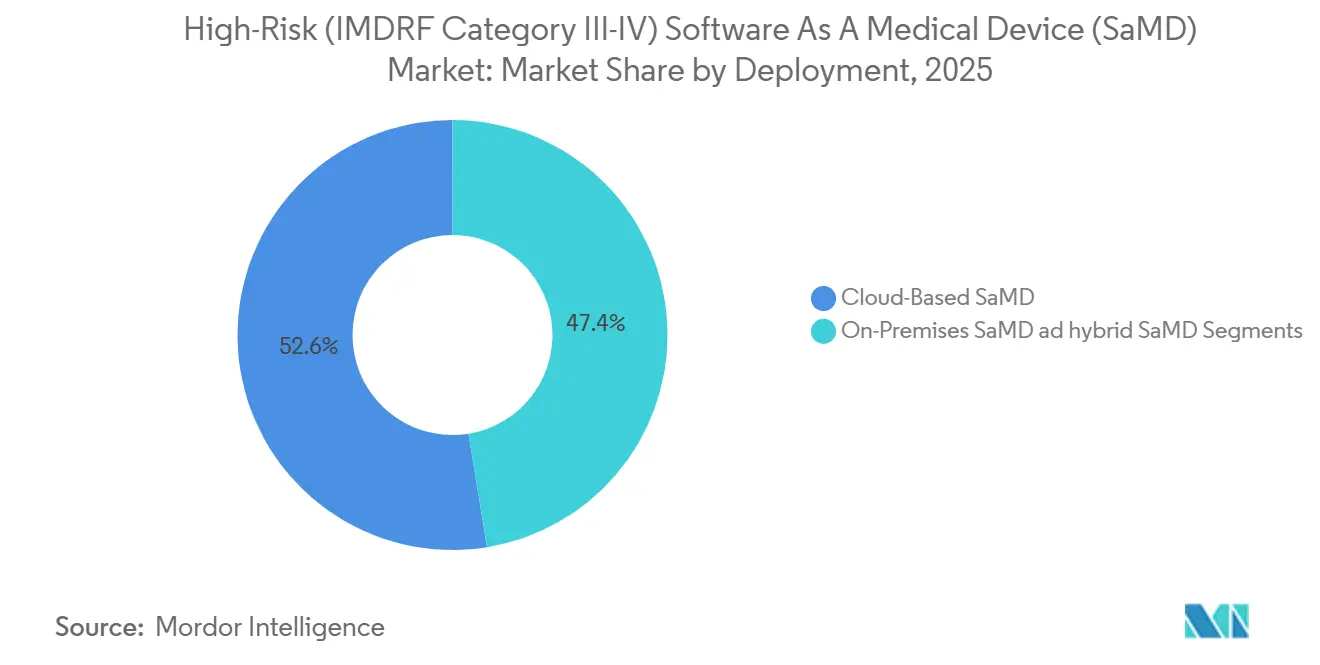
Cloud-Based SaMD held 52.56% of 2025 revenue in the deployment segment, reflecting strong enterprise preference for centralized processing across large, multi-site health systems. In the high-risk Software as a Medical Device (SaMD) market, this leadership was driven by the need to manage imaging volumes, audit trails, user permissions, and model performance in one coordinated environment. Large hospital groups favored cloud deployment for remote administration and consistent oversight across facilities using common clinical protocols.
Hybrid SaMD is forecast to expand at 14.93% CAGR through 2031, making it the fastest-growing deployment model as providers balance local control with centralized analytics. On-premises deployment retained relevance in institutions with tighter data residency obligations, stricter internal security rules, or lower tolerance for external data movement. The high-risk Software as a Medical Device (SaMD) market is therefore moving toward federated operating models that keep sensitive inference closer to the patient while preserving centralized update and compliance functions. RapidAI's enterprise platform approach showed why vendors supporting flexible architectures gained traction.



By Functionality: Autonomous Treatment Guidance Pulls the Market Forward
Diagnosis Support accounted for 38.23% of the 2025 high-risk Software as a Medical Device (SaMD) market size by functionality, supported by its broad installed base across radiology, cardiology, and decision-support workflows. Providers adopted this category earlier because it improved interpretation and prioritization without immediately shifting into direct therapy execution. This early adoption gave diagnosis support a stronger procurement position and helped it retain leadership despite rising competition in mature imaging use cases.
Treatment Guidance is forecast to expand at 14.67% CAGR through 2031, making it the fastest-growing functionality in the high-risk Software as a Medical Device (SaMD) market. Growth was strongest where software influenced procedural planning, dose selection, device programming, or other therapy-linked actions in regulated clinical settings. Monitoring and Alerting remained a steady middle cohort, while Triage and Prioritization faced uneven reimbursement and variable workflow adoption. HeartFlow's March 2026 launch of PCI Navigator illustrated the shift from diagnostic assessment to procedural guidance in interventional care.
By Clinical Application: Radiology Dominates, Neurology Accelerates
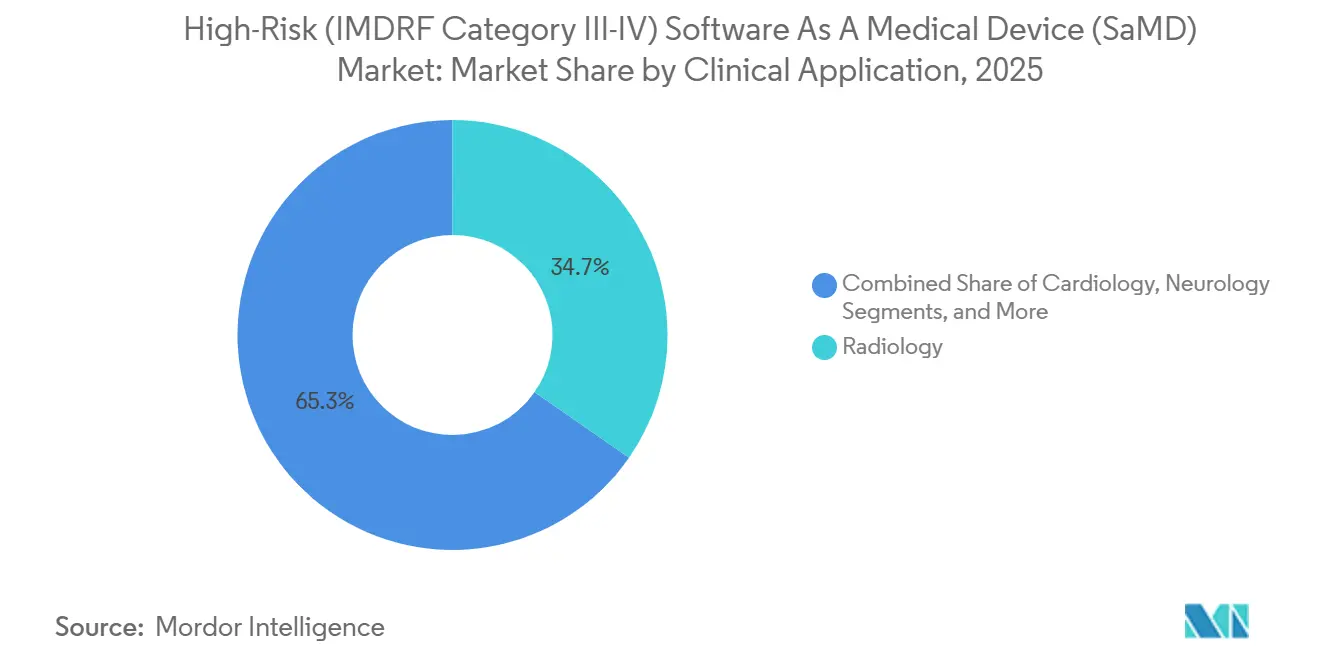
Radiology captured 34.67% of 2025 revenue by clinical application, keeping it the largest specialty segment in the high-risk Software as a Medical Device (SaMD) market. The segment benefited from standardized imaging formats, established reading workflows, and mature software use cases that providers understood operationally. Radiology also aligned well with enterprise deployment because images moved through consistent systems, making integration and monitoring easier than in many other specialties.
Neurology is forecast to grow at 15.35% CAGR through 2031 in the high-risk Software as a Medical Device (SaMD) market. NeuroPace's May 2026 FDA approval for ECoG Assistant showed how AI moved deeper into regulated neurological care and device-linked treatment pathways. Oncology also shifted toward higher-value software use, as Tempus AI launched Paige Predict in April 2026 to predict actionable biomarker presence from pathology images. The June 2026 Federal Register classification for radiological machine learning quantitative imaging software showed that imaging had the most mature regulatory architecture among adjacent clinical fields.
By End User: Diagnostic Imaging Centers Outpace Hospitals on Growth Velocity
Hospitals and health systems held 42.88% of 2025 demand in the high-risk Software as a Medical Device (SaMD) market, making them the largest end-user group by a clear margin. Their leadership was supported by centralized purchasing authority, inpatient use of high-risk applications, and governance structures for clinical credentialing, cybersecurity review, and enterprise rollout. Many Category IV products continued to depend on hospital-centered workflows, especially in emergency care, critical care, and surgical planning.
Diagnostic Imaging Centers are forecast to advance at 16.78% CAGR through 2031, the fastest rate among end users. Growth reflected the continued shift of imaging volumes into outpatient networks that needed enterprise-grade software without the full operating structure of acute care hospitals. These centers became more important buyers as they sought faster interpretation, lower staffing pressure, and scalable multi-site deployment. Ambulatory Surgical Centers and Specialty Clinics remained developing opportunities, while Home Care Settings stayed early but strategically relevant for remote monitoring and post-acute follow-up.
By IMDRF Risk Class: Category IV Defining the Growth Frontier
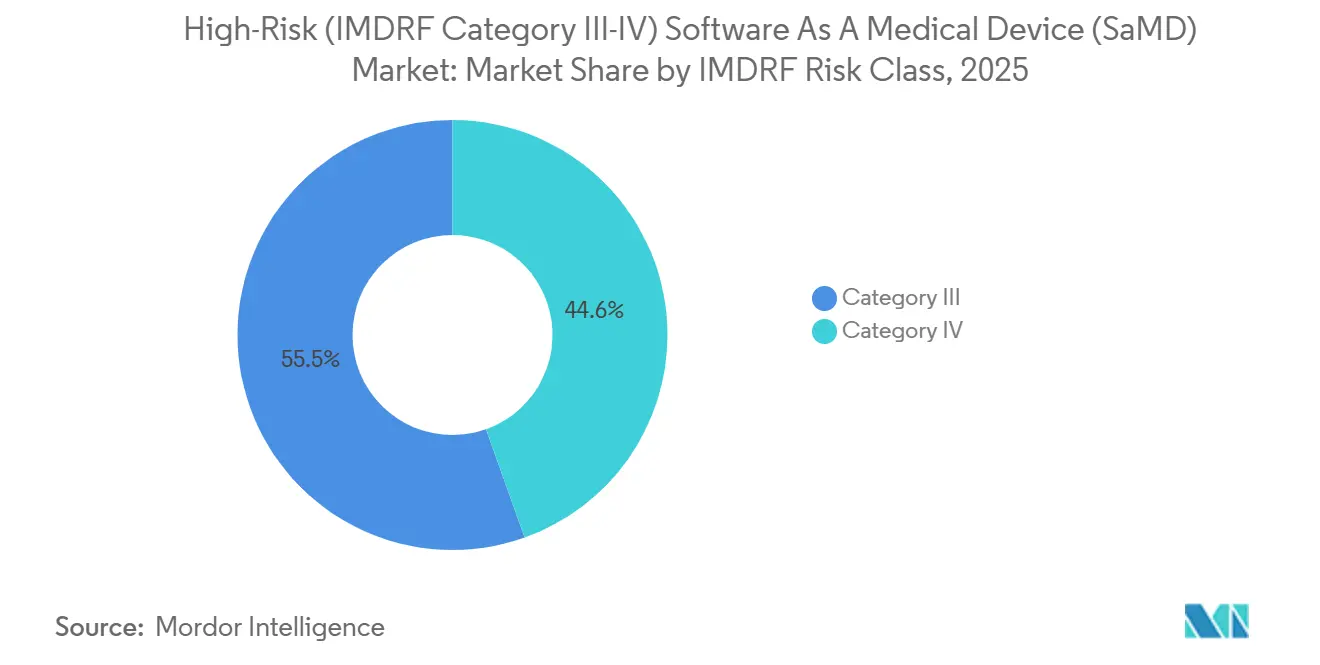
Category III devices held 55.45% of 2025 revenue by IMDRF risk class, giving them the largest installed base in the high-risk Software as a Medical Device (SaMD) market. This reflected strong adoption in serious-condition diagnostic and decision-support applications that reached clinical practice earlier than the most critical treatment-linked tools. Category III products addressed high-acuity use cases while often remaining below the highest evidence and liability thresholds in the risk framework.
Category IV devices are forecast to grow at 16.35% CAGR through 2031, making them the clearest growth frontier in the high-risk Software as a Medical Device (SaMD) market. Momentum came from software used in critical or life-threatening settings, where higher evidence expectations aligned with stronger reimbursement potential and deeper clinical dependence. HeartFlow's PCI Navigator and NeuroPace's ECoG Assistant showed how vendors moved into software functions that shaped treatment decisions more directly in regulated care environments. The segment remained harder to enter but more defensible after launch than much of the broader clinical software landscape.
Geography Analysis
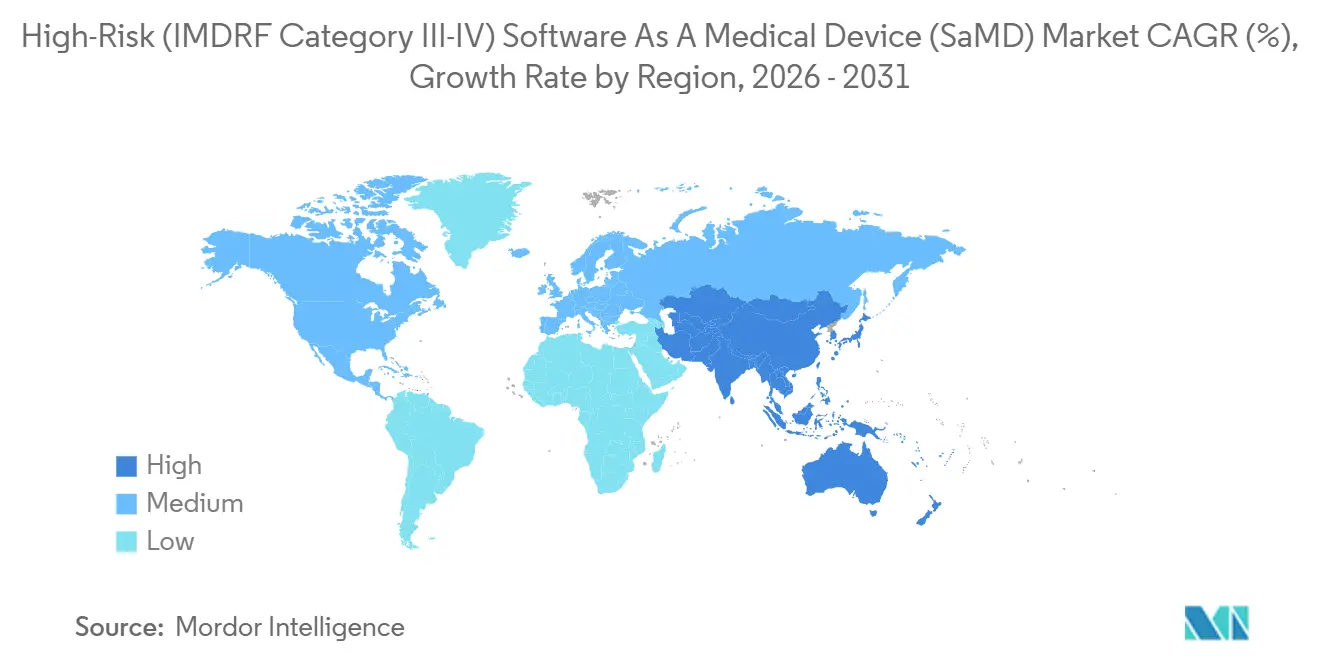
North America held 39.88% of 2025 revenue, giving it the largest regional position in the high-risk Software as a Medical Device (SaMD) market. Strong regulatory infrastructure, broad enterprise provider networks, and supportive payer conditions continue to drive adoption. The United States remains the main commercial launch market, while Canada offers a lower-friction adjacency and Mexico provides selective entry through recognition-based pathways.
Europe remained the second-largest regional cluster in the high-risk Software as a Medical Device (SaMD) market. Germany, France, the United Kingdom, and the Netherlands anchor adoption through strong hospital procurement capacity and formal reimbursement review. High-risk software faces a heavier documentation burden under medical device rules and broader AI governance expectations, extending timelines for smaller developers. The United Kingdom can offer a faster secondary launch route, while Spain and Italy show solid clinical interest but fragmented procurement conditions.
Asia-Pacific is forecast to grow at a CAGR of 17.56% through 2031, making it the fastest-growing region in the high-risk Software as a Medical Device (SaMD) market. China, Japan, South Korea, and India are driving expansion through domestic manufacturing scale, maturing regulation, and rising hospital digitization. Japan's 2026 lifecycle framework pointed to stricter post-market expectations for adaptive algorithms, while China continued to favor localized operating models for high-risk AI products. The Middle East and Africa remained at an earlier adoption stage, with GCC health systems moving first, while South America remained nascent, led by Brazil and Argentina, with medium-term opportunities in cardiovascular and oncology-focused care.

Competitive Landscape
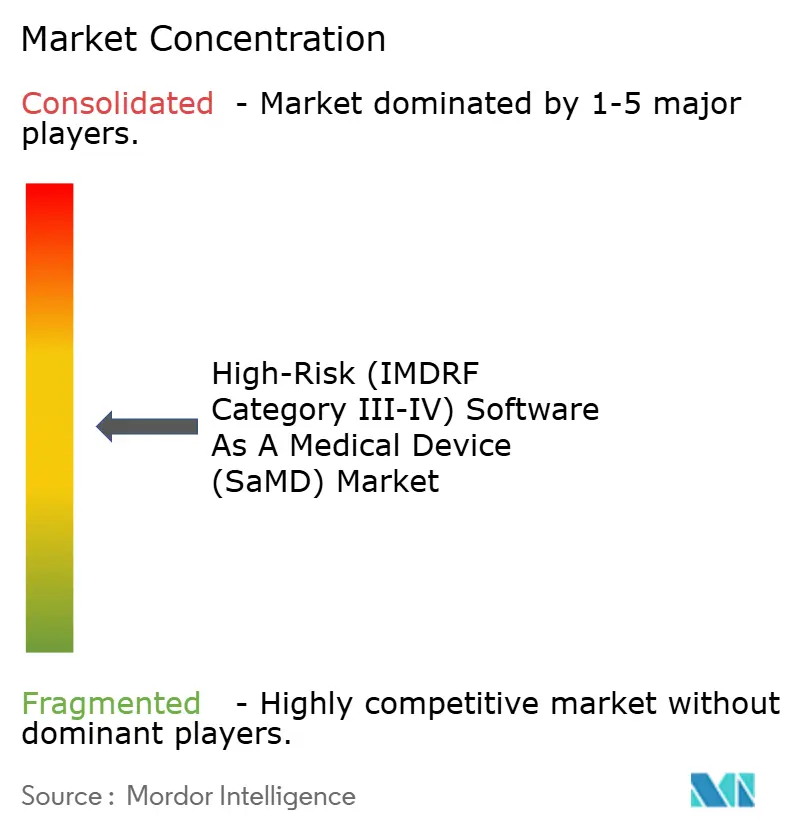
The high-risk Software as a Medical Device (SaMD) market is moderately concentrated at the platform level but remains fragmented by clinical indication. Companies with multi-specialty software libraries, embedded workflow tools, and repeatable evidence programs are extending their lead over narrow, single-use vendors. Competition is shifting from isolated algorithm claims to seamless integration with PACS environments, ordering systems, communication tools, and quality processes without adding hospital IT burden. RapidAI's broad hospital footprint and research depth show why enterprise platforms are gaining strength in the current competitive structure.
HeartFlow used 2026 to deepen its position by expanding from cardiac analysis into PCI Navigator, a treatment guidance tool that moved the platform closer to direct procedural planning. It had already strengthened commercial adoption when Aetna expanded coverage for Plaque Analysis in January 2026, improving the reimbursement outlook for its cardiac software suite. Viz.ai expanded its neuro strategy in July 2026 through a collaboration with Cortechs.ai, adding quantitative MRI analysis for multiple sclerosis and neurodegenerative disease management. Aidoc received FDA Breakthrough Device Designation in June 2026 for First Read, showing continued investment in higher-volume radiology reporting workflows. Tempus AI added another example in April 2026 when it launched Paige Predict, using its acquired pathology AI capabilities to broaden oncology software depth.
These moves show that competitive advantage in the high-risk Software as a Medical Device (SaMD) market depends on adjacency expansion, evidence reuse, and deeper clinical integration. White-space opportunities remain in specialties with diagnostic bottlenecks and fewer scaled regulatory competitors, especially where high readmission or treatment costs can support adoption. Smaller challengers can still compete but need faster evidence execution and more focused deployment strategies than broader platform leaders. Over time, leadership is likely to depend on regulatory endurance, reimbursement readiness, and the ability to support updates across complex care environments.
High-Risk (IMDRF Category III-IV) Software As A Medical Device (SaMD) Industry Leaders
GE HealthCare Technologies Inc.
Koninklijke Philips N.V.
Medtronic plc
Siemens Healthineers AG
AliveCor, Inc.
- *Disclaimer: Major Players sorted in no particular order

Recent Industry Developments
- July 2026: Viz.ai collaborated with Cortechs.ai to integrate NeuroQuant and NeuroQuant MS quantitative MRI analysis into its platform, expanding its neuro suite into multiple sclerosis and neurodegenerative disease management.
- June 2026: Aidoc received FDA Breakthrough Device Designation for First Read, an AI system for chest radiograph analysis and preliminary radiology report generation, marking its second designation in under 12 months.
- May 2026: NeuroPace received FDA approval for ECoG Assistant, an AI system that automated electrocorticography pattern interpretation for RNS System patients, and submitted its next-generation Patient Data Management System for FDA review.
- April 2026: Tempus AI launched Paige Predict globally, a digital pathology suite that predicted clinically actionable biomarkers from H&E whole slide images and integrated Paige’s FDA-authorized pathology AI library.
- March 2026: HeartFlow commercially launched PCI Navigator, an AI-driven percutaneous coronary intervention planning tool that integrated 3D anatomy, plaque composition, and lesion physiology.


Global High-Risk (IMDRF Category III-IV) Software As A Medical Device (SaMD) Market Report Scope
As per the scope of the report, High-risk Software as a Medical Device (SaMD), specifically IMDRF Categories III and IV, is standalone medical software that directly diagnoses, treats, or manages life-threatening conditions. A malfunction in these categories poses a high to critical impact on patient health, often requiring strict regulatory clearances.
The high-risk (IMDRF Category III-IV) software as a medical device (SaMD) market is segmented by deployment, functionality, clinical application, end user, IMDRF risk class, and geography. By deployment, the market includes cloud-based SaMD, on-premises SaMD, and hybrid SaMD. By functionality, the market is segmented into diagnosis support, monitoring and alerting, treatment guidance, and triage and prioritization. By clinical application, the market is categorized into radiology, cardiology, neurology, oncology, ophthalmology, gastroenterology, endocrinology, critical care and emergency care, and other clinical applications. By end user, the market is segmented into hospitals and health systems, ambulatory surgical centers, specialty clinics, diagnostic imaging centers, home care settings, and others. By IMDRF risk class, the market is segmented into Category III and Category IV. By geography, the market is analyzed across North America, Europe, Asia-Pacific, the Middle East and Africa, and South America. The report also covers the estimated market sizes and trends for 17 countries across major regions globally. The report offers the market sizes and forecasts in terms of value (USD) for the above segments.
| Cloud-Based SaMD |
| On-Premises SaMD |
| Hybrid SaMD |
| Diagnosis Support |
| Monitoring and Alerting |
| Treatment Guidance |
| Triage and Prioritization |
| Radiology |
| Cardiology |
| Neurology |
| Oncology |
| Ophthalmology |
| Gastroenterology |
| Endocrinology |
| Critical Care and Emergency Care |
| Other Clinical Applications |
| Hospitals and Health Systems |
| Ambulatory Surgical Centers |
| Specialty Clinics |
| Diagnostic Imaging Centers |
| Home Care Settings |
| Others |
| Category III |
| Category IV |
| North America | United States |
| Canada | |
| Mexico | |
| Europe | Germany |
| United Kingdom | |
| France | |
| Italy | |
| Spain | |
| Rest of Europe | |
| Asia-Pacific | China |
| India | |
| Japan | |
| Australia | |
| South Korea | |
| Rest of Asia-Pacific | |
| Middle East and Africa | GCC |
| South Africa | |
| Rest of Middle East and Africa | |
| South America | Brazil |
| Argentina | |
| Rest of South America |
| By Deployment | Cloud-Based SaMD | |
| On-Premises SaMD | ||
| Hybrid SaMD | ||
| By Functionality | Diagnosis Support | |
| Monitoring and Alerting | ||
| Treatment Guidance | ||
| Triage and Prioritization | ||
| By Clinical Application | Radiology | |
| Cardiology | ||
| Neurology | ||
| Oncology | ||
| Ophthalmology | ||
| Gastroenterology | ||
| Endocrinology | ||
| Critical Care and Emergency Care | ||
| Other Clinical Applications | ||
| By End User | Hospitals and Health Systems | |
| Ambulatory Surgical Centers | ||
| Specialty Clinics | ||
| Diagnostic Imaging Centers | ||
| Home Care Settings | ||
| Others | ||
| By IMDRF Risk Class | Category III | |
| Category IV | ||
| By Geography | North America | United States |
| Canada | ||
| Mexico | ||
| Europe | Germany | |
| United Kingdom | ||
| France | ||
| Italy | ||
| Spain | ||
| Rest of Europe | ||
| Asia-Pacific | China | |
| India | ||
| Japan | ||
| Australia | ||
| South Korea | ||
| Rest of Asia-Pacific | ||
| Middle East and Africa | GCC | |
| South Africa | ||
| Rest of Middle East and Africa | ||
| South America | Brazil | |
| Argentina | ||
| Rest of South America | ||


Key Questions Answered in the Report
What is the 2026 size and 2031 outlook for high-risk Software as a Medical Device (SaMD)?
The segment is valued at USD 25.03 billion in 2026 and is forecast to reach USD 45.41 billion by 2031 at a CAGR of 12.65%.
Which deployment model leads today and which one is growing fastest?
Cloud-Based SaMD led with 52.56% share in 2025, while Hybrid SaMD is forecast to grow fastest at 14.93% CAGR through 2031.
Why does radiology remain the largest clinical application?
Radiology benefits from standardized imaging formats, established workflows, and a long-running installed base, which helped it hold 34.67% share in 2025.
What is driving faster growth in Category IV devices?
Category IV devices are growing at 16.35% CAGR because they sit closer to critical treatment and diagnosis decisions, where reimbursement potential and clinical dependence are stronger.
Which region leads revenue and which region is expanding fastest?
North America led with 39.88% share in 2025, while Asia-Pacific is forecast to grow fastest at 17.56% CAGR through 2031.
What is the biggest hurdle after regulatory authorization?
The main hurdle is turning approval into scaled adoption through stronger clinical evidence, reimbursement support, and secure post-market software management.
Page last updated on:





