
High Purity Isobutylene Market Size and Share
Market Overview
| Study Period | 2022 - 2032 |
|---|---|
| Market Size (2027) | USD 3.42 Billion |
| Market Size (2032) | USD 4.37 Billion |
| Growth Rate (2027 - 2032) | 5.02 % |
| Fastest Growing Market | Asia-Pacific |
| Largest Market | Asia-Pacific |
| Market Concentration | Medium |
Major Players *Disclaimer: Major Players sorted in no particular order Image © Mordor Intelligence. Reuse requires attribution under CC BY 4.0. | |
High Purity Isobutylene Market Analysis by Mordor Intelligence
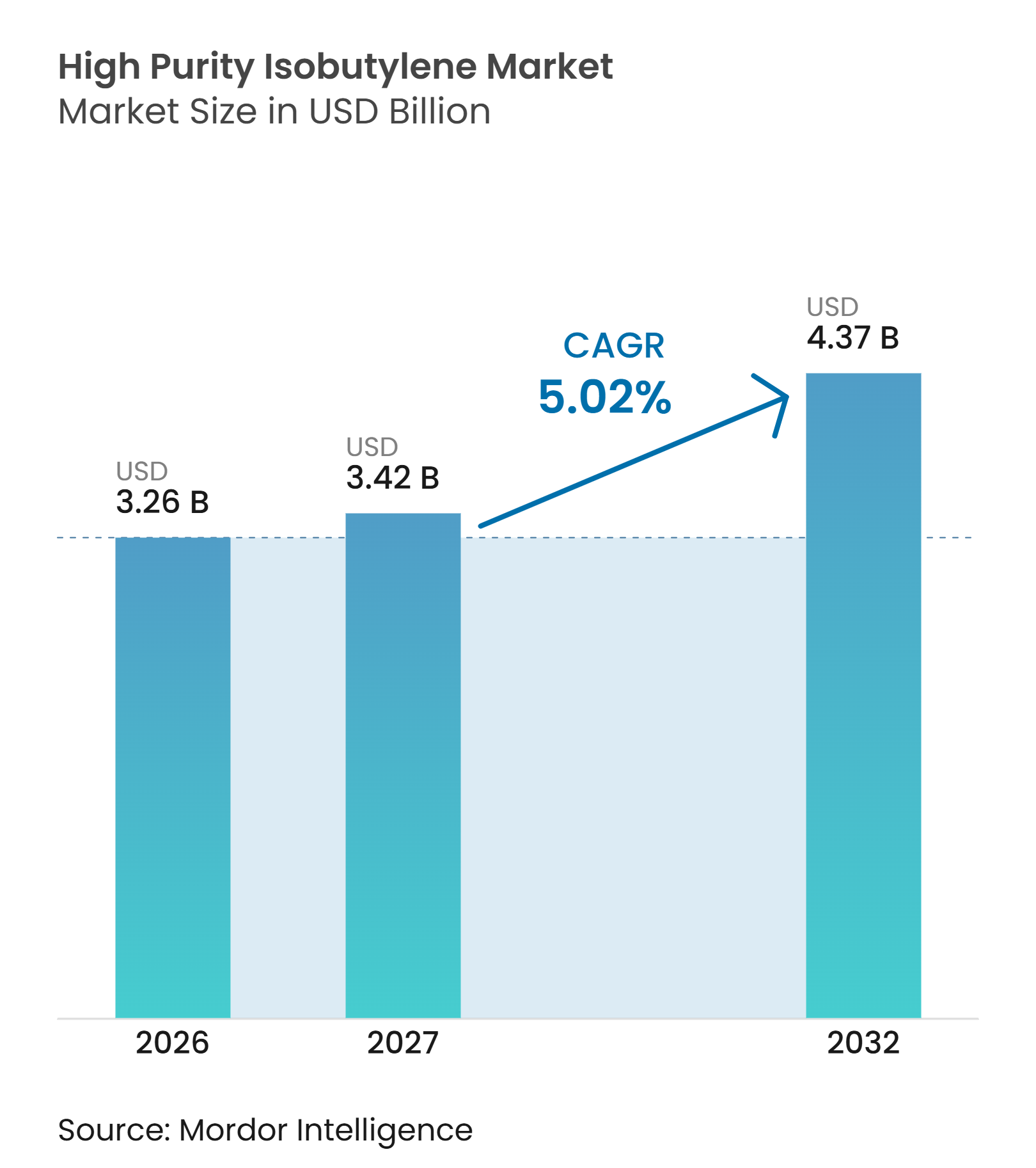
The High Purity Isobutylene market size was valued at USD 3.26 billion in 2026 and is estimated to grow from USD 3.42 billion in 2027 to USD 4.37 billion by 2032, at a CAGR of 5.02% during the forecast period (2027-2032). The high purity isobutylene market is supported by butyl rubber production, where high-purity feedstock remains important for tire inner liners and pharmaceutical closures. Demand is also linked to polyisobutylene and smaller derivative chains, including tertiary-butylphenol series products, trimethylacetic acid, and methyl allyl chloride. Producers with integrated C4 streams, methyl tert-butyl ether (MTBE) assets, or on-purpose dehydrogenation capacity hold a cost and supply advantage. Supply is shifting toward Asian production centers, while demand from North American and European elastomer and chemical producers continues to require reliable polymer-grade material. Feedstock availability and purification costs remain central constraints, as HPIB production depends on C4 economics, energy use, and stringent impurity control.
Key Report Takeaways
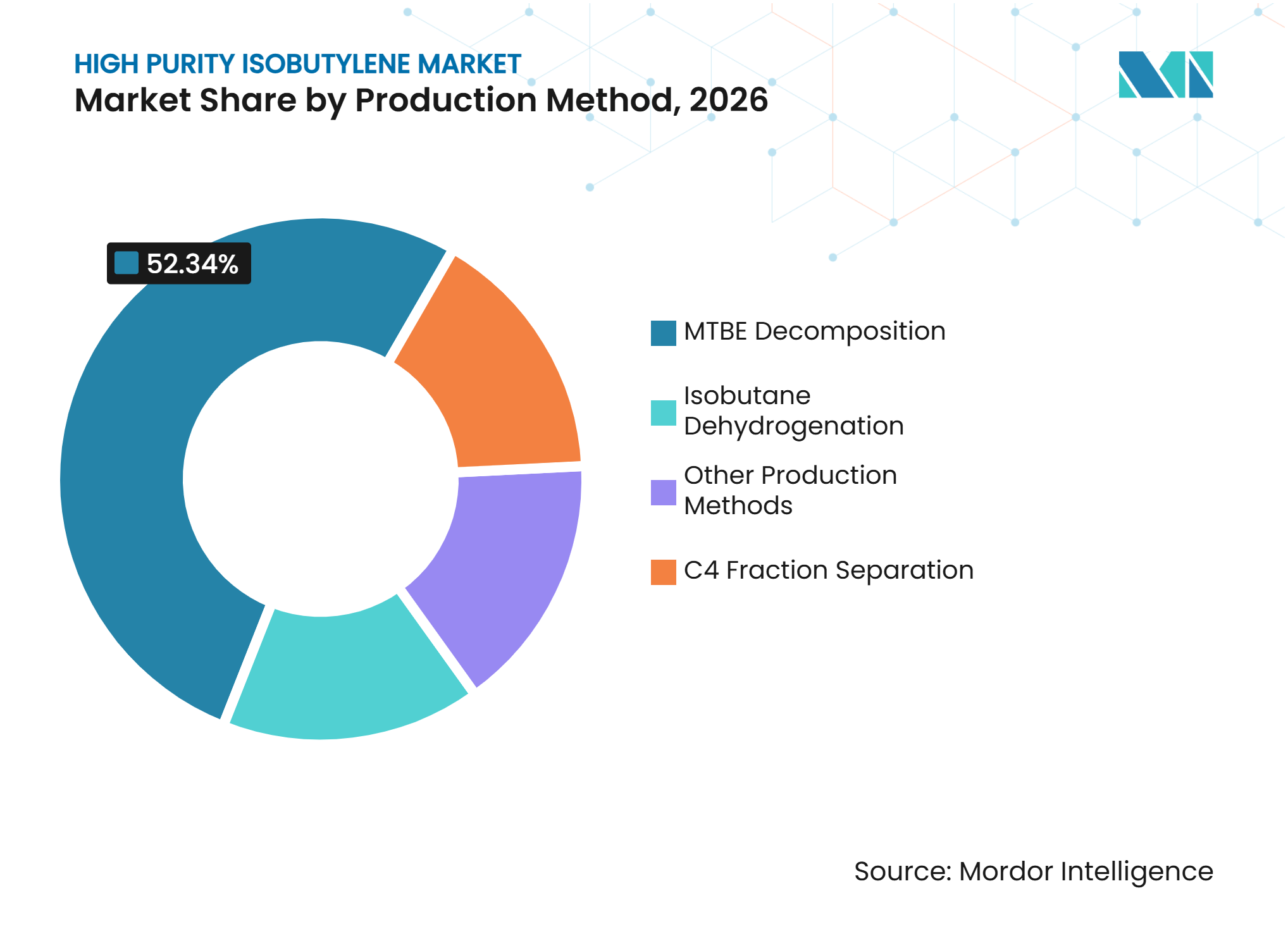
- By production method, MTBE decomposition held 52.34% of the High Purity Isobutylene market share in 2026, while isobutane dehydrogenation is forecast to record the highest CAGR of 5.67% through 2032.
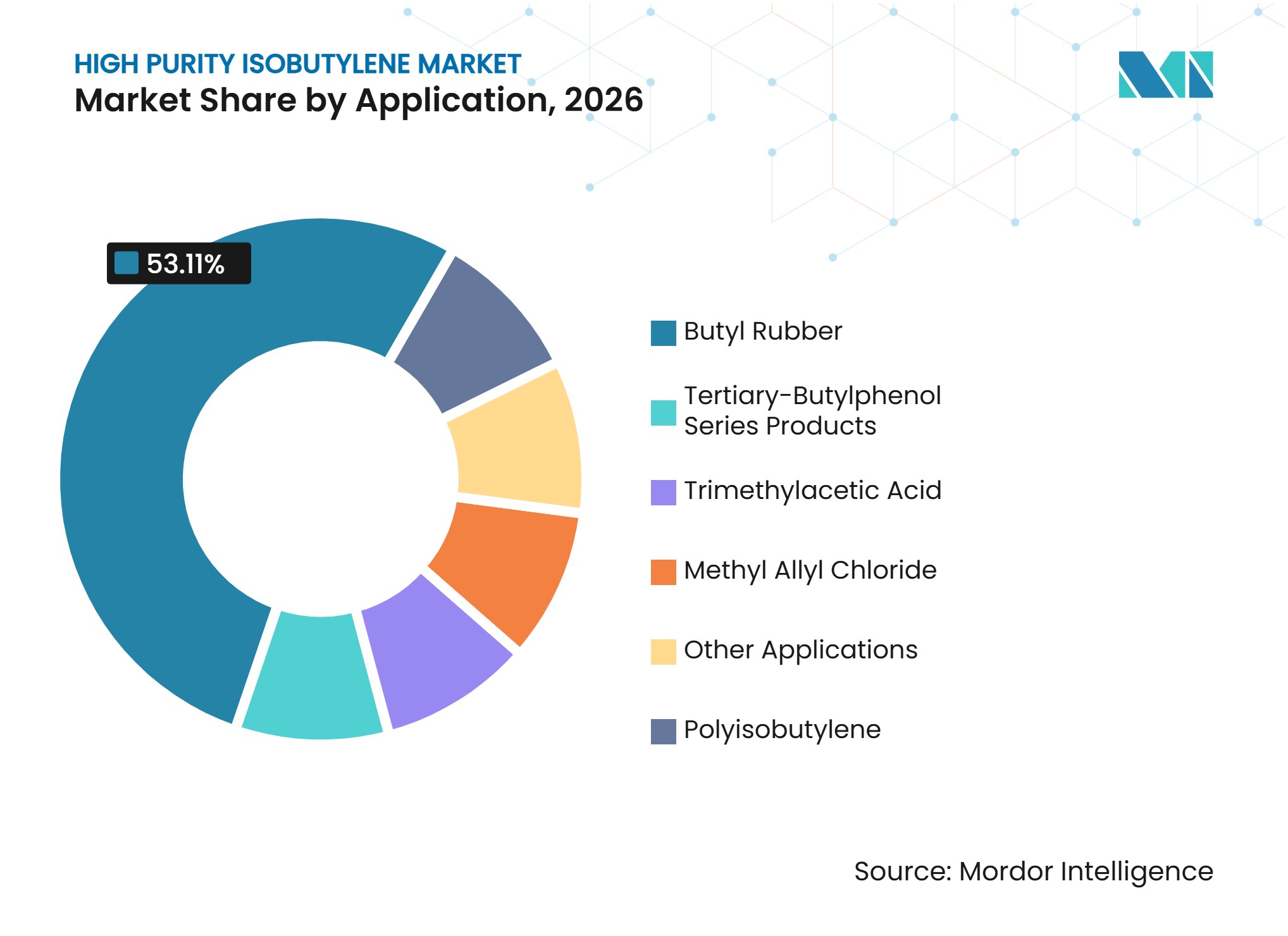
- By application, butyl rubber accounted for 53.11% of the High Purity Isobutylene market share in 2026, while polyisobutylene is forecast to expand at a CAGR of 6.12% through 2032.
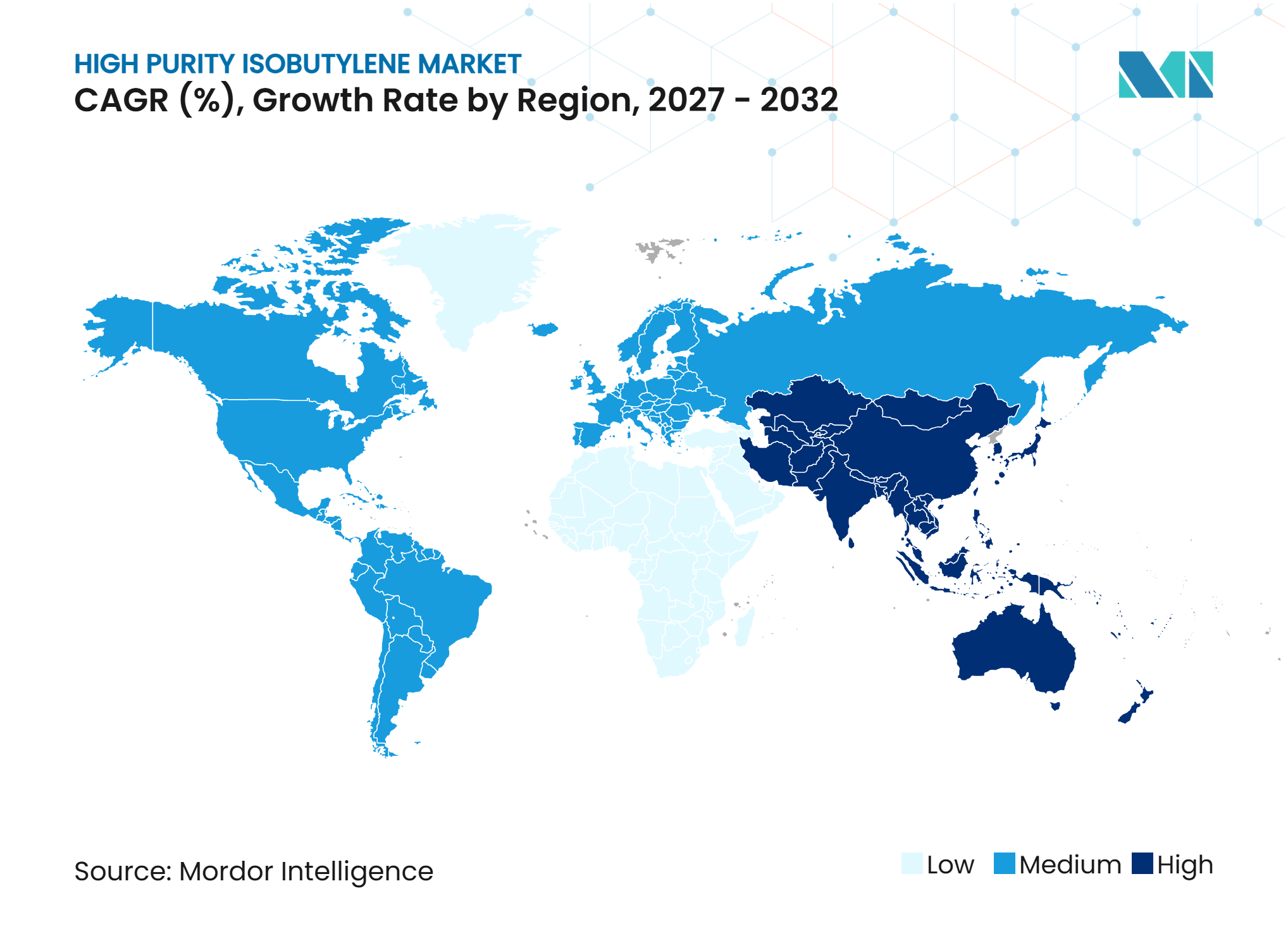
- By geography, Asia-Pacific held 44.05% of the High Purity Isobutylene market share in 2026 and is projected to grow at a CAGR of 5.78% through 2032.
Note: Market numbers in this report are based on Mordor Intelligence's proprietary estimation framework, which combines nine months of actuals with Q4 projections for base year 2026.
Market Trends and Insights
Drivers Impact Analysis of High Purity Isobutylene Market*
| Drivers | (~) % Impact on CAGR Forecast | Geographic Relevance | Impact Timeline |
|---|---|---|---|
| Rising Demand for Butyl Rubber in Tires and Medical Closures | +1.8% | Global, with intensity in Asia-Pacific and North America | Medium term (2-4 years) |
| Growth in Polyisobutylene-Based Lubricant and Fuel Additives | +0.8% | Asia-Pacific core, China and India, with spillover to North America | Medium term (2-4 years) |
| Polymer-Grade Purity Requirements for High-Performance Elastomers | +0.6% | Global, strongest in Europe and Japan | Long term (≥ 4 years) |
| Increasing Asia-Pacific Downstream Capacity | +0.9% | Asia-Pacific | Short term (≤ 2 years) |
| Integration of Methyl Tert-Butyl Ether (MTBE), Tert-Butyl Alcohol (TBA), and High-Purity Isobutylene Production | +0.4% | China, Middle East, and Europe | Medium term (2-4 years) |
| Source: Mordor Intelligence | |||
Rising Demand for Butyl Rubber in Tires and Medical Closures
The high purity isobutylene market benefits from butyl rubber's low gas permeability, which makes it suitable for tire inner liners and pharmaceutical-grade stoppers. Tire manufacturers use halobutyl grades where air retention, durability, and tire performance are priorities. ExxonMobil states that its halobutyl rubber technologies can improve air retention and support electric-vehicle range, linking material performance to evolving automotive requirements[1]. Electric vehicles continue to use tire and sealing materials, while higher vehicle mass and torque place sustained emphasis on tire construction. Pharmaceutical closures represent an additional source of demand, as injectable drug systems require rubber components that protect sterility and chemical integrity. The high purity isobutylene market therefore serves applications where qualification requirements make material substitution difficult.
Growth in Polyisobutylene-Based Lubricant and Fuel Additives
Polyisobutylene demand supports the high purity isobutylene market because polymer-grade feedstock is used to produce highly reactive grades for dispersant chemistry. Polyisobutylene succinimide (PIBSI) dispersants are used in engine oil formulations that require ashless performance. A 2025 study in ACS Sustainable Chemistry & Engineering reported that the tested PIBSI dispersants reduced low-speed pre-ignition and turbocharger deposits in controlled engine trials, supporting continued additive formulation work for modern engines. Medium-molecular-weight polyisobutylene also serves industrial and automotive applications that require stable polymer performance. Demand from lubricant additives broadens the high purity isobutylene market beyond the tire and rubber supply chain.
Polymer-Grade Purity Requirements for High-Performance Elastomers
The high purity isobutylene market relies on strict purity control because trace contaminants can disrupt the polymerization processes used to produce butyl rubber and polyisobutylene. BASF identifies its SYNCRA technology as a route to producing high-purity isobutylene for downstream chemical applications, using an integrated approach that offers producers an alternative to conventional production configurations. Purity requirements protect the value of polymer-grade material because downstream users require consistent feedstock to meet defined product specifications. BASF and OMV Downstream also received a U.S. patent in 2025 for a process to purify isobutylene from C4 streams, reflecting continued investment in separation technology. The high purity isobutylene market is therefore shaped as much by process technology as by basic C4 availability.
Increasing Asia-Pacific Downstream Capacity
The high purity isobutylene market is gaining support from downstream chemical and elastomer activity in Asia-Pacific. Regional investment in tire production, synthetic rubber, lubricant additives, and specialty chemicals is increasing demand for polymer-grade feedstock. China remains important due to its large petrochemical base, which connects C4 processing with downstream derivative production. BASF presented its SYNCRA process technology suite at the China International Petroleum & Petrochemical Technology and Equipment Exhibition (CIPPE) 2026 for refineries and petrochemical complexes seeking to integrate high-purity isobutylene production with existing infrastructure. This reflects interest in integrated facilities with C4-rich streams. The high purity isobutylene market also benefits when capacity additions are paired with downstream demand rather than built solely for merchant supply.
Restraints Impact Analysis of High Purity Isobutylene Market*
| Restraints | (~) % Impact on CAGR Forecast | Geographic Relevance | Impact Timeline |
|---|---|---|---|
| High Energy Intensity and Purification Costs | -0.5% | Global, most pronounced in Europe | Long term (≥ 4 years) |
| Dependence on Mixed C4 and Refinery Feedstock Economics | -0.3% | Global, with intensity in North America and the Middle East | Medium term (2-4 years) |
| Regulatory Pressure on Methyl Tert-Butyl Ether (MTBE) Use in Selected Fuel Markets | -0.2% | North America, Europe, and selected Asia-Pacific markets | Long term (≥ 4 years) |
| Source: Mordor Intelligence | |||
High Energy Intensity and Purification Costs
The High Purity Isobutylene market faces significant operating requirements, as polymer-grade material demands separation, purification, and reliable process control. MTBE decomposition requires reactor management and downstream recovery steps before the product reaches the required purity level. BASF's process offerings indicate that producers rely on specialized technology to meet these requirements. New purification processes also require capital investment, technical capability, and a dependable utility supply. A 2025 Journal of Cleaner Production study found that bio-based isobutene deployment could reduce fossil inputs in an MTBE cluster, though it also increased electricity, cooling water, and land requirements. These cost factors can slow capacity additions, particularly in regions with high energy costs.
Dependence on Mixed C4 and Refinery Feedstock Economics
The High Purity Isobutylene market remains exposed to refinery and cracker operating conditions, as mixed C4 streams are an important feedstock source. A reduction in petrochemical throughput can reduce isobutylene availability even when demand for downstream products remains stable. LyondellBasell reported that its C4 chemicals are sold to synthetic rubber and chemical producers and noted pressure on oxyfuels margins from additional octane capacity in 2025. Crude oil prices and refinery economics can therefore influence supply conditions across the specialty chemical chain. Producers with integrated dehydrogenation assets have a supply route that is less dependent on mixed C4 availability. Such investments can improve supply flexibility in the High Purity Isobutylene market, though these projects still face margin and capital constraints.
*Our forecasts treat driver/restraint impacts as directional, not additive. The impact forecasts reflect baseline growth, mix effects, and variable interactions.
High Purity Isobutylene Market Segment Analysis
By Production Method:
MTBE Decomposition Leads, Dehydrogenation Scales IndependentlyMTBE decomposition accounted for 52.34% of the high purity isobutylene market share in 2026. The method has a large installed base in locations where MTBE infrastructure developed alongside demand for high-purity isobutylene. Reversing the MTBE synthesis reaction under acid catalysis yields isobutylene, which is then purified for polymer applications. This route allows producers to integrate high purity isobutylene (HPIB) output with existing assets and related streams. C4 fraction separation remains relevant at refinery-linked complexes, but its output depends on the composition and availability of cracker streams. Other routes, including tertiary-butyl alcohol dehydration, occupy a smaller share but can serve specialized integrated production chains.
Isobutane dehydrogenation is projected to grow at a CAGR of 5.67% from 2027 to 2032. The high purity isobutylene market size for this method is supported by its ability to produce feedstock without relying on refinery C4 stream availability. Dedicated units allow producers to build an on-purpose supply chain where local C4 conditions are less favorable. Lummus Technology was selected as the dehydrogenation technology licensor for a butadiene and derivatives complex in Kazakhstan that is expected to produce isobutylene. This project reflects broader interest in dedicated production routes for C4 derivatives. Research on bio-based isobutylene may create an additional pathway over time, although current studies still identify material infrastructure and resource requirements.



By Application:
Butyl Rubber Commands Demand, Polyisobutylene Accelerates on Additive ChemistryButyl rubber accounted for 53.11% of the high purity isobutylene market share in 2026. The application depends on high-quality feedstock because tire inner liners and pharmaceutical closures must meet demanding performance requirements. Halobutyl rubber helps tire manufacturers manage air retention, while pharmaceutical closures must protect product quality during storage and use. ExxonMobil positions halobutyl materials for automotive applications, including those associated with electric vehicles. Tertiary-butylphenol series products use isobutylene in phenolic chemistry for coating, adhesive, and polymer applications. Trimethylacetic acid and methyl allyl chloride represent smaller but stable outlets in specialty chemical chains.
Polyisobutylene is forecast to record a CAGR of 6.12% through 2032. The high purity isobutylene market size for polyisobutylene is supported by demand for ashless dispersants and other additive applications. Polymer-grade feedstock is important when producers manufacture highly reactive polyisobutylene for derivative chemistry. The 2025 ACS Sustainable Chemistry & Engineering research on polyisobutylene succinimide (PIBSI) dispersants provides a technical basis for continued interest in these formulations. A 2025 review in Materials Advances also describes uses for polybutene- and isobutylene-based polymers in areas including energy, biomedical, and electronics applications. The broad derivative base gives the application a wider set of demand channels than conventional lubricants alone.

Geography Analysis
Asia-Pacific: Center of Gravity for Both Supply and Demand
Asia-Pacific accounted for 44.05% of the high purity isobutylene market share in 2026 and is projected to grow at a CAGR of 5.78% through 2032. The region combines large-tire, synthetic-rubber, lubricant-additive, and specialty-chemical supply chains. China has a broad petrochemical base that integrates C4 processing with downstream derivative production. BASF presented high purity isobutylene technology at the China International Petroleum & Petrochemical Technology and Equipment Exhibition (CIPPE) 2026, addressing refineries and petrochemical complexes with C4-rich streams. This reflects the commercial value of integrated capacity near downstream users. Regional tire production and automotive manufacturing continue to support demand for butyl rubber inputs. The high purity isobutylene market in Asia-Pacific also benefits from the expansion of specialty chemical chains that consume isobutylene derivatives.
North America: Integrated Value Chains, Export-Oriented Capacity
North America is characterized by integrated value chains that connect feedstock handling, chemical processing, and downstream elastomer demand. Enterprise Products Partners identifies isobutane dehydrogenation as one of its integrated NGL and petrochemical assets, which can support C4 derivative operations. LyondellBasell sells C4 chemicals to synthetic rubber and chemical producers, with activity centered in the United States and Europe. ENEOS completed its acquisition of TPC Group on October 27, 2026, bringing a Japanese petrochemical group into a major US C4 processing platform. The transaction highlights the strategic importance of Gulf Coast C4 infrastructure. The high purity isobutylene market in North America is supported by this integrated configuration and established downstream customers. Supply remains sensitive to C4 economics, though integrated assets provide greater operational flexibility.
Regional Dynamics Beyond Leading Markets
Europe's high purity isobutylene market is tied to established chemical, rubber, and automotive value chains that require reliable polymer-grade feedstock. BASF's technology portfolio provides a route for high purity production, and the company's 2026 China presentation demonstrates the exportability of European process expertise. LANXESS expanded rubber additives production in Goose Creek, South Carolina, in 2025, reflecting continued investment in the broader rubber materials value chain. The Middle East has potential to expand through refinery upgrades and integrated petrochemical projects. South America is centered on Brazil's established petrochemical base, although local fuel policy affects the appeal of MTBE-linked pathways. The Middle East and Africa remain smaller markets, with growth tied to refinery modernization and future investment in synthetic rubber. Across these regions, the high purity isobutylene market is most likely to benefit where process technology, feedstock integration, and downstream demand develop in tandem.
Competitive Landscape
Market Concentration
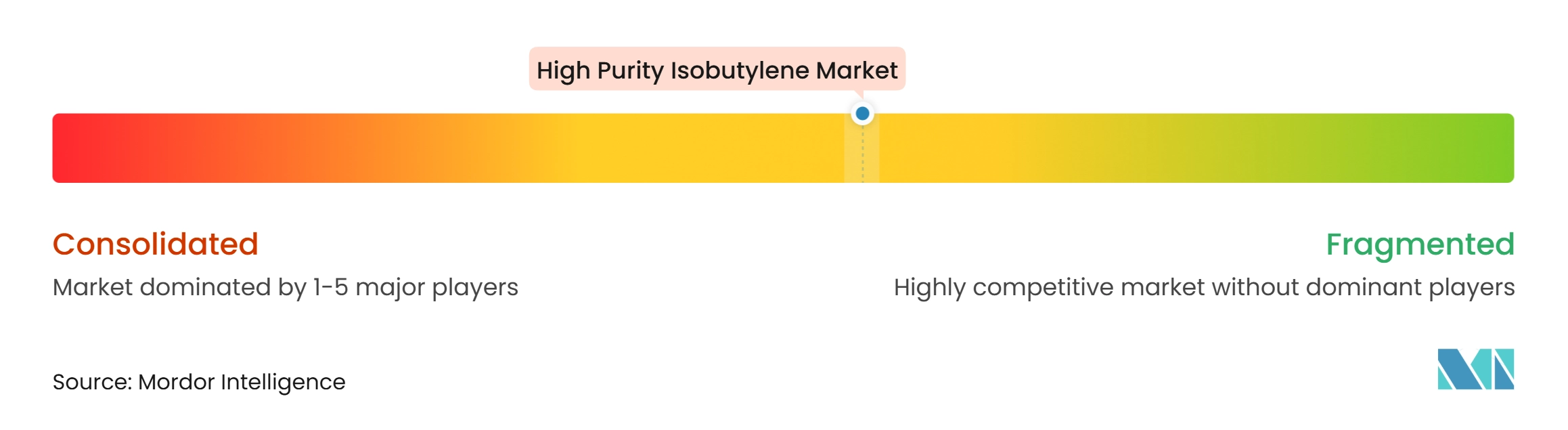
The high purity isobutylene market is moderately fragmented. ExxonMobil, LyondellBasell, Enterprise Products Partners, BASF, and Sinopec maintain different forms of integration across the value chain. Their positions create high barriers to entry for standalone processors that must source feedstock and develop purification capabilities independently. ExxonMobil continues to position halobutyl technologies for automotive applications, including electric vehicles. BASF offers high-purity isobutylene technology as part of its petrochemical licensing portfolio. Competition is therefore based on process reliability, purity, asset integration, and secured outlets rather than capacity alone.
ENEOS completed the acquisition of TPC Group in October 2026, representing consolidation around North American C4 assets[2]. The transaction expands ENEOS's role in the regional C4 value chain and links its petrochemical interests to TPC's processing platform. BASF and OMV Downstream received a 2025 patent for the purification of isobutene from C4 streams, demonstrating how established companies continue to protect their proprietary separation capabilities. ExxonMobil also received U.S. patents in 2025 for isobutylene-containing compositions and articles, reinforcing its focus on downstream material innovation. These developments indicate that technical differentiation remains an important competitive tool and raises the difficulty for smaller companies competing on merchant product pricing alone.
The high purity isobutylene market has potential for products made through lower-carbon production pathways, but large-scale commercial supply remains constrained by cost and infrastructure requirements. Research from TU Delft found that bio-based isobutene could reduce fossil dependence in existing MTBE clusters, while requiring greater electricity, cooling water, and land resources. This creates an opening for producers that can combine low-carbon feedstock with reliable polymer-grade purity. Smaller companies may focus on specialized derivatives and downstream chemical niches. The competitive structure is concentrated around technology and feedstock access, while product supply remains distributed among several regional producers.
High Purity Isobutylene Industry Leaders
-
LyondellBasell Industries Holdings B.V.
-
Exxon Mobil Corporation
-
TPC Group
-
SIBUR Holding PJSC
-
Evonik Industries AG
- *Disclaimer: Major Players sorted in no particular order
High Purity Isobutylene Market Companies Covered in this Report
- BASF
- Enterprise Products Partners L.P.
- Evonik Industries AG
- Exxon Mobil Corporation
- LANXESS
- LyondellBasell Industries Holdings B.V.
- Reliance Industries Limited
- SIBUR Holding PJSC
- Sinopec
- Songwon Industrial Group
- Sumitomo Chemical Co., Ltd.
- TASCO Group
- TPC Group
- Vinati Organics Limited
- Yeochun NCC Co., Ltd.
Recent Industry Developments in High Purity Isobutylene Market
- June 2026: BASF presented its SYNCRA process technology suite, including the high-purity isobutylene platform, at CIPPE 2026 in China. The technology targets refineries and petrochemical complexes with C4-rich streams that seek to integrate polymer-grade, high-purity isobutylene output into existing infrastructure, and it also covers downstream applications in the automotive, construction, and pharmaceutical sectors.
- April 2026: Shandong Binhua New Materials Co., Ltd. commissioned its 100,000 ton/year high-purity isobutylene and 30,000 ton/year high-purity diisobutylene plants simultaneously in a single start-up. Process parameters met design specifications, and energy consumption was reduced by approximately 50% compared with conventional processes, expanding China's domestic high-purity isobutylene supply capacity.
Global High Purity Isobutylene Market Report Scope
High Purity Isobutylene is a grade of isobutylene gas that has been refined to a concentration of 99% to 99.9% or higher to remove trace moisture, reactive impurities, and other C4 hydrocarbons. This level of refinement ensures that the gas meets the stringent quality requirements of industries such as pharmaceuticals, electronics, and specialty chemicals, where even minor impurities can affect product performance or process integrity.
The high purity isobutylene market is segmented by production method, application, and geography. By production method, the market is segmented into C4 fraction separation, MTBE decomposition, isobutane dehydrogenation, and other production methods. By application, the market is segmented into butyl rubber, polyisobutylene, tertiary-butylphenol series products, trimethylacetic acid, methyl allyl chloride, and other applications. The report also covers market sizes and forecasts for high purity isobutylene across 15 countries in major regions. The market sizes and forecasts are provided in terms of value (USD).
Segmentation Overview
| C4 Fraction Separation |
| MTBE Decomposition |
| Isobutane Dehydrogenation |
| Other Production Methods |
| Butyl Rubber |
| Polyisobutylene |
| Tertiary-Butylphenol Series Products |
| Trimethylacetic Acid |
| Methyl Allyl Chloride |
| Other Applications |
| Asia-Pacific | China |
| India | |
| Japan | |
| South Korea | |
| ASEAN Countries | |
| Rest of Asia-Pacific | |
| North America | United States |
| Canada | |
| Mexico | |
| Europe | Germany |
| United Kingdom | |
| France | |
| Italy | |
| NORDIC Countries | |
| Rest of Europe | |
| South America | Brazil |
| Argentina | |
| Rest of South America | |
| Middle East and Africa | Saudi Arabia |
| South Africa | |
| Rest of Middle East and Africa |
| By Production Method | C4 Fraction Separation | |
| MTBE Decomposition | ||
| Isobutane Dehydrogenation | ||
| Other Production Methods | ||
| By Application | Butyl Rubber | |
| Polyisobutylene | ||
| Tertiary-Butylphenol Series Products | ||
| Trimethylacetic Acid | ||
| Methyl Allyl Chloride | ||
| Other Applications | ||
| By Geography | Asia-Pacific | China |
| India | ||
| Japan | ||
| South Korea | ||
| ASEAN Countries | ||
| Rest of Asia-Pacific | ||
| North America | United States | |
| Canada | ||
| Mexico | ||
| Europe | Germany | |
| United Kingdom | ||
| France | ||
| Italy | ||
| NORDIC Countries | ||
| Rest of Europe | ||
| South America | Brazil | |
| Argentina | ||
| Rest of South America | ||
| Middle East and Africa | Saudi Arabia | |
| South Africa | ||
| Rest of Middle East and Africa | ||
Key Questions Answered in the Report
What is current market size of High Purity Isobutylene Market?
The High Purity Isobutylene market size was valued at USD 3.26 billion in 2026 and is estimated to grow from USD 3.42 billion in 2027 to USD 4.37 billion by 2032, at a CAGR of 5.02% during the forecast period (2027-2032).
Which production method leads high-purity isobutylene supply?
Methyl tert-Butyl Ether (MTBE) decomposition led with a 52.34% share in 2026. The route can use established infrastructure, subject to feedstock availability and purification requirements.
Which application is expected to grow fastest through 2032?
Polyisobutylene is forecast to grow at a CAGR of 6.12% through 2032. Lubricant additives and related polymer applications support its outlook.
Which region has the highest demand and supply of high-purity isobutylene?
Asia-Pacific held a 44.05% share in 2026 and is forecast to grow at a CAGR of 5.78% through 2032. Its tire, chemical, and refining base supports both demand and supply.