
High Heels Footwear Market Size and Share
Market Overview
| Study Period | 2022 - 2032 |
|---|---|
| Market Size (2027) | USD 47.87 Billion |
| Market Size (2032) | USD 63.11 Billion |
| Growth Rate (2027 - 2032) | 5.71 % |
| Fastest Growing Market | Europe |
| Largest Market | Asia-Pacific |
| Market Concentration | Low |
Major Players *Disclaimer: Major Players sorted in no particular order Image © Mordor Intelligence. Reuse requires attribution under CC BY 4.0. | |
High Heels Footwear Market Analysis by Mordor Intelligence
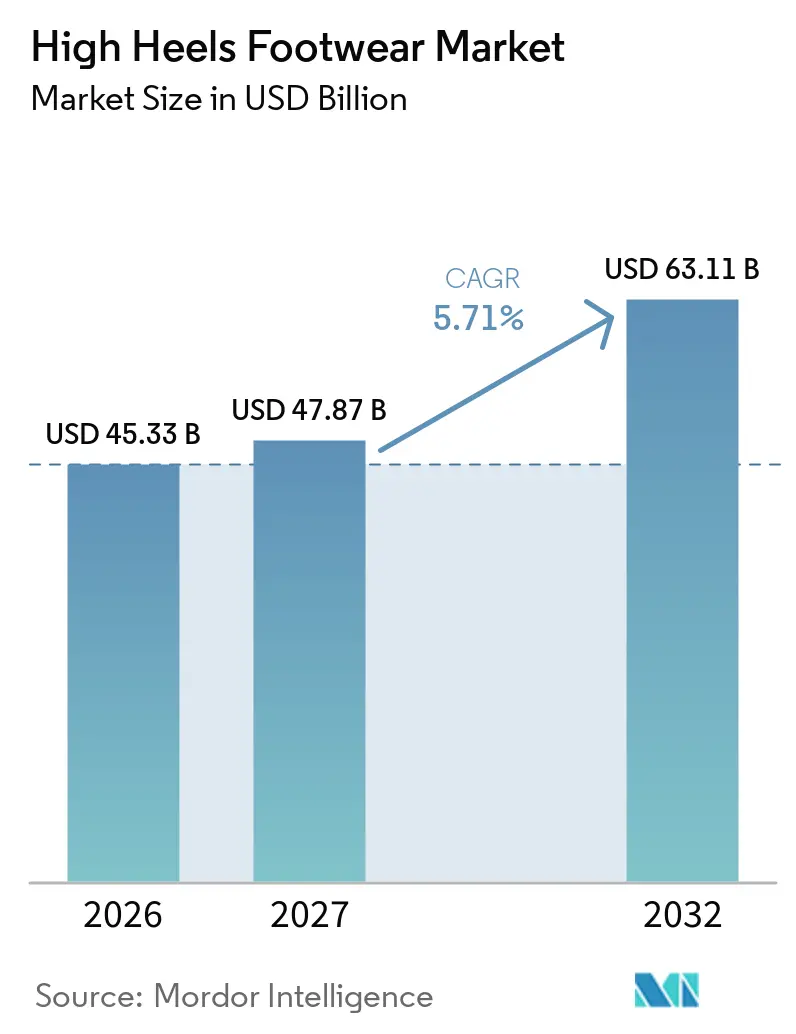
The high heels footwear market was valued at USD 45.33 billion in 2026, to USD 47.87 billion in 2027, and is estimated to grow to USD 63.11 billion by 2032, at a CAGR of 5.71% during the forecast period (2027-2032). Demand is supported by renewed interest in elevated footwear for work, formal events, and fashion-led occasions. Consumers are also placing more weight on comfort, fit, materials, and the ability to wear a style across several settings. Direct-to-consumer selling is becoming more important because it gives brands more control over consumer relationships, pricing, product presentation, and markdowns. The high heels footwear market is therefore moving toward a split between accessible, high-volume products and premium designs with stronger materials, brand stories, and comfort features. This pattern creates room for established luxury houses, specialty retailers, and digital-first labels, while increasing pressure on brands positioned between mass and luxury price points.
Key Report Takeaways
- By product type, pumps and court shoes held 34.57% of the high heels footwear market share in 2026, while high-heeled mules are expected to grow at a 6.72% CAGR through 2032.
- By inch type, the 3-to-below-4-inch bracket accounted for 32.48% of the high heels footwear market share in 2026, while above-5-inch styles are expected to grow at a 6.58% CAGR through 2032.
- By price point, the mass segment accounted for 72.35% of the high heels footwear market share in 2026, while the premium segment is forecast to grow at a 6.82% CAGR through 2032.
- By distribution channel, specialty stores held 67.52% of the high heels footwear market share in 2026, while online retail is expected to grow at a 6.37% CAGR through 2032.
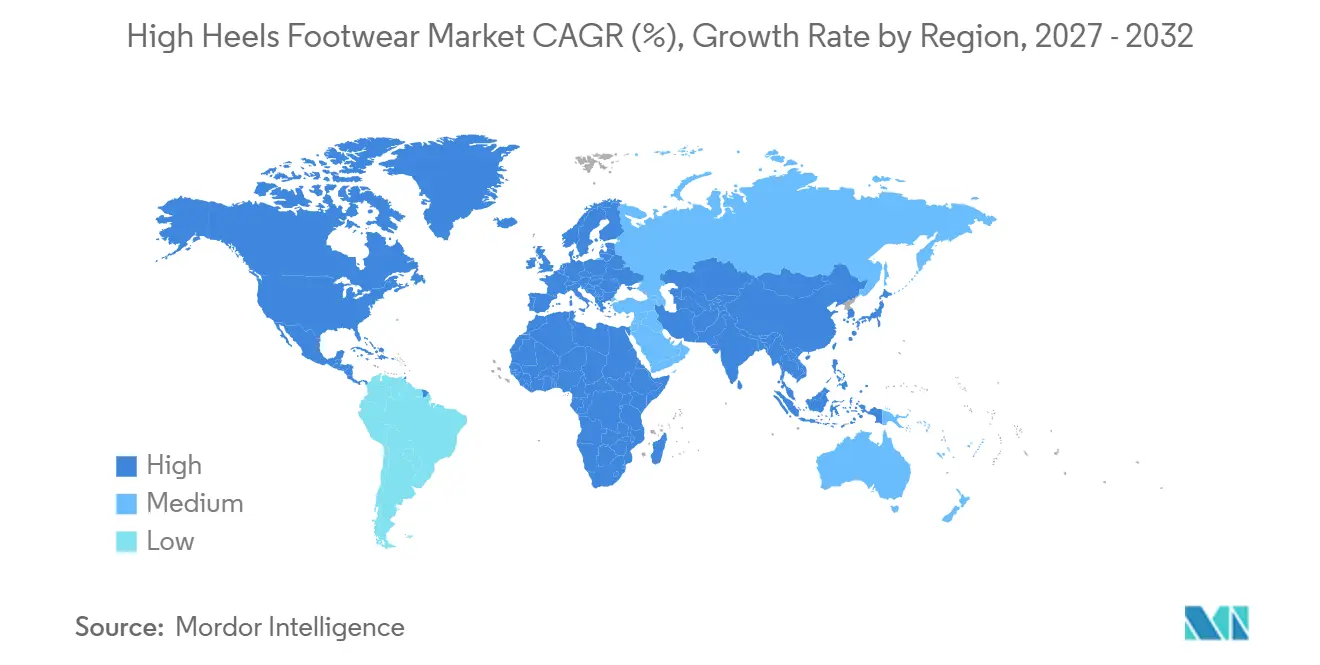
- By geography, Asia-Pacific held 38.68% of the high heels footwear market share in 2026, while Europe is expected to grow at a 7.15% CAGR through 2032.
Note: Market numbers in this report are based on Mordor Intelligence's proprietary estimation framework, which combines nine months of actuals with Q4 projections for base year 2026.
Market Trends and Insights
Drivers Impact Analysis of High Heels Footwear Market*
| Driver | (~) % Impact on CAGR Forecasts | Geographic Relevance | Impact Timeline |
|---|---|---|---|
| Growing emphasis on fashion-conscious footwear choices | +1.1% | Global, with peak intensity in Asia-Pacific and Western Europe | Short term (≤ 2 years) |
| Rising demand for heels for formal events and special occasions | +0.8% | North America, Europe, Middle East and Africa | Medium term (2–4 years) |
| Social media-driven footwear trends and celebrity influence | +1.0% | Global, concentrated in South Korea, India, Brazil, UK | Short term (≤ 2 years) |
| Advancements in heel design, materials, and comfort features | +0.9% | Global, early gains in North America and Germany | Long term (≥ 4 years) |
| Increasing demand for professional and workplace footwear | +0.7% | North America, Europe, urban Asia-Pacific | Medium term (2–4 years) |
| Expansion of online retail, DTC sales, and omnichannel distribution | +0.8% | Global, accelerating in Southeast Asia and Latin America | Short term (≤ 2 years) |
| Source: Mordor Intelligence | |||
Growing Emphasis on Fashion-Conscious Footwear Choices
Fashion-focused purchasing is supporting high heel demand beyond weddings, parties, and formal occasions. Consumers increasingly view elevated footwear as part of regular workwear, evening dressing, and fashion-led personal styling. Spring 2026 collections from Chanel and Dior placed classic pumps and heeled mules in visible fashion positions, which strengthened the relevance of established heel silhouettes. This visibility can encourage retailers to refresh assortments faster and can improve full-price demand for runway-connected products. The high heels footwear market benefits when brands combine familiar forms with updated proportions, finishes, and detailing. Accessible brands can use these shifts to offer trend-led styles at lower prices, while premium brands can use product stories and design heritage to support higher average selling prices.
Social Media-Driven Footwear Trends and Celebrity Influence
Social platforms have shortened the period between a high-profile footwear appearance and consumer search activity. A 2025 academic study found that celebrity endorsements and online advertising had a significant effect on purchase interest for footwear sold through TikTok Shop[1]. Christian Louboutin appointed Jaden Smith as its first men’s creative director in September 2025, linking product development and brand expression more closely with contemporary cultural audiences. The high heels footwear market can benefit when brands translate this attention into shoppable content, relevant stock availability, and clear product information. Social-commerce tools favor novelty, limited releases, and highly visual product details, which can help newer direct-to-consumer labels compete with larger houses. The same environment also raises execution risk because brands that do not respond quickly to product demand can lose attention to alternatives that are easier to find or buy.
Advancements in Heel Design, Materials, and Comfort Features
Comfort is becoming a more visible product requirement for consumers who want the visual effect of heels without a limited wearing window. Fashion for Good has examined bio-based materials for footwear soles, including options intended to reduce reliance on fossil-derived EVA, PU, and TPU. Material choices, cushioning systems, toe-box shape, and heel-to-ball balance can affect both fit and a consumer’s willingness to make repeat purchases. The high heels footwear market has an opportunity to make comfort claims more credible when products are supported by clear product testing and consistent design specifications. ISO/TC 137 is considering functional high heels within footwear standardization work, which could raise the importance of verifiable performance claims. Brands with design resources and established supplier relationships are better placed to respond if functional standards become more specific.
Expansion of Online Retail, Direct-to-Consumer, and Omnichannel Distribution
Direct selling gives footwear brands a closer view of consumer behavior, including product searches, fit concerns, repeat purchasing, and returns. Golden Goose reported that direct-to-consumer net revenue increased 21.0% year over year in the first 9 months of 2025, while the channel represented 79.0% of net revenue. Although Golden Goose is not a high-heel specialist, its result illustrates why own-channel selling is receiving greater attention across fashion footwear. Online retailers can reduce uncertainty around heel height and fit through better size guidance, virtual try-on, detailed imagery, and styling content. The high heels footwear market may increasingly treat stores as places for discovery and fit confirmation, while repeat transactions move to brand-owned digital channels. This model can strengthen margins, but it requires dependable fulfillment, manageable return rates, and product descriptions that set realistic expectations.
Restraints Impact Analysis of High Heels Footwear Market*
| Restraint | (~) % Impact on CAGR Forecasts | Geographic Relevance | Impact Timeline |
|---|---|---|---|
| Health concerns associated with prolonged high-heel usage | -0.7% | Global, most acute in North America and Western Europe | Long term (≥ 4 years) |
| Competition from other footwear alternatives | -0.8% | Global, concentrated in markets where athleisure and flat-shoe culture are embedded | Medium term (2–4 years) |
| Affordability challenges in premium and designer footwear | -0.4% | North America, Europe | Medium term (2–4 years) |
| Environmental concerns and rising costs of sustainable footwear production | -0.3% | Europe (EU compliance factors), North America | Long term (≥ 4 years) |
| Source: Mordor Intelligence | |||
Health Concerns Associated with Prolonged High-Heel Usage
Health considerations can limit repeat demand for higher heel styles, especially among consumers who prioritize all-day comfort. A 2025 PLOS ONE study found that heel heights of at least 3 cm were associated with shorter stride length, lower foot clearance, and slower walking speed than sneakers[2]. Another 2025 study reported that greater heel height can increase lower-limb biomechanical loads during stair descent. These findings do not eliminate demand for heels, but they increase the value of lower-height products and comfort-oriented construction. The high heels footwear market can retain consumers by offering more cushioning, stable heel forms, and products that clearly state fit and usage expectations. Health-oriented product development may be especially important in regions where ergonomic footwear messaging already has strong consumer recognition.
Competition from Other Footwear Alternatives
Flats, loafers, Mary Janes, and lower heel designs increasingly compete for occasions that previously favored higher heels. These alternatives are not sold only as comfort products because luxury and fashion brands are using design, materials, and limited distribution to make them aspirational. This changes the purchase decision for consumers who want formal styling without the practical demands of a higher heel. The high heels footwear market faces a particular challenge in the 3-to-below-4-inch range, where dressy flats can provide a similar use case. Brands need clear product stories that explain when a heel offers a distinct styling or occasion value. Products that balance visual impact, stability, and wearability are more likely to remain relevant as consumers compare a wider set of footwear choices.
*Our forecasts treat driver/restraint impacts as directional, not additive. The impact forecasts reflect baseline growth, mix effects, and variable interactions.
High Heels Footwear Market Segment Analysis
By Product Type:
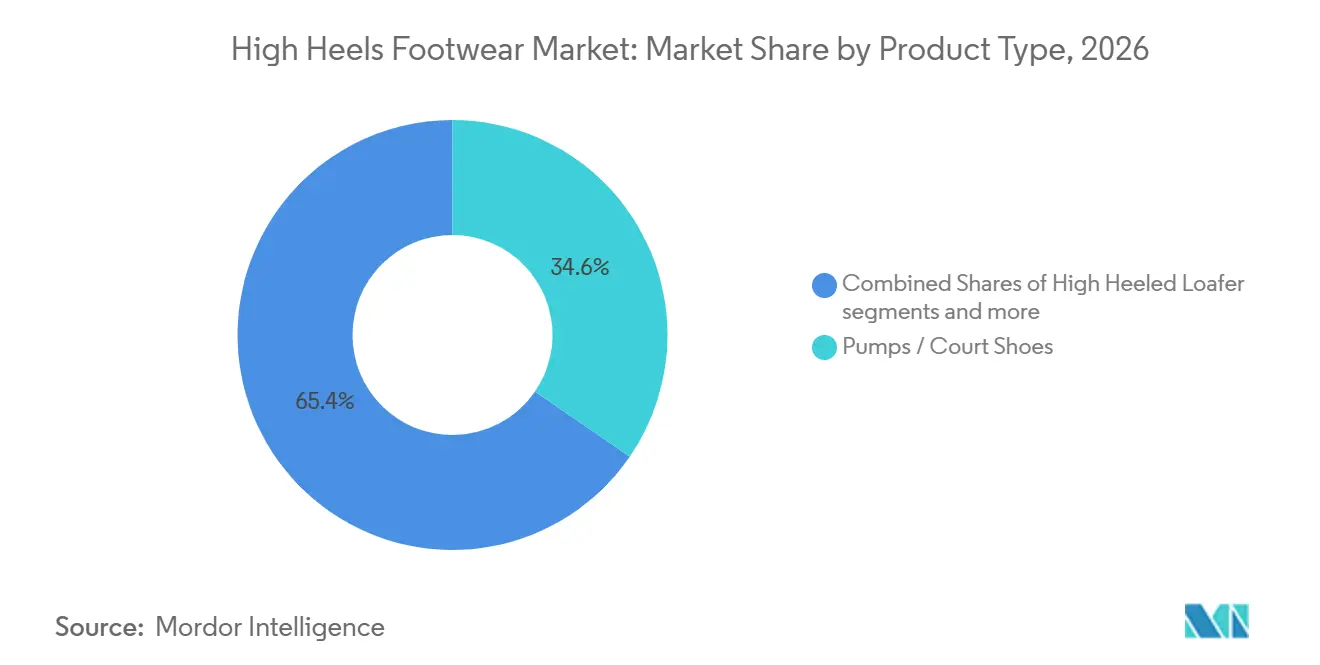
Mules Lead Innovation While Pumps Anchor VolumePumps and court shoes accounted for 34.57% market share in 2026, making them the leading product type. Their scale reflects demand from professional settings, weddings, formal events, and other occasions that favor a familiar, versatile shoe. Pumps can work with several clothing categories, which makes them a dependable volume product for retailers and brands. The product category also supports price points from accessible fashion through luxury, allowing broad consumer reach. High-heeled sandals have continued relevance in warm climates, particularly across Asia-Pacific and South America. Other high-heeled footwear, including platform and sculptural styles, tends to attract consumers looking for more expressive design. The high heels footwear market relies on this product mix because stable core categories can fund experimentation with trend-responsive styles.
High-heeled mules are expected to grow at a 6.72% CAGR through 2032, which makes them the fastest-growing product type. Their open-back format can provide an elevated appearance without the enclosed fit associated with some pumps or boots. This makes mules relevant for consumers seeking a lighter product for social events, warm-weather use, and fashion-focused dressing. Their shape also gives designers room to refresh heel forms, materials, colors, and ornamentation without changing the core silhouette. Fall 2025 fashion presentations featured heeled mules prominently at several luxury houses, which reinforced the format’s design relevance. Retailers may use mules to add newness to seasonal collections while keeping pumps as a dependable base.

By Inch Type:
Moderate Heights Drive Volume, Extreme Heights Drive GrowthThe 3-to-below-4-inch bracket accounted for 32.48% market share in 2026. This range is used across workplace, social, formal, and evening settings, which supports its broad demand. It offers more visible elevation than lower heel styles while remaining more practical for many consumers than very high heels. The category’s position is strengthened by consumers who want a single pair that can serve multiple occasions. Fit, cushioning, and walking stability remain important purchase factors in this range. Brands can protect volume by providing product guidance that explains heel profile, insole construction, toe shape, and expected fit. The 2-to-3-inch segment has relevance for commuter use and entry-level heel purchasers, including consumers who prefer restrained workplace styling.
Above-5-inch styles are expected to grow at a 6.58% CAGR through 2032, the fastest growth rate by inch type. These products are supported by event dressing, red-carpet visibility, and demand for highly expressive footwear. They are less likely to be purchased for everyday wear, but they can carry higher design value and stronger visual appeal. Limited collections can use dramatic heel height, unusual forms, and premium finishes to generate attention for a broader brand assortment. The segment is closely connected to fashion content because a striking product can drive search interest even when purchase frequency remains limited. Brands must still address stability and comfort because a product’s perceived impracticality can limit conversion.
By Price Point:
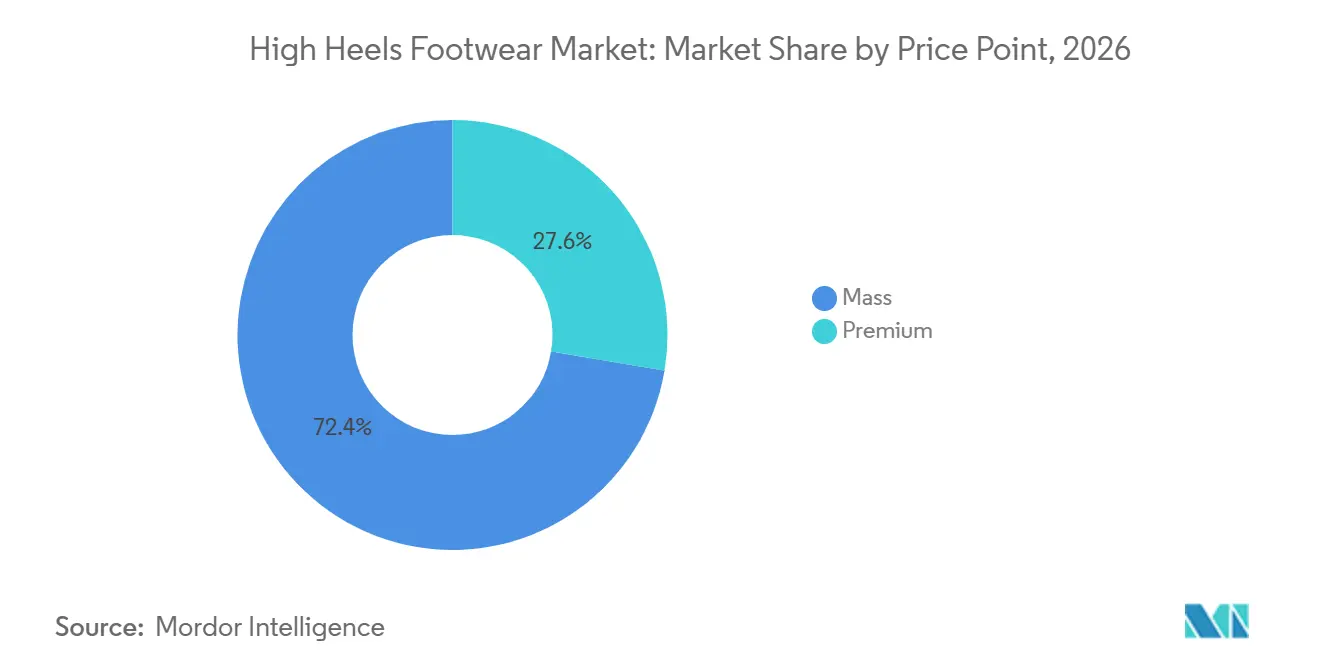
Mass Leads Volume, Premium Captures the Growth CurveThe mass segment commanded 72.35% of the high heels footwear market size in 2026. This position reflects the importance of accessible price points in Asia-Pacific and South America, where high purchase volume supports the segment. Specialty stores, hypermarkets, and domestic fast-fashion sellers supply a large selection of affordable products to repeat buyers. Mass products can respond quickly to new colors, heel shapes, and fashion details, which helps keep their assortment current. Domestic brands in China and Southeast Asia are important because they combine local market awareness with high-volume sourcing. Competition in this segment remains intense because consumers can compare many similar products across physical and digital channels.
The premium segment is expected to grow at a 6.82% CAGR through 2032. Consumers in this segment are more likely to value materials, design distinctiveness, comfort features, and brand heritage. Direct-to-consumer strategies support premium price realization because brands can present product stories without sharing economics with wholesale partners. The shift also reflects demand for footwear that feels durable and suitable for repeated formal or professional use. Tariff pressures affecting wholesale-sourced footwear in the United States have increased the appeal of stronger unit economics and more controlled selling channels. Premium brands can use retail staff, appointment selling, and digital clienteling to build consumer confidence around high-ticket purchases.
By Distribution Channel:
Specialty Stores Lead, Digital Channels AccelerateSpecialty stores held a 67.52% market share in 2026. Physical stores remain important because heel height, fit, toe shape, and walking comfort are difficult for many consumers to assess without trying a product. Staff support can also help first-time buyers choose a heel profile that suits their needs. Multi-brand specialty stores allow side-by-side comparison among different price points, silhouettes, and comfort features. This setting can encourage consumers to consider premium products that they may not search for online. Department stores and brand boutiques also remain relevant for premium and luxury consumers seeking service, range, and brand presentation.
Online retail is expected to grow at a 6.37% CAGR through 2032, making it the fastest-growing distribution channel. Digital channels can provide a broad product selection without the physical inventory limits of a store. They also allow brands to use videos, close-up imagery, size tools, and styling content to reduce the uncertainty involved in buying heels remotely. Brand-owned websites create opportunities to collect feedback on fit and returns, which can improve product development over time. Social content can move consumers from product discovery to checkout more directly, especially when retailers maintain relevant inventory.
Geography Analysis
APAC High Heels Footwear Market
Asia-Pacific held 38.68% of the high heels footwear market share in 2026, making it the largest regional contributor. China, South Korea, India, Vietnam, Indonesia, and the Philippines support demand through urban consumption, expanding access to international brands, and fast-moving digital commerce. China’s short-video and social-commerce environment gives brands a route to show new products to consumers quickly. South Korea’s fashion culture can amplify the effect of celebrity and entertainment-led footwear appearances across several markets.
Europe High Heels Footwear Market
Europe is expected to grow at a 7.15% CAGR through 2032, the highest regional rate in the high heels footwear market. Italy remains an important footwear production and export center, supported by specialized manufacturing and luxury design capabilities. European brands can benefit from established craftsmanship, global recognition, and deep experience in premium product positioning. E-commerce is adding an important growth path in markets where physical footwear retail has been under pressure. Country conditions differ, with stronger digital activity in Germany and Spain and more challenging recent conditions in France.
The Americas and MEA High Heels Footwear Market
North America remains a high-value area for premium and designer footwear, where consumers often seek product quality, recognizable design, and service. Pumps showed resilience within footwear demand during the first half of 2026, even as some other footwear categories were softer[3]. Middle East and Africa, particularly GCC markets, offer premium demand linked to formal social occasions and luxury consumption. South America is supported by strong interest in expressive occasion footwear, led by markets such as Brazil, Argentina, and Chile. Economic volatility can affect purchasing patterns in South America, which creates a more variable growth outlook. These regions provide different opportunities for the high heels footwear market because premium service, accessible pricing, local product styling, and flexible distribution do not carry equal importance in every geography.
Competitive Landscape
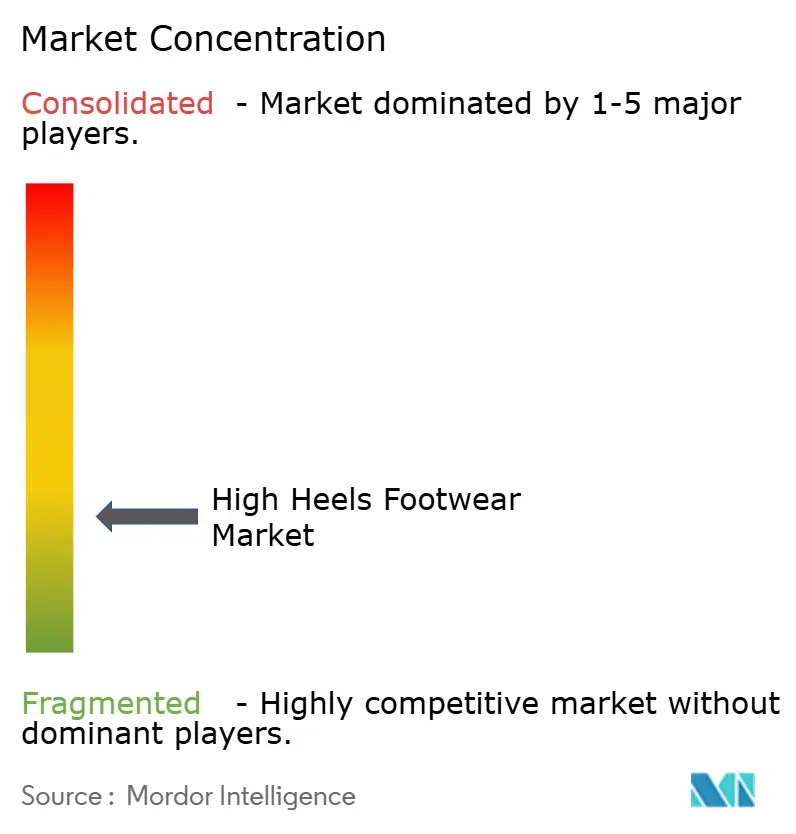
The high heels footwear market has a low concentration, with competition spread across global luxury groups, independent fashion houses, specialty retailers, direct-to-consumer brands, and mass-market labels. No single player holds a dominant market share. Luxury groups offer pumps, slingbacks, mules, sandals, and other heel styles through multiple fashion houses. Independent brands, such as Christian Louboutin and Casadei, compete through design, craftsmanship, and brand recognition, while mass-market companies focus on price, availability, trend adoption, and local market knowledge.
This fragmented market structure creates price pressure in high-volume categories but allows specialized brands to command premium prices through differentiation. It also provides opportunities for smaller companies that address underserved consumer needs. Direct-to-consumer sales are reshaping competition by giving brands greater control over customer data, pricing, presentation, and client relationships. Salvatore Ferragamo reported 2.70% growth in direct-to-consumer women’s shoe sales at constant exchange rates in the first quarter of 2026. Kering reported that new Yves Saint Laurent shoe launches supported stable comparable performance in the fourth quarter of 2025, while Bottega Veneta’s shoe and ready-to-wear categories recorded double-digit growth.
Brands are also increasing their focus on comfort through cushioning, adjustable components, and alternative sole materials. Demonstrable performance benefits can appeal to consumers seeking improved fit, stability, and wearability. The mid-premium segment remains challenging, as brands such as Steve Madden, ALDO, and Charles & Keith must offer greater design value than mass-market sellers while remaining more accessible than luxury houses. Chinese challengers are increasing pressure on international mass-market players in Southeast Asia through social commerce, competitive pricing, and product personalization.
High Heels Footwear Industry Leaders
-
Christian Louboutin SAS
-
Capri Holdings Limited
-
Kering SA
-
Bata Corporation
-
Salvatore Ferragamo S.p.A.
- *Disclaimer: Major Players sorted in no particular order
High Heels Footwear Market Companies Covered in this Report
- Christian Louboutin SAS
- Capri Holdings Limited
- Inditex (Zara)
- Salvatore Ferragamo S.p.A.
- Kering SA
- Dolce & Gabbana S.r.l.
- Valentino S.p.A.
- Steve Madden, Ltd.
- ALDO Group Inc.
- Charles & Keith Group
- Nine West Holdings, Inc.
- Deichmann SE
- Geox S.p.A.
- C. & J. Clark International Limited
- Belle International Holdings Limited
- Diana Corporation
- Casadei S.r.l.
- Bata Corporation
- Caleres, Inc.
- Tapestry, Inc.
- LVMH Moet Hennessy Louis Vuitton SE
Recent Industry Developments in High Heels Footwear Market
- August 2026: Madden NYC debuted in India with a women's footwear collection featuring sneakers, slides, statement heels, and other fashion footwear. The collection became available online and through selected retailers, expanding the brand's presence in the Indian women's footwear market.
- June 2026: Ozzaro introduced a new office heel collection designed for professional women. The range included the Urban Block, a black patent square-toe block heel, and Pure Poise, a white square-toe block heel. The collection also featured the Vectora Strap wedge heel, offering additional options for workplace footwear.
- June 2025: Christian Louboutin and Maison Margiela collaborated on the Loubiella heel, combining distinctive design elements from both fashion houses. The design featured a split-toe silhouette and a four-inch heel.
- March 2025: Christian Louboutin and Maison Margiela collaborated on the Loubiella heel, combining distinctive design elements from both fashion houses. The design featured a split-toe silhouette and a four-inch heel.
Global High Heels Footwear Market Report Scope
The high heels footwear market is segmented by product type, heel height, price point, distribution channel, and geography. By product type, the market is segmented into high-heeled mules, high-heeled boots and booties, high-heeled sandals, high-heeled loafers, pumps and court shoes, and other high-heeled footwear. By heel height, the market is categorized into 2–3 inches, 3 to below 4 inches, 4–5 inches, and above 5 inches. By price point, the market is divided into mass-market and premium footwear. By distribution channel, the market is segmented into supermarkets and hypermarkets, specialty stores, online retail channels, and other distribution channels. By geography, the market is divided into North America, Europe, Asia-Pacific, South America, and the Middle East and Africa.
Segmentation Overview
| High-Heeled Mules |
| High-Heeled Boots / Booties |
| High-Heeled Sandals |
| High Heeled Loafers |
| Pumps / Court Shoes |
| Other High-Heeled Footwear |
| 2- 3 inches |
| 3 to below 4 inches |
| 4 inches to 5 inches |
| Above 5 inches |
| Mass |
| Premium |
| Spermarkets/Hypermarkets |
| Specialty Stores |
| Online Retail Channels |
| Other Distribution Channels |
| North America | United States |
| Canada | |
| Mexico | |
| Rest of North America | |
| Europe | Germany |
| United Kingdom | |
| France | |
| Italy | |
| Spain | |
| Netherlands | |
| Sweden | |
| Poland | |
| Belgium | |
| Rest of Europe | |
| Asia-Pacific | China |
| India | |
| Japan | |
| Australia | |
| South Korea | |
| Vietnam | |
| Indonesia | |
| Rest of Asia-Pacific | |
| South America | Brazil |
| Argentina | |
| Chile | |
| Peru | |
| Colombia | |
| Rest of South America | |
| Middle East and Africa | United Arab Emirates |
| Saudi Arabia | |
| South Africa | |
| Nigeria | |
| Rest of Middle East and Africa |
| Product Type | High-Heeled Mules | |
| High-Heeled Boots / Booties | ||
| High-Heeled Sandals | ||
| High Heeled Loafers | ||
| Pumps / Court Shoes | ||
| Other High-Heeled Footwear | ||
| Inch Type | 2- 3 inches | |
| 3 to below 4 inches | ||
| 4 inches to 5 inches | ||
| Above 5 inches | ||
| Price Point | Mass | |
| Premium | ||
| Distribution Channel | Spermarkets/Hypermarkets | |
| Specialty Stores | ||
| Online Retail Channels | ||
| Other Distribution Channels | ||
| By Geography | North America | United States |
| Canada | ||
| Mexico | ||
| Rest of North America | ||
| Europe | Germany | |
| United Kingdom | ||
| France | ||
| Italy | ||
| Spain | ||
| Netherlands | ||
| Sweden | ||
| Poland | ||
| Belgium | ||
| Rest of Europe | ||
| Asia-Pacific | China | |
| India | ||
| Japan | ||
| Australia | ||
| South Korea | ||
| Vietnam | ||
| Indonesia | ||
| Rest of Asia-Pacific | ||
| South America | Brazil | |
| Argentina | ||
| Chile | ||
| Peru | ||
| Colombia | ||
| Rest of South America | ||
| Middle East and Africa | United Arab Emirates | |
| Saudi Arabia | ||
| South Africa | ||
| Nigeria | ||
| Rest of Middle East and Africa | ||
Key Questions Answered in the Report
What is the projected value of high heels footwear by 2032?
The high heels footwear market is forecast to reach USD 63.11 billion by 2032, growing at a 5.71% CAGR from 2027 to 2032.
Which product type holds the largest share of high heels footwear sales?
Pumps and court shoes lead product demand with a 34.57% share in 2026 because they are used for work, weddings, and formal occasions.
Which heel height is growing fastest?
Above-5-inch styles are forecast to grow at a 6.58% CAGR through 2032, supported by event dressing and fashion-led demand.
Why are premium high heels growing faster than mass-priced products?
The premium segment is forecast to grow at a 6.82% CAGR, supported by demand for stronger materials, comfort features, brand heritage, and direct-to-consumer selling.