
Heritage Railway Train Market Size and Share
Market Overview
| Study Period | 2021 - 2031 |
|---|---|
| Market Size (2026) | USD 1.95 Billion |
| Market Size (2031) | USD 2.59 Billion |
| Growth Rate (2026 - 2031) | 5.84 % |
| Fastest Growing Market | Asia-Pacific |
| Largest Market | Europe |
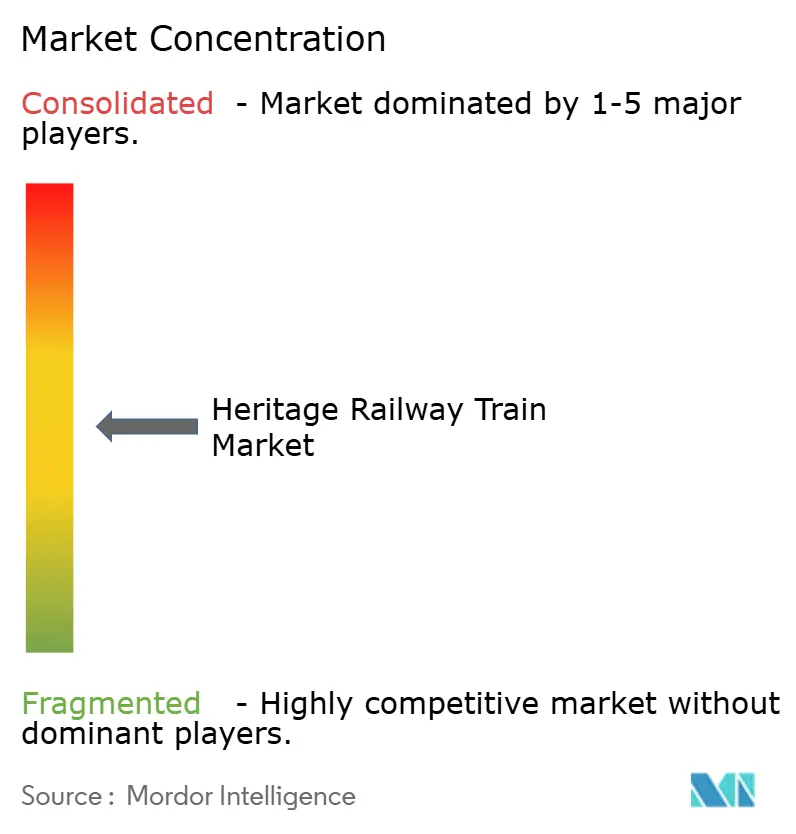
| Market Concentration | Medium |
Major Players *Disclaimer: Major Players sorted in no particular order Image © Mordor Intelligence. Reuse requires attribution under CC BY 4.0. | |
Heritage Railway Train Market Analysis by Mordor Intelligence
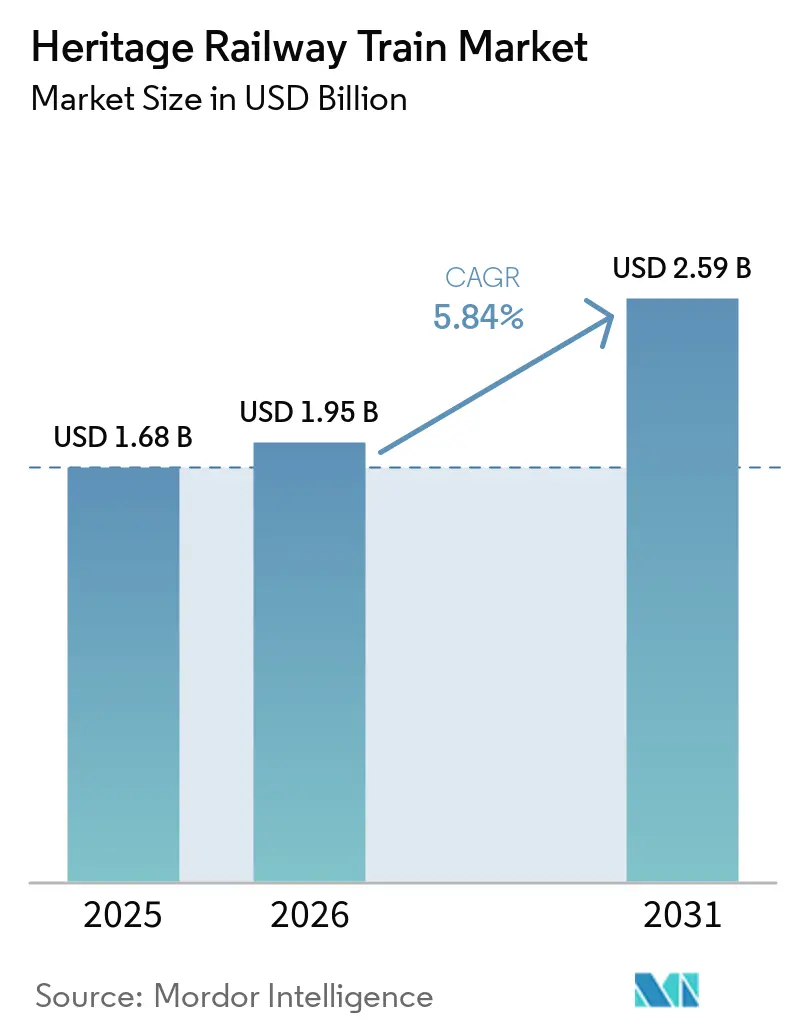
The Heritage Railway Train Market was valued at USD 1.68 billion in 2025 and estimated to grow from USD 1.95 billion in 2026 to reach USD 2.59 billion by 2031, at a CAGR of 5.84% during the forecast period (2026-2031). Positioned between cultural preservation and the shift toward experience-driven leisure travel, the market has seen demand recover post-pandemic. Europe remains the largest regional base due to its established preserved rail lines, museum assets, and volunteer-led operations. The Asia-Pacific region is expected to grow faster, driven by tourism around recognized rail corridors such as the Darjeeling Himalayan Railway. A stable domestic visitor base supports the market, while international travelers and value-added rail packages contribute to higher revenue per booking. Online booking adoption is expanding operator reach and boosting ancillary sales in retail, catering, and packaged experiences. However, supply capacity limits growth due to restoration costs, infrastructure wear, and a shortage of steam engineering talent, which restricts service expansion.
Note: Market size and forecast figures in this report are generated using Mordor Intelligence’s proprietary estimation framework, updated with the latest available data and insights as of January 2026.
Global Heritage Railway Train Market Trends and Insights
Drivers Impact Analysis*
| Driver | (~) % Impact on CAGR Forecast | Geographic Relevance | Impact Timeline |
|---|---|---|---|
| Rising Heritage Tourism Spend | +1.5% | Global, with intensity in Europe and Asia-Pacific | Medium term (2-4 years) |
| Public Funding for Railway Preservation | +1.0% | Europe, Australia, Asia-Pacific | Short term (≤ 2 years) |
| Premium Experiential Travel Demand | +1.3% | Europe, North America, Asia-Pacific | Medium term (2-4 years) |
| Private Sector Sponsorship and Brand Partnerships | +0.6% | Europe, North America | Medium term (2-4 years) |
| Digital Ticketing and Ancillary Revenue Expansion | +0.7% | Global, led by the United Kingdom, Europe, and North America | Short term (≤ 2 years) |
| Climate-Friendly Short-Haul Leisure Mobility | +0.4% | Europe and Asia-Pacific | Long term (≥ 4 years) |
| Source: Mordor Intelligence | |||
Rising Heritage Tourism Spend
Spending on cultural and heritage travel is increasing, driving growth in the heritage railway train market, particularly on leisure routes and event-focused services. Travelers aged 50 and above are showing a strong preference for rail journeys that offer relaxation, social interaction, and scenic experiences, aligning with the target audience of many preserved rail operators. In this market, revenue growth is not limited to base fares. Additional offerings such as dining upgrades, themed departures, overnight stays, and special events are boosting per-passenger revenue[1]. This trend allows operators to improve financial performance without solely relying on increased ridership. As retirees prioritize meaningful domestic and international travel experiences, demand for curated rail journeys that combine nostalgia, comfort, and local tourism is expected to grow further.
Public Funding for Railway Preservation
Public funding is providing a stable capital base for the heritage railway train market, supporting repairs, workshops, stations, and rolling stock restoration. Tasmania has allocated AUD 28.3 million (USD 18.97 million) over four years in its 2026-27 budget for the West Coast Wilderness Railway, increasing total investment to AUD 36.8 million (USD 24.66 million). The National Lottery Heritage Fund in the United Kingdom has committed GBP 3.7 million (USD 4.99 million) to Talyllyn Railway for station, workshop, and community heritage upgrades[2]. In North America, the Heritage Rail Alliance has identified FY2027 Congressional Directed Spending routes that could assist nonprofit operators in restoring historic rail assets. Climate reporting frameworks in Europe and national rail decarbonization strategies are enhancing the market’s position as a low-emission, short-haul leisure option, strengthening its case for grants and public tourism support.
Premium Experiential Travel Demand
Luxury rail travel has expanded its influence in the heritage railway market, offering high-end cabins, destination-focused itineraries, and hotel-linked packages. Belmond introduced the Britannic Explorer in July 2025, the first luxury sleeper train in England and Wales, featuring 18 cabins, wellness facilities, and Michelin-starred dining by Simon Rogan. The Venice Simplon-Orient-Express launched its Paris-to-Amalfi Coast route in 2026 as part of the 'Villeggiatura by Train' series, combining overnight rail journeys with stays at Belmond’s Italian hotels. Spain’s RENFE continued its luxury train services into the 2025 season and confirmed an expanded 2026 route, adding Extremadura, Castilla-La Mancha, and Madrid. These advancements highlight how the heritage railway market is shifting focus. Rather than competing solely with aviation or traditional sightseeing, it is now positioned as an alternative to luxury hotels and destination resorts.
Digital Ticketing and Ancillary Revenue Expansion
Digital systems are now key revenue drivers in the heritage railway train market, moving beyond their initial role as tools for advance ticket sales. West Somerset Railway partnered with DigiTickets to redesign its booking system, focusing on real-time availability and seamless online-to-on-site integration. This shift led to a notable increase in online bookings as customers increasingly opted for pre-trip purchases. Similarly, Snowdon Mountain Railway adopted Vennersys’ VenposCloud platform, integrating admissions, seating, catering, retail, customer data, and OTA access into a single system. This approach enables consistent management and sales of parking, food and beverages, gifts, memberships, and event packages. As a result, the market is achieving higher revenue per visitor, particularly on routes where ticket prices remain accessible to families and domestic leisure travelers.
Restraints Impact Analysis*
| Restraint | (~) % Impact on CAGR Forecast | Geographic Relevance | Impact Timeline |
|---|---|---|---|
| High Restoration and Compliance Costs | -1.2% | Global, particularly severe in the United Kingdom, Europe, and Asia-Pacific | Short term (≤ 2 years), Medium term (2-4 years) |
| Limited Availability of Skilled Steam and Heritage Engineering Talent | -0.8% | United Kingdom, Europe, Australia, North America | Long term (≥ 4 years) |
| Seasonal Demand Concentration | -0.6% | Global, most acute in northern temperate climates | Short term (≤ 2 years), Medium term (2-4 years) |
| Aging Infrastructure and Maintenance Disruptions | -0.9% | Europe, the United Kingdom, and South Asia | Medium term (2-4 years) |
| Source: Mordor Intelligence | |||
High Restoration and Compliance Costs
Restoration and compliance costs significantly constrain the heritage railway train market, as many operators rely on outdated infrastructure, complex locomotives, and limited financial resources. Nene Valley Railway reported that mandatory overhauls every 10 years often cost hundreds of thousands of pounds. Track renewal expenses can exceed GBP 120,000 (USD 161,893) per quarter mile. Severn Valley Railway incurred a landslip repair bill in 2025 exceeding GBP 500,000 (USD 674,555), requiring environmental approvals and contractor mobilization. Additionally, United Kingdom safety frameworks and the European Union Rail Safety Directive impose recurring obligations, including certification, boiler inspections, and track quality checks, further increasing costs for steam-led operations. This creates a persistent gap between strong visitor demand and the operational spending required to maintain lines, workshops, and locomotives.
Limited Availability of Skilled Steam and Heritage Engineering Talent
The heritage railway market faces challenges due to the slow development of a skilled talent pipeline. Specialized skills in steam and heritage engineering require years to develop and cannot be quickly replaced. Nene Valley Railway organized a STEM event to attract younger volunteers for engineering, driving, and guard roles, with staff noting the aging volunteer base. Tanfield Railway received GBP 175,384 (USD 236,612) in 2025 from the Reece Foundation to hire a People Development and Youth Engagement Manager. This initiative aims to engage 300 youths aged 10 to 25 through hands-on programs. The talent shortage impacts more than workshop staffing, as boiler recertification, restoration schedules, and safe daily operations depend on specialized mechanical expertise. Without timely recruitment and training of the next generation, operators risk constrained service frequency and fleet availability, even as passenger demand improves.
*Our forecasts treat driver/restraint impacts as directional, not additive. The impact forecasts reflect baseline growth, mix effects, and variable interactions.
Segment Analysis
By Train Type: Steam Dominates, Mixed-Haul Accelerates
Steam heritage trains held 55.63% of the heritage railway market share in 2025, highlighting the enduring appeal of authenticity. Steam traction combines sound, sight, smell, and historical symbolism, offering an experience rarely matched by diesel or electric alternatives. This preference was evident at Talyllyn Railway’s 2025 Awdry Extravaganza, which attracted over 2,600 visitors from the United States, Scandinavia, and Australia, generating an estimated local economic impact of GBP 250,000 (USD 337,278). Steam also drives media attention, event attendance, and higher pricing for special departures. Diesel and electric heritage trains play a supportive role in preservation but remain secondary in most visitor-focused operations.
Mixed-haul heritage trains are projected to grow at a 6.85% CAGR through 2031, making them the fastest-growing segment in the heritage railway market. This growth reflects a practical model where diesel traction ensures continuity during steam locomotive overhauls or certification downtimes. The Isle of Man’s heritage lines demonstrated this network resilience in 2025 by carrying a combined 463,118 passenger journeys - representing a 4.5% year-on-year market growth[3]. This network success was anchored by 155,494 journeys on the Manx Electric Railway and 129,245 journeys on the Isle of Man Steam Railway, proving that multi-traction systems successfully maintain high visitor demand. Electric heritage trains, though smaller in scale, are gaining relevance on mountain and narrow-gauge routes, balancing historical authenticity with lower-emission operations.


By Service Type: Excursion Revenue Anchors, Luxury Dining Commands Premium Yields
Tourist excursions represented 60.62% of the heritage railway train market size in 2025, forming the primary revenue source for the sector. Their popularity is driven by affordable day-trip pricing, family-friendly appeal, and consistent seasonal demand from domestic visitors. France’s tourist railways recorded about 4 million visitors in 2025, with the Train du Montenvers-Mer de Glace attracting 539,306 passengers, highlighting the potential of scenic excursions. These excursions are scalable, aligning with school calendars, local tourism, and holiday travel without requiring overnight stays, ensuring stable revenue despite regional demand variations.
Dining and luxury rail journeys are projected to grow at a 6.19% CAGR through 2031, the fastest among service types, enhancing the market's value segment. Charter and private rentals cater to corporate events, themed functions, and high-spend group travel on preserved routes. Train du Vivarais reintroduced its 1903 Mallet 403 steam locomotive in June 2025 after a EUR 287,000 (USD 337,601) restoration, demonstrating how preservation and tourism revenue can complement each other. Museum and preservation operations, while generating lower ticket income, support grant eligibility, education programs, and public credibility. SNCF Group’s 170 heritage events during the September 2025 Journées Européennes du Patrimoine showcased how preservation activities can serve as a national tourism and branding platform beyond traditional museum roles.
By End User: Domestic Visitors Underpin Stability, International Tourists Drive Value
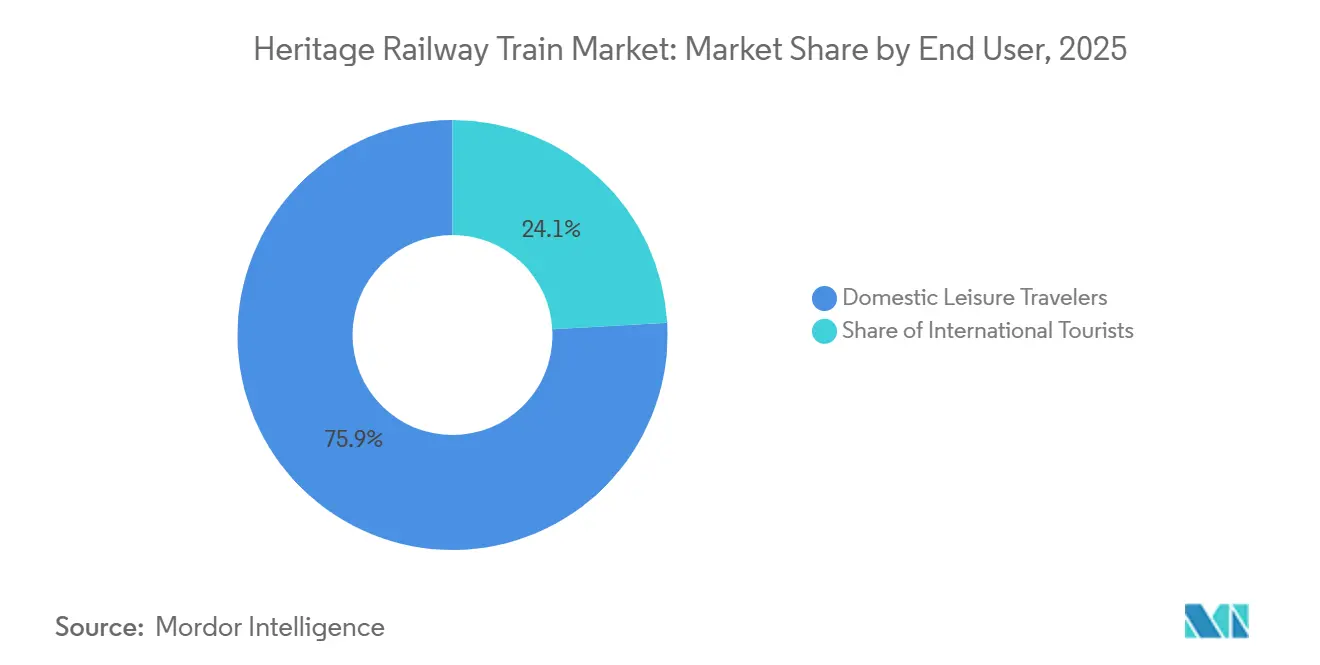
Domestic leisure travelers contributed 75.91% of revenue in 2025, highlighting the heritage railway train market's reliance on residents and short-stay travelers. This dependency provides a stable revenue base during declines in long-haul travel or foreign arrivals. Operators prioritize school holiday schedules, community events, and family-focused packages to optimize route planning and revenue. Themed rides, educational programs, and membership-driven repeat visits have helped stabilize cash flow throughout the year. Domestic demand remains crucial, supporting volunteer participation, route relevance, and recurring traffic on established lines.
International tourists accounted for 24.09% of revenue in 2025 and are projected to grow at a 6.86% CAGR through 2031, making them the fastest-growing end-user group. Their spending on accommodation, dining, seating, and itineraries amplifies their importance. Talyllyn Railway attracted visitors from the United States, Scandinavia, and Australia in 2025, demonstrating global interest in well-marketed heritage lines. The Darjeeling Himalayan Railway reported 215,000 visitors in FY2025-26, generating over INR 25 crore (USD 3 million). IRCTC expanded international outreach through travel fairs and digital platforms. Accessibility regulations in Europe and the United Kingdom are shaping investments, requiring operators to balance heritage preservation with passenger rights and inclusivity standards.
By Booking Channel: Direct Booking Leads, OTAs Digitize Discovery
Direct bookings accounted for 58.64% of transactions in 2025, highlighting the heritage railway train market's dependence on loyal visitors, community recognition, and route awareness. This channel helps operators maintain margins and build strong customer relationships. Many passengers know their preferred routes before purchasing. Group and institutional bookings, along with tour operators and travel agencies, remain vital for schools, inbound groups, and corporate events, helping balance seasonal demand. Direct bookings dominate due to repeat domestic traffic and local tourism networks driving significant volume.
Online travel agencies (OTAs) are projected to grow at a 6.63% CAGR through 2031, making them the fastest-growing distribution channel in the heritage railway train market. Railbookers reported 35% year-over-year booking growth for 2025 and 51% growth for 2026 bookings at the same sales cycle stage, reflecting increased reliance on curated rail discovery tools. Snowdon Mountain Railway’s OTA integration with Vennersys demonstrates how operators can expand visibility while retaining control of the guest experience[4]. However, commissions may reduce short-term margins, particularly for smaller operators with limited pricing flexibility. Successful operators use OTAs for first-time customer acquisition and transition returning passengers to direct, CRM-driven booking systems.
Geography Analysis
Europe held 39.85% of global revenue in the heritage railway train market in 2025, driven by a dense network of preserved lines, established volunteer systems, and integration with tourism programs. The Isle of Man heritage railways recorded 463,118 journeys across four lines, a 4.5% increase from 2024, reflecting steady demand. France’s tourist railways carried about 4 million passengers on major routes, while Spain’s RENFE luxury portfolio expanded its 2026 route offerings. Germany maintained around 300 operational steam locomotives and saw renewed interest in restored narrow-gauge sections.
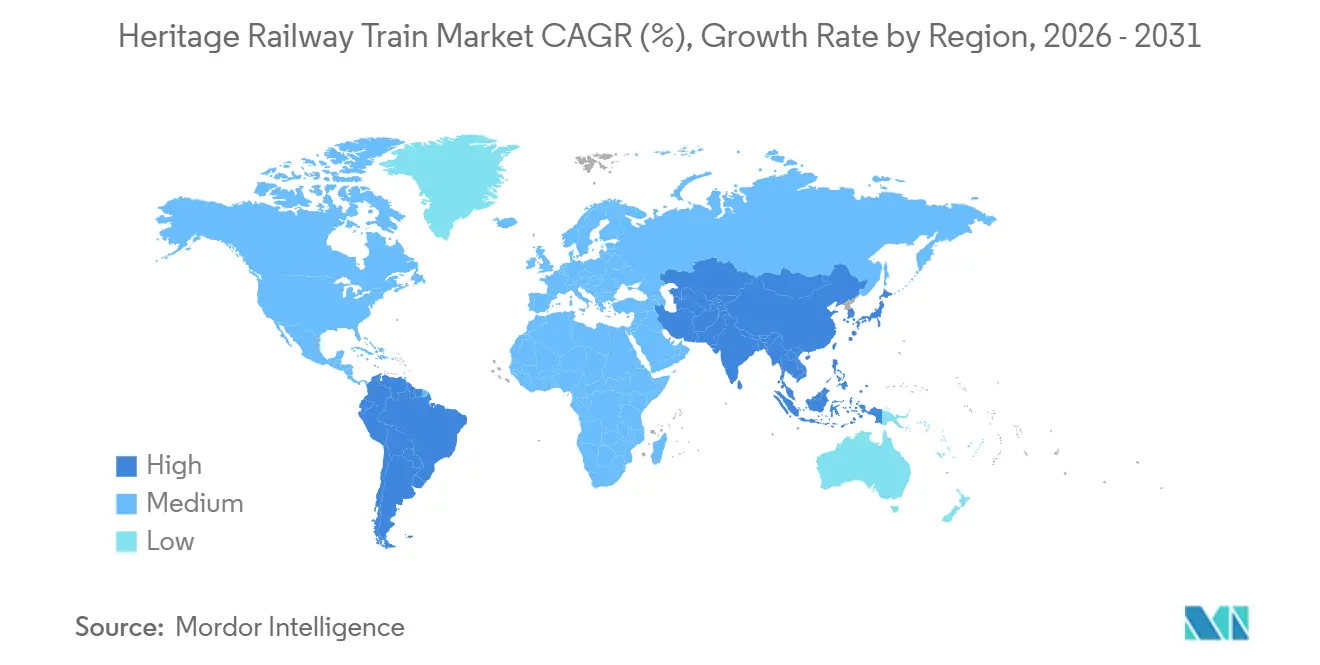
Asia-Pacific is projected to grow at a 6.24% CAGR through 2031, making it the fastest-growing region in the market. India’s UNESCO mountain railways, recognized as tourism assets, attracted 215,000 visitors to the Darjeeling Himalayan Railway in FY2025-26, generating over INR 25 crore (USD 2,782,450) in revenue. Tasmania allocated AUD 36.8 million (USD 24.66 million) to the West Coast Wilderness Railway, targeting 38,000 passengers in 2026. China, Japan, and South Korea show growth potential but have less mature preservation systems compared to Europe and India.
North America shows moderate growth, with the Heritage Rail Alliance identifying funding for about 500 heritage railroads, tourist railroads, and railroad museums in the United States and Canada. Patriot Rail launched the Gettysburg Excursion Railway in 2025, incorporating online ticketing from the start. South America shows potential in high-value segments, supported by Belmond’s Andean rail operations. The Middle East and Africa rely on a few long-distance offerings, with Rovos Rail as a key example. Broader growth in Africa depends on infrastructure development and tourism corridor expansion.
Competitive Landscape
The heritage railway train market is moderately fragmented, with competition among volunteer-led preservation groups, regional excursion operators, and luxury-focused brands. Market influence depends on route reputation, locomotive access, heritage status, and tourism partnerships rather than global dominance. In the United Kingdom, operators such as The Railway Touring Company, Vintage Trains, and West Coast Railways maintain relevance through licensed access, established branding, and rolling stock capabilities. Steam Dreams Rail Co. addresses domestic leisure demand with themed trips, while Belmond integrates rail and hospitality offerings.
Recent strategies show operators focusing on expansion, restructuring, and product redesign instead of pricing. Ridgewood Infrastructure’s acquisition of Sierra Railroad Company and its hydrogen locomotive subsidiary Railpower reflects growing investor interest in heritage-related rail assets. Skunk Train in California expanded its offerings with new services and partnerships, emphasizing experiential diversification. Severn Valley Railway restructured into a charitable community benefit society to enhance funding access and governance. Belmond introduced destination-linked itineraries, showcasing efforts to broaden appeal beyond traditional brand recognition.
Opportunities are strongest in South America, Southeast Asia, and parts of the Middle East and Africa, where route heritage exists but commercial development remains limited. Smaller operators face challenges in adopting digital memberships, dynamic pricing, and CRM systems, leaving room for improved repeat-visit monetization and channel strategies. Patent ownership holds limited significance in this market, as differentiation relies on exclusive locomotives, operating permissions, preservation credibility, and program design. Safety certifications and mainline access standards remain significant barriers for new entrants aiming to expand beyond local preserved lines into broader excursion or charter services.
Heritage Railway Train Industry Leaders
-
The Railway Touring Company
-
Vintage Trains
-
West Coast Railways
-
Belmond
-
Steam Dreams Rail Co.
- *Disclaimer: Major Players sorted in no particular order
Recent Industry Developments
- May 2026: The North Yorkshire Moors Railway has reopened its 24-mile route from Pickering to Whitby, including the restored Bridge 42. A "Kids Go Free" promotion accompanies the reopening, reactivating its primary revenue route and strengthening its connection to the Whitby tourism corridor.
- May 2026: Severn Valley Railway restructured into Severn Valley Railway Society Limited, a charitable community benefit society, after FCA approval in 2025. The change, supported by members and shareholders, streamlined governance and enabled access to charitable funding.
- March 2026: Ridgewood Infrastructure has acquired Sierra Railroad Company and its hydrogen locomotive subsidiary, Railpower, introducing private equity infrastructure capital into the heritage and short-line rail sector in the western United States.
- August 2025: Patriot Rail has launched the Gettysburg Excursion Railway in Pennsylvania, its fourth excursion product. The 25-mile route connects Gettysburg to Mount Holly Springs, with online ticket sales available from the start.
Global Heritage Railway Train Market Report Scope
| Steam Heritage Trains |
| Diesel Heritage Trains |
| Electric Heritage Trains |
| Mixed-Haul Heritage Trains |
| Tourist Excursions |
| Charter and Private Rentals |
| Dining and Luxury Rail Journeys |
| Museum and Preservation Operations |
| Domestic Leisure Travelers |
| International Tourists |
| Direct Booking |
| Online Travel Agencies (OTAs) |
| Tour Operators & Travel Agencies |
| Group & Institutional Booking |
| North America | United States |
| Canada | |
| Mexico | |
| South America | Brazil |
| Peru | |
| Chile | |
| Argentina | |
| Rest of South America | |
| Europe | United Kingdom |
| Germany | |
| France | |
| Spain | |
| Italy | |
| BENELUX (Belgium, Netherlands, and Luxembourg) | |
| NORDICS (Denmark, Finland, Iceland, Norway, and Sweden) | |
| Rest of Europe | |
| Asia-Pacific | India |
| China | |
| Japan | |
| Australia | |
| South Korea | |
| South East Asia (Singapore, Malaysia, Thailand, Indonesia, Vietnam, and Philippines) | |
| Rest of Asia-Pacific | |
| Middle East and Africa | United Arab Emirates |
| Saudi Arabia | |
| South Africa | |
| Nigeria | |
| Rest of Middle East and Africa |
| By Train Type | Steam Heritage Trains | |
| Diesel Heritage Trains | ||
| Electric Heritage Trains | ||
| Mixed-Haul Heritage Trains | ||
| By Service Type | Tourist Excursions | |
| Charter and Private Rentals | ||
| Dining and Luxury Rail Journeys | ||
| Museum and Preservation Operations | ||
| By End User | Domestic Leisure Travelers | |
| International Tourists | ||
| By Booking Channel | Direct Booking | |
| Online Travel Agencies (OTAs) | ||
| Tour Operators & Travel Agencies | ||
| Group & Institutional Booking | ||
| By Geography | North America | United States |
| Canada | ||
| Mexico | ||
| South America | Brazil | |
| Peru | ||
| Chile | ||
| Argentina | ||
| Rest of South America | ||
| Europe | United Kingdom | |
| Germany | ||
| France | ||
| Spain | ||
| Italy | ||
| BENELUX (Belgium, Netherlands, and Luxembourg) | ||
| NORDICS (Denmark, Finland, Iceland, Norway, and Sweden) | ||
| Rest of Europe | ||
| Asia-Pacific | India | |
| China | ||
| Japan | ||
| Australia | ||
| South Korea | ||
| South East Asia (Singapore, Malaysia, Thailand, Indonesia, Vietnam, and Philippines) | ||
| Rest of Asia-Pacific | ||
| Middle East and Africa | United Arab Emirates | |
| Saudi Arabia | ||
| South Africa | ||
| Nigeria | ||
| Rest of Middle East and Africa | ||
Key Questions Answered in the Report
What is driving growth in heritage railway travel through 2031?
Growth is being supported by stronger cultural tourism spending, premium rail experiences, and wider digital booking access. The sector is projected to reach USD 2.59 billion by 2031 from USD 1.95 billion in 2026 at a 5.84% CAGR.
Which train type leads global demand for preserved rail experiences?
Steam heritage trains lead demand, with 55.63% share in 2025. Their appeal remains strong because visitors continue to value historical authenticity and immersive onboard experiences.
Why is Asia-Pacific growing faster than other regions?
Asia-Pacific is forecast to expand at 6.24% CAGR through 2031, supported by internationally recognized rail assets such as India’s Darjeeling Himalayan Railway and government-backed tourism infrastructure in markets such as Australia.
How important are domestic travelers for preserved rail operators?
Domestic leisure travelers accounted for 75.91% of revenue in 2025. They provide the most stable traffic base and help operators manage seasonality through family travel, local tourism, and repeat visits.
What is changing in the booking channel mix for scenic and historic rail trips?
Direct booking still leads with 58.64% of transactions in 2025, but OTAs are growing faster at 6.63% CAGR. Operators are increasingly using digital platforms to improve discovery, advance sales, and ancillary revenue.
What are the biggest risks for operators over the next few years?
The main risks are restoration costs, compliance spending, aging infrastructure, and shortages in steam engineering talent. These factors limit fleet availability and make it harder for operators to convert demand into additional service capacity.