
Heat Sinks Market Size and Share
Market Overview
| Study Period | 2021 - 2031 |
|---|---|
| Market Size (2026) | USD 7.78 Billion |
| Market Size (2031) | USD 10.37 Billion |
| Growth Rate (2026 - 2031) | 5.93 % |
| Fastest Growing Market | Asia-Pacific |
| Largest Market | Asia-Pacific |
| Market Concentration | Low |
Major Players *Disclaimer: Major Players sorted in no particular order Image © Mordor Intelligence. Reuse requires attribution under CC BY 4.0. | |
Heat Sinks Market Analysis by Mordor Intelligence
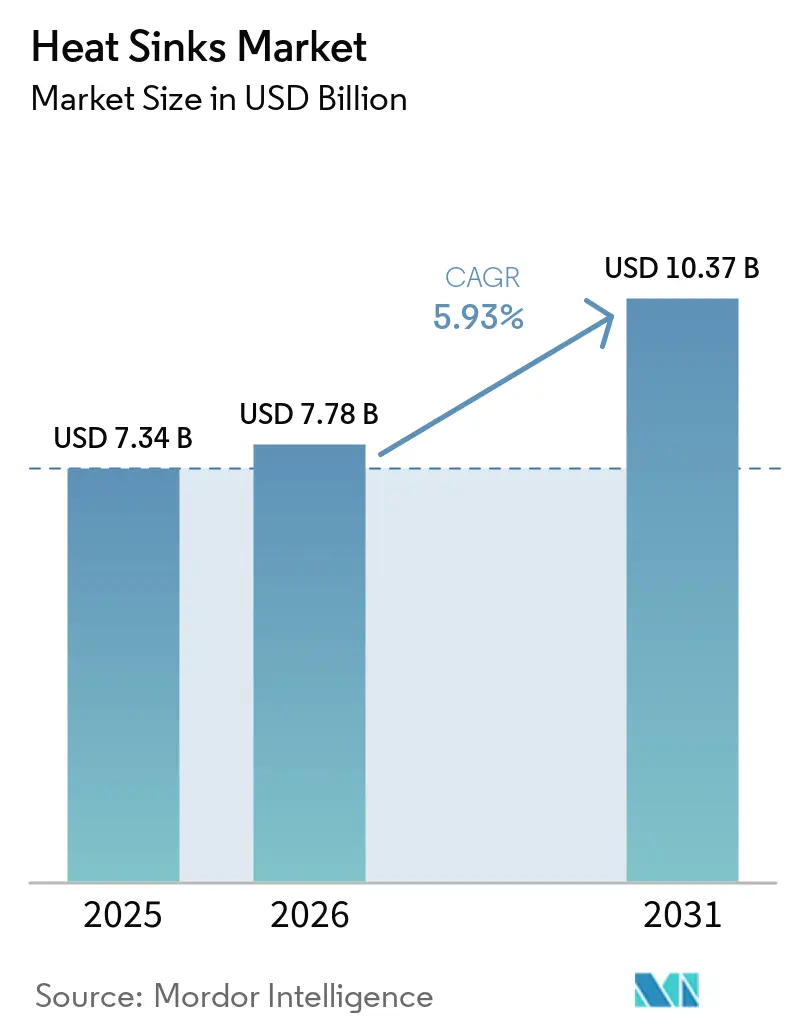
The Heat Sinks Market size was valued at USD 7.34 billion in 2025 and is estimated to grow from USD 7.78 billion in 2026 to reach USD 10.37 billion by 2031, at a CAGR of 5.93% during the forecast period (2026-2031). The heat sinks market is supported by rising thermal loads in consumer devices, automotive power electronics, data center servers, telecom equipment, and industrial automation. Artificial intelligence hardware is increasing heat density and is changing product requirements from simple fin arrays to more integrated thermal assemblies. NVIDIA stated that the Blackwell B200 graphics processing unit had a 1,000 W thermal design power in 2025, while the Vera Rubin R200 is expected to require 2,300 W per graphics processing unit in the second half of 2026. Fully liquid-cooled server designs reduce demand for some air-assisted products, but they also support demand for copper cold plates, vapor chambers, and aluminum extrusions used in cooling systems. This change is raising the value of designs that combine materials, machining, and thermal control capabilities in the heat sinks market.
Key Report Takeaways
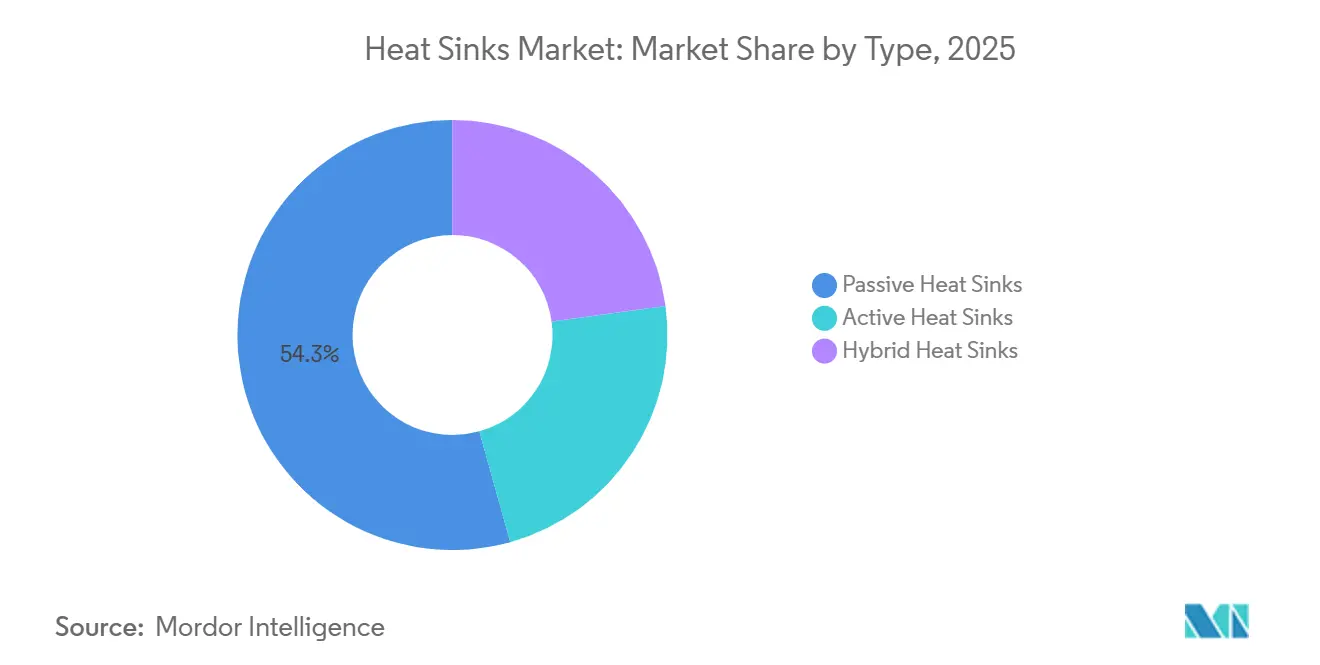
- By type, passive heat sinks held 54.32% of the heat sinks market share in 2025, while active heat sinks are projected to advance at a 7.12% CAGR through 2031.
- By substance, aluminum held 45.63% of the heat sinks market share in 2025, while copper is projected to advance at a 6.75% CAGR through 2031.
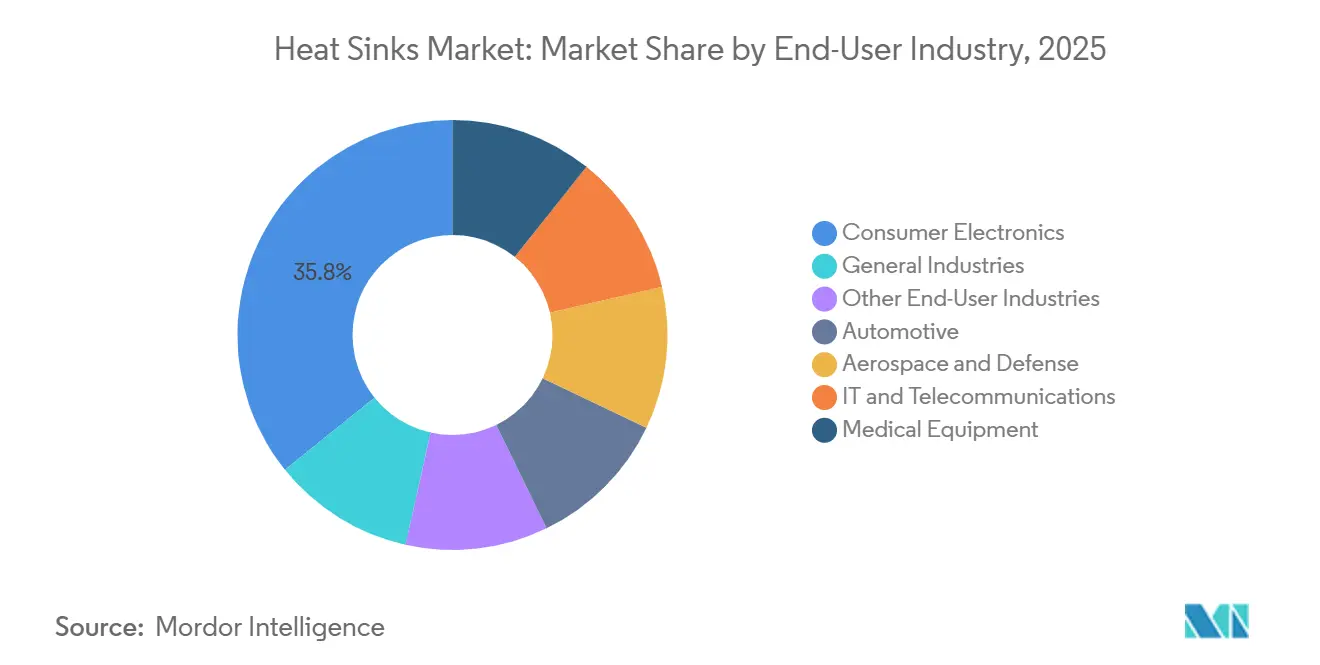
- By end-user industry, consumer electronics held 35.78% of the heat sinks market share in 2025, while automotive is projected to advance at a 7.03% CAGR through 2031.
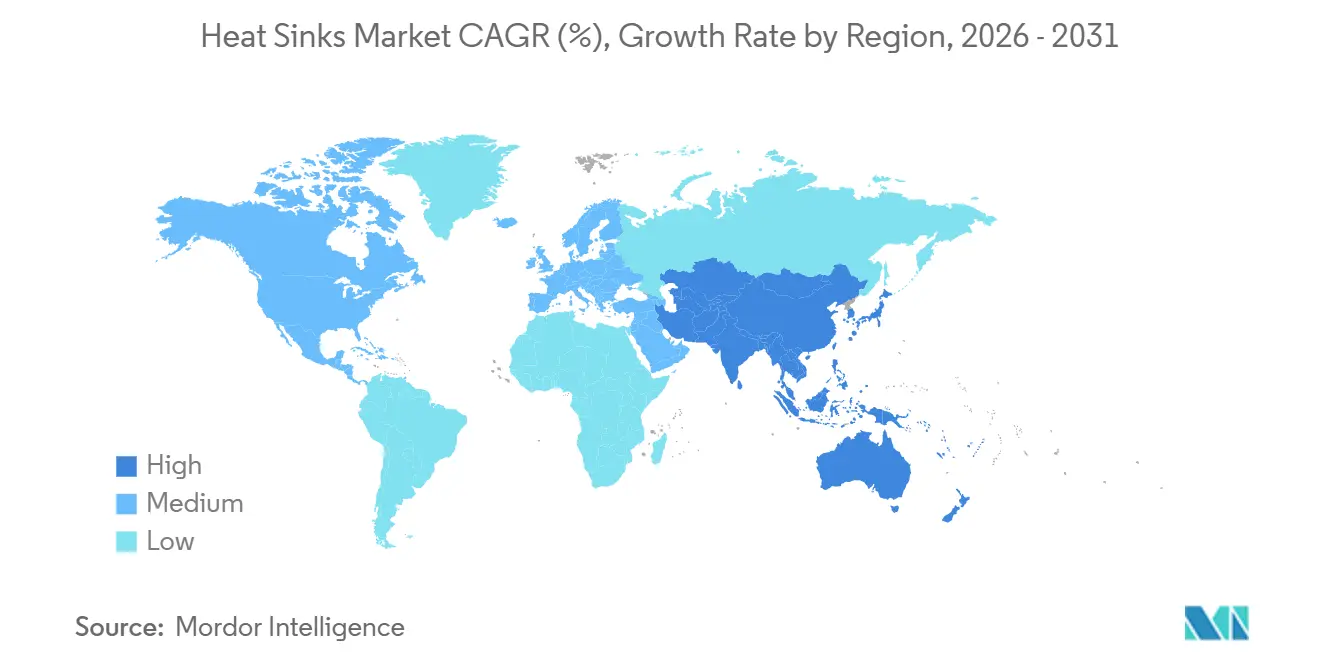
- By geography, Asia-Pacific held 42.34% of the heat sinks market share in 2025 and is projected to advance at a 6.82% CAGR through 2031.
Note: Market size and forecast figures in this report are generated using Mordor Intelligence’s proprietary estimation framework, updated with the latest available data and insights as of January 2026.
Market Trends and Insights
Drivers Impact Analysis of Heat Sinks Market*
| Driver | (~) % Impact on CAGR Forecast | Geographic Relevance | Impact Timeline |
|---|---|---|---|
| Rising Thermal Loads From AI Computing and High-Performance Electronics | +1.8% | Global, concentrated in North America and Asia-Pacific | Short term (≤ 2 years) |
| Electrification of Vehicles and Power Electronics | +1.2% | Global, core in China, Europe, and North America | Medium term (2-4 years) |
| Expansion of Data Centers, Cloud Computing and 5G Infrastructure | +1.0% | Global, with dense clusters in Asia-Pacific and North America | Short term (≤ 2 years) |
| Miniaturization of Electronic Devices | +0.7% | Global | Medium term (2-4 years) |
| Application-Specific Thermal Qualification for Edge AI, Robotics and Photonics | +0.5% | North America, Europe, Japan | Long term (≥ 4 years) |
| Source: Mordor Intelligence | |||
Rising Thermal Loads from AI Computing and High-Performance Electronics
Artificial intelligence hardware has raised the thermal baseline for servers and other high-performance electronics. Current Blackwell-era graphics processing unit deployments have heat flux levels of 85 to 150 W/cm², compared with the 30 to 40 W/cm² limit of conventional air-cooled fin arrays. The U.S. Department of Energy stated in 2024 that cooling accounted for up to 40% of data center energy use, which makes thermal efficiency important to facility operating costs. As liquid cooling reaches deeper into server designs, heat sinks are shifting from board-level passive fins to integrated cold plates. These aluminum and copper assemblies are precision thermal interfaces and can carry higher selling prices than conventional stamped fin arrays. This shift favors suppliers with machining, skiving, and vacuum-brazing capabilities in the heat sinks market.
Electrification of Vehicles and Power Electronics
Electric vehicle powertrains are creating new thermal requirements for heat sink suppliers. The move from silicon insulated-gate bipolar transistors to silicon carbide metal-oxide-semiconductor field-effect transistors has placed more heat within smaller power modules. In 800 V electric vehicle architectures, local heat flux can rise even when total power losses fall. Leading original equipment manufacturer power modules had junction temperatures above 200 °C and required thermal interface materials with conductivity above the levels common in 2024. Automotive qualification increasingly follows International Electrotechnical Commission 61287 and International Organization for Standardization 16750 reliability frameworks. These requirements favor established suppliers with certified test infrastructure and raise technical barriers for lower-cost producers in the heat sinks market.
Expansion of Data Centers, Cloud Computing and 5G Infrastructure
Data center construction is increasing total cooling demand and requiring thermal performance per server. Japan’s artificial intelligence data center information technology supply power capacity is expected to double to 600 MW by the end of 2026. The expansion includes conversions of industrial sites into artificial intelligence-focused facilities. Fifth-generation network densification also creates demand for thermal products used with co-packaged optics in 51.2 Tbit/s switching platforms. These systems need localized temperature control because temperature changes can affect optical signal quality. Data centers, cloud computing, telecommunications infrastructure, and edge computing, therefore, support demand across several product performance levels in the heat sinks market.
Miniaturization of Electronic Devices
Smaller consumer electronics and industrial Internet of Things devices are concentrating heat in restricted spaces. Research published in 2025 found that triply periodic minimal surface aluminum lattice heat sinks could increase surface area by up to 200% and improve thermal efficiency by 13% over conventional designs. The findings are relevant to Internet of Things gateways, edge artificial intelligence modules, and wearable computing devices where standard fin extrusions may not fit. A separate 2025 study described two-phase thermal circulation systems with an effective thermal conductivity of up to 11,363 W/m·K. Skived-fin, micro-lattice, and three-dimensional printed composite designs are becoming more important alongside conventional extrusion capacity. Suppliers that can manufacture compact, application-specific designs may be better placed as device architectures become denser in the heat sinks market.
Restraints Impact Analysis of Heat Sinks Market*
| Restraint | (~) % Impact on CAGR Forecast | Geographic Relevance | Impact Timeline |
|---|---|---|---|
| Rising Aluminum, Copper and Advanced-Material Costs | -1.2% | Global | Short term (≤ 2 years) |
| Noise, Space and Weight Constraints in Compact Systems | -0.8% | Global | Medium term (2-4 years) |
| Thermal-Design Trade-Offs Between Performance, Reliability and Manufacturability | -0.5% | Global | Long term (≥ 4 years) |
| Source: Mordor Intelligence | |||
Rising Aluminum, Copper and Advanced-Material Costs
Material costs are an immediate margin issue for heat sink manufacturers. Copper prices on the London Metal Exchange exceeded USD 13,300 per metric ton in January 2026, while aluminum traded above USD 3,000 per metric ton. Aluminum costs rose 25.7%, and copper costs rose 46.8% from January 2024 through March 2026 for manufacturers buying on spot or near-spot terms. Higher metal prices raise the cost of heat sinks, enclosures, and thermally sensitive component assemblies. Quarterly and annual pricing contracts can delay cost recovery when finished-product prices do not move at the same pace as input costs. Manufacturers without long-term supply agreements, internal smelting, or hedging programs face greater pressure on margins in the heat sinks market.
Noise, Space and Weight Constraints in Compact Systems
Active heat sink designs must balance thermal performance with acoustic, size, and weight limits. Fan noise above 30 to 35 dB(A) can be unsuitable for office automation, point-of-care medical monitoring, and retail digital signage. Ruggedized and aerospace applications also require extended reliability testing for assemblies exposed to vibration. Sealed and fanless edge artificial intelligence platforms can limit the addressable use of active heat sinks in applications where passive operation is required. NVIDIA Jetson AGX Orin platforms are designed for passive-only operation under sustained inference workloads. Suppliers must therefore develop passive products with stronger thermal performance for segments that previously relied on active cooling in the heat sinks market.
*Our forecasts treat driver/restraint impacts as directional, not additive. The impact forecasts reflect baseline growth, mix effects, and variable interactions.
Heat Sinks Market Segment Analysis
By Type:
Active Heat Sinks Gain Ground as the Passive Heat Sinks MaturePassive heat sinks held 54.32% of the heat sinks market share in 2025 because they use no power, have a simple mechanical structure, and serve applications with manageable thermal loads. Active heat sinks are projected to advance at a 7.12% CAGR through 2031 as server, electric vehicle inverter, and high-power radio-frequency electronics applications require greater cooling capacity. Passive fin-array geometry cannot adequately manage the 85 to 150 W/cm² heat flux levels cited for current artificial intelligence deployments. Hybrid heat sinks serve ruggedized, aerospace, and outdoor infrastructure products. Their active elements can operate above set temperature thresholds, which can extend service life while limiting noise during light-load operation.
The artificial intelligence server buildout is closely linked to the adoption of active designs. Graphics processing unit-dense racks operating at 100 to 200 kW require heat management at the chip and rack levels. Suppliers that integrate fan controls with junction-temperature monitoring can provide more responsive airflow control. Advanced Thermal Solutions, Inc. introduced thermal solutions for NVIDIA Jetson Thor modules in December 2025, including an active blower option rated to 175 W thermal design power at 50 °C. Customers are increasingly seeking designs tailored to their specific artificial intelligence deployment conditions in the heat sinks market.

By Substance:
Aluminum Leads Revenue Demand While Copper Serves Critical ApplicationsAluminum held 45.63% of the heat sinks market share in 2025 because it is machinable, offers a favorable strength-to-density ratio, and costs less than copper. It is widely used in passive fin arrays for consumer electronics, light-emitting diode lighting, telecom base stations, and industrial products. Copper is projected to advance at a 6.75% CAGR through 2031. Its higher thermal conductivity makes it suitable for electric vehicle power modules, co-packaged optics, and high-frequency fifth-generation radio-frequency amplifiers. Copper-aluminum alloy products provide a balance of conductivity and cost for industrial motor drives and power conversion equipment.
Other substances include composite materials, vapor chambers, and additively manufactured lattice structures. These materials remain important for aerospace and photonics applications where standard products may not meet the required thermal performance. Skived-fin copper products can deliver fin density and surface area that conventional milling cannot achieve. Rising copper prices can encourage design engineers to consider copper-aluminum composites or heat-pipe-embedded aluminum assemblies. This substitution can support specialists who provide mixed-material products within the heat sinks industry.
By End-User Industry:
Automotive Electrification Changes Demand PatternsConsumer electronics held 35.78% of the heat sinks market share in 2025, supported by smartphones, laptops, gaming consoles, and artificial intelligence-enabled personal computing devices. These devices use neural processing units with thermal design power levels that must be handled in compact product forms. Automotive is projected to advance at a 7.03% CAGR through 2031 as electric vehicle power electronics content increases. A typical 800 V battery electric vehicle inverter package contains several silicon carbide metal-oxide-semiconductor field-effect transistor modules. Information technology and telecommunications provide steady demand through fifth-generation deployment, outdoor fanless equipment, and co-packaged optics used in 400G and 800G transceivers.
Medical equipment heat sinks follow International Electrotechnical Commission 60601-1 equipment safety requirements, which can lengthen development cycles. Aerospace and defense demand is supported by government procurement of avionics, missile guidance electronics, and radar systems in the United States and Europe. General industries include automation, servo drives, and power conversion equipment. In these applications, gradual efficiency gains in motor-drive electronics support incremental demand for thermal management components across the heat sinks market.
Geography Analysis
APAC Heat Sinks Market
Asia-Pacific held 42.34% of the heat sinks market share in 2025 and is projected to advance at a 6.82% CAGR through 2031. Taiwan’s original design manufacturer cluster gives the region substantial capacity for artificial intelligence server cold plates and thermal modules. Auras Technology Co., Ltd. raised its 2026 revenue growth forecast to 60% to 70%, and its July 2026 revenue more than doubled from the prior year on cold-plate and liquid-cooling-module demand. China’s new-energy vehicle production, South Korea’s dynamic random-access memory and display manufacturing, and Japan’s artificial intelligence data center development support demand across the regional heat sinks market.
North America and Europe Heat Sinks Market
North America remains a major destination for hyperscale data center investment and artificial intelligence graphics processing unit clusters. The U.S. Department of Energy’s focus on data center energy efficiency supports procurement interest in optimized heat sink and cold-plate assemblies[1]. Europe is supported by Germany’s industrial automation and power electronics base. Fischer Elektronik GmbH & Co. KG expanded its extruded aluminum product range with the SK 706, SK 707, SK 708, and SK 709 heat sink series in 2025. The products were designed for free-convection industrial use.
MEA and South America Heat Sinks Market
Brazil and Saudi Arabia are expanding data centers and telecommunications infrastructure under digital economy programs. These projects require active and passive thermal assemblies that can operate in high ambient temperatures. South Africa’s mining and heavy industrial activities support demand for heat sinks used in motor drives and power conversion systems. These regions rely heavily on imports from Asian and European manufacturers. This dependence can increase logistics exposure but can also create an opportunity for regional assembly operations connected to established suppliers.
Competitive Landscape
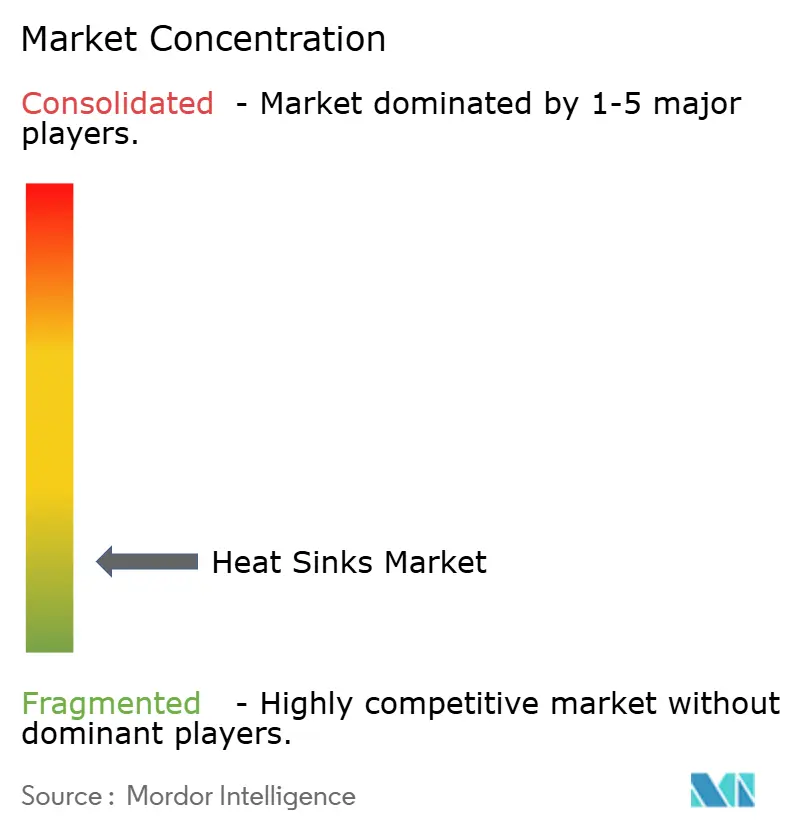
The heat sinks market is highly fragmented, with the top five players including Boyd, Advanced Thermal Solutions, Inc., Delta Electronics, Inc., SUNONWEALTH ELECTRIC MACHINE INDUSTRY CO., LTD., and Wakefield Thermal, Inc. Eaton completed its acquisition of Boyd’s thermal business for USD 9.5 billion in March 2026[2]. Auras Technology Co., Ltd. and Delta Electronics, Inc. compete through system-level offerings that combine heat sinks, fan controls, liquid distribution, and server-level thermal functions.
Delta Electronics, Inc. presented its GoCool 3 MW liquid-to-liquid coolant distribution unit at NVIDIA GTC 2026. The company stated that the product supports flow rates of up to 3,000 LPM and is on NVIDIA’s recommended vendor list for GB200 NVL72 in-rack cooling. Mersen presented direct liquid cooling products at Power, Intelligent Motion, Renewable Energy and Energy Management (PCIM) 2026 for data center power electronics. Co-packaged optics and photonic-electronic integrated packages require highly uniform temperature control and create a specialized design opportunity.
Standard fin arrays and conventional cold plates may need custom geometry and active control to meet these conditions. IBM Research presented work in 2025 on topology-optimized embedded microchannel heat sinks for multiple transient workloads in three-dimensional semiconductor packages. The research aims to reduce pressure drop while keeping temperatures within operating targets. Suppliers that develop these capabilities early may create products that are harder to replicate in the heat sinks market.
Heat Sinks Industry Leaders
-
Boyd
-
Advanced Thermal Solutions, Inc.
-
Delta Electronics, Inc.
-
SUNONWEALTH ELECTRIC MACHINE INDUSTRY CO., LTD.
-
Wakefield Thermal, Inc.
- *Disclaimer: Major Players sorted in no particular order
Heat Sinks Market Companies Covered in this Report
- Advanced Cooling Technologies, Inc.
- Advanced Thermal Solutions, Inc.
- Auras Technology Co.,Ltd.
- Boyd
- CTS Corporation
- Delta Electronics, Inc.
- Fischer Elektronik GmbH & Co. KG
- Mersen
- Ohmite Mfg Co.
- SUNONWEALTH ELECTRIC MACHINE INDUSTRY CO., LTD.
- TE Connectivity
- Wakefield Thermal, Inc.
Recent Industry Developments in Heat Sinks Market
- June 2026: GCM Corp signed a binding 24-month Joint Development Agreement (JDA) with Shenzhen Wanwei Heat Conduction Technology Co. Ltd (ALVC), a China-based thermal management manufacturer. The agreement aimed to develop an integrated thermal management product combining ALVC's vapor chamber technology with GCM's VHD heat sink platform.
- March 2026: Eaton completed the acquisition of Boyd’s thermal business for USD 9.5 billion, expanding its capabilities in thermal management alongside power-management solutions. The acquisition strengthened Eaton’s position in heat dissipation technologies, including thermal components and systems used to manage heat in data centers, electronics, and other high-power applications.
Global Heat Sinks Market Report Scope
Heat sinks are thermal management components designed to dissipate excess heat generated by electronic and electrical devices, helping maintain operating temperatures within required limits. They transfer heat away from heat-generating components and release it into the surrounding environment, supporting device reliability, performance, and service life.
The Heat Sinks Market is segmented by type, substance, end-user industry, and geography. By type, the market is segmented into passive heat sinks, active heat sinks, and hybrid heat sinks. By substance, the market is segmented into aluminum, copper, copper-aluminum alloy, and other substances. By end-user industry, the market is segmented into consumer electronics, automotive, aerospace and defense, IT and telecommunications, medical equipment, general industries, and other end-user industries. The report also covers the market size and forecasts for heat sinks in 15 countries across major regions. For each segment, the market sizing and forecasts have been done on the basis of value (USD).
Segmentation Overview
| Passive Heat Sinks |
| Active Heat Sinks |
| Hybrid Heat Sinks |
| Aluminum |
| Copper |
| Copper-Aluminum Alloy |
| Other Substances |
| Consumer Electronics |
| Automotive |
| Aerospace and Defense |
| IT and Telecommunications |
| Medical Equipment |
| General Industries |
| Other End-User Industries |
| Asia-Pacific | China |
| India | |
| Japan | |
| South Korea | |
| ASEAN Countries | |
| Rest of Asia-Pacific | |
| North America | United States |
| Canada | |
| Mexico | |
| Europe | Germany |
| United Kingdom | |
| France | |
| Italy | |
| NORDIC Countries | |
| Rest of Europe | |
| South America | Brazil |
| Argentina | |
| Rest of South America | |
| Middle East and Africa | Saudi Arabia |
| South Africa | |
| Rest of Middle East and Africa |
| By Type | Passive Heat Sinks | |
| Active Heat Sinks | ||
| Hybrid Heat Sinks | ||
| By Substance | Aluminum | |
| Copper | ||
| Copper-Aluminum Alloy | ||
| Other Substances | ||
| By End-User Industry | Consumer Electronics | |
| Automotive | ||
| Aerospace and Defense | ||
| IT and Telecommunications | ||
| Medical Equipment | ||
| General Industries | ||
| Other End-User Industries | ||
| By Geography | Asia-Pacific | China |
| India | ||
| Japan | ||
| South Korea | ||
| ASEAN Countries | ||
| Rest of Asia-Pacific | ||
| North America | United States | |
| Canada | ||
| Mexico | ||
| Europe | Germany | |
| United Kingdom | ||
| France | ||
| Italy | ||
| NORDIC Countries | ||
| Rest of Europe | ||
| South America | Brazil | |
| Argentina | ||
| Rest of South America | ||
| Middle East and Africa | Saudi Arabia | |
| South Africa | ||
| Rest of Middle East and Africa | ||
Key Questions Answered in the Report
What is the size of the heat sinks market?
The heat sinks market stands at USD 7.78 billion in 2026 and is projected to reach USD 10.37 billion by 2031.
What is driving demand for heat sinks?
Artificial intelligence hardware, data center construction, fifth-generation networks, electric vehicle power electronics, and smaller electronic devices are increasing thermal management requirements.
Which type held the largest share in 2025?
Passive heat sinks held 54.32% in 2025 because they are simple, require no power, and are suitable for many electronics and industrial applications.
Which substance held the largest share in 2025?
Aluminum held 45.63% in 2025 due to its machinability, favorable strength-to-density ratio, and cost advantage over copper.