
Heat Dissipation Materials Market Size and Share
Market Overview
| Study Period | 2021 - 2031 |
|---|---|
| Market Size (2026) | USD 3.75 Billion |
| Market Size (2031) | USD 5.83 Billion |
| Growth Rate (2026 - 2031) | 9.25 % |
| Fastest Growing Market | Asia-Pacific |
| Largest Market | Asia-Pacific |
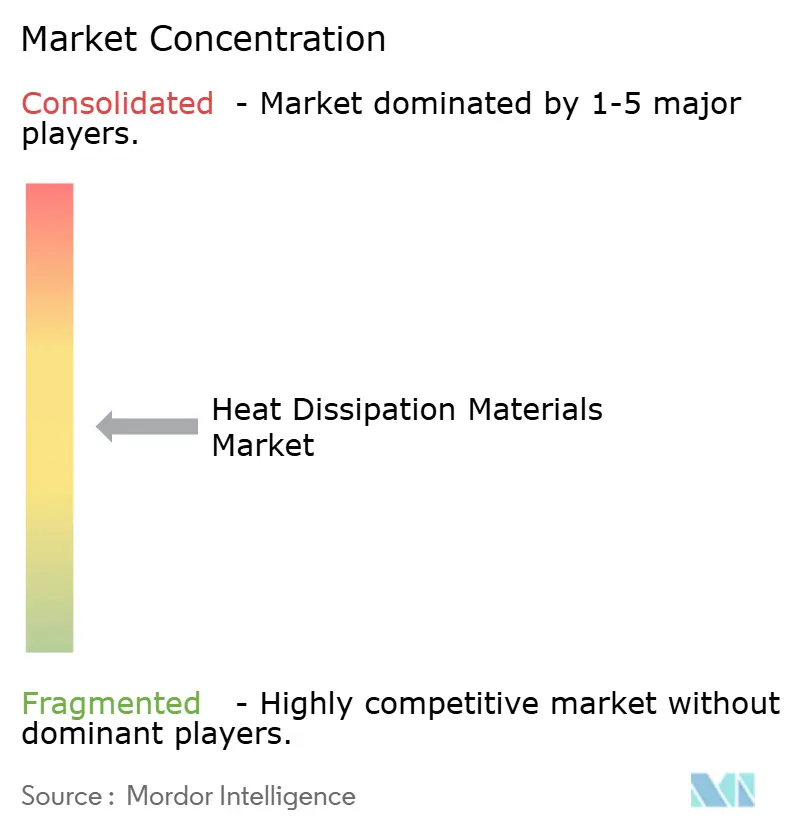
| Market Concentration | Medium |
Major Players *Disclaimer: Major Players sorted in no particular order Image © Mordor Intelligence. Reuse requires attribution under CC BY 4.0. | |
Heat Dissipation Materials Market Analysis by Mordor Intelligence
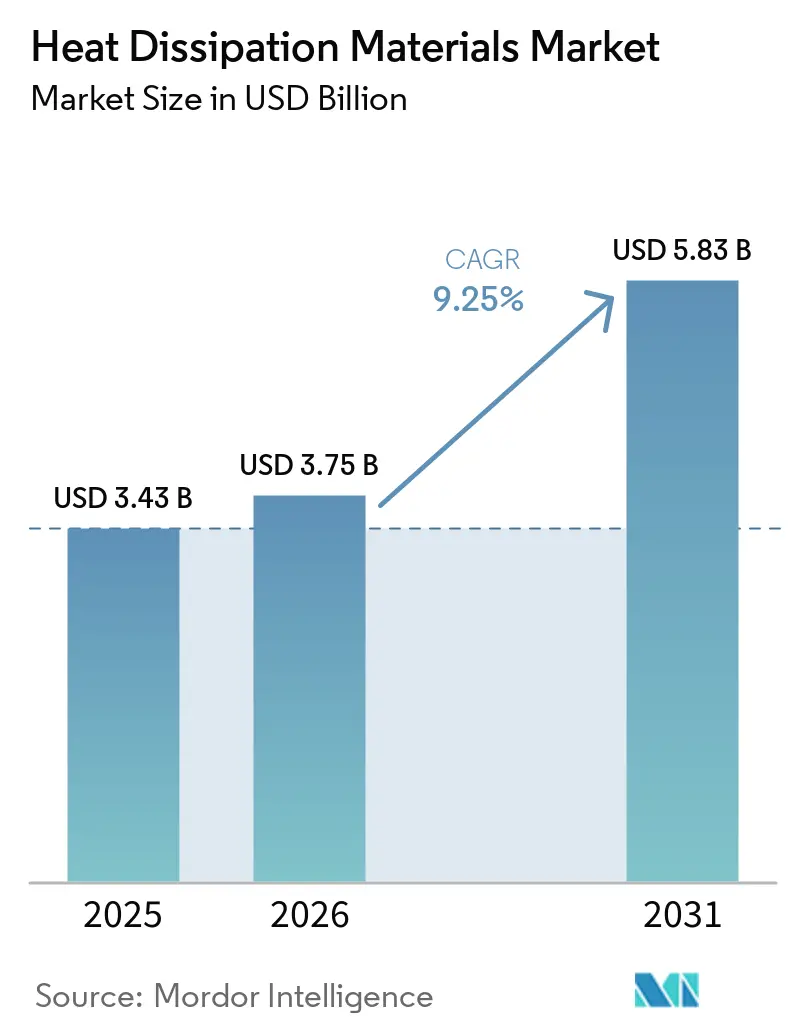
The Heat Dissipation Materials Market size was valued at USD 3.43 billion in 2025 and is estimated to grow from USD 3.75 billion in 2026 to reach USD 5.83 billion by 2031, at a CAGR of 9.25% during the forecast period (2026-2031). Artificial intelligence computing, vehicle electrification, and 3-dimensional semiconductor designs are raising thermal loads across electronics production, from chip packages to battery packs and communications assemblies. Demand is moving toward materials with high thermal conductivity and specialized performance specifications that also address bond-line stability, optical cleanliness, structural bonding, or electrical insulation. This shift supports premium pricing for advanced formulations but increases pressure on standard thermal pastes and other lower-specification products. Suppliers are adapting portfolios for applications that require several functions in one material and for qualification processes that can keep a product in use across long production cycles. The heat dissipation materials market also benefits from demand across several end uses rather than relying solely on consumer electronics, which can reduce exposure to one device category.
Key Report Takeaways
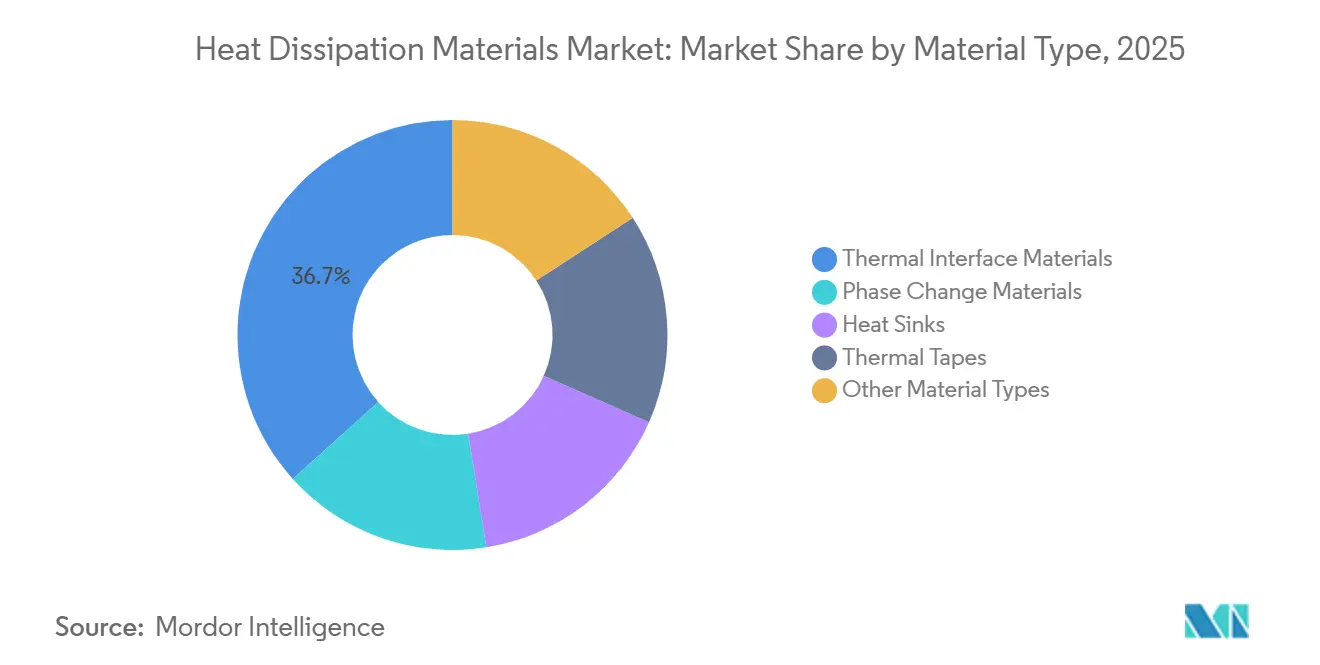
- By material type, thermal interface materials held 36.67% of the heat dissipation materials market share in 2025, while phase change materials are projected to advance at a 9.89% CAGR through 2031.
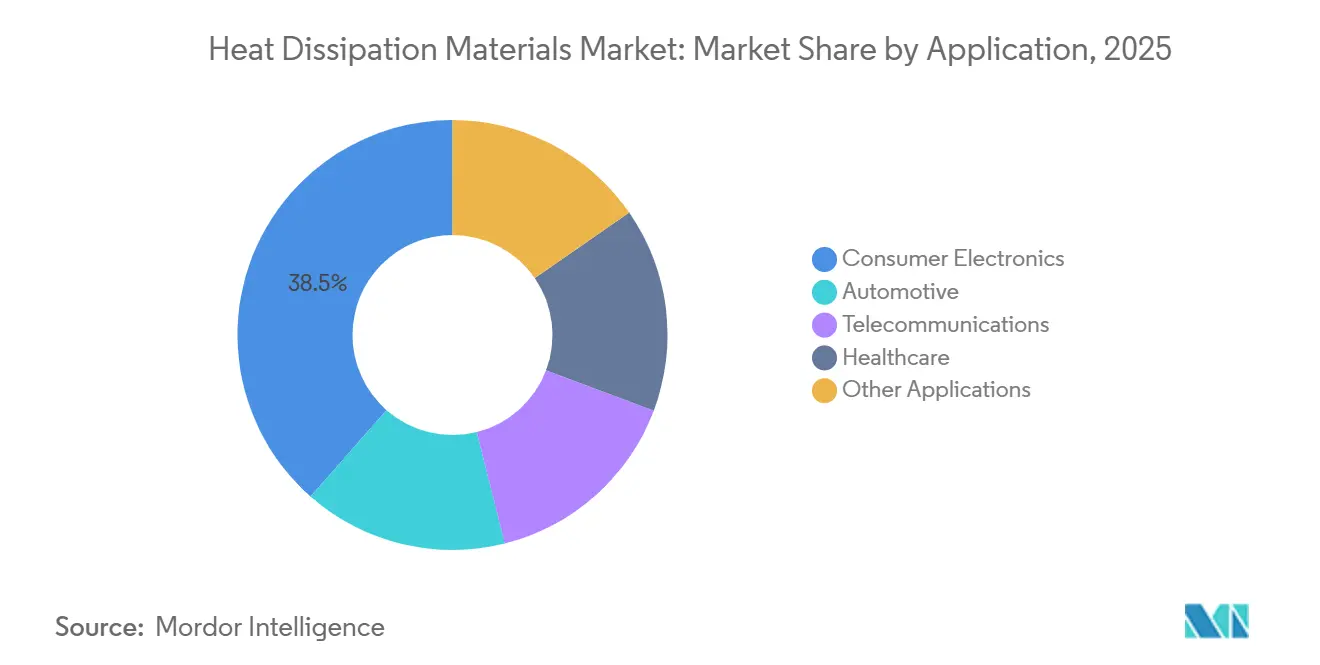
- By application, consumer electronics held 38.53% of the heat dissipation materials market share in 2025, while automotive is projected to advance at a 10.34% CAGR through 2031.
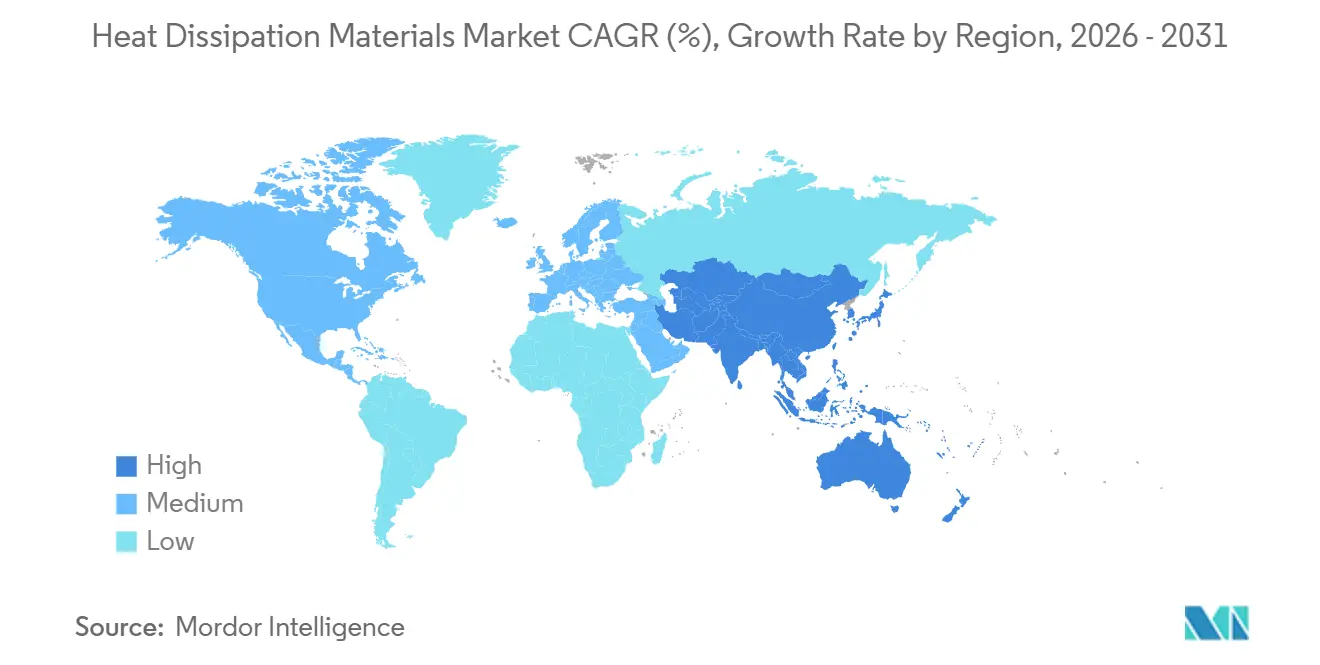
- By geography, Asia-Pacific held 42.18% of the heat dissipation materials market share in 2025 and is projected to advance at a 9.93% CAGR through 2031.
Note: Market size and forecast figures in this report are generated using Mordor Intelligence’s proprietary estimation framework, updated with the latest available data and insights as of January 2026.
Market Trends and Insights
Drivers Impact Analysis of Heat Dissipation Materials Market*
| Driver | (~) % Impact on CAGR Forecast | Geographic Relevance | Impact Timeline |
|---|---|---|---|
| AI and High-Performance Computing Power Density | +2.8% | Global | Medium term (2-4 years) |
| Electric Vehicle Battery and Power-Electronics Electrification | +2.4% | APAC core, spillover to Europe and North America | Long term (≥ 4 years) |
| Advanced Semiconductor Packaging and Chiplet Architectures | +1.6% | Global, with concentration in APAC and North America | Medium term (2-4 years) |
| 5G, 6G, and Optical-Module Deployment | +1.1% | APAC core, spillover to MEA | Medium term (2-4 years) |
| Thermal-EMI Co-Design in High-Frequency Electronics | +0.8% | Global | Long term (≥ 4 years) |
| Source: Mordor Intelligence | |||
AI and High-Performance Computing Power Density
Artificial intelligence workloads have made thermal interface material selection a system-level design requirement in server development. NVIDIA Blackwell graphics processing unit modules exceeded 575 W of total graphics power, placing sustained heat removal at the center of package design. Future kilowatt-class accelerators are designed for liquid cooling, which increases the need for reliable interfaces between the die, lid, cold plate, and cooling loop. Solder thermal interface materials achieved total thermal resistance from 0.02 K·cm²/W to 0.08 K·cm²/W below 50 µm bond lines, while gallium-based liquid metals achieved interface resistance below 0.05 K·cm²/W. Large graphics processing unit packages can experience 100 µm to 300 µm warpage, which can exceed nominal material thickness and make consistent bond-line control essential. The heat dissipation materials market gains value per rack when metal and liquid-metal formulations replace several lower-performance polymer interface solutions.
Electric Vehicle Battery and Power-Electronics Electrification
Electric vehicle platform electrification is changing the demand profile for heat dissipation materials beyond a simple rise in unit volumes. Cell-to-pack and cell-to-chassis designs place gap fillers and phase change materials directly between cells, rather than using them as replaceable service components. Material choice becomes a structural design commitment once a battery system has passed qualification and entered production. A review from Aalto University found that 1 mm to 3 mm phase change material barriers can limit cell-to-cell thermal-runaway propagation in lithium-ion battery modules. Henkel AG & Co. KGaA introduced the Bergquist TGF 2030APS silicone-free gap filler and Loctite TLB 9270APS thermally conductive adhesive for these architectures in May 2026. Inverters, on-board chargers, and direct current-to-direct current converters also need conductive potting materials as switching frequencies and fast-charging thermal loads increase. The heat dissipation materials market gains more predictable demand when qualified gap fillers remain embedded within a battery platform for its production life.
Advanced Semiconductor Packaging and Chiplet Architectures
Chiplet-based heterogeneous integration creates thermal conditions that conventional thermal interface formulations were not designed to address. A 2025 review found that 2.5-dimensional chip stacks remained thermally viable near 300 W under air cooling, while 3-dimensional stacks required liquid or hybrid cooling with high-performance thermal interface materials near 350 W. Heterogeneous chiplets use materials with different coefficients of thermal expansion, which transfer thermomechanical stress through the interface layer during operation. The interface must, therefore, conduct heat while accommodating deformation without cracking, delaminating, or losing contact with the package surfaces. Reliability frameworks from the Joint Electron Device Engineering Council and the Institute of Printed Circuits are placing greater attention on controlled bulk properties and qualification records. The heat dissipation materials market is separating into standardized solutions for mature 2-dimensional packages and engineering-intensive materials for advanced chiplet platforms. This distinction favors suppliers that can support thermal and mechanical co-design during the early stages of device architecture.
5G, 6G, and Optical-Module Deployment
The rollout of 5G active antenna units and early 6G infrastructure is increasing thermal requirements in communications equipment. Modern 5G base-station power amplifiers face junction temperatures above 150 °C and cycling from -70 °C to +180 °C, conditions associated with solder-joint cracking, dielectric degradation, and metal migration. Millimeter-wave and terahertz operation further concentrates energy dissipation in small semiconductor packages. Optical transceivers at 800G and 1.6T require thermal interface materials with silicone volatile outgassing below 100 ppm to avoid optical-interface contamination. Noritake Co., Limited demonstrated a diamond-nickel substrate with thermal conductivity of 1,200 W/(m·K) for next-generation communications semiconductors. These conditions exclude many standard gap fillers from optical assemblies and increase demand for materials with stable high-temperature performance.
Restraints Impact Analysis of Heat Dissipation Materials Market*
| Restraint | (~) % Impact on CAGR Forecast | Geographic Relevance | Impact Timeline |
|---|---|---|---|
| Filler and Specialty-Metal Cost Volatility | -1.5% | Global | Short term (≤ 2 years) |
| Qualification Cycles and Narrow Process Windows | -0.9% | Global | Medium term (2-4 years) |
| Reliability Trade-Offs at Thinner Bond Lines | -0.6% | Global, with concentration in APAC and North America | Long term (≥ 4 years) |
| Source: Mordor Intelligence | |||
Filler and Specialty-Metal Cost Volatility
Specialty filler and metal price changes remain an immediate profitability constraint for heat dissipation materials manufacturers. Boron nitride fillers support electrical insulation and high conductivity, but their complex synthesis makes them materially more expensive than standard alumina alternatives. This cost structure reduces margins for mid-specification products and limits boron nitride loading in commodity formulations. China’s gallium export controls pushed domestic Chinese gallium prices to USD 420 per kilogram in 2025, exposing metal formulations to policy-driven supply disruptions[1]. Indium and silver costs also change the price-performance balance of solder thermal interface materials, especially when suppliers must maintain coverage and warpage performance through thermal cycling. Overlapping export-control rules complicate purchasing, hedging, contract negotiations, and inventory strategies. Sustained cost pressure can limit research and development capacity and weaken gross-margin resilience for smaller specialty formulators.
Qualification Cycles and Narrow Process Windows
Automotive and aerospace qualification timelines can delay adoption of new materials for several years, even when performance improvements are clear. The Automotive Electronics Council’s AEC-Q006 Rev B framework covers board-level reliability requirements for components and assemblies. Automotive qualification programs can include more than 1,000 thermal-shock cycles and extended high-temperature operating-life testing. Dispensable gap fillers also require careful control of viscosity, cure temperature, pot life, bond-line thickness, and batch-to-batch consistency at production scale. A deviation can restart the approval process and delay commercial use after substantial application-engineering work. Once a formulation qualifies for a vehicle platform, it is rarely replaced before that platform completes production. This creates a timing gap between materials research investment and revenue realization for suppliers with limited application diversity.
*Our forecasts treat driver/restraint impacts as directional, not additive. The impact forecasts reflect baseline growth, mix effects, and variable interactions.
Heat Dissipation Materials Market Segment Analysis
By Material Type:
Thermal Interface Materials Lead While Phase Change Materials Grow FastestThermal interface materials held 36.67% of demand in 2025, reflecting their use between silicon devices and heat sinks across several electronics applications. The segment served consumer electronics, data centers, and automotive power electronics, where each assembly needed controlled heat transfer at a contact surface. Henkel AG & Co. KGaA commercialized Loctite TCF 14001 in October 2025 for 800G and 1.6T optical transceivers, with 14.5 W/(m·K) thermal conductivity and less than 100 ppm silicone volatile outgassing. Heat sinks also retained demand in server racks and consumer devices, although liquid cold plates are reducing heat-sink demand per rack in some hyperscale data centers. Thermal tapes served consumer-electronics assembly, where mechanical fastening was unsuitable, while silicone-free and optically clean tape created a more specialized use case in active optical cable applications.
Phase change materials are projected to advance at a 9.89% CAGR through 2031. Their growth is tied to electric vehicle architectures that embed thermal materials within battery assemblies and require them to manage transient heat without permanent temperature elevation. Aalto University reported that paraffin-expanded graphite composite phase change materials can balance thermal enhancement with scalable battery-module use, and 1 mm to 3 mm barriers can limit thermal-runaway propagation. Other materials include thermally conductive adhesives, potting compounds, and encapsulants for power modules, inverters, and motor drives where structural bonding and heat control are required together. The heat dissipation materials industry is increasingly combining structural, optical, dielectric, and thermal performance in one formulation, which raises switching costs for qualified designs.

By Application:
Consumer Electronics Leads Revenue While Automotive Expands FastestConsumer electronics held 38.53% of demand in 2025. Smartphones used thermal materials around processors, power-management integrated circuits, radio-frequency front ends, and batteries, while gaming laptops used 4 to 8 separate thermal interface layers. NVIDIA adopted liquid-metal thermal interface material in the GeForce RTX 5090 during January 2025, bringing a high-end metal formulation into a consumer product at scale. This product decision supported the move toward premium materials in devices with rising heat density and limited space for heat dissipation. The heat dissipation materials market continues to draw demand from consumer devices, even as some thermal architectures reduce the amount of interface material used per device.
Automotive is projected to advance at a 10.34% CAGR through 2031. Electric vehicle battery thermal materials rise with electric vehicle production, battery-pack content, and denser power-electronics systems in confined enclosures. United Nations Economic Commission for Europe Regulation No. 100 and regional battery safety standards support minimum thermal-barrier specifications, turning compliance into a direct source of material demand. Telecommunications requires optical-grade and high-temperature stable materials for base-station amplifiers and transceiver assemblies, supported by 5G densification and 6G research infrastructure. Healthcare, industrial automation, defense electronics, and grid-scale energy storage provide demand across applications and reduce reliance on a single end-use cycle.
Geography Analysis
APAC Heat Dissipation Materials Market
Asia-Pacific held 42.18% of the market demand in 2025 and is projected to advance at a 9.93% CAGR through 2031, supported by electronics manufacturing, semiconductor assembly, and electric vehicle production. China combined battery-cell manufacturing with thermal-material consumption from smartphone and laptop supply chains, while domestic electric vehicle producers adopted cell-to-pack designs that used dense thermal layers for fast-charging thermal buffering. Japan and South Korea supplied advanced semiconductor packaging, display-panel manufacturing, and automotive electronics that required high-specification thermal-management materials at several points in the device stack. India’s Production-Linked Incentive (PLI) scheme supported its emerging semiconductor and electronics manufacturing ecosystem and encouraged international formulators to develop local engineering and distribution capabilities. Vietnam, Thailand, and Malaysia expanded electronics assembly as original equipment manufacturers diversified supply chains, broadening the regional base of the heat dissipation materials market.
North America and Europe Heat Dissipation Materials Market
North America had a different demand profile centered on artificial intelligence data centers in the United States and high-specification automotive applications. Semiconductor fabrication investments supported by the CHIPS Act are expanding domestic advanced-packaging capacity and are expected to increase local thermal-material consumption as facilities reach production scale. Government and defense procurement programs also supported demand for domestically qualified materials used in critical electronics supply chains. Europe favored silicone-free, halogen-reduced, and recyclability-documented thermal materials under sustainability and chemical-compliance priorities that differed from regional requirements elsewhere. Germany’s automotive electronics base, Nordic data-center density, and defense and aerospace applications in the United Kingdom and France supported demand for high-temperature stable formulations.
MEA and South America Heat Dissipation Materials Market
South America, and Middle-East and Africa represented smaller demand areas. Brazil supported demand through automotive assembly and electric vehicle adoption programs, while some local-content requirements encouraged development of domestic distribution networks. Saudi Arabia's Vision 2030-related data-center and digital-infrastructure investments are supporting enterprise thermal-management procurement and positioning the Kingdom as a regional demand center. South Africa contributes through its established automotive manufacturing base, while multi-region sourcing by global electronics brands creates related opportunities beyond core production locations. These conditions broaden demand in the heat dissipation materials market beyond the dominant Asia-Pacific manufacturing base.
Competitive Landscape
The heat dissipation materials market is moderately concentrated, with the top five players including Shin-Etsu Chemical Co., Ltd., 3M, Henkel AG & Co. KGaA, Dow, and Parker Hannifin Corp. Multinational specialty chemicals and silicone producers hold application-engineering capabilities and proprietary formulations that cover several conductivity levels, cure chemistries, and viscosity profiles. Regional producers in China and South Korea compete on price for standard gap pads and thermal greases, which places pressure on mid-specification margins. Leading suppliers are prioritizing ultra-high-conductivity materials for artificial intelligence data centers and electric vehicle power electronics. Automotive qualification depth and multi-region application engineering are important differentiators because both capabilities require sustained investment and are difficult to reproduce quickly.
Dow formed a commercial partnership with Carbice Corporation for aligned carbon nanotube thermal interface materials, combining Dow’s silicone formulation work with Carbice Corporation’s aligned carbon nanotube technology. Wacker Chemie AG and ISOVOLTA AG filed a patent for a ceramifying silicone composite for electric vehicle battery thermal barrier fabrics. Henkel AG & Co. KGaA expanded products for cell-to-pack battery architectures in May 2026, including a silicone-free gap filler and thermally conductive adhesive[2]. These moves address high conductivity, battery safety, and qualification needs in applications where material selection can remain fixed for long production cycles. Suppliers with regional application engineering can support original equipment manufacturer programs from formulation through production ramp across Asia, Europe, and North America.
Silicone-free optical formulations remain relevant for high-speed transceiver applications that cannot accept contamination from volatile materials. Aligned carbon nanotube materials can address large-die artificial intelligence accelerators that need uniform contact across packages with substantial warpage. Ceramifying thermal barriers can support high-voltage battery-pack safety, while metal thermal interface materials can replace some polymer products in high-power servers. The heat dissipation materials industry rewards suppliers that demonstrate thermal, mechanical, optical, and qualification performance through production use.
Heat Dissipation Materials Industry Leaders
-
Shin-Etsu Chemical Co., Ltd.
-
3M
-
Henkel AG & Co. KGaA
-
Dow
-
PARKER HANNIFIN CORP
- *Disclaimer: Major Players sorted in no particular order
Heat Dissipation Materials Market Companies Covered in this Report
- 3M
- Boyd
- Dow
- DuPont
- Electrolube
- Fujipoly America, Inc.
- Henkel AG & Co. KGaA
- Honeywell International Inc.
- Indium Corporation
- Momentive
- PARKER HANNIFIN CORP
- Shin-Etsu Chemical Co., Ltd.
- Wacker Chemie AG
- Wakefield Thermal, Inc.
Recent Industry Developments in Heat Dissipation Materials Market
- June 2026: GCM Corp signed a binding 24-month Joint Development Agreement (JDA) with Shenzhen Wanwei Heat Conduction Technology Co. Ltd (ALVC), a China-based thermal management manufacturer. The agreement aimed to develop an integrated thermal management product combining ALVC's vapor chamber technology with GCM's Very High Density (VHD) heat sink platform.
- March 2026: Eaton completed the acquisition of Boyd’s thermal business for USD 9.5 billion, expanding its capabilities in thermal management alongside power-management solutions. The acquisition strengthened Eaton’s position in heat dissipation technologies, including thermal components and systems used to manage heat in data centers, electronics, and other high-power applications.
Global Heat Dissipation Materials Market Report Scope
Heat dissipation materials are thermal management materials designed to transfer, spread, or dissipate heat generated by electronic and electrical components. They help control operating temperatures, improve energy efficiency, and support the reliability and service life of devices and equipment exposed to increasing thermal loads.
The Heat Dissipation Materials Market is segmented by material type, application, and geography. By material type, the market is segmented into thermal interface materials, heat sinks, thermal tapes, phase change materials, and other material types. By application, the market is segmented into consumer electronics, automotive, telecommunications, healthcare, and other applications. The report also covers the market size and forecasts for heat dissipation materials in 16 countries across major regions. For each segment, the market sizing and forecasts have been done on the basis of value (USD).
Segmentation Overview
| Thermal Interface Materials |
| Heat Sinks |
| Thermal Tapes |
| Phase Change Materials |
| Other Material Types |
| Consumer Electronics |
| Automotive |
| Telecommunications |
| Healthcare |
| Other Applications |
| Asia-Pacific | China |
| India | |
| Japan | |
| South Korea | |
| ASEAN Countries | |
| Rest of Asia-Pacific | |
| North America | United States |
| Canada | |
| Mexico | |
| Europe | Germany |
| United Kingdom | |
| France | |
| Italy | |
| NORDIC Countries | |
| Russia | |
| Rest of Europe | |
| South America | Brazil |
| Argentina | |
| Rest of South America | |
| Middle-East and Africa | Saudi Arabia |
| South Africa | |
| Rest of Middle-East and Africa |
| By Material Type | Thermal Interface Materials | |
| Heat Sinks | ||
| Thermal Tapes | ||
| Phase Change Materials | ||
| Other Material Types | ||
| By Application | Consumer Electronics | |
| Automotive | ||
| Telecommunications | ||
| Healthcare | ||
| Other Applications | ||
| By Geography | Asia-Pacific | China |
| India | ||
| Japan | ||
| South Korea | ||
| ASEAN Countries | ||
| Rest of Asia-Pacific | ||
| North America | United States | |
| Canada | ||
| Mexico | ||
| Europe | Germany | |
| United Kingdom | ||
| France | ||
| Italy | ||
| NORDIC Countries | ||
| Russia | ||
| Rest of Europe | ||
| South America | Brazil | |
| Argentina | ||
| Rest of South America | ||
| Middle-East and Africa | Saudi Arabia | |
| South Africa | ||
| Rest of Middle-East and Africa | ||
Key Questions Answered in the Report
What is the size of the heat dissipation materials market?
The heat dissipation materials market stands at USD 3.75 billion in 2026 and is projected to reach USD 5.83 billion by 2031.
What is driving demand for heat dissipation materials?
The heat dissipation materials market is supported by artificial intelligence servers, electric vehicle battery systems, advanced semiconductor packages, and high-speed communications equipment with rising thermal loads.
Which material type led the market demand in 2025?
Thermal interface materials held 36.67% of demand in 2025 because they are used across consumer devices, server systems, and automotive power electronics in the heat dissipation materials market.
Which application is projected to grow fastest through 2031?
Automotive is projected to advance at a 10.34% CAGR through 2031 as electric vehicle batteries, inverters, chargers, and power-conversion systems need more thermal-management materials in the heat dissipation materials market.