
Healthcare Enterprise Content Management (ECM) Market Size and Share
Market Overview
| Study Period | 2020 - 2031 |
|---|---|
| Market Size (2026) | USD 5.88 Billion |
| Market Size (2031) | USD 13.28 Billion |
| Growth Rate (2026 - 2031) | 17.71% CAGR |
| Fastest Growing Market | Asia-Pacific |
| Largest Market | North America |
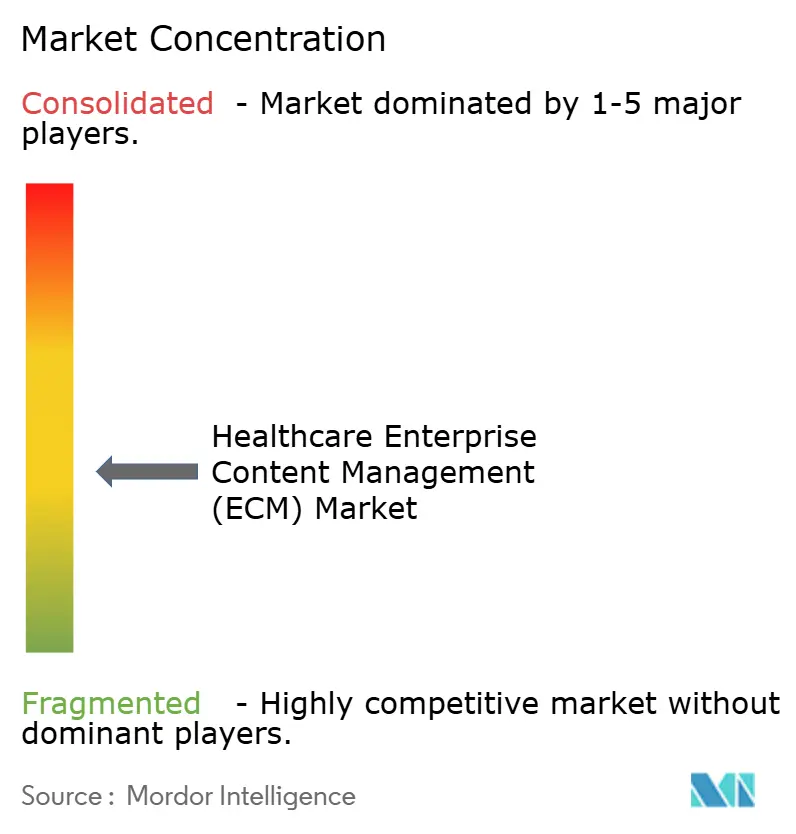
| Market Concentration | Medium |
Major Players *Disclaimer: Major Players sorted in no particular order Image © Mordor Intelligence. Reuse requires attribution under CC BY 4.0. | |
Healthcare Enterprise Content Management (ECM) Market Analysis by Mordor Intelligence
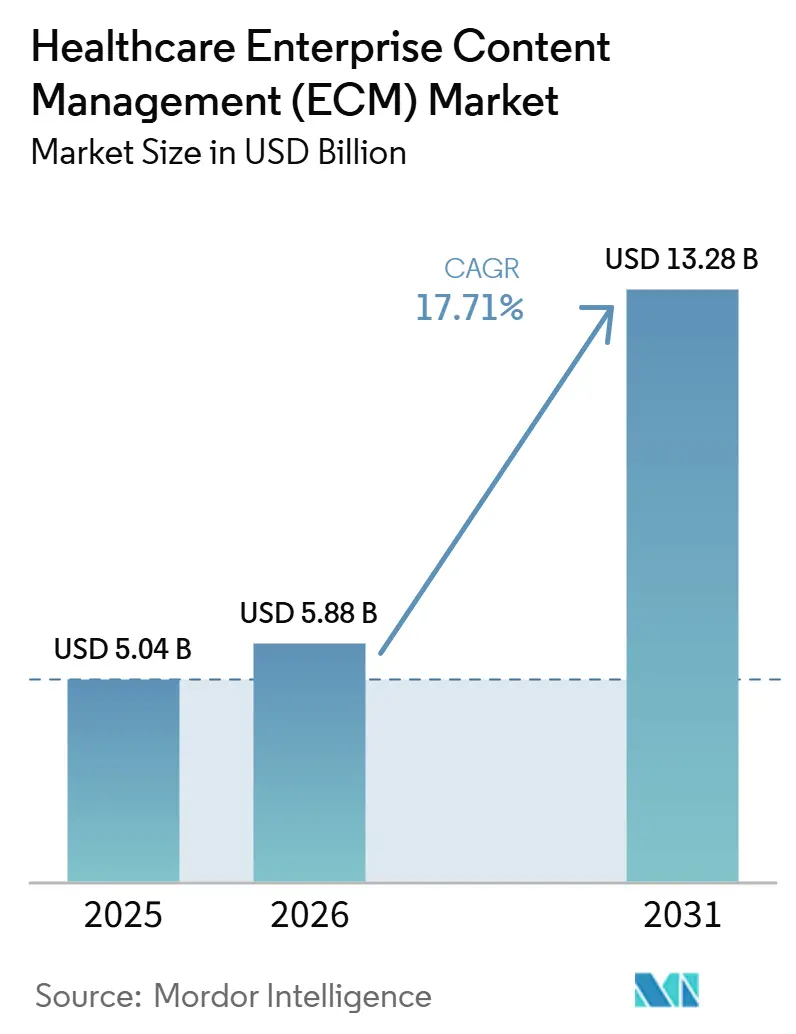
The Healthcare Enterprise Content Management (ECM) market size is expected to increase from USD 5.04 billion in 2025 to USD 5.88 billion in 2026 and reach USD 13.28 billion by 2031, growing at a CAGR of 17.71% over 2026-2031. Growth is being supported by the steady rise in digital clinical records, scanned documents, claims attachments, imaging files, and other unstructured healthcare content that must be governed across provider and payer networks. Regulatory standardization is also tightening the need for stronger content control, especially as clinical attachments and cross-border data handling move toward more formal digital exchange requirements. Vendors are responding by shifting from archive-led platforms to systems that combine document capture, search, workflow, and AI-enabled classification within a single, governed environment. The Healthcare Enterprise Content Management (ECM) market is also benefiting from cloud adoption, as health systems seek more flexible storage and retrieval models without bearing the full burden of local infrastructure expansion. Competition remains moderate at the top of the platform layer, but buying decisions are increasingly driven by workflow value, integration readiness, and compliance support rather than by storage alone.
Key Report Takeaways
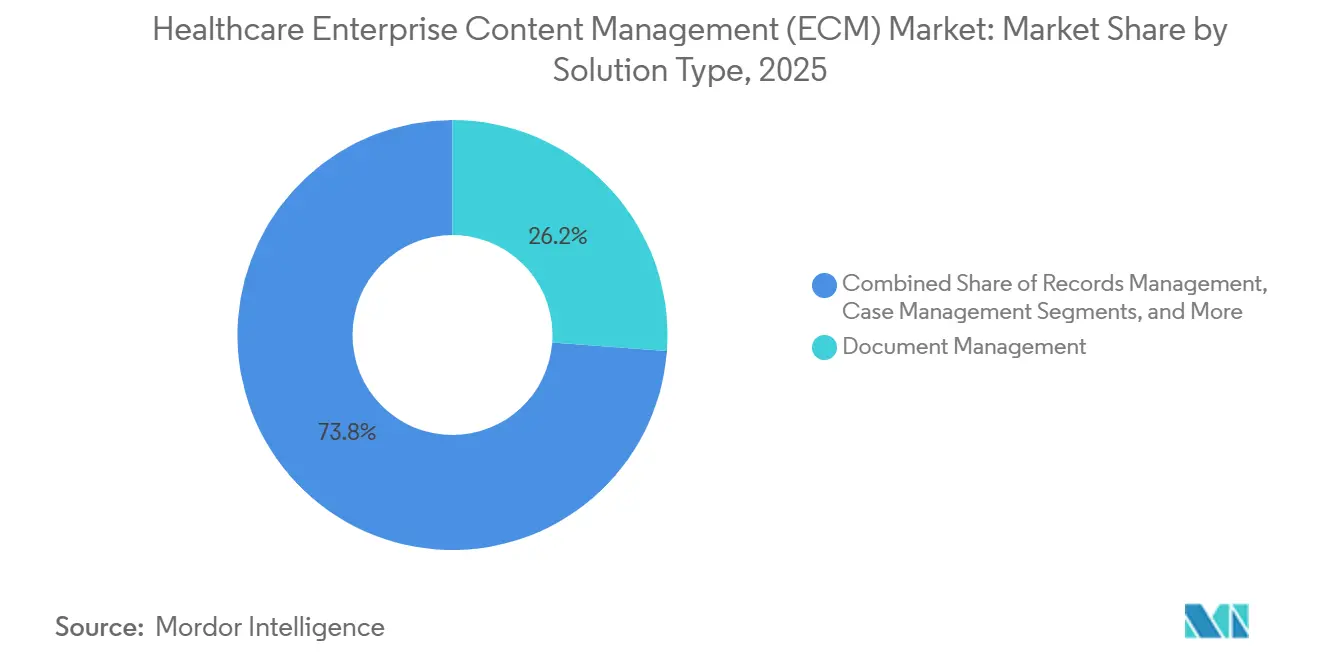
- By solution type, Document Management held 26.19% of the Healthcare Enterprise Content Management (ECM) market share in 2025, while Workflow and Business Process Management is projected to expand at an 18.89% CAGR through 2031.
- By deployment mode, Cloud held 72.29% of the Healthcare Enterprise Content Management (ECM) market share in 2025 and is projected to grow at a 19.67% CAGR through 2031.
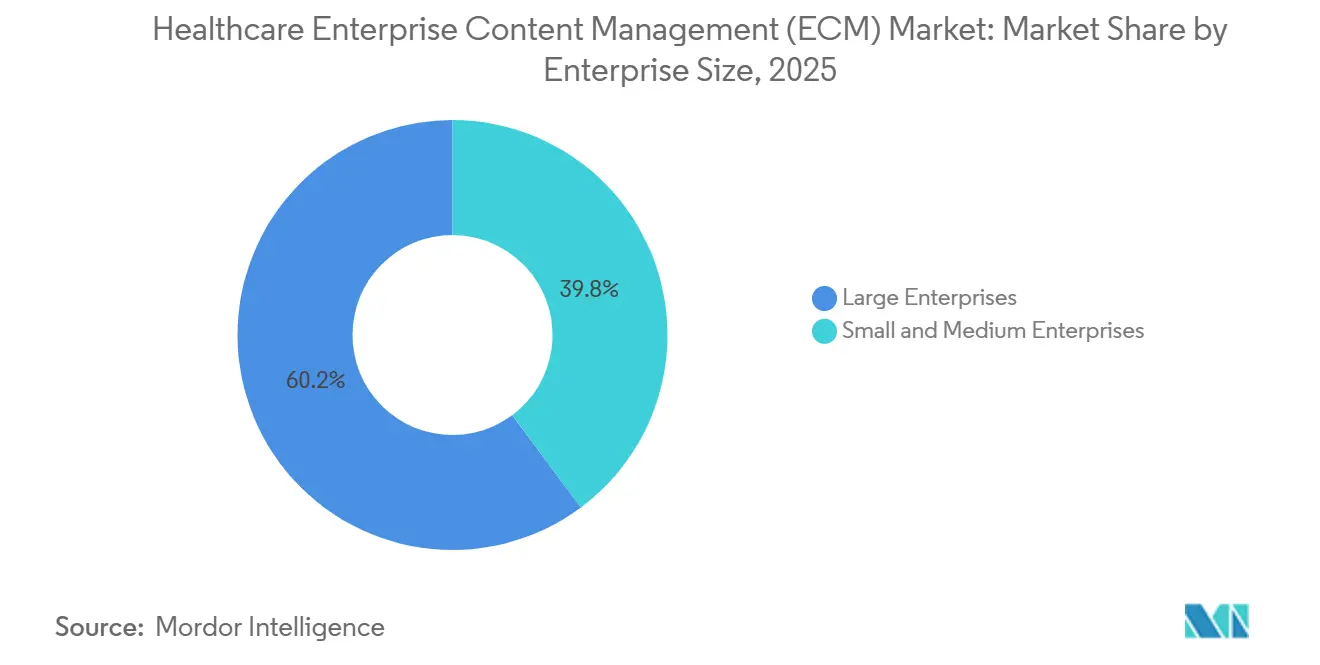
- By enterprise size, Large Enterprises held 60.19% of the Healthcare Enterprise Content Management (ECM) market share in 2025, while SMEs are projected to expand at a 19.91% CAGR through 2031.
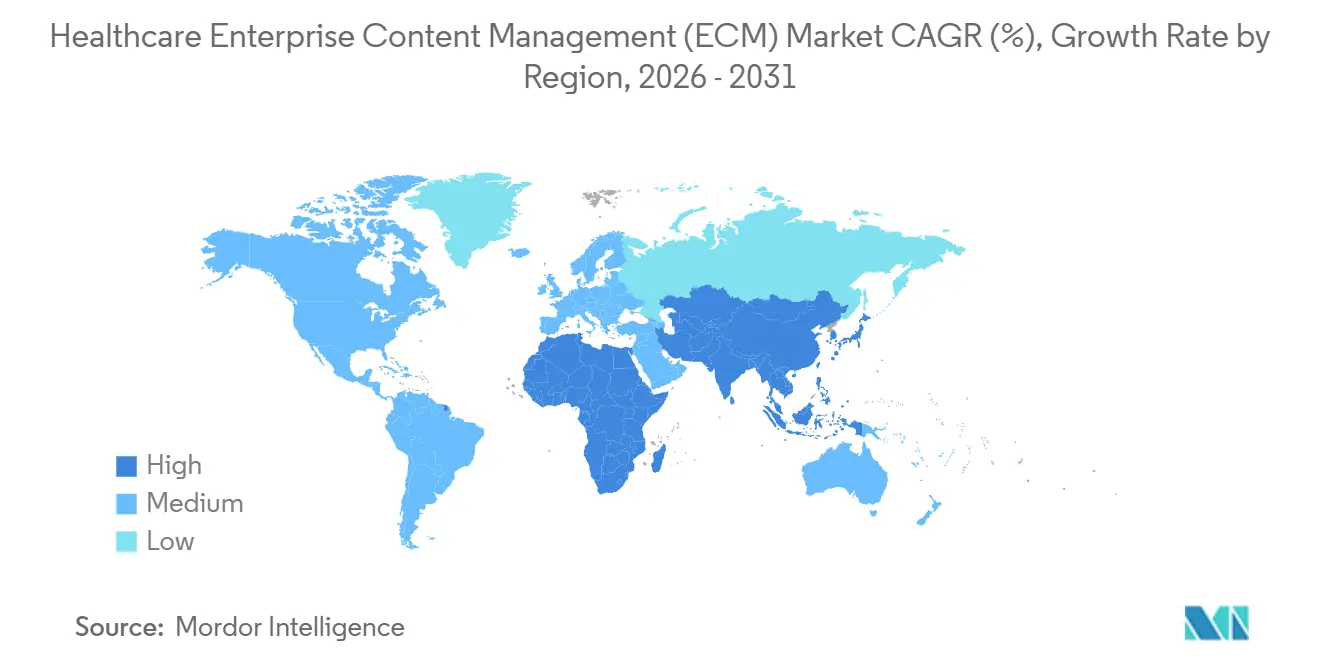
- By geography, North America held 41.07% of the Healthcare Enterprise Content Management (ECM) market share in 2025, while the Asia Pacific is projected to grow at a 19.21% CAGR through 2031.
Note: Market size and forecast figures in this report are generated using Mordor Intelligence’s proprietary estimation framework, updated with the latest available data and insights as of January 2026.
Global Healthcare Enterprise Content Management (ECM) Market Trends and Insights
Drivers Impact Analysis*
| Driver | (~) % Impact on CAGR Forecast | Geographic Relevance | Impact Timeline |
|---|---|---|---|
| Rising Electronic Health Record and Clinical Content Volumes | +4.8% | Global | Long term (≥ 4 years) |
| Regulatory Pressure for Secure Patient Data Handling | +4.2% | North America and Europe core, spill-over to Asia Pacific | Medium term (2-4 years) |
| Workflow Automation to Reduce Documentation Burden | +3.1% | Global | Medium term (2-4 years) |
| AI-Assisted Classification, Search, and Retrieval of Clinical Content | +2.8% | Global, with early gains in North America and Europe | Short term (≤ 2 years) |
| Cloud Migration of Healthcare IT Archives | +2.1% | Asia Pacific core, spill-over to Middle East and Africa | Medium term (2-4 years) |
| Interoperability Demand Across Care Settings and Legacy Systems | +1.6% | Global | Long term (≥ 4 years) |
| Source: Mordor Intelligence | |||
Rising Electronic Health Record and Clinical Content Volumes
The Healthcare Enterprise Content Management (ECM) market is being driven by the rising volume of digital clinical records and the growing volume of unstructured data that providers must store, retrieve, and govern. A 2025 framework published in Healthcare Informatics Research showed that large hospital EHR environments are moving away from legacy monolithic systems toward cloud-native and microservice architectures, underscoring the need for a stable content layer during modernization. That shift matters because long-lived records, scanned files, and clinical documents need to remain usable even when core applications are replaced or reconfigured. Separate published research also noted that Epic's Care Everywhere network processed more than 20 million patient record exchanges daily, indicating that cross-setting clinical content is already operating at a very large scale. In the Healthcare Enterprise Content Management (ECM) market, this volume pressure is turning ECM from a support tool into a core operational system for retention, access, and exchange.
Regulatory Pressure for Secure Patient Data Handling
The Healthcare Enterprise Content Management (ECM) market is also advancing because patient data rules now reach deeper into content capture, storage, and exchange. CMS finalized CMS-0053-F in March 2026 and implemented the rule on May 26, 2026, creating federal standards for electronic claims attachments and electronic signatures. CMS projected USD 781 million in annual industry savings from the rule, which gives providers and payers a direct reason to redesign document workflows and reduce manual attachment handling. In Europe, Regulation (EU) 2025/327 brought the European Health Data Space into force in February 2025 and established a framework for the access, exchange, and governance of health data across member states. As a result, the Healthcare Enterprise Content Management (ECM) market is seeing demand tied not only to digitization but also to compliance across provider, payer, and public health environments.
Workflow Automation to Reduce Documentation Burden
The Healthcare Enterprise Content Management (ECM) market benefits from the need to reduce clinician and staff time spent on documentation and repetitive administrative handling. A 2025 study indexed in PMC found that AI tools can materially reduce clinical documentation burden, while also stressing that quality oversight remains necessary in live settings. That matters because document routing, coding support, and records handling are among the first areas where providers expect measurable time savings from automation. Salesforce introduced Agentforce Health agents in 2026 with provider, payer, and public health workflow templates, which shows that workflow automation is being packaged around operational healthcare use cases rather than generic office tasks. In the Healthcare Enterprise Content Management (ECM) market, automation is becoming central because buyers want faster work cycles without weakening content governance or traceability.
AI-Assisted Classification, Search, and Retrieval of Clinical Content
The Healthcare Enterprise Content Management (ECM) market is also being lifted by AI tools that classify, search, and retrieve clinical content more effectively than older archive-led systems. A 2026 MDPI paper reported Macro F1 scores of 0.877 ± 0.012 in large-scale clinical text classification, demonstrating that privacy-aware AI methods can support real-world content governance work. AWS launched a data transformation agent for AWS HealthLake and expanded AWS HealthImaging in 2026, which signals that cloud infrastructure is being built around searchable, standards-ready, and image-aware clinical content. OpenText stated in its fiscal Q2 2026 results that its Content Management cloud business grew 18%, reflecting continued customer demand for secure information management platforms with stronger AI readiness. That shift means the Healthcare Enterprise Content Management (ECM) market is moving away from passive archives and toward active repositories that can support AI-led workflows and faster retrieval.
Restraints Impact Analysis*
| Restraint | (~) % Impact on CAGR Forecast | Geographic Relevance | Impact Timeline |
|---|---|---|---|
| Integration Complexity with Legacy Electronic Medical Record Environments | -2.3% | Global, intensified in North America and Europe | Long term (≥ 4 years) |
| High Validation and Change Management Burden in Regulated Workflows | -1.8% | Global | Medium term (2-4 years) |
| Data Sovereignty and Hosting Constraints across Multi-Country Healthcare Networks | -1.4% | Europe and Asia Pacific core | Medium term (2-4 years) |
| Buyer Concern over Vendor Lock-In for Mission Critical Clinical Repositories | -0.9% | North America and Europe | Long term (≥ 4 years) |
| Source: Mordor Intelligence | |||
Integration Complexity with Legacy Electronic Medical Record Environments
Integration complexity continues to slow the Healthcare Enterprise Content Management (ECM) market because providers must connect content repositories with EHRs, imaging platforms, payer systems, and archives that were not designed to work together. The 2025 e-HIR migration framework showed that moving large hospital EHR environments to new architectures requires structured migration methods rather than simple lift-and-shift projects. AWS's 2026 launch of a CCDA-to-FHIR R4 transformation agent also underscores how much data conversion work still sits within healthcare modernization programs. InterSystems added a Mirth migration tool and enhanced FHIR management metadata in HealthShare Health Connect 2026.1, which shows that interface replacement and standards alignment remain active technical pain points. In the Healthcare Enterprise Content Management (ECM) market, buyers therefore place heavy weight on prebuilt connectors, migration tooling, and phased deployment models that can reduce disruption during implementation.
High Validation and Change Management Burden in Regulated Workflows
The Healthcare Enterprise Content Management (ECM) market also faces slower rollout cycles because regulated workflows require careful testing, approval, and ongoing governance after every major change. The 2025 PMC study on AI documentation tools noted that oversight is necessary to prevent error propagation, meaning automation cannot be deployed as a simple plug-in within clinical record processes.[1]J. Zhao et al., “Application of Artificial Intelligence Tools and Clinical Documentation,” PubMed Central, ncbi.nlm.nih.gov CMS-0053-F fixed electronic attachment standards and established a May 26, 2028, compliance deadline, so organizations must validate not only new tools but also the way those tools generate, store, and exchange attachments. The EHDS regulation adds another layer in Europe, requiring cross-border health data use to align with rights, access conditions, and governance obligations at the platform level. This burden is especially evident in the Healthcare Enterprise Content Management (ECM) market, where content systems sit close to audit trails, retention rules, and patient data access requirements.
*Our forecasts treat driver/restraint impacts as directional, not additive. The impact forecasts reflect baseline growth, mix effects, and variable interactions.
Segment Analysis
By Solution Type: Document Management Leads as Automation Investment Accelerates
Document Management held 26.19% of the Healthcare Enterprise Content Management (ECM) market share in 2025, while Workflow and Business Process Management is projected to grow at an 18.89% CAGR through 2031. This lead reflected the basic need to digitize, store, and govern clinical records before providers could expand into more advanced analytics or AI-linked use cases. In the Healthcare Enterprise Content Management (ECM) market, document control is the first layer that health systems typically strengthen to improve retrieval, versioning, and audit support. Workflow and Business Process Management are expanding faster because providers want measurable relief from repetitive administrative work and from delays in documentation flows.
Records Management and Case Management continue to serve important needs around retention, traceability, and coordinated handling of patient and administrative content. Digital Asset Management and Web Content Management remained smaller in revenue terms, but their roles are expanding as imaging and patient-facing information flows become more integrated with broader content systems.[2]Amazon Web Services, “Automate Medical Record Digitization with Amazon Bedrock Data Automation and AWS HealthLake,” AWS Architecture Blog, aws.amazon.com The healthcare enterprise content management industry is therefore moving toward a more unified product structure in which scanned files, correspondence, image-linked content, and workflow rules are managed through interconnected governance layers. That is why the Healthcare Enterprise Content Management (ECM) market continues to prioritize document management as its top revenue driver while directing new investment toward workflow-led capabilities that improve operational throughput.



By Deployment Mode: Cloud Extends its Lead as Architecture Choices Evolve
Cloud accounted for 72.29% share of the Healthcare Enterprise Content Management (ECM) market size in 2025, and the same segment is projected to expand at a 19.67% CAGR through 2031. This large position shows that most new healthcare content programs now favor flexible infrastructure that can scale with growing volumes of documents, images, and attachments. In the Healthcare Enterprise Content Management (ECM) market, cloud models are also gaining support because they make it easier to combine storage, search, transformation, and standards-based exchange across distributed care settings. AWS's 2026 HealthLake and HealthImaging updates support that direction by improving the CCDA-to-FHIR R4 transformation and image-aware content handling in the cloud.
Hybrid deployment remains important because some health systems need local control for sensitive workloads while also seeking cloud elasticity for long-term archives and broader retrieval. In Europe, the EHDS framework reinforces the need for governance-aware architecture choices, which support continued interest in region-sensitive hosting and mixed deployment models. On-premises environments remain relevant in parts of public and tightly controlled healthcare infrastructure, especially where change cycles are slow and system replacements are staged over time. Even so, the Healthcare Enterprise Content Management (ECM) market continues to move toward cloud-first buying patterns, as health systems seek scale and standardized support without expanding fixed infrastructure at the same rate as content growth.
By Enterprise Size: SMEs Gain Momentum as Access Barriers Fall
Large Enterprises held a 60.19% share in 2025, indicating that multi-site hospital systems and payer organizations remain the largest spending pool in the Healthcare Enterprise Content Management (ECM) market. These organizations have larger document volumes, more departments, and heavier compliance demands, which make comprehensive content governance a larger budget line item. They also tend to manage more complex modernization programs, so enterprise-wide ECM decisions often sit close to EHR, claims, imaging, and revenue cycle priorities. That keeps large organizations central to current spending, even as buying criteria shift toward easier deployment and faster workflow outcomes.
SMEs are projected to grow at a 19.91% CAGR through 2031, indicating that adoption is spreading beyond the largest hospital groups. In the Healthcare Enterprise Content Management (ECM) market, this rise is being helped by cloud delivery, lighter implementation approaches, and more packaged governance tools that reduce the need for deep in-house technical teams. M-Files expanded its AI agents and industry applications in 2026, which illustrates how vendors are packaging document-centric automation in more accessible formats for targeted use cases. The healthcare enterprise content management industry is therefore seeing wider adoption, even though large enterprises remain the primary source of current revenue and the anchor for complex platform contracts.
Geography Analysis
North America held 41.07% of the Healthcare Enterprise Content Management (ECM) market share in 2025, which kept the region in the leading position within the Healthcare Enterprise Content Management (ECM) market. The United States remains the main growth engine because it combines mature EHR use, active compliance pressure, and a large installed base of provider and payer content systems. CMS-0053-F created a formal structure for electronic claims attachments and electronic signatures, prompting providers and payers to rework document exchange and attachment workflows. Canada and Mexico add a smaller but still relevant demand through public health digitization and interoperability activity, which broadens the regional base beyond the United States.
Europe remains a significant regional demand pool in the Healthcare Enterprise Content Management (ECM) market, as governance and sovereignty requirements are shaping procurement decisions across hospital and public health networks. Regulation (EU) 2025/327 brought the European Health Data Space into force in February 2025 and established the legal basis for broader access, sharing, and use of health data across the region. That framework raises the value of platforms that can support consent-aware governance, cross-border exchange, and tighter control over health information flows.[3]European Parliament and Council, “Regulation (EU) 2025/327 on the European Health Data Space,” EUR-Lex, eur-lex.europa.eu The Healthcare Enterprise Content Management (ECM) market in Europe is therefore leaning toward architectures that balance interoperability with regional control, which supports hybrid and governance-led deployment strategies.
Asia Pacific is projected to grow at a 19.21% CAGR through 2031, making it the fastest-growing geography in the Healthcare Enterprise Content Management (ECM) market. Growth is being supported by government-backed digital health programs, expanding hospital digitization, and wider adoption of electronic records across large healthcare systems. In the healthcare enterprise content management industry, that creates immediate demand for platforms that can organize newly digitized records, support multilingual content, and handle rising interoperability needs. The region also benefits from a lower legacy base in parts of the market, which allows some buyers to move more directly toward cloud-oriented content models. South America, the Middle East, and Africa remain smaller in current terms, but they continue to offer expansion potential as public-sector healthcare IT investment and content digitization programs advance.

Competitive Landscape
The Healthcare Enterprise Content Management (ECM) market is moderately consolidated at the top of the platform layer, while the specialist clinical tier remains more fragmented. Hyland Software and OpenText hold the two largest global market share positions, but competition intensifies at the health-system level, where imaging vendors, interoperability specialists, and workflow providers overlap with traditional ECM offerings. In the Healthcare Enterprise Content Management (ECM) market, this means large platform vendors still shape core buying patterns, but they do not control every workflow layer equally. Buyers are increasingly comparing vendors on integration depth, standards support, search quality, and workflow value rather than solely on repository scale.
OpenText has been sharpening its position through portfolio focus and cloud expansion. The company reported 18% revenue growth in its Content Management cloud business in fiscal Q2 2026, indicating continued demand for secure cloud-based information management capabilities.[4]OpenText, “OpenText Reports Second Quarter Fiscal Year 2026 Financial Results,” OpenText, opentext.com It also agreed in October 2025 to divest eDOCS for USD 163 million, reflecting a deliberate move to focus on core AI-ready information management priorities. InterSystems followed a different path by launching Payer Connector on the Epic Showroom in February 2026, targeting payer-facing workflow integration with prebuilt Epic-aware orchestration. That approach shows how vendors can win in the Healthcare Enterprise Content Management (ECM) market by solving narrow yet high-value content-routing problems within established care platforms.
M-Files has also been active, launching new AI agents in June 2026 and adding industry applications earlier in the year, demonstrating how document-centric vendors are packaging governance, search, and automation into more targeted offerings. InterSystems also released HealthShare Health Connect 2026.1 with enhanced FHIR management metadata and a Mirth migration tool, reinforcing the importance of interoperability depth in vendor positioning. The healthcare enterprise content management industry still has room for vendors that can address the needs of community hospitals, consent-linked governance, and regional hosting more directly than large, horizontal platforms. Overall, the Healthcare Enterprise Content Management (ECM) market remains competitive enough to limit dominance by a small group, but concentrated enough that scale, ecosystem fit, and compliance execution still matter heavily in final vendor selection.
Healthcare Enterprise Content Management (ECM) Industry Leaders
OpenText Corporation
Microsoft Corporation
Oracle Corporation
Hyland Software, Inc.
IBM Corporation
- *Disclaimer: Major Players sorted in no particular order

Recent Industry Developments
- July 2026: M-Files launched M-Files for Consulting, a purpose-built AI-native document management application for the full proposal-to-delivery lifecycle, built on its Enterprise Knowledge Graph with role-based user experiences and governance controls.
- June 2026: M-Files launched new AI agents enabling metadata enrichment, conversational access, intelligent search, workflow automation, and vertical solutions for document-centric processes, with planned support for the Model Context Protocol interoperability standard for AI platforms.
- June 2026: Hyland and Microsoft announced a strategic partnership to bring the Hyland Content Innovation Cloud to Microsoft Azure, enabling joint go-to-market and co-sell access via the Microsoft Marketplace. The agreement expands data residency options and geographic reach for regulated industry customers, including healthcare, financial services, and government, and integrates Hyland's content governance layer with Azure OpenAI Service and Azure document intelligence APIs.
- May 2026: The CMS HIPAA Claims Attachments final rule took effect on May 26, 2026, establishing the first federally standardized electronic clinical attachment formats using X12N 275/277 version 6020 and HL7 C-CDA standards. The rule projects USD 781 million in annual industry savings from reduced administrative burden and sets a compliance deadline of May 26, 2028, for all covered entities.


Global Healthcare Enterprise Content Management (ECM) Market Report Scope
The Healthcare Enterprise Content Management (ECM) Market includes software platforms and associated services that help healthcare providers, hospitals, clinics, diagnostic centers, healthcare payers, and other healthcare organizations capture, manage, store, secure, organize, retrieve, and archive enterprise content and documents throughout their lifecycle. These solutions support clinical document management, patient records management, workflow automation, case management, digital asset management, content governance, regulatory compliance, and information sharing across healthcare systems. Increasing digitization of healthcare records, growing regulatory compliance requirements, rising adoption of electronic health records (EHRs), and the need to manage healthcare information efficiently to improve operational efficiency, patient care, collaboration, and data security drive the market.
The Healthcare Enterprise Content Management (ECM) Market Report is Segmented by Solution Type (Document Management, Records Management, Workflow and Business Process Management, Case Management, Digital Asset Management, Web Content Management, and Other Solutions), Deployment Mode (On-Premises, Cloud, and Hybrid), Enterprise Size (Small and Medium Enterprises, and Large Enterprises), and Geography (North America, South America, Europe, Asia Pacific, Middle East, and Africa). The Market Forecasts are Provided in Terms of Value (USD).
| Document Management |
| Records Management |
| Workflow and Business Process Management |
| Case Management |
| Digital Asset Management |
| Web Content Management |
| Other Solutions |
| On-Premises |
| Cloud |
| Hybrid |
| Small and Medium Enterprises |
| Large Enterprises |
| North America | United States |
| Canada | |
| Mexico | |
| South America | Brazil |
| Argentina | |
| Rest of South America | |
| Europe | United Kingdom |
| Germany | |
| France | |
| Rest of Europe | |
| Asia Pacific | China |
| Japan | |
| India | |
| South Korea | |
| Australia | |
| Rest of Asia Pacific | |
| Middle East | United Arab Emirates |
| Saudi Arabia | |
| Rest of Middle East | |
| Africa | South Africa |
| Kenya | |
| Rest of Africa |
| By Solution Type | Document Management | |
| Records Management | ||
| Workflow and Business Process Management | ||
| Case Management | ||
| Digital Asset Management | ||
| Web Content Management | ||
| Other Solutions | ||
| By Deployment Mode | On-Premises | |
| Cloud | ||
| Hybrid | ||
| By Enterprise Size | Small and Medium Enterprises | |
| Large Enterprises | ||
| By Geography | North America | United States |
| Canada | ||
| Mexico | ||
| South America | Brazil | |
| Argentina | ||
| Rest of South America | ||
| Europe | United Kingdom | |
| Germany | ||
| France | ||
| Rest of Europe | ||
| Asia Pacific | China | |
| Japan | ||
| India | ||
| South Korea | ||
| Australia | ||
| Rest of Asia Pacific | ||
| Middle East | United Arab Emirates | |
| Saudi Arabia | ||
| Rest of Middle East | ||
| Africa | South Africa | |
| Kenya | ||
| Rest of Africa | ||


Key Questions Answered in the Report
What is the current and forecast value of healthcare enterprise content management?
The healthcare enterprise content management market is valued at USD 5.88 billion in 2026 and is projected to reach USD 13.28 billion by 2031, growing at a 17.71% CAGR over 2026-2031.
Which solution type leads spending in healthcare ECM?
Document Management led the solution mix in 2025 with a 26.19% share, reflecting the need to digitize and govern core clinical records before broader automation layers are added.
Which deployment model is expanding the fastest in healthcare content management?
Cloud is both the largest and fastest-growing deployment model, with a 72.29% share in 2025 and a projected 19.67% CAGR through 2031.
Why is regulation becoming a stronger buying trigger for healthcare content platforms?
Rules such as CMS-0053-F and the EHDS framework are pushing providers and payers to improve document exchange, retention, governance, and traceability across content workflows.
Which region shows the strongest growth outlook through 2031?
Asia Pacific is the fastest-growing region, with a projected 19.21% CAGR, supported by hospital digitization and government-backed digital health programs.
How are vendors competing in this space in 2026?
Vendors are competing through AI-enabled search, workflow automation, cloud delivery, interoperability depth, and targeted platform moves such as OpenText portfolio focus, InterSystems Epic-linked integration, and M-Files AI agent expansion.
Page last updated on:






