
Headless CMS Software Market Size and Share
Market Overview
| Study Period | 2020 - 2031 |
|---|---|
| Market Size (2026) | USD 1.82 Billion |
| Market Size (2031) | USD 4.42 Billion |
| Growth Rate (2026 - 2031) | 19.40 % |
| Fastest Growing Market | Asia-Pacific |
| Largest Market | North America |
| Market Concentration | Medium |
Major Players *Disclaimer: Major Players sorted in no particular order Image © Mordor Intelligence. Reuse requires attribution under CC BY 4.0. | |
Headless CMS Software Market Analysis by Mordor Intelligence
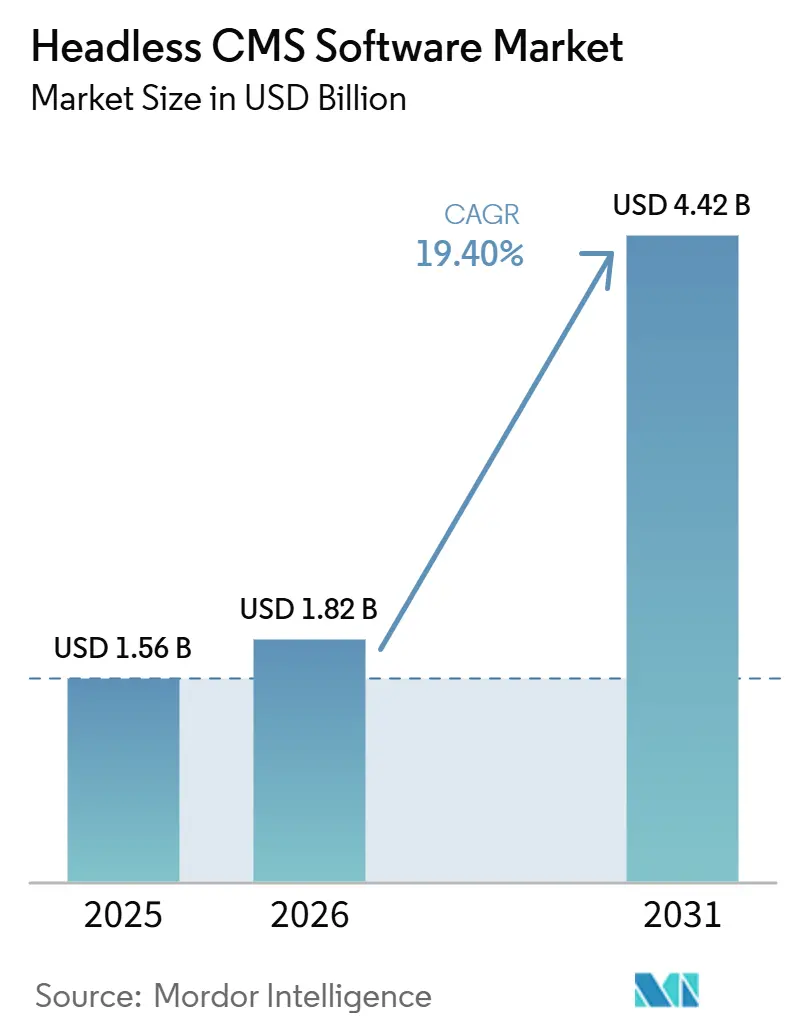
The Headless CMS Software Market size is expected to increase from USD 1.56 billion in 2025 to USD 1.82 billion in 2026 and reach USD 4.42 billion by 2031, growing at a CAGR of 19.40% over 2026-2031. The market is expanding as enterprises move away from page-based content systems toward API-first platforms that serve web, mobile, retail screens, voice interfaces, and other digital endpoints from a single, structured content layer. This shift is becoming increasingly important as organizations seek to reduce duplicate content across brands, languages, and customer touchpoints and speed up publishing. Demand is also supported by the need to make content operations better prepared for AI-driven search, personalization, and automated workflows, which increases the value of governed, reusable content structures. At the same time, integration complexity with legacy systems is slowing full migration in many enterprises, especially where CRM, PIM, DAM, analytics, and commerce platforms are already tied to older CMS environments. Competitive activity is now centered on AI-led product expansion, hybrid deployment flexibility, stronger governance features, and simpler onboarding for mid-market users, which keeps the Headless CMS Software Market open to both enterprise platform vendors and developer-led challengers.
Key Report Takeaways
- By component, software held 70.45% share of the Headless Content Management System Software Market in 2025, while services are projected to expand at a 22.02% CAGR through 2031.
- By deployment type, cloud-based deployments held a 67.11% of the Headless CMS Software Market share in 2025, while hybrid deployments are projected to expand at a 21.62% CAGR through 2031.
- By organization size, large enterprises held 72.39% of the Headless CMS Software Market share in 2025, while small and medium enterprises are projected to expand at a 22.36% CAGR through 2031.
- By application, website and portal management accounted for 58.25% of the market share in 2025, while API-driven omnichannel content delivery is projected to expand at a 21.30% CAGR through 2031.
- By end user industry, retail and e-commerce held 27.12% of the Headless CMS Software Market share in 2025, while healthcare and life sciences are projected to expand at a 20.56% CAGR through 2031.
- By geography, North America held 36.14% of the Headless CMS Software Market share in 2025, while Asia-Pacific is projected to expand at a 20.89% CAGR through 2031.
Note: Market size and forecast figures in this report are generated using Mordor Intelligence’s proprietary estimation framework, updated with the latest available data and insights as of January 2026.
Global Headless CMS Software Market Trends and Insights
Drivers Impact Analysis*
| Driver | (~) % Impact on CAGR Forecast | Geographic Relevance | Impact Timeline |
|---|---|---|---|
| Omnichannel Content Delivery Across Web, Apps, and Emerging Surfaces | +4.3% | Global | Medium term (2-4 years) |
| API-First and Composable Architecture Adoption | +3.8% | Global | Short term (≤ 2 years) |
| Generative AI-Ready Content Operations | +3.5% | Global, with early concentration in North America and Europe | Short term (≤ 2 years) |
| Faster Localization, Governance, and Multiregion Publishing | +2.8% | North America, Europe, APAC | Medium term (2-4 years) |
| Security, Performance, and Developer Autonomy Versus Monolithic CMS | +2.3% | North America and Europe | Short term (≤ 2 years) |
| Low-Code Content Operations for Mid-Market Adoption | +2.1% | APAC and North America, with spillover to South America and the Middle East and Africa | Medium term (2-4 years) |
| Source: Mordor Intelligence | |||
Omnichannel Content Delivery across Web, Apps, and Emerging Surfaces
Content operations now extend well beyond websites into apps, kiosks, wearables, voice interfaces, and immersive formats. The Storyblok State of CMS 2025 report, published in May 2025 and based on 1,300 CMS users, found that the biggest planned increases in content delivery channels were AR and VR and voice-activated speakers at 15%, followed by smartwatches at 14%. The same report said 61% of teams operated 2 or more CMSs simultaneously, showing how fragmented multichannel publishing still was in 2025. A headless model addresses this strain by storing content once and distributing it through APIs to each endpoint without rebuilding the content layer for every surface. That matters in the Headless CMS Software Market because brands expanding beyond web and mobile are reaching a practical limit with page-based systems, so migration is becoming an operating need rather than a future preference.
API-First and Composable Architecture Adoption
Enterprise software buying is moving toward modular stacks, and headless CMS sits at the content layer of that shift. The MACH Alliance reported that 87% of member enterprises had widely implemented MACH technologies, and 93% of adopters said their investment met or exceeded ROI expectations. That momentum supports the Headless CMS Software Market because API-first content platforms naturally integrate with commerce, personalization, search, and data tools selected independently. A major signal came on June 1, 2026, when Salesforce signed a definitive agreement to acquire Contentful, a composable content platform used by more than 4,800 enterprise brands. The deal showed that headless content infrastructure is moving from a specialist architecture choice into a core enterprise software layer.
Generative AI-Ready Content Operations
The role of a CMS is expanding beyond storage and publishing to orchestration for AI-driven experiences. On March 31, 2026, Progress Software launched Sitefinity Generative CMS with AI-driven hyper-personalization, Schema.org JSON-LD-structured data for generative search discovery, and agentic content workflows within a governed enterprise framework. This direction matters because structured content can be queried, assembled, and delivered more cleanly by machine agents than page-bound content can. It also underscores the value of approval workflows, audit trails, and role-based controls, as AI-generated content increases brand and compliance risks at scale. In the Headless CMS Software Market, vendors that combine reusable content models with governance and AI tooling are gaining a stronger product position than vendors that offer API delivery alone.
Faster Localization, Governance, and Multiregion Publishing
Global content teams need to publish across languages and regions without losing control over approvals and brand rules. Contentful introduced locale-based publishing in 2025 for Premium customers, which lets teams draft, review, and publish language versions independently while still using field-level localization. Contentstack also published a localization framework in 2025 that said its architecture could help brands scale across more than 100 locales with the effort previously needed to manage 2.[1] These features matter because multilocale operations often fail in governance rather than in content creation, especially when legal review, translation sequencing, and market-level publishing rights differ by region. The Headless Content Management System Software Market is benefiting from this need, as structured publishing and role-based control are increasingly purchased as operational requirements rather than optional enhancements.
Restraints Impact Analysis*
| Restraint | (~) % Impact on CAGR Forecast | Geographic Relevance | Impact Timeline |
|---|---|---|---|
| Integration Complexity with Legacy Systems and Data Models | -3.3% | Global | Medium term (2-4 years) |
| Higher Implementation Cost And Technical Skill Requirements | -2.6% | South America, APAC, MEA | Medium term (2-4 years) |
| Governance Burden across Distributed APIs and Workflows | -1.9% | Global enterprise | Long term (≥ 4 years) |
| Vendor Lock-In Risk from Platform-Specific Extensions and Hosting | -1.5% | North America and Europe | Long term (≥ 4 years) |
| Source: Mordor Intelligence | |||
Integration Complexity with Legacy Systems and Data Models
Legacy CMS environments are rarely isolated systems because they are often tied to CRM, PIM, DAM, analytics, and commerce platforms built on older data structures. Sanity's 2025 enterprise guidance said that a standard migration from a monolithic CMS to a fully headless setup typically required 16-24 weeks for core model configuration and integration wiring. Many organizations, therefore, run legacy and headless systems in parallel during migration, which creates content consistency issues, routing conflicts, and strain on version control systems. This is a serious barrier for the Headless CMS Software Market because the enterprises with the largest content estates also tend to have the most entangled legacy stacks. The result is a slower migration path, even when the long-term business case for a headless architecture has already been accepted.
Higher Implementation Cost and Technical Skill Requirements
Headless CMS projects usually require a separate frontend engineering layer, which adds work that traditional templated CMS projects did not always need. Storyblok reported in May 2025 that headless CMS skills in the United States carried salary premiums of 29% for developers and 85% for marketers compared with legacy CMS skills. That premium reflects a talent gap and also increases the total delivery cost for organizations that need specialist support. This restraint is especially relevant for mid-market buyers, who often have enough content complexity to require a headless setup but not enough internal engineering depth to manage it effectively. Vendors are responding with visual editors and no-code tools, but cost and skill availability still slow adoption where deep commerce or personalization integrations are required.
*Our forecasts treat driver/restraint impacts as directional, not additive. The impact forecasts reflect baseline growth, mix effects, and variable interactions.
Segment Analysis
By Component: Software Platform Dominance Masks Services-Led Revenue Acceleration
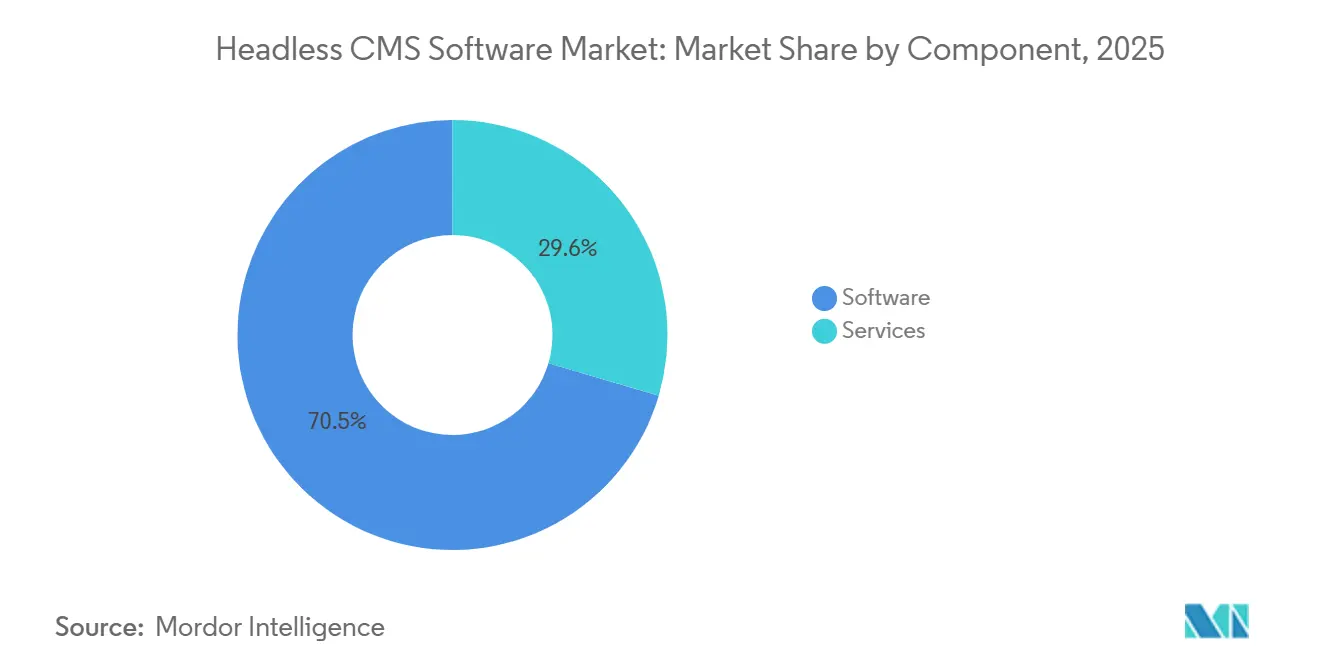
Software accounted for 70.45% of the Headless CMS Software Market in 2025, underscoring how subscription-based platform revenue still defines the category. This lead came from SaaS-native vendors that package core content modeling, API delivery, workflow controls, and user access within recurring license structures. Enterprises have generally bought headless CMS as a managed cloud platform rather than as installed software, so licensing remains the first commercial layer in most deals. Revenue concentration in software also reflects how buyers often start with platform subscriptions before they expand spending into integration, migration, and operational support. In the Headless CMS Software Market, this keeps software at the center of vendor positioning even when the real delivery effort extends far beyond the license itself.
Services are projected to expand at a 22.02% CAGR through 2031, making them the fastest-growing component of this structure. The pace is tied to the complexity of content model redesign, legacy migration, frontend buildout, and multichannel integration required by headless deployments. Many buyers still underestimate the work required to decouple content from older page-based workflows and to stand up new delivery layers across web, app, and commerce environments. That gap creates durable demand for implementation partners, managed support, and architecture specialists that can help enterprises move from platform purchase to full-scale operation. Over time, as baseline API capabilities become easier to match, services tied to AI-ready content models, governance design, and multilocale rollout are likely to influence buying decisions more directly than feature checklists alone.
By Deployment Type: Hybrid Architecture Emerges as the Enterprise Middle Ground
Cloud-based deployment held a 67.11% share in 2025, confirming that operational simplicity and elastic scale remain the strongest default advantages in this market. SaaS delivery reduces infrastructure management, shortens setup time, and supports content distribution across channels without requiring buyers to maintain underlying hosting environments. For many organizations, that is still the cleanest route into headless adoption, as it reduces the burden on internal IT teams. Cloud deployment also aligns with how most vendors package their newest workflow, personalization, and integration features. In the Headless CMS Software Market, this made cloud the leading deployment model by revenue, even as more complex governance demands began to shape enterprise roadmaps.
Hybrid deployment is projected to expand at a 21.62% CAGR through 2031, making it the fastest-growing delivery model. This reflects the needs of enterprises that want cloud-native API flexibility but also need tighter control over data residency, storage location, or content governance. Organizations in government, financial services, and healthcare are especially relevant here because some content cannot be moved fully into third-party public cloud environments without additional controls. Hybrid models give these users a practical middle path, where delivery layers and integrations can remain modern while selected content or systems stay closer to internal control. That is why hybrid adoption is rising not as a temporary compromise, but as a deliberate operating model for regulated and security-sensitive content environments.
By Organization Size: Large Enterprises Lead, but SMEs Define The Growth Frontier
Large enterprises held 72.39% of the Headless CMS Software Market share in 2025, which reflects their earlier adoption cycles and the scale of their content operations. These organizations usually manage multiple brands, geographies, teams, and publishing environments, so the value of structured content and centralized governance is high from the start. They also have the budgets needed to absorb integration work, frontend development, and migration projects that remain costly. Large enterprises often need SSO, environment promotion workflows, locale-level permissions, and stronger audit controls, creating a broader revenue opportunity for vendors beyond the initial contract. In the Headless CMS Software Market, this makes enterprise accounts both the largest current revenue base and the main source of complex, high-value deployments.
Small and medium enterprises are projected to expand at a 22.36% CAGR through 2031, which gives them the fastest growth profile by organization size. This shift is being supported by lower SaaS entry costs, improving visual editors, and a wider range of out-of-the-box integrations that reduce the need for large internal engineering teams. It is also helped by open-source alternatives that remove upfront license costs, which matter for buyers who want flexibility but must control spending tightly. The growth of Strapi in developer communities supports that direction, with the repository surpassing 55,000 GitHub stars by 2025. As a result, the next wave of demand in the Headless CMS Software Market is not only a smaller version of enterprise buying, but a different buying pattern that values speed, usability, and implementation simplicity more directly.
By Application: Website and Portal Management Anchors Revenue While API-Driven Delivery Sets the Growth Pace
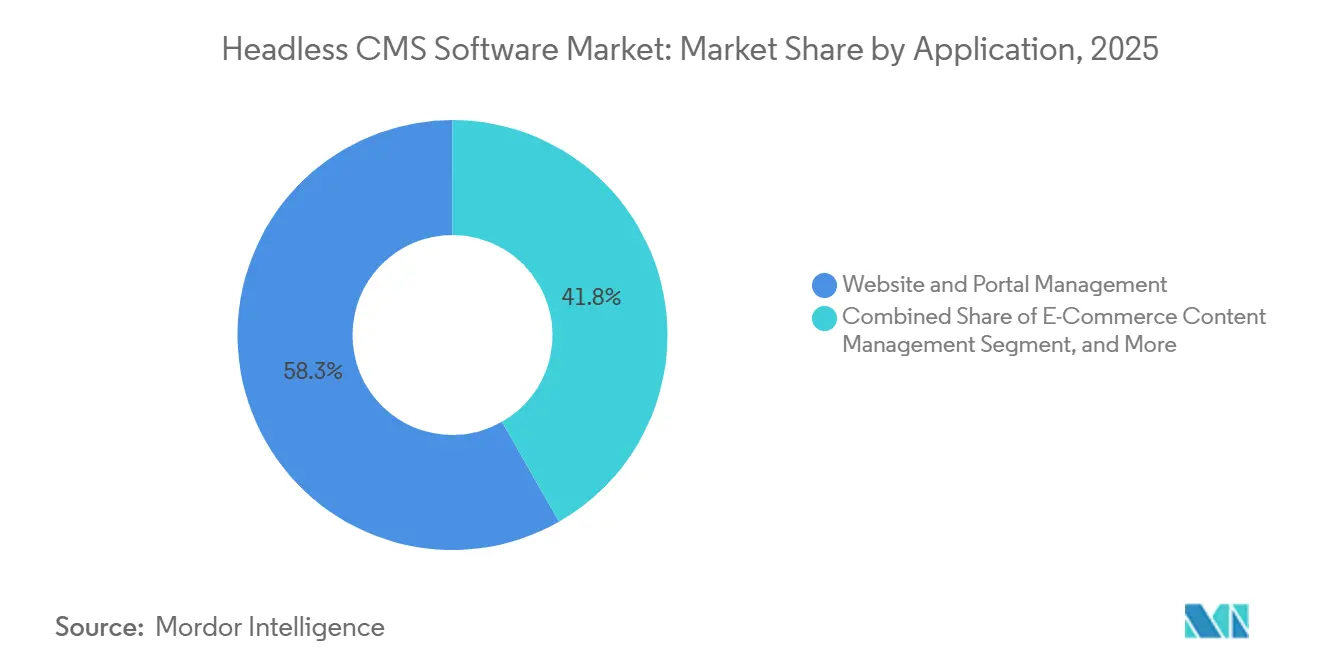
Website and portal management accounted for 58.25% of revenue in 2025, making it the largest application segment. This position reflects the fact that most organizations begin their headless transition with branded websites, corporate portals, and other owned digital properties where content control is already mission-critical. Web and portal environments are also where legacy migration pressure is most visible, because older systems are often deeply embedded in publishing workflows that need modernization. As a result, this segment remains the main entry point for adoption even when buyers expect broader omnichannel use later. In the Headless Content Management System Software Market, website and portal management continues to anchor commercial demand because it links directly to visible customer-facing experiences and internal publishing efficiency.
API-driven omnichannel content delivery is projected to expand at a 21.30% CAGR through 2031, which makes it the fastest-growing application area. The shift is being reinforced by enterprise demand for content that can be delivered across mobile apps, digital kiosks, voice interfaces, connected devices, and composable commerce environments from a single central model. The MACH Alliance's data on broad enterprise adoption of MACH technologies supports this transition, as it points to greater acceptance of modular architectures across the digital stack. This application also benefits from the need to separate content from frontend rendering so teams can update messages, campaigns, and product information without rebuilding every endpoint. In practical terms, the fastest growth is coming from use cases where content must travel across many surfaces quickly and consistently, which is exactly where headless architecture has the clearest operating advantage.

By End User Industry: Retail and E-Commerce Leads While Healthcare Rewrites the Growth Mix
Retail and e-commerce accounted for 27.12% of the market in 2025, giving it the largest share among end-user industries. This lead reflects the vertical's strong need for composable commerce stacks that allow content to be managed separately from product data, pricing, inventory, and fulfillment. Retailers also need to update promotions and brand messages across websites, apps, and in-store screens quickly, which makes structured content delivery especially valuable. In the Headless CMS Software Market, the retail lead therefore comes from both scale and operating urgency. The segment benefits when organizations want faster campaign changes without forcing backend commerce systems to carry content responsibilities they were not built to manage.
Healthcare and life sciences are projected to expand at a 20.56% CAGR through 2031, making it the fastest-growing vertical in the market. Growth is being driven by patient-facing portals, digital service communication, and stronger governance needs around how regulated content is created and delivered. DotCMS published a 2025 healthcare-focused framework that showed how a headless CMS could support flexible digital experiences while preserving structured governance controls across complex healthcare environments.[2] This matters because healthcare organizations need content systems that can support multiple sites and audiences without loosening oversight. The result is a strong fit for platforms that combine API-driven delivery with approval workflows, role-based permissions, and scalable architecture.
Geography Analysis
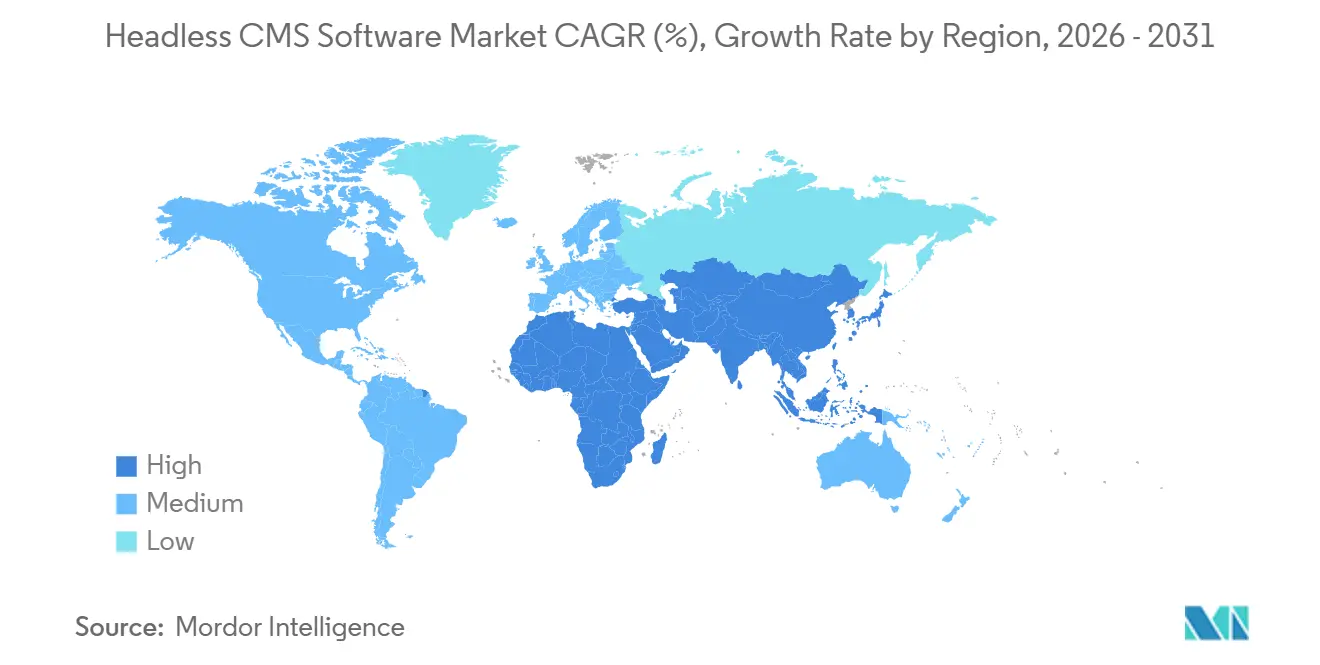
North America held a 36.14% share of the Headless CMS Software Market in 2025, making it the largest regional contributor by revenue. The region benefited from a dense base of digital-native retailers, media companies, technology firms, and financial services organizations that treat omnichannel content delivery as a competitive requirement rather than a side capability. The United States remained the main revenue center, while Canada and Mexico added support through cross-border digital commerce needs that favor unified content models. Early adoption also reflected the strength of the regional SaaS ecosystem and the availability of specialist implementation partners that can reduce deployment friction for enterprise buyers. South America remained a smaller contributor, but Brazil and Argentina continued to show interest as mobile-first commerce growth and digital modernization created a clearer case for structured content systems.
Asia-Pacific is projected to expand at a 20.89% CAGR through 2031, making it the fastest-growing region in the Headless CMS Software Market. China, India, Japan, and South Korea are driving most of that demand, although the reasons differ by country. China benefits from a large e-commerce base and content-intensive digital platforms that require scalable API-driven delivery. India adds momentum through a large software development community that is comfortable with JavaScript and API-first architectures, making adoption easier to implement in practice. Australia and New Zealand also show strong movement in line with broader composable architecture adoption, while South Korea's advanced enterprise technology environment supports continued regional growth.
Europe holds a significant share of the Headless CMS Software Market, even though the input does not assign a single regional percentage. The United Kingdom, Germany, and France form the core of demand, supported by needs around multilingual publishing, accessibility, governance, and modernization of legacy content environments. Germany stands out as a market where large industrial and enterprise organizations need audit-ready workflows and structured multiregion publishing. France remains receptive to self-hosted and private-cloud models where data control and deployment choice are important, while the Nordics and Benelux continue to develop as secondary markets. The Middle East and Africa remain early-stage markets, but the UAE and Saudi Arabia are seeing greater investment in digital government and enterprise technology, while South Africa and Nigeria continue to anchor the region's early demand base.
Competitive Landscape
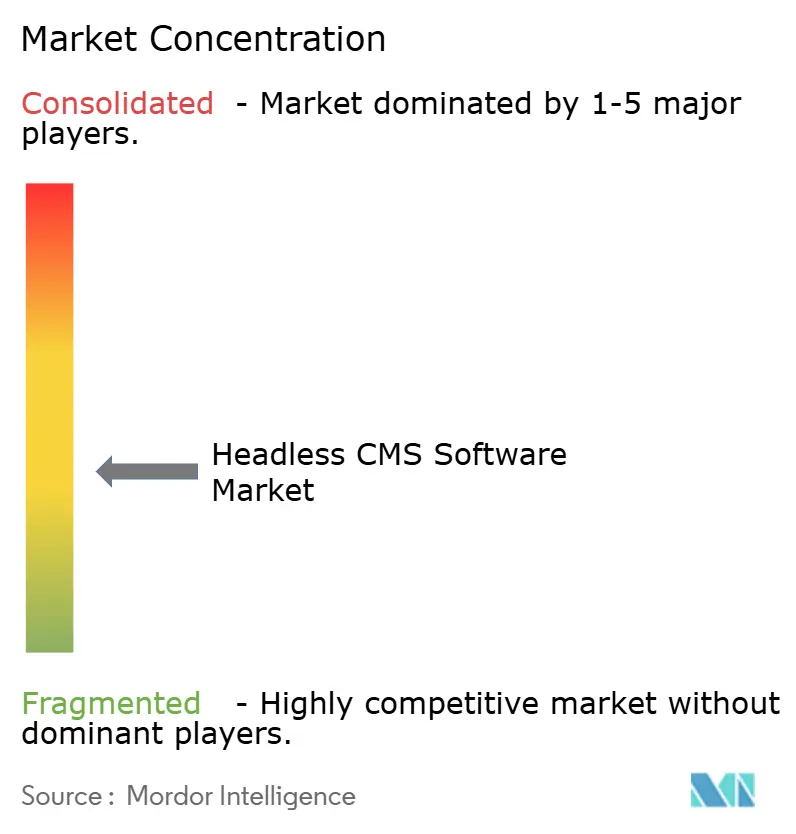
The Headless CMS Software Market remains moderately fragmented, with a core group of well-capitalized SaaS vendors competing against a longer list of open-source, regional, and use-case-specific providers. Contentful, Contentstack, and Sanity are central players in enterprise discussions, but the field remains broad enough that no single platform defines the category on its own. Basic API delivery and content modeling are becoming less distinctive, so competition is shifting toward AI capabilities, developer experience, depth of governance, and breadth of integration. This is changing how vendors present value, because buyers are now looking at orchestration, localization, approval controls, and ecosystem fit rather than content storage alone. The result is a market where product direction matters as much as scale, and where platform neutrality can be a competitive advantage.
The most important strategic move came in June 2026, when Salesforce signed a definitive agreement to acquire Contentful and bring its API-first content layer into Salesforce's broader customer experience and Agentforce environment.[3] That transaction showed that headless CMS is being pulled into larger enterprise software stacks rather than remaining a stand-alone content category. Contentstack answered the shift in June 2026 by launching its Agentic Experience Platform, including Agent OS and Agent Accelerator, which pushed autonomous content, data, and personalization capabilities more directly into the product story. Progress Software also strengthened the AI direction of the category with Sitefinity Generative CMS in March 2026, which added governed generative workflows and AI-driven discovery functions. These moves show that competitive positioning is now tied closely to how well vendors connect reusable content with AI-led delivery and control.
Open-source and developer-led vendors continue to shape the lower and mid-market ends of the Headless Content Management System Software Market. Directus expanded its deployment and localization support with version 11.17 in July 2026, adding native Netlify deployment support and a translations generator that helps teams set up internationalization more quickly. Hygraph widened access to its AI Assist capability in 2026 and introduced Click to Edit in public beta, reducing the gap between content editing and frontend review for leaner teams. This part of the market is important because it keeps pressure on enterprise vendors by making usability, flexibility, and lower-friction deployment more visible buying criteria. The overall competitive picture, therefore, supports steady innovation but not a tightly concentrated vendor structure.
Headless CMS Software Industry Leaders
-
Agility Inc.
-
Uniform Systems, Inc.
-
Netlify, Inc.
-
Hygraph GmbH
-
DotCMS LLC
- *Disclaimer: Major Players sorted in no particular order
Recent Industry Developments
- July 2026: Kontent.ai launched AI Connectors for its Agentic CMS, linking its AI agent Aiko to enterprise systems such as Asana, Atlassian, Notion, and Peec AI via zero-code integrations. The company, certified to ISO/IEC 42001 for AI management systems, reports that over 60 organizations are actively using Agentic CMS capabilities, reflecting the accelerating adoption of autonomous content operations in compliance-sensitive sectors such as healthcare, insurance, and government.
- July 2026: Directus released version 11.17, introducing native Netlify deployment support alongside a translations generator that scaffolds internationalization setup within seconds, and background data imports that eliminate interface blocking for large datasets. The release reduces multilocale deployment friction materially for enterprise teams, extending headless CMS accessibility to organizations with limited dedicated DevOps resources.
- June 2026: Salesforce signed a definitive agreement to acquire Contentful GmbH, the headless CMS platform serving more than 4,800 enterprise brands. The transaction, expected to close in Q3 of Salesforce's fiscal year 2027, integrates Contentful's API-first content layer into Salesforce's Headless 360 and Agentforce, enabling Agentforce to dynamically assemble and deliver AI-personalized content across every channel without manual publishing steps.
- June 2026: Contentstack launched its Agentic Experience Platform (AXP), including the general availability of Agent OS, an autonomous agent layer spanning content, data, and real-time personalization, and Agent Accelerator, a program designed to take customers from AI experimentation to operational impact. The platform also embeds Brand Kit for AI-powered brand guardrails, reflecting the market's growing emphasis on governed agentic content workflows.
Global Headless CMS Software Market Report Scope
The Headless CMS Software Market comprises content management platforms that separate content creation and storage from the presentation layer, enabling organizations to deliver content across multiple digital channels via APIs. These solutions support omnichannel content distribution across websites, mobile applications, e-commerce platforms, IoT devices, digital displays, and other customer touchpoints. Increasing demand for flexible content delivery architectures, growing adoption of composable digital experience platforms, and the need for personalized customer experiences drive the market. These solutions help organizations accelerate digital content management, improve scalability, and enhance omnichannel content delivery capabilities.
The Headless CMS Software Market Report is Segmented by Component (Software and Services), Deployment Type (Cloud-Based, On-Premises, and Hybrid), Organization Size (Large Enterprises, and Small and Medium Enterprises), Application (Website and Portal Management, Mobile and Application Content Management, E-Commerce Content Management, Digital Experience Platforms [DXP], and API-Driven Omnichannel Content Delivery), End User Industry (Retail and E-Commerce, Media and Publishing, Banking, Financial Services, and Insurance [BFSI], Healthcare and Life Sciences, IT and Telecommunication, Government and Public Administration, Travel and Hospitality, and Other End User Industries), and Geography (North America, South America, Europe, Asia-Pacific, Middle East, and Africa). The Market Forecasts are Provided in Terms of Value (USD).
| Software |
| Services |
| Cloud-Based |
| On-Premises |
| Hybrid |
| Large Enterprises |
| Small and Medium Enterprises |
| Website and Portal Management |
| Mobile and Application Content Management |
| E-Commerce Content Management |
| Digital Experience Platforms (DXP) |
| API-Driven Omnichannel Content Delivery |
| Retail and E-Commerce |
| Media and Publishing |
| Banking, Financial Services, and Insurance (BFSI) |
| Healthcare and Life Sciences |
| IT and Telecommunication |
| Government and Public Administration |
| Travel and Hospitality |
| Other End User Industries |
| North America | United States |
| Canada | |
| Mexico | |
| South America | Brazil |
| Argentina | |
| Rest of South America | |
| Europe | Germany |
| United Kingdom | |
| France | |
| Italy | |
| Spain | |
| Russia | |
| Rest of Europe | |
| Asia-Pacific | China |
| Japan | |
| India | |
| South Korea | |
| Australia and New Zealand | |
| Rest of Asia-Pacific | |
| Middle East | Saudi Arabia |
| United Arab Emirates | |
| Turkey | |
| Rest of Middle East | |
| Africa | South Africa |
| Nigeria | |
| Rest of Africa |
| By Component | Software | |
| Services | ||
| By Deployment Type | Cloud-Based | |
| On-Premises | ||
| Hybrid | ||
| By Organization Size | Large Enterprises | |
| Small and Medium Enterprises | ||
| By Application | Website and Portal Management | |
| Mobile and Application Content Management | ||
| E-Commerce Content Management | ||
| Digital Experience Platforms (DXP) | ||
| API-Driven Omnichannel Content Delivery | ||
| By End User Industry | Retail and E-Commerce | |
| Media and Publishing | ||
| Banking, Financial Services, and Insurance (BFSI) | ||
| Healthcare and Life Sciences | ||
| IT and Telecommunication | ||
| Government and Public Administration | ||
| Travel and Hospitality | ||
| Other End User Industries | ||
| By Geography | North America | United States |
| Canada | ||
| Mexico | ||
| South America | Brazil | |
| Argentina | ||
| Rest of South America | ||
| Europe | Germany | |
| United Kingdom | ||
| France | ||
| Italy | ||
| Spain | ||
| Russia | ||
| Rest of Europe | ||
| Asia-Pacific | China | |
| Japan | ||
| India | ||
| South Korea | ||
| Australia and New Zealand | ||
| Rest of Asia-Pacific | ||
| Middle East | Saudi Arabia | |
| United Arab Emirates | ||
| Turkey | ||
| Rest of Middle East | ||
| Africa | South Africa | |
| Nigeria | ||
| Rest of Africa | ||
Key Questions Answered in the Report
What is the current and forecast value of the Headless CMS Software Market?
The Headless CMS Software Market stood at USD 1.56 billion in 2025, moves to USD 1.82 billion in 2026, and is forecast to reach USD 4.42 billion by 2031 at a 19.40% CAGR.
Which deployment model currently leads, and which one is growing fastest?
Cloud-based deployment led with 67.11% share in 2025, while hybrid deployment is projected to grow fastest at a 21.62% CAGR through 2031.
Why do large enterprises still account for most spending?
Large enterprises held 72.39% share in 2025 because they manage more brands, locales, workflows, and integrations, which makes structured governance and reusable content more valuable.
Which application area is driving the next wave of growth?
Website and portal management remained the largest application at 58.25% share in 2025, but API-driven omnichannel content delivery is growing fastest at a 21.30% CAGR through 2031.
Which end user vertical is expanding fastest?
Healthcare and life sciences is projected to grow fastest at a 20.56% CAGR through 2031 because digital patient engagement and governed content delivery are becoming more important.
Which region shows the strongest growth momentum?
Asia-Pacific is the fastest-growing region at a 20.89% CAGR through 2031, while North America remained the largest regional market with 36.14% share in 2025.