
Hazardous Chemical Storage Market Size and Share
Market Overview
| Study Period | 2020 - 2031 |
|---|---|
| Market Size (2026) | USD 42.5 Billion |
| Market Size (2031) | USD 53.39 Billion |
| Growth Rate (2026 - 2031) | 4.67 % |
| Fastest Growing Market | Asia-Pacific |
| Largest Market | North America |
| Market Concentration | Medium |
Major Players *Disclaimer: Major Players sorted in no particular order Image © Mordor Intelligence. Reuse requires attribution under CC BY 4.0. | |
Hazardous Chemical Storage Market Analysis by Mordor Intelligence
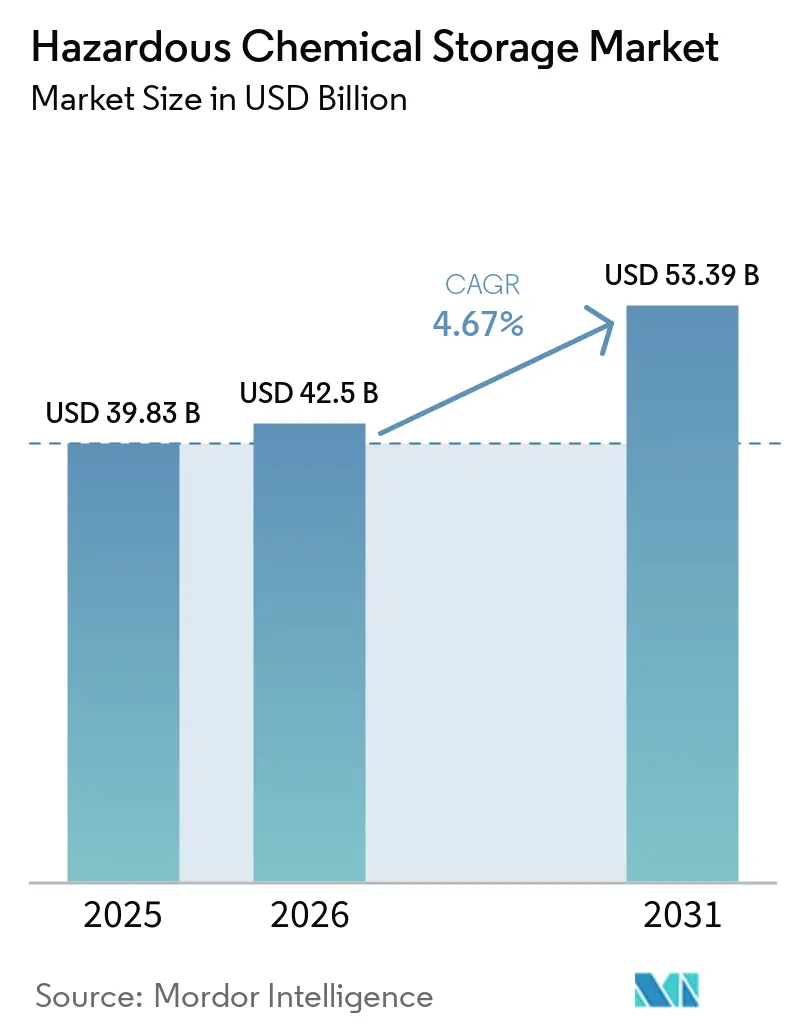
The hazardous chemical storage market size was valued at USD 39.83 billion in 2025 and is estimated to grow from USD 42.50 billion in 2026 to reach USD 53.39 billion by 2031, at a CAGR of 4.67% during the forecast period (2026-2031).
The hazardous chemical storage market is supported by tighter rules for chemical classification, segregation, labeling, and inventory reporting. OSHA’s revised Hazard Communication Standard set extended compliance deadlines to May 19, 2026, for certain manufacturers and November 20, 2026, for employers, which is prompting facilities to reassess storage layouts and records.[1] EPA’s 2026 EPCRA rule expanded hazardous chemical inventory reporting to 118 OSHA-aligned hazard categories, effective August 21, 2026, with the revised categories required for reporting beginning January 1, 2028. Chemical capacity additions, battery-material production, and port logistics are widening the need for compliant containment, while capital costs, skills gaps, and certification timelines slow adoption in some locations. Suppliers are responding with modular systems, traceable packaging, controlled battery storage, and facilities located closer to chemical production and ports.
Key Report Takeaways
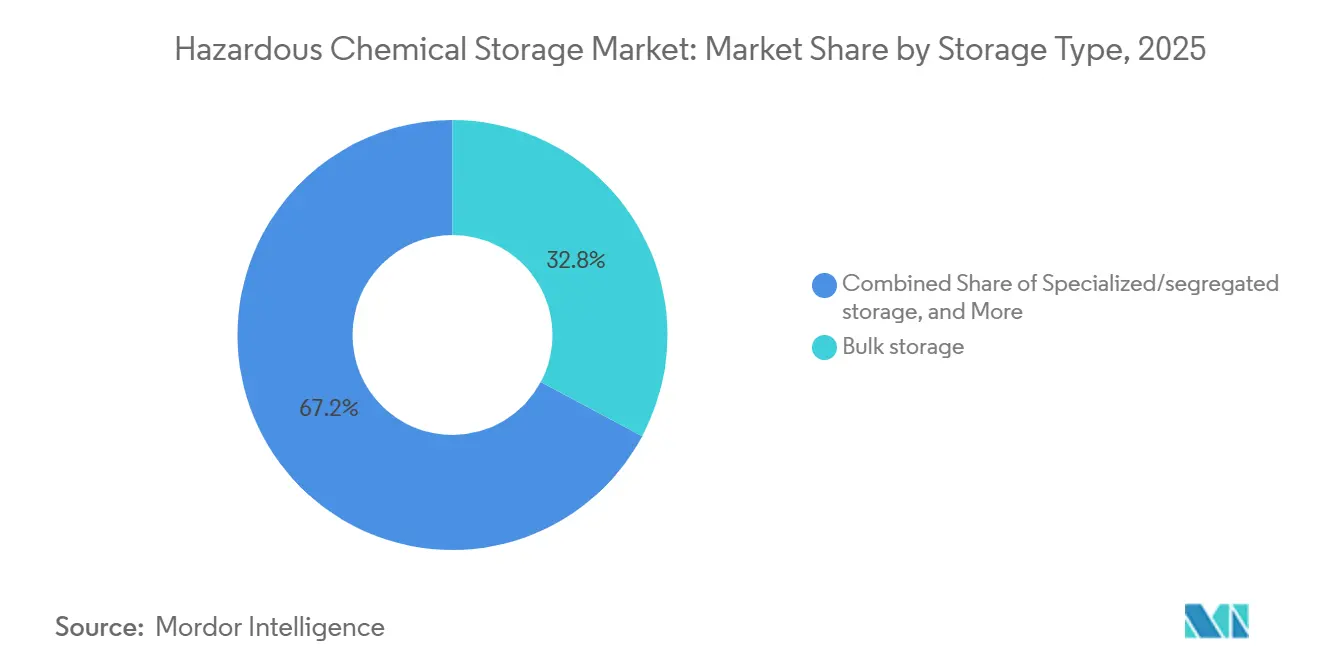
- By storage type, bulk storage held 32.80% of the hazardous chemical storage market share in 2025, while specialized and segregated storage is forecast to grow at a 6.28% CAGR through 2031.
- By hazardous chemical type, flammable chemicals accounted for 34.60% of the hazardous chemical storage market size in 2025, while reactive and water-reactive chemicals are projected to expand at a 6.61% CAGR through 2031.
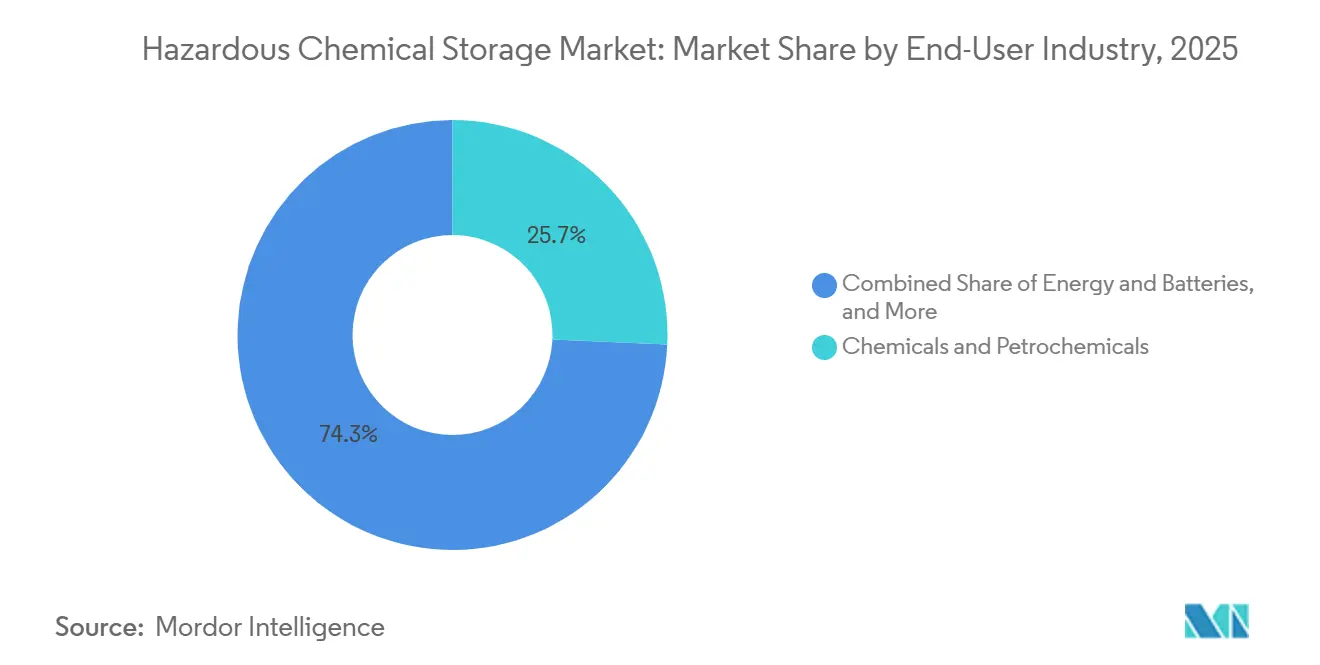
- By end-user industry, chemicals and petrochemicals represented 25.70% of total revenue in 2025, while energy and batteries are forecast to advance at a 6.44% CAGR through 2031.
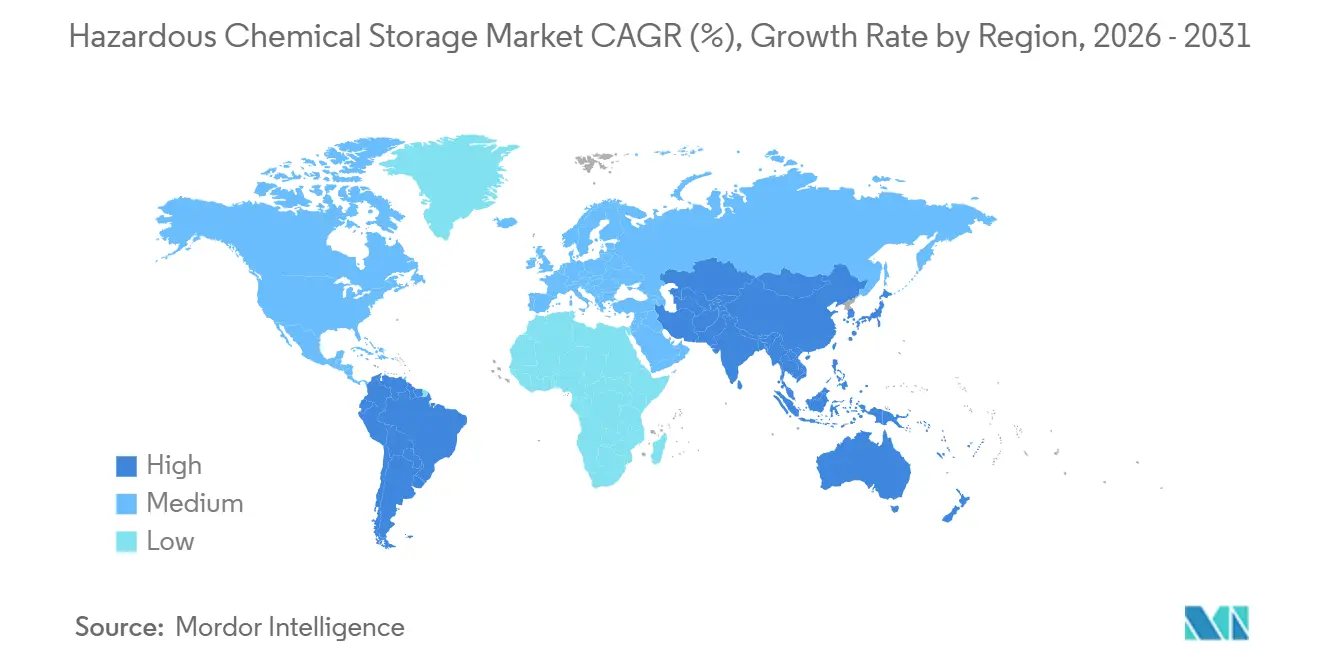
- By geography, North America held 31.30% of total revenue in 2025, while Asia-Pacific is forecast to grow at a 6.20% CAGR through 2031.
Note: Market size and forecast figures in this report are generated using Mordor Intelligence’s proprietary estimation framework, updated with the latest available data and insights as of January 2026.
Global Hazardous Chemical Storage Market Trends and Insights
Drivers Impact Analysis*
| Driver | (~) % Impact on CAGR Forecast | Geographic Relevance | Impact Timeline |
|---|---|---|---|
| Stricter Hazardous-Chemical Segregation, Labeling, and Inspection Requirements | +1.2% | North America and Europe, with effects in the Asia-Pacific, the Middle East, and Africa | Short term (≤ 2 years) |
| Expansion of Chemical, Pharmaceutical, and Specialty-Chemical Capacity | +1.0% | Global, concentrated in Asia-Pacific and North America | Long term (≥ 4 years) |
| Growth in Cross-Border Hazardous-Chemical Trade and Port-Adjacent Storage | +0.8% | Global, concentrated in Asia-Pacific ports, Antwerp, and Ruwais | Medium term (2-4 years) |
| Battery-Chemical and Electrolyte Manufacturing Requiring Controlled Storage | +0.7% | Asia-Pacific, North America, and Europe | Medium term (2-4 years) |
| Compliance Digitization and Audit-Ready Chemical Traceability | +0.5% | North America and Europe, with early gains in Asia-Pacific industrial zones | Medium term (2-4 years) |
| Replacement of Legacy Storage with Certified, Modular Systems | +0.4% | North America, Asia-Pacific, and the Middle East and Africa | Long term (≥ 4 years) |
| Source: Mordor Intelligence | |||
Stricter Hazardous-Chemical Segregation, Labeling, and Inspection Requirements
The hazardous chemical storage market is benefiting from a broader set of recognized physical hazards under OSHA’s 2024 Hazard Communication Standard. The revised standard covers aerosols, chemicals under pressure, desensitized explosives, and chemically unstable gases, each of which carries specific handling and communication requirements. EPA aligned EPCRA Sections 311 and 312 reporting with the revised OSHA structure in November 2025. Facilities need to separate and document chemicals at a more detailed level, which increases the need for classified bays, labels, and secondary containment. The move from 24 reportable categories to 112 hazard classes and subcategories favors specialized and segregated formats over co-storage of incompatible substances. OSHA’s extended transition period through November 2026 is also sustaining a requalification cycle for systems at North American and European industrial sites.
Expansion of Chemical, Pharmaceutical, and Specialty-Chemical Capacity
New chemical and pharmaceutical capacity is creating long-lived demand for storage infrastructure at production sites. BASF inaugurated its EUR 8.7 billion (USD 10.23 billion) Zhanjiang Verbund site in March 2026, with 18 plants and more than 70 products that required containment during processing and logistics. The site includes a steam cracker with an annual ethylene capacity of 1 million metric tons, showing the scale of materials handled within an integrated complex. Clariant expanded pharmaceutical-grade polyethylene glycol manufacturing at its Clear Lake, Texas, site in March 2026 to serve pharmaceutical customers in North America and Latin America. Pharmaceutical sites need controlled environments that address temperature, humidity, and cross-contamination alongside hazardous-material requirements. This creates demand for storage designs that are distinct from standard bulk tanks and general warehousing.
Growth in Cross-Border Hazardous-Chemical Trade and Port-Adjacent Storage
Cross-border chemical movements are increasing the importance of port-adjacent hazardous storage within the hazardous chemical storage market. Bertschi opened its Antwerp Zomerweg Terminal in 2025, a 60,000 m² facility for dangerous goods and non-dangerous-goods tank containers. The terminal accommodates more than 2,500 TEUs, including 1,290 dedicated dangerous-goods TEUs, and connects rail, barge, and road transport. Port facilities need to manage several transport frameworks at once, including ADR, the IMDG Code, and the IATA Dangerous Goods Regulations. IMDG Code Amendment 42-24 became mandatory from January 2026, adding requirements relevant to battery energy storage systems.[2] These combined obligations favor suppliers able to provide storage designs and documentation suited to multiple transport codes.
Battery-Chemical and Electrolyte Manufacturing Requiring Controlled Storage
Battery materials are creating a separate area of controlled storage demand within the hazardous chemical storage market. Electrolytes, lithium salts, organic carbonates, and sodium-ion chemistries can require humidity control, nitrogen blanketing, and continuous atmospheric monitoring. The EU Battery Regulation introduced battery passport requirements for industrial batteries above 2 kWh, applicable from February 2027, increasing information requirements on battery composition and lifecycle characteristics across the value chain.[3] IMDG Code Amendment 42-24 added provisions for battery energy storage systems and maintained the state-of-charge requirement for lithium-ion battery sea transport. IATA’s 67th Edition Dangerous Goods Regulations also provides current guidance for lithium battery transport in 2026. As a result, operators increasingly need certified infrastructure that can address battery chemicals and broader industrial chemical controls in the same location.
Restraints Impact Analysis*
| Restraint | (~) % Impact on CAGR Forecast | Geographic Relevance | Impact Timeline |
|---|---|---|---|
| High Capital and Site-Modification Costs for Compliant Storage | -0.9% | Global, most acute in emerging markets across Asia-Pacific and South America | Long term (≥ 4 years) |
| Shortage of Qualified Hazardous-Material Operators and Maintenance Personnel | -0.6% | North America and Europe, with growing relevance in the Asia-Pacific | Long term (≥ 4 years) |
| Certification and Qualification Bottlenecks for New Storage Designs | -0.4% | Global, most pronounced in North America and Europe | Medium term (2-4 years) |
| Chemical Compatibility, Permeation, and Material-Degradation Risk | -0.3% | Global | Medium term (2-4 years) |
| Source: Mordor Intelligence | |||
High Capital and Site-Modification Costs for Compliant Storage
High compliance costs can delay projects in the hazardous chemical storage market, especially for mid-sized operators and sites in cost-sensitive regions. Secondary containment requirements vary by material and regulatory program; applicable federal, state, and local requirements should be used to determine the required containment capacity.[4] Facilities that hold highly hazardous chemicals above threshold quantities can also fall under OSHA Process Safety Management requirements, including process hazard analysis, mechanical integrity programs, and pre-startup reviews. These obligations extend spending beyond the storage structure to engineering, inspection, maintenance, and recordkeeping. Modular units can reduce site construction work, but they remain subject to spill prevention and containment obligations under federal rules. Smaller facilities may, therefore, defer upgrades even when the safety and regulatory case for investment is clear.
Shortage of Qualified Hazardous-Material Operators and Maintenance Personnel
A limited supply of trained workers can constrain the practical deployment of advanced storage systems. OSHA’s HAZWOPER standard requires defined training, refresher instruction, and medical surveillance for personnel involved in hazardous-waste operations and emergency response. These requirements cannot be fully replaced by abbreviated or online-only training. Experienced operators also carry knowledge of legacy equipment, maintenance risks, and response procedures that are difficult to transfer through routine onboarding. The shortage is relevant when facilities introduce sensor-enabled systems that require staff to interpret alerts, maintain equipment, and produce audit-ready records. Capital investment can, therefore, deliver less value when operating capability does not keep pace with the system installed.
*Our forecasts treat driver/restraint impacts as directional, not additive. The impact forecasts reflect baseline growth, mix effects, and variable interactions.
Segment Analysis
By Storage Type: Segregated Systems Gaining Ground on Bulk Dominance
Bulk storage accounted for 32.80% of total revenue in 2025. It remains central to petrochemical, agrochemical, and industrial chemical production, where large feedstock volumes are stored at production sites and distribution locations. Acids, solvents, caustic soda, and chlorine are examples of materials commonly held in large-volume systems. Chemicals and petrochemicals provide much of this demand, notably in the United States Gulf Coast and expanding Asia-Pacific clusters. Tank storage complements bulk systems for pressurized or temperature-sensitive single-product streams. Packaged storage is more suitable for mixed inventories at smaller facilities, laboratories, and distribution centers.
Specialized and segregated storage is forecast to grow at a 6.28% CAGR from 2026 to 2031. Within the hazardous chemical storage market, this format is supported by new hazard subcategories that require physical separation of aerosols, unstable gases, pyrophoric liquids, and reactive substances. Battery chemical production also needs humidity-controlled and nitrogen-purged enclosures. EPA spill prevention rules apply to both modular and fixed systems, so operators can choose factory-certified units without changing their compliance obligations. Pre-engineered modular units can shorten commissioning compared with custom construction. This timing advantage is useful in battery and semiconductor supply chains where storage needs can emerge quickly.
By Hazardous Chemical Type: Reactive Chemistries Define the Growth Frontier
Flammable chemicals accounted for 34.60% of the hazardous chemical storage market share in 2025. Their lead reflects extensive use in petroleum refining, coatings, pharmaceutical solvent handling, and specialty chemical production. OSHA limits the storage of flammable liquids in safety cabinets and sets requirements for larger quantities held in dedicated storage rooms. These rules support continuing demand for fire-rated cabinets and controlled storage rooms. Corrosive chemicals are another large category because semiconductor fabrication, water treatment, and metalworking require acids and alkalis. Toxic and oxidizing chemicals remain regulated segments that need separation from incompatible materials.
Reactive and water-reactive chemicals are forecast to grow at a 6.61% CAGR from 2026 to 2031. The hazardous chemical storage market is being shaped by lithium hexafluorophosphate, organic carbonate solvents, and sodium-based electrolytes that are sensitive to moisture. These materials need humidity-controlled environments, nitrogen blanketing, and continuous atmospheric monitoring. Current maritime rules recognize battery energy storage systems and set transport provisions relevant to lithium-ion batteries. IATA’s 2026 guidance also addresses the transport of lithium batteries. The controls needed before shipping reinforce demand for compliant pre-transport storage.
By End-User Industry: Energy and Batteries Disrupt Established Demand Hierarchy
Chemicals and petrochemicals represented 25.70% of the hazardous chemical storage market size in 2025. The sector both produces and consumes hazardous substances across feedstock storage, intermediate handling, and finished-product warehousing. Oil and gas are the second-largest end users because refineries, upstream processing facilities, and distribution terminals hold flammable, corrosive, and toxic inventories. Pharmaceutical and life sciences sites need to meet hazardous-material requirements alongside good manufacturing practice controls. Clariant’s Texas pharmaceutical-grade polyethylene glycol expansion illustrates the wider pharmaceutical capacity development that requires controlled material handling. Agrochemicals, fertilizers, mining and metals, paints and coatings, and automotive applications provide stable demand based on established operating requirements.
Energy and batteries are forecast to grow at a 6.44% CAGR from 2026 to 2031. Within the hazardous chemical storage market, this segment requires storage for electrolyte precursors and other controlled battery materials. EU battery passport requirements increase documentation expectations for industrial batteries above 2 kWh and apply across the relevant supply chain. Electronics and semiconductors also require high-purity acids and specialty solvents in dedicated, contamination-controlled systems. These facilities commonly need real-time atmospheric monitoring in addition to physical containment. The resulting requirements create demand for systems that combine environmental control, segregation, and traceable records.
Geography Analysis
North America held 31.30% of global revenue in 2025. The hazardous chemical storage market in the region operates under a broad enforcement system that includes OSHA, EPA, RCRA, and state environmental agencies. The Gulf Coast concentrates production and logistics activities that require chemical containment at closely located sites. The 2026 OSHA compliance deadlines are driving an active review of segregation configurations and documentation systems. Shintech announced a USD 3.4 billion investment in 2025 to expand PVC, vinyl chloride monomer, and caustic soda production in Louisiana. The planned addition of 625,000 metric tons of annual ethylene capacity indicates additional containment needs at the Plaquemine site.
Asia-Pacific is forecast to grow at a 6.20% CAGR from 2026 to 2031. The hazardous chemical storage market size in the region is linked to chemical, pharmaceutical, and battery manufacturing investment across China, India, and Southeast Asia. BASF’s Zhanjiang Verbund site commenced production in late 2025 and was officially inaugurated in March 2026. Its integrated production model shows why storage is often built close to manufacturing assets. The region also requires controlled systems for reactive and humidity-sensitive battery materials. South America remains smaller, but Brazilian agrochemicals and Chilean lithium mining provide focused demand for corrosive and reactive chemical storage.
Europe remains an important hazardous chemical storage market because of the Antwerp-Rotterdam-Amsterdam chemical cluster, Germany’s chemical base, and stringent major-hazard requirements. The hazardous chemical storage market in the region is supported by facilities that need to manage production, packaging, and logistics in the same industrial areas. Bertschi’s Antwerp terminal demonstrates investment in storage linked with rail, barge, and truck connections for dangerous goods. The Middle East and Africa is developing as a port-based chemicals storage location serving Asian and African export routes. These projects need storage that can manage transport compliance alongside plant-level containment. Co-location and multi-code compliance are, therefore, relevant across both Europe and the Middle East and Africa.
Competitive Landscape
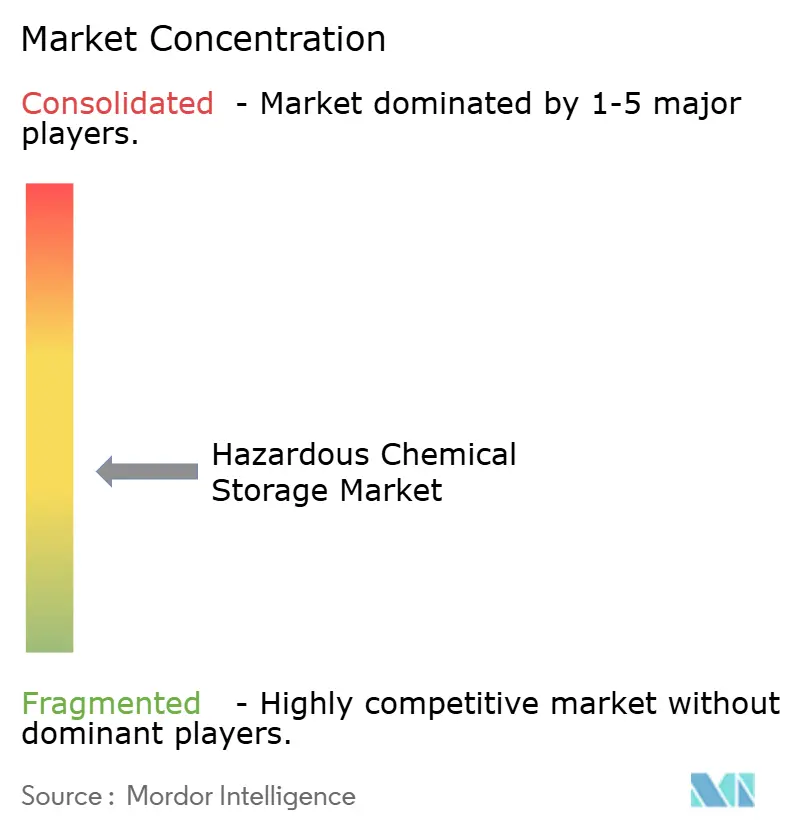
The hazardous chemical storage market has moderately fragmented competitive intensity, with safety product specialists, engineered storage providers, and industrial packaging companies serving overlapping needs. DENIOS and Justrite Safety Group compete through certified safety cabinets, spill containment products, and battery storage products. Justrite launched the Utili-Guard+ flammable safety cabinet in 2025 with FM approval and stated compliance with OSHA, NFPA, and International Fire Code standards. The product includes a 2-inch leakproof containment sump designed for hazardous liquid storage. Industrial packaging suppliers are also adding traceability to containers. Greif introduced a Track and Trace system in Europe in 2025 using a data-matrix code for drum-level identification and production data access.
Competition in the hazardous chemical storage market increasingly centers on modular design, certification, and lead times rather than price alone. Pre-engineered systems can reduce construction activity on site and simplify commissioning for operators with urgent capacity needs. Certified container and cabinet products help buyers demonstrate alignment with safety and containment requirements. Traceability also makes the storage asset part of a wider documentation system for chemical handling. Suppliers that can support reactive chemicals and battery electrolytes face a more demanding technical requirement than suppliers focused on conventional bulk storage. This creates opportunities in Asia-Pacific battery supply chains and in port facilities that need to follow several international transport codes.
The hazardous chemical storage market is also moving toward connected monitoring across temperature, gas concentration, and containment integrity. These systems can help operators prepare records for inspections and inventory reporting. The need is strongest where advanced equipment is paired with trained staff able to maintain sensors and act on alerts. Greif’s drum-level data system provides one example of how identification is moving closer to the packaging itself. Bertschi’s Antwerp terminal provides another example through dedicated dangerous-goods capacity linked to several transport modes. Justrite’s 2025 cabinet launch shows continued product development around fire and liquid containment.
Hazardous Chemical Storage Industry Leaders
-
DENIOS AG
-
Justrite Safety Group
-
asecos GmbH
-
Kewaunee Scientific Corporation
-
Securall Products
- *Disclaimer: Major Players sorted in no particular order
Recent Industry Developments
- March 2026: BASF formally inaugurated its EUR 8.7 billion (USD 10.23 billion) Zhanjiang Verbund site in China, its third-largest production site globally, with 18 plants producing more than 70 products, including a 1-million-metric-ton-per-year steam cracker powered entirely by renewable energy.
- March 2026: Clariant announced the expansion of pharmaceutical-grade polyethylene glycol manufacturing into North America, establishing a GMP-compliant production facility at its Clear Lake, Texas, site, serving pharmaceutical manufacturers across North America and Latin America.
- March 2026: Shintech, Shin-Etsu Chemical’s United States subsidiary, announced a USD 3.4 billion investment to expand PVC, VCM, and caustic soda production at its Plaquemine, Louisiana, site, adding 625,000 metric tons of annual ethylene capacity and 310,000 metric tons of caustic soda with expected completion toward the end of 2030.
- September 2025: Justrite Safety Group launched the Utili-Guard+ flammable safety cabinet, with FM approval and stated alignment with OSHA, NFPA, and International Fire Code standards, including a 2-inch leakproof containment sump.
Global Hazardous Chemical Storage Market Report Scope
| Bulk storage |
| Packaged storage |
| Tank storage |
| Specialized/segregated storage |
| Flammable Chemicals |
| Corrosive Chemicals |
| Toxic Chemicals |
| Oxidizing Chemicals |
| Reactive and Water-Reactive Chemicals |
| Other Hazardous Chemicals |
| Chemicals and Petrochemicals |
| Oil and Gas |
| Pharmaceuticals and Life Sciences |
| Agrochemicals and Fertilizers |
| Paints, Coatings, Adhesives, and Inks |
| Mining and Metals |
| Electronics and Semiconductors |
| Energy and Batteries |
| Automotive |
| Other End-User Industries |
| North America | United States |
| Canada | |
| Mexico | |
| South America | Brazil |
| Argentina | |
| Peru | |
| Chile | |
| Rest of South America | |
| Europe | Germany |
| United Kingdom | |
| France | |
| Italy | |
| Spain | |
| Russia | |
| Nordics (Denmark, Finland, Iceland, Norway, and Sweden) | |
| Rest of Europe | |
| Asia-Pacific | China |
| India | |
| Japan | |
| South Korea | |
| Australia | |
| Southeast Asia (ASEAN) | |
| Rest of Asia-Pacific | |
| Middle East and Africa | Saudi Arabia |
| United Arab Emirates | |
| Qatar | |
| South Africa | |
| Nigeria | |
| Egypt | |
| Rest of Middle East and Africa |
| By Storage Type | Bulk storage | |
| Packaged storage | ||
| Tank storage | ||
| Specialized/segregated storage | ||
| By Hazardous Chemical Type | Flammable Chemicals | |
| Corrosive Chemicals | ||
| Toxic Chemicals | ||
| Oxidizing Chemicals | ||
| Reactive and Water-Reactive Chemicals | ||
| Other Hazardous Chemicals | ||
| By End-User Industry | Chemicals and Petrochemicals | |
| Oil and Gas | ||
| Pharmaceuticals and Life Sciences | ||
| Agrochemicals and Fertilizers | ||
| Paints, Coatings, Adhesives, and Inks | ||
| Mining and Metals | ||
| Electronics and Semiconductors | ||
| Energy and Batteries | ||
| Automotive | ||
| Other End-User Industries | ||
| By Geography | North America | United States |
| Canada | ||
| Mexico | ||
| South America | Brazil | |
| Argentina | ||
| Peru | ||
| Chile | ||
| Rest of South America | ||
| Europe | Germany | |
| United Kingdom | ||
| France | ||
| Italy | ||
| Spain | ||
| Russia | ||
| Nordics (Denmark, Finland, Iceland, Norway, and Sweden) | ||
| Rest of Europe | ||
| Asia-Pacific | China | |
| India | ||
| Japan | ||
| South Korea | ||
| Australia | ||
| Southeast Asia (ASEAN) | ||
| Rest of Asia-Pacific | ||
| Middle East and Africa | Saudi Arabia | |
| United Arab Emirates | ||
| Qatar | ||
| South Africa | ||
| Nigeria | ||
| Egypt | ||
| Rest of Middle East and Africa | ||
Key Questions Answered in the Report
What is the forecast value of hazardous chemical storage in 2031?
The hazardous chemical storage market is forecast to reach USD 53.39 billion by 2031, expanding at a 4.67% CAGR from 2026. Regulatory upgrades, chemical capacity additions, and controlled battery-material storage support this growth.
Which storage type leads the hazardous chemical storage demand?
Bulk storage led with 32.80% share in 2025, reflecting its use in high-volume chemical, petrochemical, and agrochemical operations. The hazardous chemical storage market also uses bulk systems for large-volume feedstocks.
Which chemical category is growing fastest?
Reactive and water-reactive chemicals are forecast to grow at a 6.61% CAGR through 2031 because battery electrolytes and related materials need controlled storage.
Why are segregated storage systems gaining demand?
The hazardous chemical storage market requires more physical separation, labeling, and controlled containment as hazard classifications expand and incompatible chemical combinations are identified.
Which region is expanding fastest through 2031?
Asia-Pacific is forecast to grow at a 6.20% CAGR, supported by chemical, pharmaceutical, and battery manufacturing investment across China, India, and Southeast Asia.
What limits the adoption of compliant hazardous chemical storage systems?
High site-modification costs and a shortage of qualified operators can delay upgrades, particularly among smaller or cost-sensitive facilities that need to fund engineering, inspection, maintenance, training, and recordkeeping activities.