
Hair Conditioner Market Size and Share
Market Overview
| Study Period | 2027 - 2032 |
|---|---|
| Market Size (2027) | USD 21.76 Billion |
| Market Size (2032) | USD 30.37 Billion |
| Growth Rate (2027 - 2032) | 6.89 % |
| Fastest Growing Market | Asia-Pacific |
| Largest Market | Asia-Pacific |
| Market Concentration | Medium |
Major Players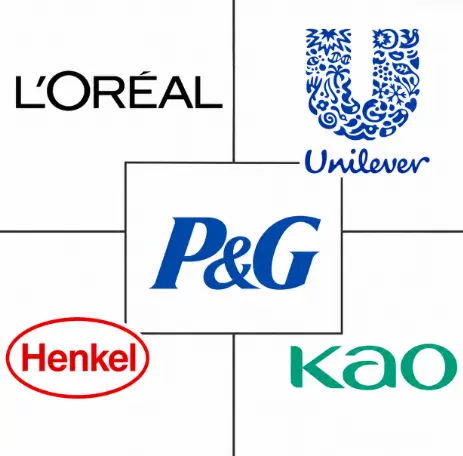 *Disclaimer: Major Players sorted in no particular order Image © Mordor Intelligence. Reuse requires attribution under CC BY 4.0. | |
Hair Conditioner Market Analysis by Mordor Intelligence
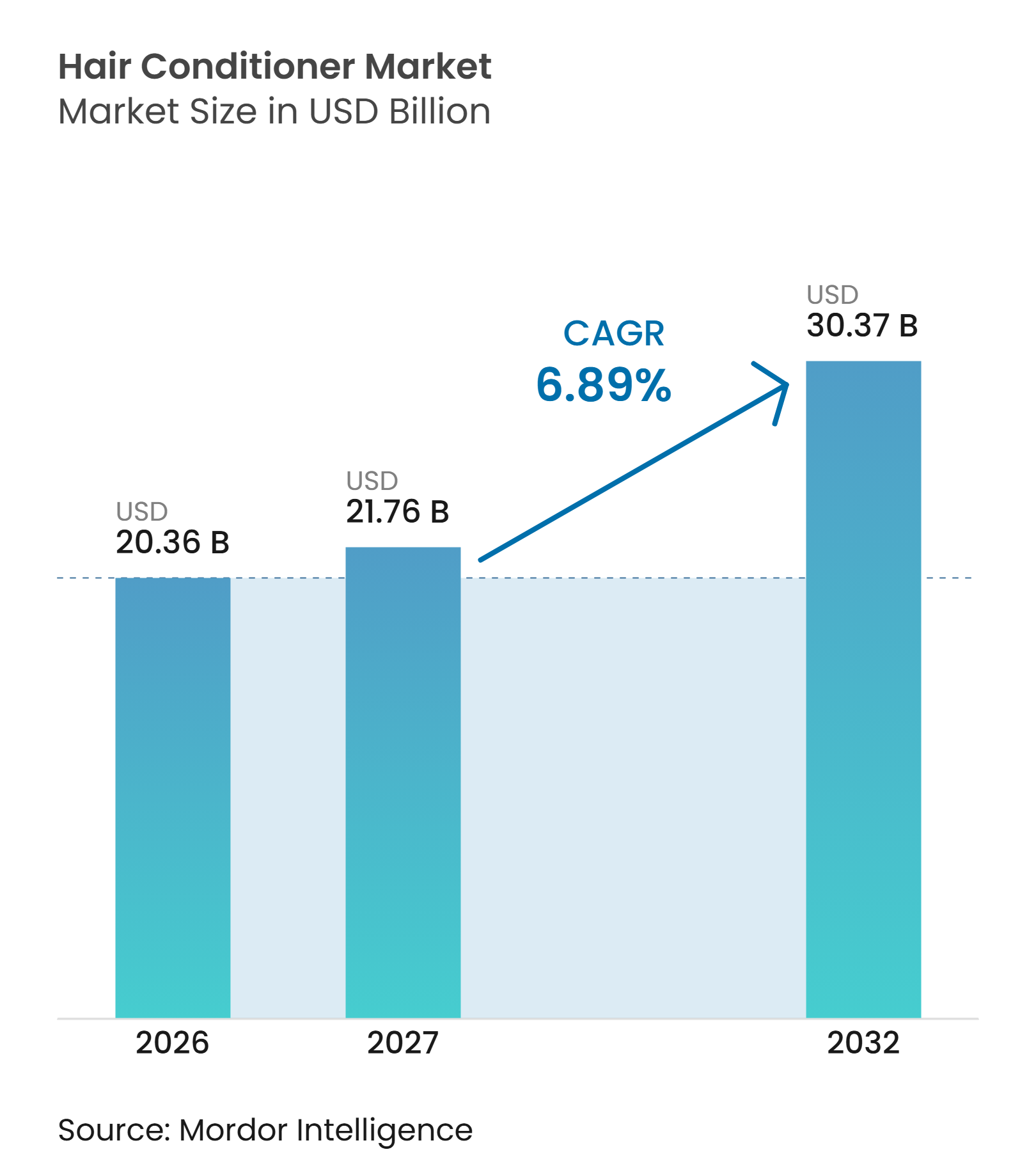
The hair conditioner market size is expected to increase from USD 20.36 billion in 2026 to USD 21.76 billion in 2027 and reach USD 30.37 billion by 2032, growing at a CAGR of 6.89% over 2027–2032. Growth is supported by increasing consumer focus on hair health, rising demand for specialized hair care formulations, and greater awareness of damage repair, scalp care, and hair fall prevention. Damage repair and strengthening products account for the largest share at 35.00% in 2026, reflecting sustained demand for conditioners that improve hair strength, manageability, and overall hair health. The growing popularity of anti-hair fall formulations, premium hair care products, and natural and organic ingredients creates opportunities for product differentiation and value-added offerings. Meanwhile, supermarkets and hypermarkets remain the leading distribution channel, while online retail stores are expected to record the fastest growth at a CAGR of 8.41% during 2026–2031, supported by expanding e-commerce accessibility and digital product discovery. Asia-Pacific dominates the market with a 47.12% share in 2026, driven by its large consumer base and established hair care consumption patterns. However, competition among established brands, concerns regarding product ingredients, counterfeit products, and fluctuations in raw material prices may constrain market expansion. Growth therefore favors manufacturers that can develop targeted hair care solutions, strengthen natural and premium product portfolios, and expand their presence across both physical and digital retail channels.
Key Report Takeaways
- By hair concern, damage repair and strengthening products accounted for the largest share at 35.00% in 2026, while anti-hair fall and hair growth products are forecast to grow fastest at a 7.20% CAGR over 2026–2031.
- By end user, adults accounted for the largest share at 74.05% in 2026, while the kids/children segment is projected to record the fastest growth at a 7.12% CAGR over 2026–2031.
- By category, mass products dominated with a 65.64% market share in 2026, while premium products are expected to grow fastest at a 7.49% CAGR over 2026–2031.
- By ingredients, conventional/synthetic products held the largest share at 63.85% in 2026, while natural/organic products are forecast to grow fastest at a 6.95% CAGR over 2026–2031.
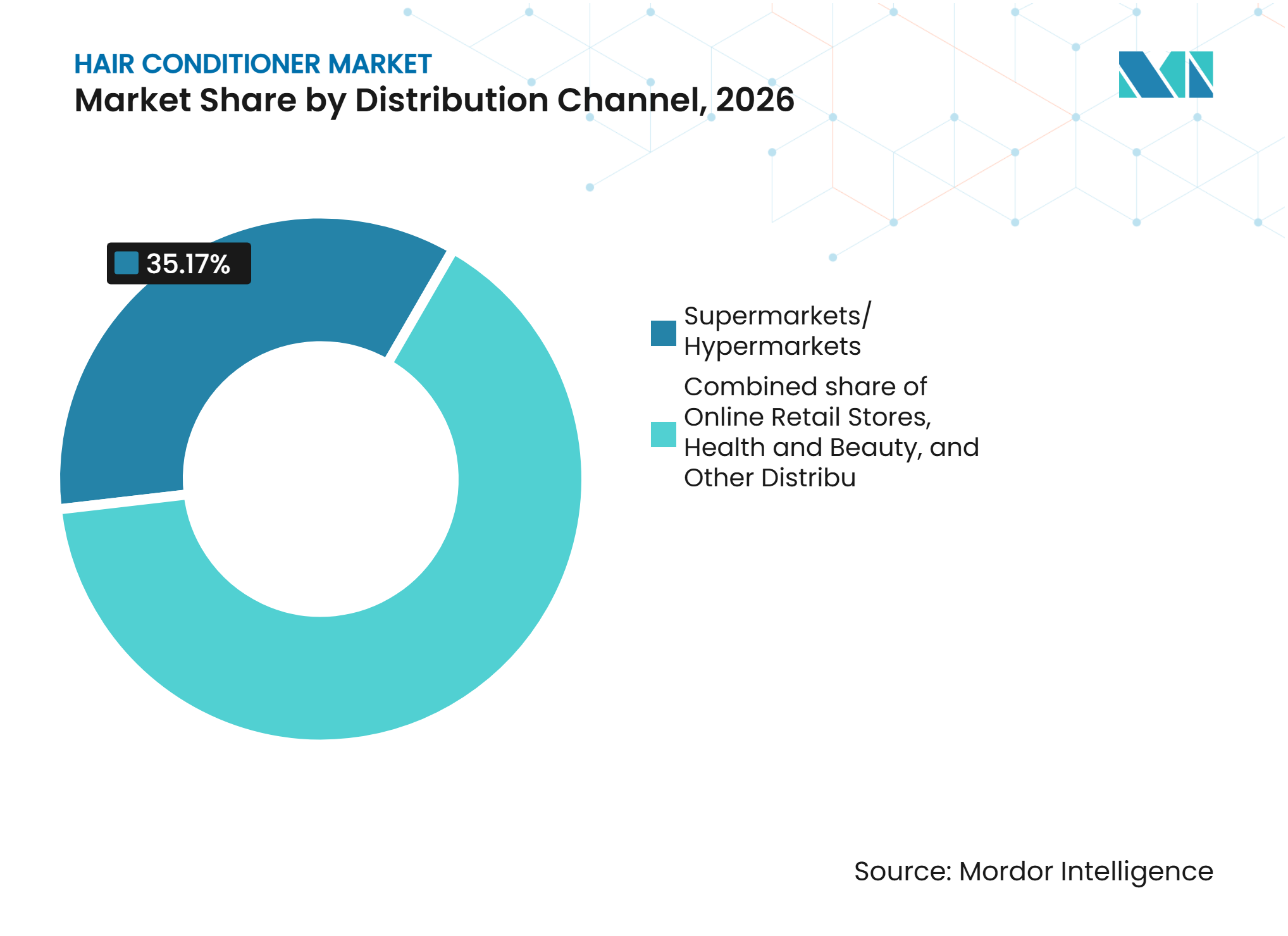
- By distribution channel, supermarkets/hypermarkets accounted for the largest share at 35.17% in 2026, while online retail stores are projected to record the fastest growth at an 8.41% CAGR over 2026–2031.
- Among geographies, Asia-Pacific led with a 47.12% share of the hair conditioner market in 2026 and is also forecast to grow at the fastest rate, with a 6.90% CAGR over 2026–2031.
Note: Market numbers in this report are based on Mordor Intelligence's proprietary estimation framework, which combines nine months of actuals with Q4 projections for base year 2026.
Market Trends and Insights
Drivers of Hair Conditioner Market*
| Driver | (~) % Impact on CAGR Forecast | Geographic Relevance | Impact Timeline |
|---|---|---|---|
| Strong demand for hair conditioners formulated with clean-label ingredients | +0.8% | Global, particularly North America and Europe, where consumers increasingly prioritize ingredient transparency and cleaner formulations | Medium term (2–4 years) |
| Influence of social media and celebrity endorsements on hair care purchasing decisions | +0.7% | Global, particularly North America, Europe and Asia-Pacific, where digital platforms and beauty influencers shape product discovery and brand preferences | Short term (Less than 2 years) |
| Consumers' inclination toward natural and organic hair conditioner products | +0.8% | Global, particularly North America and Europe, with growing opportunities across Asia-Pacific as demand for plant-derived and naturally positioned formulations expands | Medium term (2–4 years) |
| Consumer demand for multicultural hair conditioners catering to diverse hair textures and needs | +0.6% | Global, particularly North America and Europe, where diverse consumer demographics support demand for specialized hair care formulations | Medium term (2–4 years) |
| Increasing popularity of customized hair care solutions and targeted conditioner formulations | +0.7% | Global, particularly North America, Europe and Asia-Pacific, where personalized beauty products and targeted hair care routines are gaining consumer interest | Long term (More than 4 years) |
| Source: Mordor Intelligence | |||
Strong Demand for Products Formulated with Clean-Label Ingredients
Consumers are increasingly evaluating hair conditioner formulations based on ingredient transparency, perceived safety, and product performance. Demand for clean-label positioning is encouraging manufacturers to offer conditioners with clearly communicated ingredient lists, plant-derived components, and formulations that address specific hair-care needs. NSF's 2025 consumer research found that 74% of surveyed US consumers considered organic ingredients important in personal care products, highlighting the relevance of ingredient choices in purchasing decisions [1]. This trend creates opportunities for conditioner brands to differentiate their portfolios through transparent formulation practices, credible certifications, and clearly substantiated product claims. However, manufacturers need to balance clean-label positioning with formulation stability, conditioning performance, and affordability.
Influence of Social Media and Celebrity Endorsement
Social media platforms, beauty influencers, and celebrity endorsements are increasingly shaping how consumers discover and evaluate hair-care products. Tutorials, product demonstrations, reviews, and hair-care routines help consumers compare conditioners based on formulation, suitability for different hair types, and expected benefits. EMARKETER's 2025 analysis of US beauty purchasing behavior found that 16.2% of beauty shoppers considered celebrity and influencer endorsements a factor in purchase conversion, with the influence substantially higher among Gen Z consumers [2]. For hair conditioner manufacturers, creator partnerships and social media campaigns provide opportunities to demonstrate product performance, introduce new formulations, and strengthen brand visibility. However, sustained engagement depends on credible recommendations, transparent product communication, and consistent consumer experiences.
Consumers' Inclination Towards Natural and Organic Products
Growing consumer interest in naturally positioned personal care products is encouraging manufacturers to expand conditioner formulations featuring botanical extracts, plant-derived oils, and other naturally sourced ingredients. This preference is also reflected in broader personal care purchasing behavior, with NSF's 2025 research identifying strong consumer interest in organic ingredients and third-party certification [3]. In hair care, naturally derived ingredients such as aloe vera, botanical extracts, and essential oils provide opportunities to develop products positioned around nourishment, moisture retention, and scalp care. Brands can use these formulations to differentiate their portfolios and appeal to consumers seeking alternatives to conventional ingredient systems. Nevertheless, manufacturers must ensure that natural and organic positioning is supported by ingredient traceability, formulation efficacy, and accurate product claims.
Consumer Demand for Multicultural Hair Conditioners
Increasing recognition of diverse hair textures and conditioning requirements is creating opportunities for specialized hair conditioner products. Consumers with straight, wavy, curly, coily, and textured hair may have different requirements for moisture retention, frizz management, detangling, breakage prevention, and hair manageability. Clearwater's 2025 beauty and personal care analysis highlights texture, curl, and cultural inclusivity as important hair-care themes, noting the need for tailored solutions across different hair types [4]. This creates opportunities for manufacturers to develop targeted conditioners for specific textures and hair concerns rather than relying exclusively on standardized formulations. Brands that combine inclusive product development with suitable formulation performance and relevant consumer communication can strengthen their appeal across multicultural consumer groups.
Increasing Popularity of Customized Hair Care Solutions
Growing consumer awareness of individual hair characteristics is supporting demand for personalized hair-care routines and targeted conditioner formulations. Consumers are increasingly seeking products suited to their hair type, texture, condition, and specific concerns, including dryness, damage, frizz, and hair fall. Mintel's 2024 research found that 44% of surveyed Indian consumers expressed interest in personalized hair-care products tailored to their individual hair types . For conditioner manufacturers, this trend creates opportunities to introduce targeted product ranges, customized recommendations, and digital tools that help consumers identify suitable formulations. Personalized product discovery can also encourage routine-based purchases and strengthen brand engagement. However, manufacturers need reliable consumer insights and formulation capabilities to ensure that customized recommendations translate into meaningful product benefits.
Restraints of Hair Conditioner Market*
| Restraint | (~) % Impact on CAGR Forecast | Geographic Relevance | Impact Timeline |
|---|---|---|---|
| Consumer concerns over product safety and ingredients | −0.7% | Global, particularly North America and Europe, where ingredient transparency, product safety expectations and regulatory scrutiny influence purchasing decisions | Medium term (2–4 years) |
| Counterfeit products affecting brand reputation | −0.5% | Global, particularly price-sensitive and fragmented retail markets across Asia-Pacific, South America and the Middle East and Africa | Medium term (2–4 years) |
| High competition among established players | −0.6% | Global, particularly North America, Europe and Asia-Pacific, where established multinational brands and specialized hair-care companies compete across mass and premium product categories | Short term (Less than 2 years) |
| Fluctuations in raw material prices impacting profit margins | −0.5% | Global, particularly manufacturing-dependent markets and regions reliant on imported conditioning agents, fragrances, oils and specialty ingredients | Medium term (2–4 years) |
| Source: Mordor Intelligence | |||
Consumer Concerns Over Product Safety and Ingredients
Hair conditioner formulations contain combinations of conditioning agents, preservatives, fragrances, surfactants, silicones, and other functional ingredients, making product safety and ingredient transparency important considerations for consumers. Growing awareness of potential irritation, allergic reactions, and sensitivity to certain cosmetic ingredients can influence purchasing decisions, particularly among consumers with sensitive scalps or specific hair-care requirements. Regulatory requirements governing cosmetic ingredients, product safety assessments, labelling, and permitted claims also increase compliance responsibilities for manufacturers. Companies must therefore invest in formulation testing, ingredient evaluation, and transparent product communication to maintain consumer confidence. These requirements can increase product development and compliance costs, while concerns surrounding particular ingredients may restrict demand for some conventional conditioner formulations.
Counterfeit Products Affecting Brand Reputation
The availability of counterfeit and unauthorized hair-care products can undermine consumer confidence and affect the reputation of established conditioner brands. Counterfeit products may imitate branded packaging, product names, and claims while using ingredients or manufacturing processes that differ from those of the genuine products. Such products can create safety and performance concerns, particularly when consumers cannot easily distinguish authentic conditioners from unauthorized alternatives across online marketplaces and fragmented retail channels. The problem can also result in lost sales, pricing pressure, and reduced brand loyalty for legitimate manufacturers. Companies therefore need to strengthen product authentication, packaging security, distribution monitoring, and cooperation with e-commerce platforms to protect brand value and consumer trust.
*Our forecasts treat driver/restraint impacts as directional, not additive. The impact forecasts reflect baseline growth, mix effects, and variable interactions.
Hair Conditioner Market Segment Analysis
By Hair Concern:
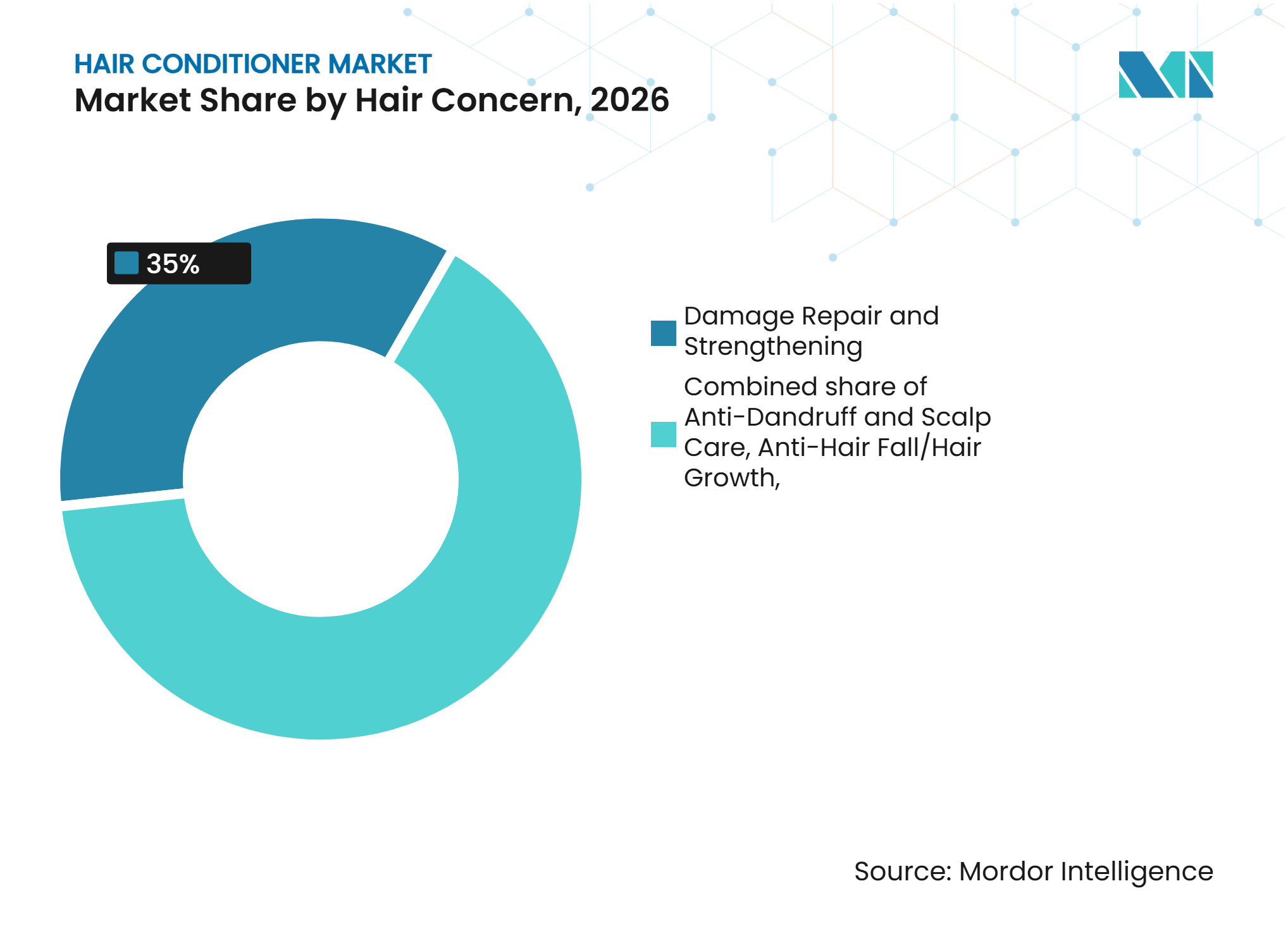
Damage Repair and Strengthening Leads While Anti-Hair Fall Products Expand FasterIn 2026, damage repair and strengthening products accounted for 35.00% of the hair conditioner market, making them the leading segment by hair concern. Their position reflects consumer demand for conditioners that address common hair problems such as dryness, breakage, split ends, and damage caused by heat styling, chemical treatments, and environmental exposure. Meanwhile, anti-hair fall and hair growth conditioners are projected to record the fastest growth, at a CAGR of 7.20% over 2026–2031. Growing consumer attention to hair thinning, scalp health, and hair-strengthening routines is encouraging manufacturers to develop targeted formulations with ingredients positioned to support stronger and healthier-looking hair.
Anti-dandruff and scalp care conditioners address concerns related to scalp comfort, dryness, and flaking, while color protection products cater to consumers seeking to maintain dyed hair appearance and manageability. Other formulations serve additional requirements, including frizz control, hydration, and specialized hair care. Across these segments, manufacturers are focusing on targeted product benefits, ingredient innovation, and formulations suited to different hair types and concerns. The ability to combine conditioning performance with specialized hair-care benefits will remain important for product differentiation and market expansion.



By End User:
Adults Lead While Kids/Children Products Expand FasterIn 2026, adult consumers accounted for 74.05% of the hair conditioner market, making them the leading end-user segment. This dominance reflects the broader use of conditioners in adult hair-care routines, supported by demand for products addressing dryness, damage repair, frizz management, scalp care, and color protection. Meanwhile, the kids/children segment is projected to record the fastest growth, at a CAGR of 7.12% over 2026–2031. Growing parental attention to children's personal care and demand for age-appropriate products are creating opportunities for conditioners formulated with gentle cleansing and conditioning systems.
Adult-focused conditioners continue to serve a wider range of hair textures, styling preferences, and specific hair concerns, encouraging manufacturers to maintain extensive product portfolios. In contrast, children's products are generally positioned around gentle formulations, ease of application, and suitability for younger users. Manufacturers that address the distinct formulation and communication requirements of both groups can strengthen their reach across household hair-care purchases.
By Category:
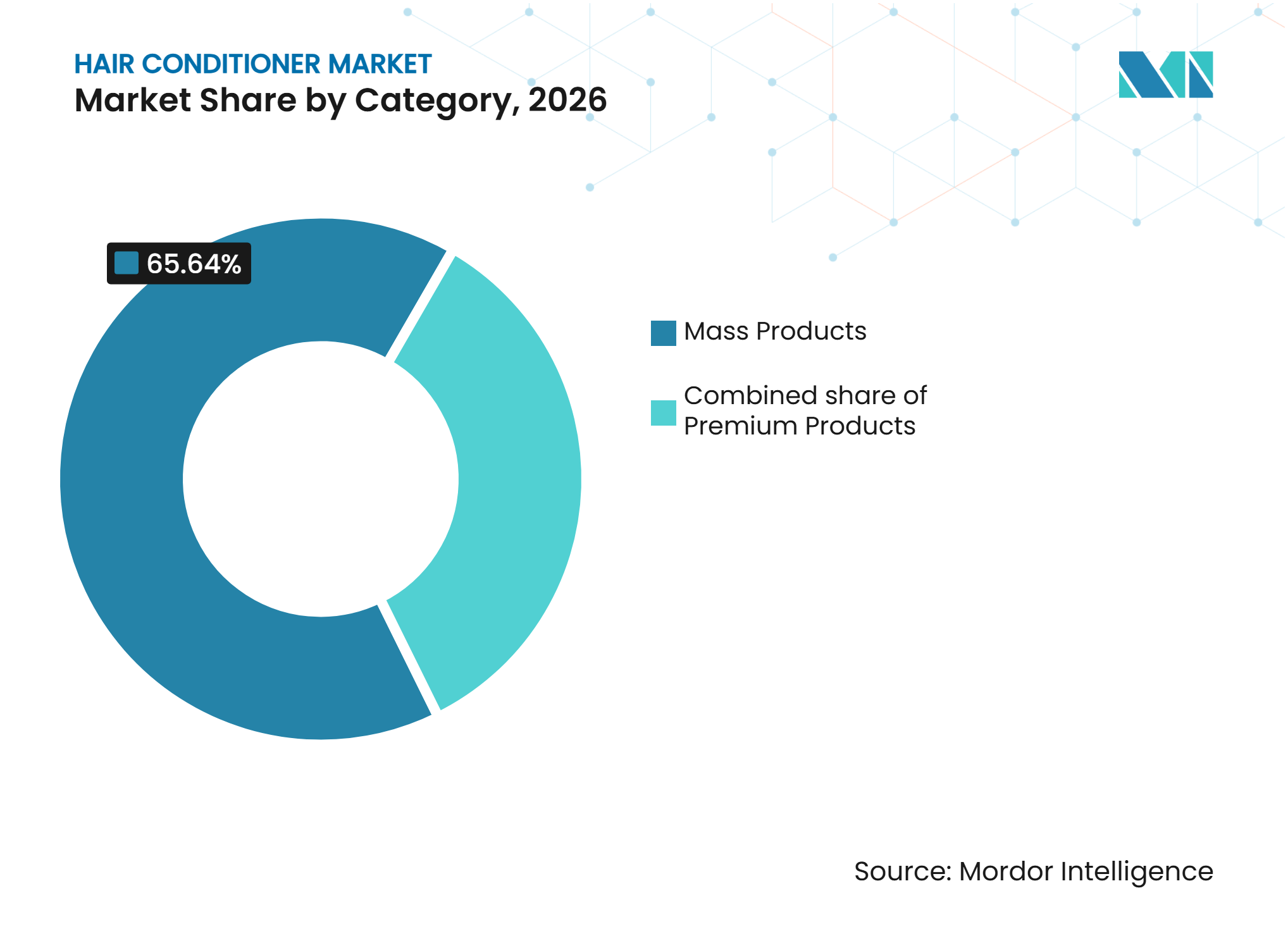
Mass Products Lead While Premium Products Expand FasterIn 2026, mass products accounted for 65.64% of the hair conditioner market, making them the leading category. Their dominance reflects broad consumer accessibility, competitive pricing, extensive product availability, and established distribution through supermarkets, hypermarkets, and other retail outlets. Meanwhile, premium products are projected to record the fastest growth, at a CAGR of 7.49% over 2026–2031. Increasing interest in specialized hair-care solutions, advanced formulations, salon-inspired products, and targeted benefits is supporting demand for higher-value conditioners.
Mass-market conditioners continue to attract consumers through affordable everyday products designed for moisturizing, detangling, and general hair maintenance. Premium offerings, meanwhile, differentiate themselves through specialized ingredients, targeted performance claims, distinctive formulations, and brand positioning. Manufacturers are therefore balancing high-volume mass-market portfolios with premium products that address more specific consumer requirements and support value growth.

By Ingredients:
Conventional/Synthetic Products Lead While Natural/Organic Products ExpandIn 2026, conventional/synthetic conditioners accounted for 63.85% of the hair conditioner market, making them the leading ingredient category. Their position reflects the established use of synthetic conditioning agents, silicones, emulsifiers, and other functional ingredients that support smoothness, detangling, manageability, and formulation stability. Meanwhile, natural/organic conditioners are projected to record the fastest growth, at a CAGR of 6.95% over 2026–2031. Growing consumer interest in plant-derived ingredients, ingredient transparency, and naturally positioned personal care products is encouraging manufacturers to expand their natural and organic product portfolios.
Conventional formulations remain important because they offer manufacturers established ingredient systems and flexibility in developing products for different hair concerns. Natural and organic conditioners provide opportunities to differentiate through botanical extracts, plant oils, and alternative conditioning ingredients. However, manufacturers need to maintain product performance, formulation stability, and affordability while meeting consumer expectations regarding ingredient sourcing and transparency.
By Distribution Channel:
Supermarkets/Hypermarkets Lead While Online Retail Stores Expand FasterIn 2026, supermarkets and hypermarkets accounted for 35.17% of the hair conditioner market, making them the leading distribution channel. Their position reflects broad product availability, established retail networks, in-store brand visibility, and consumers' ability to compare different conditioner brands and formulations during shopping. Meanwhile, online retail stores are projected to record the fastest growth, at a CAGR of 8.41% over 2026–2031. Expanding e-commerce access, digital product discovery, customer reviews, subscription options, and direct-to-consumer platforms are supporting online purchases of hair-care products.
Health and beauty stores serve consumers seeking specialized hair-care products, professional recommendations, and premium formulations. Other distribution channels, including salon-based and alternative retail outlets, provide additional access to targeted conditioner ranges. Manufacturers are increasingly required to maintain a consistent product presence across physical and digital channels, using online platforms to improve product discovery while retaining supermarket and specialist retail relationships to support wider consumer reach.
Geography Analysis
Asia-Pacific Hair Conditioner Market
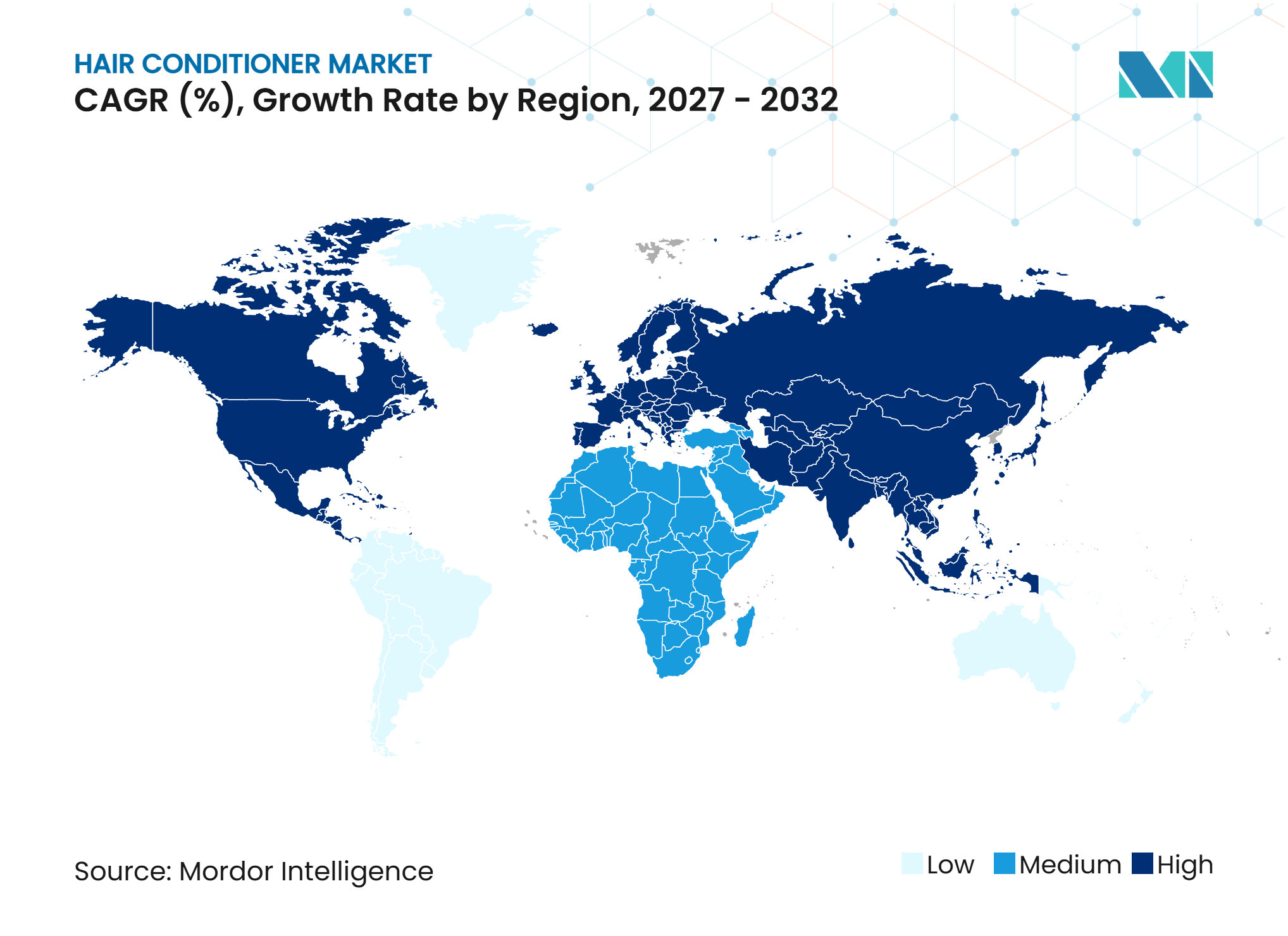
Asia-Pacific accounted for an estimated 47.12% of the hair conditioner market in 2026, making it the largest regional market. The region's large population, established personal care consumption, and diverse hair textures create demand for conditioners addressing damage repair, frizz control, moisture retention, scalp care, and hair fall concerns. Countries such as China, India, Japan, South Korea, and Indonesia offer opportunities for manufacturers through a combination of mass-market products and specialized formulations. Growing e-commerce penetration and expanding modern retail networks also improve access to a wider range of hair-care products. Manufacturers can strengthen their regional presence by adapting formulations, pricing, and product positioning to local hair-care preferences.
Asia-Pacific Hair Conditioner Market Growth Outlook
Asia-Pacific is also projected to be the fastest-growing regional market, with an estimated CAGR of 6.90% over 2026–2031. Rising disposable incomes, increasing awareness of specialized hair-care routines, and growing interest in premium and naturally positioned products are supporting demand. The expansion of online retail stores provides additional opportunities for brands to reach consumers through digital product discovery, reviews, and targeted marketing. Demand for anti-hair fall, damage repair, and strengthening conditioners can further support product innovation across the region. However, manufacturers need to address differences in consumer purchasing power, hair-care preferences, and regulatory requirements across individual markets.
North America, Europe, South America, and Middle East and Africa Hair Conditioner Markets
North America represents an established market for hair conditioners, supported by demand for specialized formulations addressing damage repair, hair fall prevention, scalp care, and color protection. The region offers opportunities for premium products, salon-inspired conditioners, and formulations targeting different hair textures. Europe also provides opportunities through consumer interest in ingredient transparency, natural and organic formulations, and specialized hair-care products. In South America, demand for conditioners addressing dryness, frizz, and hair manageability creates opportunities for manufacturers to develop products suited to regional hair types and climatic conditions. Meanwhile, the Middle East and Africa offer growth potential through expanding personal care consumption, modern retail access, and increasing availability of mass-market and premium hair-care products. Across these regions, manufacturers need to balance product innovation, affordability, ingredient preferences, and distribution reach to strengthen market penetration.
Competitive Landscape
Market Concentration
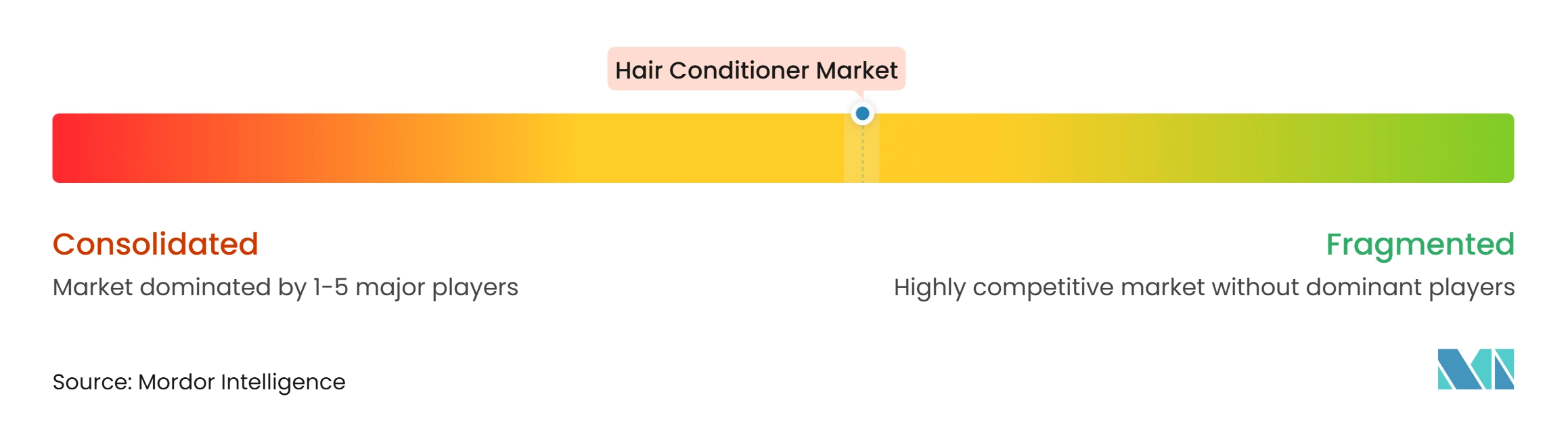
The Hair Conditioner Market includes multinational personal care companies, established hair-care brands, salon-focused businesses, and specialist hair treatment manufacturers competing through product innovation, ingredient selection, brand positioning, and distribution reach. These companies participate in different parts of the market through mass-market conditioners, premium formulations, targeted hair treatments, and products designed for specific hair concerns. Established consumer goods companies can leverage broad product portfolios and extensive retail networks, while specialist brands differentiate through targeted formulations, premium positioning, and focused hair-care expertise.
Competitive strategies in the Hair Conditioner Market focus on developing targeted formulations, expanding premium and natural product portfolios, and addressing specific consumer hair-care needs. For example, Procter & Gamble offers conditioner brands such as Pantene and Herbal Essences, while L'Oréal participates through brands including L'Oréal Paris, Kérastase, and Garnier. Unilever markets conditioner products through brands such as Dove and TRESemmé, while specialist companies such as Olaplex, Moroccanoil, and Davines focus on products positioned around hair repair, nourishment, and professional hair care. These strategies allow companies to address different consumer requirements, ranging from everyday conditioning and damage repair to premium and specialized hair-care routines.
Product differentiation and distribution remain important competitive considerations. Manufacturers are expanding offerings across damage repair and strengthening, anti-dandruff and scalp care, anti-hair fall, and color protection to address diverse hair concerns. The growing interest in natural and organic ingredients, premium formulations, and personalized hair-care solutions also creates opportunities for brands to differentiate their products. Meanwhile, supermarkets and hypermarkets provide access to established consumer shopping networks, while online retail stores support product discovery, brand engagement, and access to specialized formulations. However, competition from established brands and specialist manufacturers, fluctuations in the prices of conditioning agents and other raw materials, product safety expectations, and counterfeit products can affect market performance. These factors make targeted product development, ingredient transparency, brand credibility, reliable sourcing, and effective omnichannel distribution important areas of competition.
Hair Conditioner Industry Leaders
-
Procter & Gamble
-
L’Oréal
-
Unilever
-
Henkel
-
Kao
- *Disclaimer: Major Players sorted in no particular order
Hair Conditioner Market Companies Covered in this Report
- Procter & Gamble Company
- L'Oreal S.A.
- Unilever PLC
- Henkel AG and Co. KGaA
- Kao Corporation
- Kenvue Inc.
- The Estee Lauder Companies Inc.
- Church and Dwight Co., Inc.
- Olaplex Holdings, Inc.
- Moroccanoil, Inc.
- Davines Group SpA
- John Paul Mitchell Systems
- Coty Inc.
- Akita Brands, Inc. (Fable & Mane)
- L'Occitane Groupe S.A.
- Luxury Brand Partners, LLC
- LolaVie
- BondiBoost
- Cecred
- Zuru Edge Limited
Recent Industry Developments in Hair Conditioner Market
- September 2026: Dermis Oracle introduced its Anable D-Calm Hard Water Repair Shampoo and Conditioner range in India, targeting mineral buildup, dryness, frizz, and damage caused by hard-water exposure. The conditioner combines shea butter, hydrolysed pea protein, argan oil, and vitamin E to support hair strength and smoothness.
- September 2026: SENSAI, a premium beauty brand owned by Kao Corporation, returned to the hair-care category with a new hair and scalp care range comprising two shampoos, a nourishing conditioner, a mask, and a treatment essence. The conditioner features CPX Repair Inner technology, designed to condition the scalp and strengthen the hair fibre.
- July 2026: Unilever introduced TRESemmé Professional in the United Kingdom and Ireland, repositioning the brand with a premium, science-led hair-care range. The portfolio upgrade covers wash-and-care products targeting damaged hair, hydration, frizz control, shine, colour protection, and curl definition.
- February 2026: Procter & Gamble's Pantene launched the Miracle Rescue Bond Repair Conditioner in India, targeting visible hair damage caused by frequent styling. The formulation features Melting Pro-V technology and 5,000 Pro-Vitamin B5 nutrient pearls, designed to replenish lost lipids and support hair-bond repair.
Global Hair Conditioner Market Report Scope
For this study, the Hair Conditioner Market is defined as the sales value of commercially produced hair conditioning products formulated to improve hair softness, smoothness, manageability, hydration, and overall hair health. The market covers hair conditioners across different hair concerns, including damage repair and strengthening, anti-dandruff and scalp care, anti-hair fall and hair growth, color protection, and other hair-care needs. The market is segmented by end user into adults and kids/children; by category into premium and mass products; by ingredients into natural/organic and conventional/synthetic products; and by distribution channel into supermarkets/hypermarkets, online retail stores, health and beauty stores, and other distribution channels. The market is analyzed across North America, Europe, Asia-Pacific, South America, and the Middle East and Africa, with country-level coverage as specified in the report. Market sizing and forecasts are presented in value terms (USD) across the defined segments and geographies.
Segmentation Overview
| Damage Repair and Strengthening |
| Anti-Dandruff and Scalp Care |
| Anti-Hair Fall/Hair Growth |
| Color Protection |
| Others |
| Adults |
| Kids/Children |
| Premium Products |
| Mass Products |
| Natural/Organic |
| Conventional/Synthetic |
| Supermarkets/Hypermarkets |
| Online Retail Stores |
| Health & Beauty |
| Other Distribution Channels |
| North America | United States |
| Canada | |
| Mexico | |
| Rest of North America | |
| Europe | United Kingdom |
| Germany | |
| France | |
| Italy | |
| Spain | |
| Sweden | |
| Belgium | |
| Poland | |
| Netherlands | |
| Europe | |
| Asia-Pacific | China |
| Japan | |
| India | |
| Thailand | |
| Singapore | |
| Indonesia | |
| Korea | |
| Australia | |
| Rest of Asia-Pacific | |
| South America | Brazil |
| Argentina | |
| Colombia | |
| Peru | |
| Chile | |
| Rest of South America | |
| Middle East and Africa | South Africa |
| Saudi Arabia | |
| United Arab Emirates | |
| Nigeria | |
| Egypt | |
| Morocco | |
| Turkey | |
| Rest of Middle East and Africa |
| By Hair Concern | Damage Repair and Strengthening | |
| Anti-Dandruff and Scalp Care | ||
| Anti-Hair Fall/Hair Growth | ||
| Color Protection | ||
| Others | ||
| By End User | Adults | |
| Kids/Children | ||
| By Category | Premium Products | |
| Mass Products | ||
| By Ingredients | Natural/Organic | |
| Conventional/Synthetic | ||
| By Distribution Channel | Supermarkets/Hypermarkets | |
| Online Retail Stores | ||
| Health & Beauty | ||
| Other Distribution Channels | ||
| By Geography | North America | United States |
| Canada | ||
| Mexico | ||
| Rest of North America | ||
| Europe | United Kingdom | |
| Germany | ||
| France | ||
| Italy | ||
| Spain | ||
| Sweden | ||
| Belgium | ||
| Poland | ||
| Netherlands | ||
| Europe | ||
| Asia-Pacific | China | |
| Japan | ||
| India | ||
| Thailand | ||
| Singapore | ||
| Indonesia | ||
| Korea | ||
| Australia | ||
| Rest of Asia-Pacific | ||
| South America | Brazil | |
| Argentina | ||
| Colombia | ||
| Peru | ||
| Chile | ||
| Rest of South America | ||
| Middle East and Africa | South Africa | |
| Saudi Arabia | ||
| United Arab Emirates | ||
| Nigeria | ||
| Egypt | ||
| Morocco | ||
| Turkey | ||
| Rest of Middle East and Africa | ||
Key Questions Answered in the Report
What is the size of the Hair Conditioner Market?
The Hair Conditioner Market is estimated at USD 20.36 billion in 2026.
What is the projected growth rate of the Hair Conditioner Market?
The market is projected to grow at a CAGR of 6.89% over 2027–2032.
Which segment holds the largest share of the Hair Conditioner Market?
Damage repair and strengthening holds the largest share by hair concern, accounting for 35.00% of the market in 2026.
Which region dominates the Hair Conditioner Market?
Asia-Pacific dominates the market, accounting for 47.12% of the market in 2026.