
Gripe Water Market Size and Share
Market Overview
| Study Period | 2021 - 2031 |
|---|---|
| Market Size (2026) | USD 331.82 Million |
| Market Size (2031) | USD 407.91 Million |
| Growth Rate (2026 - 2031) | 4.22 % |
| Fastest Growing Market | Asia-Pacific |
| Largest Market | Asia-Pacific |
| Market Concentration | Medium |
Major Players *Disclaimer: Major Players sorted in no particular order Image © Mordor Intelligence. Reuse requires attribution under CC BY 4.0. | |
Gripe Water Market Analysis by Mordor Intelligence
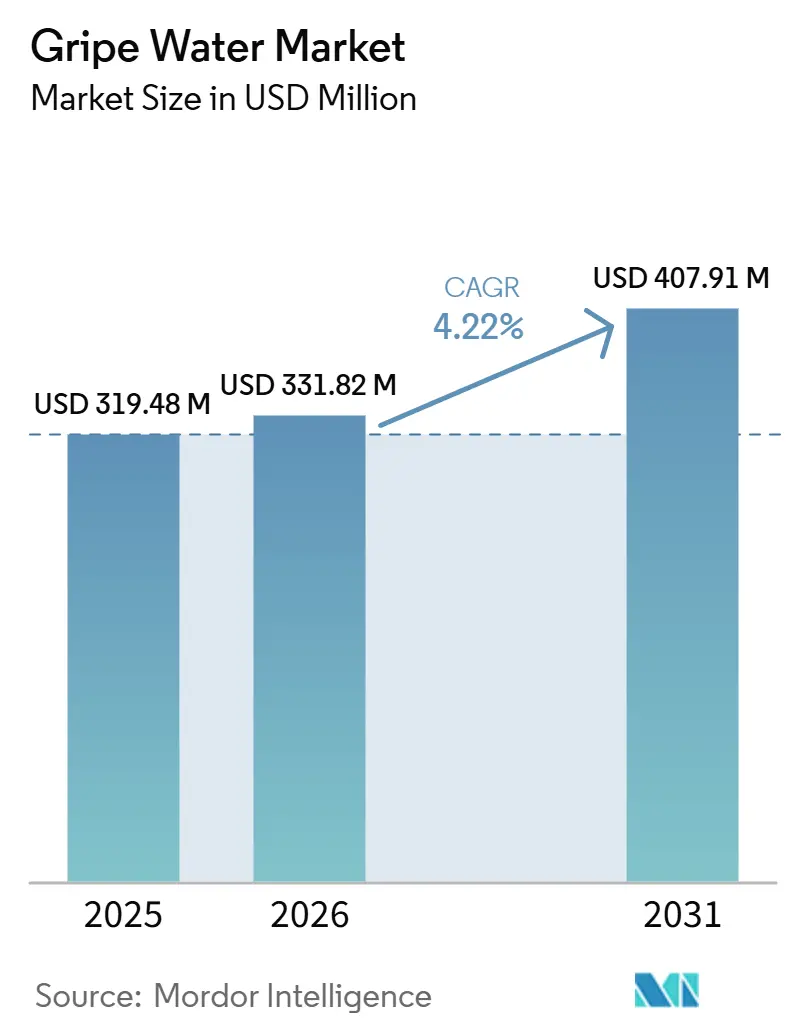
The Gripe Water Market size is expected to be valued at USD 319.48 million in 2025 and is projected to grow from USD 331.82 million in 2026 to USD 407.91 million by 2031, registering a CAGR of 4.22% during the forecast period (2026-2031). Infant colic and digestive discomfort continue to support demand, as parents have limited established options for managing unexplained distress in early infancy. According to the International Breastfeeding Journal, a 2026 cohort study found colic symptoms in 17.2% of infants aged 3 to 21 weeks, with the rate reaching 23.7% among infants aged 7 to 9 weeks[1]Source: International Breastfeeding Journal, “Exclusive Breastfeeding and Infantile Colic: A Cohort Study,” International Breastfeeding Journal, link.springer.com. The Gripe Water Market is shifting toward alcohol-free, sugar-free, preservative-free, organic, and plant-based formulations as parents and pharmacy buyers place greater emphasis on ingredient disclosure. Large pharmacy networks, online marketplaces, and subscription models are expanding product access, while stricter product and packaging compliance rules are increasing participation costs. Asia-Pacific remains central to volume and future growth, supported by its large infant population, established herbal care traditions, and expanding digital retail access.
Key Report Takeaways
- By product type, alcohol-free formulations held 62.71% of the Gripe Water Market share in 2025 and are forecast to grow at a 7.46% CAGR through 2031.
- By category, conventional products held 75.62% of the Gripe Water Market share in 2025, while organic products are forecast to expand at a 7.11% CAGR through 2031.
- By packaging format, plastic bottles accounted for 59.51% of sales in 2025 and are forecast to grow at a 6.88% CAGR through 2031.
- By distribution channel, pharmacies and drug stores held 37.13% of sales in 2025, while online retail stores are forecast to expand at a 7.51% CAGR through 2031.
- By geography, Asia-Pacific held 43.90% of global sales in 2025 and is forecast to grow at a 7.98% CAGR through 2031.
Note: Market size and forecast figures in this report are generated using Mordor Intelligence’s proprietary estimation framework, updated with the latest available data and insights as of January 2026.
Market Trends and Insights
Drivers Impact Analysis of Gripe Water Market*
| Driver | (~) % Impact on CAGR Forecast | Geographic Relevance | Impact Timeline |
|---|---|---|---|
| Rising prevalence of infant colic, gas, and digestive discomfort | +1.2% | Global | Short term (≤ 2 years) |
| Increasing parental preference for herbal and natural infant care products | +1.0% | Asia-Pacific, North America, Europe | Medium term (2-4 years) |
| Growing awareness of alcohol-free, sugar-free, and preservative-free gripe water formulations | +0.8% | North America and Europe | Short term (≤ 2 years) |
| Expansion of OTC availability of pediatric digestive remedies | +0.6% | Asia-Pacific and Latin America | Medium term (2-4 years) |
| Rising birth rates in emerging markets | +0.5% | Sub-Saharan Africa, South Asia, Southeast Asia | Long term (≥ 4 years) |
| Product innovation featuring clean-label, organic, and plant-based ingredients | +0.7% | North America, Europe, and the Asia-Pacific core | Medium term (2-4 years) |
| Source: Mordor Intelligence | |||
Rising prevalence of infant colic, gas, and digestive discomfort
Colic affects a clinically significant share of the global infant population, making it the most durable demand anchor for the gripe water category. A 2025 study in the European Journal of Pediatrics identifies gas and bloating as the most prevalent gastrointestinal symptom among infants globally, at 22%, with healthcare professionals in the Middle East reporting the highest prevalence rates for most symptoms[2]Source: European Journal of Pediatrics, “Prevalence and Possible Causes of Crying and Mild Gastrointestinal Symptoms in Infants Worldwide Data,” European Journal of Pediatrics, doi.org. A separate investigation published in Nature Scientific Reports found infantile colic in 2.09% of infants under strict diagnostic criteria and 5.57% under broader case definitions. The study also noted that clinicians identify a medical explanation in fewer than 5% of colic cases. This diagnostic gap creates the commercial opportunity for gripe water, as parents often seek herbal symptomatic relief when conventional medicine offers few alternatives for undifferentiated infant distress during the first 12 weeks of life. Therefore, the demand anchor remains structural rather than cyclical, as colic prevalence shows no correlation with improvements in prenatal care or neonatal outcomes.
Increasing parental preference for herbal and natural infant care products
The shift toward herbal, plant-based formulations in infant care reflects a structural change in how millennial and Gen-Z parents assess product safety, and this trend is accelerating rather than plateauing. The global Ayurvedic and natural herbal baby care segment continues to grow as traditional formulations, such as dill-based and fennel-based digestive remedies, reach new consumer cohorts. A less obvious second-order implication is that herbal positioning increasingly serves as regulatory arbitrage in markets such as India, where Ayurvedic classification under the Drugs and Cosmetics Act’s Schedule T framework allows brands to launch new product variants with lighter clinical trial requirements than conventional drug approval pathways. This structural advantage disproportionately benefits established players such as Himalaya Wellness and Dabur, which can rapidly introduce formulation variants, while newer entrants face longer commercialization timelines. Cross-border e-commerce has further amplified this dynamic. Western organic gripe water brands now reach Russian-speaking markets, including Russia, Uzbekistan, and Ukraine, through iHerb and similar platforms, demonstrating that premium herbal positioning supports geographic premium elasticity beyond traditional pharmacy markets.
Growing awareness of alcohol-free, sugar-free, and preservative-free gripe water formulations
Formulation transparency has become a non-negotiable purchase criterion for premium gripe water buyers. “Free-from” claims, which drive the alcohol-free segment’s 7.46% CAGR, are accelerating category-wide reformulation rather than creating a niche shift. Woodward’s Gripe Water’s Summary of Product Characteristics on the UK Electronic Medicines Compendium database (certified November 2025, updated October 2025) explicitly highlights its alcohol-free and sugar-free composition, with terpeneless dill seed oil as the active ingredient, while maintaining its marketing authorization under PL 00063/0698. A less visible market dynamic is that “free-from” claims reinforce themselves: as alcohol-free variants become the category norm, alcohol-containing products face accelerated delisting rather than gradual share erosion, shortening the timeline for legacy formula exit. Regulatory influence from the UK Infant Feeding Equipment (Safety) Regulations 2025, which mandated BPA-free certification for all baby bottles as of January 1, 2025, aligned with EN 14350:2020 safety standards, extends this formulation quality escalation to packaging materials. According to the Child Care Council, United Kingdom, this shift indirectly raises baseline quality expectations across the entire liquid infant supplement value chain.
Expansion of the over-the-counter (OTC) availability of pediatric digestive remedies
OTC accessibility is expanding gripe water’s reach into pharmacy ecosystems that previously restricted infant supplement sales, while major brand strategy shifts indicate confidence in the depth of retail channels. Mommy's Bliss, the leading gripe water brand by US retail volume, is set to discontinue direct-to-consumer website sales in January 2026 and consolidate distribution exclusively through Amazon, Target, Walmart, Walgreens, and CVS. This channel consolidation is structurally significant. As premium herbal brands secure placement in major pharmacy chains, gripe water is moving from specialty retail to mainstream shelf placement, significantly lowering the barrier to consumer discovery. In parallel, the expansion of organized pharmacy retail across Southeast Asia and Sub-Saharan Africa, where OTC infant supplements are among the first healthcare touchpoints for low-income households, is increasing the addressable market beyond Western economies.
Restraints Impact Analysis of Gripe Water Market*
| Restraint | (~) % Impact on CAGR Forecast | Geographic Relevance | Impact Timeline |
|---|---|---|---|
| Limited clinical evidence and paediatric skepticism | -0.7% | North America, Europe | Medium term (2-4 years) |
| Regulatory, recall, and adverse-event exposure | -0.5% | North America (FDA) and Europe | Short term (≤ 2 years) |
| Infant-safe preservative and microbial-control trade-offs | -0.3% | Global | Medium term (2-4 years) |
| Substitution by non-product soothing practices and gas-relief alternatives | -0.2% | North America, Europe | Long term (≥ 4 years) |
| Source: Mordor Intelligence | |||
Limited clinical evidence and paediatric skepticism
The most consequential structural challenge for the gripe water category is not regulatory restriction but the persistent lack of peer-reviewed clinical validation. The Cleveland Clinic’s published guidance explicitly states that there is “little research to suggest it actually works,” noting that fennel, the ingredient with the strongest evidence base, has demonstrated efficacy only in adults and older children, not in neonates. UK prescribing guidance compiled by PrescQIPP also states that gripe water “should not be prescribed for infantile colic as it is not licensed for this condition and there are no clinical data to support using it.” A less discussed second-order consequence is that pediatric skepticism reduces healthcare professional recommendation rates, shifting gripe water purchases toward impulse and word-of-mouth channels. This shift correlates with higher brand-switching risk and lower repeat-purchase predictability for manufacturers. Brands that invest in proprietary clinical studies, even small-scale studies, can differentiate themselves. However, no brand has yet translated such evidence into formal OTC drug approval, which represents the category’s most significant untapped strategic moat.
Regulatory, recall, and adverse-event exposure
Regulatory enforcement actions expose the gripe water segment to headline risk that is disproportionate to its market size. A single incident can structurally depress trial rates for several months. In April 2025, the US FDA issued a warning letter to M.O.M. Enterprises LLC after an August–September 2024 facility inspection[3]Source: U.S. Food and Drug Administration, “M.O.M. Enterprises, LLC, Warning Letter 698651,” U.S. Food and Drug Administration, fda.gov. The agency cited multiple cGMP violations under 21 CFR Part 111 across its Gripe Water Original and Gripe Water Night Time products. These violations included the company’s failure to investigate serious adverse events involving hospitalized infants and the misbranding of Gripe Water Original as an unapproved new drug based on disease treatment claims on its website. This enforcement pattern highlights a systemic compliance gap. Since US gripe water is classified as a dietary supplement rather than an OTC drug, manufacturers must comply with cGMP requirements but do not undergo pre-market approval, creating recurring adverse-event exposure and misbranding risk. Compliance requirements under 21 CFR Part 111, including robust adverse event tracking and label accuracy protocols, represent an ongoing operational cost that smaller manufacturers often underinvest in relative to their product liability exposure.
*Our forecasts treat driver/restraint impacts as directional, not additive. The impact forecasts reflect baseline growth, mix effects, and variable interactions.
Gripe Water Market Segment Analysis
By Product Type:
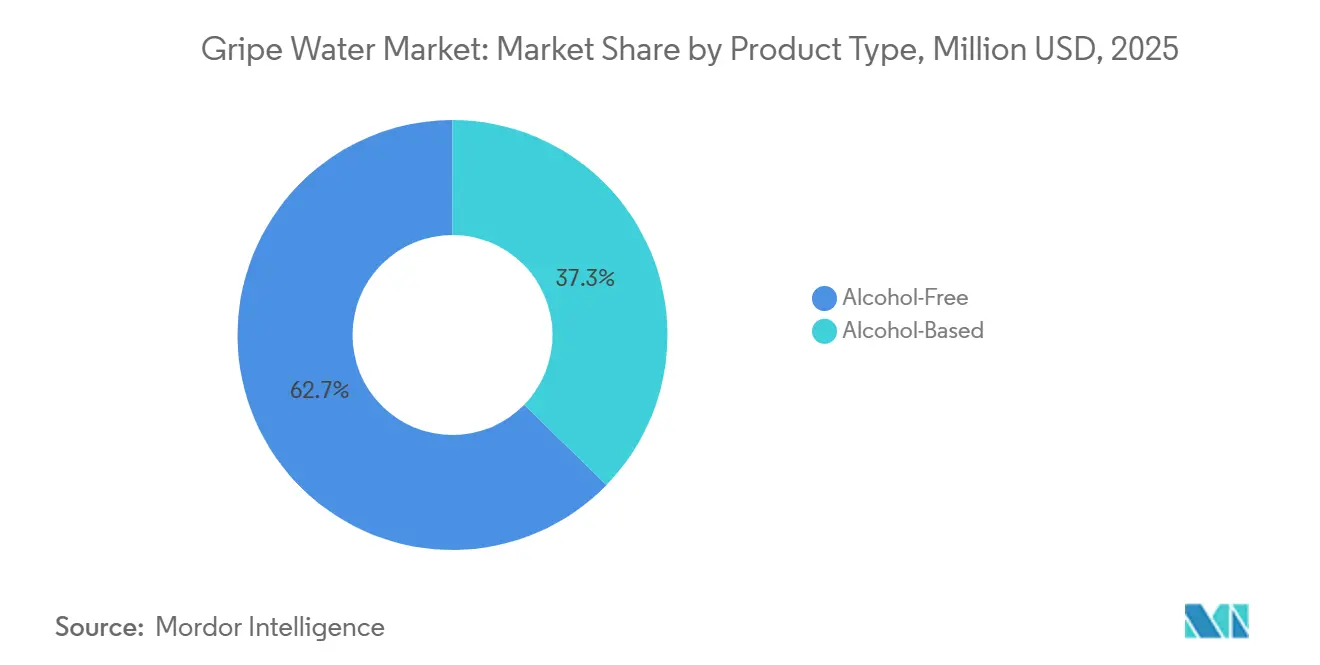
Alcohol-Free Formulations Reset the Category BaselineAlcohol-free formulations are expected to account for 62.71% of product type sales in 2025 and remain the fastest-growing sub-segment, registering a 7.46% CAGR during 2026-2031. This convergence of the largest share and fastest growth is atypical and indicates structural reformulation in the market rather than an incremental transition. This dual leadership reflects a decade-long regulatory and consumer shift that continues to reinforce itself. As pharmacy chains make alcohol-free certification a baseline listing requirement, alcohol-based products face accelerated delisting rather than gradual share erosion. The alcohol-based segment continues to serve price-sensitive markets in parts of Sub-Saharan Africa and South Asia, where older proprietary formulas maintain legacy pharmacy placement and a price advantage over premium reformulated variants.
The second-order market shift within the alcohol-free space is the expansion of formulation use occasions. Brands such as Mommy's Bliss have introduced nighttime variants that combine traditional fennel and ginger extracts with chamomile and passionflower. These products effectively double the use occasion per household, shifting the category from a single daytime relief product to a paired day-night system. NSF International certification, which Mommy's Bliss products carry, is becoming a credentialing differentiator among major pharmacy chains evaluating premium listings. It provides third-party purity verification that bridges gripe water's supplement classification with drug-grade quality signaling. This certification race within the alcohol-free sub-segment is raising barriers for smaller manufacturers while rewarding brands with scale and quality infrastructure investments.



By Category:
Conventional Dominates While Organic Gripe Water Manufacturers AccelerateOrganic gripe water manufacturers are expected to record a 7.11% CAGR during 2026-2031, the fastest growth within the category segmentation. Meanwhile, the conventional segment retained 75.62% of category value in 2025, supported by established pharmacy relationships and long-standing consumer familiarity with legacy formulas, including Woodward's and Babuline. The organic segment's growth rate significantly outpaces the overall market CAGR of 4.22%, indicating that premium parents are trading up within the category rather than simply switching products. Garden of Life Baby Gripe Water, registered in the USDA Dietary Supplement Label Database in February 2025 as a USDA Organic and vegan-certified product, demonstrates how third-party certification infrastructure is becoming the primary commercial differentiator for organic-positioned brands against conventional competitors.
Conventional brands are responding to this shift. Woodward's reformulation to an improved Ayurvedic formula, introduced in new Royal Blue packaging in 2024 while retaining its core dill seed oil and Sarjikakshara formulation, represents a positioning bridge: incumbent authenticity presented through modern clean-label aesthetics. India's Babuline Pharma has adopted a similar heritage-meets-contemporary strategy for its 95-year-old Ayurvedic formula, maintaining price accessibility while progressively aligning its marketing with the alcohol-free and additive-free narrative that appeals to organic-seeking parents. However, conventional players face the risk that certification gaps may widen over time as organic-certified competitors build review equity and secure higher pharmacist recommendation rates in urban pharmacy chains.
By Packaging Format:
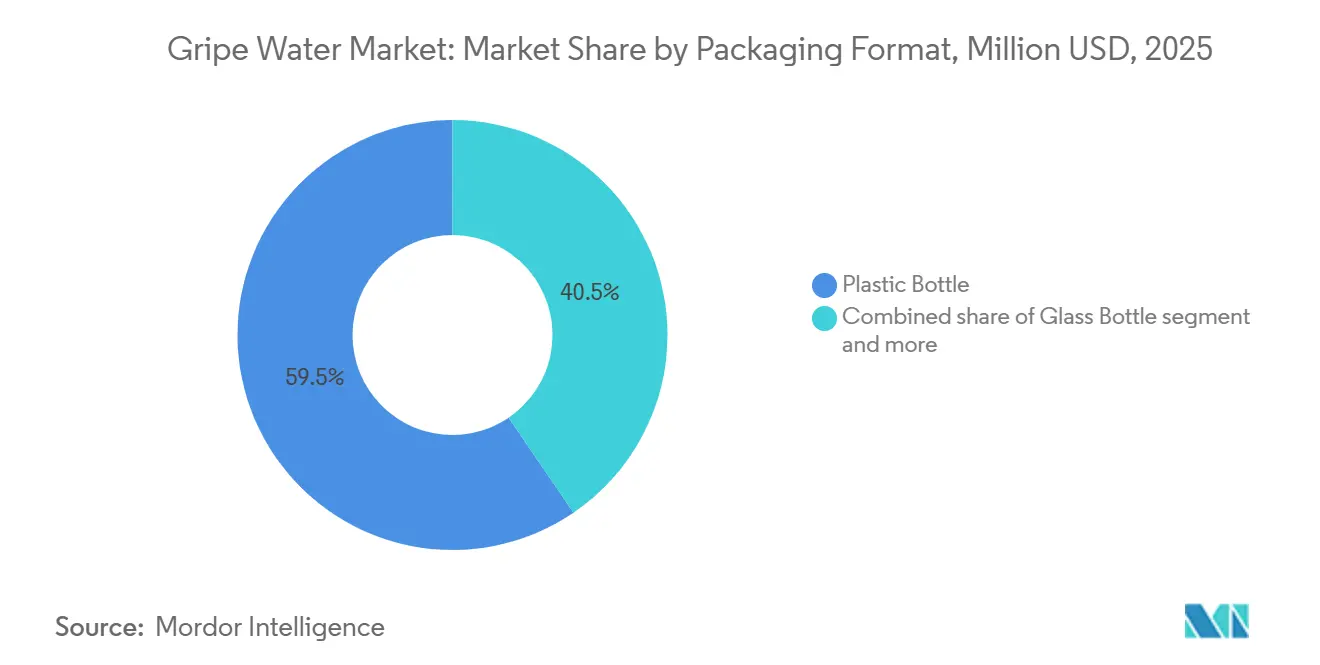
Plastic Bottles Lead, BPA Compliance Reshapes Format EconomicsPlastic bottles are expected to account for 59.51% of packaging format sales in 2025 and lead growth at a 6.88% CAGR during 2026-2031. Lower costs, lighter shipping weight, and reduced breakage risk in e-commerce fulfillment are driving adoption, particularly across price-sensitive markets in Asia and Africa. Glass bottles maintain a premium position among parents who prioritize minimizing chemical migration. However, logistical fragility in online retail channels, where breakage can damage the brand experience, has compressed their share. Other packaging types, including concentrated drops and sachets, are emerging formats that target travel convenience and on-the-go parenting occasions, but they continue to represent a minor share of overall category volume.
Compliance requirements are reshaping plastic bottle sourcing economics for gripe water manufacturers. EU Regulation 2024/3190, scheduled to enter into force on January 20, 2025, extends restrictions on bisphenol A and other bisphenol compounds across food-contact plastics used for infants, creating both compliance costs and opportunities for reformulation-based differentiation. California's SB 1266, set to take effect on January 1, 2026, establishes practical quantitation limit-based bans on all bisphenols in juvenile feeding products. Manufacturers that source food-grade BPA-free PET or polypropylene packaging are expected to gain a compliance advantage in regulated markets, even as they absorb marginal input cost increases over conventional plastics. As a result, packaging material investment is becoming a forward-looking competitive variable rather than a pure cost line.
By Distribution Channel:
Pharmacies Anchor Trust, Online Retail Channels Capture GrowthOnline retail stores are the fastest-growing distribution channel, with a 7.51% CAGR during 2026-2031. The channel is outpacing the overall market and every individual offline channel, driven by search-led discovery, subscription-based repeat-purchase models, and deeper e-commerce penetration across infant care categories in Asia-Pacific. Pharmacies and drug stores maintain their leading position, accounting for 37.13% of the distribution channel share in 2025. Their dominance is supported by pharmacist adjacency and OTC positioning, which give drug stores a credibility advantage over mass retail. Supermarkets/hypermarkets, specialty stores, and other channels play complementary roles but lack the clinical-environment signal that drives first-time purchases in a category where safety remains the primary purchase criterion.
Channel divergence has significant strategic implications for brand investment prioritization. Online retail favors brands with strong review volumes, subscription-model adoption, and cross-platform visibility. These advantages benefit digitally native challengers such as Mother Sparsh, which expanded from a DTC-first positioning to a broad platform presence across Amazon India, Flipkart, and FirstCry. E-commerce penetration for baby essentials in urban China and Southeast Asia exceeded 40% of category volume in 2026. In addition, content e-commerce platforms in China are on a growth trajectory, with live streaming and social commerce emerging as the fastest-scaling discovery channels for infant care products. Gripe water brands with agile digital teams are beginning to adapt this playbook from adjacent baby care categories.
Geography Analysis
APAC Gripe Water Market
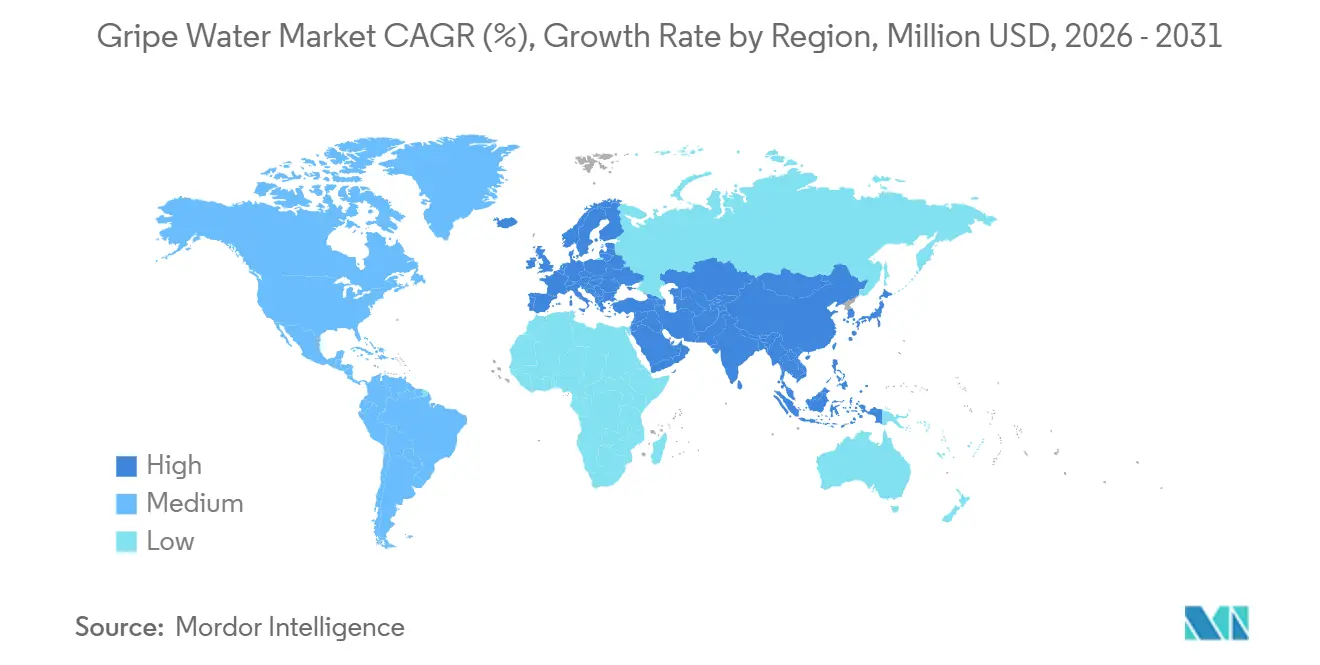
Asia-Pacific is expected to account for 43.9% of global sales in 2025 and grow at an 8.0% CAGR through 2031. The region represents the largest geographic component of the Gripe Water Market and is expected to be its fastest-growing area. India supports this position through its large infant population, widespread familiarity with Ayurvedic care, and active pharmacy and digital retail networks. The region also includes markets where price accessibility remains important, alongside rising demand for premium natural products. Domestic brands can compete through established herbal positioning and local distribution networks. International brands can participate by adapting packaging, claims, and price points to local buying patterns.
North America and Europe Gripe Water Market
North America and Europe are established markets with developed pharmacy networks and stricter compliance expectations. In the United Kingdom, Woodward’s Gripe Water holds marketing authorization PL 00063/0698. This formal product status distinguishes the United Kingdom from countries where companies may offer products under dietary supplement frameworks. The United States remains important but carries compliance risks related to manufacturing, adverse-event handling, and disease claims. Across Europe, clean-label and preservative-free positioning can strengthen shelf appeal. Mature regions, therefore, reward brands that align formulation transparency with careful regulatory management.
MEA and South America Gripe Water Market
South America, the Middle East, and Africa offer different routes for longer-term expansion. Urban pharmacy channels remain important in Brazil, Argentina, and Colombia. Premium herbal products can attract demand in the UAE and Saudi Arabia, where pharmacy density and purchasing power support higher-value offerings. Across Sub-Saharan Africa, consumer need exists alongside limited organized pharmacy infrastructure. Affordable herbal digestive products may have potential where companies can improve access through suitable distribution models. Mobile commerce and community-based health channels may help broaden availability. The Gripe Water Market will require locally appropriate pack sizes, pricing, and distribution arrangements in these regions.

Competitive Landscape
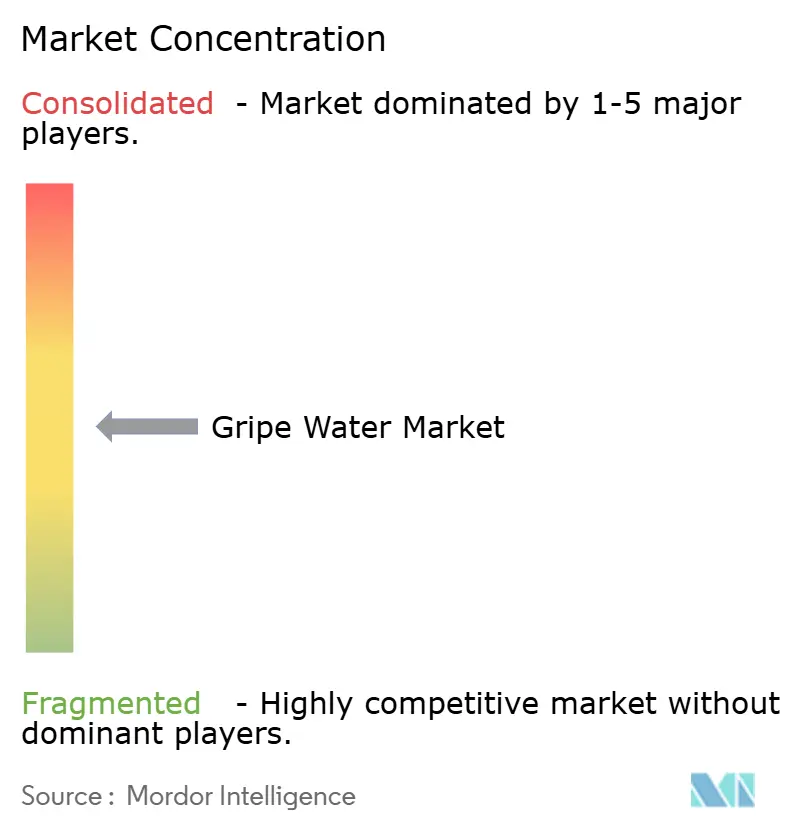
The Gripe Water Market is moderately fragmented, with distinct competitive patterns across Western and Asian markets. Mommy’s Bliss has established a strong retail position in North America through distribution partnerships with major retailers and pharmacy chains. In Asia, domestic Ayurvedic brands benefit from formulation familiarity, established consumer trust, and locally developed distribution networks. Competition is most active in alcohol-free and organic products, where brands use clean labels and certifications to differentiate themselves. Private-label suppliers also influence the North American market by competing on availability and price. Since no company share data were provided for the leading manufacturers, a quantified ranking cannot be established.
Company strategies reflect the needs of their core regions. Mommy’s Bliss plans to move away from direct sales in January 2026 and focus on distribution through Amazon, Target, Walmart, Walgreens, and CVS. This decision supports its retail relationships and places greater emphasis on discovery content rather than direct transactions. Woodward’s maintains a recognized UK authorization and provides clear product information for its alcohol-free and sugar-free formula. It also updated its Ayurvedic product presentation in India in 2024. These actions show how legacy brands can retain familiar formulations while responding to current ingredient expectations.
Regulatory capability is becoming a competitive factor alongside brand recognition. Companies with strong quality systems can manage product documentation, claims review, and adverse-event procedures more effectively. The FDA action involving M.O.M. Enterprises illustrates the consequences of weaknesses in these areas. Companies also have opportunities to explore more convenient formats, including gels and concentrated drops, while maintaining focus on safety and claim compliance. Clear evidence remains an important gap across the category, as formal clinical support is limited. Competitive strength will depend on credible quality practices, accessible retail coverage, and formulations that meet parent expectations.
Gripe Water Industry Leaders
Mommy's Bliss
Little Remedies
Wellements
TTK Healthcare
Dabur India Ltd.
- *Disclaimer: Major Players sorted in no particular order
Gripe Water Market Companies Covered in this Report
- Mommy's Bliss
- Little Remedies
- Wellements
- Colic Calm
- Woodward's, TTK Healthcare
- Dabur India Ltd.
- Himalaya Wellness Company
- Mother Sparsh
- Tollyjoy Baby Products
- Zarbee's
- Kingston Pharma
- Perrigo Company plc
- Pigeon Corporation
- Walgreens Boots Alliance
- CVS Health
- Babuline Pharma Pvt. Ltd.
- Livealth Biopharma Pvt. Ltd.
- Aetos Life Care
- Arlak Ayurveda
- Conical Pharmaceuticals

Recent Industry Developments in Gripe Water Market
- November 2025: TTK Healthcare modernized the Woodward's Gripe Water brand with a refreshed logo, updated packaging, and the national "I Am Woodward's Baby" campaign, alongside expanded TV, print, digital, and medical influencer engagement.
- January 2025: Mommy's Bliss continued expanding and promoting its flagship Original Gripe Water with NSF-certified, organic ginger and fennel formulations while integrating the product into a broader digestive wellness portfolio sold through over 40,000 retail outlets. Although not a new SKU launch, it represented continued portfolio expansion around the gripe water franchise.
- January 2025: ITC Limited signed definitive agreements to acquire the remaining 73.5% stake in Mother Sparsh, a premium Ayurvedic and natural baby care brand that had gripe water in its core range, at a total investment of approximately INR 126 crore (~USD 15.0 million) over 2-3 years. The acquisition gave ITC direct exposure to India's fast-growing premium infant care segment via a digital-first brand with established Ayurvedic product credentials.


Global Gripe Water Market Report Scope
Gripe water is an oral liquid supplement formulated to help relieve infant colic, gas, hiccups, and digestive discomfort. The global gripe water market is segmented by product type, category, packaging format, distribution channel, and geography. By product type, the market is segmented into alcohol-free and alcohol-based. By category, the market is segmented into conventional and organic. By packaging format, the market is segmented into glass bottles, plastic bottles, and other packaging types. By distribution channel, the market is segmented into supermarkets/hypermarkets, pharmacies and drug stores, specialty stores, online retail stores, and other distribution channels. By geography, the market is segmented into North America, Europe, Asia-Pacific, South America, and the Middle East and Africa. The market forecasts are provided in terms of value (USD).
| Alcohol-Free |
| Alcohol-Based |
| Conventional |
| Organic |
| Glass Bottle |
| Plastic Bottle |
| Other Packaging Types |
| Supermarkets/Hypermarkets |
| Pharmacies and Drug Stores |
| Specialty Stores |
| Online Retail Stores |
| Other Distribution Channels |
| North America | United States |
| Canada | |
| Mexico | |
| Rest of North America | |
| Europe | United Kingdom |
| Germany | |
| France | |
| Italy | |
| Spain | |
| Sweden | |
| Belgium | |
| Poland | |
| Netherlands | |
| Rest of Europe | |
| Asia-Pacific | China |
| Japan | |
| India | |
| Thailand | |
| Singapore | |
| Indonesia | |
| South Korea | |
| Australia | |
| Rest of Asia-Pacific | |
| South America | Brazil |
| Argentina | |
| Colombia | |
| Peru | |
| Chile | |
| Rest of South America | |
| Middle East and Africa | United Arab Emirates |
| South Africa | |
| Saudi Arabia | |
| Nigeria | |
| Egypt | |
| Morocco | |
| Turkey | |
| Rest of Middle East and Africa |
| Product Type | Alcohol-Free | |
| Alcohol-Based | ||
| Category | Conventional | |
| Organic | ||
| Packaging Format | Glass Bottle | |
| Plastic Bottle | ||
| Other Packaging Types | ||
| Distribution Channel | Supermarkets/Hypermarkets | |
| Pharmacies and Drug Stores | ||
| Specialty Stores | ||
| Online Retail Stores | ||
| Other Distribution Channels | ||
| Geography | North America | United States |
| Canada | ||
| Mexico | ||
| Rest of North America | ||
| Europe | United Kingdom | |
| Germany | ||
| France | ||
| Italy | ||
| Spain | ||
| Sweden | ||
| Belgium | ||
| Poland | ||
| Netherlands | ||
| Rest of Europe | ||
| Asia-Pacific | China | |
| Japan | ||
| India | ||
| Thailand | ||
| Singapore | ||
| Indonesia | ||
| South Korea | ||
| Australia | ||
| Rest of Asia-Pacific | ||
| South America | Brazil | |
| Argentina | ||
| Colombia | ||
| Peru | ||
| Chile | ||
| Rest of South America | ||
| Middle East and Africa | United Arab Emirates | |
| South Africa | ||
| Saudi Arabia | ||
| Nigeria | ||
| Egypt | ||
| Morocco | ||
| Turkey | ||
| Rest of Middle East and Africa | ||


Key Questions Answered in the Report
What is driving demand for gripe water products?
Infant colic, gas, and digestive discomfort support demand, while parents increasingly seek alcohol-free and clearly labeled infant products.
How large is the Gripe Water Market?
The Gripe Water Market is estimated at USD 331.82 million in 2026 and is forecast to reach USD 407.91 million by 2031 at a 4.22% CAGR.
Which gripe water product type is growing fastest?
Alcohol-free formulations are the largest product type at 62.71% of 2025 sales and are forecast to grow at a 7.46% CAGR through 2031.
Why are pharmacies important for gripe water sales?
Pharmacies and drug stores held 37.13% of sales in 2025 because parents often prefer a health-oriented setting for infant digestive products.
Page last updated on:





