
Grinding Wheels Market Size and Share
Market Overview
| Study Period | 2021 - 2031 |
|---|---|
| Market Size (2026) | USD 7.48 Billion |
| Market Size (2031) | USD 9.70 Billion |
| Growth Rate (2026 - 2031) | 5.34 % |
| Fastest Growing Market | Asia-Pacific |
| Largest Market | Asia-Pacific |
| Market Concentration | Low |
Major Players *Disclaimer: Major Players sorted in no particular order Image © Mordor Intelligence. Reuse requires attribution under CC BY 4.0. | |
Grinding Wheels Market Analysis by Mordor Intelligence
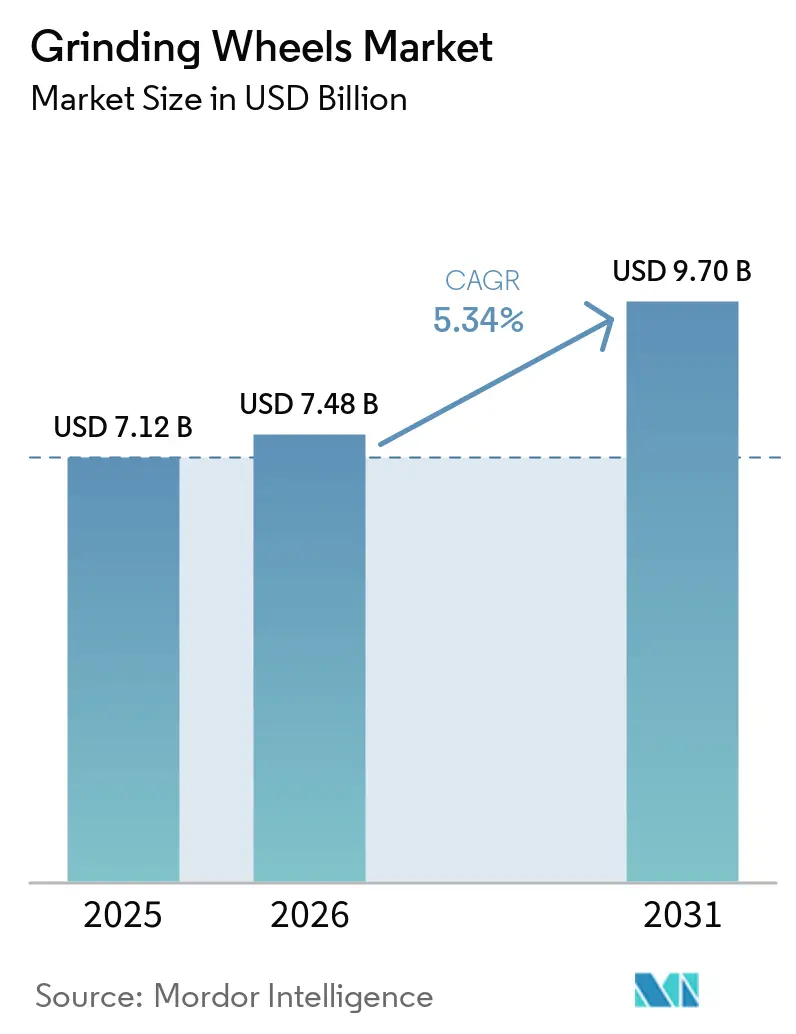
The Grinding Wheels Market size was estimated at USD 7.12 billion in 2025 and is estimated to grow from USD 7.48 billion in 2026 to USD 9.70 billion by 2031, at a CAGR of 5.34% during the forecast period (2026-2031). The grinding wheels market is driven by electric vehicle component production, semiconductor fabrication expansion, and infrastructure activity in India, Southeast Asia, and the Middle East. These demand sources favor precise, durable abrasive tools and a larger premium product mix. Automotive, semiconductor, and photovoltaic demand spans distinct end uses, reducing dependence on any single manufacturing cycle. European brake-emission regulations add a grinding stage for hard-coated brake discs as production lines move into mass production from 2026.
Key Report Takeaways
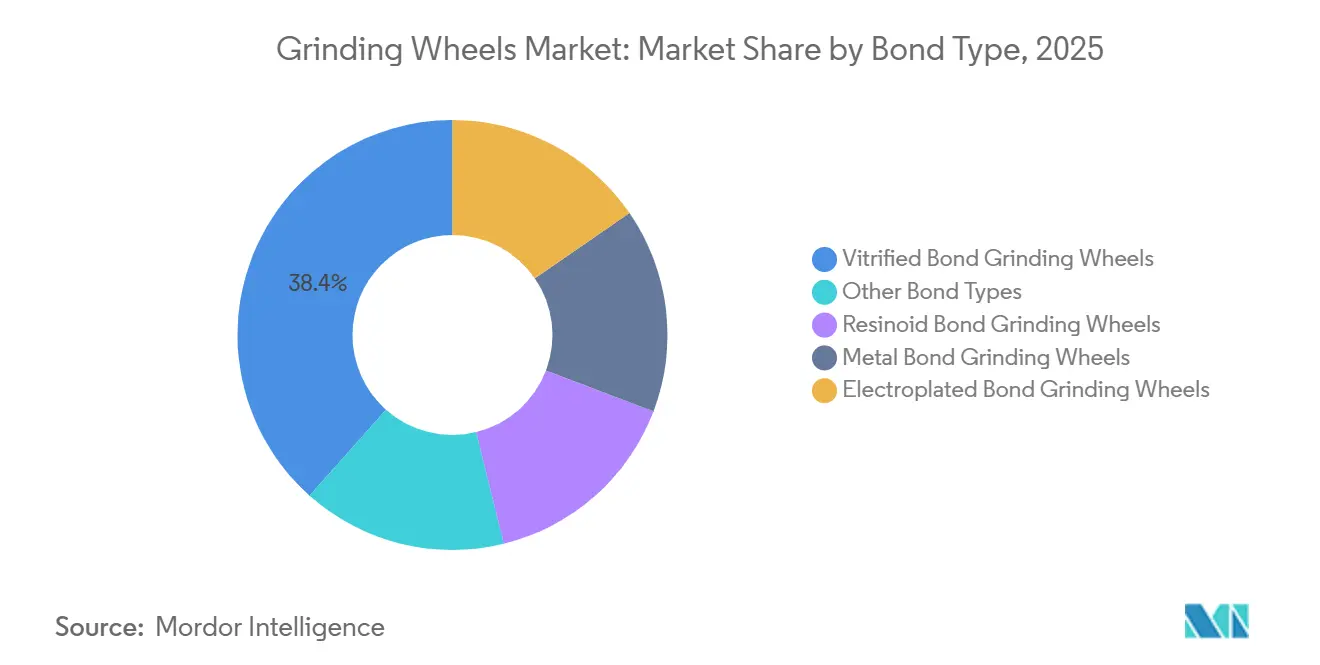
- By bond type, vitrified wheels held 38.43% of the global value in 2025, while electroplated bond grinding wheels are forecast to grow at a 5.89% CAGR through 2031.
- By abrasive material, aluminum oxide held 42.15% of the global value in 2025, while diamond is forecast to grow at a 6.32% CAGR through 2031.
- By grain size, medium-grain wheels held 35.62% of global value in 2025, while superfine wheels are forecast to grow at a 6.27% CAGR through 2031.
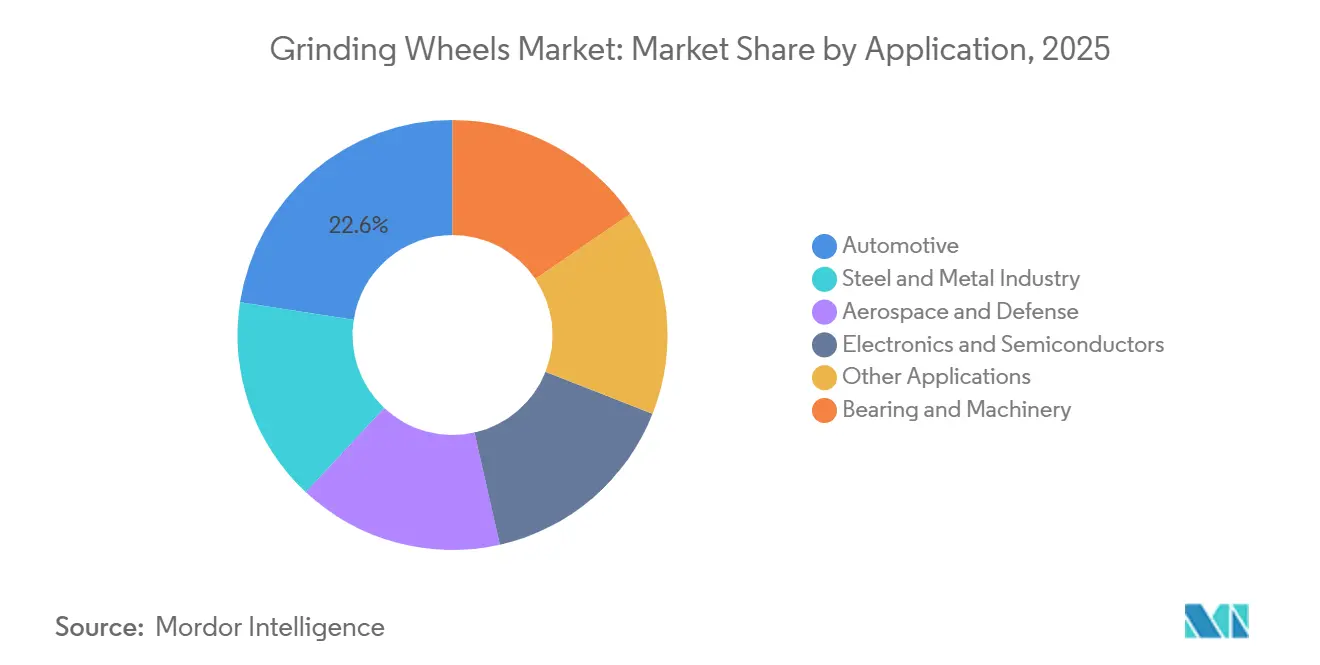
- By application, automotive held 22.56% of global value in 2025, while electronics and semiconductors are forecast to grow at a 6.78% CAGR through 2031.
- By geography, Asia-Pacific held 40.74% of global value in 2025 and is forecast to grow at a 6.24% CAGR through 2031.
Note: Market size and forecast figures in this report are generated using Mordor Intelligence’s proprietary estimation framework, updated with the latest available data and insights as of January 2026.
Market Trends and Insights
Drivers Impact Analysis of Grinding Wheels Market*
| Drivers | (~) % Impact on CAGR Forecast | Geographic Relevance | Impact Timeline |
|---|---|---|---|
| Automotive and Electric Vehicle Component Manufacturing | +1.5% | Global, concentrated in Asia-Pacific, Europe, and North America | Long term (≥ 4 years) |
| Aerospace, Defense, and Superalloy Machining | +0.9% | North America and Europe, with an expanding Asia-Pacific presence | Medium term (2-4 years) |
| Infrastructure, Steel, and Fabricated Metal Production | +0.8% | Asia-Pacific core, the Middle East and Africa, and South America | Long term (≥ 4 years) |
| Semiconductor, Electronics, and Advanced-Material Processing | +1.0% | Asia-Pacific and North America | Long term (≥ 4 years) |
| Automated CNC Grinding and Industry 4.0 Adoption | +0.7% | Global, with early gains in Germany, Japan, and China | Medium term (2-4 years) |
| Source: Mordor Intelligence | |||
Automotive and Electric Vehicle Component Manufacturing
Battery-electric drivetrains require higher-specification abrasive tools across the automotive supply chain. Rotor shafts, constant-velocity joint cages, and electric transmission gears need submicrometer surface finishes to control noise and vibration. Research presented at GrindingHub 2026 linked grinding quality with electric-drive performance requirements. A 2025 SAE technical paper found that ground electric-vehicle transmission gears had better resistance to micropitting-related failure than shaved gears[1]. Euro 7, adopted by the European Parliament in March 2024, set brake particulate limits for passenger cars and light trucks. Hard-coated brake discs require double-sided grinding of the laser-clad carbide friction layers, creating a new application for cubic boron nitride (CBN) and engineered vitrified wheels as European production increases.
Aerospace, Defense, and Superalloy Machining
Nickel-based superalloys such as Inconel 718, GH4169, and single-crystal DD6 require specialized grinding systems. These materials work-harden quickly and concentrate heat at the contact point, reducing dimensional control with conventional aluminum oxide wheels. Research on GH4169 found that nano-ceramic-bonded CBN wheels produced compressive residual stresses up to -416.7 MPa and a compressive layer of approximately 40 µm. A 2025 study found that grinding temperatures below 135°C helped avoid subsurface microcracks and material bulging in nickel-based superalloys. The grinding wheels market benefits when suppliers document grinding force, surface roughness, and residual-stress performance for qualified aerospace applications. AS9100 traceability requirements make this documentation important for supplier qualification and repeat orders.
Semiconductor, Electronics, and Advanced Material Processing
Silicon carbide (SiC) production requires diamond tooling from ingot preparation through wafer processing. Hardinge Group and Kellenberger demonstrated at GrindingHub 2026 that automated 5-axis grinding reduced a SiC process from 24 hours to 2-3 hours. SiC requires fine surface quality, including Ra 5 angstrom outcomes cited for advanced substrate applications. Wafer producers seek to shorten downstream slurry polishing as that step adds cycle time and coolant infrastructure costs. Hyperion Materials & Technologies released its Diamond Solutions for Semiconductors guide in July 2026, covering engineered diamond parameters for silicon, SiC, gallium nitride, sapphire, and aluminum nitride processing. The guide reflects a shift toward application-engineered wheel systems with documented yield and throughput outcomes.
Automated Computer Numerical Control (CNC) Grinding and Industry 4.0 Adoption
Digital process twins combine machine sensor data with physics-based models to predict surface roughness and residual stress before production begins. Research teams from RWTH Aachen University and Fraunhofer IPT presented in-process quality monitoring methods at GrindingHub 2026. These methods identify deviations during an operation and reduce scrap in high-value grinding work. Tyrolit's STARTEC PG-3 metal-bonded diamond wheel reduced peel-grinding time by 25% for solid-carbide cutting tools in a May 2026 demonstration. Automation makes wheel inconsistency more visible as sensors report process variation in real time, shifting low-quality abrasive from a surface-quality issue to an equipment uptime issue and supporting the use of certified premium grades.
Restraints Impact Analysis of Grinding Wheels Market*
| Restraints | (~) % Impact on CAGR Forecast | Geographic Relevance | Impact Timeline |
|---|---|---|---|
| Alternative Technologies, Including Hard Turning, EDM, and Laser Ablation | -0.7% | North America and Europe, with growing use in East Asia | Long term (≥ 4 years) |
| Raw-Material Price and Availability Volatility | -0.8% | Global, with high exposure among Southeast Asian small and medium-sized producers and European buyers | Short term (≤ 2 years) |
| Energy-Intensive Vitrified Wheel Manufacturing | -0.5% | Europe and East Asia | Medium term (2-4 years) |
| Source: Mordor Intelligence | |||
Alternative Technologies, Including Hard Turning, EDM, and Laser Ablation
Hard turning with polycrystalline cubic boron nitride (PCBN) inserts can finish hardened steel automotive components, particularly where machining lengths are short. A 2026 study of gas-carburized SAE 8620 steel found that PCBN hard turning under minimum quantity lubrication achieved surface and dimensional results comparable to grinding, while requiring less coolant-management infrastructure. Fraunhofer ILT demonstrated in 2025 that ultrashort-pulse laser ablation could shape and polish hard materials in a single clamping operation[2]. Laser polishing can eliminate grinding-induced subsurface stress layers in applications where such layers are unacceptable. These alternatives require different equipment and become more viable when component complexity, material hardness, and batch size justify the higher capital cost.
Raw-Material Price and Availability Volatility
Input-cost inflation is an immediate pressure on grinding-wheel producers' margins. Silicon carbide prices declined 18% year over year in Q4 2025 from the 2024 peak, but synthetic diamond and cubic boron nitride (CBN) costs rose 15-25% in some 2026 contracts. This increase reflects higher graphite, nickel, and cobalt costs associated with high-pressure, high-temperature diamond synthesis. U.S. tariff expansions added 7.5-25% to landed costs for certain abrasive stock-keeping units, while export licensing delays extended North American buyer qualification timelines by 6-12 weeks. Small and medium-sized producers in Southeast Asia face greater pressure due to shorter inventory cover and more limited raw material contracts.
*Our forecasts treat driver/restraint impacts as directional, not additive. The impact forecasts reflect baseline growth, mix effects, and variable interactions.
Grinding Wheels Market Segment Analysis
By Bond Type:
Vitrified Systems Lead While Electroplated Wheels Advance in Precision ApplicationsVitrified bond wheels accounted for 38.43% of the grinding wheels market share in 2025. They remain widely used in automotive, bearing, and gear grinding because they support dressing, thermal stability, and repeatable dimensions. Their porous structure supports coolant delivery and helps reduce thermal damage on hardened steel parts. Research on high-speed cylindrical grinding of 18CrNiMo7-6 steel reported compressive residual stresses up to -416.7 MPa and a compressive layer of approximately 40 µm. Norton Saint-Gobain will present VS3PN gear-grinding wheels for profile retention and burn-free grinding at the International Manufacturing Technology Show (IMTS) 2026.
Resinoid wheels serve flexible grinding and heavy stock removal in steel conditioning and fabrication. Metal bond wheels remain important for silicon carbide (SiC) and sapphire processing because they retain diamond under demanding material-removal conditions. Electroplated wheels are forecast to grow at a 5.89% CAGR through 2031, making them the fastest-growing bond subsegment. Their single-layer diamond or cubic boron nitride (CBN) design supports complex profiles for grinding aerospace turbine and medical implant components. The grinding wheels market is separating into stable, high-output conventional products and premium engineered bonds for precise applications. Premium wheels can carry unit values 3-5 times higher than conventional alternatives without requiring equivalent output growth.

By Abrasive Material:
Diamond Traction Signals a Strategic Shift Toward Superabrasive SystemsAluminum oxide retained 42.15% of the segment value in 2025. It is used for grinding steel, cast iron, and general alloys in automotive, bearing, and fabrication work. The material remains competitive in cost-sensitive bulk applications. Ceramic alumina and CBN are stronger alternatives where wheel life and surface finish justify a higher purchase price. Silicon carbide is used for nonferrous, hard, and brittle materials such as glass, ceramic, and semiconductor substrates.
The diamond segment is projected to grow at a 6.32% CAGR through 2031, the fastest rate among abrasive materials. CBN is established in camshaft, crankshaft, and bearing-race grinding, while aerospace and medical applications add demand. A 2025 review of new-energy vehicle gears identified worm-wheel grinding and internal-meshing power honing as leading finishing processes for electric transmissions. A 2024 review found that a conventional wheel embodied nearly 450 MJ of manufacturing energy, whereas a superabrasive wheel embodied more than 1,200 MJ but can last more than 1,000 times longer. This lifecycle relationship supports the adoption of superabrasives, in which tooling energy and service life are factored into procurement decisions.
By Grain Size:
Medium Grit Anchors Broad Applications, While Superfine Enables Nanoscale FinishingMedium-grain wheels accounted for 35.62% of the segment value in 2025. This class broadly covers F100-F220 and is suitable for cylindrical, surface, and gear grinding. It balances material removal with surface finish for automotive, bearing, and steel-conditioning work. Coarse grain is used in billet conditioning and roughing. Fine grain is used for precision bore finishing, sealing surfaces, and honing.
Superfine grain in the grinding wheels market is projected to expand at a 6.27% CAGR through 2031. It supports wafer backgrinding, optical lens finishing, and medical implant grinding that require submicron surface outcomes. Production requires controlled environments for particles below 10 µm and bond systems compatible with submicron diamond. White-light interferometry and atomic force microscopy can verify these surfaces when conventional profilometry is insufficient. Porous vitrified bonds for superfine diamond combine coolant delivery with lower grinding force, offering a point of differentiation.
By Application:
Automotive Output Anchors the Market While Electronics and Semiconductors Drive Value GrowthAutomotive held 22.56% of the application value in 2025. Vehicle production and the grinding intensity of powertrain components support this position. The shift to electric vehicles changes the component mix rather than eliminating demand for automotive grinding. Camshafts and fuel-injection parts are less relevant, while rotor shafts, motor cores, and electric transmission gears require higher-value tools. Bearing and machinery represent the second-largest application, while steel and metal processing support high demand for snagging and conditioning.
Electronics and semiconductors are projected to expand at a 6.78% CAGR through 2031, the fastest rate among application segments. Larger wafers and harder substrates, including SiC and sapphire, require fine surface quality and limited subsurface damage. Hyperion Materials & Technologies' July 2026 application guide covered diamond solutions across ingot isolation, slicing, profiling, grinding, lapping, polishing, thinning, and dicing. Semiconductor fabrication growth in Taiwan, South Korea, Japan, the United States, and Europe aligns with demand for SiC and gallium nitride power electronics. This supports a larger role for application-specific superabrasive sourcing in the grinding wheels market.
Geography Analysis
APAC Grinding Wheels Market
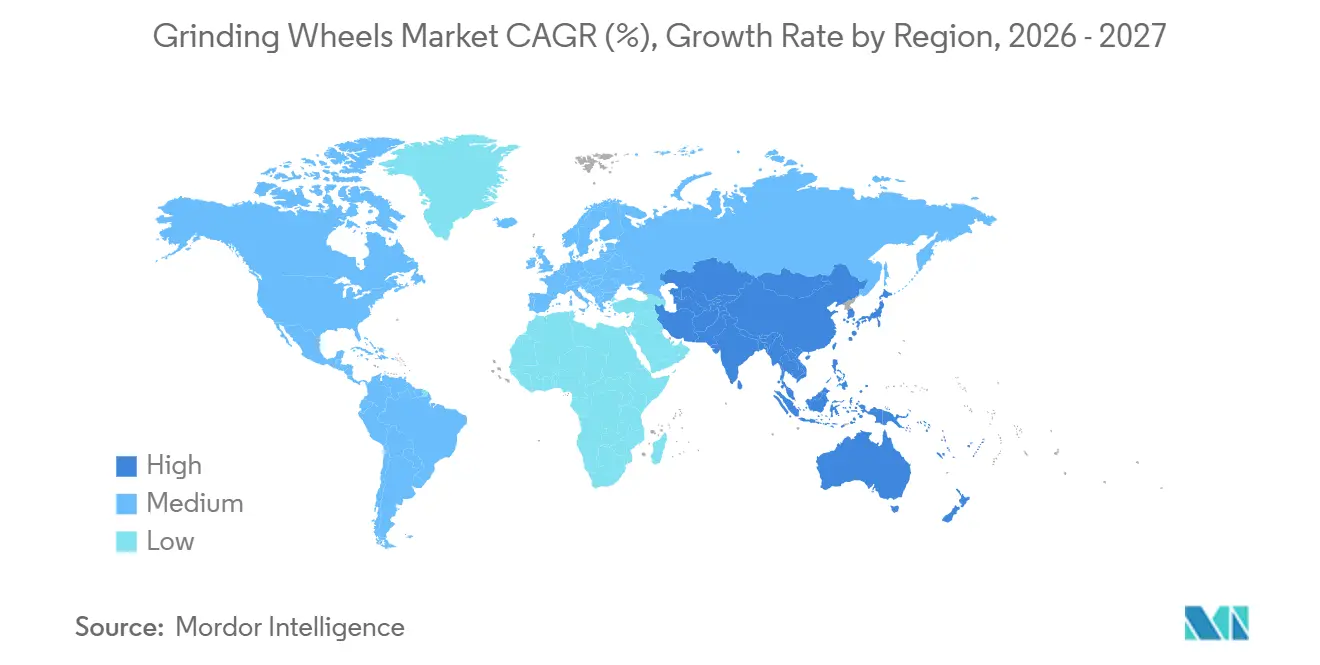
Asia-Pacific accounted for 40.74% of the grinding wheels market share in 2025 and is forecast to grow at a 6.24% CAGR through 2031. China drives regional consumption through high machine-tool density, automotive output, and new-energy vehicle production. The region combines high equipment density with major automotive and semiconductor production bases. Japan and South Korea consume high-value superabrasive wheels for precision applications in the semiconductor and automotive industries.
India, North America and Europe Grinding Wheels Market
India is an important production and consumption base in the grinding wheels market. Carborundum Universal Limited (CUMI) commissioned its Hosur facility in March 2026, increasing annual capacity from 45 million to more than 90 million wheels. North America and Europe represent the most value-intensive demand clusters outside Asia-Pacific. In the United States, aerospace manufacturing drives demand for superabrasives, while OSHA silica regulations drive demand for controlled-dust solutions and documented wheel specifications.
South America, APAC and MEA Grinding Wheels Market
South America, the Middle East, and Africa are smaller grinding wheel market regions, supported by automotive, fabrication, construction, and processing activities. Brazil anchors South American demand through automotive manufacturing in São Paulo and Minas Gerais. India and ASEAN are expected to account for a large share of steel production growth in emerging economies, supporting steel-conditioning applications. Saudi Arabia and South Africa support demand through infrastructure, oil and gas processing, and construction activities. In 2026, Saint-Gobain announced plans to accelerate investment and acquisitions in India, with the aim of more than doubling its business there within five years. These investments add regional production capacity to a grinding wheel market that is increasingly centered on Asian manufacturing.
Competitive Landscape
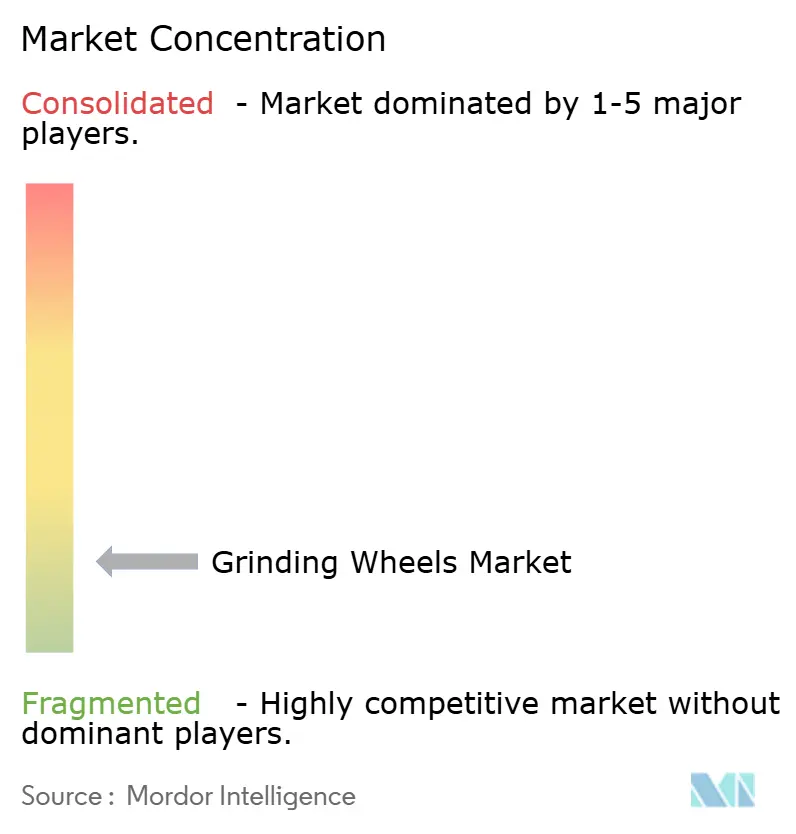
The grinding wheels market is fragmented. Saint-Gobain (through Norton), Tyrolit Group, and CUMI hold differentiated positions across broad product portfolios. Regional specialists include Asahi Diamond, Noritake, Kure, Atlantic, Klingspor, Wendt, SAK Abrasives, and Camel Grinding Wheels. Global suppliers invest in proprietary bond systems, machine-tool collaboration, and application certifications. Norton's VS3PN and Quantum Prime products, together with Tyrolit's CERABOND X and MIDTEC systems, illustrate this focus on higher-performance abrasive systems. Regional companies compete through application knowledge, service response, and localized supply.
The semiconductor and advanced-substrate segment remains open to specialists such as Meister Abrasives, Asahi Diamond Industrial, and KURE GRINDING WHEEL, which hold application positions in wafer backgrinding and SiC substrate processing. Digital process traceability is becoming important for automotive and aerospace customers who incorporate supplier data into their quality systems. At GrindingHub 2026, CUMI presented bonded wheels for aerospace, automotive, rail, steel, and bearing applications, emphasizing cost per part rather than the wheel acquisition price. ISO 9001, AS9100, and IATF 16949 requirements limit qualifying competition for applications with strict documentation requirements.
Winterthur Technology Group made its first public trade fair appearance at GrindingHub 2026 following the separation of 3M's Precision Grinding and Finishing business, a transition that created uncertainty for some existing customer relationships. Tyrolit launched the STARTEC PG-3 metal-bonded diamond wheel in May 2026 to reduce peel-grinding time for solid-carbide cutting tools. Saint-Gobain showcased gear-grinding wheels designed for burn-free performance and profile retention at the International Manufacturing Technology Show (IMTS) 2026. The grinding wheels market remains moderately fragmented, with leading suppliers coexisting alongside numerous regional and application-focused producers.
Grinding Wheels Industry Leaders
-
Saint-Gobain
-
3M
-
Tyrolit AG
-
Klingspor AG
-
NORITAKE CO., LIMITED
- *Disclaimer: Major Players sorted in no particular order
Grinding Wheels Market Companies Covered in this Report
- 3M
- Andre Abrasive Articles Spółka z ograniczoną odpowiedzialnością
- Asahi Diamond Industrial Co.,Ltd.
- ATLANTIC GmbH
- Camel Grinding Wheels Works Sarid LTD
- CUMI
- DK Holdings Ltd.
- DSA Products Ltd
- Klingspor AG
- KURE GRINDING WHEEL
- Mirka Ltd
- NORITAKE CO., LIMITED
- Saint-Gobain
- SAK ABRASIVES LIMITED
- SHIN-EI Grinding Wheels MFG. Co.,Ltd.
- Tyrolit AG
- Wendt (India) Limited
Recent Industry Developments in Grinding Wheels Market
- July 2026: Hyperion Materials & Technologies released its "Diamond Solutions for Semiconductors" application guide, specifying engineered diamond abrasive parameters for ingot isolation, wafer slicing, edge profiling, grinding, lapping, chemical-mechanical polishing, wafer thinning, and device dicing across silicon, SiC, gallium nitride, sapphire, and aluminum nitride substrates. The guide positions Hyperion as a full-value-chain supplier across the semiconductor wafer-processing value chain rather than a commodity diamond grain vendor.
- May 2026: Kapp Niles Group (Coburg, Germany) introduced CBN roughing and finishing grinding wheels for brake rotor machining at GrindingHub 2026, Stuttgart. The finishing wheel features an optimized CBN grain for cast-iron machining, aimed at extended tool life and consistent component quality in EV and ICE brake systems.
Global Grinding Wheels Market Report Scope
A grinding wheel is a circular cutting and shaping tool made of abrasive particles held together by a bonding matrix. As it spins at high speeds on a grinder, thousands of tiny grain edges wear away metal, stone, glass, or wood to cut, smooth, sharpen, or polish surfaces with precision.
The grinding wheels market is segmented by bond type, abrasive material, grain size, application, and geography. By bond type, the market is segmented into vitrified bond grinding wheels, resinoid bond grinding wheels, metal bond grinding wheels, electroplated bond grinding wheels, and other bond types. By abrasive material, the market is segmented into aluminum oxide, silicon carbide, ceramic alumina, cubic boron nitride (CBN), diamond, and other abrasive materials. By grain size, the market is segmented into coarse, medium, fine, and superfine. By application, the market is segmented into automotive, bearing and machinery, steel and metal industry, aerospace and defense, electronics and semiconductors, and other applications. The report also covers market size and forecasts for the grinding wheels across 15 countries in major regions. The market sizes and forecasts are provided in terms of value (USD).
Segmentation Overview
| Vitrified Bond Grinding Wheels |
| Resinoid Bond Grinding Wheels |
| Metal Bond Grinding Wheels |
| Electroplated Bond Grinding Wheels |
| Other Bond Types |
| Aluminum Oxide |
| Silicon Carbide |
| Ceramic Alumina |
| Cubic Boron Nitride (CBN) |
| Diamond |
| Other Abrasive Materials |
| Coarse |
| Medium |
| Fine |
| Superfine |
| Automotive |
| Bearing and Machinery |
| Steel and Metal Industry |
| Aerospace and Defense |
| Electronics and Semiconductors |
| Other Applications |
| Asia-Pacific | China |
| India | |
| Japan | |
| South Korea | |
| ASEAN Countries | |
| Rest of Asia-Pacific | |
| North America | United States |
| Canada | |
| Mexico | |
| Europe | Germany |
| United Kingdom | |
| France | |
| Italy | |
| NORDIC Countries | |
| Rest of Europe | |
| South America | Brazil |
| Argentina | |
| Rest of South America | |
| Middle East and Africa | Saudi Arabia |
| South Africa | |
| Rest of Middle East and Africa |
| By Bond Type | Vitrified Bond Grinding Wheels | |
| Resinoid Bond Grinding Wheels | ||
| Metal Bond Grinding Wheels | ||
| Electroplated Bond Grinding Wheels | ||
| Other Bond Types | ||
| By Abrasive Material | Aluminum Oxide | |
| Silicon Carbide | ||
| Ceramic Alumina | ||
| Cubic Boron Nitride (CBN) | ||
| Diamond | ||
| Other Abrasive Materials | ||
| By Grain Size | Coarse | |
| Medium | ||
| Fine | ||
| Superfine | ||
| By Application | Automotive | |
| Bearing and Machinery | ||
| Steel and Metal Industry | ||
| Aerospace and Defense | ||
| Electronics and Semiconductors | ||
| Other Applications | ||
| By Geography | Asia-Pacific | China |
| India | ||
| Japan | ||
| South Korea | ||
| ASEAN Countries | ||
| Rest of Asia-Pacific | ||
| North America | United States | |
| Canada | ||
| Mexico | ||
| Europe | Germany | |
| United Kingdom | ||
| France | ||
| Italy | ||
| NORDIC Countries | ||
| Rest of Europe | ||
| South America | Brazil | |
| Argentina | ||
| Rest of South America | ||
| Middle East and Africa | Saudi Arabia | |
| South Africa | ||
| Rest of Middle East and Africa | ||
Key Questions Answered in the Report
What is current market size of Grinding Wheels Market?
The Grinding Wheels Market size was estimated at USD 7.12 billion in 2025 and is estimated to grow from USD 7.48 billion in 2026 to USD 9.70 billion by 2031, at a CAGR of 5.34% during the forecast period (2026-2031).
Which application will grow fastest through 2031?
Electronics and semiconductors are forecast to grow at a 6.78% CAGR, supported by wafer processing, hard substrates, and demand for power electronics.
Which bond type leads to global demand?
Vitrified bond wheels led with a 38.43% share in 2025 because they offer dressing, cooling, thermal stability, and repeatable dimensions for automotive and bearing applications.
Why are diamond grinding wheels gaining demand?
Diamond is forecast to grow at a 6.32% CAGR because silicon carbide (SiC), photovoltaic wafer, and semiconductor applications require durable superabrasive tooling and close surface control.