
Green Ammonia Fertilizer Market Size and Share
Market Overview
| Study Period | 2021 - 2031 |
|---|---|
| Market Size (2026) | USD 2.97 Billion |
| Market Size (2031) | USD 3.97 Billion |
| Growth Rate (2026 - 2031) | 6.00 % |
| Fastest Growing Market | Asia-Pacific |
| Largest Market | Europe |
| Market Concentration | Medium |
Major Players
*Disclaimer: Major Players sorted in no particular order Image © Mordor Intelligence. Reuse requires attribution under CC BY 4.0. |
|
Green Ammonia Fertilizer Market Analysis by Mordor Intelligence
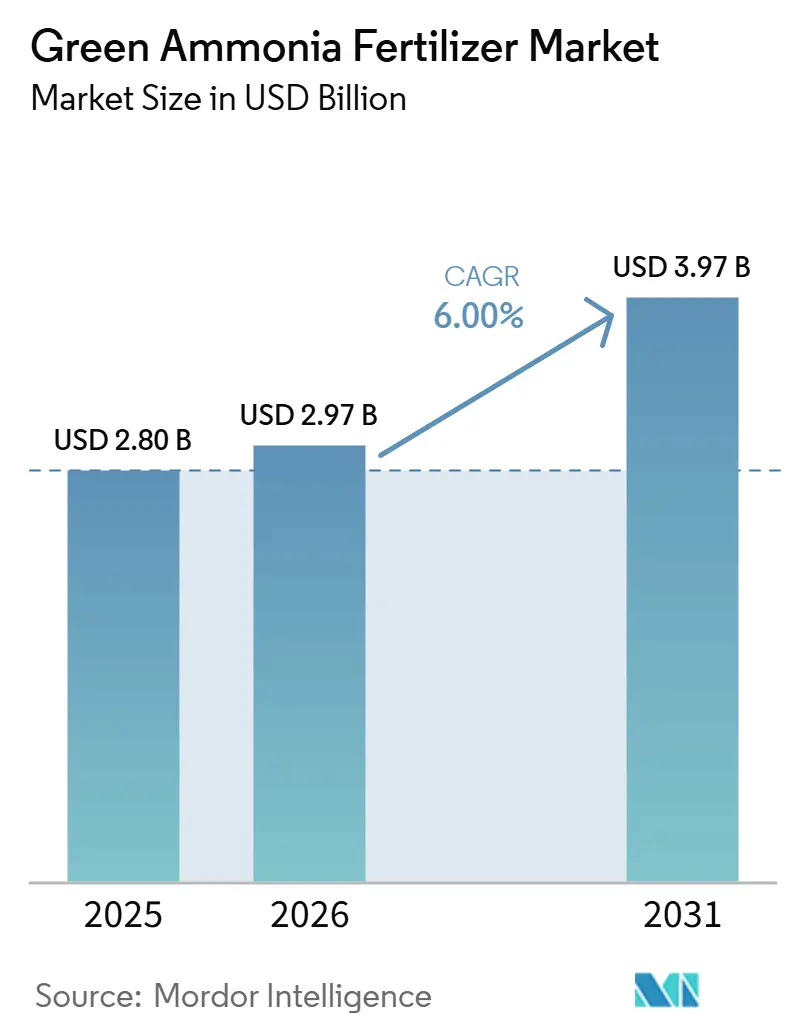
The green ammonia fertilizer market is anticipated to grow from USD 2.80 billion in 2025 to USD 2.97 billion in 2026, reaching USD 3.97 billion by 2031, at a CAGR of 6.0% during the forecast period 2026-2031. The market is expanding as decarbonization policies, lower electrolyzer costs, and demand for certified low-emission inputs shift purchasing decisions from pilot activity to commercial contracting. Green ammonia's dual role as a crop nutrient and fuel candidate gives producers a broader demand base and supports large capital projects. In Europe, carbon pricing and import-related compliance costs continue to support the market, while Asia-Pacific is gaining momentum as governments aggregate long-term offtake demand for domestic fertilizer use. The market remains moderately concentrated, with established fertilizer companies holding the largest revenue share. The main commercial opportunity lies in securing long-term contracts and certification credibility, while the primary risk remains the sensitivity of project economics to fossil gas prices, subsidy continuity, and agronomic validation cycles for newer formulations.
Key Report Takeaways
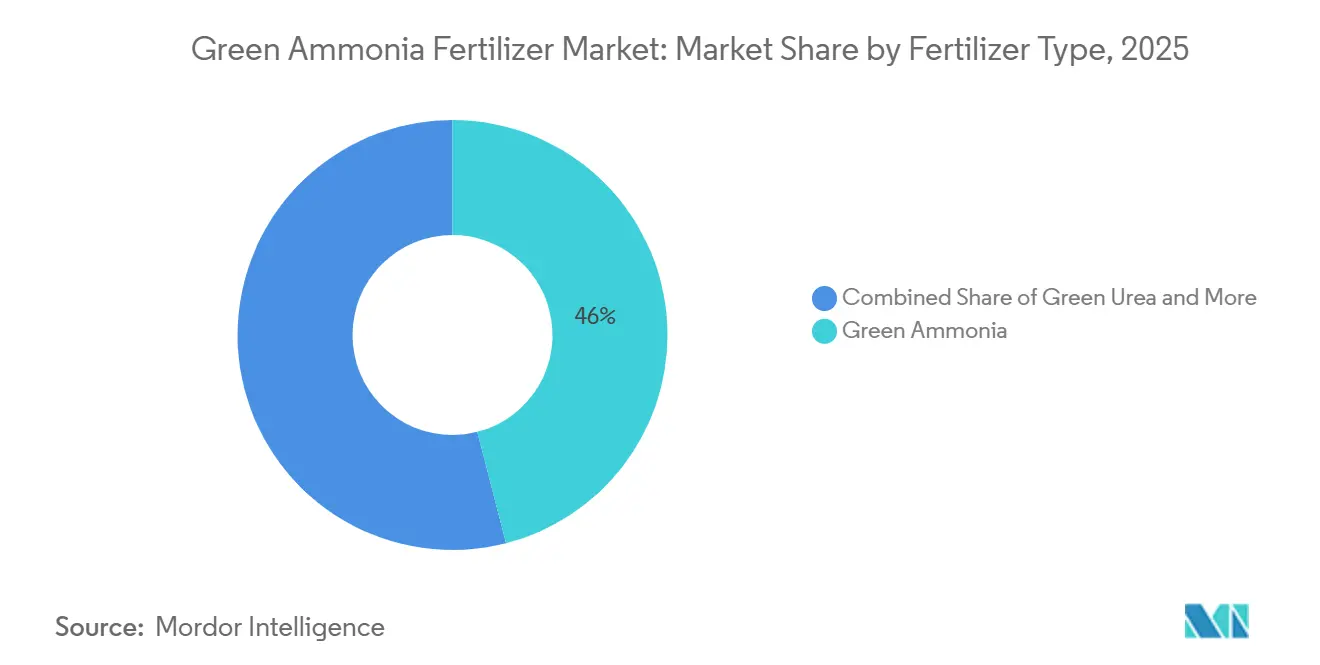
- By fertilizer type, green ammonia was the largest segment and held 46.0% of the green ammonia fertilizer market share in 2025, while green ammonia is also the fastest-growing segment and is anticipated to expand at a 6.8% CAGR between 2026 and 2031.
- By source technology, electrolytic hydrogen-based production was the largest segment and held 54.0% of the green ammonia fertilizer market size in 2025, while waste-to-hydrogen-based production is the fastest-growing segment and is anticipated to expand at a 10.0% CAGR between 2026 and 2031.
- By form, solid products were the largest segment and held 65.0% share in 2025, while liquid products are the fastest-growing segment and are anticipated to expand at a 7.2% CAGR between 2026 and 2031.
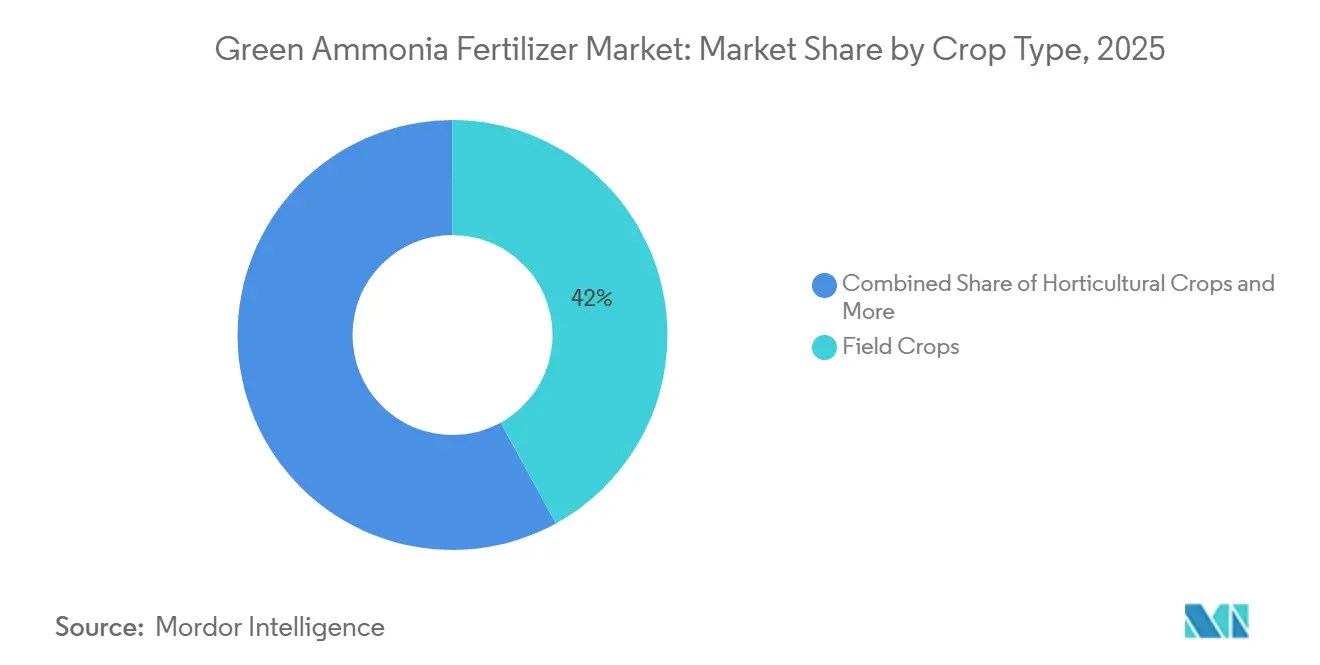
- By crop type, field crops were the largest segment and held 42.0% share in 2025, while horticultural crops are the fastest-growing segment and are anticipated to expand at a 7.5% CAGR between 2026 and 2031.
- By geography, Europe is the largest segment and held 32.0% share in 2025, while Asia-Pacific is the fastest-growing segment and is anticipated to expand at a 7.6% CAGR between 2026 and 2031.
Note: Market size and forecast figures in this report are generated using Mordor Intelligence’s proprietary estimation framework, updated with the latest available data and insights as of January 2026.
Market Trends and Insights
Drivers Impact Analysis of Green Ammonia Fertilizer Market*
| Driver | (~) % Impact on CAGR Forecast | Geographic Relevance | Impact Timeline |
|---|---|---|---|
| Carbon-neutral fertilizer mandates | +1.2% | Europe, Japan, South Korea | Medium term (2-4 years) |
| Renewable power cost parity in production hubs | +1.0% | United States, Australia, Saudi Arabia, Chile | Short term (≤ 2 years) |
| Corporate net-zero farming procurement | +0.8% | United States, Canada, United Kingdom, Japan | Medium term (2-4 years) |
| Green-hydrogen tax credits and production incentives | +0.9% | United States, Canada | Medium term (2-4 years) |
| Carbon border adjustment pressure on fertilizer trade | +0.7% | European Union member states, Turkey | Short term (≤ 2 years) |
| Ammonia bunkering demand pull-through from maritime decarbonization | +0.6% | Norway, Singapore, Japan, South Korea | Long term (≥ 4 years) |
| Source: Mordor Intelligence | |||
Carbon-Neutral Fertilizer Mandates
Binding emissions regulations are shifting the low-carbon nitrogen procurement from a voluntary option to a contractual requirement in several agricultural supply chains. The European Union's (EU) Effort Sharing Regulation (ESR) 2021-2030 requires member states to reduce greenhouse gas emissions in non-Emissions Trading System sectors, including agriculture, pushing fertilizer buyers toward certified lower-emission inputs. This policy shift is also increasing the value of traceability, as buyers increasingly require lifecycle verification rather than offset-based claims alone, which favors larger producers and more integrated supply chains. Japan's Hydrogen Society Promotion Act of 2024 is creating a similar demand pattern in East Asia by supporting imports through a policy structure that enables long-term contracting. As a result, compliance standards are now shaping upstream investment decisions across the green ammonia fertilizer market.
Renewable Power Cost Parity in Production Hubs
Falling renewable electricity and electrolyzer costs are narrowing the commercial gap between electrolytic ammonia and conventional ammonia production. The International Energy Agency (IEA) reported in its 2025 Global Hydrogen Review that electrolyzer installation costs outside China ranged from USD 2,000 to USD 2,600 per kilowatt in 2024[1]Source: IEA Report, "Global Hydrogen Review 2025,"iea.org. The cost advantage favors projects with reliable renewable grid access, as they can combine lower operating costs with stronger emissions performance. Flexible production modeling published in 2025 in MDPI also indicated materially lower future ammonia costs under optimized wind and solar-wind hybrid systems, supporting the view that cost competitiveness will improve as projects scale and system design matures. As this cost gap narrows, the green ammonia fertilizer market becomes less dependent on policy support and more capable of expanding on a commercial basis.
Corporate Net-Zero Farming Procurement
Food and agribusiness companies are generating demand for green ammonia fertilizers as they work to reduce Scope 3 emissions across crop supply chains. In January 2026, CF Industries Holdings Inc., POET, LLC., and major United States agricultural cooperatives launched a low-carbon fertilizer pilot that tracks carbon intensity certification from ammonia production to retail corn farming[2]Source: News Report, "CF Industries, POET, and Major Agriculture Co-Operatives Launch Low-Carbon Fertilizer Pilot to Cut Ethanol Production Carbon Intensity,"cfindustries.com. European processors and retailers are also adding certified low-emission fertilizer requirements to supplier contracts as disclosure obligations and buyer commitments tighten. These agreements are becoming increasingly significant, as many are structured as 10-year to 15-year fixed-volume contracts, which improve revenue visibility for developers and lenders. North American grain cooperatives are building procurement frameworks to hedge rising carbon-related input costs, suggesting that this demand is beginning to sustain itself rather than relying solely on direct incentives. This shift supports a more durable commercial base for the market.
Green-Hydrogen Tax Credits and Production Incentives
Tax credits, contracts, and competitive subsidy auctions are reducing the time required for green ammonia projects to reach final investment decision. Under Section 45V of the Inflation Reduction Act (IRA) in the United States, qualifying clean hydrogen producers can receive up to USD 3.0 per kilogram of hydrogen for 10 years, which materially improves project economics for electrolytic ammonia facilities. In 2026, Fertiglobe stated that its Egypt Green Hydrogen project was supported by an H2Global contract with a maximum value of EUR 397 million (USD 437 million) for renewable ammonia supply to Germany from 2027. In 2025, CF Industries Holdings, Inc., JERA Co., Inc., and Mitsui and Co., Inc. confirmed a final investment decision on the Blue Point Complex in Louisiana, a project positioned to become the world's largest ammonia facility. In July 2026, the ACME Group and IHI Corporation joint venture in Odisha received Japan's Contract for Difference support for a 405,000 metric tons per year project, with 25-year price support tied to exports to Japan. These mechanisms reduce price uncertainty and improve access to financing across the market.
Restraints Impact Analysis of Green Ammonia Fertilizer Market*
| Restraint | (~) % Impact on CAGR Forecast | Geographic Relevance | Impact Timeline |
|---|---|---|---|
| High capital intensity of large-scale electrolyzers and synthesis trains | -1.5% | Global, with concentration in North America and Europe | Medium term (2-4 years) |
| Grid congestion delaying renewable power purchase agreements | -1.2% | Texas, California, Germany, Australia, India | Short term (≤ 2 years) |
| Scarcity of certified green water resources in arid production zones | -1.0% | Saudi Arabia, United Arab Emirates, Australia, Chile | Long term (≥ 4 years) |
| Slow agronomic validation of novel green fertilizer formulations | -0.8% | Global, with emphasis on bio-based and liquid products | Medium term (2-4 years) |
| Source: Mordor Intelligence | |||
High Capital Intensity of Large-Scale Electrolyzers and Synthesis Trains
The high cost of building large green ammonia fertilizer plants remains the most significant barrier to faster supply expansion. The International Energy Agency reported in 2025 that only 4% of the global electrolyzer pipeline planned for 2030 had reached final investment decision or begun construction, despite a project pipeline of 520 gigawatts. This is significant because green ammonia fertilizer projects typically have build periods of 3 to 5 years, meaning any changes in carbon pricing or subsidy rules during construction can weaken returns before production begins. Financing is more difficult in emerging markets, where long-tenor project debt is limited and sovereign risk premiums increase the effective cost of capital. Progress therefore depends on long-term offtake contracts, policy stability, and construction-period risk support.
Grid Congestion Delaying Renewable Power Purchase Agreements
Transmission bottlenecks are delaying the renewable power purchase agreements that many green hydrogen and ammonia projects require before financing can close. The Electric Reliability Council of Texas (ERCOT) reported 410 gigawatts of interconnection requests in 2026, with many study timelines extending beyond four years, directly slowing projects along the United States Gulf Coast and in the Midwest. Germany faces a similar challenge, as industrial demand is concentrated away from major renewable generation zones, stretching project timelines and weakening confidence in power availability. This gives a relative advantage to port-based or dedicated-generation projects, such as the Slagen project in Norway, where purpose-built renewable supply and electrolyzer integration reduce exposure to grid constraints. India and Australia also face interconnection delays, despite both countries having strong renewable resources and significant developer interest. The result is a narrower pool of financially viable projects, with the best-positioned facilities being those that can secure dedicated power or structure offtake-backed energy procurement.
*Our forecasts treat driver/restraint impacts as directional, not additive. The impact forecasts reflect baseline growth, mix effects, and variable interactions.
Green Ammonia Fertilizer Market Segment Analysis
By Fertilizer Type:
Green Ammonia Leads Both Volume and Forecast GrowthGreen ammonia fertilizer accounted for 46.0% of market revenue in 2025, making it the largest product segment in the green fertilizer market. Its dominant position is supported by compatibility with existing Haber-Bosch production facilities, ammonia terminals, and handling infrastructure used across the conventional nitrogen fertilizer industry. This established infrastructure lowers the transition costs for buyers by enabling the adoption of lower-emission ammonia without requiring major changes to existing production and logistics networks. Green ammonia also benefits from demand beyond agriculture, as its use as a marine fuel provides an additional offtake channel that helps improve asset utilization during periods of slower agricultural demand.
Green ammonia is projected to grow at a CAGR of 6.8% between 2026 and 2031, further strengthening its position as related green fertilizer categories continue to evolve. Government initiatives promoting low-carbon fertilizer production and the use of green ammonia in fertilizer manufacturing are improving the commercial outlook for green urea and other sustainable nitrogen products. At the same time, the fertilizer product mix is gradually expanding beyond conventional nitrogen substitution toward a broader portfolio of low-emission and circular nutrient solutions. Despite this diversification, green ammonia is anticipated to remain the commercial anchor of the market because it serves both agricultural and industrial end users.



By Source Technology:
Electrolytic Hydrogen Leads While Waste-To-Hydrogen Builds MomentumElectrolytic hydrogen-based production held 54.0% of source technology revenue in 2025, accounting for the largest share of the green ammonia fertilizer market. Its position is supported by direct alignment with zero-carbon certification requirements and eligibility for major incentive programs in the United States, Europe, and Japan. This pathway also benefits from a more mature ecosystem of certifiers, insurers, engineering providers, and offtakers, which reduces transaction friction for large projects. Developers that choose electrolytic routes are often able to move faster because counterparties have a clearer understanding of the certification logic and financing structure. Biomass gasification-based production retains a presence in markets where crop residues create strong local feedstock advantages, particularly across South and Southeast Asia.
Waste-to-hydrogen based production is anticipated to expand at a 10.0% CAGR between 2026 and 2031, making it the fastest-growing source technology. This route attracts interest because it combines waste management and fertilizer decarbonization within a single business case, which can broaden the pool of capital available to projects. The strongest opportunity exists in locations where tipping-fee revenue or municipal waste obligations can directly support hydrogen production economics. Other pathways, such as plasma-assisted synthesis and electrochemical nitrogen reduction, remain at an earlier stage and are better viewed as longer-term technology options rather than near-term volume contributors in the green ammonia fertilizer market.
By Form:
Solid Products Retain Scale While Liquid Formats Advance in Precision AgricultureSolid fertilizer held 65.0% of 2025 revenue by form, representing the largest share of the green ammonia fertilizer market. Their dominant position reflects direct compatibility with existing farm equipment, storage systems, and bulk transport networks, which lowers switching costs for distributors and growers. Agricultural cooperatives and retail channels are also structured around solid handling, which further strengthens the position of granular and prilled products. As a result, adoption can scale faster in mainstream cropping systems because buyers do not require immediate capital investment at the farm or warehouse level. The established advantage of solids is likely to remain significant in large scale intensive agriculture, where simplicity and logistics efficiency continue to shape purchasing behavior.
Liquid products are anticipated to expand at a 7.2% CAGR between 2026 and 2031, with this segment gaining ground as precision agriculture tools become more widespread. Variable-rate application systems, root-zone targeting, and sensor-based monitoring are improving the value case for liquids by enabling more controlled nutrient delivery. The format is particularly attractive in horticulture, fertigation, and protected cultivation, where application timing and input efficiency have a strong effect on crop quality and margins. In April 2026, Siemens Energy and Shomax announced work on NitroLEAF, a zero-carbon liquid fertilizer concept built on off-grid renewable electrolysis for United States farmers. The shift toward liquids will therefore be selective rather than universal, with the clearest gains appearing where agronomy and equipment already support targeted nutrient delivery.
By Crop Type:
Field Crops Provide Volume While Horticulture Supports Premium DemandField crops accounted for 42.0% of demand by crop type in 2025, making them the largest segment in the green ammonia fertilizer market. Cereals, grains, oilseeds, and pulses consume large volumes of nitrogen, so even a small green premium per unit becomes significant at scale. This makes field crops the primary volume base for large ammonia projects, as they can absorb substantial tonnage once procurement frameworks are in place. Commercial expansion in this segment depends heavily on whether developers can narrow the delivered cost gap sufficiently for broad-acre growers and cooperatives. Turf and ornamentals remain the smallest crop-type segment, though they are relevant in regulated urban and landscape applications where nutrient runoff rules are becoming stricter.
Horticultural crops are anticipated to expand at a 7.5% CAGR between 2026 and 2031, supported by premium export supply chains. Fresh produce exporters increasingly face residue checks, sustainability audits, and provenance requirements that favor certified lower-emission inputs. Chile and Argentina illustrate this pattern in fruit and wine-related supply chains, where low-carbon input claims can support export positioning. Buyers in these crop systems often accept higher input scrutiny because the value of market access and premium branding outweighs the cost considerations typical of bulk commodity crops. This keeps horticulture relevant for margin expansion even as field crops continue to define the volume base for the green fertilizer market.
Geography Analysis
Europe Green Ammonia Fertilizer Market
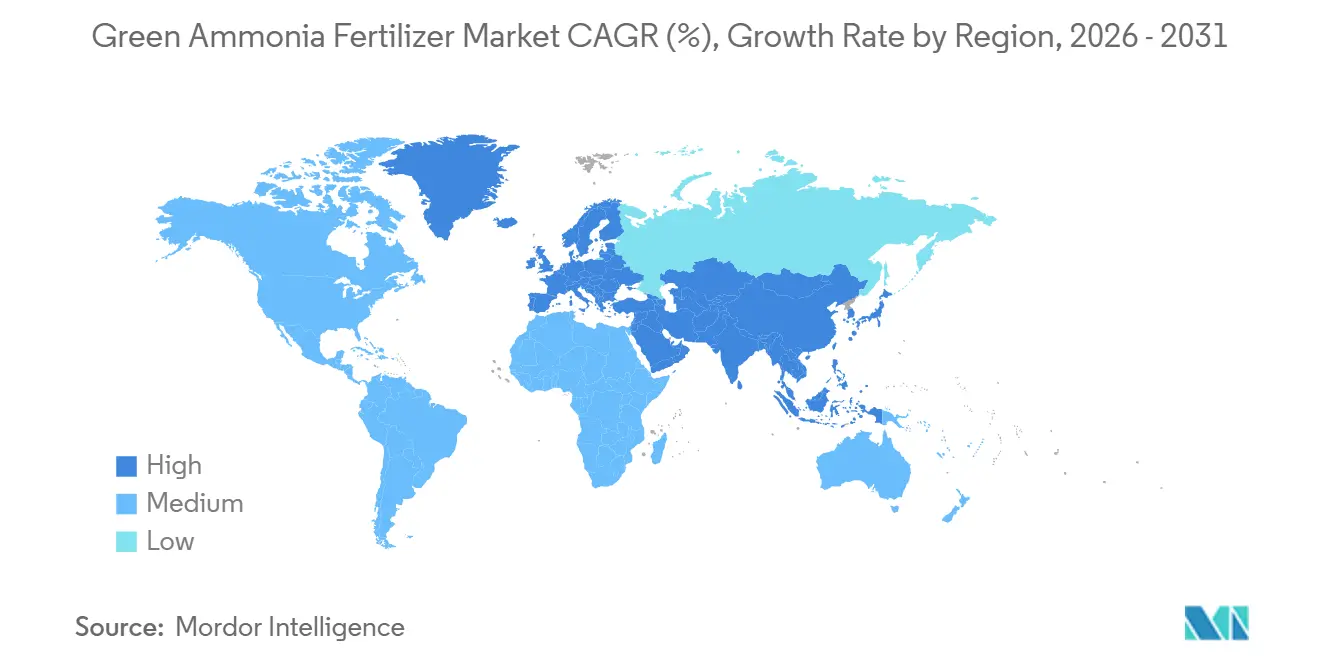
Europe held 32.0% of the green fertilizer market share in 2025, making it the largest region. Europe's position is supported by carbon pricing, stricter import accountability, and greater willingness among buyers to pay for certified lower-emission ammonia and downstream fertilizers. The Carbon Border Adjustment Mechanism (CBAM) moved into its definitive phase in January 2026, which improves the relative competitiveness of low-emission fertilizer supply, particularly for buyers with long-term exposure to imported conventional ammonia. Europe also remains a significant demand center as producers seek to reduce dependence on Russian-gas-linked feedstocks and reposition their supply chains around low-carbon sources.
APAC and MEA Green Ammonia Fertilizer Market
Asia-Pacific is anticipated to expand at a 7.6% CAGR between 2026 and 2031, making it the fastest-growing region. Growth is being driven by governments in India, Japan, South Korea, China, and Australia combining demand creation with supply-side investment support. In June 2026, India signed 10-year agreements through the Solar Energy Corporation of India (SECI) covering 670,000 metric tons per year of green ammonia supply for 11 domestic fertilizer plants under the National Green Hydrogen Mission. Japan is supporting regional expansion through price-support frameworks that help cross-border green ammonia projects secure bankable export demand[3]Source: News Article, "India locks in 670,000t of green ammonia annually for fertilizer plants at half the global benchmark price,"fertilizerdaily.com. Western Asia is also gaining importance, as Saudi Arabia, the United Arab Emirates, and Egypt combine low-cost renewable resources with export-oriented project strategies targeting European and East Asian buyers.
The Americas, Africa and Russia Green Ammonia Fertilizer Market
North America remains commercially significant, as the United States policy framework provides clean hydrogen and low-carbon ammonia projects with stronger financial support and clearer investment visibility. South America is building demand through export agriculture, particularly where growers and exporters require verifiable sustainable input use to maintain access to premium markets. Africa has a smaller but notable project pipeline, with Egypt and South Africa standing out as markets where resource quality and fertilizer demand support a viable long-term case for expansion. Russia remains a slower market, as low-cost natural gas, limited clean-energy policy momentum, and reduced access to Western technology partnerships continue to constrain the pace of change.

Competitive Landscape
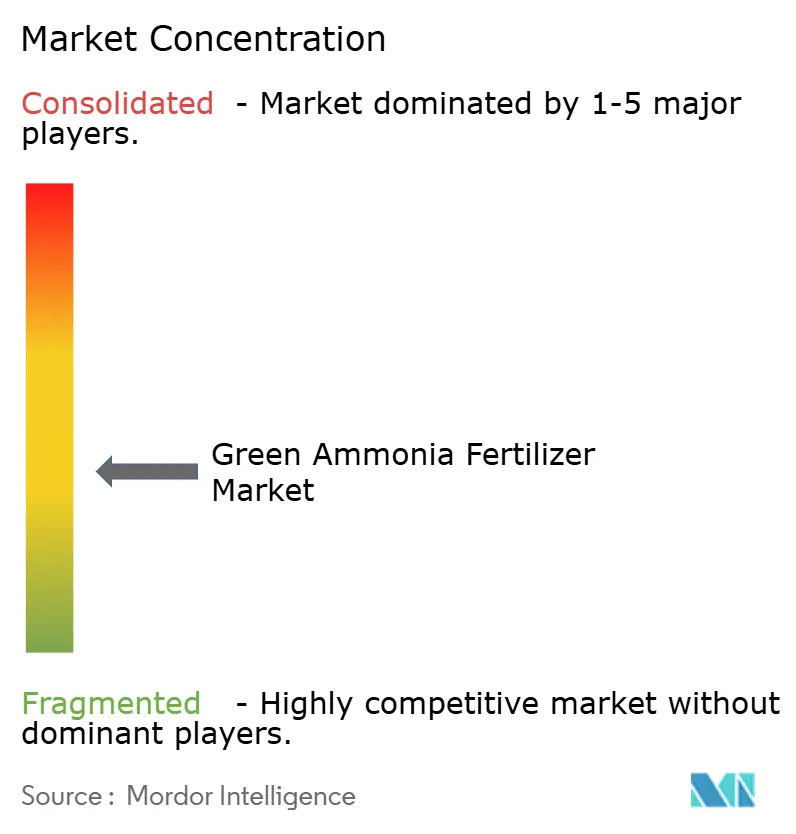
The green fertilizer market remains moderately concentrated, with the top five companies accounting for a major share in 2025. Yara International ASA, CF Industries Holdings Inc., Nutrien Ltd., OCI N.V., and Fertiglobe PLC currently anchor the commercial structure, but their positions are being challenged by renewable energy developers and specialized project sponsors. Companies with low-cost solar or wind access can compete with traditional fertilizer producers because power economics increasingly determine who can produce certified green hydrogen and ammonia fertilizer at a viable cost. Electrolyzer suppliers such as Nel ASA and Siemens Energy are also reshaping the competitive landscape, as falling system costs make smaller or more modular plant concepts more feasible for regional markets. This leaves the green ammonia fertilizer market open to competition from firms that have historically operated outside the conventional fertilizer supply chain.
A clear pattern in the market is the rise of cross-sector partnerships that combine fertilizer production, energy supply, technology, and trading capability under a single structure. This model is significant because large projects now require capital depth, certification credibility, and secure offtake simultaneously. Growth opportunities remain strongest in bio-integrated products, waste-to-hydrogen systems linked to industrial or municipal waste streams, and modular ammonia solutions for regions with high bulk logistics costs. Certification programs such as Verified Ammonia Carbon Intensity (VACI) are becoming stronger differentiators, as they help producers translate low-emission claims into premium pricing and preferred-supplier status.
In July 2026, Yara agreed to acquire Gulf Coast Ammonia's Texas City facility, strengthening its North American production platform and creating a path toward lower-emission ammonia. In May 2026, Nel ASA launched its next-generation pressurized alkaline electrolyzer platform, supporting lower system costs and broader project viability. Collectively, these moves reflect a broader shift in the market toward consolidating production assets, advancing electrolyzer technology, and expanding export capacity for low-carbon ammonia fertilizer.
Green Ammonia Fertilizer Industry Leaders
-
Yara Clean Ammonia AS (Yara International ASA)
-
CF Industries Holdings Inc.
-
Nutrien Ltd.
-
OCI Global (OCI N.V.)
-
Fertiglobe PLC
- *Disclaimer: Major Players sorted in no particular order
Green Ammonia Fertilizer Market Companies Covered in this Report
- Yara Clean Ammonia AS (Yara International ASA)
- CF Industries Holdings Inc.
- Nutrien Ltd.
- OCI Global (OCI N.V.)
- Fertiglobe PLC
- ACME Cleantech Solutions Private Limited (ACME Group)
- Air Products and Chemicals Inc.
- ENGIE SA
- Iberdrola S.A.
- thyssenkrupp Uhde GmbH (thyssenkrupp AG)
- Siemens Energy AG
- Nel ASA
- AmmPower Corp.
- Avina Clean Hydrogen Inc.
- Casale SA
- AM Green Ammonia India Private Limited (AM Green Group)
- Greenko Energy Holdings
- Fortescue Energy Pty Ltd
- Technip Energies N.V.

Recent Industry Developments in Green Ammonia Fertilizer Market
- July 2026: Yara International ASA agreed to acquire Gulf Coast Ammonia's production facility in Texas City, Texas for USD 1.3 billion from GCA Holdings LLC, adding large-scale conventional ammonia capacity upgradeable to low-emission production and reinforcing Yara's North American supply footprint.
- July 2026: The ACME Group and IHI Corporation green ammonia joint venture received Japan's Contract for Difference certification worth ¥480 billion (USD 3 billion), under the Hydrogen Society Promotion Act for its 405,000 metric tons per year project in Gopalpur, Odisha, providing 25-year price support for 228,000 metric tons per year of green ammonia exports to Japan commencing in 2030.
- March 2026: India signed 10-year green ammonia purchase and supply agreements through SECI covering 670,000 metric tons per year for 11 domestic fertilizer plants under the National Green Hydrogen Mission, anticipated to substitute 25% of gray ammonia in non-urea fertilizer units and save USD 2.5 billion in foreign exchange over the contract period.


Global Green Ammonia Fertilizer Market Report Scope
Green ammonia fertilizer is ammonia produced using renewable energy, offering a low-carbon alternative to conventional fertilizers while maintaining the same agricultural effectiveness.
The Green Ammonia Fertilizer Market is Segmented by Fertilizer Type (Green Ammonia, Green Urea, and Other Fertilizer Types), by Source Technology (Electrolytic Hydrogen Based, Biomass Gasification Based, and Waste-To-Hydrogen Based), by Form (Solid and Liquid), by Crop Type (Field Crops, Horticultural Crops, and Turf and Ornamental), and by Geography (North America, South America, Europe, Asia-Pacific, Middle East, and Africa). The Market Forecasts are Provided in Terms of Value (USD) and Volume (Metric Tons).
| Green Ammonia | Fully Green Ammonia |
| Blended Green Ammonia Fertilizers | |
| Green Ammonia Based Bio Integrated Fertilizers | |
| Green Urea | |
| Other Fertilizer Types |
| Electrolytic Hydrogen Based |
| Biomass Gasification Based |
| Waste-to-Hydrogen Based |
| Other Emerging Technologies |
| Solid |
| Liquid |
| Field Crops |
| Horticultural Crops |
| Turf and Ornamental |
| North America | United States |
| Canada | |
| Mexico | |
| Rest of North America | |
| South America | Brazil |
| Argentina | |
| Rest of South America | |
| Europe | Germany |
| France | |
| United Kingdom | |
| Italy | |
| Spain | |
| Russia | |
| Rest of Europe | |
| Asia- Pacific | China |
| Japan | |
| India | |
| South Korea | |
| Australia and New Zealand | |
| Rest of Asia-Pacific | |
| Middle East | Saudi Arabia |
| United Arab Emirates | |
| Turkey | |
| Rest of Middle East | |
| Africa | South Africa |
| Egypt | |
| Rest of Africa |
| By Fertilizer Type | Green Ammonia | Fully Green Ammonia |
| Blended Green Ammonia Fertilizers | ||
| Green Ammonia Based Bio Integrated Fertilizers | ||
| Green Urea | ||
| Other Fertilizer Types | ||
| By Source Technology | Electrolytic Hydrogen Based | |
| Biomass Gasification Based | ||
| Waste-to-Hydrogen Based | ||
| Other Emerging Technologies | ||
| By Form | Solid | |
| Liquid | ||
| By Crop Type | Field Crops | |
| Horticultural Crops | ||
| Turf and Ornamental | ||
| By Geography | North America | United States |
| Canada | ||
| Mexico | ||
| Rest of North America | ||
| South America | Brazil | |
| Argentina | ||
| Rest of South America | ||
| Europe | Germany | |
| France | ||
| United Kingdom | ||
| Italy | ||
| Spain | ||
| Russia | ||
| Rest of Europe | ||
| Asia- Pacific | China | |
| Japan | ||
| India | ||
| South Korea | ||
| Australia and New Zealand | ||
| Rest of Asia-Pacific | ||
| Middle East | Saudi Arabia | |
| United Arab Emirates | ||
| Turkey | ||
| Rest of Middle East | ||
| Africa | South Africa | |
| Egypt | ||
| Rest of Africa | ||


Key Questions Answered in the Report
What is the 2026 size of the green ammonia fertilizer market?
The green ammonia fertilizer market size stands at USD 2.97 billion in 2026.
Which product segment leads green ammonia fertilizer demand?
Green ammonia led product demand with a 46.0% revenue share in 2025 because it fits existing ammonia infrastructure and logistics systems.
Why is Europe leading adoption of green fertilizers?
Europe leads because carbon pricing, traceability requirements, and import-related carbon costs are pushing buyers toward lower-emission fertilizer inputs.
What is the biggest challenge for green ammonia fertilizer projects?
The main challenge is high capital intensity, because large electrolyzer and synthesis projects still need policy stability, long-term offtake, and affordable renewable power before financing can close.
Page last updated on:





