
GPU Liquid Cooling Market Size and Share
Market Overview
| Study Period | 2020 - 2031 |
|---|---|
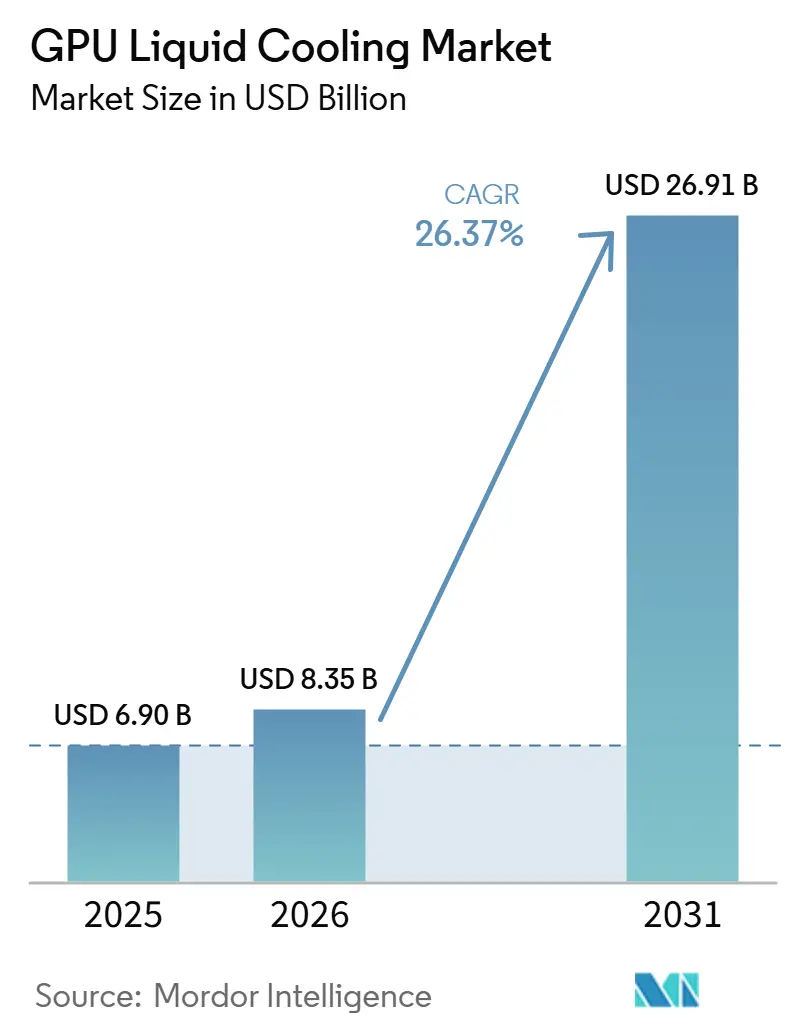
| Market Size (2026) | USD 8.35 Billion |
| Market Size (2031) | USD 26.91 Billion |
| Growth Rate (2026 - 2031) | 26.37 % |
| Fastest Growing Market | Asia-Pacific |
| Largest Market | North America |
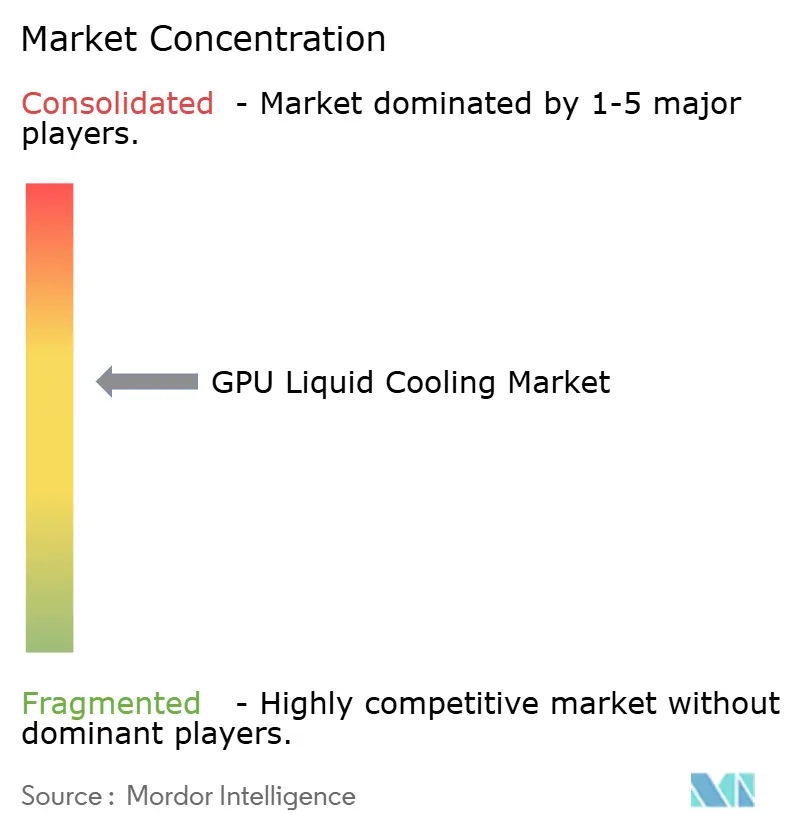
| Market Concentration | Medium |
Major Players *Disclaimer: Major Players sorted in no particular order Image © Mordor Intelligence. Reuse requires attribution under CC BY 4.0. | |
GPU Liquid Cooling Market Analysis by Mordor Intelligence
The GPU liquid cooling market size is expected to increase from USD 6.90 billion in 2025 to USD 8.35 billion in 2026 and reach USD 26.91 billion by 2031, growing at a CAGR of 26.37% over 2026-2031. Rapid adoption of AI accelerators that dissipate more than 1,000 watts per chip is forcing data centers to abandon conventional air cooling, and liquid solutions now underpin capacity expansions at hyperscale campuses. Equipment makers have begun shipping factory-integrated liquid-cooled servers, eliminating costly retrofits and compressing deployment timelines. Stricter power-usage-effectiveness (PUE) mandates across North America and Europe are converting regulatory pressure into immediate capital budgets for liquid projects. Asia-Pacific leads deployment volumes, yet North America is setting technology benchmarks through early adoption of two-phase evaporative platforms.
Key Report Takeaways
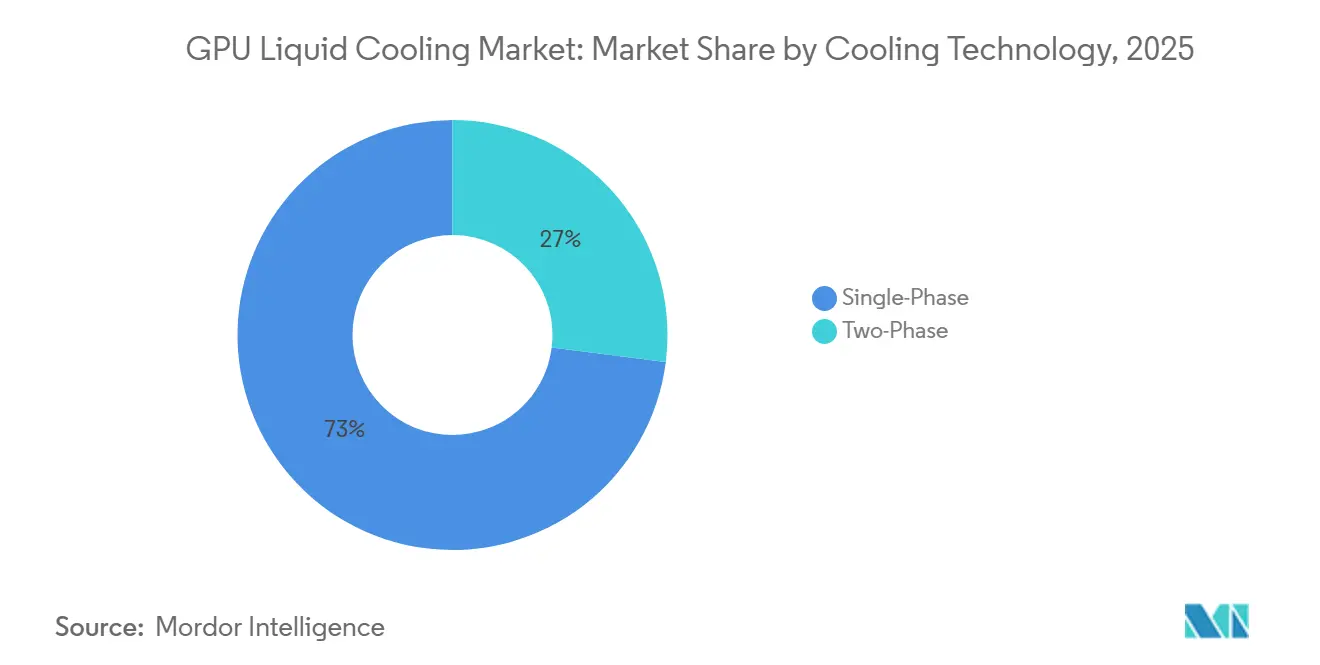
- By cooling type, single-phase direct-to-chip solutions led the GPU liquid cooling market with a 73% revenue share in 2025, while two-phase systems are projected to expand at a 27.80% CAGR through 2031.
- By cooling level, component-level cold plates held 56% of the GPU liquid cooling market share in 2025, whereas rack-level immersion is forecast to grow at 28.10% between 2026 and 2031.
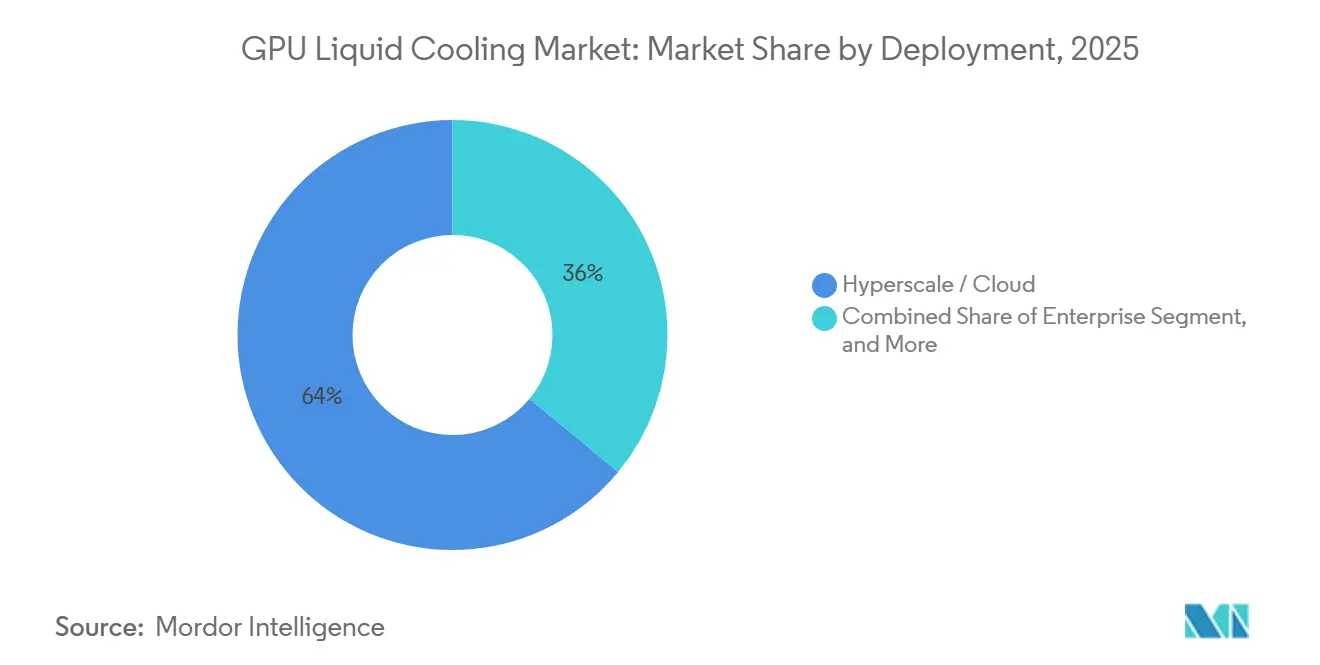
- By deployment, hyperscale and cloud providers captured 64% revenue of the GPU liquid cooling market in 2025, yet the enterprise segment is on track for a 26.80% CAGR to 2031.
- By GPU power density, the 300-watt to 700-watt band accounted for 52% of the GPU liquid-cooling market in 2025, while the above-700-watt category is advancing at a 28.60% CAGR through 2031.
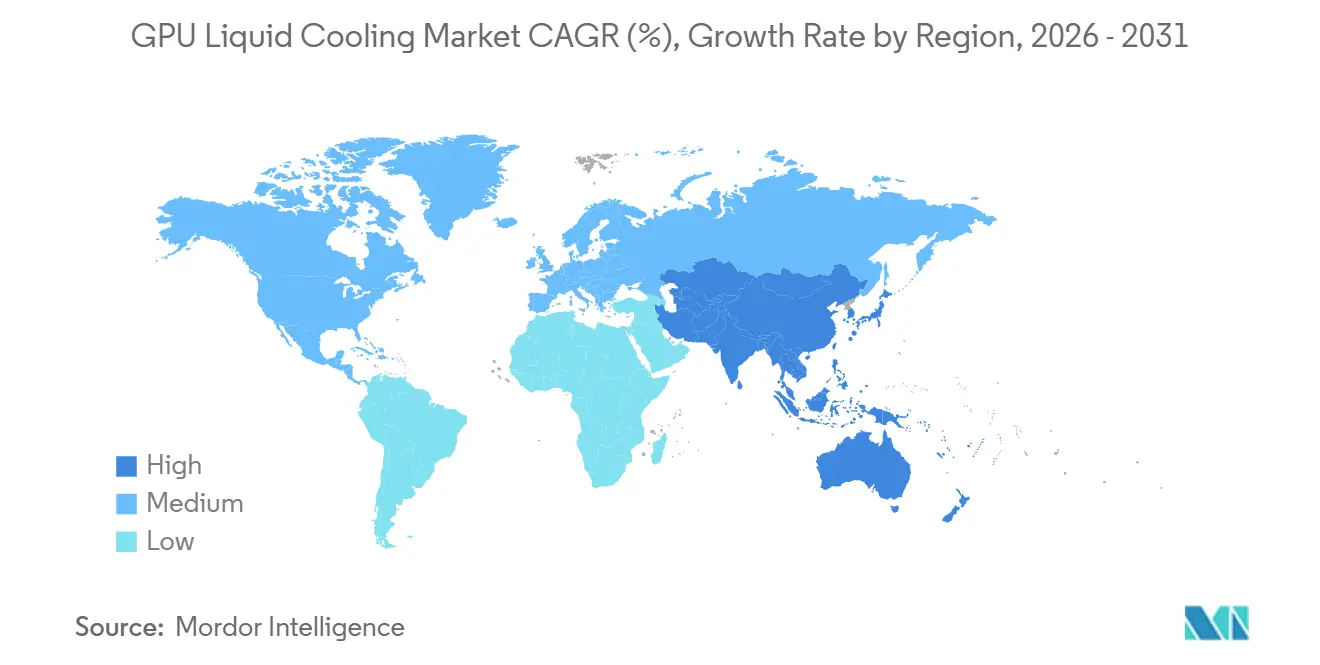
- By geography, Asia-Pacific dominated the graphics processing unit (GPU) liquid cooling market with a 68% share in 2025 and is anticipated to expand at a 29.10% CAGR over 2026-2031.
Note: Market size and forecast figures in this report are generated using Mordor Intelligence’s proprietary estimation framework, updated with the latest available data and insights as of January 2026.
Market Trends and Insights
Drivers Impact Analysis of GPU Liquid Cooling Market*
| Driver | (~) % Impact on CAGR Forecast | Geographic Relevance | Impact Timeline |
|---|---|---|---|
| Hyperscale GPU Rack Densities Exceeding 120 kW Accelerate Liquid Cooling Adoption | +8.2% | Global, concentrated in North America hubs and China AI clusters | Short term (≤ 2 years) |
| OEM Launches of Liquid-Cooled GPU Platforms From NVIDIA, AMD, and Supermicro | +6.5% | Global, led by North America and Asia-Pacific manufacturing bases | Short term (≤ 2 years) |
| Next-Generation AI ASICs Above 1 kW TDP Require Two-Phase Solutions | +5.1% | Global, with R&D leadership in North America, early rollouts in Asia-Pacific | Medium term (2-4 years) |
| Stricter Data Center PUE Mandates in North America and Europe | +3.8% | North America and Europe, influencing multinational operators in Asia-Pacific | Medium term (2-4 years) |
| Heat Reuse Incentives in District Energy Networks | +1.9% | Core Europe, pilots in Canada and Japan | Long term (≥ 4 years) |
| Supply Chain Localization of CDUs and Quick Disconnects in Southeast Asia | +1.4% | Asia-Pacific manufacturing corridors | Medium term (2-4 years) |
| Source: Mordor Intelligence | |||
Hyperscale Rack Density Pushes Liquid Cooling Into the Mainstream
Rack-level power density ballooned from 27 kW in 2024 to well above 100 kW in 2026, and leading campuses already test 250 kW racks. At these thermal loads, airflow velocity becomes impractical, and acoustic limits prohibit further fan speed increases. Operators therefore retrofit existing halls with coolant distribution units that tolerate 45 °C supply temperatures, allowing chillers to run in economizer mode all year. Early adopters documented 35% smaller building footprints, saving more than USD 180 million in avoided concrete and steel. The outcome is a visible migration budgeted directly into hyperscale capital-expenditure plans rather than deferred operational spending.[1]AFCOM, “2026 State of the Data Center,” afcom.com
OEM Platforms Remove Integration Barriers
Server manufacturers moved liquid cooling from a specialized option to a default for high-performance GPU nodes. Factory-installed cold plates, quick disconnects, and leak-detection loops now ship on NVIDIA GB200, AMD MI325X, and Supermicro X14 systems. The turnkey approach cuts rack-level installation time from 16 hours to less than three, reducing commissioning labor by 80%. End users gain immediate performance headroom, as liquid-cooled variants sustain up to 18% higher clock frequencies under the same power envelope. The commercial message is clear that liquid cooling is no longer exotic; it is the shipping configuration for flagship AI hardware.[2]NVIDIA Corporation, “Investor Presentation Q4 2025,” nvidia.com
Two-Phase Technology Answers 1 kW-Plus Chips
With chip thermal design power doubling in three years, single-phase water-glycol loops approach their material limits. Two-phase evaporative modules exploit the latent heat of vaporization, absorbing roughly tenfold more energy per kilogram of coolant. Field pilots kept 1,100-watt accelerators below 65 °C junction temperature while slashing chiller loads by 30%. Equipment makers integrate micro-evaporators directly on silicon packages, eliminating external pumps and shrinking coolant inventory. Standardization work inside the Open Compute Project now aligns refrigerant chemistry and manifold geometry, removing interoperability barriers for hyperscalers.[3]IEEE, “Heat-Transfer Performance of Two-Phase Cold Plates,” ieeexplore.ieee.org
Regulation Turns Efficiency From Nice-to-Have Into Legal Requirement
Germany, France, California, and the European Union have codified PUE thresholds between 1.15 and 1.20 for facilities commissioned after 2027. For AI workloads that push rack densities beyond 30 kW, meeting those limits without liquid cooling is mathematically impossible. Fiscal penalties include higher grid-connection fees and, in some regions, mandatory waste-heat recovery plans. Consequently, sustainability officers, facilities engineers, and finance teams converge on liquid cooling as the lowest-risk compliance path, accelerating deal cycles and pulling enterprise adoption forward by at least two years.[4]Bundesministerium für Wirtschaft und Klimaschutz, “Energy Efficiency Act Amendment 2024,” bmwk.de
Restraints Impact Analysis of GPU Liquid Cooling Market*
| Restraint | (~) % Impact on CAGR Forecast | Geographic Relevance | Impact Timeline |
|---|---|---|---|
| High CapEx Premium for Immersion Systems | -3.2% | Global, especially cost-constrained enterprise and edge deployments | Short term (≤ 2 years) |
| Fluorinated Coolant Environmental Regulations | -2.1% | Europe and North America, with spillover to Asia-Pacific multinationals | Medium term (2-4 years) |
| Limited Field Expertise for Edge AI Retrofits | -1.5% | Global secondary markets | Medium term (2-4 years) |
| Long Qualification Cycles for Government HPC Facilities | -0.9% | North American and European procurement, emerging Asia-Pacific labs | Long term (≥ 4 years) |
| Source: Mordor Intelligence | |||
Capital Cost Premium Slows Immersion Uptake
Immersion tanks cost 30%-50% more than air-based cooling solutions and continue to carry a 15% cost uplift over single-phase cold plates, making upfront capital expenditure a key barrier for many buyers. Dielectric fluids further increase deployment costs, adding USD 15,000-30,000 per rack, and operators must budget for yearly top-offs that can approach 10% of total fluid volume. For enterprises that typically refresh or renew hardware every three years, these added costs extend the payback period beyond acceptable investment horizons, slowing adoption and delaying broader rollouts. Vendors are now pursuing cost reductions by using commodity fluids, simplifying system designs, and standardizing tank dimensions to improve manufacturing scale and installation efficiency. However, most observers expect immersion cooling to reach price parity with competing solutions only after 2028.
Environmental Rules Complicate Coolant Choice
European F-gas revisions ban high-GWP fluorocarbons by 2030, and the Netherlands already outlawed PFAS fluids in 2026, accelerating regulatory pressure on immersion cooling deployments that rely on these chemistries. The exit of 3M Novec from the market further forces operators and suppliers to transition rapidly to hydrocarbon or bio-based alternatives, which offer lower dielectric strength and higher viscosity compared with incumbent fluids. As a result, operators face unexpected retrofit bills for seal replacements and pump upgrades, creating additional technical and financial burdens. These requirements introduce uncertainty into capital planning, complicate procurement decisions, and temporarily curb the momentum of the immersion market.
*Our forecasts treat driver/restraint impacts as directional, not additive. The impact forecasts reflect baseline growth, mix effects, and variable interactions.
GPU Liquid Cooling Market Segment Analysis
By Cooling Type:
Two-Phase Momentum Builds at Extreme Thermal LoadsSingle-phase systems accounted for 73% of revenue in 2025, reflecting a decade-long field maturity and seamless integration with legacy chillers. These installations circulate water-glycol mixtures between 30 °C and 45 °C, capture up to 85% of chip heat, and slot directly into existing building chilled-water loops. The GPU liquid-cooling market for single-phase solutions benefited from hyperscalers standardizing on manifold designs under the Open Compute Project, trimming integration labor by nearly one-fifth. Continued shipments of Lenovo Neptune, Dell PowerEdge XE9680L, and HPE Cray EX servers sustain the installed base, especially for workloads where 700-watt accelerators remain dominant.
Two-phase platforms are projected to grow at a 27.80% CAGR, making them the fastest-growing segment of the GPU liquid cooling market. Evaporative cold plates capture almost the entire 1,000-watt-plus heat load directly on silicon, returning liquid to chillers at elevated temperatures that support near-free cooling for much of the year. Vertiv Liebert PCW and ZutaCore HyperCool field trials demonstrate 98% chip-level heat capture, halving cooling energy use and freeing rack space for power-conversion gear. Though dielectric management imposes stricter material compatibility rules, hyperscalers weigh those costs against the alternative of building entirely new halls to house future Blackwell Ultra clusters.



By Cooling Level:
Immersion Tanks Accelerate Deployment TimelinesComponent-level cold plates retained 56% share in 2025, underpinned by ship-through volumes from server OEMs. Direct-to-chip plates require no new server enclosures and leverage standardized quick disconnects, making them attractive for enterprises performing gradual retrofits. Cold-plate loops also minimize fluid inventory, reducing environmental risk and meeting insurance-carrier guidelines with minimal paperwork. However, they still demand per-node plumbing labor and cannot fully exploit heat-re-use schemes because exhaust temperatures sit below 50 °C.
Rack-level immersion is forecast to expand at 28.10% per year. Submer, GRC, and LiquidStack tanks enable 200 kW racks within existing floor grids, shrink installation windows to a single afternoon, and simplify maintenance with live-service capabilities. The GPU liquid cooling market share for immersion rose sharply after ByteDance documented PUE 1.08 and 85% waste-heat recovery, influencing procurement strategies across mainland China. Financial models show that once electricity exceeds USD 0.10 per kilowatt-hour, immersion’s operational savings eclipse its capital premium in under three years, tilting total-cost-of-ownership calculations decisively.
By Deployment:
Enterprise Momentum Builds Under Sustainability ScrutinyHyperscalers accounted for 64% of 2025 revenue, leveraging million-square-foot campuses and custom power-distribution schemes. Their early leadership established volume orders that anchored supplier cost curves and catalyzed broad ecosystem standardization. Even so, enterprise demand is catching up quickly, posting a forecast 26.80% CAGR as mid-tier colocation providers face Scope 2 disclosure obligations. For example, an OVHcloud retrofit cut PUE from 1.42 to 1.18, sparing EUR 3.20 million (USD 3.62 million) in annual grid surcharges and making liquid cooling a CFO-endorsed sustainability lever.
Edge AI and government research deployments remain niche but strategically important within the graphics processing unit (GPU) cooling solutions market. Edge rollouts favor sealed, pre-filled cooling modules that arrive ready for immediate power-on, as this approach eliminates the need for on-site coolant handling and simplifies deployment in distributed locations. In the public sector, procurement cycles often extend for 5 years or more due to funding approvals, technical evaluations, and compliance requirements. However, once these projects receive funding, large-scale systems such as Lawrence Livermore’s El Capitan require the highest thermal envelopes, making liquid cooling effectively mandatory for another decade.
By GPU Power Density:
Above-700-Watt Nodes Drive New Revenue StreamsThe 300-watt to 700-watt class still leads installed base metrics, but the above-700-watt tier is where suppliers extract margins and differentiation in the graphics processing unit (GPU) liquid-cooling market. NVIDIA GB200 and AMD MI325X accelerators, each cresting the 1,000-watt mark, are available only with liquid cooling, expanding the GPU liquid-cooling market with every shipment. Rack designs now host eight of these chips per 4U chassis, hitting 200 kW densities that are simply infeasible with any form of air cooling. Microsoft reported a 35% reduction in floor space after retrofitting H100 racks with liquid loops, highlighting that even mid-power silicon benefits from liquid cooling in high-density layouts.
Longer term, chip roadmaps indicate that devices could reach 1,500 watts by 2028, increasing the need for cooling infrastructure capable of supporting higher thermal loads. Suppliers are therefore future-proofing today’s infrastructure by oversizing coolant manifolds and adopting modular CDU frames that can accommodate future capacity requirements. Operators installing two-phase evaporators now can avoid another round of capital retrofits in three years, strengthening the business case for early investment. This argument resonates strongly with treasury teams scrutinizing cash yields, as it supports more predictable capital planning and reduces the risk of near-term infrastructure replacement.
Geography Analysis
APAC GPU Liquid Cooling Market
Asia-Pacific accounted for 68% revenue in 2025 and is forecast to grow 29.10% annually through 2031. Sovereign AI programs in China inject billions of dollars into national GPU clusters, while Southeast Asia leverages tax incentives to localize production of CDUs and quick disconnects. ByteDance documented a PUE of 1.08 at its Tianjin campus and shared blueprints with domestic cloud peers, creating a demonstration effect that ripples through the region’s colocation market. In parallel, Japan and South Korea channel state grants toward liquid-ready fabs, ensuring regional supply security against export-control uncertainty.
North America GPU Liquid Cooling Market
North America trails Asia-Pacific in volume but leads in technology adoption and regulatory impetus. California’s Title 24 and the United States federal push for district-energy coupling obligate new builds to meet PUE below 1.18 within the decade. Hyperscale operators pre-empt compliance risk through aggressive two-phase pilots in Virginia and Arizona. Canada’s colder climate further sweetens the server heat-export narrative, with Quebec utilities offering tariff rebates for waste-heat recovery connections, compressing payback to 24 months in some metro sites.
Europe GPU Liquid Cooling Market
Europe presents a mosaic of drivers that Germany enforces statutory PUE caps, France ties grid fees to efficiency scores, and the Nordics monetize heat reuse within well-established district networks. Combined, these policies accelerate adoption schedules and generate attractive secondary revenue from heat sales. However, European operators must simultaneously pivot away from high-GWP coolants, compelling suppliers to certify hydrocarbon or ester formulations before facility-commissioning deadlines. This dual pressure fosters a vibrant vendor landscape comprising transformer oil specialists, chemical majors, and newly formed fluid recyclers.

Competitive Landscape
The top five suppliers accounted for roughly 45% of revenue in 2025, indicating a moderately concentrated graphics processing unit (GPU) liquid cooling market. Vertiv, Schneider Electric, and CoolIT anchor the CDU and manifold niche, while Asetek and Boyd lead silicon-level cold plates through OEM design wins with Dell, HPE, and Lenovo. Immersion specialists Submer, GRC, and LiquidStack differentiate on rapid deployment and high heat-reuse factors, yet face margin compression from fluid reformulation costs. Consolidation accelerated when Eaton bought Boyd for USD 9.50 billion, and Ecolab purchased CoolIT for USD 4.75 billion, forming vertically integrated stacks that mix chemistry, mechanics, and long-term service contracts.
Hyperscalers are meanwhile drafting open interface specifications that erode historical vendor lock-in. The Open Compute Project’s 2025 liquid spec unified manifold dimensions and sensor protocols, enabling second-tier suppliers to compete on price rather than proprietary fittings. Patent filings for micro-channel evaporators jumped 60% in 2025, led by ZutaCore and Accelsius, signaling the next battlefront for chip-level performance. Edge AI remains a white-space segment where Iceotope’s sealed KUL AI modules promise plug-and-play installation in remote telecom huts, potentially expanding total addressable units by hundreds of thousands over five years.
Finally, chemical giants Shell and Chemours are accelerating efforts to supply PFAS-free fluids that can meet performance requirements while maintaining competitive viscosity levels. At the same time, logistics firms in Singapore, Malaysia, and Thailand are positioning themselves to support OEMs by delivering assembled CDUs just in time, helping reduce lead times and improve deployment efficiency. Together, these trends indicate that while the market continues to consolidate around mechanical infrastructure, opportunities in fluid chemistry and edge deployment formats will remain open to a diverse group of entrants, supporting continued innovation across the ecosystem.
GPU Liquid Cooling Industry Leaders
Vertiv Group Corporation
Schneider Electric SE
CoolIT Systems Inc.
LiquidStack Holdings Inc.
Submer Technologies SL
- *Disclaimer: Major Players sorted in no particular order
GPU Liquid Cooling Market Companies Covered in this Report
- Vertiv Group Corporation
- Schneider Electric SE
- CoolIT Systems Inc.
- LiquidStack Holdings Inc.
- Submer Technologies SL
- Green Revolution Cooling Inc.
- Asetek AS
- Iceotope Technologies Ltd.
- Fujitsu Ltd.
- Dell Technologies Inc.
- Hewlett Packard Enterprise Company
- Lenovo Group Ltd.
- Super Micro Computer Inc.
- BOYD Corporation
- Delta Electronics Inc.
- Parker Hannifin Corporation
- CPC Colder Products Company
- Danfoss AS
- Staubli International AG
- Zutacore Ltd.
- LiquidCool Solutions Inc.
- Asperitas BV

Recent Industry Developments in GPU Liquid Cooling Market
- April 2026: Iceotope Technologies surpassed 200 granted patents in precision immersion, opening a 15,000-square-foot research laboratory in Sheffield to advance two-phase micro-channel cooling for GPUs above 1,200 watts.
- April 2026: Carrier Global increased its stake in ZutaCore to 25% and committed USD 30 million for HyperCool production aimed at 200 kW-plus racks.
- March 2026: Ecolab closed its USD 4.75 billion acquisition of CoolIT Systems, pairing coolant chemistry with cold-plate mechanics for end-to-end solutions.
- January 2026: Vertiv launched the Liebert PCW phase-change platform, achieving 98% chip-level heat capture on NVIDIA GB200 racks and enabling 250 kW densities.


Global GPU Liquid Cooling Market Report Scope
The GPU Liquid Cooling Market comprises the development, manufacturing, integration, and deployment of liquid-based thermal management solutions designed to dissipate heat generated by graphics processing units (GPUs) in high-performance computing environments. These solutions enable efficient heat transfer, support higher computing densities, improve energy efficiency, and ensure reliable operation of GPUs used in artificial intelligence (AI), machine learning, cloud computing, scientific research, and enterprise data centers.
The GPU Liquid Cooling Market Report is Segmented by Cooling Type (Single-Phase Liquid Cooling, and Two-Phase Liquid Cooling), Cooling Level (Component-Level Cooling, and Server Rack-Level Cooling), Deployment (Hyperscale Cloud, Enterprise, Government and Research HPC, and Edge AI), GPU Power Density (Below 300 W, 300 W-700 W, and Above 700 W), and Geography (North America, Europe, Asia-Pacific, South America, and Middle East and Africa). The Market Forecasts are Provided in Terms of Value (USD).
| Single-Phase Liquid Cooling |
| Two-Phase Liquid Cooling |
| Component-Level Cooling |
| Server Rack-Level Cooling |
| Hyperscale Cloud |
| Enterprise |
| Government and Research HPC |
| Edge AI |
| Below 300 W |
| 300 W - 700 W |
| Above 700 W |
| North America | United States |
| Canada | |
| Mexico | |
| Europe | Germany |
| United Kingdom | |
| France | |
| Italy | |
| Rest of Europe | |
| Asia-Pacific | China |
| Japan | |
| South Korea | |
| India | |
| Southeast Asia | |
| Rest of Asia-Pacific | |
| South America | Brazil |
| Rest of South America | |
| Middle East and Africa |
| By Cooling Type | Single-Phase Liquid Cooling | |
| Two-Phase Liquid Cooling | ||
| By Cooling Level | Component-Level Cooling | |
| Server Rack-Level Cooling | ||
| By Deployment | Hyperscale Cloud | |
| Enterprise | ||
| Government and Research HPC | ||
| Edge AI | ||
| By GPU Power Density | Below 300 W | |
| 300 W - 700 W | ||
| Above 700 W | ||
| By Geography | North America | United States |
| Canada | ||
| Mexico | ||
| Europe | Germany | |
| United Kingdom | ||
| France | ||
| Italy | ||
| Rest of Europe | ||
| Asia-Pacific | China | |
| Japan | ||
| South Korea | ||
| India | ||
| Southeast Asia | ||
| Rest of Asia-Pacific | ||
| South America | Brazil | |
| Rest of South America | ||
| Middle East and Africa | ||


Key Questions Answered in the Report
What is the current GPU liquid cooling market size and how fast is it growing?
The GPU liquid cooling market size stands at USD 8.35 billion in 2026 and is projected to reach USD 26.91 billion by 2031 at a 26.37% CAGR.
Which cooling technology is projected to grow fastest within data centers?
Two-phase evaporative systems are expected to post a 27.80% CAGR as next-generation GPUs exceed 1,000 watts, driving demand for higher heat-transfer efficiency.
Why are enterprises accelerating adoption of liquid cooling?
Rising electricity prices and mandatory sustainability disclosures are shortening payback periods, with some retrofits achieving PUE reductions from 1.42 to 1.18 and yielding multi-million-dollar grid-fee savings.
How are regulations influencing coolant chemistry choices?
European and North American bans on high-GWP and PFAS fluids are forcing operators to switch to hydrocarbon or bio-based coolants, spurring reformulation efforts by chemical suppliers.
Which regions will lead market expansion through 2031?
Asia-Pacific will dominate absolute spend, but North America and Europe will push technology frontiers through aggressive PUE and waste-heat mandates.
What competitive moves signal consolidation in this landscape?
Eaton's USD 9.50 billion acquisition of Boyd and Ecolab's USD 4.75 billion purchase of CoolIT illustrate a shift toward vertically integrated offerings that bundle cold plates, CDUs, and coolant chemistry.
Page last updated on:





