
Wellness Resort and Retreat Market Size and Share
Market Overview
| Study Period | 2022 - 2031 |
|---|---|
| Market Size (2026) | USD 121.32 Billion |
| Market Size (2031) | USD 189.14 Billion |
| Growth Rate (2026 - 2031) | 9.29 % |
| Fastest Growing Market | Asia-Pacific |
| Largest Market | North America |
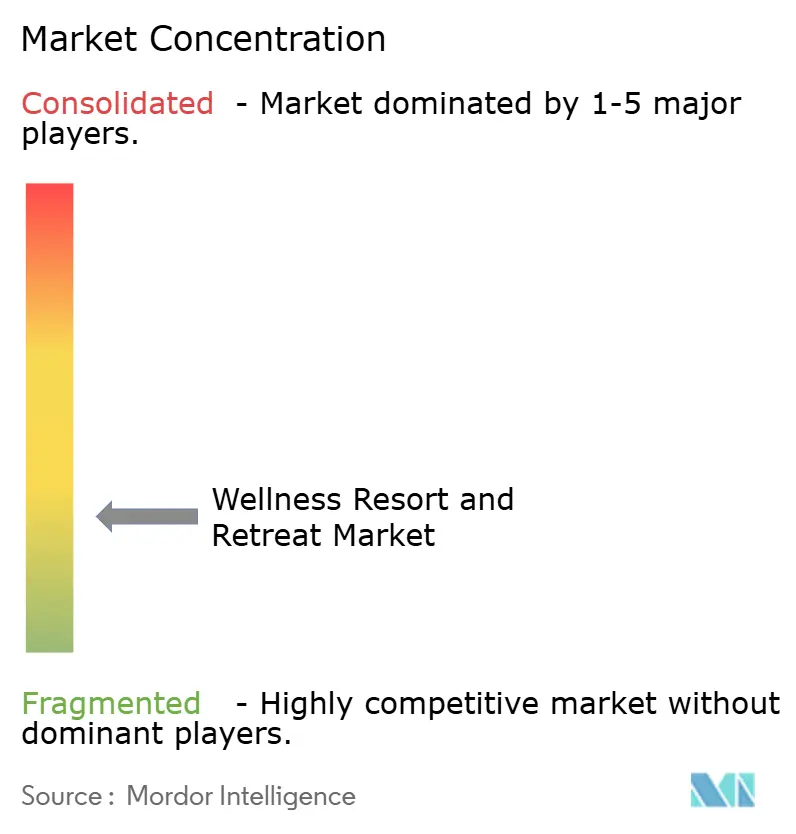
| Market Concentration | Low |
Major Players *Disclaimer: Major Players sorted in no particular order Image © Mordor Intelligence. Reuse requires attribution under CC BY 4.0. | |
Wellness Resort and Retreat Market Analysis by Mordor Intelligence
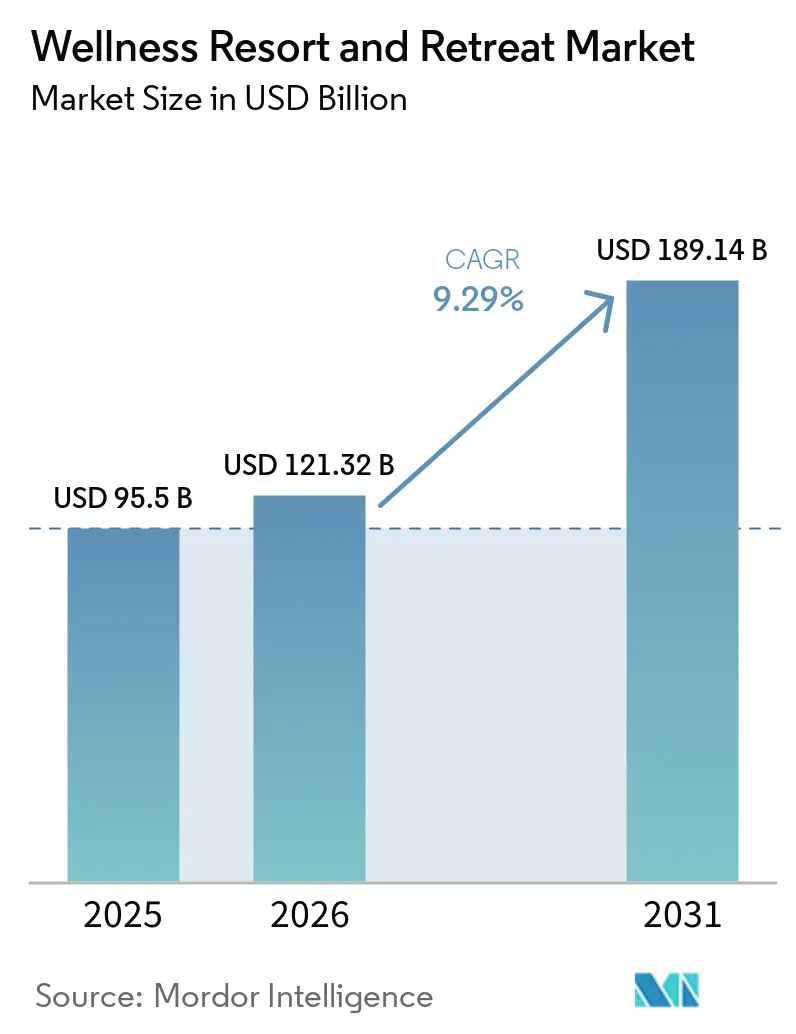
The Wellness Resort And Retreat Market size is projected to be USD 95.5 billion in 2025, USD 121.32 billion in 2026, and reach USD 189.14 billion by 2031, growing at a CAGR of 9.29% from 2026 to 2031.
The expansion reflects a sustained shift toward travel that combines health, fitness, nutrition, mindfulness, and longer stays with organized programs. The wellness resort and retreat market is also moving toward programs that link preventive care with measurable guest outcomes, which raises the importance of clinical staff, diagnostics, and follow-up support. Large hotel groups are using their distribution and loyalty platforms to broaden wellness offerings, while specialist operators are protecting premium positions through clinical credibility and differentiated programs. This creates opportunities for Indian operators with Ayurveda, yoga, naturopathy, and medical wellness capabilities, although labor costs, practitioner availability, and compliance requirements remain material constraints.[1]
Key Report Takeaways
- By property type, Wellness Resorts held 32.23% of the wellness resort and retreat market share in 2025, while Ayurveda Retreats are forecast to grow at an 11.22% CAGR through 2031.
- By wellness focus, Physical Wellness accounted for 24.91% of the wellness resort and retreat market share in 2025, while Longevity and Preventive Wellness are forecast to expand at a 12.42% CAGR through 2031.
- By price tier, Luxury and Ultra-Luxury held 48.73% of the wellness resort and retreat market size in 2025 and is projected to advance at a 10.64% CAGR through 2031.
- By traveler type, Couples Travelers represented 36.63% of revenue in 2025, while Solo Travelers are forecast to grow at a 10.83% CAGR through 2031.
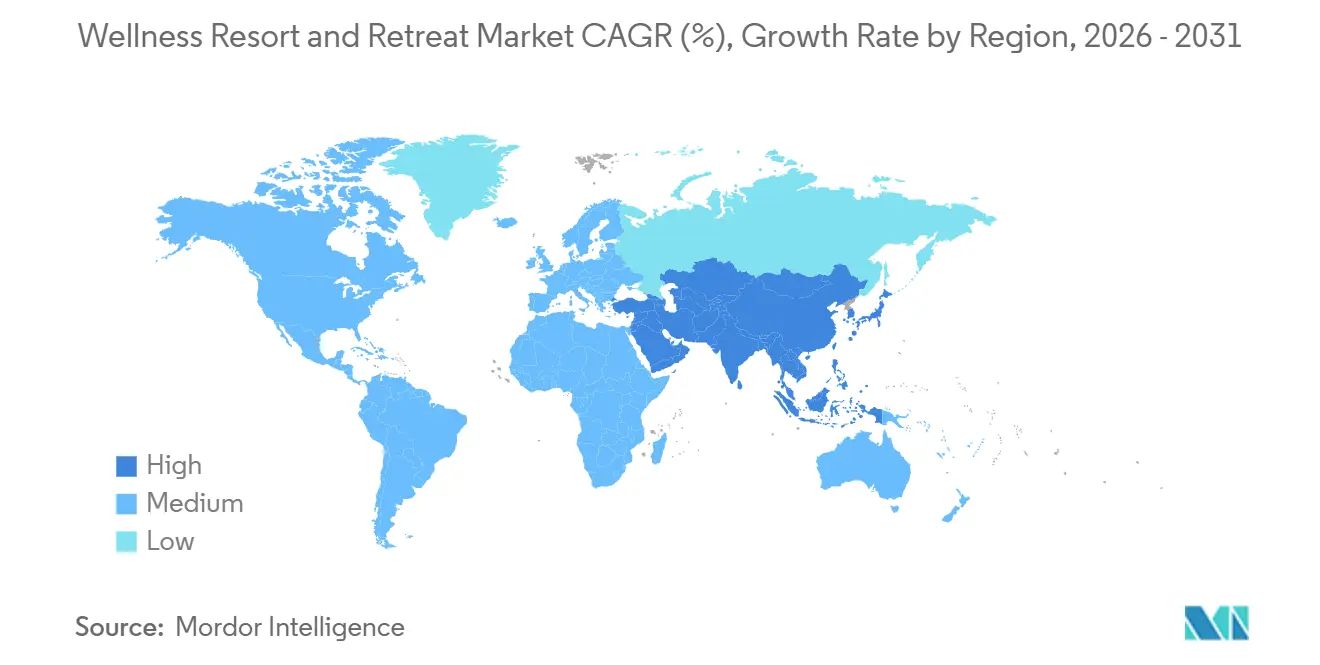
- By geography, North America held 35.91% of the wellness resort and retreat market in 2025, while Asia-Pacific is projected to grow at an 11.81% CAGR through 2031.
Note: Market size and forecast figures in this report are generated using Mordor Intelligence’s proprietary estimation framework, updated with the latest available data and insights as of January 2026.
Global Wellness Resort and Retreat Market Trends and Insights
Drivers Impact Analysis*
| Drivers | (~) % Impact on CAGR Forecast | Geographic Relevance | Impact Timeline |
|---|---|---|---|
| Rising Demand for Preventive and Holistic Wellness | +2.0% | Global | Medium term (2-4 years) |
| Growth of Wellness Tourism and Experiential Travel | +1.8% | Global, especially North America & Asia-Pacific | Medium term (2-4 years) |
| Increasing Consumer Spending on Health and Well-being | +1.5% | North America, Europe, APAC core | Long term (≥ 4 years) |
| Technology-Enabled Personalized Wellness | +1.0% | North America, Europe, APAC | Medium term (2-4 years) |
| Expansion of Wellness Resort and Retreat Infrastructure | +0.9% | APAC core, spill-over to MEA | Medium term (2-4 years) |
| Growing Demand for Personalized Nutrition and Fitness Programs | +0.7% | Global | Short term (≤ 2 years) |
| Source: Mordor Intelligence | |||
Rising Demand for Preventive and Holistic Wellness
Demand is shifting toward preventive health, healthy aging, and programs that combine physical, mental, and lifestyle support. Younger, higher-spending consumers increasingly view wellness as part of their daily routine and seek programs built around defined health goals. This behavior favors immersive stays that combine structured activities with practitioner guidance. It also strengthens demand for health screening, nutrition, movement, and post-stay support when these services are delivered responsibly. Resorts need to make staff qualifications and program limits clear to guests before arrival. The wellness resort and retreat market, therefore, rewards operators that can provide credible support without overstating medical outcomes.
Growth of Wellness Tourism and Experiential Travel
Wellness travel has continued to grow faster than many traditional leisure travel formats in the period following the pandemic. Governments and tourism bodies are increasingly treating wellness travel as part of destination development, which can support specialized resort investment and visitor demand. The World Health Organization has also identified links between tourism, health, and sustainable development, giving public-health relevance to responsible wellness travel. For the wellness resort and retreat market, this environment supports destinations that align hospitality development with local culture, natural resources, and credible wellness services.[2]
Increasing Consumer Spending on Health and Well-Being
Consumer spending on health and well-being is supporting demand for premium travel experiences that offer organized treatment, nutrition, movement, and recovery programs. Guests with intensive wellness needs often seek specialized nutrition, fitness, and recovery services as part of a single stay. This spending pattern supports longer programs and higher-value packages where accommodation, consultation, fitness, and nutrition are sold together. In India, this can support demand for supervised Ayurveda and yoga stays when providers maintain service quality and transparent program standards. It also creates a need for clear pricing and complete descriptions of inclusions. The wellness resort and retreat market benefits when operators explain outcomes, staff qualifications, and program content before arrival.
Technology-Enabled Personalized Wellness
Technology is changing the way premium resorts assess guest needs and deliver personalized wellness programs. Wearables, health monitoring, digital assessments, and data-informed recommendations can help staff tailor services before, during, and after a stay. Sensei Lanai, a Four Seasons Resort, launched Metabolic Health and Cognitive Fitness Collections in 2026 with cognitive assessments and data-informed lifestyle recommendations integrated into the stay itinerary. These tools can create continuity between visits when guests choose to maintain coaching or track progress after returning home. They also increase the need for careful handling of health information, clear guest consent, and claims that remain within applicable rules. The wellness resort and retreat market can gain from this approach when technology strengthens practitioner judgment rather than replacing it.
Restraints Impact Analysis*
| Restraint | (~) % Impact on CAGR Forecast | Geographic Relevance | Impact Timeline |
|---|---|---|---|
| High Operating and Development Costs | -1.2% | Global, particularly North America & Europe | Long term (≥ 4 years) |
| Shortage of Qualified Wellness and Clinical Practitioners | -0.8% | Global, acute in APAC & MEA | Medium term (2-4 years) |
| Regulatory Restrictions on Health and Medical Claims | -0.5% | North America, EU | Medium term (2-4 years) |
| Data Privacy and Health Information Compliance | -0.4% | North America & EU core, spill-over to APAC | Short term (≤ 2 years) |
| Source: Mordor Intelligence | |||
High Operating and Development Costs
Wellness resorts require substantial investment in treatment rooms, specialized equipment, spa infrastructure, fitness spaces, clinical services, and skilled personnel. These requirements increase both development costs and operating complexity, particularly for properties offering medical or longevity-oriented programs. Canyon Ranch Austin has an estimated total development cost of USD 500 million for its 600-acre, 141-room project, illustrating the capital intensity of ultra-premium ground-up developments. Labor-intensive treatments and large wellness areas can limit profit conversion even when room and non-room revenue increase. Medical-grade equipment also requires trained operators, maintenance contracts, and periodic replacement, which adds recurring cost pressure. The wellness resort and retreat market will remain difficult for smaller operators when they cannot spread these costs across multiple properties or sustain consistent occupancy.
Shortage of Qualified Wellness and Clinical Practitioners
The availability of trained wellness, spa, therapeutic, and clinical practitioners remains a structural constraint. Staffing gaps can reduce operating capacity, increase recruitment and retention costs, and weaken the consistency of specialized programs. The International Spa Association recorded 187 million annual United States spa visits against employment of 376,200 people as of January 2025, showing the scale of service demand facing the sector. The OECD has identified persistent labor shortages, skills gaps, and retention pressure across tourism businesses, especially in roles that need both clinical knowledge and hospitality skills. This issue is acute in regions that are adding resort capacity quickly, including parts of Asia-Pacific and the Middle East. In India, standardized practitioner development and retention will be important if Ayurveda and wellness properties are to meet international expectations for quality and safety.[3]
*Our forecasts treat driver/restraint impacts as directional, not additive. The impact forecasts reflect baseline growth, mix effects, and variable interactions.
Segment Analysis
By Property Type: Ayurveda Retreats Lead the Fastest Growth
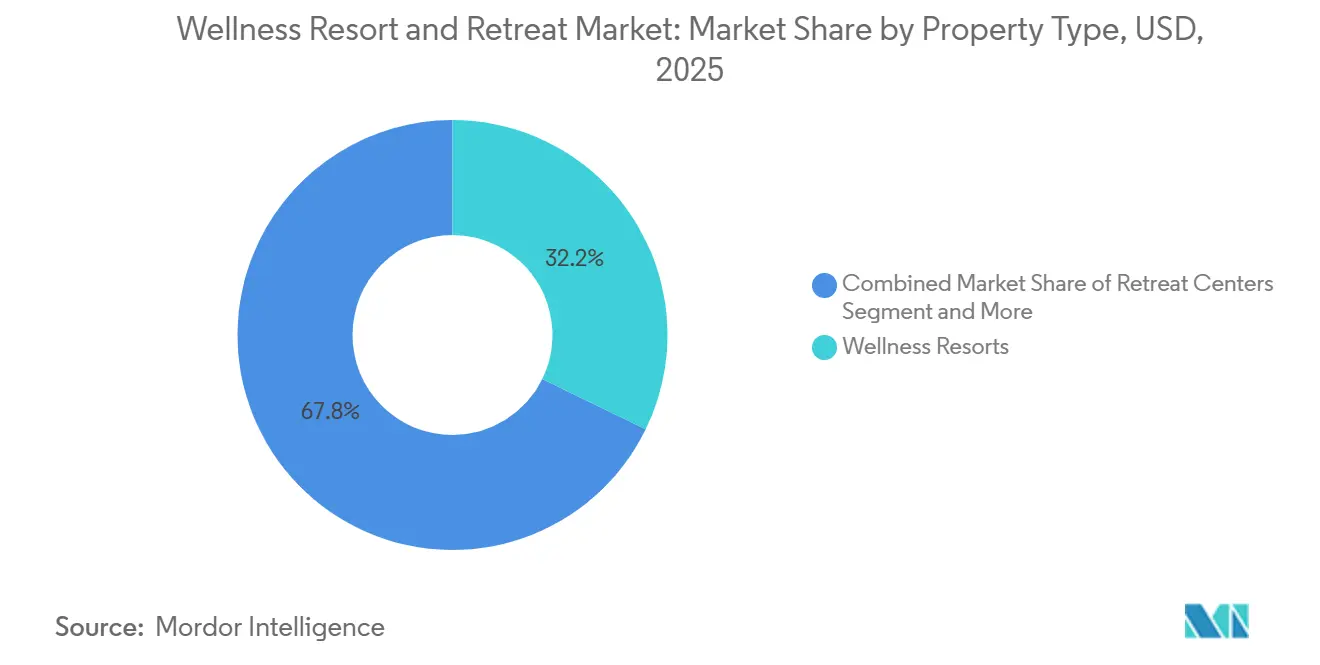
Wellness Resorts held 32.23% of revenue in 2025, giving them the largest position among property types. Their broad offering can combine consultations, fitness programs, spa services, nutrition, and digital tools within a single stay. This makes the format relevant for both first-time guests and returning guests who want a wider choice of services. Retreat Centers held the second-largest position because their smaller, program-specific format appeals to visitors seeking guided change rather than a large amenity base. Destination Spas and Holistic Healing Centers serve guests who want leisure travel alongside preventive and therapeutic services. Yoga and Meditation Retreats are also gaining relevance as younger urban consumers incorporate mindfulness practices into regular wellness routines.
Ayurveda Retreats are projected to record the fastest growth at an 11.22% CAGR between 2026 and 2031. The wellness resort and retreat market size for this format benefits from India’s established Ayurveda, yoga, and naturopathy base. India’s Union Budget 2025-26 included a USD 2.2 billion Heal in India allocation focused on Ayurveda, yoga, and naturopathy as healthcare services, while the Ministry of AYUSH’s e-Ayush visa stream supports inbound wellness travel. Standardization and accreditation can strengthen international confidence in supervised Ayurveda programs. Affluent wellness travelers pay USD 6,000 to USD 12,000 for 2-week Panchakarma programs that combine detox protocols, sattvic nutrition, yoga, and clinical guidance. IHCL acquired a 51% stake in Atmantan Wellness Resort in November 2025 for INR 240 crore, equivalent to USD 28.6 million in the source material, indicating institutional interest in Ayurveda-led wellness hospitality.

By Wellness Focus: Longevity and Preventive Wellness Changes Guest Expectations
Physical Wellness commanded the largest wellness-focus share at 24.91% in 2025. Fitness, movement, and body-centered therapies remain established components of wellness resort and retreat offerings across different guest segments. Mental and Emotional Wellness represented another major focus area, supported by continued consumer interest in stress management, mental well-being, and restorative travel experiences. Spiritual Wellness, Beauty and Aesthetics, and Sleep and Stress Management are often integrated as complementary services within broader wellness programs, allowing guests to address multiple wellness objectives during a single stay.
Longevity and Preventive Wellness is forecast to be the fastest-growing focus at a 12.42% CAGR from 2026 to 2031. The demand for preventive health, diagnostics, healthy aging, personalized nutrition, fitness, and long-term health management is supporting the development of longevity-oriented wellness programs. In January 2026, the World Economic Forum highlighted preventive medicine as an emerging approach to longevity, emphasizing prevention's role in extending healthy life expectancy. Wellness resorts are increasingly incorporating assessments, practitioner consultations, nutrition, movement, recovery, and other personalized services alongside traditional relaxation offerings. Specialized programs are also emerging around healthy aging, metabolic health, sleep, physical performance, and women's health. Canyon Ranch Austin illustrates this specialization through its dedicated Women's Wellness practice, scheduled to launch with the resort's opening in October 2026.
By Price Tier: Luxury and Ultra-Luxury Maintain the Leading Position
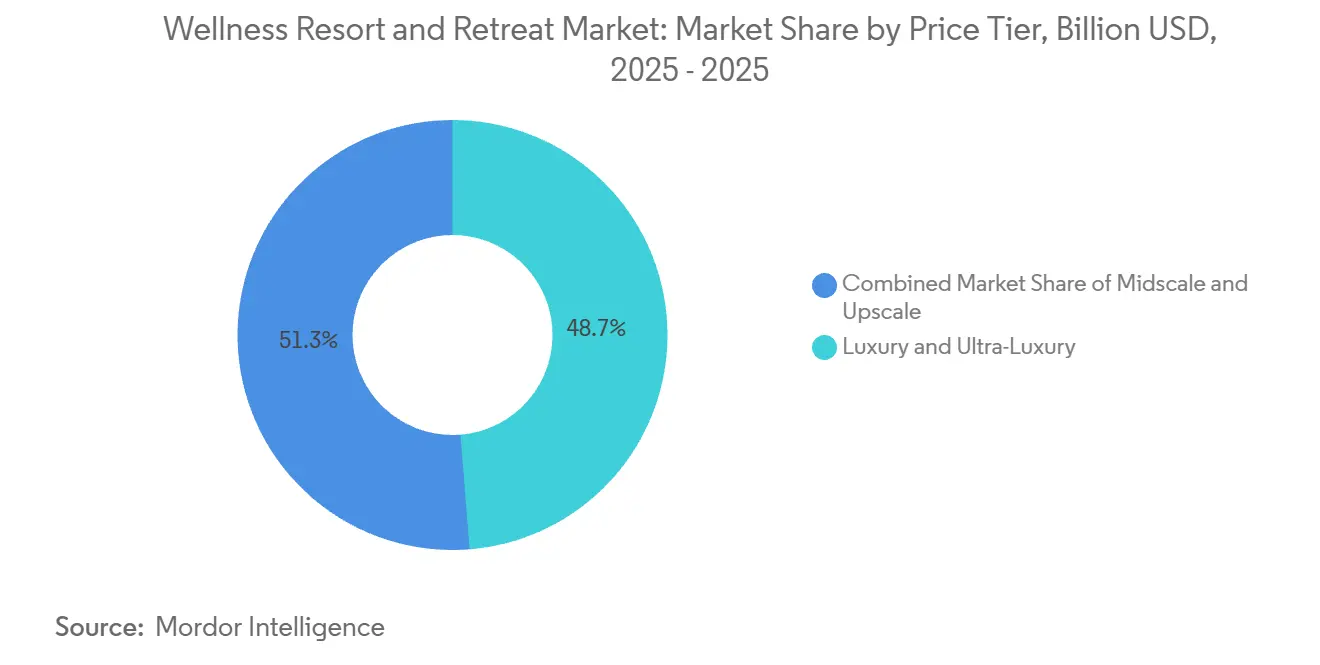
Luxury and Ultra-Luxury properties captured 48.73% of revenue in 2025. This position reflects the sector’s premium orientation and emphasis on privacy, clinical quality, personalized services, and exclusive settings. Luxury and Ultra-Luxury also recorded the highest projected growth rate at a 10.64% CAGR from 2026 to 2031. Demand in this tier is linked to settings that provide privacy, structured care, and differentiated guest experiences. The specialized nature of purpose-built ultra-luxury wellness properties can support premium pricing when operators maintain high service and clinical standards. This positioning also increases the importance of consistent staffing and carefully managed operating costs.
Upscale properties face competition from both higher-end and lower-priced offerings. Luxury providers can differentiate through credentialed clinical programs, personalized services, and exclusivity, while Midscale properties can offer wellness services at comparatively accessible price points. This can make broad, general-purpose upscale positioning harder to defend. Clear program differentiation is increasingly important in this tier, particularly where properties compete primarily on amenities rather than a defined wellness proposition. Midscale properties can broaden access to wellness-oriented travel by offering services at comparatively accessible price points. Therme Group’s large urban wellbeing destinations illustrate how broad-access formats can establish a distinct position from traditional destination resorts. The wellness resort and retreat market can therefore develop through both premium clinical formats and more accessible urban wellbeing models.
By Traveler Type: Solo Travelers Expand the Guest Base
Couples Travelers represented the largest traveler group at 36.63% in 2025. Wellness retreats can support relationship renewal and shared experiences, creating opportunities for resorts to package multiple services for couples. Banyan Tree’s Connections program is designed as a private holistic wellbeing journey for two, incorporating movement, mindfulness, and shared rituals. In March 2026, Banyan Tree announced the expansion of the program to eight additional destinations across Saudi Arabia, the United Arab Emirates, Vietnam, China, Thailand, and Indonesia, with availability from May 2026. Group and Family Travelers are supported by multigenerational wellness travel, while Corporate Travelers are gaining relevance through employer-sponsored well-being programs. Business Group on Health’s 2026 survey covered 156 employers collectively representing 12.4 million employees worldwide and examined current and future employer well-being strategies.
Solo Travelers are forecast to grow at a 10.83% CAGR between 2026 and 2031. The segment is associated with individual health goals, including longevity, sleep support, mental well-being, and fitness. Solo guests can provide opportunities for resorts to generate revenue through single-occupancy accommodation, treatment add-ons, personalized programs, and post-stay digital services. Operators need to provide safe environments, flexible itineraries, and transparent inclusions for this group. The wellness resort and retreat industry can serve solo guests through programs that encourage individual participation while maintaining opportunities for social interaction.
Geography Analysis
North America accounted for 35.91% of the wellness resort and retreat market in 2025. The region benefits from high consumer spending, an established branded resort infrastructure, and demand for corporate and individual wellness offerings. The United States had the world's largest wellness economy, valued at USD 2.1 trillion in 2024, and recorded 7.9% annual growth between 2019 and 2024. Canyon Ranch Austin is scheduled to open in Texas in October 2026 as a USD 500 million project spanning more than 600 acres with 141 rooms. Canada and Mexico are expanding their wellness tourism offerings, supported by nature-based destinations, cross-border demand, and resort development. These markets support both established branded resorts and independent properties offering differentiated wellness programs.
Europe has a well-established spa and wellness tourism base, while South America offers nature-based and independent retreat formats. Europe's wellness tourism expenditure reached USD 258.2 billion in 2024. Germany held 19.92% of the European wellness tourism market in 2025, supported by its established spa and therapeutic-bath tradition and international clientele. Italy's wellness tourism is projected to grow at an 8.55% CAGR through 2031 within Europe. Marriott completed its joint venture with the Leali family in June 2026, bringing Lefay into its global portfolio as its first brand focused exclusively on luxury wellness, with additional properties in development across Italy and the Swiss Alps. South America's wellness offering remains smaller but benefits from nature-based retreats, particularly in Brazil and other destinations with strong biodiversity and cultural assets.
Asia-Pacific is the fastest-growing geographic segment at an 11.81% CAGR through 2031. India's Ayurveda and yoga tourism base, Southeast Asia's luxury wellness infrastructure, and Northeast Asia's urban well-being projects support regional growth. India was the world's seventh-largest wellness economy, valued at USD 180 billion in 2024, and recorded 11.3% annual growth between 2019 and 2024. Therme Singapore is being developed at Marina South as a large-scale urban well-being destination, with groundbreaking taking place in June 2026. The Middle East and Africa remain smaller in absolute value, while Saudi Arabia and the United Arab Emirates are expanding premium wellness capacity through tourism development. Miraval The Red Sea opened on Shura Island in Saudi Arabia in June 2026, featuring a 40,000-square-foot spa with 39 treatment rooms.
Competitive Landscape
The wellness resort and retreat market is fragmented at the property level, while branded operators are strengthening their positions through acquisitions, joint ventures, and expanded distribution networks. IHG Hotels & Resorts’ Six Senses portfolio includes 27 operating properties across 20 countries and 39 signed projects in its development pipeline. Marriott completed its joint venture with Italy’s Leali family in June 2026, bringing Lefay into its global portfolio as its first brand dedicated exclusively to luxury wellness. The transaction incorporates Lefay’s existing resorts and development pipeline. Hyatt has also expanded Miraval internationally, including the June 2026 opening of Miraval The Red Sea on Shura Island. These moves strengthen major hospitality platforms through established loyalty programs, sales networks, and booking infrastructure that can be more difficult for smaller independent properties to replicate.
Independent specialists are differentiating through capital investment, clinical expertise, and specialized program offerings. Lanserhof is expanding its international footprint, including the development of its Marbella location. Therme Group is pursuing a different model through large-scale urban well-being destinations rather than traditional boutique resort properties. In February 2025, Therme Group formed a United States development joint venture with The Georgetown Company to support up to 10 large-scale destinations of approximately 500,000 square feet each. This range of operating models allows the wellness resort and retreat market to serve both high-end destination guests and broader urban visitor groups.
Technology and specialized programming are also important areas of differentiation. Sensei’s Metabolic Health and Cognitive Fitness programs demonstrate how assessments and individualized lifestyle recommendations can be incorporated into resort experiences. Canyon Ranch Austin is scheduled to open in October 2026 with a dedicated Women’s Wellness practice, adding a specialized women’s health offering to the property's broader wellness proposition. Banyan Group surpassed the 100-resort milestone and has announced plans for 15 additional spa outlets across multiple international markets. India-based operators can differentiate through Ayurveda, yoga, and naturopathy programs supported by appropriate practitioner qualifications, accreditation, privacy standards, and consistent guest service. The wellness resort and retreat industry is therefore becoming more competitive, although available information does not provide a combined market share for leading companies.
Wellness Resort and Retreat Industry Leaders
-
Accor S.A.
-
Marriott International, Inc.
-
Hyatt Hotels Corporation
-
Six Senses Hotels Resorts Spas
-
Canyon Ranch
- *Disclaimer: Major Players sorted in no particular order
Recent Industry Developments
- July 2026: Six Senses AMAALA opened in Saudi Arabia as part of the AMAALA wellness destination on the Red Sea coast. The resort features 100 suites and villas and 25 branded residences, with wellness offerings including a Longevity Center, Biohacking Recovery Lounge, Watsu pool, sound dome, fitness and yoga programs, and multi-day wellness experiences.
- June 2026: Miraval The Red Sea opened on Shura Island, Saudi Arabia, marking Miraval's first international destination outside the United States. The adults-only retreat introduces Miraval's mindfulness and intentional wellness philosophy to the Red Sea destination.
- June 2026: Marriott International completed its joint venture with the Leali family, founders of Lefay, bringing the Italian luxury wellness brand into Marriott's global portfolio as its first brand dedicated exclusively to luxury wellness. The transaction brings Lefay's existing resorts and development pipeline into Marriott's portfolio, with the properties expected to operate under long-term management agreements and integrate with Marriott Bonvoy.
- June 2026: Therme Group broke ground on Therme Singapore at Marina South. The development spans more than 720,000 square feet of gross floor area and is expected to attract around 2 million visitors annually at full operational capacity. The project follows Therme Group's successful bid for the Singapore Tourism Board's Marina South wellness attraction tender, with an announced investment of approximately SGD 1 billion (USD 0.78 billion).
Global Wellness Resort and Retreat Market Report Scope
| Wellness Resorts |
| Retreat Centers |
| Destination Spas |
| Holistic Healing Centers |
| Yoga and Meditation Retreats |
| Ayurveda Retreats |
| Physical Wellness |
| Mental & Emotional Wellness |
| Spiritual Wellness |
| Beauty and Aesthetics |
| Sleep and Stress Management |
| Longevity and Preventive Wellness |
| Midscale |
| Upscale |
| Luxury and Ultra-Luxury |
| Solo Travelers |
| Couples Travelers |
| Group/ Family Travelers |
| Corporate Travelers |
| North America | United States |
| Canada | |
| Mexico | |
| South America | Brazil |
| Peru | |
| Chile | |
| Argentina | |
| Rest of South America | |
| Europe | United Kingdom |
| Germany | |
| France | |
| Spain | |
| Italy | |
| BENELUX (Belgium, Netherlands, and Luxembourg) | |
| NORDICS (Denmark, Finland, Iceland, Norway, and Sweden) | |
| Russia | |
| Rest of Europe | |
| Asia-Pacific | India |
| China | |
| Japan | |
| Australia | |
| South Korea | |
| South East Asia (Singapore, Malaysia, Thailand, Indonesia, Vietnam, and Philippines) | |
| Rest of Asia-Pacific | |
| Middle East and Africa | United Arab Emirates |
| Saudi Arabia | |
| South Africa | |
| Nigeria | |
| Rest of Middle East and Africa |
| By Property Type | Wellness Resorts | |
| Retreat Centers | ||
| Destination Spas | ||
| Holistic Healing Centers | ||
| Yoga and Meditation Retreats | ||
| Ayurveda Retreats | ||
| By Wellness Focus | Physical Wellness | |
| Mental & Emotional Wellness | ||
| Spiritual Wellness | ||
| Beauty and Aesthetics | ||
| Sleep and Stress Management | ||
| Longevity and Preventive Wellness | ||
| By Price Tier | Midscale | |
| Upscale | ||
| Luxury and Ultra-Luxury | ||
| By Traveler Type | Solo Travelers | |
| Couples Travelers | ||
| Group/ Family Travelers | ||
| Corporate Travelers | ||
| By Geography | North America | United States |
| Canada | ||
| Mexico | ||
| South America | Brazil | |
| Peru | ||
| Chile | ||
| Argentina | ||
| Rest of South America | ||
| Europe | United Kingdom | |
| Germany | ||
| France | ||
| Spain | ||
| Italy | ||
| BENELUX (Belgium, Netherlands, and Luxembourg) | ||
| NORDICS (Denmark, Finland, Iceland, Norway, and Sweden) | ||
| Russia | ||
| Rest of Europe | ||
| Asia-Pacific | India | |
| China | ||
| Japan | ||
| Australia | ||
| South Korea | ||
| South East Asia (Singapore, Malaysia, Thailand, Indonesia, Vietnam, and Philippines) | ||
| Rest of Asia-Pacific | ||
| Middle East and Africa | United Arab Emirates | |
| Saudi Arabia | ||
| South Africa | ||
| Nigeria | ||
| Rest of Middle East and Africa | ||
Key Questions Answered in the Report
What is the projected growth rate for wellness resorts and retreats?
The wellness resort and retreat market is projected to grow at a 9.29% CAGR from 2026 to 2031, increasing from USD 121.324 billion in 2026 to USD 189.14 billion by 2031.
Which property type is growing fastest in wellness travel?
Ayurveda Retreats are projected to be the fastest-growing property type at an 11.22% CAGR through 2031, supported by demand for supervised Ayurveda, yoga, and naturopathy programs.
Why is India important for wellness travel?
India combines established Ayurveda, yoga, and naturopathy traditions with government support for wellness travel, including the Heal in India allocation and the e-Ayush visa stream.
Which wellness focus is expanding fastest?
Longevity and Preventive Wellness is projected to grow at a 12.42% CAGR through 2031 as guests seek programs focused on prevention, diagnostics, healthy aging, and longer-term health routines.
What are the main operational challenges for resort operators?
High development and operating costs, shortages of trained practitioners, medical-claim rules, and health-data privacy obligations can limit capacity and profitability.
Which traveler group is growing most quickly?
Solo Travelers are projected to grow at a 10.83% CAGR through 2031, driven by demand for individual programs focused on longevity, sleep, fitness, and mental well-being.