
Travel Tourism Market Size and Share
Market Overview
| Study Period | 2022 - 2032 |
|---|---|
| Market Size (2027) | USD 2.76 Trillion |
| Market Size (2032) | USD 3.71 Trillion |
| Growth Rate (2027 - 2032) | 6.09 % |
| Fastest Growing Market | Asia-Pacific |
| Largest Market | Europe |
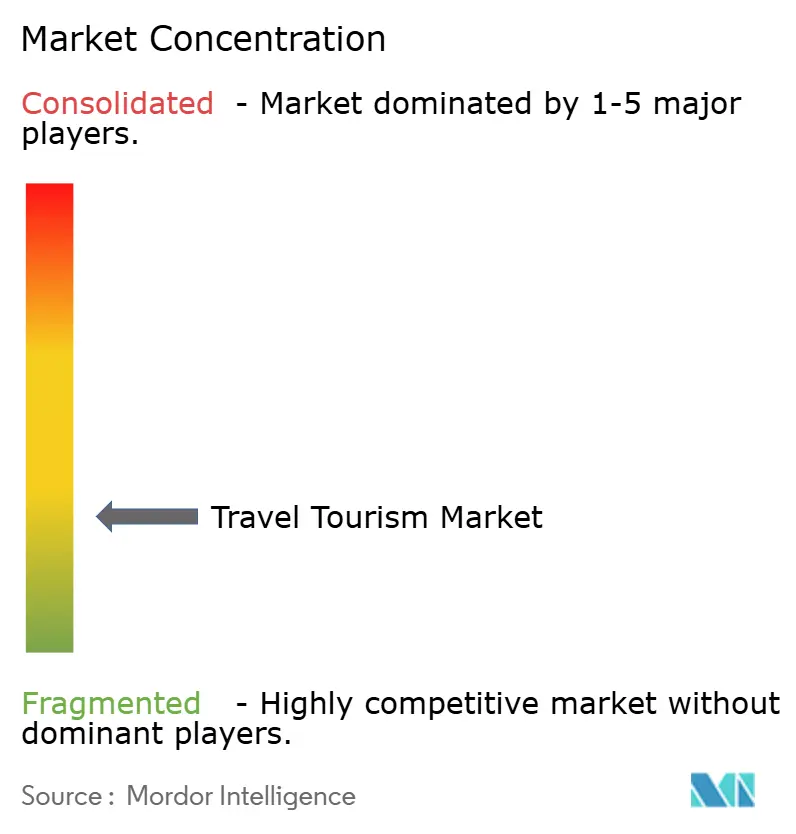
| Market Concentration | Low |
Major Players *Disclaimer: Major Players sorted in no particular order Image © Mordor Intelligence. Reuse requires attribution under CC BY 4.0. | |
Travel Tourism Market Analysis by Mordor Intelligence
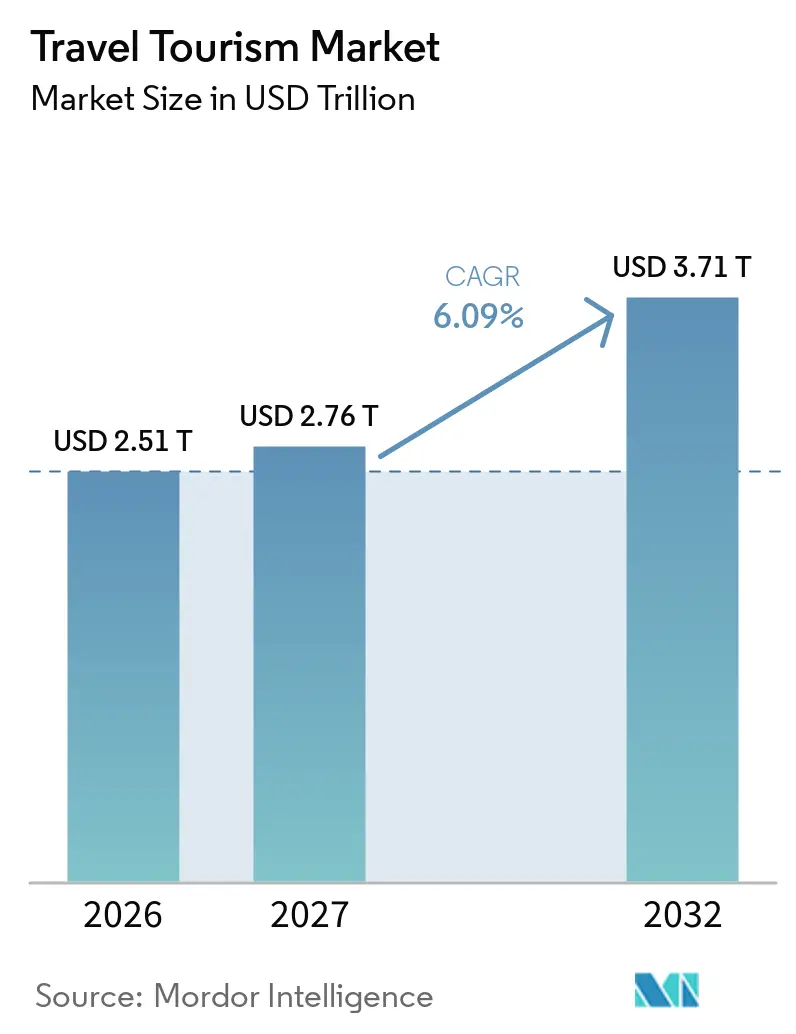
The global travel tourism market size was valued at USD 2.511 trillion in 2026 and is estimated to grow from USD 2.762 trillion in 2027 to reach USD 3.712 trillion by 2032, at a CAGR of 6.09% during the forecast period (2027–2032). Travel and tourism contributed USD 11.6 trillion to global GDP in 2025, accounting for 9.8% of the global economy. The sector grew by 4.1%, outpacing overall economic growth by 2.8%, and supported 366 million jobs worldwide[1]. International tourist arrivals reached approximately 1.54 billion, while international air passenger demand increased by 7.1% and the global passenger load factor reached 83.6%. In India, rising domestic tourism, expanding aviation capacity, and hotel development supported travel demand. However, geopolitical uncertainty, high fuel prices, inflation, and increased travel costs continued to challenge the sector. The FIFA World Cup 2026 and the Milano Cortina 2026 Winter Olympics supported travel opportunities. The World Travel & Tourism Council (WTTC) projected 2.5% growth in global travel and tourism, while UN Tourism forecast international tourist arrivals growth of 1%-2%.
Key Report Takeaways
- By tourism type, Leisure Tourism accounted for 65.00% of the global travel tourism market share in 2026, while Medical and Wellness Tourism is projected to grow at a 9.73% CAGR through 2032.
- By destination, Domestic Tourism accounted for 71.24% of the global travel tourism market share in 2026, while International Tourism is projected to grow at a 7.49% CAGR through 2032.
- By end user, Family Travelers accounted for 39.81% of the global travel tourism market share in 2026, while Solo Travelers are projected to grow at a 7.93% CAGR through 2032.
- By booking channel, Online Travel Agencies accounted for 38.94% of the global travel tourism market share in 2026, while Direct Booking is projected to grow at a 7.41% CAGR through 2032.
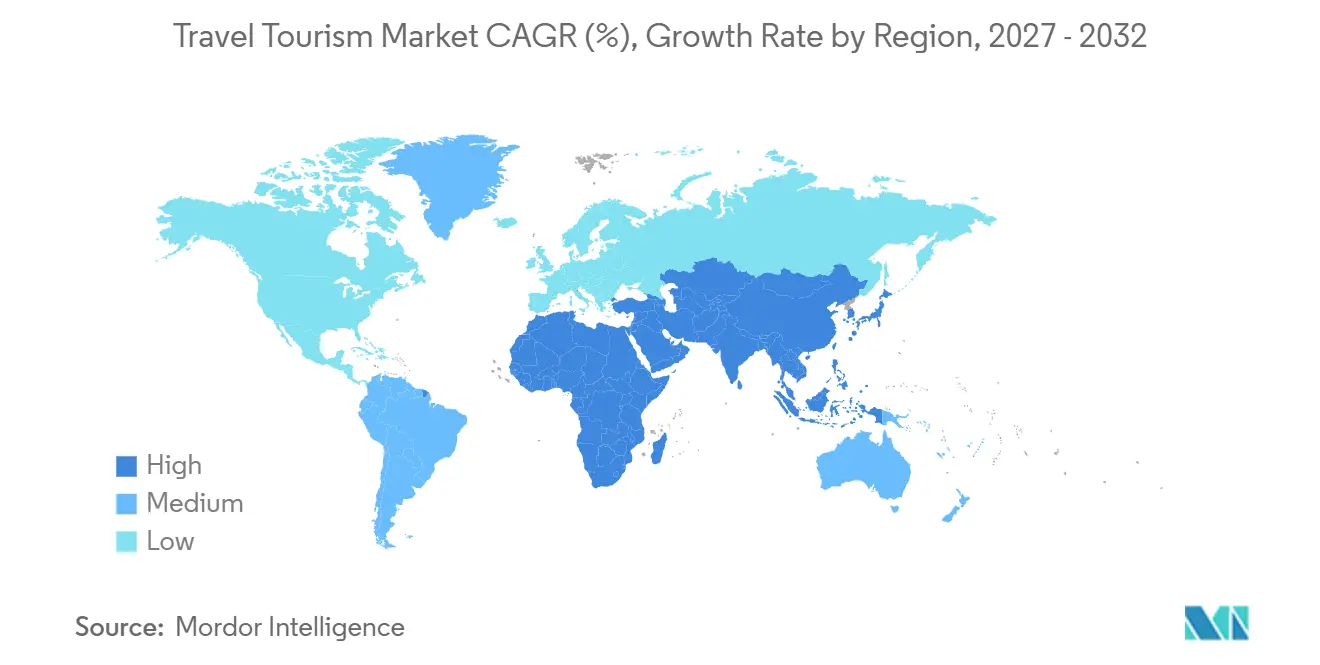
- By geography, Europe accounted for 32.73% of the global travel tourism market share in 2026, while Asia-Pacific is projected to grow at a 7.35% CAGR through 2032.
Note: Market numbers in this report are based on Mordor Intelligence's proprietary estimation framework, which combines nine months of actuals with Q4 projections for base year 2026.
Global Travel Tourism Market Trends and Insights
Drivers Impact Analysis*
| Driver | (~) % Impact on CAGR Forecast | Geographic Relevance | Impact Timeline |
|---|---|---|---|
| Rising Disposable Income and Middle-Class Travel Participation | +1.2% | Global, led by India, Southeast Asia, and China | Long term (≥ 4 years) |
| Air Connectivity, Visa Facilitation, and Cross-Border Mobility | +1.0% | Asia-Pacific core, spill-over to Middle East and Africa and South America | Short term (≤ 2 years) |
| Mobile-First Booking, Digital Payments, and AI-Powered Personalization | +0.9% | Global, with faster adoption in North America, Europe, and Asia-Pacific | Medium term (2-4 years) |
| Experience-Led, Wellness, Cultural, and Premium Travel Demand | +0.8% | Global, with premium gains concentrated in North America, Europe, and Gulf Cooperation Council | Medium term (2-4 years) |
| Climate-Shifted Seasonality and Demand for Cooler Destinations | +0.4% | Northern Europe, Nordics, Canadian Rockies, Japan highlands | Short term (≤ 2 years) |
| Secondary-Destination Dispersal Through Events, Local Creators, and Destination Capacity Investment | +0.3% | Europe, Asia-Pacific and South America | Medium term (2-4 years) |
| Source: Mordor Intelligence | |||
Rising Disposable Income and Middle-Class Travel Participation
India’s economic expansion and strengthening private consumption support the long-term growth of domestic and outbound tourism. The World Bank reported GDP growth of 6.5% in FY2024–25, driven by robust private consumption and strengthening rural demand[2]. The Ministry of Tourism recorded 4.29 billion domestic tourist visits in 2025, a 45.6% year-on-year increase, while Indian national departures rose 6.3% to 32.83 million. These trends indicate broader travel participation and opportunities for affordable holidays, repeat domestic trips, and international travel. Tourism businesses can address this demand through flexible packages, tiered accommodation, and regional experiences. Sustained growth will depend on household purchasing power, transport connectivity, and travel affordability across income groups.
Air Connectivity, Visa Facilitation, and Cross-Border Mobility
Air connectivity and visa facilitation reduce travel barriers and expand the reach of the global travel tourism market. International passenger traffic grew by 7.1% in 2025, while Asia-Pacific airlines recorded 10.9% growth in international revenue passenger kilometers[3]. In February 2025, the UAE expanded visa-on-arrival eligibility for eligible Indian nationals holding documents issued by Australia, Canada, Japan, New Zealand, Singapore, or South Korea. Visa facilitation measures in China, Egypt, and Gulf Cooperation Council markets also supported cross-border travel. This driver can have a short-term impact, as route additions and simplified entry requirements can influence destination choices soon after implementation.
Mobile-First Booking, Digital Payments, and AI-Powered Personalization
Mobile-first booking platforms, secure digital payments, and personalized planning tools simplify travel discovery and purchasing. The global travel tourism market benefits as travelers compare options, complete payments, and manage changes through integrated platforms rather than using multiple systems. MakeMyTrip partnered with Google Cloud in October 2025 to develop faster, simpler planning and booking experiences for millions of travelers, including multilingual and voice-enabled capabilities. Booking Holdings launched Vayo in October 2026 with a planned USD 100 million investment, positioning it as an AI-powered travel agent that organizes bookings and manages trips. This driver has a medium-term impact, as adoption depends on consumer trust and the integration of planning, booking, payment, and servicing functions.
Experience-Led, Wellness, Cultural, and Premium Travel Demand
Experience-led tourism enables the integration of wellness, cultural heritage, culinary activities, and nature-based experiences into broader travel itineraries. India's Ministry of Tourism promoted wellness and cultural tourism through International Day of Yoga 2025 events at 40 culturally and naturally significant tourist sites, connecting wellness activities with heritage offerings. The government has established a national strategy for medical and wellness tourism focused on destination branding, digital accessibility, and stronger service ecosystems. These initiatives create opportunities for hotels and tour operators to offer bundled wellness retreats, heritage tours, and culinary experiences. Consistent service quality, accessibility, and destination management remain essential to convert visitor interest into sustained tourism spending.
Restraints Impact Analysis*
| Restraint | (~) % Impact on CAGR Forecast | Geographic Relevance | Impact Timeline |
|---|---|---|---|
| High Transport, Accommodation, and Experience Costs | -0.7% | Global, most acute in North America and Western Europe | Short term (≤ 2 years) |
| Geopolitical Conflict, Airspace Disruption, and Travel-Confidence Volatility | -0.6% | Eastern Europe, Middle East, North America | Short term (≤ 2 years) |
| Overtourism, Climate Exposure, and Destination Carrying-Capacity Mismatch | -0.3% | Southern Europe, Southeast Asian islands, North Africa | Medium term (2-4 years) |
| Tourism Workforce Gaps and Fragmented Supplier Data Interoperability | -0.2% | Global, with structural concentration in Asia-Pacific and Middle East and Africa | Long term (≥ 4 years) |
| Source: Mordor Intelligence | |||
High Transport, Accommodation, and Experience Costs
High transportation, accommodation, and activity costs can limit participation in the global travel tourism market. In 2025, business travel spending reached USD 1.57 trillion; however, inflation-adjusted spending remained 14% below the 2019 level, demonstrating inflation's effect on trip frequency and scope[4]. Hotel rates and food and beverage costs in major tourism cities also continued to rise. Higher-income travelers may sustain travel demand, while price-sensitive travelers may shorten stays, choose closer destinations, or postpone trips. This short-term restraint can quickly affect bookings as fares, accommodation rates, and household budgets change.
Geopolitical Conflict, Airspace Disruption, and Travel-Confidence Volatility
Geopolitical conflicts and airspace disruptions create uncertainty for travelers, airlines, and destination businesses. Airspace closures can lengthen flight routes, raise fuel costs, disrupt schedules, and reduce connectivity on established routes. UN Tourism identifies geopolitical tensions and trade conflicts as material downside risks to the 2026 tourism outlook. Changes in traveler confidence can affect leisure and corporate travel, especially when travelers perceive destinations as difficult to reach or unsafe. While these disruptions often have short-term effects, destination reputations and airline network decisions may require more time to recover.
*Our forecasts treat driver/restraint impacts as directional, not additive. The impact forecasts reflect baseline growth, mix effects, and variable interactions.
Consumer Behavior Analysis
India recorded 4.29 billion domestic tourist visits in 2025, up 45.6% year on year, according to the Ministry of Tourism. This scale supports multi-stop itineraries that combine regional cuisine, heritage, pilgrimage, and wellness experiences. MakeMyTrip’s partnership with Google Cloud introduced AI-enabled planning based on preferences such as adventure, wellness, and pilgrimage, demonstrating the value of personalized discovery. Suppliers can address demand through tailored packages and reliable local services.
Global business travel spending reached USD 1.57 trillion in 2025, with 86% of surveyed business travelers considering their trips worthwhile. Booking Holdings reported USD 186.1 billion in gross bookings in 2025, up 12%, while room nights increased 8%, according to company disclosures. These results highlight the importance of convenient digital booking and integrated travel services. In India, multilingual planning, secure payments, and coordinated reservations can improve conversion and help smaller providers reach customers.
Tourism Performance Intelligence
International tourist arrivals reached 1.52 billion in 2025, up 4% year on year. Africa recorded the strongest regional growth at 8%, followed by Asia-Pacific at 6%, Europe at 4%, and the Americas at 1%, according to UN Tourism. International air passenger demand grew 7.1%, while Asia-Pacific carriers recorded 10.9% growth in international revenue passenger kilometers, according to IATA. Strong aviation growth highlights the need for route capacity and connectivity to convert regional travel demand into arrivals. India can benefit from stronger Asia-Pacific traffic if visa access, destination infrastructure, and accommodation capacity keep pace.
International tourism receipts rose 5% to USD 1.9 trillion in 2025, while tourism export revenues, including passenger transport, reached USD 2.2 trillion, according to UN Tourism. Faster receipts growth than arrivals indicated higher spending per international visit. Linking heritage sites, pilgrimage circuits, wellness destinations, and major cities into multi-stop itineraries could increase visitor spending in India. Reliable transport, transparent pricing, and coordinated destination services remain essential to extend stays and distribute tourism revenue beyond gateway cities.
Segment Analysis
By Tourism Type: Leisure Dominates, but Wellness Sets the Pace
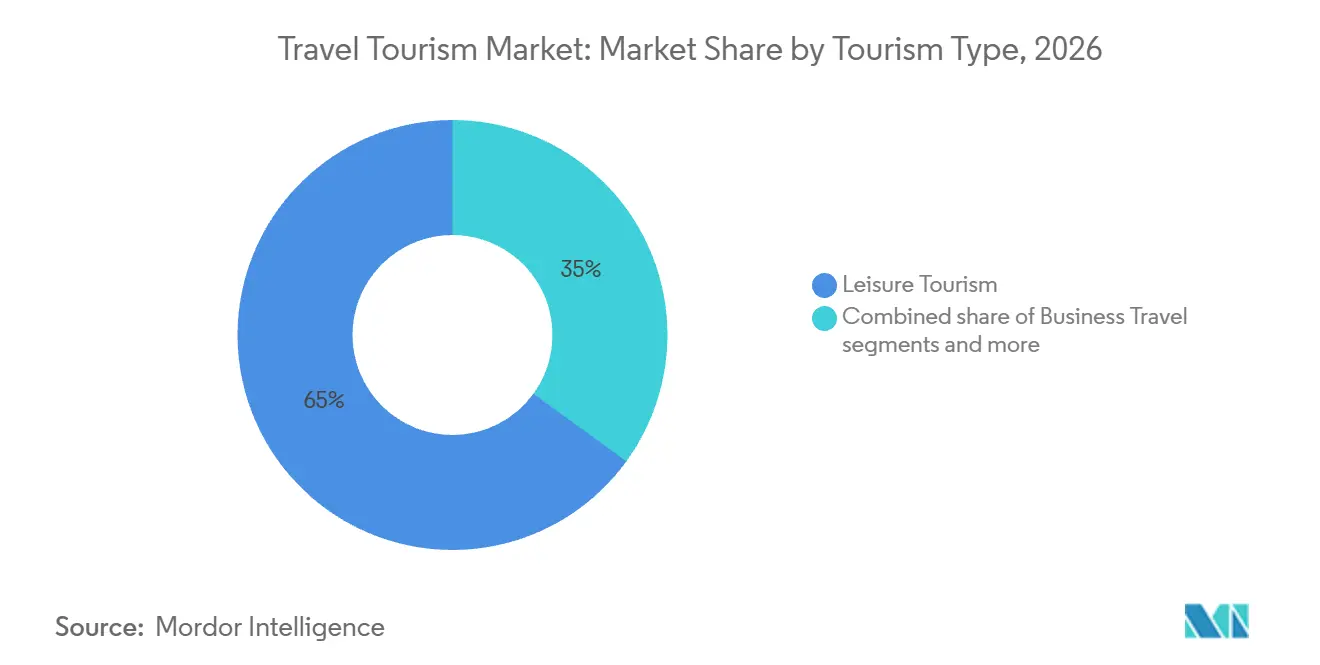
Leisure tourism accounted for 65.00% of global travel spending in 2026, making it the largest tourism type in the provided segmentation. Family vacations, short breaks, and cultural experiences drive leisure travel demand. According to the Global Business Travel Association (GBTA), business travel spending reached USD 1.57 trillion in 2025, while inflation-adjusted spending remained 14% below 2019 levels. Adventure, cultural, nature-based, sports, and educational travel are distinct demand segments in India, connecting major gateways with heritage sites, natural attractions, educational journeys, and regional experiences.
Medical and wellness tourism is projected to grow at a CAGR of 9.73% through 2032, making it the fastest-growing tourism type in the provided segmentation. Travelers seek medical treatment, preventive care, relaxation, and wellness experiences. Religious and pilgrimage travel also remains important. India can integrate medical services, wellness retreats, pilgrimage circuits, cultural experiences, and accommodation to serve domestic visitors, diaspora travelers, and international guests.

By Destination: Domestic Scale, International Yield
Domestic tourism accounted for 71.24% of global travel spending in 2026, making it the largest destination category. Road, rail, and air connectivity, along with familiarity with local languages and payment systems, support domestic travel. It also provides suppliers with a broader customer base when international demand weakens. In India, domestic tourism supports accommodation and visitor services across states and cities. Localized content and shorter travel options can encourage repeat demand.
International tourism is forecast to grow at a CAGR of 7.49% through 2032, outpacing domestic travel within the segmentation. International trips can generate higher spending per traveler but depend on visa policies, air capacity, currency conditions, and traveler confidence. Asia-Pacific recovery and expanding outbound travel support this segment. India can benefit as both a destination and an outbound source market. Suppliers need reliable cross-border connectivity and suitable services to encourage longer stays and diverse itineraries.
By End User: Families Lead, Solo Travelers Accelerate
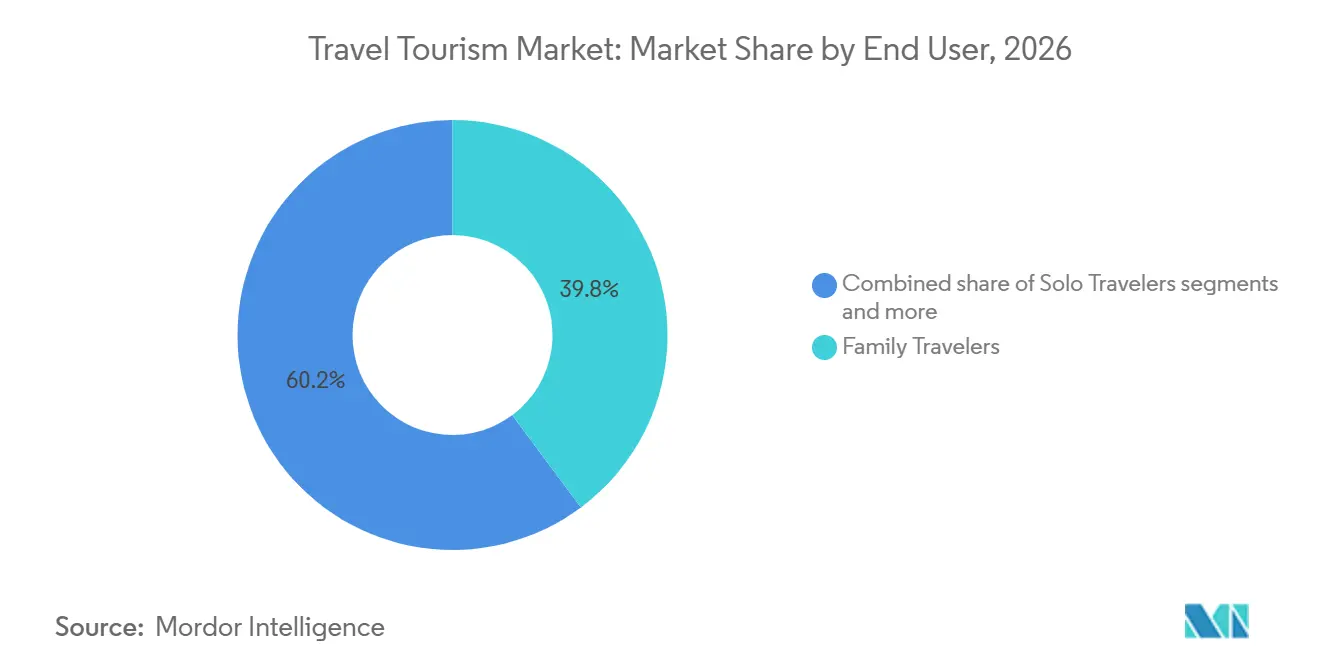
Family travelers accounted for 39.81% of global travel spending in 2026, making them the largest end-user segment. According to the Family Travel Association’s 2025 survey, 92% of parents surveyed planned to travel with their children within the following year, while 57% planned multigenerational trips. These trends support demand for spacious accommodation, family-oriented activities, and shared cultural and recreational experiences. In India, travel providers can target this segment through family-friendly accommodation, religious and heritage itineraries, nature-based activities, and convenient transportation, supported by transparent pricing and coordinated travel arrangements.
Solo Travelers are forecast to grow at a CAGR of 7.93% through 2032, making them the fastest-growing end-user group in the global travel tourism market. Agoda reported a 16% increase in solo accommodation searches across Asia in 2025, while Indonesia recorded a 72% rise in solo travel interest. Solo travelers prioritize safety information, flexible dates, smaller tours, and options that reduce single-occupancy costs. In India, operators can address this segment through transparent guidance, secure local transportation, and experiences for independent visitors.
By Booking Channel: OTAs Lead, Direct Booking Catches Up
Online travel agencies (OTAs) accounted for 38.94% of global travel spending in 2026, making them the largest booking channel. Their strengths include broad inventory, price comparison, and the ability to bundle trip components. OTAs also help small accommodation providers and local activity operators reach wider audiences. In India, they consolidate fragmented supply into a searchable digital marketplace. Their effectiveness depends on accurate information, fair display practices, secure transactions, and responsive after-sales support.
Direct booking is projected to grow at a CAGR of 7.41% through 2032, making it the fastest-growing channel in the outlook. Hotel groups invest in loyalty programs, mobile applications, member pricing, and direct engagement to reduce intermediary costs and increase repeat bookings. Hilton’s record development pipeline and conversion-led growth demonstrate branded operators’ focus on extending customer relationships beyond individual stays. Direct channels can coexist with OTAs, as travelers use different channels for discovery, comparison, and repeat purchases. Indian operators can benefit by offering clear, mobile-friendly direct booking options with consistent inventory and pricing across channels.
Geography Analysis
Europe accounted for 32.73% of global travel spending in 2026, making it the largest geography in the forecast. It recorded 793 million international tourist arrivals in 2025, 6% above 2019 levels. Western Europe grew by 5%, Southern Mediterranean Europe by 3%, and Central and Eastern Europe by 6%. The United Kingdom processed 269.7 million air passengers, while Spain processed 252.7 million. Visitor management measures and heat exposure require operators to manage seasonality, access, and local capacity.
Asia-Pacific is forecast to grow at a CAGR of 7.35% through 2032. The region recorded 331 million international tourist arrivals in 2025, 9% below 2019 levels. The MakeMyTrip-Google Cloud initiative supports local-language and mobile-first travel planning. Travel and tourism contributed USD 2.6 trillion to US GDP in 2024. North America grew by 1.0% in 2025. South America recorded 7% arrival growth, including 37% growth in Brazil. Middle East arrivals were 39% above 2019 levels, while Africa grew by 8%. These regions require distinct pricing, connectivity, and product strategies for India-related travel, aviation, pilgrimage, and hospitality investment.
Tourism Supply & Development Intelligence
In Q2 2025, the global hotel pipeline reached 15,871 projects and 2.44 million rooms. Early planning activity increased by 10% in projects and 9% in room count. The United States recorded 6,280 projects, followed by China with 3,733 and India with 761. Hilton achieved 6.7% net unit growth in 2025, adding nearly 800 hotels and 100,000 rooms. Conversions accounted for nearly 40% of openings. These trends indicated opportunities for asset-light expansion and conversions, although financing constraints and construction costs could limit new developments.
Asia-Pacific had 523,672 rooms under construction in mid-2025, including 40,950 in India and 36,338 in Vietnam. Saudi Arabia accounted for 46,015 rooms under construction across the Middle East and Africa. Global accommodation occupancy stood at 66% in November 2025, unchanged year over year. As supply expanded, demand absorption remained important. India’s pipeline could support emerging destinations, while occupancy growth depended on transport connectivity, destination infrastructure, workforce availability, and effective direct and intermediary distribution channels.
Competitive Landscape
The global travel tourism market has a fragmented concentration score, as spending is distributed across airlines, accommodation providers, online travel agencies (OTAs), tour operators, destination management companies, and independent attractions. No company controls a substantial share of end-to-end global travel spending. Booking Holdings, Expedia Group, and Airbnb are integrating flights, accommodations, ground transportation, and activities into broader customer journeys. This trend increases the importance of customer data, service consistency, and change management across travel components. It also creates opportunities for India-focused platforms and local suppliers that address price sensitivity, language requirements, and fragmented destination supply.
Expedia Group announced its agreement to acquire Tiqets in December 2025 to expand its activities and experiences offering. Booking Holdings and Ryanair signed a partnership in August 2025, making Ryanair’s network of more than 235 destinations available through Booking.com, KAYAK, Priceline, and Agoda, with price transparency and myRyanair integration. Booking Holdings launched Vayo in October 2026, with a planned USD 100 million investment in an AI-powered travel agent. These developments reflect a shift toward broader trip management and increase the value of trusted inventory, bundled experiences, and post-booking support.
Accommodation brands compete through asset-light expansion, conversions, and loyalty programs. Hilton added nearly 800 hotels and 100,000 rooms in 2025, with conversions representing nearly 40% of openings. Accor plans to open approximately 350 new properties in 2026. In India and neighboring markets, companies can combine local market knowledge with service standards and digital reach. This environment supports a low concentration score, as companies compete in individual categories or destinations without controlling the full travel journey.
Travel Tourism Industry Leaders
-
Booking Holdings Inc.
-
Expedia Group, Inc.
-
Airbnb, Inc.
-
Trip.com Group Limited
-
Trip.com Group Limited
- *Disclaimer: Major Players sorted in no particular order
Recent Industry Developments
- October 2026: Booking Holdings launched Vayo, a personal AI travel agent, with a planned USD 100 million investment. It manages bookings, learns traveler behavior, and proactively manages trips.
- March 2026: Mastercard launched Lifestyle Navigator in India through MakeMyTrip’s Myra platform, integrating AI-driven concierge recommendations into booking and payment workflows for Indian travelers. The launch supports Mastercard’s global travel and payments product rollout.
- January 2026: eDreams ODIGEO expanded Prime to include rail products in Spain and Italy, targeting a European rail market exceeding EUR 40 billion (USD 47.05 billion). The expansion supports multimodal trip planning and its goal of reaching 13 million Prime members by 2030.
- December 2025: Expedia Group agreed to acquire Tiqets to expand its activities and experiences offering, integrating attraction inventory with accommodation and transportation bookings.
Global Travel Tourism Market Report Scope
The global travel and tourism market report analyzes travel demand, tourism spending, and visitor activities across major destinations worldwide. The market is segmented by tourism type (leisure tourism, business travel, medical and wellness tourism, religious and pilgrimage tourism, and other tourism types); destination (domestic and international); end user (solo travelers, family travelers, and friends and other group travelers); booking channel (online travel agencies, direct booking, travel agents and tour operators, and other channels); and geography. The study examines market drivers, including rising disposable incomes, expanding air connectivity, visa facilitation, digital booking adoption, demand for experience-led travel, and climate-driven destination shifts. It also assesses restraints, such as high travel costs, geopolitical disruptions, visa barriers, climate risks, and tourism workforce shortages. The report evaluates tourism infrastructure, hospitality supply, tourist arrivals, length of stay, traveler preferences, booking behavior, spending patterns, regulatory developments, and competitive intensity using Porter’s Five Forces Analysis. It provides market size and growth forecasts, market share analysis, competitive landscape assessments, strategic developments, and profiles of online travel agencies, business travel providers, tour operators, hospitality groups, airlines, cruise operators, and experience providers. The report also explores opportunities in AI-enabled travel planning, personalized offerings, secondary-city and rural destinations, shoulder-season travel, and ancillary revenue expansion. Market estimates and forecasts are presented in value (USD) for all covered segments.
Key Questions Answered in the Report
What is the projected value of the global travel tourism market by 2032?
The global travel tourism market is projected to reach USD 3.712 trillion by 2032, growing at a 6.09% CAGR through 2032.
Which tourism type leads global travel spending?
Leisure Tourism leads the global travel tourism market with a 65.00% share in 2026, while Medical and Wellness Tourism is the fastest-growing type at a 9.73% CAGR.
Why is India important to global travel demand?
India combines growing domestic travel, 218.2 million air passengers in 2025, a record 761 hotel projects, and travel technology designed for local languages.
Which booking channel has the largest share?
Online Travel Agencies hold a 38.94% share in 2026, while Direct Booking is forecast to grow at a 7.41% CAGR through 2032.
What are the main constraints on travel demand?
High travel costs, geopolitical disruption, capacity pressure at popular destinations, workforce gaps, and disconnected supplier systems can limit demand and service quality.
Which region is set to drive the fastest growth in global travel tourism through 2032?
Asia-Pacific is the fastest-growing region in the global travel tourism market, forecast at a 7.35% CAGR through 2032.