
Sportswear Retail Market Size and Share
Market Overview
| Study Period | 2022 - 2031 |
|---|---|
| Market Size (2026) | USD 518.83 Billion |
| Market Size (2031) | USD 667.38 Billion |
| Growth Rate (2026 - 2031) | 5.16 % |
| Fastest Growing Market | Asia-Pacific |
| Largest Market | Asia-Pacific |
| Market Concentration | Medium |
Major Players *Disclaimer: Major Players sorted in no particular order Image © Mordor Intelligence. Reuse requires attribution under CC BY 4.0. | |
Sportswear Retail Market Analysis by Mordor Intelligence
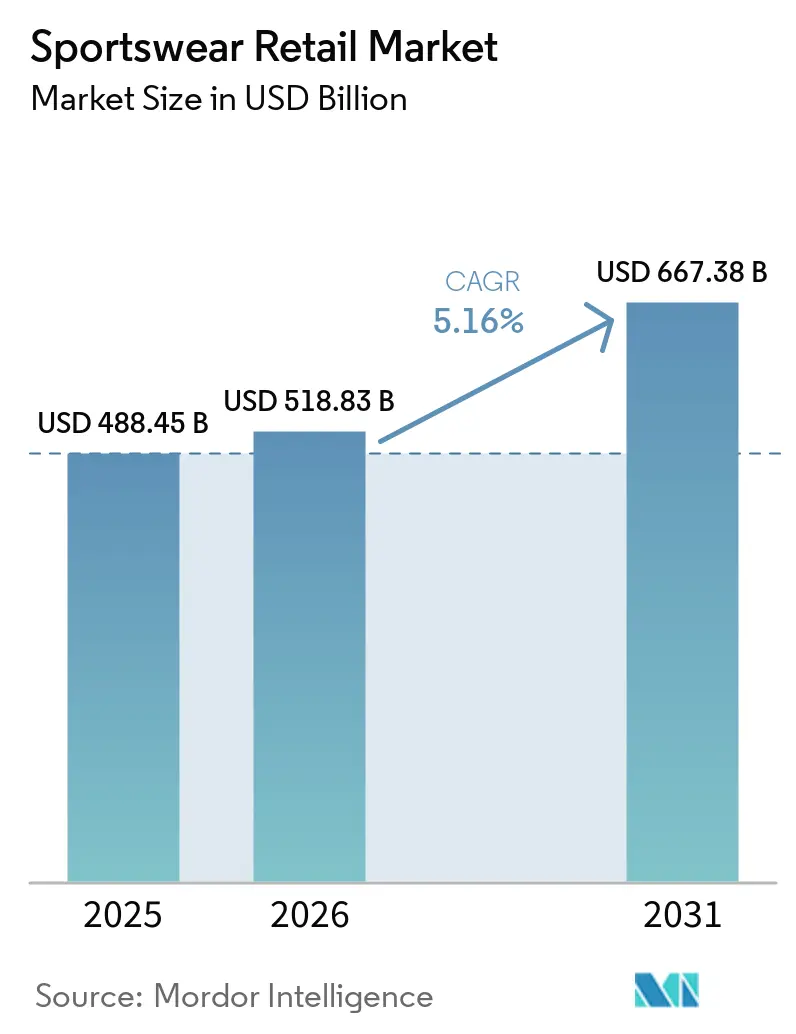
The Sportswear Retail Market size is expected to increase from USD 488.45 billion in 2025 to USD 518.83 billion in 2026 and reach USD 667.38 billion by 2031, growing at a CAGR of 5.16% over 2026-2031.
The sportswear retail market is supported by a broad rise in regular physical activity, which has shifted demand away from event-led buying toward everyday repeat use. The Sports & Fitness Industry Association reported that 250 million Americans participated in at least 1 sport, fitness, or leisure activity in 2025, the highest level on record, indicating that active lifestyles are reaching a wider consumer base. The Health & Fitness Association stated that 81 million Americans held gym memberships in 2025, with penetration reaching 26.1% among people aged 6 and older, which supports steady replacement demand across footwear, apparel, and accessories. The sportswear retail market is also seeing stronger premium demand, faster digital conversion, and a broader women’s consumer base. At the same time, margin pressure from discounting, tariffs, and inventory errors continues to separate stronger operators from weaker ones.[1]
Key Report Takeaways
- By product type, Footwear held 55.11% of the sportswear retail market in 2025, while Apparel is projected to expand at a 7.53% CAGR through 2031.
- By sports type, Running accounted for 30.34% of the sportswear retail market in 2025 and is also forecast to record the fastest CAGR at 7.81% through 2031.
- By end user, Men held 45.67% of the sportswear retail market in 2025, while Women segment is projected to advance at an 8.00% CAGR through 2031.
- By price tier, Mid-Range controlled 50.86% of the sportswear retail market in 2025, while Premium is forecast to grow at a 7.53% CAGR through 2031.
- By distribution channel, Offline Retail held 60.12% of the sportswear retail market share in 2025, while Online Retail is expected to expand at a 12.55% CAGR through 2031.
- By geography, Asia-Pacific captured 35.77% of the sportswear retail market share in 2025 and is projected to grow at an 8.12% CAGR through 2031.
Note: Market size and forecast figures in this report are generated using Mordor Intelligence’s proprietary estimation framework, updated with the latest available data and insights as of January 2026.
Market Trends and Insights
Drivers Impact Analysis of Sportswear Retail Market*
| Drivers | (~) % Impact on CAGR Forecast | Geographic Relevance | Impact Timeline |
|---|---|---|---|
| Rising Demand for Athleisure and Performance Casualwear | +1.5% | Global, with concentrated strength in North America, Asia-Pacific, and Western Europe | Long term (≥ 4 years) |
| Omnichannel Retail Expansion and Unified Inventory Models | +0.9% | North America and Europe leading, Asia-Pacific scaling rapidly | Medium term (2-4 years) |
| Premiumization of Sportswear and Brand-Led Positioning | +0.8% | North America, Asia-Pacific, and EMEA | Medium term (2-4 years) to Long term (≥ 4 years) |
| Growth in Women’s Participation in Fitness and Sports | +1.0% | Global, with the highest incremental impact in North America, Asia-Pacific, and MEA | Long term (≥ 4 years) |
| Value-Driven Private Label and Exclusive Collaboration Expansion | +0.5% | Europe and North America, with emerging traction in the Asia-Pacific | Short term (≤ 2 years) to Medium term (2-4 years) |
| Digital Commerce, Social Selling, and Creator-Led Discovery | +0.8% | Asia-Pacific, North America, and EMEA | Medium term (2-4 years) |
| Source: Mordor Intelligence | |||
Rising Demand for Athleisure and Performance Casualwear
The sportswear retail market is benefiting from a steady shift in how consumers dress for work, leisure, and exercise across the same day. Sportswear is no longer bought only for training, as the same products are now used for travel, informal work settings, and everyday wear. The Sports & Fitness Industry Association stated that 250 million Americans participated in at least 1 sport, fitness, or leisure activity in 2025, indicating that the active consumer base is widening rather than just spending more per user. The Health & Fitness Association also reported that Gen Z adults aged 18 to 24 had the highest membership penetration at 35.5% in 2025, which matters because this group often blends performance wear with casual use and refreshes its wardrobe more often. As a result, the sportswear retail market is seeing durable demand across footwear, apparel, and accessories rather than isolated growth in a single product line.
Omnichannel Retail Expansion and Unified Inventory Models
The sportswear retail market is moving toward a model where inventory visibility matters more than a simple online-versus-offline split. Retailers that cannot view stock across stores and digital channels often lose sales online, mark down excess stock in stores, and pay more for inefficient fulfillment. VF Corporation announced in April 2026 that it would deploy the Nedap Inventory Engine across its global brand portfolio and more than 1,500 stores, aiming to create a single, trusted view of stock to enable stronger omnichannel execution. That move reflects a broader shift in the sportswear retail market, where stock accuracy is becoming central to conversion, margin protection, and delivery speed. Companies that unify store inventory with digital demand are better placed to capture event-led spikes and routine replenishment demand without creating heavy markdown pressure later.
Premiumization of Sportswear and Brand-Led Positioning
The sportswear retail market continues to show that consumers will still pay more when performance claims, brand identity, and product credibility are clear. On Holding reported Q4 2025 net sales of CHF 743.8 million (USD 832 million), with reported growth of 22.6% and constant-currency growth of 30.6%, demonstrating that premium performance positioning continued to scale even in a more cautious demand environment. The same filing showed that direct-to-consumer accounted for 41.8% of full-year net sales and that Asia-Pacific revenue rose 110.9% at constant currency, pointing to strong full-price demand and tighter control over brand presentation. Adidas also reported record 2025 revenue of EUR 24.8 billion (USD 29.17 billion) and expects operating profit to rise to EUR 2.3 billion (USD 2.7 billion) in 2026, despite EUR 400 million (USD 470 million) in tariff and currency headwinds. This shows that premium products with strong brand positioning are helping parts of the sportswear retail market defend pricing better than undifferentiated offers.
Growth in Women’s Participation in Fitness and Sports
The sportswear retail market is gaining support from a larger and more visible women’s consumer base across exercise, school sports, and professional competition. The NCAA stated that women’s championship participation reached 242,341 student-athletes in 2024-25, up 14% from 10 years earlier, supporting long-term demand for performance-oriented product lines. Nike reinforced this direction by launching NikeSKIMS in February 2025 as a distinct women’s brand built around fit, performance, and inclusion rather than a limited extension of an existing range. This shift is important for the sportswear retail market because brands with dedicated women’s product development are better placed to capture repeat demand than those offering resized men’s assortments.
Restraints Impact Analysis of Sportswear Retail Market*
| Restraints | (~) % Impact on CAGR Forecast | Geographic Relevance | Impact Timeline |
|---|---|---|---|
| Intense Price Competition and Promotional Dependency | -0.6% | Global, most acute in North America and Western Europe | Short term (≤ 2 years) to Medium term (2-4 years) |
| Inventory Misalignment from Fast Trend Cycles | -0.4% | Global, concentrated in athleisure and lifestyle-led ranges | Short term (≤ 2 years) to Medium term (2-4 years) |
| Margin Pressure from Logistics, Returns, and Fulfillment Costs | -0.5% | Global, with higher severity in high e-commerce markets | Medium term (2-4 years) |
| Counterfeit Products and Parallel Market Leakage | -0.3% | Asia-Pacific, MEA, and global online marketplaces | Long term (≥ 4 years) |
| Source: Mordor Intelligence | |||
Intense Price Competition and Promotional Dependency
The sportswear retail market remains exposed to a pricing pattern in which frequent promotions can weaken brand discipline and make subsequent price recovery harder. Lululemon reported that operating income in Q1 fiscal 2026 fell 37% year over year, and that gross margin declined to 54.2%, amid higher markdowns and tariff-related issues. Adidas also expects EUR 400 million in tariff and currency headwinds in 2026, which shows that cost pressure is not limited to weaker brands or lower price tiers. When products are already sold in a highly promotional environment, passing these cost increases to consumers becomes more difficult. This keeps parts of the sportswear retail market caught between rising costs, discount-led traffic building, and slower full-price sell-through.
Inventory Misalignment from Fast Trend Cycles
The sportswear retail market faces inventory risk because trends in athleisure and lifestyle-led assortments can move faster than typical planning cycles. Product drops, collaborations, and short-lived color or silhouette trends can leave brands with inventory that no longer matches current demand by the time it reaches stores. Lululemon stated in its fiscal 2025 reporting that higher markdowns weighed on gross profit, which reflected the cost of clearing goods in a market where product timing matters more than before. VF’s 2026 rollout of a global inventory engine also showed that leading groups are still investing heavily to improve stock accuracy and allocation, which indicates that the problem is operational and persistent rather than temporary. Inventory mistakes weigh on the sportswear retail market through extra storage, rerouting, clearance activity, and missed launch windows.
*Our forecasts treat driver/restraint impacts as directional, not additive. The impact forecasts reflect baseline growth, mix effects, and variable interactions.
Sportswear Retail Market Segment Analysis
By Product Type:
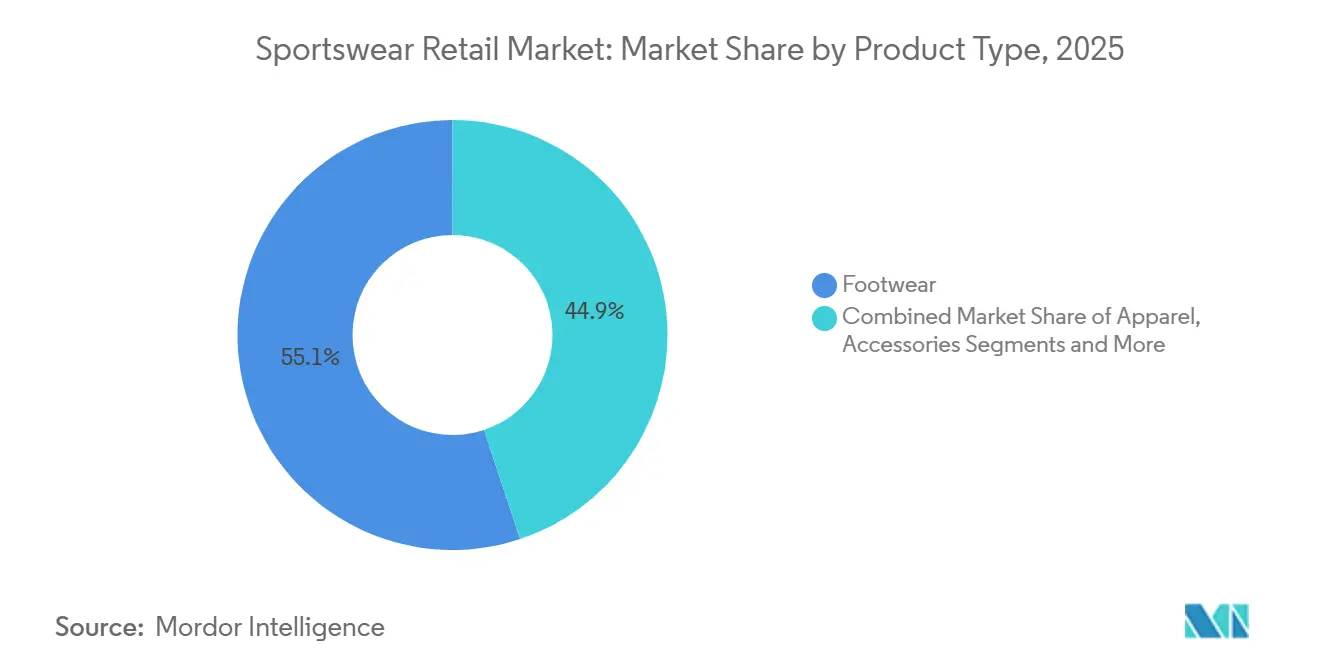
Footwear Dominates but Apparel AcceleratesFootwear accounted for 55.11% of the sportswear retail market in 2025, keeping it firmly ahead of all other product categories. Its lead reflects higher average selling prices, stronger brand signaling, and frequent replacement in running, basketball, and training use cases. Footwear also remains the category where consumers are most easily able to understand visible product technology, which helps sustain premium pricing. Apparel, however, is projected to grow at a 7.53% CAGR through 2031, which shows that the next demand wave is not limited to shoes. This widening demand base means the sportswear retail market is increasingly shaped by full-look purchases rather than one-time footwear-led transactions.
Nike also expanded its innovation pipeline in 2025 and 2026 with Aero-FIT, Air Milano, Nike Mind, and Project Amplify, which showed that the innovation race in footwear remains intense even as apparel grows faster. Accessories and other equipment still account for the remaining value pool and offer repeat-purchase potential, especially for training and running routines. Brands with depth across footwear and apparel are better positioned to increase basket sizes and keep shoppers within their own brand ecosystem. That balance matters in the sportswear retail industry because cross-category strength reduces dependence on a single hero product or short trend cycle.

By Sports Type:
Running Anchors Both Scale and MomentumRunning accounted for 30.34% of the sportswear retail market in 2025, making it the largest sports segment by value. It is also forecast to grow at a 7.81% CAGR through 2031, indicating leadership in both scale and forward demand. Running remains accessible across age groups and income bands, keeping participation broad even as discretionary spending becomes more selective. The category also supports frequent product refreshes across footwear, apparel, and accessories, helping maintain regular purchase cycles. This combination makes running one of the most structurally important demand engines in the sportswear retail market.
The National Sporting Goods Association reported that running and jogging exceeded 50 million participants in the United States in 2025 for the first time since 2020, confirming that the category is expanding again at a mass level. Soccer remains important because event-linked demand can lift sales of boots, training wear, and licensed apparel during major tournaments. Basketball and golf continue to carry strong regional weight, especially in North America and affluent Asia-Pacific markets where brand and performance positioning are well established. Other sports are also gaining ground as more consumers adopt racket sports, fitness training, and hybrid activity routines. For the sportswear retail market, that means running remains the anchor segment, but adjacent activity categories are steadily widening the total demand base.[2]
By End User:
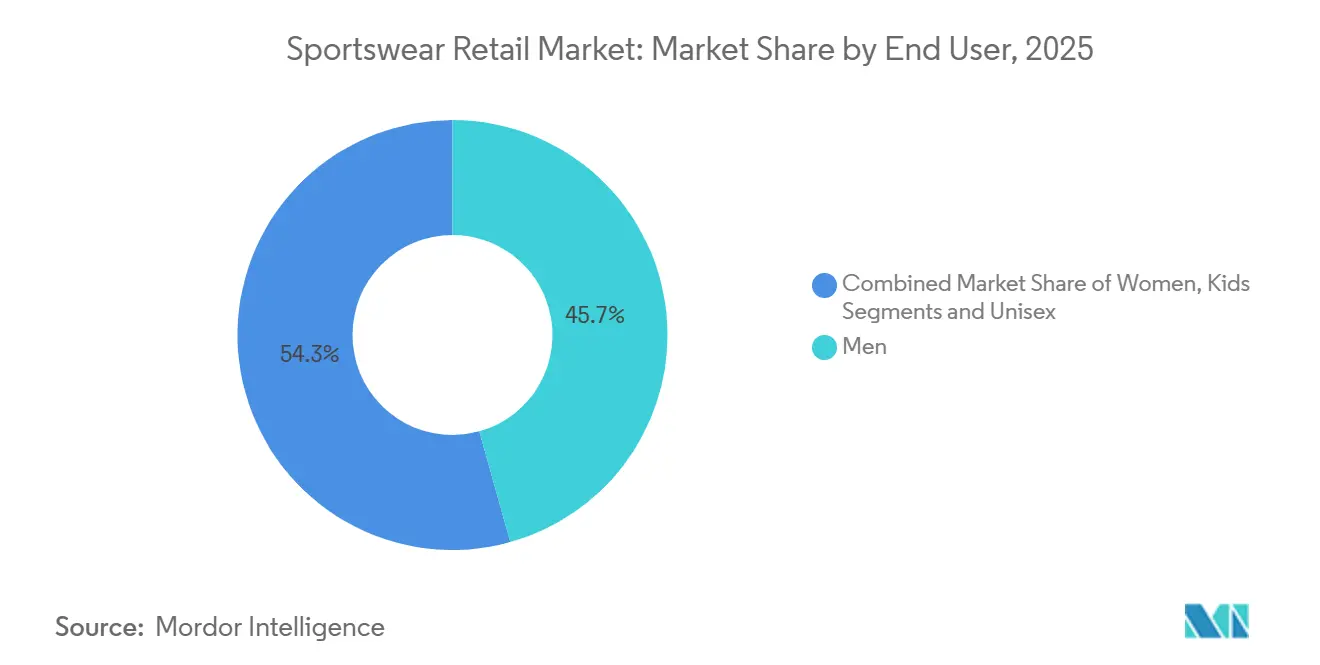
Men Lead by Share, Women Define the Growth CurveMen held 45.67% of the sportswear retail market in 2025, supported by broad product availability and higher average transaction values in footwear-heavy baskets. This position reflects the historical depth of men’s assortments across global brands and the mature demand base in established sport categories. Women, however, are the fastest-growing end-user segment, with an 8.00% CAGR through 2031, indicating genuine demand growth rather than a simple shift from one buyer group to another. The strength of the women’s segment is tied to participation, visibility, and better product design across performance categories. That makes the sportswear retail market more balanced than before, with growth now coming from parts of the consumer base that had been underdeveloped for years.
Nike SKIMS also showed that major brands are now treating women’s performance wear as a standalone growth platform with dedicated fit and product architecture. Kids remain a long-cycle opportunity because early sports participation often shapes later brand preferences and repeat demand. Unisex is still smaller by value, but it is benefiting from simpler silhouettes and more versatile training and running product lines. In this context, women’s growth is one of the clearest signals that the sportswear retail market is broadening structurally rather than depending only on legacy male demand.
By Price Tier:
Mid-Range Holds the Floor, Premium Captures UpsideMid-Range controlled 50.86% of the sportswear retail market in 2025, which kept it at the center of global volume demand. This tier benefits from broad brand participation, wide style breadth, and a consumer base that still seeks product credibility without moving fully into premium price points. Premium, however, is projected to expand at a 7.53% CAGR through 2031, faster than the overall sportswear retail market and indicating ongoing willingness to pay for stronger performance and brand distinction. In 2025, Premium represented the clearest upside pocket within the price architecture, while Mass Market remained important for volume but faced tighter pricing pressure. This means the sportswear retail market for premium-positioned assortments is growing faster than the broader category.
Adidas also expects operating profit to increase in 2026 despite major tariff and currency headwinds, suggesting that a better product mix and brand strength can provide a margin cushion that lower-tier players may struggle to match. Mass Market continues to serve value-conscious buyers, but it is squeezed by retailer-led value offers at the bottom and more accessible premium brands at the top. The most exposed position is the undifferentiated middle of the mid-range tier, where products are not cheap enough to win on value and not distinctive enough to hold loyalty. That dynamic is likely to keep shaping how the sportswear retail market allocates growth across pricing bands over the next 5 years.
By Distribution Channel:
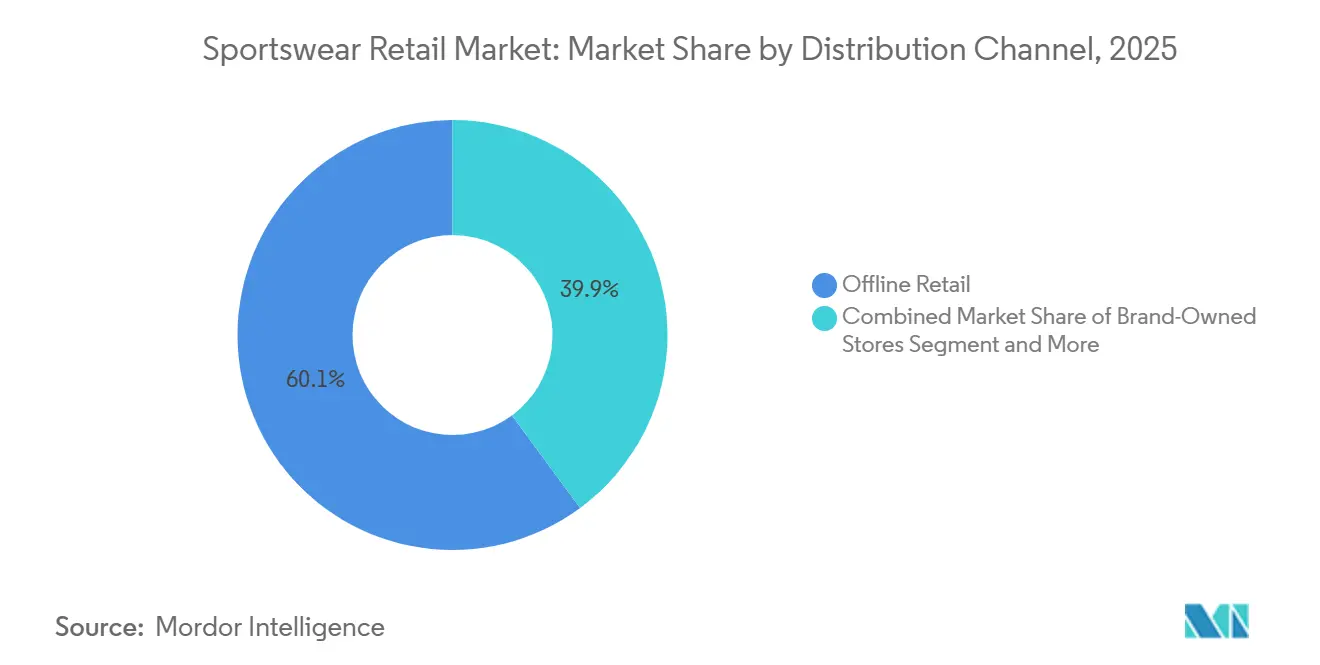
Physical Holds the Present, Digital Rewrites the FutureOffline Retail held 60.12% of the sportswear retail market share in 2025, indicating that physical stores still matter strongly in sportswear purchases. Consumers continue to use stores for fit checks, product trial, community engagement, and immediate purchase, especially in footwear and higher-value baskets. Brand-owned stores also play an outsized role in presentation, service, and full-price selling, even when the final sale is supported by digital browsing. Lululemon ended fiscal 2025 with 811 stores globally after adding 44 net new stores, and it plans to open 40 to 45 more in 2026, confirming that physical retail remains a growth channel for strong brands. The sportswear retail market, therefore, remains store-led in scale, even as digital formats take a larger role in discovery and replenishment.
Online Retail is forecast to grow at a 12.55% CAGR through 2031, which makes it the fastest-growing distribution channel in the sportswear retail market. This pace reflects better fulfillment, stronger direct-to-consumer ecosystems, and a younger buyer base that is comfortable moving from content to purchase without visiting a store. Myntra’s 2025 social commerce update showed that creator-led shopping already accounts for 10% of platform revenue, a useful signal for India that digital demand is becoming more community-driven and measurable. On Holding’s 41.8% direct-to-consumer mix also shows how digital channels support both pricing discipline and customer data capture. As a result, the sportswear retail market for digital channels is expanding faster than the store-based market, even though physical retail still accounts for the largest share in 2025.
Geography Analysis
APAC Sportswear Retail Market
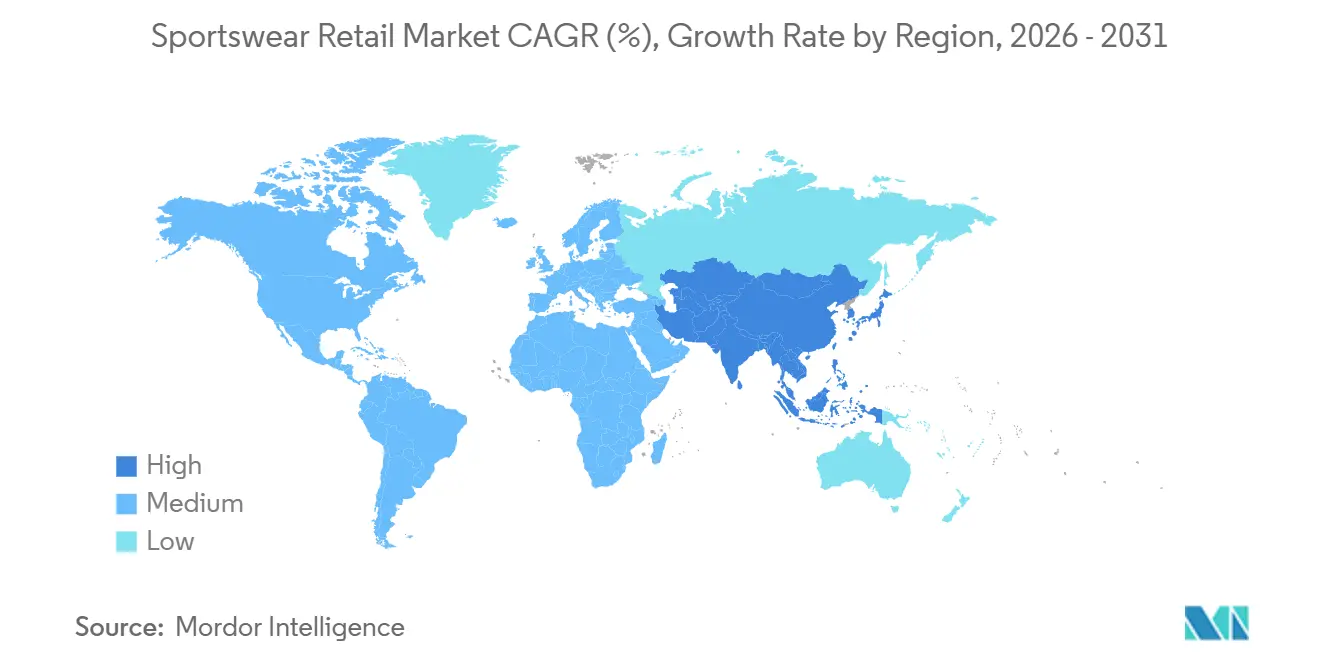
Asia-Pacific accounted for 35.77% of the sportswear retail market in 2025 and is projected to expand at an 8.12% CAGR through 2031, making it both the largest and fastest-growing regional market. China remains important for scale, while India stands out for its demand runway, digital engagement, and growing relevance to global brand strategy. India also adds an important local angle, as creator-led commerce is already meaningful in sports and fashion purchases, with Myntra reporting that social commerce accounted for 10% of revenue in 2025. This makes Asia-Pacific the clearest expansion zone for the sportswear retail market, with India particularly relevant for brands looking to drive medium-term volume growth.
North America Sportswear Retail Market
North America remains one of the most commercially developed regions in the sportswear retail market, with deep brand penetration, high fitness participation, and advanced direct-to-consumer infrastructure. The Sports & Fitness Industry Association confirmed that 250 million Americans participated in at least 1 sport, fitness, or leisure activity in 2025, which keeps the addressable consumer pool unusually broad. The Health & Fitness Association also reported 81 million gym memberships in 2025, which supports strong replacement and cross-category demand. At the same time, the region shows the clearest tension between premium demand and promotional stress, with markdowns and tariffs weighing on profitability at major brands. This means North America remains essential to the sportswear retail market, but it is also where pricing discipline is tested most visibly.
EMEA and South America Sportswear Retail Market
Europe continues to hold a meaningful share of the sportswear retail market through established retail systems and strong participation in club and outdoor sports. Adidas reported record revenue of EUR 24.8 billion (USD 29.17 billion) in 2025 and expects strong sales and profit growth to continue in 2026, supporting the view that European demand remains resilient despite cost pressures. South America remains led by football-linked demand, especially in Brazil, where apparel and footwear consumption stays tied to sport culture as much as style. The Middle East and Africa remain smaller in terms of share, but a younger population base and growing sports infrastructure support their long-term outlook. Across these regions, the sportswear retail market is still uneven in maturity, but brand investment continues to follow the combination of participation growth, income expansion, and local sport culture.[3]
Competitive Landscape
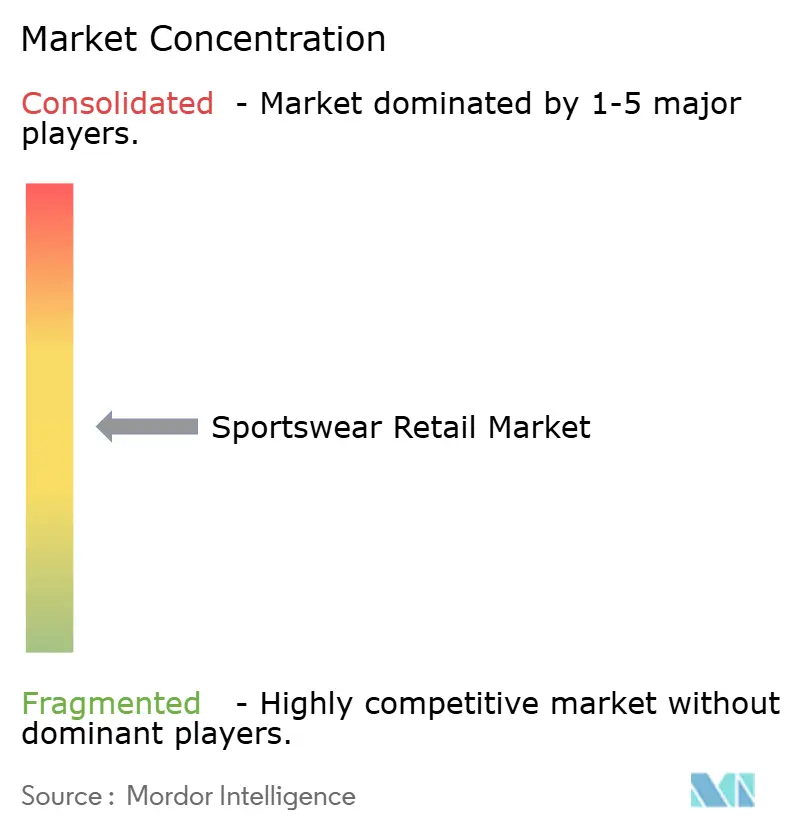
The sportswear retail market is moderately concentrated, with Nike and adidas together accounting for a large share of global sales. At the same time, the remainder is spread across specialist labels, premium challengers, and regional players. That structure gives the 2 largest brands scale advantages in sourcing, marketing, retail presence, and product development. At the same time, the category is not closed, because emerging brands can still gain traction by focusing on a narrow performance identity and building demand through direct-to-consumer channels. Holding's 2025 results showed how that strategy can work, with strong global sales growth and a 41.8% direct-to-consumer mix that supported pricing control and brand visibility. This keeps the sportswear retail market competitive even though the top global names remain highly influential.
Large players are responding through product innovation, channel control, and selective structural moves rather than relying only on advertising scale. Nike expanded its innovation platform set in 2025 and 2026, including Project Amplify, which it described as the world's first powered footwear system for running and walking. Adidas's combined 2025 revenue record and 2026 profit growth target suggest it is managing mix, pricing, and operating execution with greater stability than many peers. ANTA's agreement to acquire a 29.06% stake in PUMA for EUR 1.5 billion is also one of the clearest signs that global consolidation in sportswear remains active and that Chinese groups are pursuing a larger international role. These moves show that the sportswear retail market is being shaped by both organic brand building and capital-led repositioning.
Channel execution is becoming just as important as product strength in determining who gains share. VF's 2026 decision to deploy the Nedap Inventory Engine across more than 1,500 stores showed that inventory accuracy and omnichannel service are now core competitive tools rather than back-end support functions. Lululemon's plan to open 40 to 45 net new stores in 2026 also showed that physical expansion still matters when paired with premium positioning and disciplined product flow. Nike SKIMS added another layer to competition by creating a fresh women's platform that can compete across fit, style, and performance simultaneously. Taken together, these actions suggest that the sportswear retail market will continue to reward companies that combine product credibility, digital control, and cleaner operational execution.
Sportswear Retail Industry Leaders
-
NIKE, Inc.
-
adidas AG
-
Puma SE
-
JD Sports Fashion plc
-
Decathlon S.A.
- *Disclaimer: Major Players sorted in no particular order
Sportswear Retail Market Companies Covered in this Report
- NIKE, Inc.
- adidas AG
- Puma SE
- Lululemon Athletica Inc.
- Under Armour, Inc.
- ASICS Corporation
- New Balance Athletics, Inc.
- Skechers U.S.A., Inc.
- Columbia Sportswear Company
- Anta Sports Products Limited
- Li Ning Company Limited
- JD Sports Fashion plc
- Foot Locker, Inc.
- DICK'S Sporting Goods, Inc.
- Decathlon S.A.
- Zalando SE
- H&M Hennes & Mauritz AB
- Fast Retailing Co., Ltd.
- Gap Inc.
- American Eagle Outfitters, Inc.
Recent Industry Developments in Sportswear Retail Market
- April 2026: On Holding AG unveiled its first fully co-created footwear and apparel collection with actress Zendaya, directed by Spike Jonze, marking the expansion of their multi-year partnership from endorsement to co-creation. The collection launched globally via on.com, On stores, and select retail partners, reinforcing On Holding AG's strategy to gain younger demographics and extend its position beyond performance running into the lifestyle segment.
- April 2026: VF Corporation, parent company of The North Face, Vans, and Timberland, announced a strategic partnership with Nedap to deploy the Nedap Inventory Engine across its global brand portfolio, aiming to deliver a single, trusted view of inventory to support omnichannel performance. The deployment addresses one of the sector's most critical operational gaps: real-time item-level stock visibility across physical and digital channels.
- January 2026: ANTA Sports Products agreed to acquire a 29.06% stake in PUMA SE from Groupe Artemis for EUR 1.5 billion (USD 1.7 billion) in cash, becoming PUMA's largest shareholder.
- February 2025: NIKE, Inc. and SKIMS announced the launch of NikeSKIMS, an independent brand targeting the global women's fitness and activewear segment with dedicated innovation in fit, performance, and inclusion.
Global Sportswear Retail Market Report Scope
Segmentation Overview
| Footwear |
| Apparel |
| Accessories |
| Other Sportswear Equipment |
| Golf |
| Soccer |
| Basketball |
| Baseball |
| Running |
| Other Sport Types |
| Men |
| Women |
| Kids |
| Unisex |
| Premium |
| Mid-Range |
| Mass Market |
| Offline Retail |
| Brand-Owned Stores |
| Online Retail |
| Social and Creator Commerce |
| North America | United States |
| Canada | |
| Mexico | |
| South America | Brazil |
| Peru | |
| Chile | |
| Argentina | |
| Rest of South America | |
| Europe | United Kingdom |
| Germany | |
| France | |
| Spain | |
| Italy | |
| BENELUX (Belgium, Netherlands, and Luxembourg) | |
| NORDICS (Denmark, Finland, Iceland, Norway, and Sweden) | |
| Rest of Europe | |
| Asia-Pacific | India |
| China | |
| Japan | |
| Australia | |
| South Korea | |
| South East Asia (Singapore, Malaysia, Thailand, Indonesia, Vietnam, and Philippines) | |
| Rest of Asia-Pacific | |
| Middle East and Africa | United Arab Emirates |
| Saudi Arabia | |
| South Africa | |
| Nigeria | |
| Rest of Middle East and Africa |
| By Product Type | Footwear | |
| Apparel | ||
| Accessories | ||
| Other Sportswear Equipment | ||
| By Sports Type | Golf | |
| Soccer | ||
| Basketball | ||
| Baseball | ||
| Running | ||
| Other Sport Types | ||
| By End User | Men | |
| Women | ||
| Kids | ||
| Unisex | ||
| By Price Tier | Premium | |
| Mid-Range | ||
| Mass Market | ||
| By Distribution Channel | Offline Retail | |
| Brand-Owned Stores | ||
| Online Retail | ||
| Social and Creator Commerce | ||
| By Geography | North America | United States |
| Canada | ||
| Mexico | ||
| South America | Brazil | |
| Peru | ||
| Chile | ||
| Argentina | ||
| Rest of South America | ||
| Europe | United Kingdom | |
| Germany | ||
| France | ||
| Spain | ||
| Italy | ||
| BENELUX (Belgium, Netherlands, and Luxembourg) | ||
| NORDICS (Denmark, Finland, Iceland, Norway, and Sweden) | ||
| Rest of Europe | ||
| Asia-Pacific | India | |
| China | ||
| Japan | ||
| Australia | ||
| South Korea | ||
| South East Asia (Singapore, Malaysia, Thailand, Indonesia, Vietnam, and Philippines) | ||
| Rest of Asia-Pacific | ||
| Middle East and Africa | United Arab Emirates | |
| Saudi Arabia | ||
| South Africa | ||
| Nigeria | ||
| Rest of Middle East and Africa | ||
Key Questions Answered in the Report
What is driving growth in sportswear retail through 2031?
Growth is being supported by wider participation in fitness and sport, stronger demand from women, greater acceptance of premium products, and faster online conversion rates. The category is forecast to reach USD 667.38 billion by 2031 at a 5.16% CAGR.
Which product category contributes the most revenue?
Footwear remained the largest category with 55.11% share in 2025, supported by higher average selling prices and frequent replacement cycles.
Which consumer group is expanding the fastest?
Women is the fastest-growing end-user segment, with an 8.00% CAGR through 2031, supported by rising participation and stronger brand focus on fit and performance.
Why does running matter so much for sportswear demand?
Running held 30.34% share in 2025 and is projected to grow at a 7.81% CAGR through 2031, making it both the largest and fastest-growing sports-type segment in the report.
How important are digital channels for future sales?
Online Retail is projected to grow at a 12.55% CAGR through 2031, well above the overall category pace, even though Offline Retail still led with 60.12% share in 2025.
Why is Asia-Pacific central to long-term expansion?
Asia-Pacific held 35.77% share in 2025 and is projected to grow at an 8.12% CAGR through 2031, with India and China standing out for scale, digital engagement, and brand expansion potential.