
Market Overview
| Study Period | 2020 - 2031 |
|---|---|
| Market Size (2026) | USD 9.94 Billion |
| Market Size (2031) | USD 13.77 Billion |
| Growth Rate (2026 - 2031) | 6.74 % |
| Fastest Growing Market | Asia Pacific |
| Largest Market | North America |
| Market Concentration | Medium |
Major Players *Disclaimer: Major Players sorted in no particular order Image © Mordor Intelligence. Reuse requires attribution under CC BY 4.0. | |
Security Screening Market Analysis by Mordor Intelligence
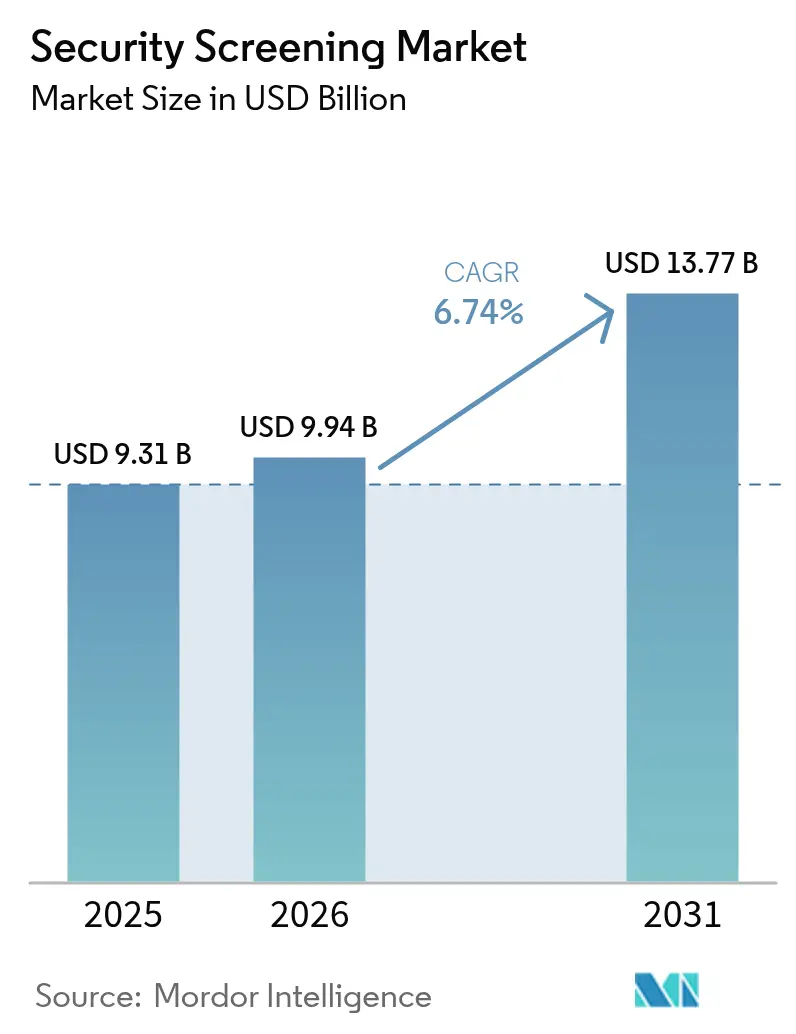
The security screening market size in 2026 is estimated at USD 9.94 billion, growing from 2025 value of USD 9.31 billion with 2031 projections showing USD 13.77 billion, growing at 6.74% CAGR over 2026-2031. Sustained government procurement programs, aviation traffic recovery, and rising geopolitical tensions anchor demand for advanced detection equipment. Convergence of millimeter-wave imaging with 5G backbones enables real-time analytics, while AI-enhanced computed tomography (CT) reduces false alarms and accelerates passenger throughput, prompting airports to upgrade legacy X-ray lanes. Border agencies are adopting mobile units to counter drone-borne contraband, and critical infrastructure operators are integrating cyber monitoring with physical screening to mitigate blended threats. Supply-chain pressure on rare-earth magnets and semiconductors may moderate near-term installation rates, yet strategic stockpiling initiatives by large vendors help stabilize deliveries. Growing privacy regulation in Europe and North America requires vendors to embed data-protection controls within body-scanning workflows without eroding detection accuracy.
Key Report Takeaways
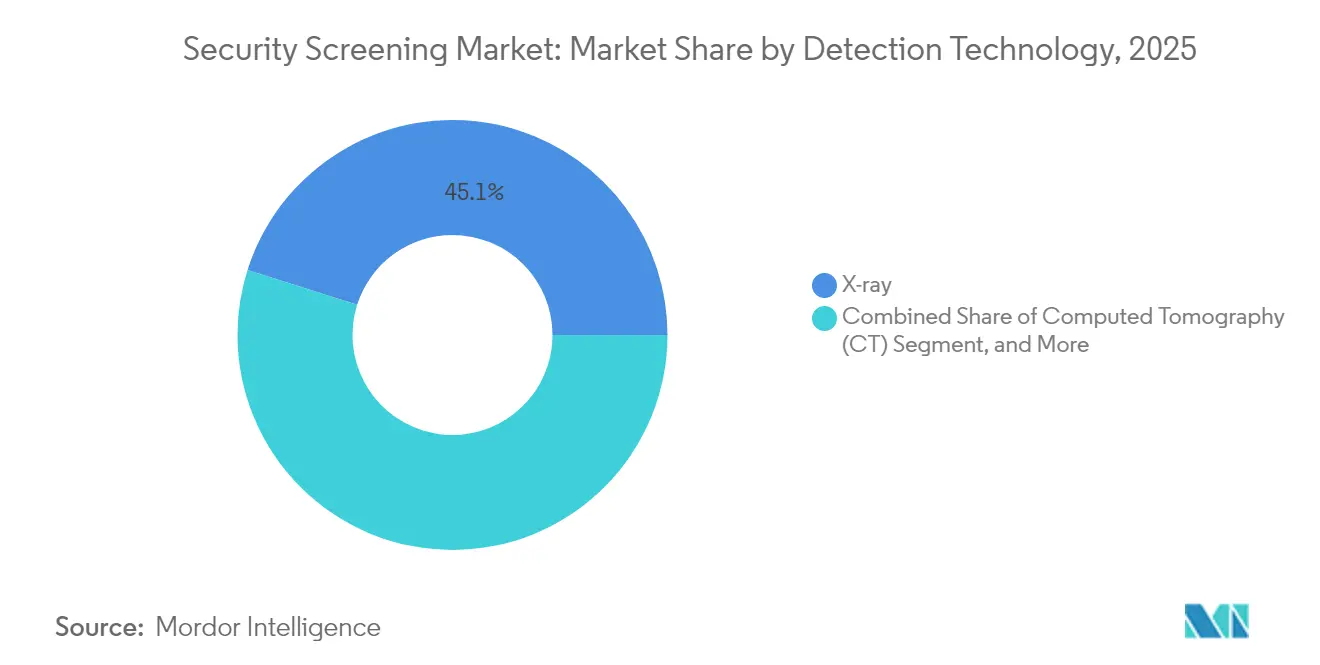
- By detection technology, X-ray imaging led with 45.12% of the security screening market share in 2025, while computed tomography is forecast to expand at an 7.76% CAGR to 2031.
- By equipment type, walk-through metal detectors accounted for 34.25% of the security screening market size in 2025; portable screening units are advancing at an 8.32% CAGR through 2031.
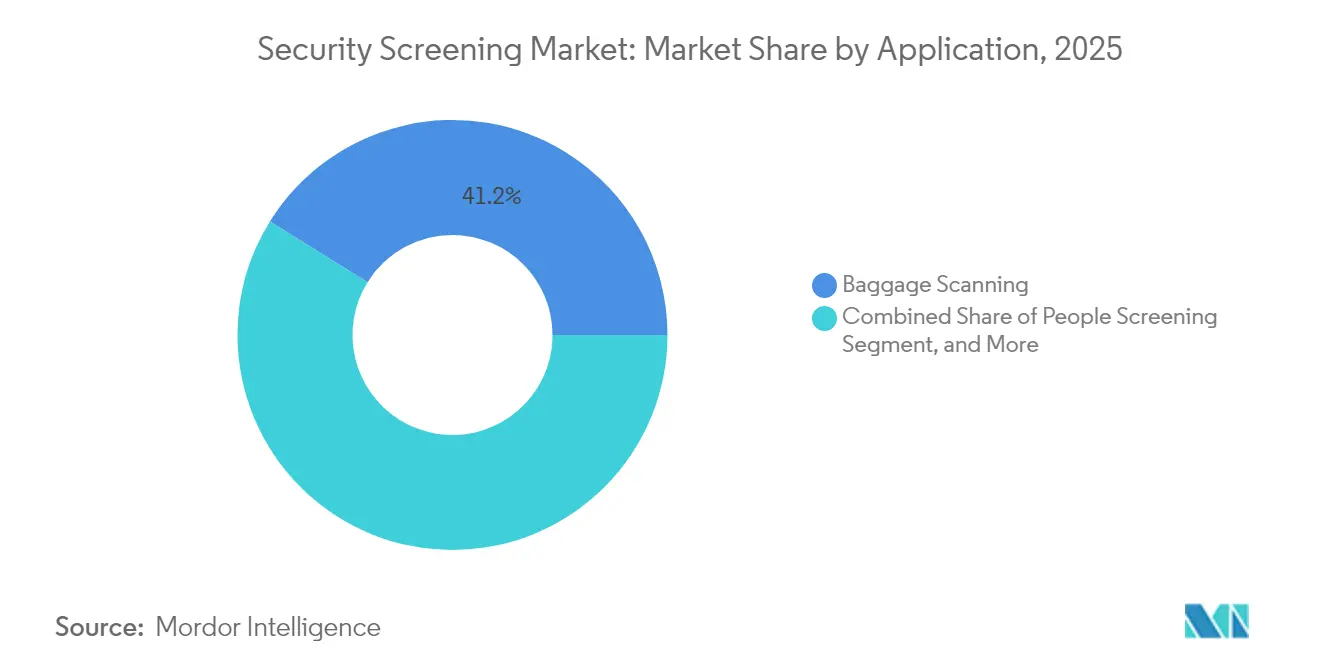
- By application, baggage scanning captured 41.15% revenue share of the security screening market in 2025, and cargo and vehicle inspection is projected to rise at an 8.27% CAGR to 2031.
- By end-user industry, airports held 49.02% of the security screening market size in 2025, while defense installations are growing fastest at an 8.55% CAGR through 2031.
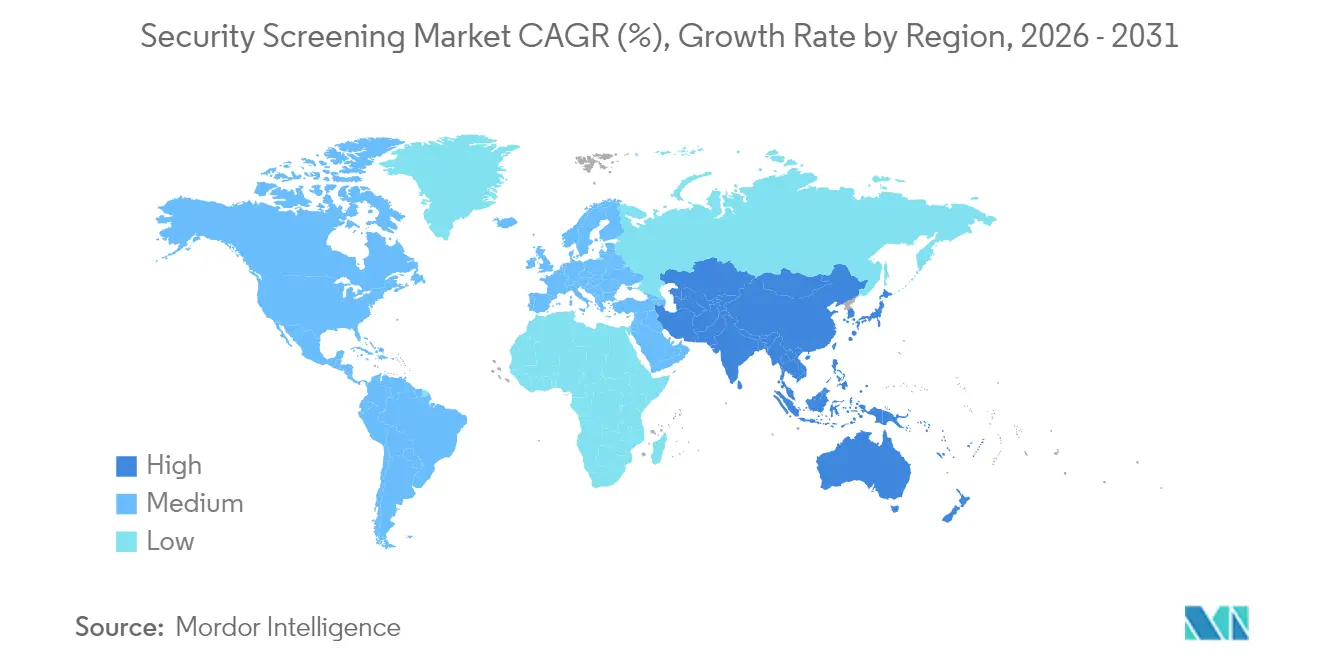
- By geography, North America commanded 36.05% share of the security screening market in 2025; Asia-Pacific is on track for an 8.14% CAGR between 2026-2031.
Note: Market size and forecast figures in this report are generated using Mordor Intelligence’s proprietary estimation framework, updated with the latest available data and insights as of 2026.
Market Trends and Insights
Drivers Impact Analysis of Security Screening Market*
| Driver | (~) % Impact on CAGR Forecast | Geographic Relevance | Impact Timeline |
|---|---|---|---|
| Upsurge in terror activities and security threats globally | +1.8% | Global, with heightened focus on Middle East and Africa | Medium term (2-4 years) |
| Regulatory mandates for aviation and border security | +1.2% | North America and Europe, expanding to Asia-Pacific | Short term (≤ 2 years) |
| Technological advancements in AI-powered automated threat detection | +0.8% | Global, led by North America and Europe | Long term (≥ 4 years) |
| Integration of millimeter-wave imaging with 5G infrastructure | +0.6% | APAC core, spill-over to North America and Europe | Medium term (2-4 years) |
| Contactless passenger-flow solutions post-pandemic | +0.5% | Global, with early adoption in North America and Europe | Short term (≤ 2 years) |
| Drone-borne contraband driving vertical screening adoption | +0.3% | Border regions globally, concentrated in North America and Middle East | Medium term (2-4 years) |
| Source: Mordor Intelligence | |||


Upsurge in Terror Activities and Security Threats Globally
Persistent extremist networks and transnational trafficking rings elevate baseline threat levels at airports, borders, and seaports. The U.S. Department of Homeland Security’s 2024 maritime cybersecurity white paper underscores how kinetic and cyber vectors are converging, compelling authorities to procure multi-modal systems that screen containers, people, and digital signals in one workflow.[1]U.S. Department of Homeland Security, “Maritime Cybersecurity White Paper,” dhs.gov Border agencies are piloting vertical screening towers that detect low-flying drones delivering weapons or narcotics. Portable units featuring integrated X-ray and millimeter-wave arrays are rotated among chokepoints to disrupt unpredictable smuggling routes. Governments in the Middle East and Africa are fast-tracking project financing for rapid-deployment checkpoints after a spike in cross-border incursions, bolstering long-term equipment replacement pipelines. These dynamics collectively underpin the steady expansion of the security screening market.
Regulatory Mandates for Aviation and Border Security
Regulators are translating evolving risk profiles into hard technology requirements. The European Civil Aviation Conference approved the removal of the 100 ml liquid limit at airports equipped with ECAC-certified CT scanners, forcing operators across the bloc to adopt next-generation equipment or preserve legacy restrictions that slow queues.[2]European Civil Aviation Conference, “ECAC Standards and Recommended Practices,” ecac-ceac.org In the United States, the Transportation Security Administration locked in USD 5.5 billion of multi-year CT contracts, standardizing checkpoint configurations nationwide. Similar mandates are emerging in India and Indonesia, where civil-aviation regulators now stipulate AI-ready imaging platforms for new terminal builds. Such codified thresholds effectively convert optional upgrades into non-negotiable capital expenditure, accelerating the security screening market’s technology refresh cycle.
Technological Advancements in AI-Powered Automated Threat Detection
Artificial intelligence is shifting screening from reactive object identification toward predictive risk analytics. BigBear.ai and Analogic fuse CT image streams with machine-learning models that cut false alarms by double-digit percentages and relieve operator fatigue.[3]Marketscreener, “BigBear.ai Joins Forces with Analogic to Transform Airport Threat Detection,” marketscreener.com Vision-language models let security staff query an archive of scanned objects using everyday phrases, shortening adjudication time for ambiguous items. Algorithms continuously retrain on adversary tactics, keeping pace with emerging 3D-printed weapons that evade traditional signature libraries. AI modules are delivered as cloud-native microservices, enabling field upgrades without replacing whole imaging stacks and protecting capital outlays.
Integration of Millimeter-Wave Imaging with 5G Infrastructure
Linking millimeter-wave portals to 5G edge nodes provides sub-second data transfer to centralized analytic engines. Trials at Frankfurt Airport demonstrated concurrent processing of body-scan data for 10 lanes with no latency penalties, validating scalable architectures for mega-terminals. Telecom operators in South Korea and Japan are co-locating security analytics at 5G edge datacenters, reducing on-premise hardware footprints. The arrangement also supports remote troubleshooting and continuous software patching, a critical capability as cyber vulnerabilities in imaging firmware become attractive targets. Vendors are embedding 5G modems directly into portable inspection vans, permitting real-time collaboration with command centers and improving situational awareness during ad-hoc deployments.
Restraints Impact Analysis of Security Screening Market*
| Restraint | (~) % Impact on CAGR Forecast | Geographic Relevance | Impact Timeline |
|---|---|---|---|
| High procurement and maintenance costs of advanced systems | -0.9% | Global, with acute impact on developing markets | Short term (≤ 2 years) |
| Data-privacy concerns surrounding body scanners | -0.7% | Europe and North America, expanding to Asia-Pacific | Medium term (2-4 years) |
| Supply-chain disruptions in rare-earth and semiconductor components | -0.4% | Global, with manufacturing concentration in Asia-Pacific | Short term (≤ 2 years) |
| False-alarm fatigue causing operational bottlenecks | -0.3% | Global, particularly high-traffic airports and borders | Medium term (2-4 years) |
| Source: Mordor Intelligence | |||
High Procurement and Maintenance Costs of Advanced Systems
Computed tomography and millimeter-wave installations often exceed USD 1 million per lane. OSI Systems’ USD 76 million contract for a single hub airport illustrates the scale of outlays necessary to modernize checkpoints. Beyond purchase price, airports incur facility retrofits for higher power loads and cooling, along with software-update subscriptions to sustain certification. Smaller Caribbean and African airports struggle to justify the outlay against limited passenger throughput, leading to a bifurcated security environment that adversaries can exploit. Leasing models and performance-based service contracts are emerging to distribute costs over operational budgets, but uptake remains nascent.
Data-Privacy Concerns Surrounding Body Scanners
Full-body systems that generate high-resolution anatomical images face stringent biometric-data rules under the European Union’s General Data Protection Regulation, compelling airports to anonymize or instantly purge scans. These workflows complicate evidence retention when law enforcement must prosecute smuggling cases. In North America, advocacy groups press for opt-out options, prolonging queue times and eroding throughput gains. Asia-Pacific regulators are drafting similar statutes, potentially expanding the compliance burden. Vendors are responding with software that renders generic avatars rather than raw images, yet the perception of intrusive scanning still tempers deployment velocity.
*Our forecasts treat driver/restraint impacts as directional, not additive. The impact forecasts reflect baseline growth, mix effects, and variable interactions.
Security Screening Market Segment Analysis
By Detection Technology:
CT Adoption Accelerates Throughput-Driven InvestmentsCT scanners accounted for USD 2.08 billion of revenue in 2025, translating to 22.37% of the security screening market size, and they are projected to post an 7.76% CAGR on the back of liquid-carry-on policy relaxations. X-ray systems retained their leadership with a 45.12% share in 2025, favored for lower capital cost and mature regulatory approvals. Nonetheless, airlines lobbying for faster boarding are swaying airports toward CT, particularly in Asia-Pacific’s new greenfield terminals. Terahertz and neutron sensing systems cater to specialized nuclear material detection but remain below 5% of the overall revenue pool. Integration of AI classifiers into CT consoles sharply reduces false positives, a principal driver behind procurement decisions in Europe and the Gulf states.
In the medium term, chip-scale terahertz emitters emerging from MIT Lincoln Laboratory trials will unlock handheld screening formats, broadening use cases beyond fixed checkpoints. Vendors are bundling radiation monitors with conventional lanes to comply with updated International Atomic Energy Agency guidance on orphan source interdiction, gradually lifting unit shipments. The security screening industry is thereby pivoting from single-modality hardware toward software-defined, multi-sensor ecosystems that evolve through over-the-air updates rather than forklift upgrades.


By Equipment Type:
Mobility and Modularity Gain TractionWalk-through metal detectors collected 34.25% revenue share in 2025 by virtue of ubiquity and low ownership cost. Portable and mobile units, though only 11.2% of current shipments, are expanding at an 8.32% CAGR as border patrols demand rapid redeployment to emerging smuggling corridors. Explosives trace detection systems remain indispensable for alarm resolution, with the U.S. Transportation Security Administration ordering more than 2,500 Itemiser 5X devices for secondary screening in 2025. Full-body scanners record the highest average selling price but are penetrating mass-transit hubs where throughput gains offset acquisition cost.
Market leaders now package lane components, imagers, trays, and divestment tables as modular kits that fit both permanent halls and pop-up checkpoints. Lifecycle service contracts covering firmware, spare parts, and operator training comprise nearly 30% of total contract value, creating annuity revenue streams. Hardware commoditization thus shifts competitive edge toward analytics software, cybersecurity hardening, and predictive maintenance algorithms that reduce downtime at high-traffic sites.
By Application:
Cargo Screening Mitigates Supply-Chain ThreatsBaggage scanning preserved a 41.15% share in 2025 because aviation authorities mandate 100% screening of passenger luggage. Yet cargo and vehicle inspection lines are accelerating at an 8.27% CAGR, fueled by sudden shipping-route shifts after Red Sea disruptions and heightened contraband seizures at land crossings. Customs agencies in the Middle East rolled out drive-through CT portals capable of 150 trucks per hour, demonstrating the scalability of high-energy imaging for commerce flows.
Mail and parcel screening benefits from cross-border e-commerce growth, especially in Southeast Asia, where volumes rise 20% year-over-year. People-screening applications extend to stadiums and corporate campuses, adopting contactless walk-through technology to minimize queue build-ups. The security screening market continues to diversify as operators blend imaging, trace, and canine solutions into layered concepts of operation that adapt to threat intelligence feeds in real time.
By End-User Industry:
Defense Modernization Spurs Highest CAGRAirports remained the core customer segment with 49.02% of spending in 2025, underpinned by global passenger rebounds and mandated re-inspection cycles. Defense facilities, however, are advancing at an 8.55% CAGR as militaries retrofit perimeters with radar-coupled imaging and vehicle-mounted scanners that protect forward operating bases. Ports and borders consume a rising share, encouraged by government stimulus earmarked for trade-lane security upgrades.
Critical infrastructure operators, such as nuclear plants and data centers, now embed screening lanes within visitor management suites to counter insider threats. Retail malls and convention centers adopt weapon detection gates to reassure patrons after several high-profile attacks. The security screening industry is consequently broadening its user base beyond aviation, cushioning vendors against cyclical airline capital expenditure slumps.
Geography Analysis
North America Security Screening Market
North America generated 36.05% of 2025 revenue on the back of the Transportation Security Administration’s multibillion-dollar CT and maintenance framework agreements. Continued contract modifications, including Leidos’ eight-year USD 2.6 billion checkpoint sustainment award, lock in predictable aftermarket receipts. Canadian airports align procurement standards with U.S. counterparts, while Mexican customs deploy mobile X-ray vans along the southern border to stem narcotics inflows, adding incremental demand.
APAC Security Screening Market
Asia-Pacific is forecast to grow at an 8.14% CAGR through 2031 as China, India, and Indonesia expand greenfield airports and high-speed rail corridors. Beijing’s push for domestic AI chips used in CT consoles reduces import dependence and compresses lead times, giving local vendors cost advantages. Singapore’s Changi Airport is piloting biometric-linked security lanes that fuse identity management with threat detection, setting performance benchmarks for the region.
EMEA Security Screening Market
Europe maintains a steady upgrade cadence driven by the ECAC liquid-ban repeal and stringent data-privacy rules that favor vendors with built-in anonymization features. Zurich Airport’s live trials of CT and automated tray return systems exemplify how regional hubs validate new layouts before full-fleet rollouts. Eastern European states tapping EU security funds are leapfrogging directly to AI-ready CT, sidestepping intermediate X-ray generations. Meanwhile, Middle East and Africa governments allocate oil-windfall budgets to protect mega-events and critical infrastructure, often bundling physical screening with drone perimeter defenses in integrated tenders.

Regulatory Landscape
Aviation security screening is governed by global standards and national transpositions that increasingly hard-code technology capabilities. ICAO security policy (including GASeP and the USAP-CMA audit framework) continues to guide state programs, and by September 2025, 46% of states had reached or exceeded 75% Effective Implementation of ICAO security standards, reinforcing the push toward measurable compliance and technology-enabled quality control.
In Europe, implementing acts continue to refine operating procedures and oversight obligations. Commission Implementing Regulation (EU) 2026/449 (adopted 27 February 2026) introduced procedural adjustments affecting the use of X-ray and explosive detection equipment, while Commission Regulation (EU) 2026/247 (adopted 2 February 2026) updated expectations for national civil aviation security quality control programmes, including a mandatory confidential reporting system requirement. Cargo and mail screening rules also tightened via Commission Implementing Regulation (EU) 2025/920, which required, from 1 January 2026, that explosive detection dog screening be validated against Attachment 6-M. In the United States, TSA identity and checkpoint processes continue to evolve alongside technology refresh cycles, including the launch of ConfirmID as a modernized alternative identity verification option tied to traveler processing for access to sterile areas.
Value Chain Analysis
The security screening value chain spans sensor and detector components (X-ray sources, scintillators, detectors, rare-earth magnet assemblies, and radiation-hardened semiconductors), system integration (CT, X-ray, millimeter-wave, and trace detection platforms), certification and testing, and then installation, commissioning, and lifecycle support. Lead-time risk clusters around specialized electronics and detector subassemblies, with cited 6 to 12 month lead times for items such as fast scintillation detectors and radiation-hardened FPGAs. Inventory planning and dual sourcing are therefore central to vendor delivery performance.
Downstream, the chain is heavily services-led. Site preparation (power, cooling, shielding, and space reconfiguration), software and cyber hardening, operator training, and multi-year maintenance contracts drive a large share of realized contract value. Deployment at ports of entry and border crossings can be constrained by civil works readiness and integration planning rather than scanner availability, creating opportunities for prime contractors and integrators to bundle hardware with infrastructure, program management, and sustainment. Industry consolidation also shapes the chain: Leidos announced a joint venture with Altaris-owned Analogic in April 2026 to combine detection technologies and manufacturing capabilities, signaling tighter coupling between product engineering, production capacity, and go-to-market execution for aviation and border programs.
Competitive Landscape
The security screening market exhibits moderate consolidation: the top five suppliers generated around 62% of global revenue in 2024. Smiths Detection leverages a broad imaging portfolio to secure multi-year airport frameworks across Europe and Asia. OSI Systems capitalizes on cargo and vehicle inspection demand, boasting a record USD 1.8 billion backlog in 2025 after a series of large awards. Leidos underpins its position with lifecycle logistics contracts that embed technicians on-site at more than 430 U.S. airports.[4]Leidos, “Leidos Wins TSA Logistics Contract,” leidos.com
Disruptors are reshaping value propositions. Evolv Technology’s contactless gates process 4,000 people per hour and embed SaaS analytics that monetize crowd-flow data. SeeTrue’s AI plug-in retrofits existing X-ray machines to elevate automatic threat recognition, giving mid-tier airports a lower-cost modernization path. BigBear.ai’s cloud-based fusion engine integrates radar, lidar, and CT feeds to extend detection beyond standard checkpoint imagery. Strategic M&A and partnerships abound as incumbents acquire software talent to defend their share. Supply-chain resilience efforts include dual-sourcing rare-earth magnets and in-house ASIC design to mitigate chip shortages.
Security Screening Industry Leaders
Smiths Group plc (Smiths Detection)
Leidos Holdings Inc.
OSI Systems Inc. (Rapiscan Systems)
Nuctech Company Limited
3DX-Ray Limited
- *Disclaimer: Major Players sorted in no particular order

Security Screening Market Companies Covered in this Report
- Smiths Group plc (Smiths Detection)
- Leidos Holdings Inc.
- OSI Systems Inc. (Rapiscan Systems)
- Nuctech Company Limited
- 3DX-Ray Limited
- Analogic Corporation
- Astrophysics Inc.
- CEIA S.p.A.
- Gilardoni S.p.A.
- Teledyne ICM S.A.
- Muon Systems
- Decision Sciences International Corporation
- Passport Systems Inc.
- Lingacom Ltd.
- Garrett Electronics Inc.
- Thruvision Group plc
- L3Harris Technologies Inc.
- Rohde and Schwarz GmbH and Co KG
- Westminster Group plc
- Vanderlande Industries B.V.
- Autoclear LLC

Market Opportunities and Future Outlook
Remote and distributed screening architectures are opening whitespace beyond traditional checkpoint footprints, especially where agencies need secure data exchange across jurisdictions. TSA launched a remote screening pilot at Boston Logan International Airport on June 1, 2026, and Smiths Detection highlighted an operational International Remote Baggage Screening System (IRBS) linking Incheon International Airport with U.S. ports, showing how CT-based screening can be operationalized with cross-border data handling when cyber-secure workflows are built into deployments.
Regulatory and operating-model shifts also create addressable needs for compliance-ready software, privacy controls, and service delivery. India moved full-body scanners into multi-airport trials (BCAS) during 2026, aligning with broader people-screening investments outside North America and Europe, while TSA introduced the Gold Plus initiative in 2026 to encourage public-private partnerships for checkpoint operations, which can reshape how some airports procure and run advanced lanes. Border and cargo inspection demand is also tied to long-horizon funding and integration programs, including U.S. legislation passed in June 2026 directing CBP procurement and integration of new non-intrusive inspection equipment and related infrastructure through fiscal 2029. That increases emphasis on end-to-end delivery, covering hardware, integration platforms, and sustainment, rather than stand-alone scanner sales.
Recent Industry Developments in Security Screening Market
- June 2026: OSI Systems reported that its Security division received a USD 50 million services order from a North American customer to maintain deployed Rapiscan inspection systems and support the CertScan platform. The award highlights how recurring maintenance and software support are becoming a larger share of supplier revenue as installed bases expand and customers standardize sustainment.
- April 2026: Leidos and Altaris announced a joint venture agreement that combines Leidos Security Enterprise Solutions with Analogic to form a U.S.-based security screening enterprise. The move consolidates detection technology and manufacturing capabilities under a single platform, supporting faster packaging of integrated screening solutions for aviation and border customers.
- September 2025: OSI Systems was awarded a multi-year contract to support U.S. Customs and Border Protection's Common Integration Platform. The contract reinforces the strategic role of interoperable integration layers that connect non-intrusive inspection systems, data workflows, and operations across distributed border sites.


Security Screening Market Report Scope and Research Methodology
Market Definition and Coverage
For this methodology, the global security screening market covers revenue generated from equipment and solutions used to detect prohibited items or threats across people, baggage, cargo, mail, and vehicles in controlled facilities such as airports, borders, and critical infrastructure.
Scope exclusions: We exclude general building surveillance and access control that does not perform screening or threat detection.
Segments Covered in This Report
- By Detection Technology
- X-ray
- Computed Tomography (CT)
- Neutron Sensing and Detection
- Terahertz and Millimeter-wave
- Other Detection Technologies
- By Equipment Type
- Walk-through Metal Detectors
- Hand-held Metal Detectors
- Full-body Scanners
- Explosives Trace Detection Systems
- Radiation Detection Equipment
- Portable / Mobile Screening Units
- By Application
- Mail and Parcel
- Baggage Scanning
- Cargo and Vehicle Inspection
- People Screening
- Explosives and Narcotics Detection
- By End-User Industry
- Airports
- Ports and Borders
- Defense
- Critical Infrastructure
- Commercial Buildings and Malls
- Law Enforcement and Public Transport
- Other End-User Industries
- By Geography
- North America
- United States
- Canada
- Mexico
- South America
- Brazil
- Argentina
- Chile
- Rest of South America
- Europe
- Germany
- United Kingdom
- France
- Italy
- Spain
- Rest of Europe
- Asia-Pacific
- China
- Japan
- South Korea
- India
- Singapore
- Australia
- Rest of Asia-Pacific
- Middle East and Africa
- Middle East
- Saudi Arabia
- United Arab Emirates
- Turkey
- Rest of Middle East
- Africa
- South Africa
- Nigeria
- Egypt
- Rest of Africa
- Middle East
- North America
Data Sources, Market Sizing, and Validation
Desk Research
Desk research was used to set the core market boundaries and build an initial demand map by end users like airports, ports and borders, and public transport. We mainly relied on non-paywalled public sources such as ICAO and airport operator traffic statistics, IATA releases on passenger recovery, and government procurement portals for aviation and border security projects.
To keep assumptions realistic, we also reviewed regulatory and standards signals (for example, TSA and EU aviation security requirements) and technical references from bodies such as IAEA for radiation-related screening context, along with peer reviewed articles on screening performance and upgrade cycles. For company-level context, filings, annual reports, investor presentations, and reputable press were used, and a paid subscription for company financials and news was referenced where disclosures were limited. These are illustrative sources only, and other public documents were consulted for data collection, validation, and clarification.
Primary Interviews and Surveys
Primary work focused on interviews and structured surveys with screening system OEMs, component suppliers, system integrators, and buyers in aviation, ports and borders, and critical infrastructure. We also spoke with operations and security managers to pressure test replacement cycles, tender timing, and typical system pricing, including installation and service bundles. This helped narrow gaps left by public data sources.
Distribution of primary research fieldwork respondents
| Company type | Respondent position | Region |
|---|---|---|
| Top tier: 38% | CXOs: 16% | APAC: 39% |
| Mid tier: 46% | Functional/Unit leaders: 31% | EMEA: 37% |
| Smaller Players: 16% | Managers: 53% | Americas: 24% |
Market-Sizing & Forecasting
We sized the market using a top-down demand pool approach that starts from screened throughput and infrastructure activity, then applies realistic adoption and replacement patterns by end user. For example, airport passenger volumes and baggage screening lanes, cargo inspection activity, border checkpoint upgrades, and commercial venue security requirements were translated into annual system demand before revenues were modeled.
To keep totals grounded, the outputs were cross-checked with selective bottom-up checks such as sampling typical average selling prices for X-ray and CT systems, walk-through and hand-held metal detectors, and advanced people screening units, then multiplying by plausible shipment or project volumes surfaced in interviews and public tenders. Key inputs that shaped the model included airport and seaport traffic trends, share of CT upgrades in baggage screening programs, procurement lead times, service and maintenance attach rates, and regional price differences driven by certification requirements and installation scope.
For forecasting, we applied scenario analysis around upgrade mandates, aviation traffic trajectories, and government security budgets, then tuned the scenario path using primary feedback on likely tender timing and technology refresh cycles. Where bottom-up visibility was incomplete in smaller geographies, we used proxy indicators like airport capacity additions and known modernization programs to avoid overstating out-of-scope demand.
Data Validation & Update Cycle
Results were validated through triangulation across independent signals, followed by variance checks by region, end user, and technology to spot outliers such as unusually high implied pricing or replacement rates that did not match typical procurement behavior. If an anomaly showed up, assumptions were revisited and, where needed, experts were re-contacted to confirm whether the driver was a one-time tender, a regulatory change, or a scope mismatch.
Before sign-off, the model and narrative go through multi-step analyst reviews so calculations, currency handling, and growth drivers remain consistent with the stated scope. Reports refresh annually, with interim updates triggered by material events like new screening mandates, major airport upgrade waves, or sharp changes in travel volumes. A final pre-delivery review is completed to reflect the latest public information.
Mordor Intelligence's Global Security Screening Market Market Estimate Compared With Other Published Estimates
Published market sizes for security screening often vary because firms do not count the same technologies, the same end users, or the same revenue lines, even when the title looks identical. Differences can also come from how each study treats upgrade cycles, service revenue, and regional price levels, which can shift totals by year.
Passenger and baggage screening demand signals, including airport traffic recovery and the pace of CT upgrade programs, are the checks that keep Mordor Intelligence's 2026 estimate tied to the spend that is actually triggered by screening mandates and facility modernization, rather than broader safety and security equipment.
Benchmark comparison
| Source | Market Size | Gaps in Research Methodology |
|---|---|---|
| Mordor Intelligence | USD 9.94 B (2026) | |
| Global Consultancy A | USD 11.10 B (2025) | This figure appears to use a broader security screening boundary across public spaces and critical infrastructure. It may also pull a larger share of software and services into the same total, which lifts the starting value. |
| Industry Publisher B | USD 9.99 B (2025) | This estimate is anchored to a different base year and a faster growth curve. It likely assumes quicker multi-region replacement of older systems, which increases the implied near-term revenue run rate. |
Across the three figures, the spread is mostly explained by scope edges (what is counted as screening) and by the assumed speed of upgrade rollouts in aviation and border facilities. By keeping the model traceable to throughput-driven demand, replacement timing, and realistic pricing logic, the resulting market value remains repeatable for year to year decisions.


Key Questions Answered in the Report
How large is the security screening market in 2026?
The security screening market size is USD 9.94 billion in 2026 and is forecast to reach USD 13.77 billion by 2031.
Which detection technology is expanding fastest?
Computed tomography is projected to grow at an 7.76% CAGR as airports adopt liquid-friendly screening lanes.
What region offers the highest growth potential?
Asia-Pacific is set for an 8.14% CAGR to 2031, propelled by airport expansions in China, India, and Southeast Asia.
Why are portable screening units gaining traction?
Mobile systems support rapid redeployment to new threat corridors and are growing at an 8.32% CAGR.
What is driving defense sector demand?
Military bases are upgrading perimeter and vehicle access controls, pushing defense applications to an 8.55% CAGR.
Which companies dominate the market?
Smiths Detection, OSI Systems, and Leidos lead with roughly 62% combined revenue, while AI-focused entrants such as Evolv Technology are challenging incumbents.
Page last updated on:


 Your data is secure and never sold or shared.


