
Screw Pump Market Size and Share
Market Overview
| Study Period | 2022 - 2032 |
|---|---|
| Market Size (2027) | USD 5.87 Billion |
| Market Size (2032) | USD 7.66 Billion |
| Growth Rate (2027 - 2032) | 5.44 % |
| Fastest Growing Market | Asia-Pacific |
| Largest Market | Asia-Pacific |
| Market Concentration | Medium |
Major Players *Disclaimer: Major Players sorted in no particular order Image © Mordor Intelligence. Reuse requires attribution under CC BY 4.0. | |
Screw Pump Market Analysis by Mordor Intelligence
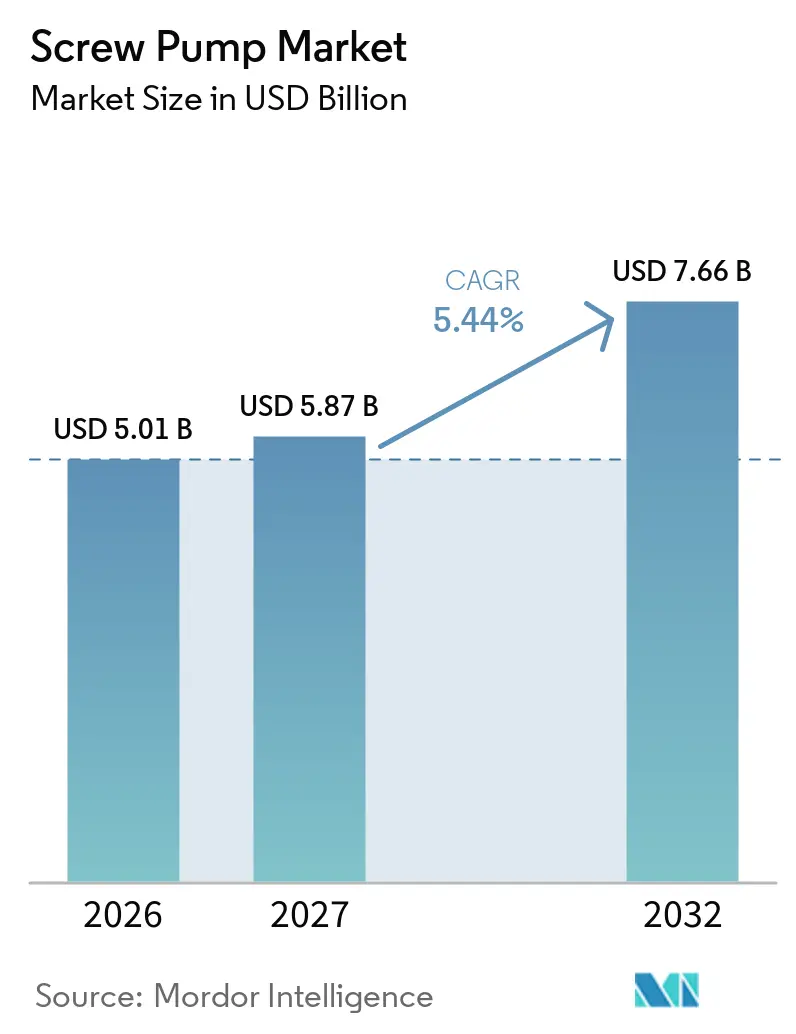
The global screw pump market size is projected to be USD 5.01 billion in 2026, USD 5.87 billion in 2027, and reach USD 7.66 billion by 2032, at a CAGR of 5.44% from 2027 to 2032. The market is supported by municipal water investment, oilfield artificial lift needs, and demand for hygienic or multiphase fluid handling. Positive displacement performance remains important when operators require steady transfer of viscous fluids, solids, or gas-containing streams. Procurement decisions increasingly reflect energy use, service availability, and expected equipment life, rather than purchase price alone. Large suppliers are strengthening their position through application engineering, digital monitoring, and service contracts. The market also faces pressure from volatile material costs and the higher initial price of screw designs compared with centrifugal and gear pumps.
Key Report Takeaways
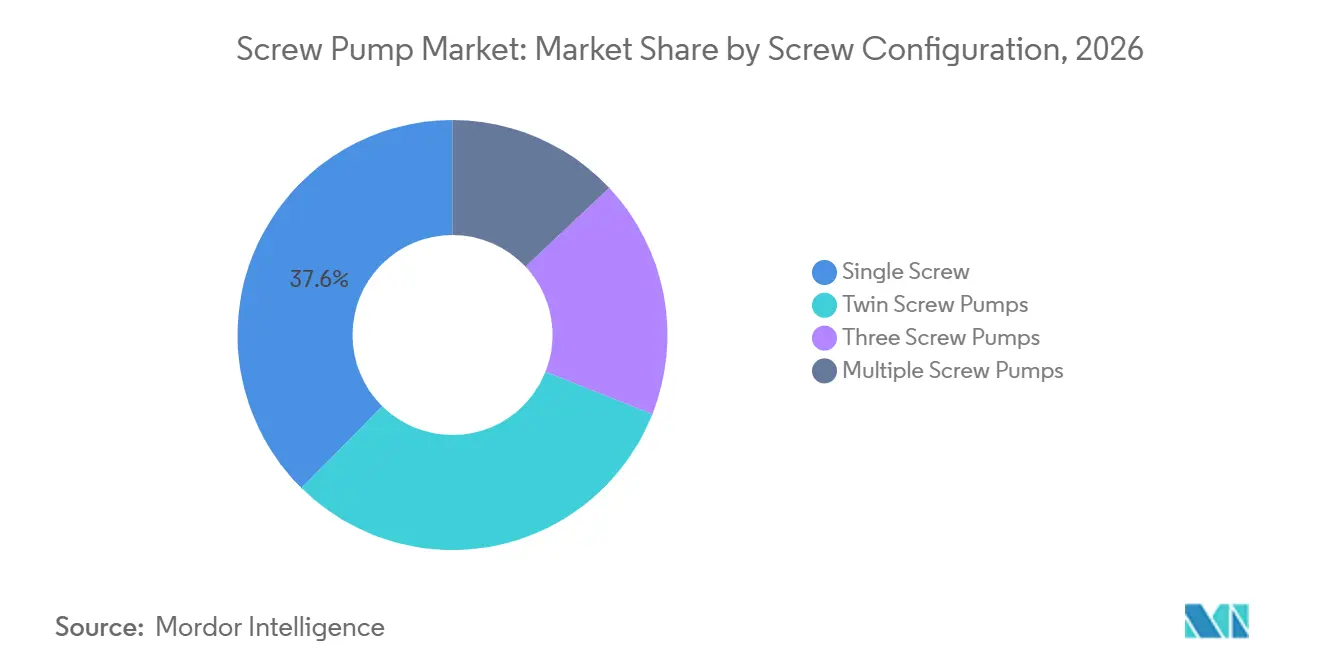
- By screw configuration, single screw pumps held 37.6% revenue share in 2026, while twin screw pumps are forecast to grow at a 5.8% CAGR through 2032.
- By maximum pressure, the 15 to 35 bar range accounted for 27.5% revenue share in 2026, while the above 80 bar range is forecast to grow at a 5.9% CAGR through 2032.
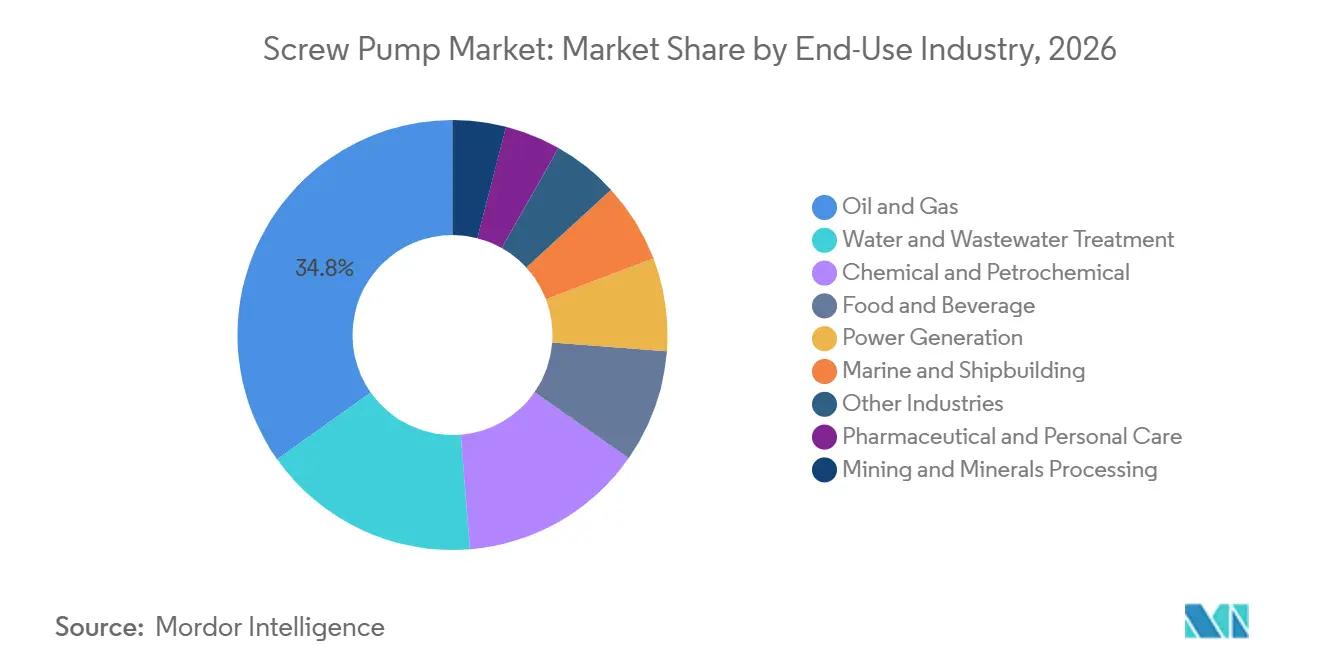
- By end-use industry, oil and gas held 34.8% revenue share in 2026, while water and wastewater treatment is forecast to grow at a 6.2% CAGR through 2032.
- By geography, Asia-Pacific accounted for 36.5% revenue share in 2026 and is forecast to grow at a 6.4% CAGR through 2032.
Note: Market numbers in this report are based on Mordor Intelligence's proprietary estimation framework, which combines nine months of actuals with Q4 projections for base year 2026.
Market Trends and Insights
Drivers Impact Analysis of Screw Pump Market*
| Driver | (~) % Impact on CAGR Forecast | Geographic Relevance | Impact Timeline |
|---|---|---|---|
| Water And Wastewater Infrastructure Expansion | +1.5% | Global, strongest in Asia-Pacific and MENA | Long term (≥ 4 years) |
| Oil And Gas Fluid Transfer And Artificial Lift | +1.2% | North America, Middle East, and offshore Asia-Pacific | Medium term (2-4 years) |
| Low-Pulsation Handling Of Viscous And Multiphase Fluids | +0.8% | Global chemical, food and beverage, and offshore applications | Medium term (2-4 years) |
| Energy-Efficiency And Pump Replacement Programs | +0.6% | Europe, North America, China, and South Korea | Short term (≤ 2 years) |
| Hygienic Processing And Clean-In-Place Requirements | +0.4% | Europe, North America, and Asia-Pacific food and pharmaceutical hubs | Long term (≥ 4 years) |
| Digital Condition Monitoring And Predictive Maintenance | +0.3% | Global, led by industrialized economies | Medium term (2-4 years) |
| Source: Mordor Intelligence | |||
Expansion Of Water and Wastewater Treatment Infrastructure
Water and wastewater infrastructure represents a major source of demand for the screw pump market, as treatment operators require dependable solids handling. The European Investment Bank committed EUR 15,000,000,000 to water financing for 2025-2027 and deployed EUR 5,000,000,000 in 2025.[1] This financing supports treatment assets that require dependable transfer of sludge, biosolids, and chemical streams. Progressive cavity and single screw pumps are well suited to sludge-handling duties due to their solids tolerance and controlled flow characteristics. The revised Urban Wastewater Treatment Directive requires treatment capacity upgrades across European Union member states by 2030, supporting multi-year equipment procurement for suppliers with local service networks. The screw pump market stands to benefit not only from new treatment facilities but also from equipment requirements at the sludge-thickening and dewatering stages.
Oil And Gas Fluid Transfer and Artificial Lift Requirements
Oil and gas operations provide a broad installed base for progressive cavity, twin screw, and multiple screw equipment. The screw pump market benefits where field conditions limit the usefulness of standard alternatives. Screw configurations are used where crude is viscous, sand content is high, or production streams contain both gas and liquid. In December 2025, Baker Hughes secured a multiyear artificial lift contract with Kuwait Oil Company. The contract combines submersible pumping systems with intelligent production drives and automated field-production software, indicating that operators are linking pump selection more closely with production control and downtime reduction. CO2-enhanced oil recovery and carbon sequestration programs also require equipment capable of managing pressurized and corrosive streams, supporting demand for specialized high-pressure configurations.
Energy-Efficiency and Pump Replacement Programs
Energy efficiency regulations and replacement programs support the screw pump market where equipment can reduce lifecycle operating costs. Sulzer reported that industrial pump systems account for 10% of global electricity consumption. The EU Monitoring and Roadmapping for Energy (EU-MORE) program reported potential annual savings of 29.8 TWh from earlier replacement of inefficient pump systems in European industry and services. The IEA 4E Efficient Motor Systems Activity (EMSA) states that minimum energy performance standards apply across the European Union, United States, China, South Korea, and the United Arab Emirates.[2] New pumps placed on the European market must meet a minimum efficiency index of 0.4. These requirements encourage suppliers to pair pump replacement with motor upgrades, variable-speed drives, and system-level service.
Digital Condition Monitoring and Predictive Maintenance
Condition monitoring is changing how suppliers support installed screw pumps. At IFAT 2026, SEEPEX GmbH introduced its SEEPEX IQ system with Smart Stator Monitoring and connectivity for supervisory and maintenance systems. The system monitors stator wear, temperature, and pressure, enabling users to shift from fixed service intervals to condition-based maintenance. Siemens AG described SITRANS SCM IQ as a system that monitors vibration characteristics and provides event-based warnings of potential asset failure. A 2025 study of industrial pump systems found classification accuracy of 100% in 25 of 150 tested configurations, while the lowest result was 81.8%. These systems support recurring maintenance services and reduce the operational impact of unexpected failures.
Restraints Impact Analysis of Screw Pump Market*
| Restraint | (~) % Impact on CAGR Forecast | Geographic Relevance | Impact Timeline |
|---|---|---|---|
| High Initial Cost Versus Centrifugal And Gear Pumps | -0.6% | South and Southeast Asia, sub-Saharan Africa, and budget-limited municipal buyers | Long term (≥ 4 years) |
| Rotor-Stator Wear And Specialist Maintenance Requirements | -0.3% | Global, most acute in remote service regions | Medium term (2-4 years) |
| Dry-Running And Solids-Concentration Sensitivity | -0.2% | Asia-Pacific and Latin America | Medium term (2-4 years) |
| Premium Metals And Elastomer Cost Volatility | -0.2% | Global, with high exposure in Europe and North America | Short term (≤ 2 years) |
| Source: Mordor Intelligence | |||
High Initial Cost Versus Centrifugal and Gear Pumps
The initial cost of screw pumps remains a significant adoption barrier in price-sensitive applications. Depending on configuration, the cost premium ranges from 30% to more than 100% above equivalent-duty centrifugal units, which can limit screw pump adoption in projects with tight upfront budgets. This cost gap is particularly relevant in municipal procurement where buyers do not apply consistent lifecycle-cost methods. Twin screw products also require careful matching to the duty cycle, as their economics vary by fluid viscosity and operating conditions. Suppliers are responding through leasing structures, modular offerings, and performance-based service agreements. These commercial approaches can distribute capital costs over the operating life, although their adoption remains limited outside North America and Northern Europe.
Rotor-Stator Wear and Specialist Maintenance Requirements
Rotor-stator wear can increase operating costs and reduce uptime in progressive cavity applications. Wear rates vary with fluid abrasivity, temperature, and chemical exposure, making replacement timing less predictable. Proper replacement also requires knowledge of stator compression ratios, elastomer compatibility, and interference fit. This challenge is more pronounced at remote oilfield and mining sites where specialist technicians are scarce. In January 2026, NETZSCH Pumpen und Systeme GmbH received US Patent 12535070 for an eccentric screw pump design incorporating weakening recesses in the power train. The design aims to reduce stress under torque overloads and extend maintenance intervals for abrasive or high-solids duties.
*Our forecasts treat driver/restraint impacts as directional, not additive. The impact forecasts reflect baseline growth, mix effects, and variable interactions.
Screw Pump Market Segment Analysis
By Screw Configuration, Single Screw Dominates And Twin Screw Pumps Drive Incremental Growth
Single screw pumps held 37.6% of the screw pump market in 2026. Their position reflects widespread use in wastewater sludge transfer, food and beverage dosing, and oilfield artificial lift. These applications require steady flow and solids tolerance rather than very high pressure. The single rotor and stator design also offers a relatively simple mechanical arrangement, which is an advantage in maintenance-intensive operations. Municipal utilities in emerging markets value this balance between operating capability and service requirements. Three screw and multiple screw products serve high-speed, low-viscosity hydraulic and lubrication applications. These configurations maintain a stable role in marine, power generation, pipeline boosting, and offshore skid applications.
Twin screw pumps are forecast to grow at a 5.8% CAGR from 2027 to 2032. Their externally timed dual-rotor design handles gas-entrained and lower-viscosity fluids that can destabilize other configurations. This supports use in dairy, beverage, personal care, pharmaceutical, bioprocess, and specialty chemical facilities. In June 2026, ITT Incorporated expanded Bornemann twin screw pump distribution through the Waukesha Cherry-Burrell network in the United States.[3] This arrangement enables assembly and shipment from Delavan, Wisconsin, with the aim of improving lead times and local service. EHEDG and 3-A sanitary requirements continue to influence design and supplier selection for hygienic facilities.

By Maximum Pressure, Mid-Range Pressure Leads And High-Pressure Applications Accelerate
The 15 to 35 bar pressure range accounted for 27.5% of the screw pump market in 2026. It serves a broad range of applications, including chemical dosing, food processing circulation, oilfield surface transfer, and wastewater handling. This range benefits from established elastomer and metallurgy options, shorter lead times, and familiar aftermarket supply chains. The up-to-15-bar range supports municipal and light-industrial dosing applications, while the 36 to 50 bar and 50 to 80 bar ranges serve refinery transfer, chemical injection, and marine cargo operations.
Above-80-bar screw pumps are forecast to grow at a 5.9% CAGR from 2027 to 2032, driven by deepwater production, CO2 injection, and high-pressure chemical synthesis. A 2025 Offshore Mediterranean Conference paper described a contra-helical screw multiphase pump using high-torque permanent magnet motors for wells with extreme gas-liquid ratios, solids content, and depth.[4] This equipment targets operating conditions that can limit standard electric submersible or rod-driven progressive cavity alternatives. A 2025 engineering study found that optimized twin screw pump profiles could sustain efficiency close to 50% at 3,000 rpm in engine-cooling tests. These applications increasingly require duplex stainless steel and Hastelloy C-276, making material cost an important consideration.
By End-Use Industry, Oil And Gas Anchors Share And Water And Wastewater Lead Growth
Oil and gas accounted for 34.8% of the screw pump market by end use in 2026. The sector uses progressive cavity, twin screw, and multiple screw products in artificial lift, pipeline boosting, crude transfer, and subsea multiphase service. This installed base gives the segment a durable role that extends beyond individual upstream capital spending cycles. Chemical and petrochemical, food and beverage, pharmaceutical, power generation, marine, and mining industries also contribute to demand. Marine and shipbuilding applications use three screw products for lube-oil and hydraulic duties. This range of end uses gives the screw pump market exposure to both process industries and infrastructure.
Water and wastewater treatment is forecast to grow at a 6.2% CAGR from 2027 to 2032. Sludge thickening and biosolids dewatering require equipment capable of handling high-solids material without the rapid abrasion associated with centrifugal alternatives. Nutrient recovery and biogas generation requirements add further demand for reliable sludge handling. In January 2026, SEEPEX GmbH launched its Easy Maintenance Macerator, with a stated throughput of up to 100 m3/h. The equipment is designed to protect downstream progressive cavity pumps from oversized solids. Mining purchases are linked to minerals investment, while pharmaceutical and personal care demand reflects tighter hygiene requirements.
Geography Analysis
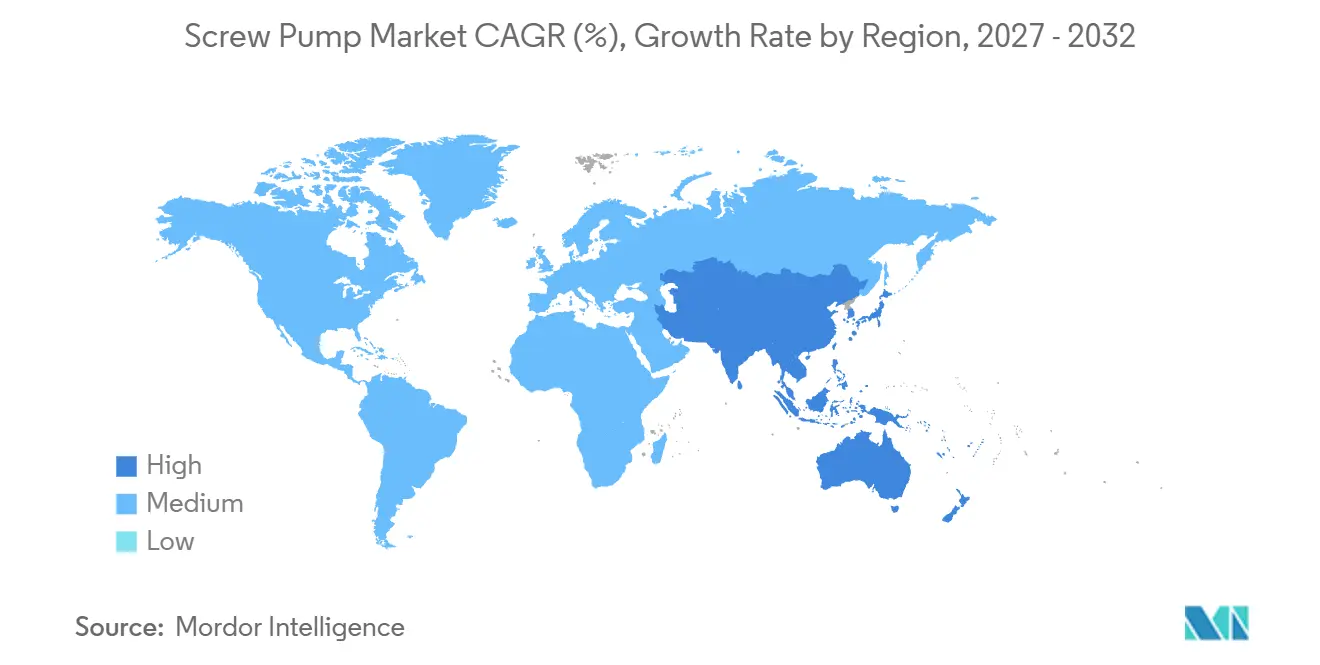
Asia-Pacific held 36.5% of the screw pump market share in 2026 and is forecast to grow at a 6.4% CAGR through 2032. China and India are central to regional water, wastewater, chemical, and oilfield demand. China's 14th Five-Year Plan allocates more than CNY 1 trillion for urban sewage treatment infrastructure. India's Jal Jeevan Mission and Atal Mission for Rejuvenation and Urban Transformation (AMRUT) 2.0 programs are extending sewage network investment across more than 500 cities. Japan is a mature market focused on replacement and energy-efficient upgrades in aging municipal systems. Vietnam, Indonesia, and Thailand are emerging procurement centers as peri-urban wastewater infrastructure expands.
North America and Europe are driven more by regulatory replacement cycles than by greenfield construction. North American demand comes from artificial lift in the Permian Basin and Gulf of Mexico, refinery and chemical transfer, and hygienic processing. Flowserve Corporation received US Department of Energy authorization in September 2025 to manufacture safety-critical pumps for Indian nuclear reactors at its Coimbatore facility. European demand is shaped by the revised Urban Wastewater Treatment Directive and pump ecodesign requirements. German suppliers including KSB SE and Co. KGaA, NETZSCH Group, Leistritz AG, SEEPEX GmbH, and WANGEN Pumpen GmbH benefit from regional service infrastructure and familiarity with European Hygienic Engineering and Design Group (EHEDG) and DIN requirements.
South America and the Middle East and Africa remain smaller in value but have specialized demand profiles. Desalination, wastewater recycling, chemical dosing, and brine recirculation support demand in GCC countries. Sulzer AG signed a five-year global purchasing framework agreement with Veolia Environnement SA in September 2025 for pumps, mixers, and turbocompressors. Sulzer AG also signed a 2025 contract with Inpasa Agroindustrial to supply more than 600 pieces of pumping equipment for ethanol, Dried Distillers Grains with Solubles (DDGS), corn oil, and renewable energy facilities in Brazil. South Africa's mining sector supports demand for heavy-duty progressive cavity and multiple screw products used with abrasive mineral slurries and tailings.
Competitive Landscape
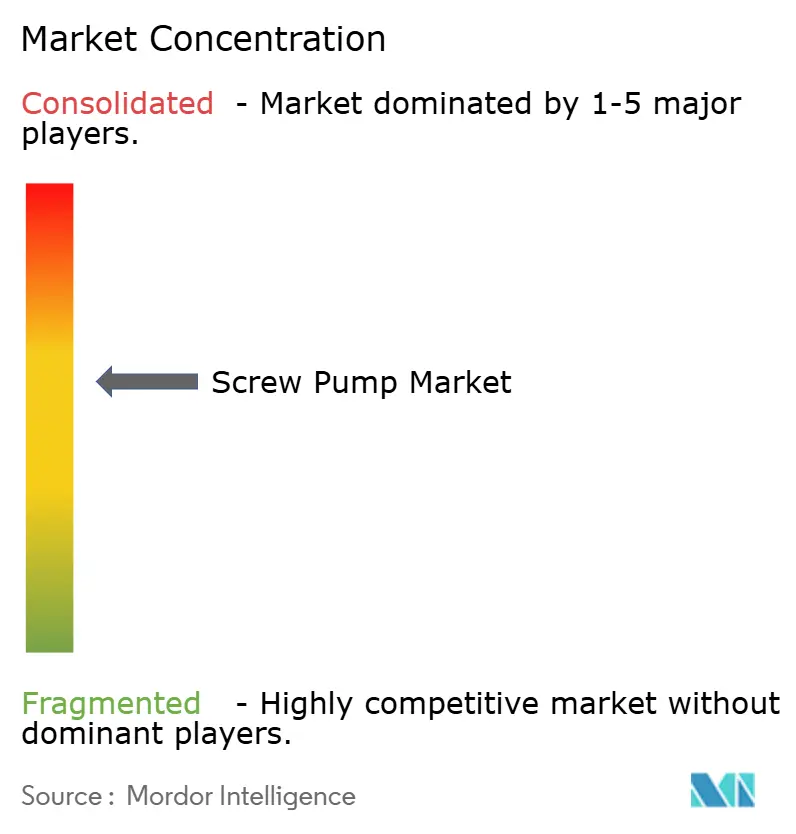
The screw pump market is moderately consolidated, with a group of multinational OEMs competing across higher-value applications. Alfa Laval AB, Sulzer AG, ITT Bornemann GmbH, SEEPEX GmbH, KSB SE and Co. KGaA, NETZSCH Group, and Leistritz AG differentiate through rotor-stator design, digital monitoring, certification, and application support. API 676, EHEDG Type EL Class I, and ATmosphères EXplosibles (ATEX) requirements narrow the qualified supplier base in petroleum, chemical, gas, and hygienic applications. These requirements support established suppliers with tested equipment and service coverage. Price-focused regional fabricators remain active in commodity single-screw applications. The market concentration score is 6 out of 10, as the leading 10 to 12 OEMs hold a majority of value-added revenue while regional suppliers retain material participation in lower-value applications.
Suppliers are using acquisitions to strengthen water treatment, gas handling, and specialized fluid management portfolios. Alfa Laval AB completed the EUR 800 million acquisition of Fives Group's cryogenics business in 2025. Grundfos Holding A/S completed its acquisition of Newterra Group in the third quarter of 2025, strengthening its North American water and wastewater treatment offering. Atlas Copco AB acquired CRI-MAN S.p.A., adding chopper pump capability for high-solids applications. These actions reflect a focus on broader systems, technical services, and specialized flow control capabilities rather than hardware sales alone.
Digital service and high-pressure applications remain key areas of competition in the screw pump market. SEEPEX GmbH's SEEPEX IQ and Siemens AG's SITRANS SCM IQ demonstrate how monitoring products can link installed equipment with maintenance services. National Oilwell Varco reported that its electrical submersible contra-helical pump technology exceeded 240 operating days in Permian unconventional wells, compared with prior electric submersible pump runs of 40 days in the same wells. This highlights the value of reliability in a niche where high downtime significantly affects equipment economics. NETZSCH Group's 2026 patent reflects continued investment in mechanical reliability for severe service conditions. Suppliers that combine durable hardware, application knowledge, and accessible service are better positioned in qualified end markets.
Screw Pump Industry Leaders
-
Alfa Laval AB
-
CIRCOR International, Inc.
-
NETZSCH Pumpen and Systeme GmbH
-
Flowserve Corporation
-
SEEPEX GmbH
- *Disclaimer: Major Players sorted in no particular order
Screw Pump Market Companies Covered in this Report
- Alfa Laval AB
- Baker Hughes Company
- CIRCOR International, Inc.
- Dover Corporation
- Flowserve Corporation
- Grundfos Holding A/S
- ITT Inc.
- KRAL GmbH
- KSB SE and Co. KGaA
- Leistritz Pumpen GmbH
- NETZSCH Pumpen and Systeme GmbH
- NOV Inc.
- PCM Group
- Roto Pumps Limited
- SEEPEX GmbH
- SPX FLOW, Inc.
- Sulzer Ltd.
- WANGEN Pumpen GmbH
- Weatherford International plc
- Xylem Inc.
Recent Industry Developments in Screw Pump Market
- June 2026: ITT Flow Technologies expanded the distribution of its Bornemann twin screw pump portfolio through the Waukesha Cherry-Burrell channel network across the United States. The integration supports local assembly, distribution, and shipment from Delavan, Wisconsin, improving accessibility of twin screw pump technology for food, beverage, industrial, and process applications.
- May 2026: SEEPEX unveiled SEEPEX IQ at IFAT 2026, introducing digital monitoring capabilities for progressive cavity (eccentric screw) pumps. The platform incorporates Smart Stator Monitoring, adaptive drive technology, and industrial communication protocols including OPC UA, Modbus, and MQTT, enabling predictive maintenance and improved pump lifecycle management.
- January 2026: SEEPEX launched its Easy Maintenance Macerator, designed to protect downstream progressive cavity screw pumps from oversized solids and contaminants. The system provides throughput of up to 100 m³/h and supports wastewater, sludge handling, and industrial pumping applications.
- January 2026: NETZSCH Pumpen & Systeme GmbH received U.S. Patent No. 12,535,070 covering an eccentric screw pump design incorporating weakening recesses in the power train. The patent is intended to improve operational reliability and mechanical performance in progressing cavity pump systems.
Global Screw Pump Market Report Scope
A screw pump is a positive displacement machine that moves liquids or semi-solids along the axis of one or more rotating, intermeshing screw threads. As the screws turn inside a close-fitting casing, they trap fluid in sealed cavities and push it continuously from the inlet port to the discharge port. Because the transfer relies on volumetric displacement rather than centrifugal velocity, the flow rate remains steady and predictable even during pressure variations.
The global screw pump market is segmented by screw configuration into single screw, twin screw, three screw, and multiple screw pumps. By maximum pressure, the market is segmented into up to 15 bar, 15-35 bar, 36-50 bar, 50-80 bar, and above 80 bar. By end-use industry, the market is segmented into oil and gas, water and wastewater treatment, chemical and petrochemical, food and beverage, power generation, marine and shipbuilding, pharmaceutical and personal care, mining and minerals processing, and other industries. The report also covers the market size and forecasts for the global screw pump market across 26 countries in key regions. For each segment, the market sizing and forecasts are provided on the basis of value (USD).
Segmentation Overview
| Single Screw |
| Twin Screw Pumps |
| Three Screw Pumps |
| Multiple Screw Pumps |
| Up to 15 Bar |
| 15-35 Bar |
| 36-50 Bar |
| 50-80 Bar |
| Above 80 Bar |
| Oil and Gas |
| Water and Wastewater Treatment |
| Chemical and Petrochemical |
| Food and Beverage |
| Power Generation |
| Marine and Shipbuilding |
| Pharmaceutical and Personal Care |
| Mining and Minerals Processing |
| Other Industries |
| North America | United States |
| Canada | |
| Mexico | |
| Europe | Germany |
| France | |
| Italy | |
| Spain | |
| United Kingdom | |
| Poland | |
| Russia | |
| Rest of Europe | |
| Asia-Pacific | China |
| India | |
| Japan | |
| South Korea | |
| Australia | |
| Indonesia | |
| Vietnam | |
| Thailand | |
| Rest of Asia-Pacific | |
| South America | Brazil |
| Argentina | |
| Chile | |
| Rest of South America | |
| Middle East and Africa | Saudi Arabia |
| United Arab Emirates | |
| Egypt | |
| South Africa | |
| Morocco | |
| Rest of Middle East and Africa |
| By Screw Configuration | Single Screw | |
| Twin Screw Pumps | ||
| Three Screw Pumps | ||
| Multiple Screw Pumps | ||
| By Maximum Pressure | Up to 15 Bar | |
| 15-35 Bar | ||
| 36-50 Bar | ||
| 50-80 Bar | ||
| Above 80 Bar | ||
| By End-Use Industry | Oil and Gas | |
| Water and Wastewater Treatment | ||
| Chemical and Petrochemical | ||
| Food and Beverage | ||
| Power Generation | ||
| Marine and Shipbuilding | ||
| Pharmaceutical and Personal Care | ||
| Mining and Minerals Processing | ||
| Other Industries | ||
| By Geography | North America | United States |
| Canada | ||
| Mexico | ||
| Europe | Germany | |
| France | ||
| Italy | ||
| Spain | ||
| United Kingdom | ||
| Poland | ||
| Russia | ||
| Rest of Europe | ||
| Asia-Pacific | China | |
| India | ||
| Japan | ||
| South Korea | ||
| Australia | ||
| Indonesia | ||
| Vietnam | ||
| Thailand | ||
| Rest of Asia-Pacific | ||
| South America | Brazil | |
| Argentina | ||
| Chile | ||
| Rest of South America | ||
| Middle East and Africa | Saudi Arabia | |
| United Arab Emirates | ||
| Egypt | ||
| South Africa | ||
| Morocco | ||
| Rest of Middle East and Africa | ||
Key Questions Answered in the Report
What is the projected value of the screw pump market by 2032?
The screw pump market is forecast to reach USD 7.66 billion by 2032, growing at a CAGR of 5.44% from 2027.
Which screw configuration is growing fastest?
Twin screw pumps are forecast to grow at a CAGR of 5.8% through 2032, driven by demand for hygienic and multiphase processing applications.
Which end-use sector has the largest share?
Oil and gas held a 34.8% revenue share in 2026, driven by artificial lift, crude transfer, pipeline boosting, and subsea service applications.
Why are water and wastewater applications expanding?
Water and wastewater treatment is forecast to grow at a CAGR of 6.2%, as facilities require equipment for sludge, biosolids, and chemical transfer.
Which region leads demand?
Asia-Pacific held a 36.5% revenue share in 2026 and is forecast to grow at a CAGR of 6.4% through 2032.
What limits wider adoption of screw pumps?
Higher initial costs, rotor-stator wear, specialist service requirements, dry-running sensitivity, and material cost volatility remain key limiting factors.