
Nicotine Pouches Market Size and Share
Market Overview
| Study Period | 2021 - 2031 |
|---|---|
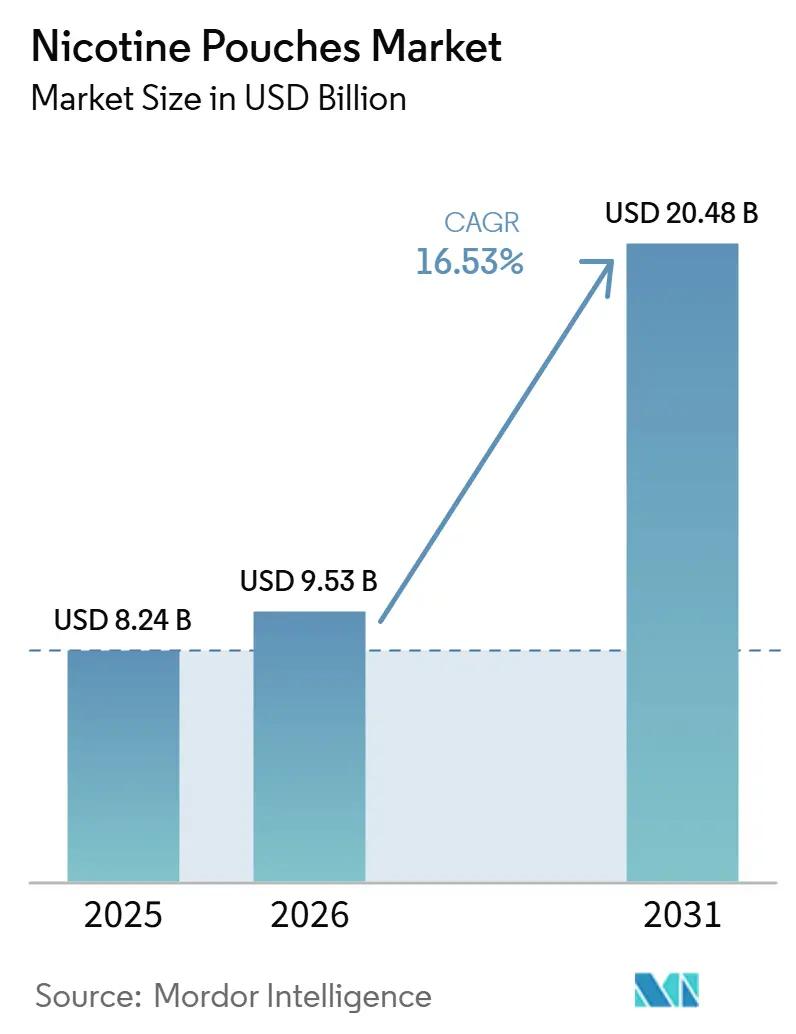
| Market Size (2026) | USD 9.53 Billion |
| Market Size (2031) | USD 20.48 Billion |
| Growth Rate (2026 - 2031) | 16.53 % |
| Fastest Growing Market | Asia-Pacific |
| Largest Market | Europe |
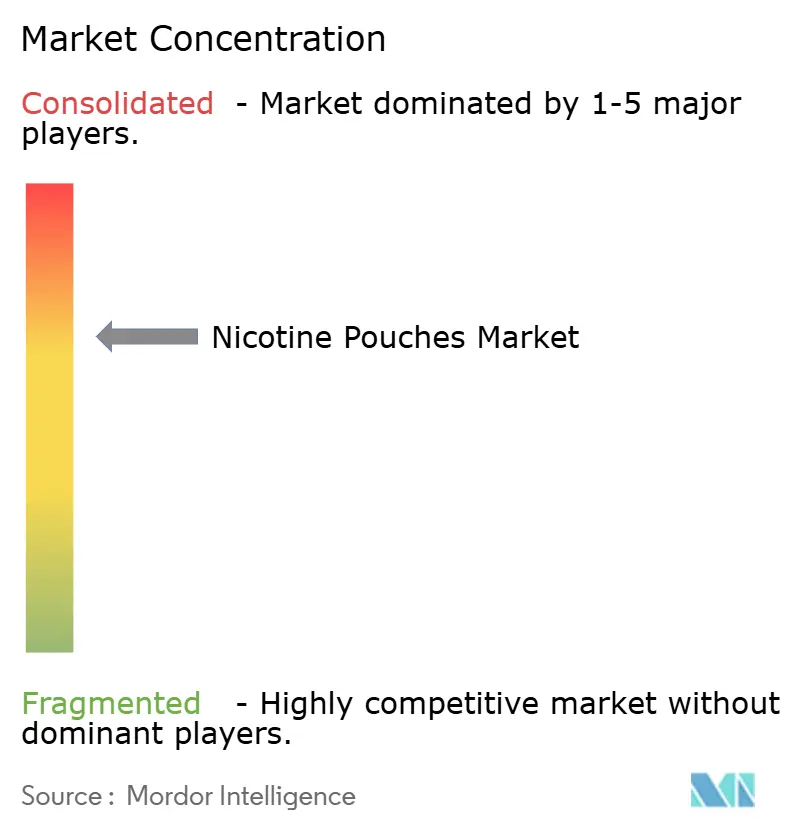
| Market Concentration | Medium |
Major Players *Disclaimer: Major Players sorted in no particular order Image © Mordor Intelligence. Reuse requires attribution under CC BY 4.0. | |
Nicotine Pouches Market Analysis by Mordor Intelligence
The nicotine pouches market is projected to grow from USD 8.24 billion in 2025 to USD 20.48 billion by 2031, registering a CAGR of 16.5% between 2026 and 2031. This growth is driven by a broader shift in adult nicotine consumption, as cigarette volumes decline across developed markets and users seek smoke-free alternatives that fit daily routines. Anti-smoking regulations, workplace wellness expectations, and growing public discomfort with visible nicotine use are sustaining demand. As adult smokers look for products that are easier to use in shared spaces and align with harm-reduction trends, major companies are expanding geographically, filing regulatory approvals, and refining brand positioning. Compliance capability and manufacturing scale are becoming equally important. The primary growth opportunity remains adult switching, though expansion will depend on how effectively brands navigate varying regulations across countries and channels.
Key Report Takeaways
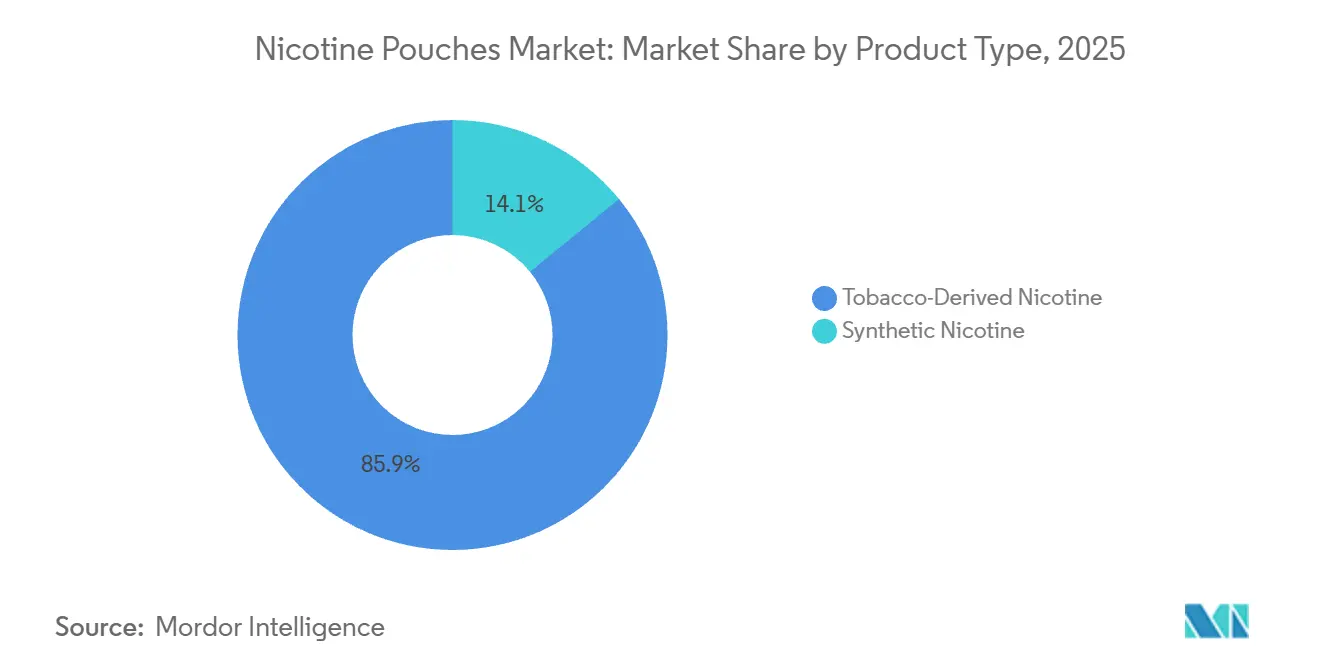
- By product type, tobacco-derived nicotine held 85.9% of the nicotine pouches market share in 2025, while synthetic nicotine is forecast to expand at 17.3% CAGR through 2031.
- By flavor type, flavored products accounted for 80.1% share of the nicotine pouches market size in 2025, while unflavored products are projected to grow at 17.5% CAGR through 2031.
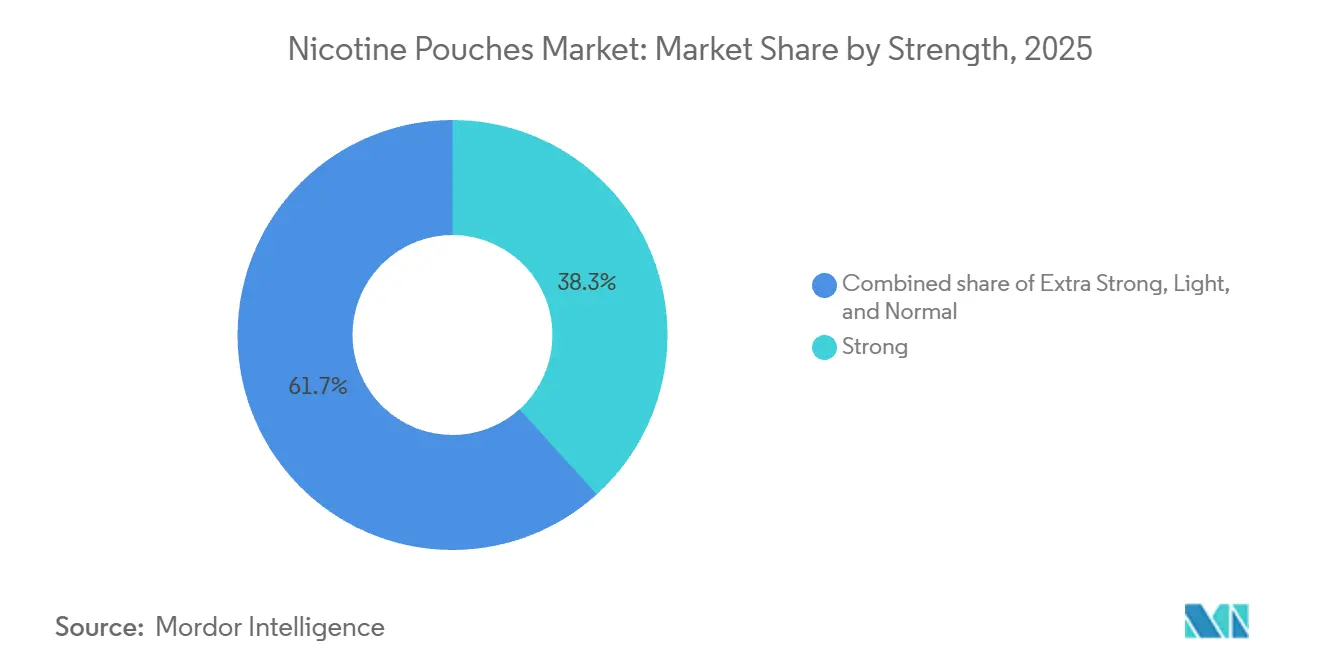
- By strength, the Strong tier held 38.3% share in 2025, while Extra Strong is forecast to expand at 18.2% CAGR through 2031.
- By distribution channel, offline channels held 90.4% share in 2025, while online channels are projected to grow at 19.3% CAGR through 2031.
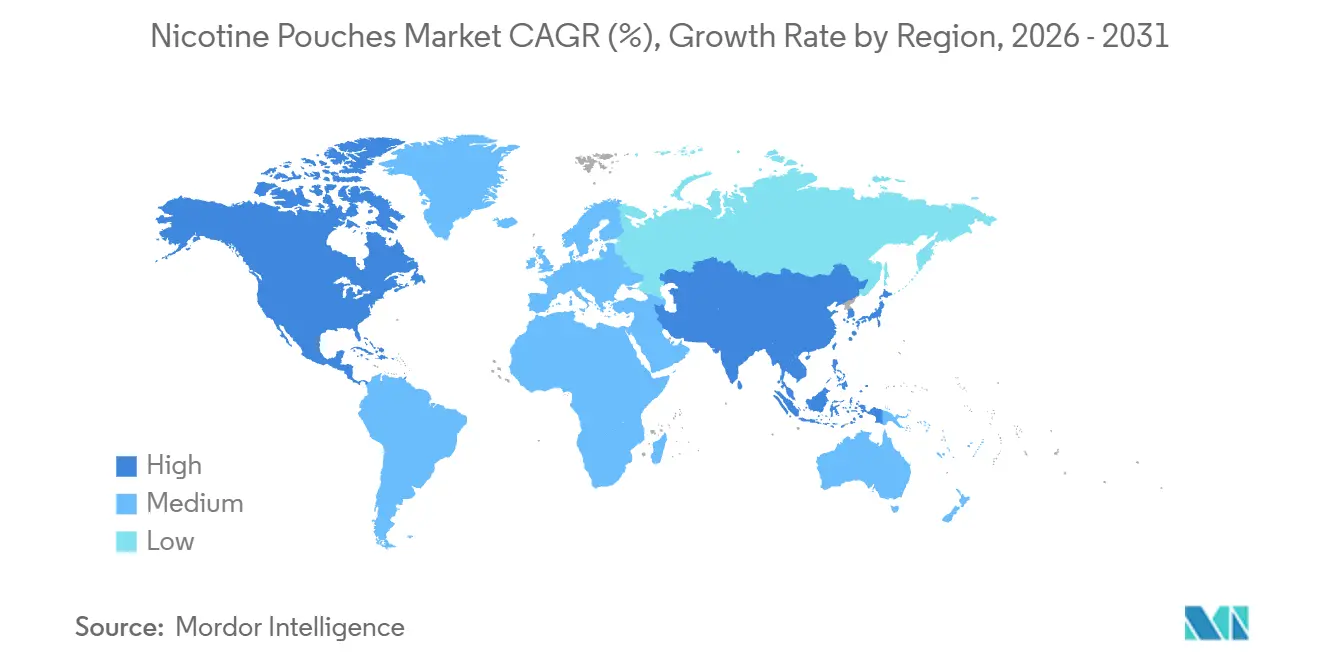
- By geography, Europe accounted for 38.6% share of the nicotine pouches market size in 2025, while Asia-Pacific is forecast to advance at 17.9% CAGR through 2031.
Note: Market size and forecast figures in this report are generated using Mordor Intelligence’s proprietary estimation framework, updated with the latest available data and insights as of January 2026.
Market Trends and Insights
Drivers Impact Analysis of Nicotine Pouches Market*
| Drivers | (~) % Impact on CAGR Forecast | Geographic Relevance | Impact Timeline |
|---|---|---|---|
| Rising Demand for Smoke-Free Alternatives | +4.5% | Global | Long term (≥ 4 years) |
| Growing Preference for Discreet Nicotine Use | +3.0% | North America, Europe, APAC core | Medium term (2-4 years) |
| Product Innovation in Nicotine Strength | +2.2% | North America and Europe | Medium term (2-4 years) |
| Flavor Diversification | +1.8% | North America, Europe, APAC core | Medium term (2-4 years) |
| Convenience and Portability | +2.0% | Global | Short term (≤ 2 years) |
| Expansion of Offline Retail Visibility | +1.3% | Global, early gains in North America and Europe | Short term (≤ 2 years) |
| Source: Mordor Intelligence | |||
Rising Demand for Smoke-Free Alternatives
Declining cigarette use across developed markets is creating room for smoke-free nicotine formats and is supporting the nicotine pouches market. The FDA granted Swedish Match USA a modified risk tobacco product order for 20 ZYN nicotine pouch products on June 30, 2026, which authorized claims that using ZYN instead of cigarettes reduces exposure to harmful chemicals. That decision gave the category stronger regulatory credibility and reduced some hesitation among adult users, policymakers, and health professionals. A 2026 JMIR Public Health and Surveillance study that reviewed more than 19 million Scandinavian e-commerce orders found that nicotine pouches moved ahead of traditional snus in both Sweden and Norway in 2025, reaching 55% and 56% volume share, respectively. The same study found women moved first, which shows the nicotine pouch market still has room to widen adoption among men[1]Source: JMIR Public Health and Surveillance, “Cross-Sectional Study on Oral Nicotine Product Sales Trends in Scandinavia From 2018 to 2025”, publichealth.jmir.org .
Growing Preference for Discreet Nicotine Use
Nicotine pouches create no smoke, vapor, or lingering odor, which makes them easier to use in many daily settings. That gives adult users a practical option in offices, shared transport, and public venues where cigarettes and many vaping products face direct restrictions or social resistance. The format also fits workplace norms more easily, which can raise daily use frequency because consumption no longer depends on a dedicated smoking break. This usage pattern helps explain why revenue growth can move ahead of simple user adoption counts in the nicotine pouches market. It also supports a two-step buying path in which adults compare products privately and then settle into repeated purchases through their preferred retail channel.
Product Innovation in Nicotine Strength
Nicotine strength is becoming a more important part of product choice as the category matures and user needs become more varied. The Extra Strong tier is forecast to grow at 18.2% through 2031, which shows that demand is moving beyond the standard middle range. This pattern reflects two clear needs, with some adult users wanting stronger nicotine delivery and others looking for a lighter or more controlled experience. As a result, mid-range products face more pressure, while specialized strength tiers capture more premium demand in the nicotine pouches market. For manufacturers, strength innovation has shifted from a product extension to a retention tool that helps keep users within the same brand family.
Flavor Diversification
The diversity of flavors plays a crucial role in the competitive landscape of the nicotine pouches market, as evidenced by the fact that flavored products accounted for a staggering 80.1% of the segment in 2025. This substantial share underscores the importance of flavor variety as a key strategy for attracting and retaining customers. However, regulatory changes are on the horizon, with Finland implementing restrictions on characterizing flavors starting February 2026. Additionally, the World Health Organization (WHO) has called for tighter controls on flavors in its report released in May 2026[2]Source: World Health Organization, “WHO Warns Nicotine Pouch Brands Targeting Youth as Sales Surge”, who.in. Brands that maintain a wider array of products, spanning popular mint flavors, essential flavor profiles, and unflavored alternatives, are strategically positioned to navigate these regulatory changes while maintaining their presence on retail shelves. This adaptability will be key in an evolving market where flavor preferences and regulations are increasingly influencing consumer choices.
Restraints Impact Analysis of Nicotine Pouches Market*
| Restraint | (~) % Impact on CAGR Forecast | Geographic Relevance | Impact Timeline |
|---|---|---|---|
| Stringent Regulatory Frameworks | -1.8% | Global, concentrated in EU and North America | Long term (≥ 4 years) |
| Competition from Other Smoke-Free Products | -1.2% | North America, Asia-Pacific, Europe | Medium term (2-4 years) |
| Public Perception Challenges | -0.8% | Global | Medium term (2-4 years) |
| Enforcement Gaps and Loopholes | -0.6% | MEA, South America, Southeast Asia | Long term (≥ 4 years) |
| Source: Mordor Intelligence | |||
Stringent Regulatory Frameworks
Regulation remains the heaviest long-term constraint because rules differ by country, flavor, strength, and sales channel. The WHO reported in May 2026 that 160 countries still lacked specific nicotine pouch frameworks, 16 banned sales, and only 32 regulated the category in some form. Finland's amended Tobacco Act took effect on February 1, 2026, and banned all characterizing flavors except menthol and mint in smokeless nicotine products. Oregon expanded its tobacco product definition to include oral nicotine pouches from June 5, 2026, which brought age-21 purchase rules into force. The nicotine pouches market in Europe also faces another layer of uncertainty because the next EU tobacco rule revision could add nicotine caps, taxes, and further flavor limits. Each new rule set raises compliance costs, slows product rollout, and forces manufacturers to manage separate portfolios across jurisdictions.
Competition from Other Smoke-Free Products
The category also competes with other smoke-free formats, including heated tobacco products, regulated e-cigarettes, and nicotine replacement therapies. In Japan and other early APAC entry markets, pouches are moving into retail systems where reduced-risk demand has already been shaped by other nicotine formats. In the United States, enforcement against illicit disposable vapes supported short-term pouch demand, but some of that volume could move again if legal vape choices stabilize. Large tobacco groups are investing across several reduced-risk categories at once, so they can support pouch expansion while defending other product lines. This makes it harder for single-category brands in the nicotine pouches industry to match pricing, regulatory, and distribution spending over time.
*Our forecasts treat driver/restraint impacts as directional, not additive. The impact forecasts reflect baseline growth, mix effects, and variable interactions.
Nicotine Pouches Market Segment Analysis
By Product Type:
Incumbents Defend on Regulatory Depth, Synthetic Gains on Formulation FreedomTobacco-derived nicotine pouches held 85.9% of the product type segment in 2025, giving established brands the larger position within this split. Their lead comes from stronger regulatory access, deeper filing history, and manufacturing systems built for scale. The June 2026 MRTP decision for ZYN further reinforced tobacco-derived products as the benchmark class in the United States. PMI also reported 794 million ZYN cans shipped in the United States in 2025, which shows the scale advantages behind this segment.
Synthetic nicotine is forecast to grow at 17.3% CAGR through 2031, making it the faster-moving side of the product mix. The segment is gaining support as pharmaceutical-grade inputs and more standardized formulation practices lower acceptance barriers for retailers and adult users. Ispire Technology's May 2026 joint venture with Shandong Jincheng Pharmaceutical Group shows how upstream pharmaceutical capability is becoming part of the competitive equation in APAC. That shift matters because the nicotine pouches industry is not only competing on brand visibility; it is also competing on ingredient sourcing, formulation control, and scale economics.


By Flavor Type:
Flavored Dominates the Entry Point, Unflavored Gains at the Regulation FrontierFlavored products accounted for an 80.1% share of the nicotine pouches market size in 2025, which kept them at the center of category trial and repeat purchases. Their lead reflects years of brand investment in taste variety, especially around mint and menthol profiles. The same strength is also a clear vulnerability because regulators are focusing closely on characterizing flavors. Finland's 2026 rule change shows how quickly flavored portfolios can lose room for expansion when national restrictions tighten.
Unflavored products are forecast to grow at 17.5% CAGR through 2031, the fastest rate within the flavor split. Growth is being supported by a user base that becomes less dependent on novelty flavors and more focused on delivery consistency, comfort, and pouch feel. That makes unflavored formats more than a compliance fallback in the nicotine pouches market. Brands that invest in product performance rather than treat unflavored as a stripped-down option are better placed to retain experienced adult users.
By Strength:
The Strong Tier Anchors Mainstream Adoption, Extra Strong Redefines the PremiumThe Strong tier held 38.3% of the strength segment in 2025, which made it the volume center of the category. It serves the broadest group of adult switchers because it offers familiar nicotine delivery without moving into the most heavily scrutinized range. Standard strengths also fit more easily into mainstream retail and existing compliance frameworks. That combination keeps Strong products central to entry-level and repeat purchasing across the nicotine pouches market.
Extra Strong is projected to grow at 18.2% CAGR through 2031, which marks it as the fastest-growing strength tier. The segment is benefiting from an upgrade path in which experienced users seek higher nicotine delivery after initial adoption. The WHO said in May 2026 that some products on the market exceed 150 mg per pouch and called for nicotine caps, which makes regulatory mapping essential for brands active in this tier. If major markets adopt those caps, growth in Extra Strong will continue, but it will become more dependent on markets with clearer room for high-strength products.

By Distribution Channel:
Convenience Retail Anchors Volume, E-Commerce Accelerates Innovation DiscoveryOffline channels held 90.4% of the nicotine pouches market share in 2025, confirming that convenience-led retail still anchors category scale. Physical retail remains important because it combines visibility, repeat traffic, and impulse purchasing in the same setting. It also gives large brands broader national reach once wholesale and merchandising systems are in place. Altria's nationwide March 2026 rollout of on! PLUS showed that mass retail execution remains the fastest route to volume establishment in the United States.
Online sales are forecast to expand at 19.3% CAGR through 2031, making digital the faster-growing distribution channel. The online channel supports the nicotine pouches market by giving adults wider product choice, easier comparison, and faster access to new formats. It also gives manufacturers and retailers quicker feedback on which flavors, strengths, and pack types gain traction. Over time, this makes e-commerce an important discovery layer even when offline stores continue to hold most revenue.
Geography Analysis
Europe Nicotine Pouches Market
Europe held a 38.6% share of the nicotine pouches market size in 2025, which kept it as the largest regional revenue pool. The region's lead came first from Scandinavia's long oral nicotine tradition and then from wider commercialization across Western Europe. A 2026 JMIR study found nicotine pouches moved ahead of traditional snus in both Sweden and Norway in 2025, reaching 55% and 56% volume share. The same study showed women crossed that line earlier than men, which suggests adoption still has room to deepen across the broader adult population. Snusbolaget also reported that nicotine pouches grew 12% in Sweden in 2025 while traditional tobacco snus declined 9%, which supports the view that the shift is sustained rather than temporary.
North America Nicotine Pouches Market
North America was the second-largest geography, and the United States remained the clear center of demand. PMI said ZYN held around two-thirds of U.S. value share in 2025 and shipped 794 million cans in the country that year. The June 2026 MRTP order for ZYN and the March 2026 national retail expansion of on! PLUS gave the region two defining commercial and regulatory milestones in the same period. Canada is still earlier in its category buildout, while Mexico remains an emerging opportunity tied to cross-border distribution logic and urban consumer adoption.
APAC, South America and MEA Nicotine Pouches Market
Asia-Pacific is forecast to grow at 17.9% CAGR through 2031, the fastest regional rate in the nicotine pouches market. The region is moving from a low-base phase into a period of category building as manufacturers establish product, supply, and regulatory infrastructure. Ispire Technology's 2026 joint venture with Shandong Jincheng Pharmaceutical Group highlighted how local manufacturing and pharmaceutical inputs are becoming part of the APAC entry model. South America and the Middle East and Africa still account for smaller revenue pools, but early entry can carry outsized value where modern oral nicotine rules are still taking shape.

Competitive Landscape
The nicotine pouches market is dominated by major tobacco companies that utilize regulatory resources and global distribution. PMI led with approximately 40% of global market share in 2025 through ZYN, expanding from 37 to 56 markets. Altria strengthened its position in March 2026 when on! PLUS became the first nicotine pouch cleared by the FDA’s PMTA pilot program for nationwide distribution. Market advantage hinges on regulatory execution, manufacturing capability, and brand awareness.
Opportunities exist in ultra-high-strength niches and emerging markets. Imperial Brands expanded its U.S. portfolio by acquiring Black Buffalo in May 2026, while Turning Point Brands leveraged brand partnerships, such as becoming the official nicotine pouch partner for TKO properties. This indicates that mid-tier challengers can find success through positioning and brand identity.
Online retailers and distribution partners play a key role in product visibility. The joint venture between Ispire and Jincheng underscores the importance of supply chain partnerships in Asia-Pacific. Future growth will rely on rapid regulatory adaptation, effective local strategies, and robust branding, allowing room for challengers in specific strengths, flavors, and regions.
Nicotine Pouches Industry Leaders
Philip Morris International Inc.
British American Tobacco PLC
Imperial Brands PLC
Swedish Match AB
Japan Tobacco Inc.
- *Disclaimer: Major Players sorted in no particular order
Nicotine Pouches Market Companies Covered in this Report
- Philip Morris International Inc.
- British American Tobacco PLC
- Altria Group, Inc.
- Imperial Brands PLC
- Scandinavian Tobacco Group A/S
- Swedish Match AB
- Japan Tobacco Inc.
- GN Tobacco Sweden AB
- Skruf Snus AB
- Nicopods ehf.
- Swedish Smokeless Co.
- Black Buffalo Inc.
- Turning Point Brands, Inc.
- Helix Innovations LLC
- Next Generation Labs LLC
- Fiedler and Lundgren AB
- Triumph Tobacco Alternatives LLC
- Haypp Group AB
- Swisher
- Tobacco Concept Factory

Recent Industry Developments in Nicotine Pouches Market
- May 2026: Imperial Brands (through its US subsidiary ITG Brands) acquired Black Buffalo, a differentiated US oral nicotine company using a proprietary farm-to-can process with pharmaceutical-grade nicotine and US-grown barn-cured leafy greens. The acquisition immediately expanded Imperial's US oral nicotine portfolio and complemented its existing zone nicotine pouch brand.
- May 2026: Ispire Technology Inc. entered a joint venture with Shandong Jincheng Pharmaceutical Group to manufacture and commercialize nicotine pouch products in Asia-Pacific, combining Jincheng's pharmaceutical-grade nicotine materials and manufacturing equipment with Ispire's precision dosing technology, regulatory compliance infrastructure, and global distribution capability.
- April 2026: TKO Group Holdings and FRE Nicotine Pouches (Turning Point Brands) announced a multiyear partnership, making FRE the Official Nicotine Pouch Partner of UFC, Zuffa Boxing, PBR, UFC BJJ, World's Strongest Man, and Formula Drift, the largest sports sponsorship deal in the nicotine pouch category to date, and a strategic investment in lifestyle-brand positioning.


Global Nicotine Pouches Market Report Scope
| Tobacco-Derived Nicotine |
| Synthetic Nicotine |
| Unflavored |
| Flavored |
| Light |
| Normal |
| Strong |
| Extra Strong |
| Offline |
| Online |
| North America | United States |
| Canada | |
| Mexico | |
| Rest of North America | |
| Europe | Germany |
| United Kingdom | |
| Italy | |
| France | |
| Spain | |
| Netherlands | |
| Poland | |
| Belgium | |
| Sweden | |
| Rest of Europe | |
| Asia-Pacific | China |
| India | |
| Japan | |
| Australia | |
| Indonesia | |
| South Korea | |
| Thailand | |
| Singapore | |
| Rest of Asia-Pacific | |
| South America | Brazil |
| Argentina | |
| Colombia | |
| Chile | |
| Peru | |
| Rest of South America | |
| Middle East and Africa | South Africa |
| Saudi Arabia | |
| United Arab Emirates | |
| Nigeria | |
| Egypt | |
| Morocco | |
| Turkey | |
| Rest of Middle East and Africa |
| By Product Type | Tobacco-Derived Nicotine | |
| Synthetic Nicotine | ||
| By Flavor Type | Unflavored | |
| Flavored | ||
| By Strength | Light | |
| Normal | ||
| Strong | ||
| Extra Strong | ||
| By Distribution Channel | Offline | |
| Online | ||
| By Geography | North America | United States |
| Canada | ||
| Mexico | ||
| Rest of North America | ||
| Europe | Germany | |
| United Kingdom | ||
| Italy | ||
| France | ||
| Spain | ||
| Netherlands | ||
| Poland | ||
| Belgium | ||
| Sweden | ||
| Rest of Europe | ||
| Asia-Pacific | China | |
| India | ||
| Japan | ||
| Australia | ||
| Indonesia | ||
| South Korea | ||
| Thailand | ||
| Singapore | ||
| Rest of Asia-Pacific | ||
| South America | Brazil | |
| Argentina | ||
| Colombia | ||
| Chile | ||
| Peru | ||
| Rest of South America | ||
| Middle East and Africa | South Africa | |
| Saudi Arabia | ||
| United Arab Emirates | ||
| Nigeria | ||
| Egypt | ||
| Morocco | ||
| Turkey | ||
| Rest of Middle East and Africa | ||


Key Questions Answered in the Report
How fast are nicotine pouches expected to grow through 2031?
The nicotine pouches market is projected to rise from USD 9.53 billion in 2026 to USD 20.48 billion by 2031 at a 16.53% CAGR.
Which product type leads revenue today?
Tobacco-derived nicotine remains the leading product type with 85.9% share in 2025, supported by scale, regulatory depth, and established manufacturing systems.
Why are unflavored products gaining traction?
Unflavored products are projected to grow at 17.5% CAGR through 2031 because regulation is tightening around characterizing flavors and more experienced users often focus more on nicotine delivery consistency than flavor novelty.
Which region is expanding the fastest?
Asia-Pacific is forecast to grow at 17.9% CAGR through 2031 as manufacturers build local supply, commercialization, and regulatory infrastructure in markets that are still early in oral nicotine adoption.
Page last updated on:





