
Music and Festival Tourism Market Size and Share
Market Overview
| Study Period | 2022 - 2031 |
|---|---|
| Market Size (2026) | USD 112.84 Billion |
| Market Size (2031) | USD 139.72 Billion |
| Growth Rate (2026 - 2031) | 4.37 % |
| Fastest Growing Market | Asia-Pacific |
| Largest Market | Europe |
| Market Concentration | Medium |
Major Players *Disclaimer: Major Players sorted in no particular order Image © Mordor Intelligence. Reuse requires attribution under CC BY 4.0. | |
Music and Festival Tourism Market Analysis by Mordor Intelligence
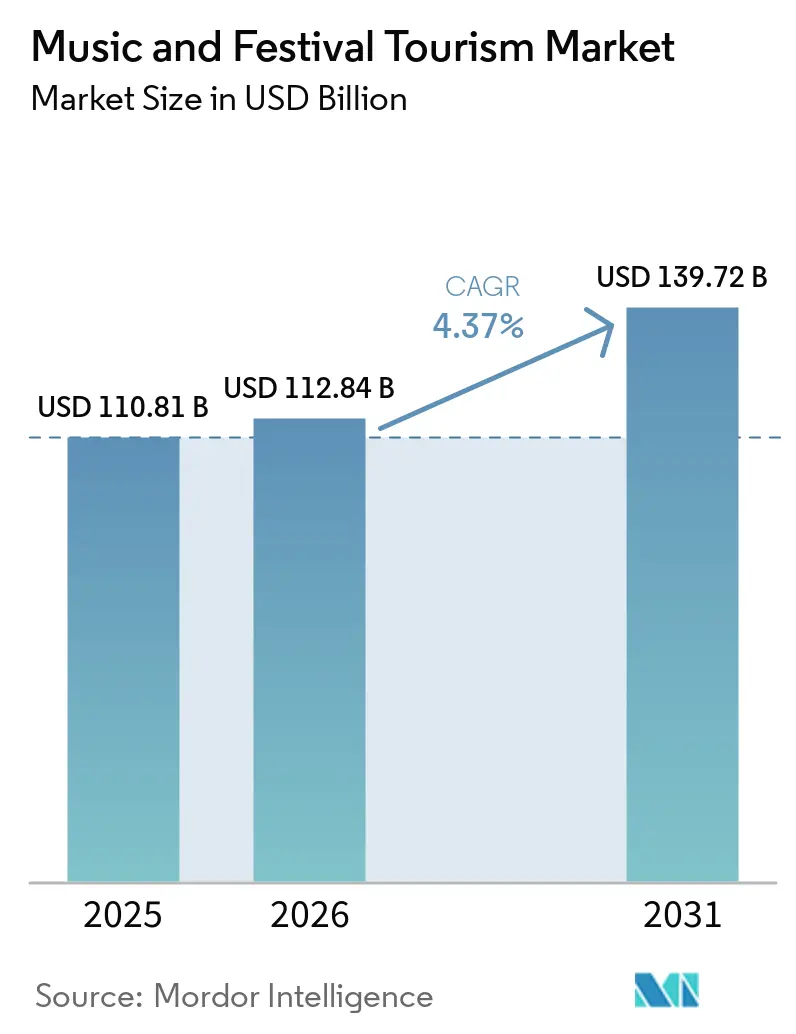
The Global Music And Festival Tourism Market size was valued at USD 110.81 billion in 2025 and is estimated to grow from USD 112.84 billion in 2026 to reach USD 139.72 billion by 2031, at a CAGR of 4.37% during the forecast period (2026-2031).
The Music festival tourism market is being shaped by a sustained consumer shift toward live experiences, which is making festivals a core reason for travel rather than an add-on to leisure trips. The Music festival tourism market is also benefiting from the spread of festival infrastructure into secondary cities, where public authorities and operators are using live events to widen tourism flows and extend visitor spending beyond traditional hubs. Domestic travel still provides the largest attendance base, while international visitors continue to support higher trip values through longer stays, air travel, and bundled purchases. Promoters are responding by integrating ticketing, accommodation, transport, and premium access into a single commercial offering, changing revenue capture across the Music festival tourism market. Competitive activity is becoming more uneven, with large promoter groups and digital ticketing platforms gaining scale, while smaller operators face tighter cost, licensing, and weather-related pressures.[1]
Key Report Takeaways
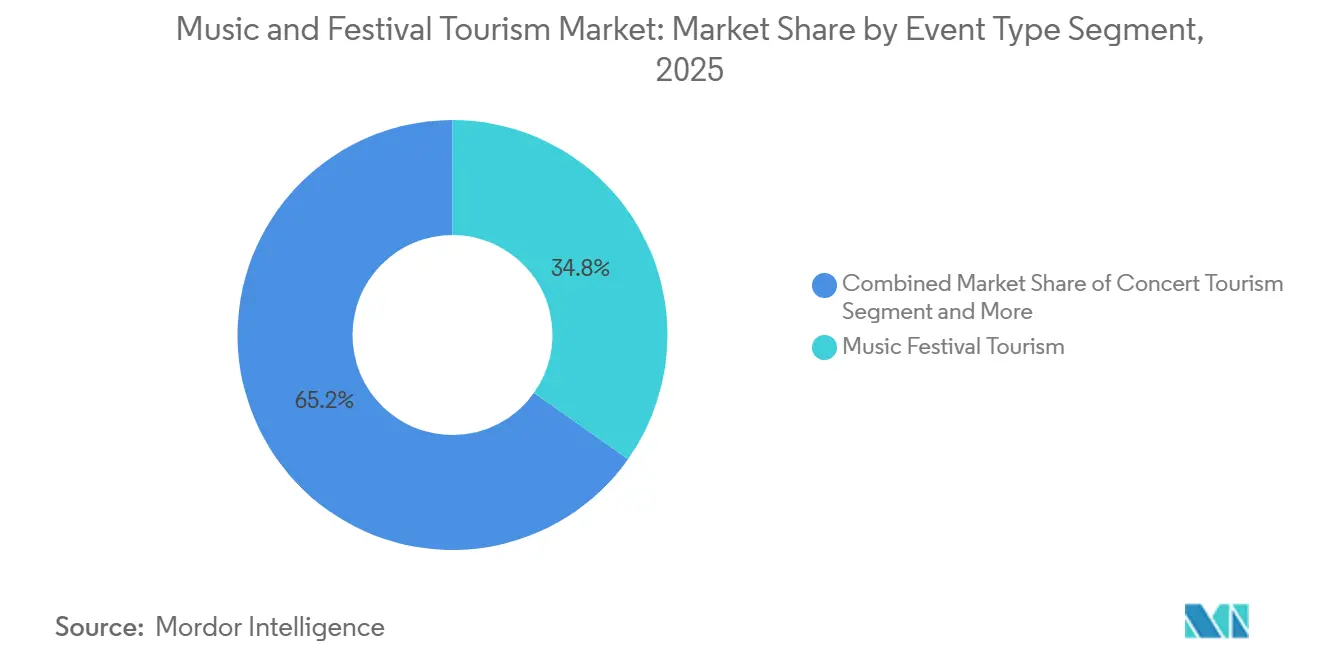
- By event type, Music Festival Tourism led with 34.8% share in 2025, while EDM Festivals are projected to grow at a 5.6% CAGR through 2031.
- By traveler type, Domestic travelers held 68.7% share in 2025, while International travelers are projected to expand at a 5.3% CAGR through 2031.
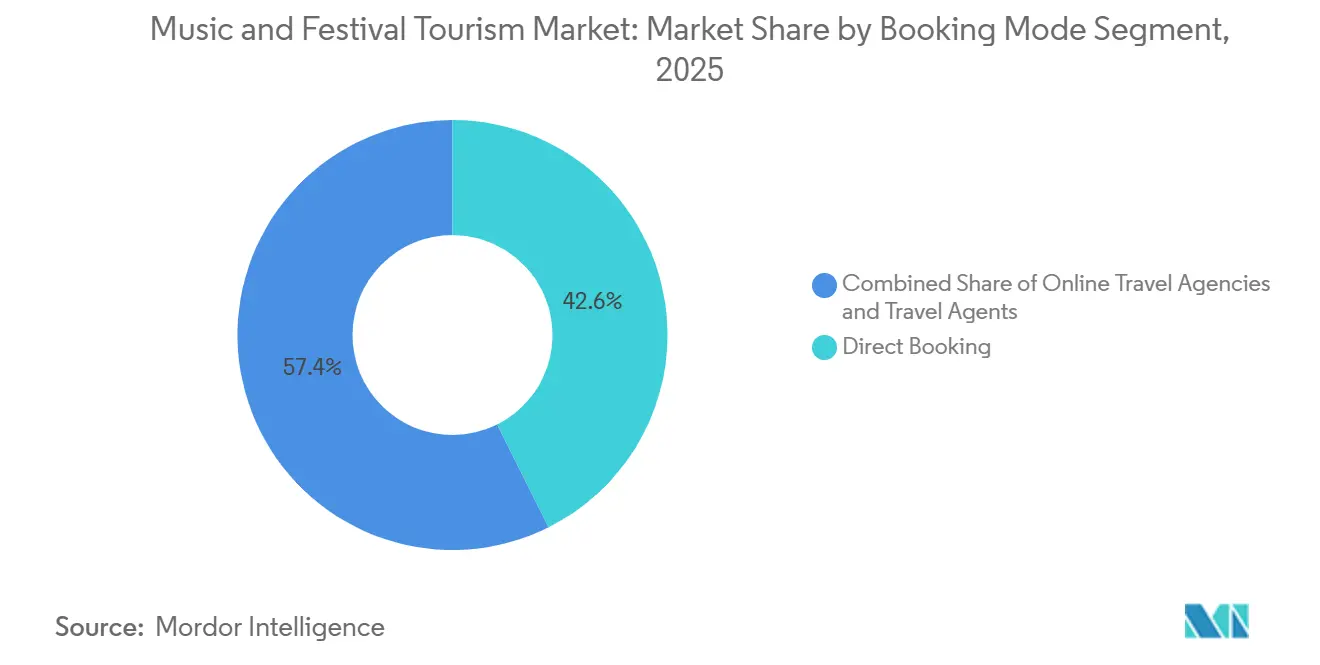
- By booking mode, Direct Booking accounted for 42.6% share in 2025, while Online Travel Agencies are projected to grow at a 5.1% CAGR through 2031.
- By spending category, Accommodation held 28.5% share in 2025, while Merchandise and VIP Experiences are projected to advance at a 5.8% CAGR through 2031.
- By geography, Europe led with 34.4% share in 2025, while Asia-Pacific is projected to expand at a 6.1% CAGR through 2031.
Note: Market size and forecast figures in this report are generated using Mordor Intelligence’s proprietary estimation framework, updated with the latest available data and insights as of January 2026.
Market Trends and Insights
Drivers Impact Analysis of Music and Festival Tourism Market*
| Drivers | (~) % Impact on CAGR Forecast | Geographic Relevance | Impact Timeline |
|---|---|---|---|
| Rising Demand for Destination-Led Live Music Travel | +1.1% | Global, with the strongest intensity in North America, the United Kingdom, and emerging Asia-Pacific markets | Short term (≤ 2 years) |
| Growth of Premium Festival Packages and VIP Travel Bundles | +0.8% | North America and Europe, with spillover into Australia and Southeast Asia | Medium term (2-4 years) |
| Event Tourism Spending Spillover Into Lodging, Food, and Local Mobility | +0.9% | Global, with the strongest multiplier effects in secondary city host markets | Short term (≤ 2 years) |
| Artist-Driven Fan Pilgrimage Behavior and Repeat Attendance | +0.7% | Global, with especially strong momentum in K-pop corridors and South America | Medium term (2-4 years) |
| Festivalization of Secondary Cities and Non-Hub Destinations | +0.5% | Asia-Pacific, with spillover into the Middle East, Africa, and South America | Medium term (2-4 years) |
| Expansion of Online Discovery, Booking, and Ticket Resale Ecosystems | +0.4% | Global, with the largest adoption gains in India, Southeast Asia | Short term (≤ 2 years) |
| Source: Mordor Intelligence | |||
Rising Demand for Destination-Led Live Music Travel
Live music travel is now a primary trip trigger for a meaningful share of consumers, giving the Music festival tourism market a broader demand base across age groups. Live entertainment is increasingly becoming a key driver of travel, particularly among younger travelers, with concerts, festivals, and performing arts experiences often shaping destination choices and trip planning. India is also witnessing growing intercity travel linked to major music events, reflecting the rising influence of entertainment-led travel, a trend supported by growing infrastructure and the expansion of touring circuits, with average per-trip spending among Gen Z indian travelers reaching approximately USD 570 per music-event trip. That shift matters for the Music festival tourism market because event-led travel strengthens local hotel demand, boosts food and mobility spending, and provides newer host cities with a repeat-visit pathway once festival awareness is established.
Growth of Premium Festival Packages and VIP Travel Bundles
The Music festival tourism market is moving away from a model centered solely on ticket sales toward a broader package model that combines travel, hospitality, and premium access. VIP and premium offerings are experiencing strong growth across live music venues and major festivals, reflecting increasing demand for enhanced hospitality, exclusive access, premium seating, and differentiated event experiences. Live Nation is expanding its premium offering strategy across amphitheaters. Tomorrowland’s Global Journey program follows the same logic, packaging flights, hotels, transfers, and festival passes for attendees from 180 countries, thereby boosting revenue per traveler compared to a stand-alone ticket. This is a key driver for the Music festival tourism market because it increases yield per attendee, improves booking visibility, and gives operators more control over the traveler journey from discovery to on-site spending.
Event Tourism Spending Spillover into Lodging, Food, and Local Mobility
The Music festival tourism market is supported by the fact that festival spending spreads well beyond the event gate and into the local visitor economy. Major music festivals and live events are generating substantial economic benefits across host destinations, extending beyond ticket sales to food and beverage, accommodation, air travel, tourism spending, and wider supply-chain activity. This highlights the significant contribution of music tourism to local businesses, hospitality ecosystems, and destination economies. This pattern is important because it provides governments and city authorities with a clearer basis for supporting festival infrastructure as a tourism asset rather than treating events solely as entertainment. For the Music festival tourism market, that spillover effect is especially relevant in secondary cities, where incremental visitor nights, restaurant demand, and transport usage can alter the economics of destination marketing.
Artist-Driven Fan Pilgrimage Behavior and Repeat Attendance
The Music festival tourism market is also benefiting from stronger fan commitment, where travel is linked to identity, community, and repeat attendance rather than one-off entertainment spending. Major events are increasingly influencing accommodation demand and travel planning, while younger travelers in India show a strong willingness to prioritize spending on music-driven trips. The surge in BTS-related demand in Peru further demonstrates how artist fandom and tour announcements can stimulate destination interest and measurable travel demand. South Korea’s planned Fanomenon initiative by HYBE, SM Entertainment, JYP Entertainment, and YG Entertainment points in the same direction, with fandom being converted into recurring international travel demand. This strengthens the Music festival tourism market because strong artist affinity improves booking, repeat visitation, and premium package uptake across multiple festival cycles.[2]
Restraints Impact Analysis of Music and Festival Tourism Market*
| Restraints | (~) % Impact on CAGR Forecast | Geographic Relevance | Impact Timeline |
|---|---|---|---|
| High Total Trip Cost Limits Price-Sensitive Participation | -0.7% | Global, with the greatest pressure in North America and Northern Europe | Short term (≤ 2 years) |
| Event Cancellations, Weather Volatility, and Safety Risk | -0.4% | Global, with the highest exposure in the United Kingdom outdoor festival circuit and coastal Asia-Pacific venues | Medium term (2-4 years) |
| Visa Friction and Cross-Border Travel Complexity | -0.5% | North America inbound, and Europe for travelers from the Middle East, Africa, and Asia-Pacific | Short term (≤ 2 years) |
| Local Community Pushback on Noise, Congestion, and Overtourism | -0.3% | Europe, especially the United Kingdom, Spain, Italy, and the Netherlands, with early signs in Asia-Pacific secondary cities | Medium term (2-4 years) |
| Source: Mordor Intelligence | |||
High Total Trip Cost Limits Price-Sensitive Participation
The Music festival tourism market still faces a clear affordability constraint because the total trip cost combines tickets, lodging, transport, food, and merchandise into one high outlay. Slowing consumer spending growth is creating greater pressure on household budgets, reducing disposable income flexibility and making non-essential travel and leisure spending more discretionary. It also notes that trip frequency is holding, but per-trip spend is falling as travelers shift to closer destinations and lower accommodation tiers. This issue affects India as well, because rising interest in live-event travel does not eliminate the need for cost discipline among younger travelers, especially for intercity or international trips. In the Music festival tourism market, the result is a wider gap between premium attendees and price-sensitive audiences, while smaller festivals face greater difficulty preserving accessible price points.
Event Cancellations, Weather Volatility, and Safety Risk
Weather and safety risks remain a structural drag on the Music festival tourism market because large outdoor events depend on long planning cycles and high advance commitments. Event cancellation coverage is still an emerging area of travel insurance, which can undermine booking confidence among international travelers making expensive plans months in advance. It also points to more frequent extreme weather events in the United Kingdom, Belgium, and coastal Southeast Asia, which are pushing organizers to spend more on covered-stage infrastructure and contingency planning. Local regulatory pressure in places such as London parks shows that safety and site suitability now influence licensing decisions more directly than before. This raises the operating threshold in the Music festival tourism market, and that pressure is felt most by independent organizers that lack the balance sheet depth of global promoter groups.
*Our forecasts treat driver/restraint impacts as directional, not additive. The impact forecasts reflect baseline growth, mix effects, and variable interactions.
Music and Festival Tourism Market Segment Analysis
By Event Type:
Multi-Day Festival Formats Anchor Demand, EDM Expands FastestMusic Festival Tourism accounted for 34.8% of the Music festival tourism market size in 2025, making it the leading event type. This position reflects the strength of multi-day formats that combine music programming with social, cultural, and destination experiences. Flagship brands such as Glastonbury, Coachella, Tomorrowland, and Rock in Rio continue to support this leadership because they create long booking windows and stronger accommodation demand than single-day formats. Concert tourism remained the second major pillar because arena tours and artist residencies can still generate concentrated lodging and transportation demand over shorter timeframes. Cultural and traditional music festivals also widened their role by attracting heritage-focused travelers in destinations where music events are tied to local identity and established cultural settings.
EDM festivals are projected to grow at a 5.6% CAGR through 2031, making them the fastest-expanding event format in the Music festival tourism market. Their momentum is linked to scalable branding, younger traveler demand, and the ability to franchise proven concepts across new destinations. State-backed expansion is particularly evident in Asia-Pacific, where Thailand has positioned itself as a host market for globally recognized EDM properties and as a driver of long-term growth in event tourism. That model matters for India because festival demand in large urban centers is deepening and format replication is becoming more feasible in high-consumption cities. The wider Music festival tourism industry is therefore seeing a clear split, with multi-day destination festivals holding the largest base and EDM formats moving faster as policy support, youth demand, and digital discoverability converge.

By Traveler Type:
Domestic Volume, International Yield PremiumDomestic travelers held a 68.7% share of the Music festival tourism market in 2025, indicating that local and intercity attendance still form the attendance base for most festivals. This share is grounded in lower travel friction, lower documentation barriers, and easier access to repeat attendance across dense festival calendars. In markets such as India, domestic movement is especially important because urban music demand is rising while price sensitivity still shapes long-haul decisions. Domestic attendance also provides a more stable revenue floor, which helps operators plan venues, staffing, and ticket inventory with greater confidence. In the Music festival tourism market, this domestic depth supports infrastructure development first, before international travel adds higher-value demand.
International travelers are projected to grow at a 5.3% CAGR through 2031, making them the fastest-growing traveler group in the Music festival tourism market. Their contribution is important because cross-border attendees tend to spend more per trip on flights, longer stays, and bundled experiences. Europe remains well-positioned to benefit from this trend because of its dense event calendar and strong intra-regional connectivity, while Asia-Pacific is building momentum through younger outbound and inbound demand. The Music festival tourism industry, therefore, continues to rely on domestic volume for scale, but it depends on international travelers for stronger per-visitor economics.
By Booking Mode:
Direct Channels Hold Share, OTAs Gain FastestDirect Booking held 42.6% of the Music festival tourism market share in 2025, which kept organizer-owned and primary ticketing channels in the lead. Strong festival brands benefit from this model because loyal customers are willing to purchase through official websites or trusted ticketing systems tied to the event. Direct channels also allow promoters to keep more of the trip value within their ecosystem, especially when tickets are sold alongside accommodation or premium upgrades. Travel agents still matter in this segment, particularly for complex international routing, group movements, and travelers who prefer managed itineraries. In the Music festival tourism market, direct control remains strongest among event brands with high trust, repeat demand, and the technical ability to package multiple services into a single booking flow.
Online travel agencies are projected to grow at a 5.1% CAGR through 2031, making them the fastest-growing booking channel in the Music festival tourism market. Their strength lies in combining flights, rooms, local transfers, and activities into a single transaction, which is useful for cross-border event travel and for younger, digital-first users. SeatGeek’s Spotify integration and ChatGPT launch show how ticketing inventory is moving closer to the point of music discovery, potentially shifting conversions toward integrated digital channels. This trend is particularly relevant in India, where mobile-led travel planning and the adoption of digital payments support a quicker transition from search to purchase. The Music festival tourism market is therefore likely to remain led by direct booking in absolute terms. At the same time, OTA-led pathways continue to gain importance in fragmented, multi-component travel journeys.
By Spending Category:
Accommodation Leads, Experiences OutpaceAccommodation accounted for 28.5% of the Music festival tourism market in 2025, making it the largest spending category. That outcome is consistent with the multi-night nature of destination festivals, where hotel and short-term rental pricing often rises sharply during event weekends. Tickets remained the second major category because premium festivals in North America and Europe continue to command high face values and tiered access structures. Transportation, food, and beverage also retained key shares, as large events generate visible spending across flights, local mobility, dining, and on-site consumption. In the Music festival tourism market, this spending profile shows that value creation extends across the full trip rather than being centered only on admission revenue.
Merchandise and VIP Experiences are projected to grow at a 5.8% CAGR through 2031, making them the fastest-growing spending category in the Music festival tourism market. This reflects a deliberate push by operators to capture more value from attendees who want exclusivity, convenience, and deeper artist-linked engagement. Platinum-style packages account for a smaller share of inventory but a much larger share of premium revenue, highlighting the strong economics of upper-tier products. That pattern is relevant to India as well, as rising urban demand and aspirational spending can support premium sub-segments even as the broader audience remains price-sensitive. The Music festival tourism industry is therefore shifting toward a model where accommodation anchors absolute spend, while high-margin experiences drive a faster uplift in average revenue per visitor.
Geography Analysis
Europe Music and Festival Tourism Market
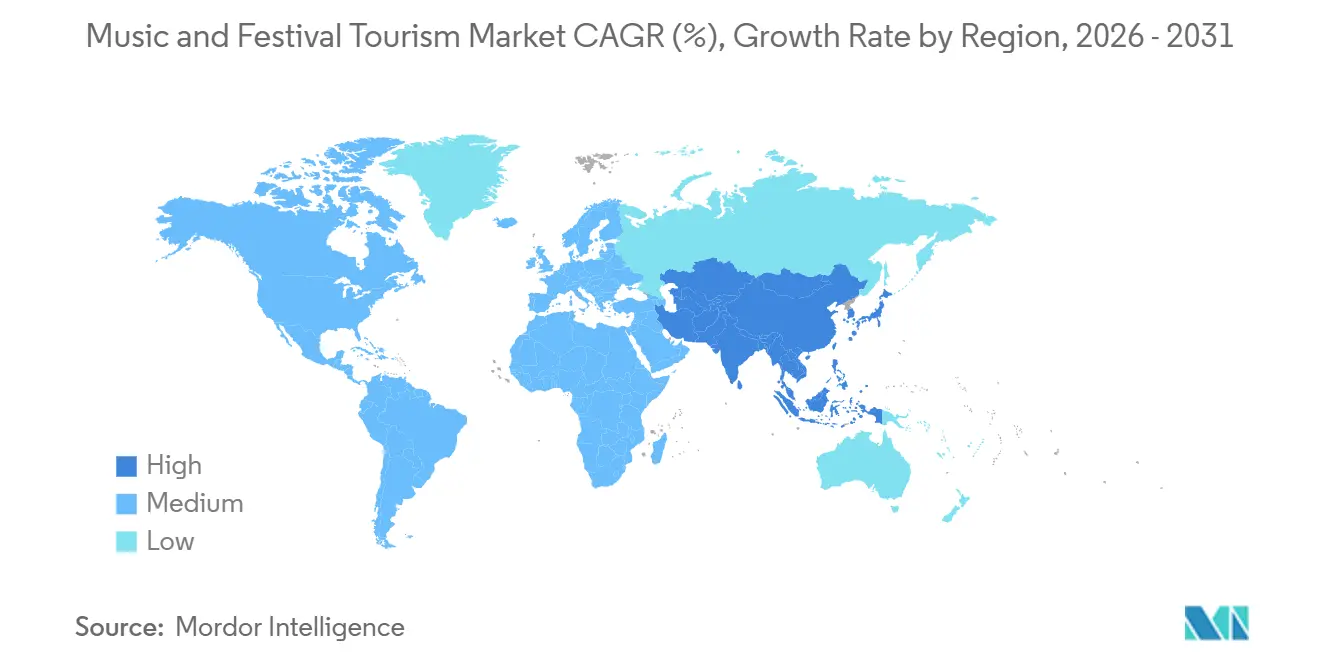
Europe led the Music festival tourism market with 34.4% market share in 2025, reflecting the region’s dense festival infrastructure, broad event mix, and strong short-haul travel connectivity. The United Kingdom remained one of the clearest examples, with 23.5 million music tourists attending shows in 2024 and generating GBP 10 billion in economic impact, while international music tourists rose to 1.6 million, up 62% year on year. Germany also continued to show resilience, with industry reports citing over 5 million regular concert attendees annually, as BDKV data consistently highlights a visitor base that remains highly willing to travel for live events. Europe’s scale still gives it the broadest festival base, but the region is also where licensing pressure, noise rules, and congestion concerns are becoming more visible. That means Europe remains the largest region in the Music festival tourism market, even as its mature status brings tighter operating conditions in certain urban venues.
The Americas Music and Festival Tourism Market
North America held a strong position in the Music festival tourism market because of its large event brands, high spending power, and advanced promoter-ticketing systems. Austin City Limits Music Festival alone generated USD 557.8 million in direct economic impact in 2025, including USD 87.4 million in hotel revenue, which shows the staying power of flagship events in the region. Live Nation reported Q1 2026 revenue of USD 3.79 billion (+12% year-on-year), beating analyst expectations despite higher operating costs, and recorded USD 6.6 billion in deferred revenue, reflecting robust forward demand for the 2026 touring season. South America is also gaining visibility as promoter investment expands and fan demand for artist-led travel events strengthens. Fan communities in the region can now generate destination-level demand at scale, which suggests a stronger role for South America within the wider Music festival tourism market over time.
APAC and MEA Music and Festival Tourism Market
Asia-Pacific is projected to grow at a 6.1% CAGR through 2031, making it the fastest-growing regional cluster in the Music festival tourism market. The region benefits from younger demographics, growing middle-class spending, and public support for live entertainment as a tourism catalyst. India stands out within this trend because intercity event travel has already moved up sharply, urban music demand is deepening, and large festival formats are being positioned more deliberately in major consumption centers. South Korea is building a cross-border festival model around K-pop fandom, while Thailand is using globally recognized festival properties to strengthen inbound tourism positioning. The Middle East and Africa remain smaller than they were. Still, investment interest is increasing, and Uganda’s Nyege Nyege example shows that secondary-city festival tourism can already create measurable local returns.[3]
Competitive Landscape
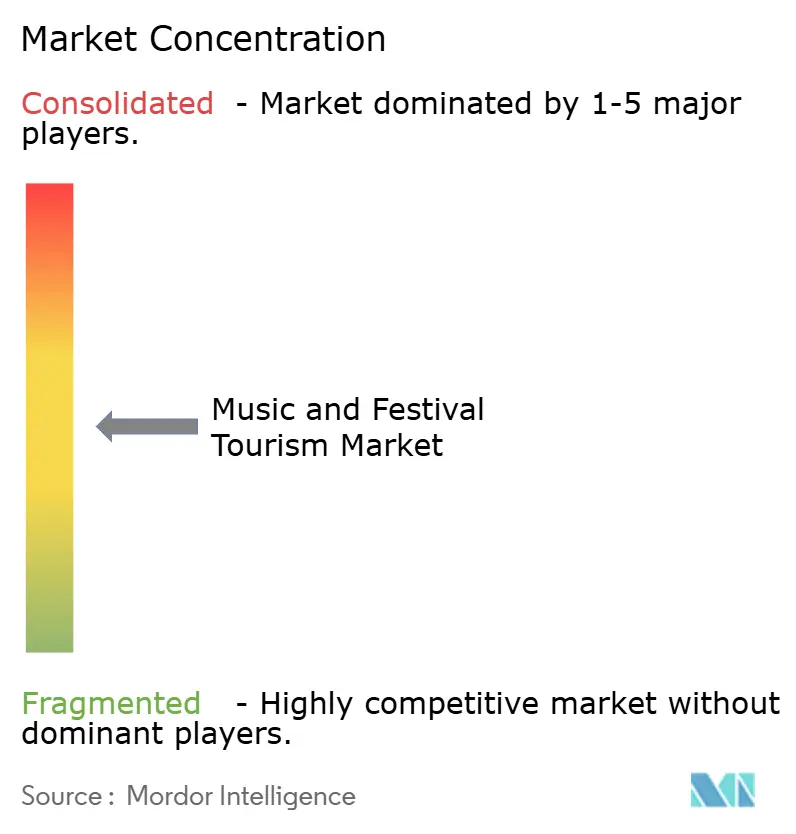
The Music festival tourism market has a two-tier structure, with a consolidating group of large promoter-venue ecosystems at the top and a fragmented base of independent operators below. More than 150 of the EU’s largest festivals are operated by four groups, suggesting rising concentration in the formal large-event segment, even though the total global market remains broad. CTS Eventim crossed USD 3 billion in revenue in 2025 and sold 177.9 million tickets across 30 countries, which shows the scale that integrated ticketing and promotion platforms can now achieve.
Strategic competition in the Music festival tourism market is now centered on ecosystem control and distribution technology. Live Nation is pushing deeper into venue ownership and exclusive venue agreements, which improves its ability to control capacity, routing, and premium monetization across multiple regions. SeatGeek is taking a different route, using integrations with Spotify and ChatGPT to insert ticket inventory earlier in the consumer journey and accelerate the discovery-to-purchase journey. CTS Eventim is also emphasizing technology, data, and AI while deepening its user profile reach and digital touchpoints. Together, these moves show that the Music festival tourism market is no longer shaped only by event programming, because data access, channel control, and venue-backed scale are now central sources of competitive advantage.
India has a relevant place in this competitive picture because the country combines rising live entertainment demand with strong digital booking behavior and a growing intercity event travel base. That creates room for global promoter strategies, but it also leaves space for domestic platforms and co-producers that understand local routing, city permissions, and consumer price thresholds. The presence of a fragmented independent layer means that local execution still matters, especially in newer city markets and format launches. At the same time, the growing weight of global promoter groups suggests that partnership-led entry and venue-linked expansion will become more common in the Music festival tourism market. Competitive intensity is therefore increasing, but the market still offers meaningful opportunities for regional specialists who can package discovery, ticketing, and destination travel in ways that fit local demand conditions.
Music and Festival Tourism Industry Leaders
-
Live Nation Entertainment Inc.
-
Anschutz Entertainment Group
-
CTS Eventim AG & Co. KGaA
-
Ticketmaster Entertainment LLC
-
Eventbrite, Inc.
- *Disclaimer: Major Players sorted in no particular order
Music and Festival Tourism Market Companies Covered in this Report
- Live Nation Entertainment Inc.
Recent Industry Developments in Music and Festival Tourism Market
- May 2026: Live Nation Entertainment reported Q1 2026 revenue of USD 3.8 billion (+12% year-on-year), with record deferred revenue of USD 6.6 billion (+22%), 107 million concert tickets sold through April (+11%), and confirmed acquisitions of Movistar Arena Santiago, Unipol Forum Milan, and IMPACT Arena Bangkok, adding approximately 4 million in cumulative annual fan capacity.
- March 2026: SeatGeek launched in ChatGPT, becoming the first ticketing platform to offer both official primary and resale ticket inventory within a conversational AI interface. Following its February 2026 Spotify integration, it reached 751 million monthly active users.
- February 2026: DEAG Deutsche Entertainment AG acquired a majority stake in "Juicy Beats," a major urban and EDM festival in Dortmund, and acquired remaining minority interests in Wizard Live, LiveGeist Entertainment, and Wizard Communications, continuing its pan-European festival consolidation strategy.
- December 2025: SeatGeek announced participation in Google's agentic AI search experience, making it one of the first ticketing platforms whose event listings can be understood and acted on by Google's AI systems, ahead of its subsequent Spotify and ChatGPT integrations
Global Music and Festival Tourism Market Report Scope
Segmentation Overview
| Concert Tourism |
| Music Festival Tourism |
| Cultural & Traditional Music Festivals |
| Electronic Dance Music (EDM) Festivals |
| Others (Religious & Spiritual,Classical & Opera,Jazz & Blues Festivals etc.) |
| Domestic |
| International |
| Online Travel Agencies |
| Direct Booking |
| Travel Agents |
| Tickets |
| Accommodation |
| Transportation |
| Food & Beverage |
| Merchandise & VIP Experiences |
| North America | United States |
| Canada | |
| Mexico | |
| South America | Brazil |
| Peru | |
| Chile | |
| Argentina | |
| Rest of South America | |
| Europe | United Kingdom |
| Germany | |
| France | |
| Spain | |
| Italy | |
| BENELUX (Belgium, Netherlands, and Luxembourg) | |
| NORDICS (Denmark, Finland, Iceland, Norway, and Sweden) | |
| Rest of Europe | |
| Asia-Pacific | India |
| China | |
| Japan | |
| Australia | |
| South Korea | |
| South East Asia (Singapore, Malaysia, Thailand, Indonesia, Vietnam, and Philippines) | |
| Rest of Asia-Pacific | |
| Middle East and Africa | United Arab Emirates |
| Saudi Arabia | |
| South Africa | |
| Nigeria | |
| Rest of Middle East and Africa |
| By Event Type | Concert Tourism | |
| Music Festival Tourism | ||
| Cultural & Traditional Music Festivals | ||
| Electronic Dance Music (EDM) Festivals | ||
| Others (Religious & Spiritual,Classical & Opera,Jazz & Blues Festivals etc.) | ||
| By Traveler Type | Domestic | |
| International | ||
| By Booking Mode | Online Travel Agencies | |
| Direct Booking | ||
| Travel Agents | ||
| By Spending Category | Tickets | |
| Accommodation | ||
| Transportation | ||
| Food & Beverage | ||
| Merchandise & VIP Experiences | ||
| By Geography | North America | United States |
| Canada | ||
| Mexico | ||
| South America | Brazil | |
| Peru | ||
| Chile | ||
| Argentina | ||
| Rest of South America | ||
| Europe | United Kingdom | |
| Germany | ||
| France | ||
| Spain | ||
| Italy | ||
| BENELUX (Belgium, Netherlands, and Luxembourg) | ||
| NORDICS (Denmark, Finland, Iceland, Norway, and Sweden) | ||
| Rest of Europe | ||
| Asia-Pacific | India | |
| China | ||
| Japan | ||
| Australia | ||
| South Korea | ||
| South East Asia (Singapore, Malaysia, Thailand, Indonesia, Vietnam, and Philippines) | ||
| Rest of Asia-Pacific | ||
| Middle East and Africa | United Arab Emirates | |
| Saudi Arabia | ||
| South Africa | ||
| Nigeria | ||
| Rest of Middle East and Africa | ||
Key Questions Answered in the Report
What is the 2031 outlook for music-led travel demand?
The Music festival tourism market is projected to reach USD 139.7 billion by 2031 from USD 112.8 billion in 2026, growing at a 4.4% CAGR.
Which event format is driving revenue?
Music Festival Tourism led with 34.8% share in 2025, supported by multi-day formats that create longer stays and stronger local spending.
Which format is expanding the fastest through 2031?
EDM Festivals are projected to grow at a 5.6% CAGR, helped by youth demand, global brand replication, and public support in newer host destinations.
Why do domestic travelers matter so much in this space?
Domestic travelers held 68.7% share in 2025, giving festivals a stable attendance base and helping operators build scale before attracting more international demand.
What is the biggest spending bucket during festival trips?
Accommodation led with 28.5% share in 2025, reflecting the multi-night nature of destination festival travel and strong room-rate premiums during event periods.
Why is India becoming more relevant in music-led travel?
Music events are increasingly driving intercity travel in India, particularly among younger audiences, with Gen Z travelers showing a growing propensity to spend on event-led trips and associated travel experiences.