
Homestay Market Size and Share
Market Overview
| Study Period | 2022 - 2032 |
|---|---|
| Market Size (2027) | USD 37.21 Billion |
| Market Size (2032) | USD 51.54 Billion |
| Growth Rate (2027 - 2032) | 6.73 % |
| Fastest Growing Market | Asia-Pacific |
| Largest Market | Asia-Pacific |
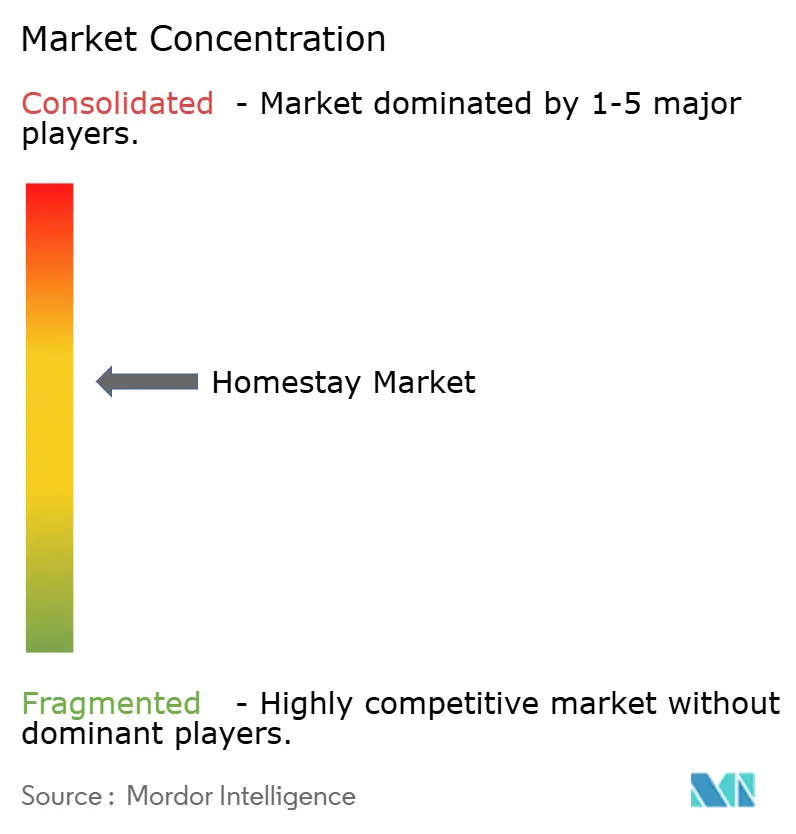
| Market Concentration | Medium |
Major Players *Disclaimer: Major Players sorted in no particular order Image © Mordor Intelligence. Reuse requires attribution under CC BY 4.0. | |
Homestay Market Analysis by Mordor Intelligence
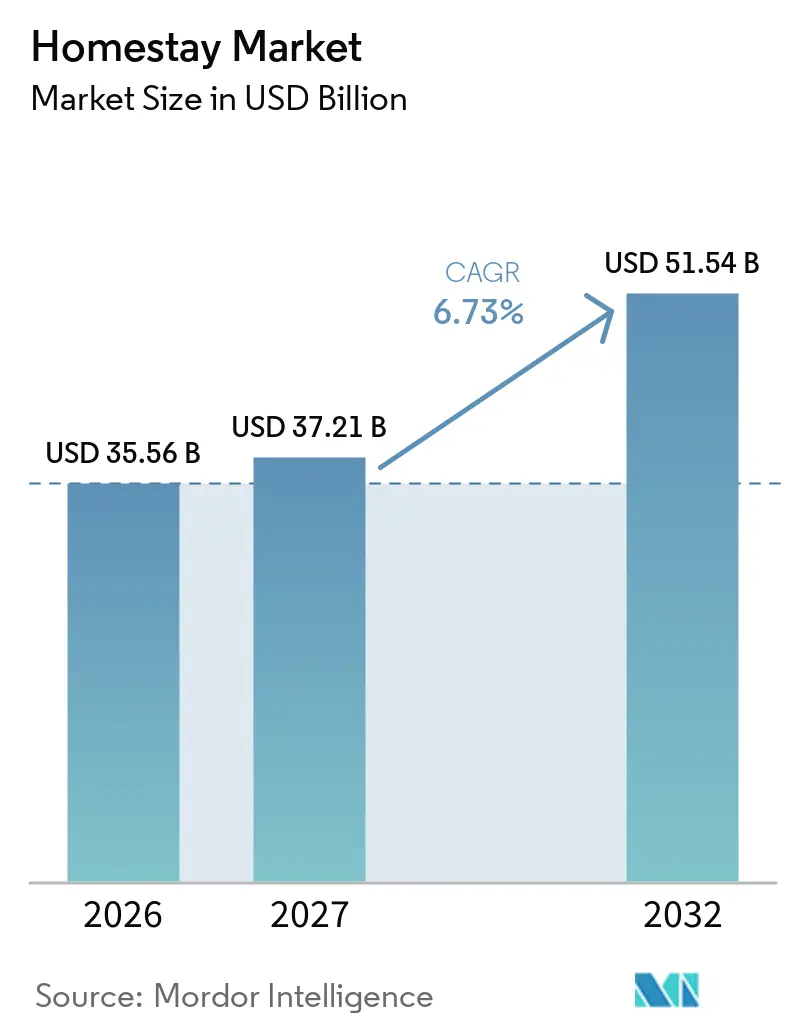
The Global Homestay Market was valued at USD 35.56 billion in 2026 and is estimated to grow from USD 37.21 billion in 2027 to reach USD 51.54 billion by 2032, at a CAGR of 6.73% during the forecast period (2027-2032). International travel demand supports the global homestay market. UN Tourism recorded 1.52 billion international tourist arrivals in 2025, up 4% from 2024[1]. Travelers increasingly seek residential settings, local experiences, and lower-cost alternatives to conventional hotels. Digital platforms are integrating informal accommodations into organized distribution channels, particularly in India, China, and Southeast Asia. Regulatory controls, insurance requirements, and service-quality expectations are shaping host participation. In India, growing domestic travel and limited formal accommodation supply support certified homestays, while operators must meet guest expectations for safety, cleanliness, and booking reliability.
Key Report Takeaways
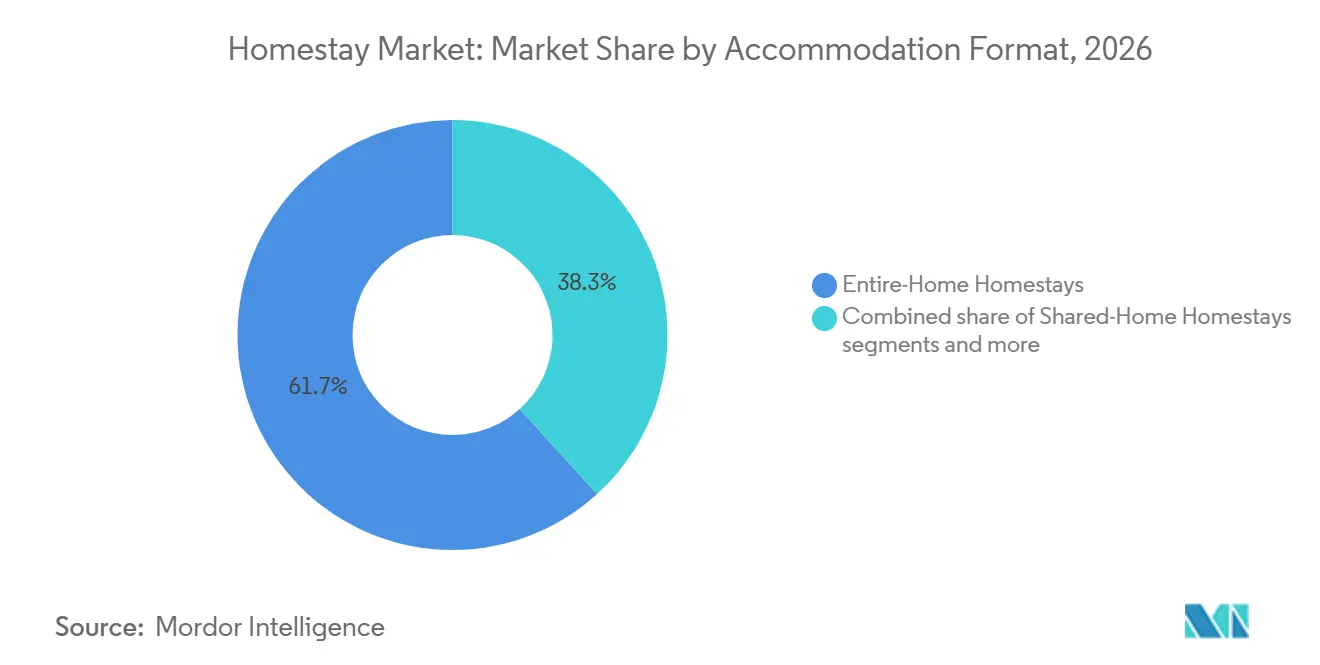
- By accommodation format, entire-home homestays accounted for 61.74% of the global homestay market share in 2026 and are projected to grow at an 8.25% CAGR through 2032.
- By booking channel, digital OTAs accounted for 48.61% of the global homestay market share in 2026, while direct bookings are projected to grow at the highest CAGR of 9.11% through 2032.
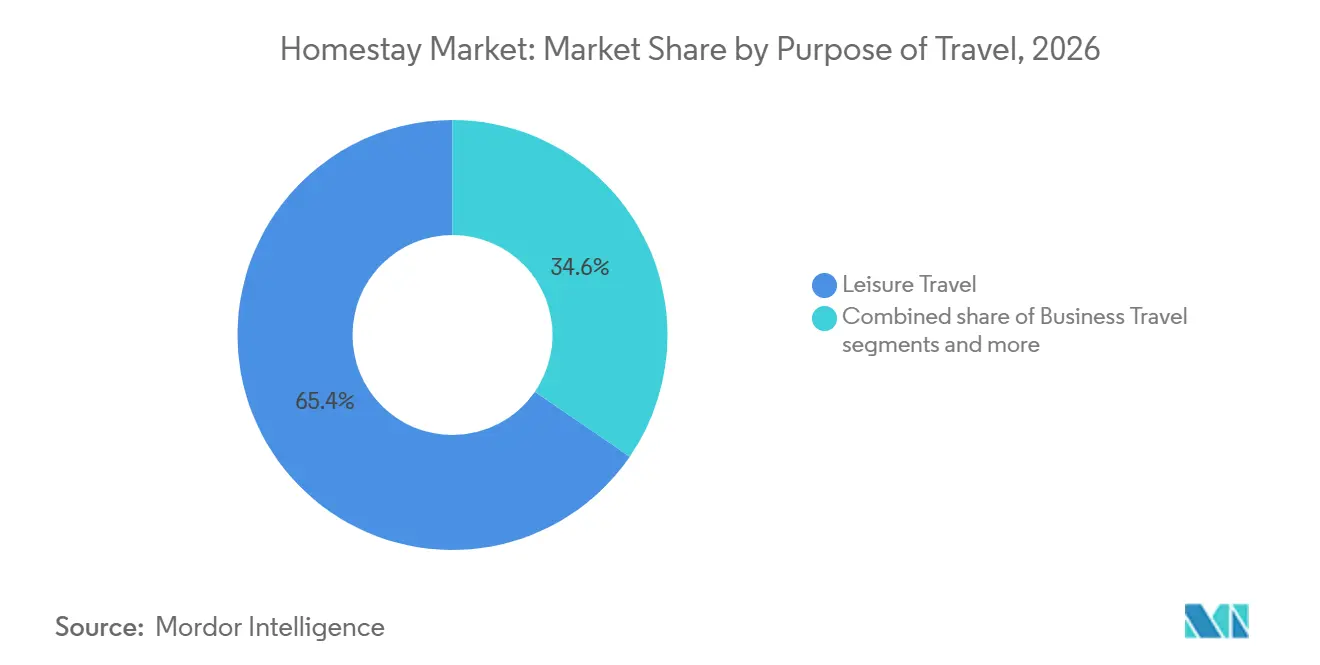
- By purpose of travel, leisure travel accounted for 65.41% of the global homestay market share in 2026, while wellness and experiential travel is projected to grow at an 8.65% CAGR through 2032.
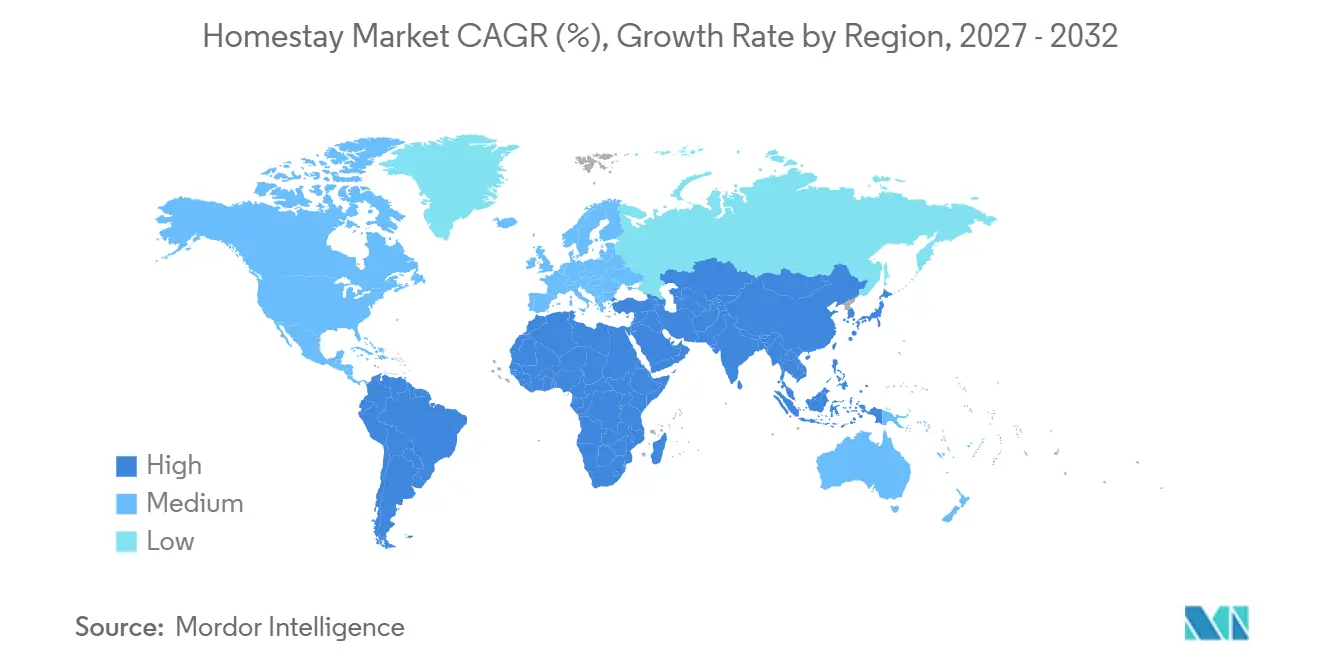
- By geography, Asia-Pacific accounted for 35.82% of the global homestay market share in 2026 and is projected to grow at an 8.96% CAGR through 2032.
Note: Market numbers in this report are based on Mordor Intelligence's proprietary estimation framework, which combines nine months of actuals with Q4 projections for base year 2026.
Market Trends and Insights
Drivers Impact Analysis of Homestay Market*
| Driver | (~) % Impact on CAGR Forecast | Geographic Relevance | Impact Timeline |
|---|---|---|---|
| Rising Demand for Authentic and Immersive Travel Experiences | +1.6% | Global, with highest intensity in Europe and Asia-Pacific | Long term (≥ 4 years) |
| Expansion of Online Accommodation Platforms and Digital Booking | +1.4% | Global, particularly North America, Europe, and Asia-Pacific core | Medium term (2-4 years) |
| Growth of Flexible, Mid-Term and Workcation Stays | +1.0% | Global, with spillover to Southeast Asia, Southern Europe, and South America | Medium term (2-4 years) |
| Increasing Family and Multigenerational Travel | +0.8% | North America, Western Europe, and Australia | Long term (≥ 4 years) |
| Rising Travel Spending Among Emerging-Market Middle-Class Consumers | +1.2% | Asia-Pacific core, including India, China, and Indonesia, with spillover to the Middle East and Africa | Long term (≥ 4 years) |
| Professionalization of Host and Property Management | +0.7% | Global, with early gains in North America and Western Europe | Medium term (2-4 years) |
| Source: Mordor Intelligence | |||
Rising Demand for Authentic and Immersive Travel Experiences
Travelers are moving away from standardized accommodation to engage more deeply with local neighborhoods, cuisine, heritage, and community life. Mastercard identified wellness, adventure, and food-led experiences as key motivations for international travel in 2025. The global homestay market meets this demand by offering local knowledge, distinctive homes, and access to residential areas that branded hotels often cannot replicate. Properties with authentic local character, including host interaction, regional design, and locally sourced amenities, can command higher rates than undifferentiated alternative accommodation. This trend also supports rural, coastal, and heritage destinations. In India, it supports village, tribal, and culturally distinctive homestays under the national classification framework.
Expansion of Online Accommodation Platforms and Digital Booking
Online platforms form the primary distribution backbone of the global homestay market, integrating discovery, payments, reviews, and booking confirmations. By the end of 2025, Airbnb had more than 9 million active listings and 5.5 million hosts. Airbnb reported that nights booked in expansion markets outside its five core countries grew nearly twice as fast as those in its core markets, with India contributing to new-user growth. Trip.com Group generated CNY 26.1 billion (USD 3.73 billion) in accommodation reservation revenue in 2025, up 21% from 2024. Platform investments in India and other emerging markets are expanding the addressable supply base while increasing the need for transparent quality controls and responsible host onboarding[2].
Growth of Flexible, Mid-Term and Workcation Stays
Hybrid work is increasing demand for accommodation between short leisure trips and long-term leases. Research identifies work-enabled travel as a growing use case for flexible-term stays with reliable work facilities. In the global homestay market, stays of 20-30 nights can generate higher gross revenue than standard short-term stays while reducing per-night cleaning, turnover, and check-in costs. Operators offering reliable Wi-Fi, dedicated workspaces, monthly pricing, and utility-inclusive terms are better positioned to meet this demand. India can benefit, particularly in leisure and pilgrimage destinations with improving connectivity; however, consistent infrastructure remains essential outside established tourist centers.
Increasing Family and Multigenerational Travel
Family travel supports demand for larger private homes, as guests value kitchens, shared living spaces, and privacy across age groups. A strong preference for family and multigenerational travel is supporting demand for homestays, with 92% of parents planning to travel with children in the following year and 57% planning multigenerational trips. Average family travel spending reached USD 8,052 in 2024, up 20% from 2023, while 39% of respondents planned to increase spending further[3]. Entire-home accommodation caters to these needs by offering communal areas, separate bedrooms, and meal preparation facilities. This trend supports the entire-home format in the global homestay market and increases the importance of accurate property descriptions, child-safety measures, and reliable amenities in family booking decisions.
Restraints Impact Analysis of Homestay Market*
| Restraint | (~) % Impact on CAGR Forecast | Geographic Relevance | Impact Timeline |
|---|---|---|---|
| Tightening Short-Term-Rental Regulations and Licensing Caps | -1.2% | Europe, including Barcelona, Amsterdam, Paris, and Athens, and North America, including New York | Short term (≤ 2 years) |
| Inconsistent Service Quality, Cleanliness and Safety Standards | -0.9% | Global, particularly severe in emerging-market destinations | Medium term (2-4 years) |
| Rising Insurance, Compliance and Operating Costs | -0.7% | North America and Western Europe | Medium term (2-4 years) |
| Seasonality and Infrastructure Constraints in Rural Destinations | -0.5% | Middle East and Africa, rural South Asia, and Rest of South America | Long term (≥ 4 years) |
| Source: Mordor Intelligence | |||
Tightening Short-Term-Rental Regulations and Licensing Caps
Municipal regulations are tightening in high-demand cities across Europe and North America, creating uncertainty for hosts and accommodation supply. Athens extended its ban on new accommodation registrations in the city’s first, second, and third municipal districts through December 2026[4]. Barcelona plans to phase out 10,101 tourist-apartment licenses when they expire in November 2028. The European Union’s Short-Term Rental Data-Sharing Regulation took effect on May 20, 2026, requiring online platforms to share host and booking data with national authorities. These measures may reduce casual supply, shift listings to neighboring areas, or encourage property owners to offer medium-term stays. In the global homestay market, compliant properties may command higher average daily rates, while operators must account for city-level restrictions when planning expansion.
Inconsistent Service Quality, Cleanliness and Safety Standards
The absence of a binding global quality standard can discourage first-time or risk-averse travelers from booking homestays. Hotels typically follow established rating systems, while homestay quality often depends on accurate guest reviews. Airbnb has strengthened quality controls through its updated hosting system to reduce service issues as supply expands. India addresses this gap through the Incredible India Homestay Establishment Classification Scheme, which offers gold and silver categories for eligible properties. Clear cleanliness protocols, safety measures, and visible certification can help qualified properties attract demand from unverified supply. These measures are increasingly important as the global homestay market attracts families, international travelers, and higher-spending guests.
*Our forecasts treat driver/restraint impacts as directional, not additive. The impact forecasts reflect baseline growth, mix effects, and variable interactions.
Consumer Behavior Analysis
Booking behavior in the global homestay market reflects demand for flexible, experience-led accommodation. Airbnb reported a 90% year-on-year increase in solo spring travel searches in 2025. Solo travelers averaged 17-night stays, versus nine nights for couples and eight for families, supporting demand for monthly discounts, flexible cancellations, and work-ready amenities. European guests booked 951.6 million nights in short-term rentals through online platforms in 2025, an 11.4% annual increase.
Preferences vary by travel purpose, group size, and destination. India’s 2025 tribal homestay initiative targeted 1,000 homestays and offered up to INR 0.5 million (USD 0.006 million) per unit for new construction. Hosts can improve competitiveness through clean facilities, secure payments, responsive communication, reliable internet, family-friendly spaces, and digital booking visibility.
Homestay Performance Intelligence
Homestay performance in 2025 varied across regions, with occupancy trends and pricing dynamics shaping market outcomes. In Europe, average occupancy reached 59%, while average daily rates declined 1.1% to EUR 130 (USD 175.38). In the United States, annual occupancy reached 56.9%, compared with 56.7% in 2024, indicating broadly stable performance.
Airbnb’s global average daily rate reached USD 168 in Q4 2025, increasing 6% year over year, or 3% excluding foreign exchange effects. Regional pricing trends varied, with average daily rates increasing 9% in South America and 2% in Asia-Pacific. Asia-Pacific also recorded mid-teens growth in nights and seats booked. Rising insurance premiums, regulatory compliance requirements, and property maintenance costs continue to pressure independent-host margins. Larger property managers may have a cost advantage by spreading fixed operating expenses across multiple properties.
Homestay Market Segment Analysis
By Accommodation Format:
Entire-Home Demand Restructures the Supply ModelEntire-home homestays accounted for 61.74% of the global homestay market size in 2026 and are projected to grow at a CAGR of 8.25% through 2032. Demand for private space among families, multigenerational groups, and bleisure travelers supports this format. Separate bedrooms, kitchens, and living areas reduce travel challenges for guests with children or extended family. As of December 31, 2025, Booking.com listed 3.9 million homes, apartments, and other unique accommodations. Shared homes and hybrid formats also attract budget-conscious guests and travelers seeking host interaction.
Shared formats remain relevant when affordability and cultural exchange influence booking decisions. A 2025 study found that online homestay listings in China rose from 590,000 in 2016 to more than 7.8 million in 2024, driven largely by entire-home and boutique bed-and-breakfast properties. Regulations affect the format mix: New York Local Law 18 favors hosted rentals, while Amsterdam's annual cap on whole-home rentals shifts inventory toward longer stays. Operators must assess local regulations. Entire-home properties can scale more freely in less restrictive Asia-Pacific and South American markets. In India, certified whole-home stays can address domestic travel demand where hotels are limited, subject to local regulations and community conditions.

By Booking Channel:
Direct Bookings Challenge Platform EconomicsDigital OTAs are projected to hold a 48.61% share of the global homestay market in 2026, supported by investments in search, demand aggregation, reviews, and payment systems. Booking Holdings processed 1.2 billion room nights in 2025 and reported USD 186.1 billion in gross travel bookings. This scale makes it difficult for single-property hosts to generate comparable demand independently. Digital platforms also provide international reach, which supports Indian hosts targeting domestic and overseas travelers. However, standardized platform policies can limit professional hosts’ control over guest relationships and pricing.
Direct bookings are forecast to grow at a 9.11% CAGR through 2032, the fastest rate among channels in the research. Multi-property operators are investing in direct booking engines, loyalty programs, and property management systems to reduce commission exposure. OTA commission rates of 15% to 25% create margin pressure for operators managing 10 or more homes. Wholesale channels and traditional travel agents remain relevant for group travel, educational placements, wellness retreats, and complex long-haul itineraries. The channel mix will depend on host scale, destination source markets, and the ability to convert platform-acquired guests into repeat direct bookings.
By Purpose of Travel:
Wellness and Experiential Travel Redefines the High-Value SegmentLeisure travel accounted for 65.41% of the global homestay market size in 2026, as travelers allocated more spending to experiences. Wellness and experiential travel are projected to grow at an 8.65% CAGR through 2032, making it the fastest-growing purpose segment. Wellness-oriented travel is supporting demand for higher-value stays focused on meditation, nature immersion, culinary experiences, and local culture. Homestays can cater to these preferences by offering authentic residential experiences while maintaining quality and safety standards.
Beyond leisure and wellness, business travelers increasingly seek reliable Wi-Fi, dedicated workspaces, and quiet settings, while educational homestays serve language learning, study abroad, and cultural exchange programs. These segments offer opportunities for longer stays and more predictable bookings, although demand depends on business travel activity, international student flows, and visa policies. Operators can address these needs through tailored amenities, pricing, and length-of-stay options. India also offers potential across wellness, heritage, educational, and pilgrimage travel, supported by credible local services.
Geography Analysis
APAC Homestay Market
Asia-Pacific held 35.82% of the global homestay market in 2026 and is forecast to expand at an 8.96% CAGR through 2032. India recorded 4,286.90 million domestic tourist visits in 2025, up 45.6% from 2024, according to the Ministry of Tourism. NITI Aayog estimated a shortage of more than 200,000 rooms, creating opportunities for formal homestay supply where hotel capacity is limited. China had 331,000 registered homestay-related businesses in 2024, reflecting the expansion of its homestay sector and online booking activity. Japan’s annual hosting cap of 180 nights constrains supply, although inbound travel supports demand.
APAC and Europe Homestay Market
South Korea, Singapore, Malaysia, Thailand, Indonesia, Vietnam, the Philippines, and Australia diversify the Asia-Pacific accommodation landscape. Variations in digital booking adoption, visitor flows, and regulatory frameworks create distinct opportunities for hosts and platforms. Europe is the second-largest regional segment, with the United Kingdom, Germany, France, Spain, and Italy accounting for much of its value. International tourism expanded across Europe in 2025, supported by demand in major destinations. Short-term rental performance varied by market, with occupancy and bookings improving in some areas while average daily rates remained relatively stable. Nordic countries are emerging as nature and wellness destinations, although higher prices may constrain demand.
The Americas and MEA Homestay Market
North America is a mature segment of the global homestay market, supported by established short-term rental platforms and strong domestic travel demand. In the United States, occupancy and average daily rates indicate continued short-term rental activity. South America is experiencing growing platform demand, with Brazil serving as a key growth market for Airbnb. The Middle East and Africa remain comparatively underpenetrated. The United Arab Emirates and Saudi Arabia are expanding organized homestay supply, while Nigeria and South Africa show emerging peer-to-peer hosting activity. Rural infrastructure gaps and regulatory differences continue to constrain market development.
Homestay Supply & Development Intelligence
Global homestay listings increased by 9% between December 2023 and December 2024. North America and the Middle East recorded near-flat supply growth, while Asia-Pacific and South America expanded faster. Airbnb’s more than 7.7 million active listings reflected host acquisition and the removal of lower-quality supply, including over 400,000 lower-quality listings. In India, support for Gold- and Silver-classified homestays and collateral-free Mudra Loans aimed to formalize supply.
Integrated tools helped managers of 10 to 50 properties manage reservations, revenue, and guests. However, licensing rules and night camps reduced availability in several Western European cities. Supply growth varied by destination and host type, favoring operators that complied with local rules and maintained guest quality.
Competitive Landscape
The global homestay market features moderate competition, with major travel platforms capturing digital demand alongside regional operators, property managers, and independent hosts. Airbnb, Booking Holdings, Expedia Group, Trip.com Group, and HomeToGo SE are key competitors. Booking Holdings reported USD 186.1 billion in gross travel bookings in 2025, while Airbnb generated USD 12.24 billion in revenue, up 10% year over year. Competition increasingly extends beyond accommodation bookings, as platforms expand into travel experiences, ancillary services, and integrated trip-planning solutions to strengthen customer engagement and retention.
Strategic partnerships, acquisitions, and property-management technologies are reshaping the competitive landscape. HomeToGo completed its acquisition of Interhome in August 2025, strengthening its vacation rental portfolio. Platforms are also expanding attraction-booking capabilities and developing business-to-business solutions for accommodation providers. Meanwhile, professional managers and technology vendors are using pricing optimization, occupancy forecasting, and automated guest communication to improve operating efficiency. Regulatory compliance and reporting requirements may create additional challenges for smaller operators with limited resources. In India, rising domestic travel demand and the formalization of homestay accommodation offer opportunities for global platforms, local booking providers, and technology-enabled property managers to expand their presence.
Homestay Industry Leaders
-
Airbnb, Inc.
-
Booking Holdings Inc.
-
Expedia Group, Inc.
-
Trip.com Group Limited
-
HomeToGo SE
- *Disclaimer: Major Players sorted in no particular order
Homestay Market Companies Covered in this Report
- Airbnb, Inc.
- Booking Holdings Inc.
- Expedia Group, Inc.
- Trip.com Group Limited
- HomeToGo SE
- PRISM
- Casago
- MakeMyTrip Limited
- Tujia
- Homestay.com
- Plum Guide
- Evolve
- 9flats.com
- Accor SA
- Travel + Leisure Co.
- SaffronStays
- StayVista
- Rakuten Group, Inc.
- StayAfrika Bookings Limited
- Fursat
Recent Industry Developments in Homestay Market
- September 2026: Expedia Group acquired B2B car rental technology platform CarTrawler for approximately USD 350 million, expanding its ground transportation capabilities and travel technology portfolio to support integrated trip planning and partner services worldwide.
- December 2025: Expedia Group acquired Amsterdam-based Tiqets for approximately USD 279 million in Q1 2026. It initially integrated the platform into its B2B partner business before expanding it across consumer brands, strengthening its full-trip solution capabilities.
- September 2025: Booking.com integrated FareHarbor, acquired in 2018, adding 150,000 attractions across 5,000 cities in 115 countries. The integration bypasses intermediaries, supporting competition with Airbnb Experiences and connected-trip economics.
- August 2025: HomeToGo SE acquired Interhome, expanding its managed supply base and launching a B2B professional management segment. The transaction tripled profitability, with pro forma Adjusted EBITDA growing 27.7% year over year in FY2025 and FY2026 revenue guidance of EUR 400-410 million (USD 470.52- 482.29 million).
Global Homestay Market Report Scope
The Global Homestay Market report examines homestay accommodation providers and booking platforms across major tourism markets worldwide. The market is segmented by accommodation format (entire-home homestays, shared-home homestays, and other homestays), booking channel (direct, digital online travel agencies (OTAs), wholesale and traditional agents, and others), travel purpose (leisure, business, education, wellness and experiential travel, and others), and geography. The study analyzes market drivers, including demand for authentic travel experiences, digital booking adoption, flexible and mid-term stays, family travel, rising travel spending, and professional host management. Restraints include tightening accommodation regulations, inconsistent service and safety standards, rising operating costs, and seasonality and infrastructure constraints.
The report assesses supply and development trends, room inventory, occupancy rates, average daily rates, traveler preferences, booking behavior, regulations, technology, and competitive intensity through Porter’s Five Forces framework. It provides market size and growth forecasts, competitive landscape and concentration analysis, strategic developments, market share analysis, and company profiles of homestay operators and booking platforms. The study also assesses opportunities in rural and community-based homestay networks and verified mid-term stays for digital nomads, students, and bleisure travelers. The report provides market size and forecasts for the Global Homestay Market in value terms (USD) across all segments.
Segmentation Overview
Key Questions Answered in the Report
What is driving the Global homestay market through 2032?
Growth is supported by international and domestic travel demand, platform-based booking, demand for local experiences, and longer work-enabled stays. The market is forecast to grow at a 6.73% CAGR from 2027 to 2032.
Which accommodation format is leading to global homestay demand?
Entire-Home Homestays led with a 61.74% share in 2026 and are also forecast to grow at an 8.25% CAGR through 2032.
Why is India important for homestay operators?
India recorded 4,287 million domestic tourist visits in 2025 and has a formal room shortage of more than 200,000 rooms, creating an opening for certified homestay supply.
Which booking channel is growing fast for homestays?
Direct bookings are forecast to grow at a 9.11% CAGR through 2032 as professional hosts seek to reduce OTA commission costs.
What are the main risks for homestay providers?
Tighter rental rules, uneven safety and cleanliness standards, rising insurance and compliance costs, and rural infrastructure gaps remain important constraints.
How concentrated is the Global homestay market?
Major platforms direct a large share of digital demand, but regional operators, specialist curators, and direct-booking hosts keep the sector moderately concentrated.