
Dual Axis Solar Trackers Market Size and Share
Market Overview
| Study Period | 2022 - 2032 |
|---|---|
| Market Size (2027) | USD 41.14 Billion |
| Market Size (2032) | USD 113.68 Billion |
| Growth Rate (2027 - 2032) | 22.54 % |
| Fastest Growing Market | Asia-Pacific |
| Largest Market | North America |
| Market Concentration | Medium |
Major Players *Disclaimer: Major Players sorted in no particular order Image © Mordor Intelligence. Reuse requires attribution under CC BY 4.0. | |
Dual Axis Solar Trackers Market Analysis by Mordor Intelligence
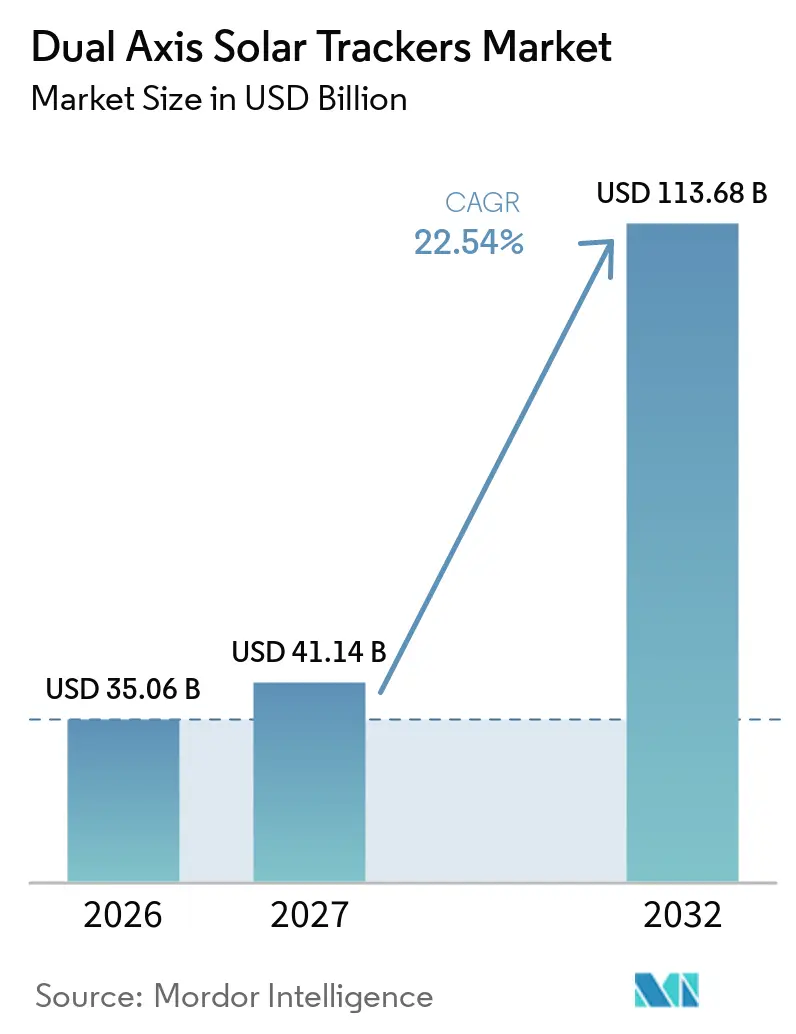
The dual axis solar trackers market size is expected to increase from USD 35.06 billion in 2026 to USD 41.14 billion in 2027 and reach USD 113.68 billion by 2032, at a CAGR of 22.54% over 2027-2032. Global solar photovoltaic additions surpassed 600 GW in 2025, with centralized utility-scale plants accounting for 60% of new deployment. This expands the project base where two-plane tracking can improve generation per installed megawatt.[1] The market is further supported by projects that require higher output during morning and late afternoon hours, rather than only at midday. Domestic-content rules in the United States and utility-scale buildouts in China, India, and the Middle East are shaping procurement choices and supplier location decisions. Higher equipment costs, mechanical complexity, and the operating record required by lenders continue to limit adoption in price-sensitive projects. Suppliers are responding with stronger drives, weather-responsive controls, certification, and designs suited to bifacial modules, energy storage, and agricultural land use.
Key Report Takeaways
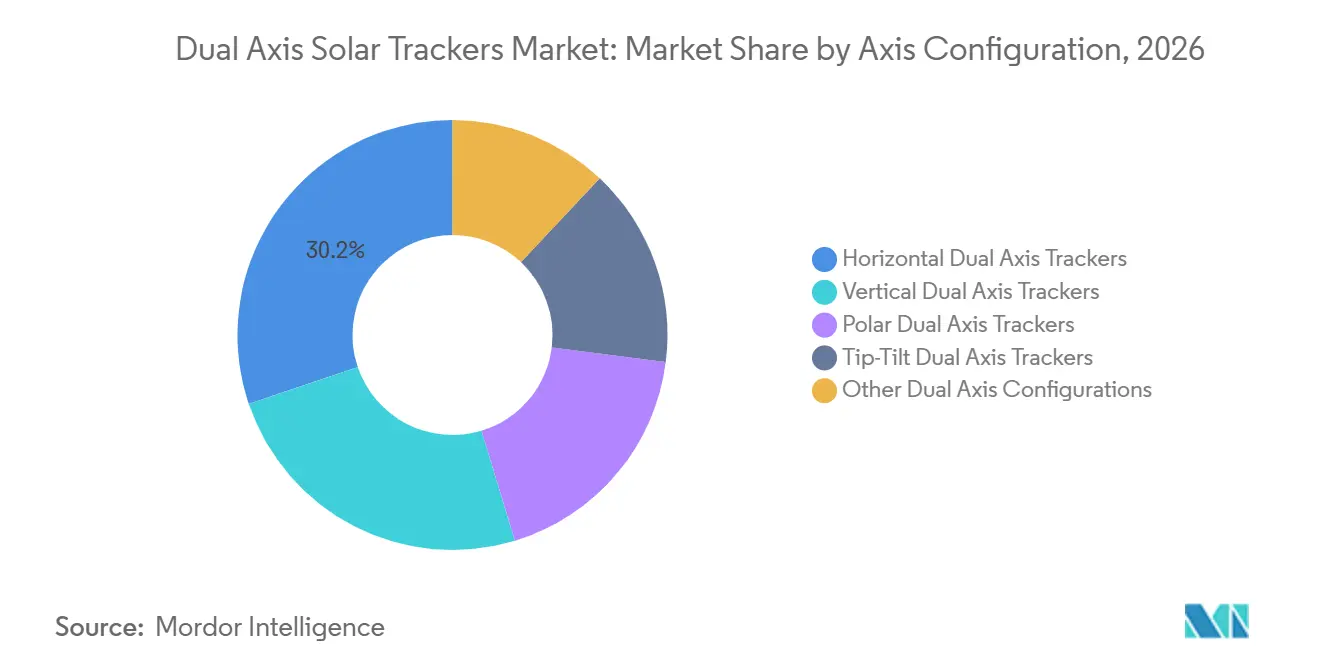
- By axis configuration, horizontal dual-axis trackers held 30.2% of the global dual-axis solar trackers market share in 2026, while tip-tilt trackers are forecast to grow at a 22.9% CAGR through 2032.
- By drive system, electric motor-based systems held 42.7% of revenue in 2026, while hydraulic systems are forecast to grow at a 22.8% CAGR through 2032.
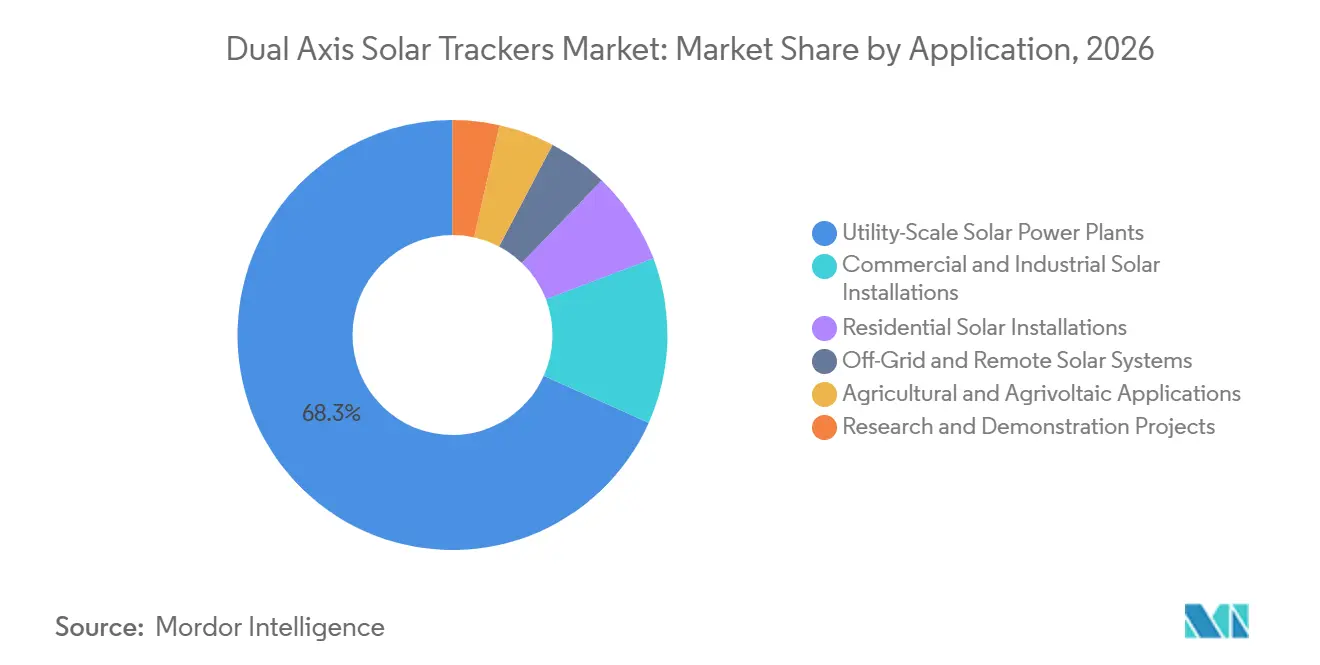
- By application, utility-scale solar power plants held 68.3% of revenue in 2026, while commercial and industrial installations are forecast to grow at a 23.2% CAGR through 2032.
- By geography, North America held 35.9% of revenue in 2026, while Asia-Pacific is forecast to grow at a 23.5% CAGR through 2032.
Note: Market numbers in this report are based on Mordor Intelligence's proprietary estimation framework, which combines nine months of actuals with Q4 projections for base year 2026.
Market Trends and Insights
Drivers Impact Analysis of Dual Axis Solar Trackers Market*
| Driver | (~) % Impact on CAGR Forecast | Geographic Relevance | Impact Timeline |
|---|---|---|---|
| Utility-Scale Solar Capacity Expansion | +6.0% | Global, strongest in China, India, North America, and MENA | Short term (≤ 2 years) |
| Higher Energy Yield and Land-Use Optimization | +4.8% | Global, strongest where land costs are high in Europe and Northeast Asia | Medium term (2-4 years) |
| Bifacial Module and High-Albedo Site Adoption | +3.5% | North America and Europe, with spillover to Asia-Pacific | Long term (≥ 4 years) |
| Storage-Coupled Solar Projects and Longer Dispatch Windows | +2.8% | Global, concentrated in North America, Southeast Asia, and the Middle East and Africa | Medium term (2-4 years) |
| Weather-Adaptive Tracking and Autonomous Control | +2.5% | Asia-Pacific cyclone belt, with spillover to South America and the Middle East and Africa | Medium term (2-4 years) |
| Declining Tracker Costs and Improved Solar Project Economics | +2.2% | Global, strongest in South America and Africa | Short term (≤ 2 years) |
| Source: Mordor Intelligence | |||
Utility-Scale Solar Capacity Expansion
Utility-scale solar capacity represents the largest demand base for the global dual-axis solar trackers market. Solar PV additions exceeded 600 GW in 2025, more than 12% above 2024 levels, with centralized utility-scale plants accounting for 60% of new installations. The Middle East and North Africa installed 12.2 GW of solar in 2025, and Saudi Arabia's capacity surpassed 11 GW following the commissioning of major projects, including Al Shuaibah 2, Ar Rass 2, and Al Kahfah. Projects above 500 MW place greater pressure on land use and generation yield, which can strengthen the case for two-plane tracking. India's renewable energy auctions and China's utility-scale construction pipeline make tracker selection an important early procurement decision. These project pipelines can influence supplier positions for several years after financial close.
Higher Energy Yield and Land-Use Optimization
The global dual-axis solar trackers market benefits where higher energy yield can offset additional equipment costs. Field evidence shows a 28.6% improvement for a tracked two-axis bifacial configuration in Jordan and a 33.7% to 40.3% increase in monitored Polish installations compared to fixed-tilt arrays. Dual-axis systems can also capture more low-angle light in the early morning and late afternoon, which becomes more valuable when high solar penetration increases curtailment at midday. Research by the University of Cordoba found that dual-axis tracker arrangements can retain up to 74% of inter-row land for cultivation. This layout can support agricultural income alongside electricity revenue and gives developers a stronger basis for discussions with landowners and planning authorities.
Bifacial Module and High-Albedo Site Adoption
Bifacial modules can strengthen the value proposition of the global dual-axis solar trackers market at high-latitude and high-albedo locations. A two-year Vermont study by AllEarth Renewables found that bifacial modules on dual-axis trackers generated 14% more electricity annually than monofacial modules on the same tracker type.[2] The same study recorded up to 40% more generation during peak winter months, when snow reflection was highest. The combination of bifacial modules and two-plane movement can improve project economics in Canada, Scandinavia, and alpine European locations. Integrated design verification is increasingly relevant as tracker and module systems are assessed together. Established manufacturers can benefit where qualification requirements favor suppliers with complete testing and certification capabilities.
Storage-Coupled Solar Projects and Longer Dispatch Windows
Battery storage is changing how developers assess output from the global dual-axis solar trackers market. Research on grid-connected PV with battery storage found that European systems face frequent negative price periods during 2026 to 2030, increasing the importance of the timing of solar generation. MODMEC modeling indicated that its row-based design can provide up to 11% more output after 4 PM than an equivalent single-axis system. The later generation can reduce the depth of evening battery discharge and may allow a smaller storage configuration for a comparable demand profile. This is relevant to behind-the-meter commercial systems and grid-connected projects with capacity obligations. In markets such as PJM Interconnection, a longer generation window can improve the revenue case for systems that pair solar production with storage.
Restraints Impact Analysis of Dual Axis Solar Trackers Market*
| Restraint | (~) % Impact on CAGR Forecast | Geographic Relevance | Impact Timeline |
|---|---|---|---|
| High Upfront Cost and Mechanical Complexity | -1.8% | Global, most acute in South America, Africa, and South and Southeast Asia | Short term (≤ 2 years) |
| Extreme-Weather, Reliability, and Bankability Risks | -1.2% | Asia-Pacific cyclone belt, South America, and the Middle East and Africa | Medium term (2-4 years) |
| Site-Specific Engineering and Skilled Operations and Maintenance Requirements | -0.8% | Emerging markets with limited engineering contractor capacity | Medium term (2-4 years) |
| Higher Land, Installation, and Maintenance Requirements | -0.9% | Northern Europe and urban-fringe sites globally | Long term (≥ 4 years) |
| Source: Mordor Intelligence | |||
High Upfront Cost and Mechanical Complexity
The higher installed cost of dual-axis hardware remains a structural restraint on the global dual-axis solar trackers market. IEA Photovoltaic Power Systems (PVPS) benchmarks put dual-axis tracker hardware at USD 0.20 to USD 0.40 per watt, compared with USD 0.06 to USD 0.14 per watt for single-axis alternatives.[3] This cost gap can reduce returns from higher energy output in competitive auctions in India, Brazil, and South Africa. Two-axis rotation also requires azimuth and elevation drives, sensors, and control systems that must operate together under varying wind conditions. These requirements can extend installation and commissioning schedules and increase engineering, procurement, and construction costs. Smaller manufacturers may also face higher entry costs where project financiers require quality management and mounting safety qualifications.
Extreme-Weather, Reliability, and Bankability Risks
Weather exposure and operating history continue to affect lender confidence in the global dual-axis solar trackers market. Elevated module structures can have greater exposure to typhoons, extreme winds, sandstorms, and flash flooding than simpler designs. Lenders often seek operating records spanning over a decade, while many utility-scale dual-axis designs have shorter commercial histories outside Europe and North America. Structural and environmental testing can support qualification, but does not fully replace long-term field performance data in credit assessments. Suppliers are addressing these concerns through hydraulic systems designed for 60 m/s wind loads and predictive maintenance systems based on operational sensors. These measures can reduce risk, but have not fully removed the financing premium relative to single-axis trackers.
*Our forecasts treat driver/restraint impacts as directional, not additive. The impact forecasts reflect baseline growth, mix effects, and variable interactions.
Dual Axis Solar Trackers Market Segment Analysis
By Axis Configuration:
Horizontal Architecture Leads, Tip-Tilt Expands Through AgrivoltaicsHorizontal dual-axis trackers held 30.2% of revenue in 2026, giving them the largest share in the global dual-axis solar trackers market. Their structure is compatible with large-format module tables used in utility-scale projects across flat, semi-arid areas in North America, the Middle East, and South Asia. Backtracking can limit inter-row shading when the sun is low and ground coverage ratios are high. This capability is useful on sites where developers seek yield protection without increasing land requirements. Polar dual-axis trackers retain a specialized role in Northern Europe and Canada, where seasonal changes in solar position are more pronounced. Their primary axis can reduce motor energy use compared with azimuth-altitude designs. Vertical dual-axis trackers are used more often on rooftops and compact commercial sites where horizontal mounting is less practical. Their ground anchoring approach can also reduce civil work requirements in urban-fringe installations.
Tip-tilt trackers are forecast to grow at a 22.9% CAGR through 2032, the fastest rate among axis configurations. Their key advantage is the ability to move module tables toward a near-vertical position during harvesting activities, preserving machinery access below elevated photovoltaic structures. Energie Wasser Schwyz reported 14% higher winter wheat yields in a 12-meter cultivation zone at its Bruck an der Leitha research site during the dry summer of 2026. The finding remains under evaluation by the University of Natural Resources and Life Sciences, Vienna. The University of Cordoba's work on retaining arable inter-row land further supports the role of tip-tilt systems in agricultural projects. The design can support a dual revenue structure for farmers and developers. Agrivoltaic deployment therefore broadens the range of locations where this configuration can be considered in the global dual-axis solar trackers market.

By Drive System:
Electric Motors Lead While Hydraulic Systems Address High-Wind ConditionsElectric motor-based drive systems held 42.7% of revenue in 2026, the largest share within the drive-system segment. This position reflects their compatibility with programmable logic controller (PLC)-based supervisory control and data acquisition systems, lower maintenance needs in temperate conditions, and the benefit of scaled production of motors and controllers. Slew drives are gaining relevance in concentrated photovoltaic and concentrated solar power applications that require precise pointing, meeting positioning tolerances that standard linear actuators may not achieve. Linear actuators continue to serve smaller commercial and off-grid installations, where their simpler geometry can reduce installation skill requirements. This mix allows the global dual-axis solar trackers market to address different operating conditions and levels of project complexity across the value chain.
Hydraulic systems are forecast to grow at a 22.8% CAGR through 2032, the fastest rate in the drive-system segment. Demand is supported by projects in Southeast Asia, South America, and the Middle East and North Africa that face sustained wind risk. Hydraulic fluid can hold a load without continuous motor power, helping maintain module orientation during extended wind events. That feature is important in remote settings where auxiliary power is constrained. In 2025, HYDAC International presented integrated electric and hydraulic tracking systems with optional condition monitoring for single-axis and dual-axis concentrated solar applications. Higher production volumes and improved circuit monitoring are expected to reduce the cost difference between hydraulic and electric systems. This shift also reflects developers' greater focus on equipment performance under difficult site conditions.
By Application:
Utility-Scale Projects Provide Revenue While Commercial and Industrial Demand Grows FastestUtility-scale solar power plants accounted for 68.3% of revenue in 2026, forming the largest application base. Projects above 100 MW can spread the added cost of two-plane tracking over a larger installed capacity. In India, utility-scale parks above 100 MW remain an important procurement channel for tracker systems. A 2026 technical assessment indicated that tracker-based systems can deliver up to 23% higher specific energy yield than fixed-tilt designs and may reduce overall engineering, procurement, and construction costs by up to 10% through structural optimization. Research and demonstration projects remain smaller in revenue but provide evidence for new designs and operating contexts. The Horizon Europe-funded Symbiosyst project used the Convert Agri-PV v4.0 tracker in Italy to assess agricultural applications in vineyards and permanent tree crops, helping qualify equipment for orchard-scale deployment across Southern Europe. Utility-scale demand will remain central to the dual-axis solar trackers market as it represents the largest volume opportunity.
Commercial and industrial installations are forecast to grow at a 23.2% CAGR through 2032. Corporate demand for 24/7 clean-energy supply and Scope 2 emissions reduction is increasing interest in output that extends into the afternoon. The MODMEC model showed up to 11% additional generation after 4 PM compared with an equivalent single-axis system. This generation profile can reduce the battery capacity needed to meet an evening demand peak and improve project economics for behind-the-meter developers. Agricultural use remains smaller in revenue but represents a distinct expansion path. Nadara and Amazon inaugurated the 227 MW Big Fish agrivoltaic project in Sicily in September 2026 on a 400-hectare site that continues crop cultivation. The project demonstrates that agrivoltaic designs can be deployed at utility scale while retaining agricultural activity, creating an additional use case in the global dual-axis solar trackers market.
Geography Analysis
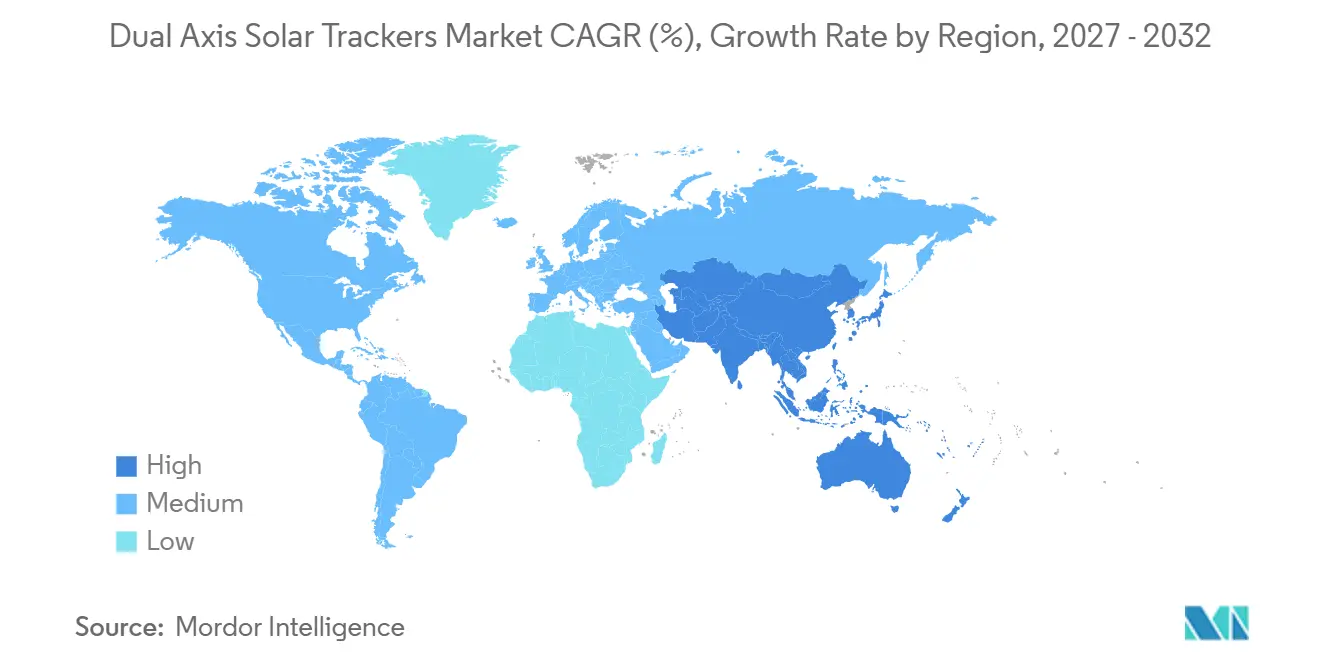
North America held 35.9% of 2026 revenue, making it the largest regional contributor to the global dual-axis solar trackers market. In the United States, domestic-content incentives are encouraging supply chain localization and tracker procurement from manufacturers with qualifying components. Array Technologies announced in August 2025 that it would supply 100% domestic-content OmniTrack trackers for the 200 MW Emerald Green Solar project in Indiana.[4] The project was identified as its first full-site deployment of this domestic-content tracker solution. Canada remains a smaller market, but its high-latitude conditions can favor bifacial dual-axis systems. Vermont field data showed that bifacial modules on dual-axis trackers can produce up to 40% more energy during peak winter months than monofacial counterparts. Mexico is also gaining relevance as manufacturing expansion in northern states adds demand for on-site electricity supply and corporate sustainability solutions.
Europe is the second-largest regional market, supported by activity in Germany, Spain, Italy, and Poland. Spain added 14 GW of solar capacity in 2025, which was 50% above 2024, according to IEA data. Ground-mounted projects in Extremadura, Andalusia, and Castilla-La Mancha offer conditions that can support dual-axis economics. Array Technologies commissioned the La Nava and Ebro I plants in Navarre in June 2025 using its STI H250 dual-row tracker across more than 100 MWp. DEGERenergie announced in 2026 that it planned to expand into Africa and South America and establish a research center. Its flat-roof systems also extend its reach beyond ground-mounted sites. Agrivoltaic policy development in Germany, France, and Italy may increase the addressable base and project pipeline for the global dual-axis solar trackers market.
Asia-Pacific is forecast to grow at a 23.5% CAGR through 2032, the fastest regional rate. China added 370 GW of solar capacity in 2025, partly as developers moved ahead of a June 2025 shift from fixed tariffs to competitive auctions. India commissioned nearly 50 GW of solar PV in 2025, and projects above 100 MW are a primary channel for dual-axis tracker procurement. Antaisolar reported cumulative global tracker shipments of 50.1 GW across 21 countries by the end of 2025 and signed agreements for more than 800 MW of projects in Southeast Asia and Australia in June 2026. South America and the Middle East and Africa remain additional growth areas. Saudi Arabia's solar capacity crossed 11 GW in 2025 as large projects progressed, while Chile's Atacama Desert continued to attract tracker deployment.
Competitive Landscape
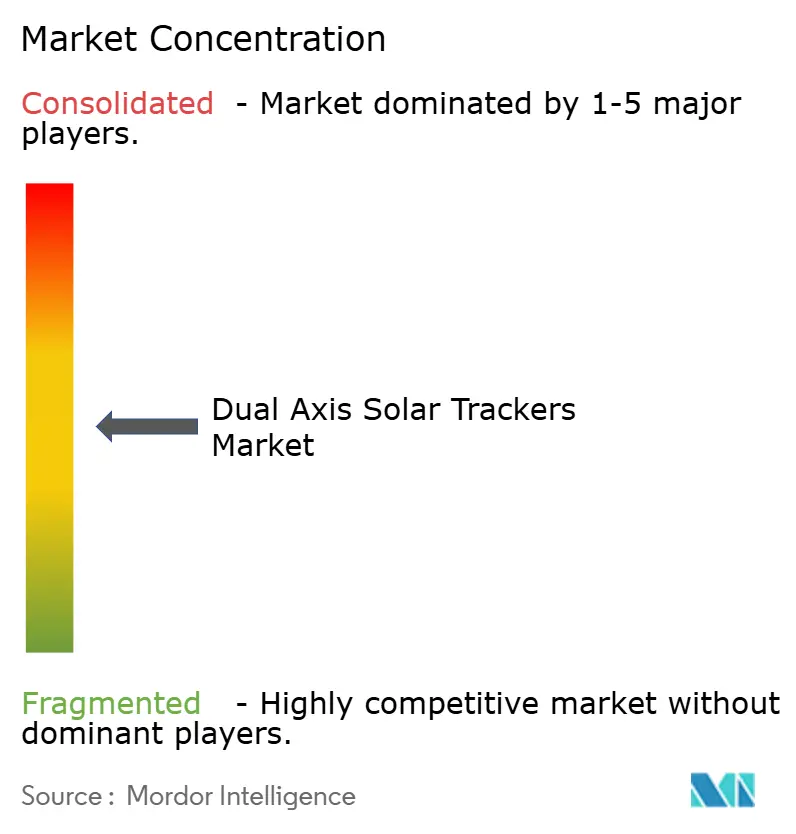
The global dual-axis solar trackers market is moderately fragmented, with European specialists, North American utility-scale suppliers, and Chinese manufacturers competing across overlapping customer groups. DEGERenergie differentiates through its Maximum Light Detection system, which responds to real-time irradiance rather than relying only on astronomical positioning. This approach is intended to improve output during partially cloudy conditions. Mecasolar uses a commercial off-the-shelf component approach, seeking to reduce reliance on proprietary parts. It entered a strategic partnership with JinkoSolar for Southeast Asian utility projects in June 2024 and introduced a rapid-shutdown-equipped product with Tigo Energy for critical infrastructure in November 2024. These positions reflect the different ways suppliers are addressing yield, serviceability, and compliance.
Array Technologies is moving beyond tracker hardware toward integrated engineered solutions. In 2026, it introduced the Array Atlas foundation-to-tracker suite and 60-degree tilt capability intended to improve bifacial rear-side exposure. The company also reported more than 100 GW in cumulative tracker shipments and a USD 2.5 billion order backlog in its second-quarter 2026 results. MODMEC announced its intended entry into the United States in September 2026 with a row-based dual-axis design. Its monitored Polish installations were reported to show a 33.7% to 40.3% increase in production compared with fixed-tilt systems. MODMEC also holds a Polish patent and has a pending US patent application for its design. Competition in the global dual-axis solar trackers market is therefore moving toward system engineering, software, and designs that seek to approach single-axis cost levels.
Open opportunities remain in weather-adaptive control, agrivoltaic-focused equipment, and designs for locations with high wind exposure. Chinese suppliers, including Powerway Renewable Energy and Shandong Zhaori, use export pricing and vertically integrated steel fabrication in markets where delivered cost is a primary consideration. Certification requirements can still favor suppliers with the resources to maintain multiple engineering and safety qualifications. Antaisolar's 2026 reinforced multi-drive product and its project agreements in Southeast Asia and Australia demonstrate the importance of structural capability and regional partnerships. DEGERenergie's 2026 project at Märchenlandtherme Breuna also showed continuing deployment of its light-detection technology in Germany. The competitive environment remains broad, as no company-level market share data was available to identify a leading group. Supplier differentiation in the global dual-axis solar trackers market depends on operating data, local service support, certification, and the ability to meet site-specific requirements.
Dual Axis Solar Trackers Industry Leaders
-
DEGERenergie GmbH & Co. KG
-
Mechatron Solar Inc.
-
AllEarth Renewables, Inc.
-
Sun Action Trackers LLC
-
Scorpius Trackers Private Limited
- *Disclaimer: Major Players sorted in no particular order
Dual Axis Solar Trackers Market Companies Covered in this Report
- AllEarth Renewables, Inc.
- ASUN
- Big Sun Energy Technology Inc.
- Convert Italia S.p.A.
- DEGERenergie GmbH & Co. KG
- Wuxi Hao Solar Technology Co., Ltd.
- Ideematec Deutschland GmbH
- InfiniteERCAM S.A.
- Mecasolar
- Mechatron Solar Inc.
- PARU Corporation
- Powerway Renewable Energy Co., Ltd.
- Qingdao Eternal Electronic Co., Ltd.
- Scorpius Trackers Private Limited
- Shandong Zhaori New Energy Technology Co., Ltd.
- SmartTrak Solar Systems Pvt. Ltd.
- Solar CenTex
- Stracker Incorporated
- Sun Action Trackers LLC
- Titan Tracker S.L.
Recent Industry Developments in Dual Axis Solar Trackers Market
- September 2026: MODMEC, a Poland-based solar technology developer, announced plans to enter the U.S. market with its row-based dual-axis solar tracker architecture. The company reported a weighted-average 36.1% energy production uplift versus fixed-tilt systems across monitored installations in Poland and is seeking a U.S. pilot project host while pursuing patent protection for the technology.
- July 2026: DEGERenergie completed commissioning of its D80 solar tracking system at the Märchenlandtherme Breuna facility near Kassel, Germany. The project utilizes the company's proprietary MLD (Maximum Light Detection) technology, designed to maximize solar capture under varying weather and irradiation conditions.
- May 2026: DEGERenergie introduced a new flat-roof dual-axis tracker solution for the German solar market. The system features an aerodynamic design intended to reduce roof loading while maintaining precise two-axis sun tracking.
- May 2025: Mecasolar signed a contract for a 6.9 MW solar project in Nicaragua utilizing its latest-generation solar tracking technology. While the company offers multiple tracker configurations, including dual-axis systems, the project demonstrates continued deployment of tracking solutions in emerging solar markets.
Global Dual Axis Solar Trackers Market Report Scope
Dual-axis solar trackers are devices that automatically rotate solar panels along two independent axes, typically horizontal (tilt) and vertical (azimuth), to continuously face the sun throughout the day. By tracking the sun's position from east to west and adjusting for seasonal height variations, these systems maintain an optimal angle of incidence for solar radiation. This dual-movement capability allows them to capture maximum sunlight, significantly increasing energy generation compared to fixed or single-axis systems.
The global dual-axis solar trackers market is segmented by axis configuration into horizontal dual-axis trackers, vertical dual-axis trackers, polar dual-axis trackers, tip-tilt dual-axis trackers, and other dual-axis configurations. By drive system, the market is segmented into electric motor-based drive systems, hydraulic drive systems, linear actuator-based systems, slew drive systems, and other drive systems. By application, the market is segmented into utility-scale solar power plants, commercial and industrial solar installations, residential solar installations, off-grid and remote solar systems, agricultural and agrivoltaic applications, and research and demonstration projects. The report also covers the market size and forecasts for the global dual-axis solar trackers market across 26 countries in key regions. For each segment, the market sizing and forecasts are provided on the basis of value (USD).
Segmentation Overview
| Horizontal Dual Axis Trackers |
| Vertical Dual Axis Trackers |
| Polar Dual Axis Trackers |
| Tip-Tilt Dual Axis Trackers |
| Other Dual Axis Configurations |
| Electric Motor-Based Drive Systems |
| Hydraulic Drive Systems |
| Linear Actuator-Based Systems |
| Slew Drive Systems |
| Other Drive Systems |
| Utility-Scale Solar Power Plants |
| Commercial and Industrial Solar Installations |
| Residential Solar Installations |
| Off-Grid and Remote Solar Systems |
| Agricultural and Agrivoltaic Applications |
| Research and Demonstration Projects |
| North America | United States |
| Canada | |
| Mexico | |
| Europe | Germany |
| France | |
| Italy | |
| Spain | |
| United Kingdom | |
| Poland | |
| Russia | |
| Rest of Europe | |
| Asia-Pacific | China |
| India | |
| Japan | |
| South Korea | |
| Australia | |
| Indonesia | |
| Vietnam | |
| Thailand | |
| Rest of Asia-Pacific | |
| South America | Brazil |
| Argentina | |
| Chile | |
| Rest of South America | |
| Middle East and Africa | Saudi Arabia |
| United Arab Emirates | |
| Egypt | |
| South Africa | |
| Morocco | |
| Rest of Middle East and Africa |
| By Axis Configuration | Horizontal Dual Axis Trackers | |
| Vertical Dual Axis Trackers | ||
| Polar Dual Axis Trackers | ||
| Tip-Tilt Dual Axis Trackers | ||
| Other Dual Axis Configurations | ||
| By Drive System | Electric Motor-Based Drive Systems | |
| Hydraulic Drive Systems | ||
| Linear Actuator-Based Systems | ||
| Slew Drive Systems | ||
| Other Drive Systems | ||
| By Application | Utility-Scale Solar Power Plants | |
| Commercial and Industrial Solar Installations | ||
| Residential Solar Installations | ||
| Off-Grid and Remote Solar Systems | ||
| Agricultural and Agrivoltaic Applications | ||
| Research and Demonstration Projects | ||
| By Geography | North America | United States |
| Canada | ||
| Mexico | ||
| Europe | Germany | |
| France | ||
| Italy | ||
| Spain | ||
| United Kingdom | ||
| Poland | ||
| Russia | ||
| Rest of Europe | ||
| Asia-Pacific | China | |
| India | ||
| Japan | ||
| South Korea | ||
| Australia | ||
| Indonesia | ||
| Vietnam | ||
| Thailand | ||
| Rest of Asia-Pacific | ||
| South America | Brazil | |
| Argentina | ||
| Chile | ||
| Rest of South America | ||
| Middle East and Africa | Saudi Arabia | |
| United Arab Emirates | ||
| Egypt | ||
| South Africa | ||
| Morocco | ||
| Rest of Middle East and Africa | ||
Key Questions Answered in the Report
What is driving demand for global dual-axis solar trackers?
Utility-scale solar construction, higher energy yield, bifacial modules, energy storage, and agrivoltaic deployment are supporting demand. Global solar PV additions exceeded 600 GW in 2025.
What is the forecast growth rate for dual axis solar trackers?
The global dual axis solar trackers market is forecast to grow at a 22.54% CAGR from 2027 to 2032 and reach USD 113.68 billion by 2032.
Which dual-axis tracker configuration is growing the fastest?
Tip-tilt dual-axis trackers are forecast to grow at a 22.9% CAGR through 2032, supported by agrivoltaic projects that require machinery clearance.
Why are hydraulic drives gaining traction in the global dual-axis solar trackers market?
Hydraulic systems are forecast to grow at a 22.8% CAGR because they maintain load stability in high-wind locations and are suitable for remote sites.
Which region has the fastest projected growth for dual-axis trackers?
Asia-Pacific is forecast to grow at a 23.5% CAGR through 2032, supported by solar construction in China, India, Southeast Asia, and the Middle East.
What limits the adoption of dual-axis solar trackers?
Higher installed costs, more complex mechanical systems, severe-weather exposure, and lender concerns over operating history can limit project adoption.