
Digital Travel Market Size and Share
Market Overview
| Study Period | 2022 - 2032 |
|---|---|
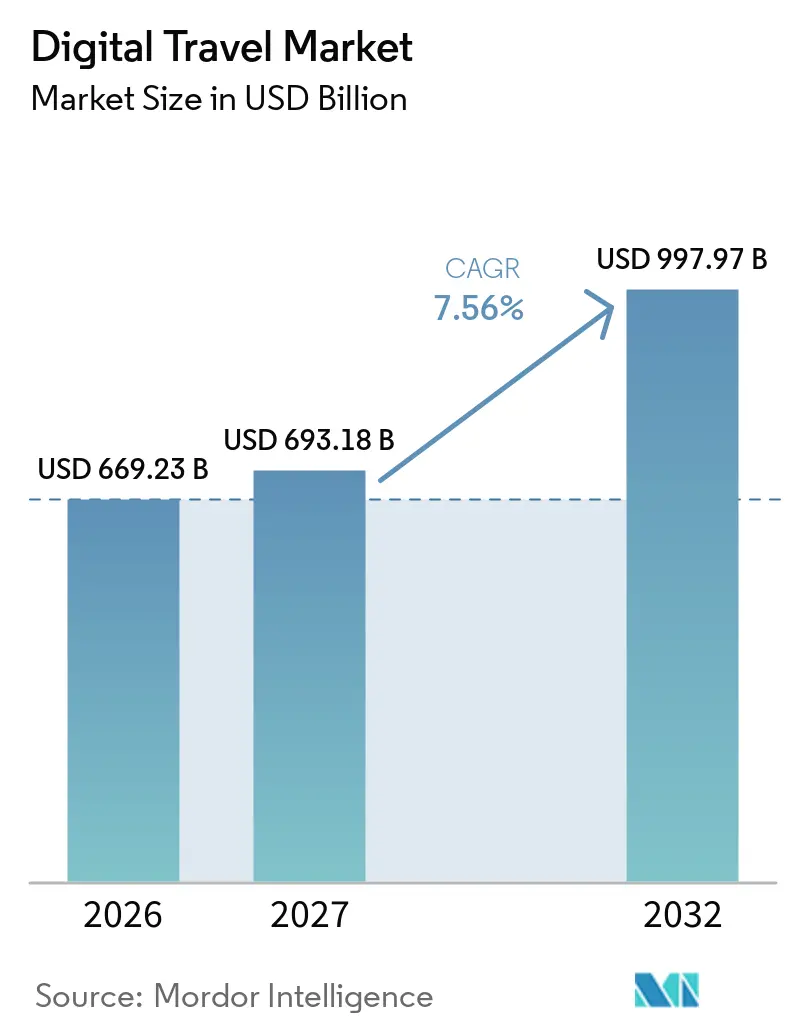
| Market Size (2027) | USD 693.18 Billion |
| Market Size (2032) | USD 997.97 Billion |
| Growth Rate (2027 - 2032) | 7.56 % |
| Fastest Growing Market | Asia-Pacific |
| Largest Market | North America |
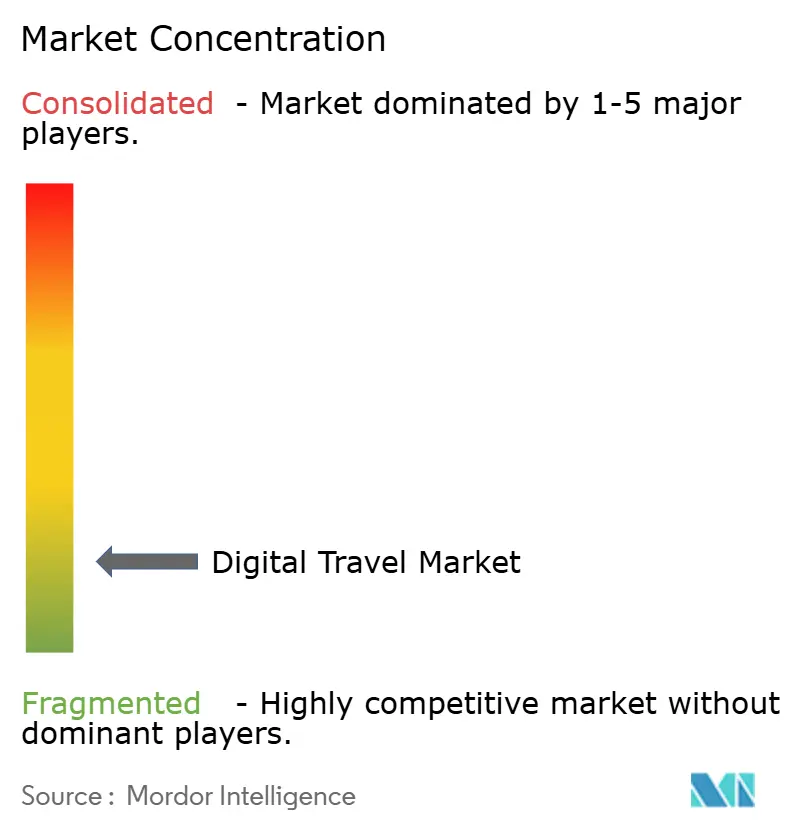
| Market Concentration | Low |
Major Players *Disclaimer: Major Players sorted in no particular order Image © Mordor Intelligence. Reuse requires attribution under CC BY 4.0. | |
Digital Travel Market Analysis by Mordor Intelligence
The global digital travel market was valued at USD 669.23 billion in 2026 and is estimated to grow from USD 693.18 billion in 2027 to reach USD 997.97 billion by 2032, at a CAGR of 7.56% during the forecast period (2027-2032). The global digital travel market is evolving from a booking channel into a broader service layer that integrates search, payments, loyalty programs, and post-booking support. Mobile usage is reshaping travel journeys, particularly in Asia-Pacific markets, where consumers expect rail, bus, hotel, and air options in a single application. Payment integration and AI-enabled assistance increase the value of platforms that reduce booking and payment friction. Meanwhile, supplier-direct websites, changes in airline retailing, and regulatory scrutiny limit online travel agencies’ ability to rely solely on scale. Opportunities in the global digital travel market depend on improving conversion rates, offering relevant inventory, providing trusted payment options, and delivering clear customer value.
Key Report Takeaways
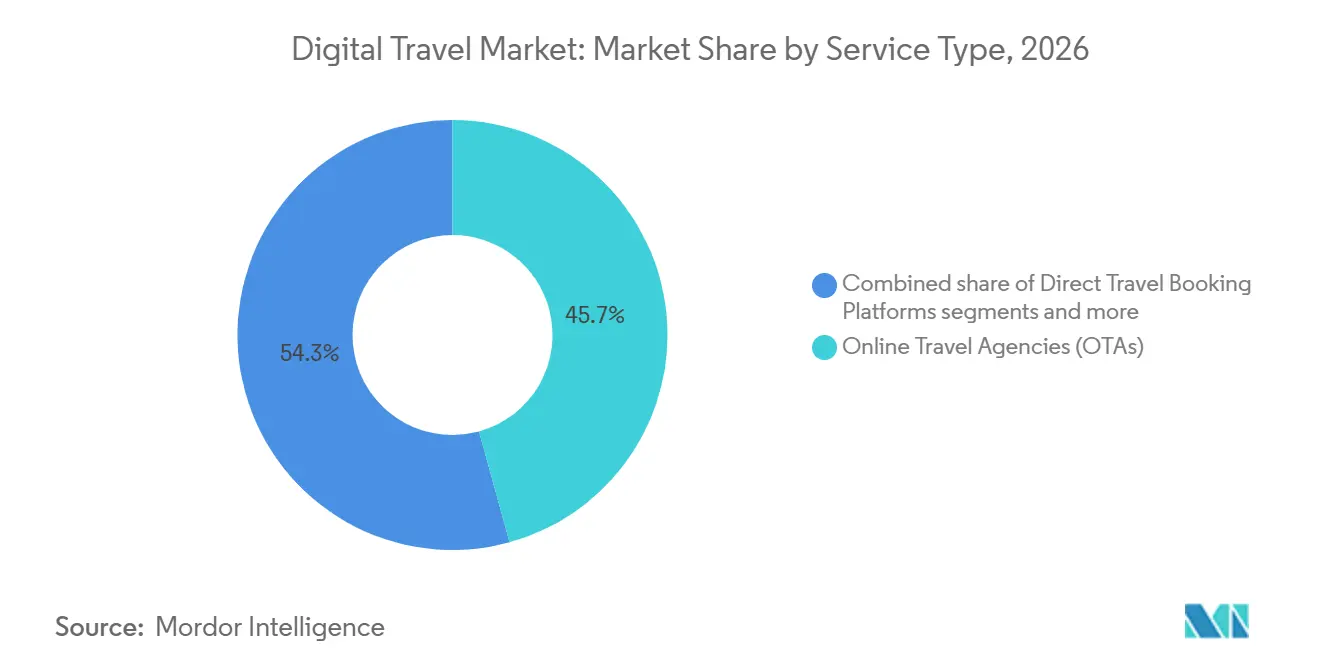
- By service type, Online Travel Agencies accounted for 45.73% of the global digital travel market share in 2026, while Corporate Travel Booking Platforms are projected to grow at an 8.34% CAGR through 2032.
- By booking type, Air Ticket Booking accounted for 35.62% of the global digital travel market share in 2026, while Tour, Activity, and Experience Booking is projected to grow at an 8.73% CAGR through 2032.
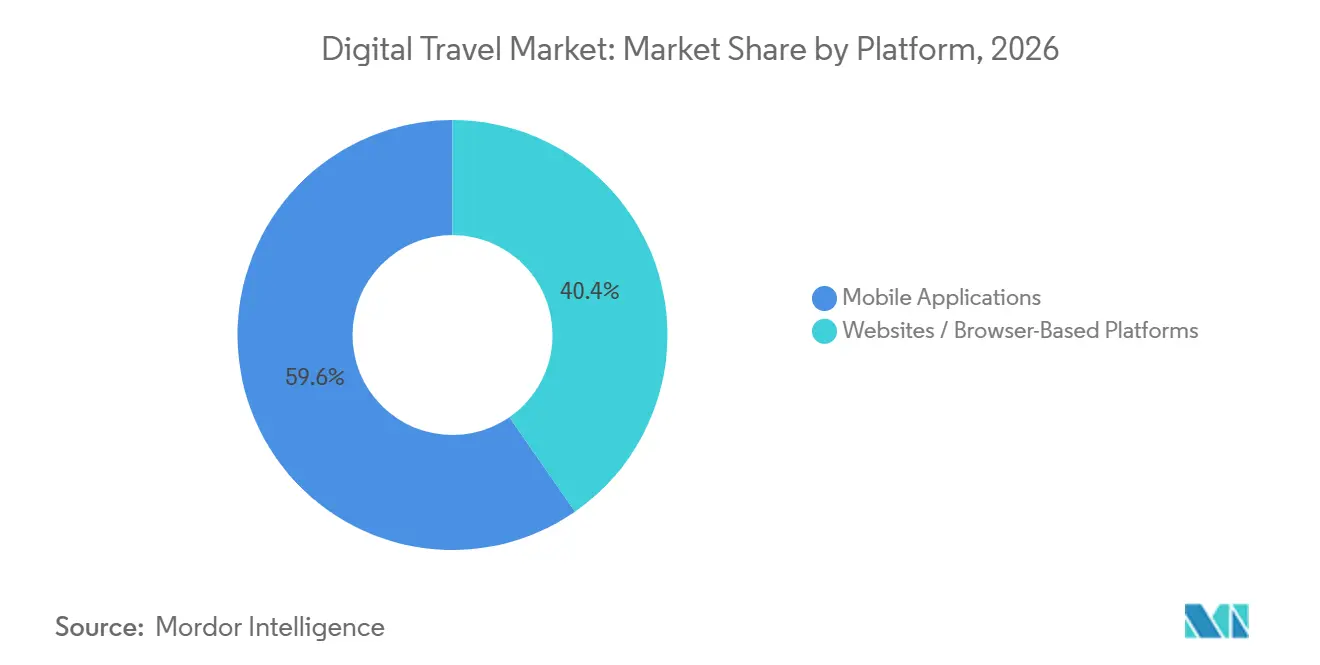
- By platform, Mobile Applications accounted for 59.64% of the global digital travel market share in 2026 and are projected to grow at a 9.13% CAGR through 2032.
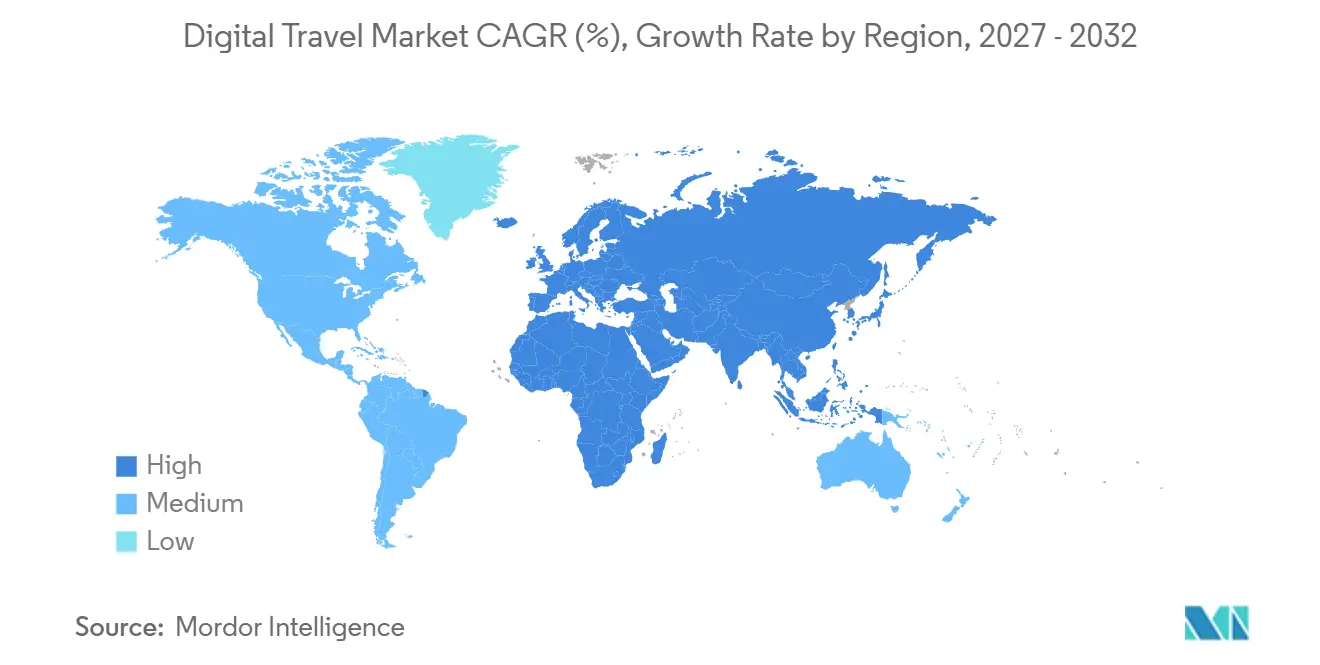
- By geography, North America accounted for 33.53% of the global digital travel market share in 2026, while Asia-Pacific is projected to grow at an 8.85% CAGR through 2032.
Note: Market numbers in this report are based on Mordor Intelligence's proprietary estimation framework, which combines nine months of actuals with Q4 projections for base year 2026.
Market Trends and Insights
Drivers Impact Analysis of Digital Travel Market*
| Driver | (~) % Impact on CAGR Forecast | Geographic Relevance | Impact Timeline |
|---|---|---|---|
| Smartphone-Led Booking and App Adoption | +1.5% | Global | Short term (≤ 2 years) |
| Expansion of Digital Payments and Embedded Finance | +1.2% | Global, high in Asia-Pacific and South America | Medium term (2-4 years) |
| AI-Powered Personalization and Dynamic Pricing | +1.4% | Global, with early adoption in North America and Europe | Medium term (2-4 years) |
| Growth of Mobile-First Travel Demand in Asia-Pacific | +1.3% | Asia-Pacific, with spillover to Middle East and Africa | Medium term (2-4 years) |
| Expansion of Multimodal and NDC-Based Travel Distribution | +0.9% | North America and Europe | Long term (≥ 4 years) |
| Social, Experience-Led, and Creator-Influenced Travel Discovery | +0.8% | Global, with early gains in Asia-Pacific and North America | Short term (≤ 2 years) |
| Source: Mordor Intelligence | |||
Smartphone-Led Booking and App Adoption
Mobile booking drives the global digital travel market by integrating travel research, payment, and servicing on a single device. Mobile devices accounted for 70.5% of global online travel traffic, highlighting the audience platforms must convert into bookings[1]. In 2025, Booking.com’s mobile app accounted for a share of room nights in the mid-50% range, up from the low-50% range in 2024. This trend is particularly relevant in markets where a unified app can combine rail, intercity bus, accommodation, and air travel in one purchasing flow. Strong onboarding, secure authentication, and fast checkout can reduce customer acquisition costs over time. Applications support market growth by enabling users to move from trip discovery to booking confirmation without a separate payment process.
Expansion of Digital Payments and Embedded Finance
Digital payment flexibility is an increasingly important competitive factor in the global digital travel market. Travel payment research by Nuvei and Edgar, Dunn & Company found that 92% of surveyed travelers considered payment ease important. In comparison, 59% would abandon a booking if their preferred payment method was unavailable and 75% preferred split payments. The research also estimated that payment declines and checkout friction put more than USD 30.00 billion in annual revenue at risk for airlines and online travel agencies[2]. These findings highlight opportunities for digital travel platforms to offer localized payment methods, digital wallets, multi-currency pricing, and installment options. Tailoring checkout experiences to regional preferences and improving failed-transaction recovery can help reduce booking abandonment and strengthen customer confidence.
AI-Powered Personalization and Dynamic Pricing
AI-supported personalization is reshaping competition in the global digital travel market by enabling platforms to present relevant offers and service options. Sabre expanded its collaboration with Aeromexico through Air Price IQ and Ancillary IQ, using real-time data to support airfare and ancillary offer decisions. Booking Holdings reported 30% year-over-year growth in multi-vertical bookings in the second quarter of 2025, reflecting demand for integrated travel journeys. The commercial value lies in combining flights, accommodations, and activities without complicating search results. Consumer protection and data privacy regulations remain important as personalized pricing becomes more common.
Growth of Mobile-First Travel Demand in Asia-Pacific
Asia-Pacific supports global digital travel market growth, as mobile commerce is embedded in travel purchase journeys. In India, MakeMyTrip reported USD 9.80 billion in gross bookings and USD 978.30 million in revenue in FY2025, with revenue increasing 25% year over year. These results indicate that users in tier-2 and tier-3 cities can support digital travel demand when platforms offer inventory and payment options suited to local needs. China, India, and Southeast Asia provide a large base of travelers who use applications for travel discovery and booking. The regional market can expand as travel companies simplify cross-border payments, language options, and customer support.
Restraints Impact Analysis of Digital Travel Market*
| Restraint | (~) % Impact on CAGR Forecast | Geographic Relevance | Impact Timeline |
|---|---|---|---|
| Customer-Acquisition Cost and Search-Platform Dependence | -0.9% | Global, most acute in North America and Europe | Short term (≤ 2 years) |
| Cybersecurity, Payment Fraud, and Data-Privacy Exposure | -0.7% | Global | Medium term (2-4 years) |
| Fragmented Supplier Technology and Servicing Complexity | -0.6% | Global, most acute in the Middle East and Africa and South America | Long term (≥ 4 years) |
| Travel Affordability, Currency Volatility, and Price Sensitivity | -0.8% | Asia-Pacific, South America, Middle East and Africa | Short term (≤ 2 years) |
| Source: Mordor Intelligence | |||
Customer-Acquisition Cost and Search-Platform Dependence
Customer acquisition remains a restraint in the global digital travel market, as many platforms rely on search engines and metasearch channels for paid demand. Booking Holdings’ transformation program generated USD 500.00-550.00 million in annual run-rate savings through improved operating efficiency. Search results that answer travel queries without directing users to booking platforms can reduce referral traffic and increase paid visibility costs. Loyalty programs, direct applications, and post-booking services can reduce dependence on a single traffic source. Smaller regional travel operators may face greater pressure due to limited budgets for traffic acquisition and brand building. The market remains vulnerable when external discovery platforms control customer relationships.
Cybersecurity, Payment Fraud, and Data-Privacy Exposure
Cybersecurity and data privacy remain key challenges in the global digital travel market because online bookings involve personal, reservation, and payment data. WestJet confirmed in June 2025 that a criminal third party had accessed its systems without authorization, exposing some customers’ personal and travel-related data. The airline reported that card details, CVVs, expiration dates, and passwords were not compromised. A March 2025 survey by Outpayce, Amadeus’ payment specialist, of 4,500 travelers found that over 70% prioritized payment security, while 67% would not accept a 5% discount to book with a company with poor cybersecurity[3]. These findings underscore the need for data protection, secure payments, and customer trust. Compliance and cybersecurity investments may increase costs, especially for smaller platforms.
*Our forecasts treat driver/restraint impacts as directional, not additive. The impact forecasts reflect baseline growth, mix effects, and variable interactions.
Consumer Behavior Analysis
Consumer preferences increasingly balance convenience, digital control, and privacy. IATA’s 2025 Global Passenger Survey, based on more than 10,000 responses from more than 200 countries, found that 78% of travelers wanted smartphones to integrate digital wallets, passports, and loyalty cards. Additionally, electronic bag tag use also rose from 28% in 2024 to 35% in 2025. Biometric adoption reached 50% in 2025, up from 46% in 2024, reflecting greater acceptance of connected travel services. Digital platforms can integrate itinerary management, loyalty benefits, and live updates while addressing data security concerns.
Booking preferences varied by age and payment method. Among travelers under 25, 54% preferred digital wallets, compared with 28% of all respondents. Additionally, 26% preferred booking flights through airline apps, versus 19% overall. Providers can attract younger travelers through mobile-first interfaces, flexible payment options, personalized trip tools, and clear privacy safeguards.
Digital Travel Performance Intelligence
In 2025, Booking Holdings recorded USD 186.10 billion in gross bookings and USD 26.90 billion in revenue, while Expedia Group generated USD 119.60 billion in gross bookings and USD 14.70 billion in revenue. These figures demonstrate the scale of digital travel distribution and the importance of converting online searches into complete transactions. Expedia’s B2B gross bookings grew 24% in Q4 2025, reflecting demand for travel technology and distribution partnerships.
SiteMinder found that hotel websites generated an average booking value of USD 516.00 in 2025, compared with USD 312.00 through online travel agencies (OTAs), highlighting the revenue potential of direct bookings. Trip.com Group’s 2025 revenue rose 17% to USD 8.90 billion, while international platform bookings increased 60%. These results underscore the need to balance direct channels with third-party reach and tailor platforms to regional demand.
Digital Travel Market Segment Analysis
By Service Type:
OTAs Anchor Distribution, Corporate Platforms Drive GrowthOnline travel agencies held 45.73% of the global digital travel market in 2026, supported by broad inventory, loyalty tools, and consumer-facing applications. In 2025, Booking Holdings reported USD 186.10 billion in gross bookings and USD 26.90 billion in revenue, while Expedia reported USD 119.60 billion and USD 14.70 billion, respectively. Regional platforms, such as MakeMyTrip in India, combine domestic transportation and lodging for mobile-led audiences.
Corporate travel booking platforms are forecast to register an 8.34% CAGR through 2032, making them the fastest-growing service type. These platforms support connected booking, expense, policy, and traveler-support processes. They provide approved inventory and help firms meet duty-of-care requirements. Direct supplier websites remain relevant as hotels and airlines seek direct traveler relationships. In 2025, hotel websites generated an average booking value of USD 516.00, compared with USD 312.00 through online travel agencies. The market will continue to include intermediary and direct channels, as each serves distinct traveler and supplier needs. Metasearch and travel comparison platforms support price discovery and referral traffic, while other digital travel services, such as trip-planning and itinerary-management tools, add value before and after booking.

By Booking Type:
Air Leads Share, Experiences Lead GrowthAir ticket booking accounted for 35.62% of the global digital travel market in 2026, making it the largest booking type. Booking Holdings recorded 68 million airline tickets purchased in 2025, while Expedia reported 57 million booked air tickets. Air travel anchors many digital trips by setting travel dates and destinations. Airlines’ expansion of New Distribution Capability (NDC) may change how platforms display fares and ancillary services. Air bookings also connect domestic routes, international travel, and multimodal trip planning.
Tour, activity, and experience bookings are forecast to grow at an 8.73% CAGR through 2032, faster than other booking types. Accommodation remains a high-value category, while ground transport gains importance in complete itineraries. Travelers are allocating more spending to structured experiences. Expedia’s B2B business grew 24% in the fourth quarter of 2025, indicating demand beyond consumer hotel bookings. Platforms can add value by offering activities and local transport alongside lodging reservations.
By Platform:
Mobile Dominates Share and Leads Forecast GrowthMobile applications held a 59.64% share in 2026 and are projected to grow at a 9.13% CAGR through 2032. They support direct customer engagement through alerts, saved preferences, loyalty benefits, payments, and post-booking services. Booking.com’s mobile app accounted for a mid-50% share of its room nights in 2025. Mobile travel sales represented 37% of global travel sales and are projected to reach 44% by 2029[4]. For consumers, a single interface can support multiple transportation and accommodation decisions.
Web and browser platforms continue to support complex or high-value trip planning, including multi-destination itineraries, group travel, and corporate approvals. The gap between mobile traffic and completion rates remains a commercial challenge for the global digital travel market. Embedded payments, biometric authentication, and relevant support can reduce abandonment. Mobile applications are likely to receive greater product investment because they support ongoing engagement.
Geography Analysis
North America Digital Travel Market
North America accounted for 33.53% of the global digital travel market in 2026, making it the largest regional market. Established online travel agencies, loyalty programs, direct supplier channels, and B2B platform investments characterize the mature market. Supplier-direct booking channels and card-linked travel portals compete with online travel agencies, increasing the importance of loyalty, service quality, and direct traffic. Platforms must demonstrate value beyond search and transaction services.
Europe Digital Travel Market
Europe remains a major digital travel market, supported by strong platform use and a demanding regulatory environment. Online travel planning is substantial across the United Kingdom, Germany, France, Spain, and Italy. In November 2025, eDreams ODIGEO reported 7.70 million Prime subscribers, up 18%. Data privacy requirements and airline distribution disputes continue to shape platform operations.
APAC Digital Travel Market
Asia-Pacific is forecast to grow at an 8.85% CAGR from 2027 to 2032, making it the fastest-growing region. China, India, Japan, South Korea, and Southeast Asia support growth through rising travel demand and mobile adoption. In FY2025, Trip.com Group reported USD 8.90 billion in net revenue, up 17%, while international platform bookings grew 60% year over year. Local payments, cross-border travel, language support, and mobile-led service expectations will shape the market.
Digital Travel Supply & Development Intelligence
The global digital travel market is evolving as airline retailing, mobile bookings, and integrated payments reshape distribution. IATA’s New Distribution Capability (NDC) enables airlines to distribute flexible offers, giving travelers clearer fare and ancillary options. It requires airlines, travel agencies, and booking platforms to integrate modern systems with existing processes. In India, trips may combine air, rail, bus, lodging, and destination services. Supply systems must provide consistent content, servicing, and cancellation support.
MakeMyTrip reported USD 9.80 billion in gross bookings and USD 978.30 million in revenue in FY2025, with revenue up 25% year over year. Its performance highlights unified mobile interfaces for booking transportation and accommodations. eDreams ODIGEO reported 7.70 million Prime subscribers in November 2025, up 18%, demonstrating subscription-led engagement. The market includes global and country-focused operators, as local inventory, payment methods, and language support remain important.
Competitive Landscape
The global digital travel market remains fragmented across accommodations, air travel, ground transportation, and experiences. Booking Holdings, Expedia, Airbnb, Trip.com, and Tripadvisor are major consumer-facing platforms with differing capabilities and geographic strengths. In 2025, Booking Holdings generated USD 186.10 billion in gross bookings and reported a 36.9% adjusted EBITDA margin, while Expedia generated USD 119.60 billion in gross bookings. Their scale supports broad inventory and marketing reach, but local players and supplier-direct channels remain relevant.
Companies are expanding into adjacent services beyond hotel and flight reservations. Expedia reported 24% growth in B2B gross bookings in the fourth quarter of 2025. Booking Holdings reported 30% year-over-year growth in multi-vertical bookings in the second quarter of 2025. eDreams ODIGEO focused on membership growth, subscription tiers, and rail integration. MakeMyTrip combines multiple travel services through a mobile-led customer relationship. Competition depends on service quality, loyalty, pricing transparency, payment capabilities, and local inventory.
AI and modern airline retailing are expanding competition. Sabre’s partnership with Aeromexico supports dynamic airfare and ancillary offers, while Agoda’s creator program uses commission-based content partnerships to generate demand. The industry faces scrutiny over data use, search visibility, and supplier relationships. Across markets, global companies, regional platforms, direct suppliers, and financial services firms offering travel features support market fragmentation, despite increasing concentration in select online travel agency categories.
Digital Travel Industry Leaders
-
Booking Holdings Inc.
-
Expedia Group, Inc.
-
Airbnb, Inc.
-
Trip.com Group Limited
-
Tripadvisor, Inc.
- *Disclaimer: Major Players sorted in no particular order
Digital Travel Market Companies Covered in this Report
- Booking Holdings Inc.
- Expedia Group, Inc.
- Airbnb, Inc.
- Trip.com Group Limited
- Tripadvisor, Inc.
- MakeMyTrip Limited
- eDreams ODIGEO S.A.
- Despegar.com, Corp.
- Amadeus IT Group, S.A.
- Sabre Corporation
- Travelport Limited
- Klook
- GetYourGuide
- Traveloka Group
- Yatra Online Limited
- Seera Group
- Wego Pte Ltd
- Hopper Inc.
- Webjet Group Limited
- Tongcheng Travel Holdings Limited
Recent Industry Developments in Digital Travel Market
- October 2026: Booking Holdings launched Vayo, an AI-powered travel agent in private beta that manages cross-platform bookings and monitors prices and travel plans. The company announced a planned investment of up to USD 100.00 million, signaling competition in AI-driven trip management.
- October 2026: eDreams ODIGEO collaborated with Amazon Alexa to enable AI travel search and voice-first booking in the Alexa+ environment using its proprietary Model Context Protocol technology.
- November 2025: eDreams ODIGEO reached 7.70 million Prime subscribers, up 18%, and targets over 13 million by 2030 through rail integration and new subscription tiers.
- October 2025: Agoda launched its Ambassador Program, allowing travel creators to earn commissions through unique promo codes, receive sponsored stays worth up to USD 225.00 monthly, and gain exposure through Agoda marketing campaigns.
Global Digital Travel Market Report Scope
The global digital travel market report analyzes online travel services and digital booking platforms worldwide. The market is segmented by service type (online travel agencies, metasearch, direct travel booking platforms, corporate travel booking platforms, and other digital travel services), booking type, platform, and geography. The study examines key drivers, including smartphone-led booking adoption, digital payment flexibility, AI-powered personalization, social-media-influenced travel discovery, and expansion of digital distribution, alongside restraints such as customer-acquisition costs, cybersecurity risks, fragmented supplier technology, and travel affordability. It evaluates platform development, booking volumes, transaction trends, revenue performance, average booking value, traveler preferences, channel selection, and digital spending behavior. The report provides market size and growth forecasts, competitive landscape analysis, market concentration, market share assessment, strategic developments, and profiles of leading providers. It also explores opportunities in AI-driven trip planning, automated booking, integrated travel services, and expansion across emerging markets. Market estimates and forecasts are presented in value (USD) across all covered segments.
Segmentation Overview
Key Questions Answered in the Report
What is the projected size of the global digital travel market by 2032?
The global digital travel market was valued at USD 669.23 billion in 2026 and is projected to reach USD 997.97 billion by 2032, expanding at a 7.56% CAGR from 2027 to 2032.
Which service type leads digital travel bookings?
Online travel agencies lead with a 45.73% share in 2026, supported by broad inventory, loyalty programs, and mobile applications.
Why are mobile applications important for digital travel companies?
Mobile applications held a 59.64% share in 2026 and are projected to grow at a 9.13% CAGR through 2032 because they combine discovery, payments, and customer service.
Which region is growing fastest in the global digital travel market?
Asia-Pacific is forecast to grow at the fastest rate, at an 8.85% CAGR from 2027 to 2032.
Which booking category is expected to grow fastest?
Tour, activity, and experience booking is forecast to grow at an 8.73% CAGR through 2032 as travelers add local experiences to their itineraries.
What are the main risks for digital travel platforms?
Key risks include high customer-acquisition costs, cyber fraud, fragmented supplier systems, and price sensitivity during periods of higher travel costs.