
Germany Scaffolding Rental Market Size and Share
Market Overview
| Study Period | 2021 - 2032 |
|---|---|
| Forecast Data Period | 2027 - 2032 |
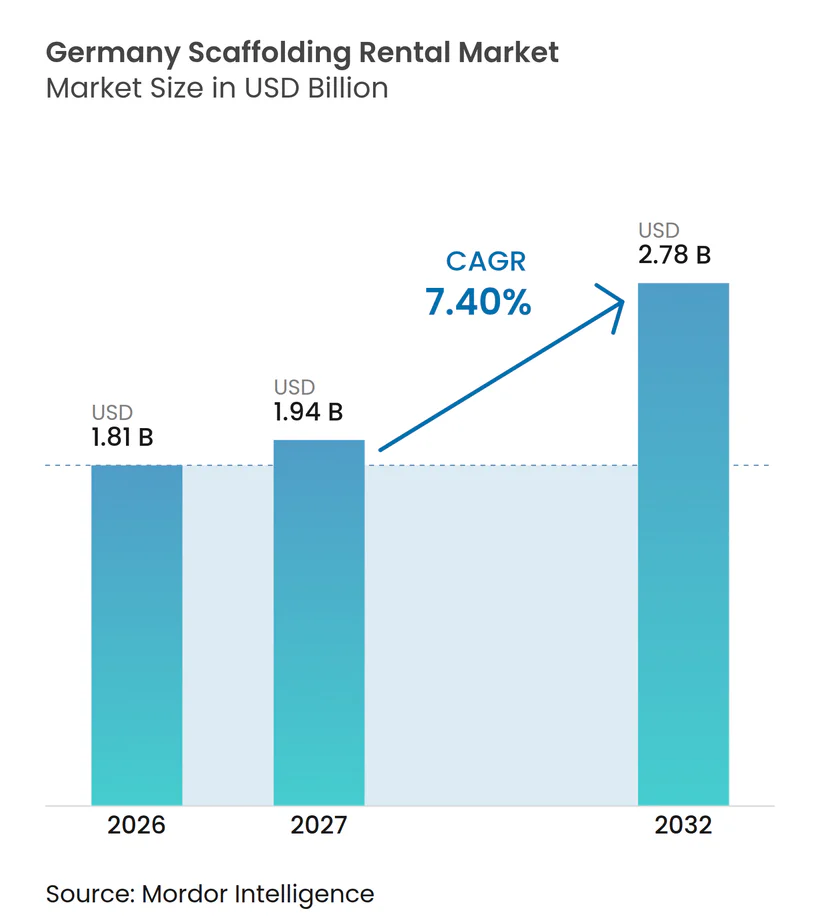
| Base Year Market Size (2026) | USD 1.81 Billion |
| Market Size (2027) | USD 1.94 Billion |
| Market Size (2032) | USD 2.78 Billion |
| Growth Rate (2027 - 2032) | 7.40 % |
| Market Concentration | Medium |
Major Players *Disclaimer: Major Players sorted in no particular order Image © Mordor Intelligence. Reuse requires attribution under CC BY 4.0. | |
Germany Scaffolding Rental Market Analysis by Mordor Intelligence
The Germany Scaffolding Rental Market size is expected to grow from USD 1.81 billion in 2026 to USD 1.94 billion in 2027 and is forecast to reach USD 2.78 billion by 2032 at 7.40% CAGR over 2027-2032.
Demand is increasingly linked to renovation, transport rehabilitation, and energy projects rather than residential new construction. Germany completed 206,600 dwellings in 2025, down 18.00% from 2024 and the lowest total since 2012, which limits the recovery path for residential-focused rental fleets. Public investment is shifting toward bridge repairs and rail upgrades, which usually require longer access periods and more specialized systems. Building renovation is also sustaining work because serial façade projects need extensive scaffold grids during compressed installation periods. These conditions support fleet utilization for operators that can meet engineering, documentation, and labor requirements.
Key Report Takeaways
- By type, Supported Scaffold held 45.00% of the Germany scaffolding rental market share in 2026, while Suspended Scaffold is forecast to grow at an 8.70% CAGR through 2032.
- By system, Modular and Ringlock held 40.00% of the Germany scaffolding rental market share in 2026 and are forecast to grow at an 8.00% CAGR through 2032.
- By material type, Steel held a 59.00% share in 2026, while Aluminum is forecast to grow at an 8.20% CAGR through 2032.
- By sector, Infrastructure held a 42.00% share in 2026 and is forecast to grow at an 8.30% CAGR through 2032.
- By geography, the Rest of Germany held a 73.00% share in 2026, while Berlin is forecast to grow at a 7.80% CAGR through 2032.
Note: Market numbers in this report are based on Mordor Intelligence's proprietary estimation framework, which combines nine months of actuals with Q4 projections for base year 2026.
Market Trends and Insights
Drivers Impact Analysis of Germany Scaffolding Rental Market*
| Drivers | (~) % Impact on CAGR Forecast | Geographic Relevance | Impact Timeline |
|---|---|---|---|
| Energy-Efficient Building Renovation and Facade Refurbishment | +1.8% | National, concentrated in North Rhine-Westphalia, Bavaria, and Berlin | Medium term (2-4 years) |
| Transport Infrastructure and Bridge Rehabilitation Programs | +1.5% | National, with intensity in Baden-Württemberg, Lower Saxony, and Brandenburg | Long term (≥ 4 years) |
| Energy-Transition Projects, Grid, Wind, and Hydrogen | +1.1% | Northern Germany, with spillover to central Germany | Long term (≥ 4 years) |
| Strict Safety Regulation Favoring Certified Systems | +0.8% | National | Short term (≤ 2 years) |
| High Rental Penetration Among Gerüstbau Contractors | +0.6% | National, with urban concentration in the top 5 cities | Short term (≤ 2 years) |
| BIM and Digital Scaffold Planning | +0.4% | National, with early adoption in Berlin, Munich, and Hamburg | Medium term (2-4 years) |
| Source: Mordor Intelligence | |||
Energy-Efficient Building Renovation and Facade Refurbishment
Germany’s existing building stock remains an important source of scaffold work. The German Energy Agency reported that serial renovation approvals rose from under 2% of high-efficiency renovation applications before the bonus program to an average of 23% afterward[1]. The 2,143 approved projects covered 11,600 residential units, creating work that is concentrated across whole building blocks rather than isolated properties. Such projects require large scaffold grids to be erected at the same time, which increases rental intensity within short construction windows. The serial-renovation pipeline has triggered USD 2.2 billion in construction activity, while its stated potential reaches USD 550 billion through 2045. Grant-linked energy performance requirements continue to direct spending toward façade work and other access-dependent interventions.
Transport Infrastructure and Bridge Rehabilitation Programs
Germany has committed USD 182.6 billion to transport investment through 2029, with a stated focus on maintaining rail networks and motorway bridges rather than expanding new routes[2]. Bridge repair often needs suspended or modular access systems that can operate under live traffic conditions. DEGES completed the Kochertalbrücke rehabilitation on the A81 in August 2025 after a 3-year program[3]. Work also began on Berlin’s A100 Ringbahnbrücke replacement, a project with a USD 88 million investment volume. These projects call for contractors that can supply engineered systems and maintain required safety records. Their longer construction schedules can give the Germany scaffolding rental market more stable utilization than short residential contracts.
Energy-Transition Projects, Grid, Wind, and Hydrogen
Power grid, offshore wind, and hydrogen projects are creating a durable source of access work in northern and central Germany. The network development plan proposes 4,800 km of new high-voltage lines and 35 high-voltage direct current corridors, each with 2 GW capacity, to connect offshore wind capacity. Converter stations, cable facilities, and grid interfaces need scaffold access during construction and maintenance. Gasunie commissioned a hydrogen pipeline pilot in Buchholz, Nordheide, in September 2025, using low-emission equipment and hydrogen-fueled generators. EWE’s 320 MW electrolyzer project in Emden also moved forward when it awarded a compressor contract in May 2025. These projects favor industrial modular systems because access needs extend across complex structures and multi-stage programs.
Strict Safety Regulation, Rental Penetration, and Digital Planning
Safety rules support demand for certified scaffold systems and documented project processes. In January 2025, the Bundesinnung revised inspection and handover forms with BG BAU to strengthen shared accountability between scaffold erectors and users under TRBS 2121-1 and the Betriebssicherheitsverordnung. DIBt also published guidance on scaffold column joints in August 2025 under DIN EN 12811-1 and DIN EN 12812. These compliance factors make certified fleets more relevant in public procurement and complex industrial projects. High rental use among Gerüstbau contractors reduces the need for customers to hold large equipment inventories, especially in dense cities. Digital planning is becoming more useful as PERI expanded its Scaffold Estimation Tool and project-management tools at bauma 2025. BIM workflows and model-based erection can reduce planning errors and help large contractors deploy equipment across several sites.
Restraints Impact Analysis of Germany Scaffolding Rental Market*
| Restraints | (~) % Impact on CAGR Forecast | Geographic Relevance | Impact Timeline |
|---|---|---|---|
| Skilled Erector Shortages and Rising Labor Costs | -1.1% | National, most acute in Hamburg, Berlin, Munich, and Frankfurt | Long term (≥ 4 years) |
| Weak Residential New-Build Activity | -0.9% | National, with greatest exposure in smaller cities and suburban markets | Medium term (2-4 years) |
| Steel and Aluminum Price Volatility | -0.6% | National, concentrated among fleet-heavy rental operators | Short term (≤ 2 years) |
| Environmental Compliance and Logistics Costs | -0.4% | National, with the highest impact in urban cores subject to noise and access restrictions | Medium term (2-4 years) |
| Source: Mordor Intelligence | |||
Skilled Erector Shortages and Rising Labor Costs
Qualified erector availability remains a key operating constraint for the Germany scaffolding rental market. The Bundesinnung has identified recruitment as a priority because retirements are widening the gap between demand for trained Gerüstbauer and available labor. In October 2025, the sector’s employers and IG Bauen-Agrar-Umwelt concluded a new wage agreement that became effective on November 1, 2025, after a 2-year gap. The agreement covered 35,000 workers and included higher wages, revised apprentice compensation, and a heat-day payment. These measures raise the cost of deploying crews and can pressure margins where fleet capacity is already high. Immigration support and digital tools may ease part of the problem, but autonomous scaffold erection is not yet a standard operating tool.
Weak Residential New-Build Activity and Input-Cost Pressures
Residential construction weakness reduces demand from customers focused on new homes. Germany completed 206,600 dwellings in 2025, a decline of 18.00%, while multi-family completions in eastern Germany fell 34.3%. The construction association reported that 35,700 building permits expired unused in 2025, indicating that approved projects can still fail to reach the worksite. Material costs have moderated from their 2022 peaks but remain elevated against earlier levels, which affects fleet replacement decisions. Steel and aluminum prices can also be affected by trade-related volatility. Urban operators face additional logistics, noise, and access restrictions that can extend installation time and increase project costs.
*Our forecasts treat driver/restraint impacts as directional, not additive. The impact forecasts reflect baseline growth, mix effects, and variable interactions.
Germany Scaffolding Rental Market Segment Analysis
By Type:
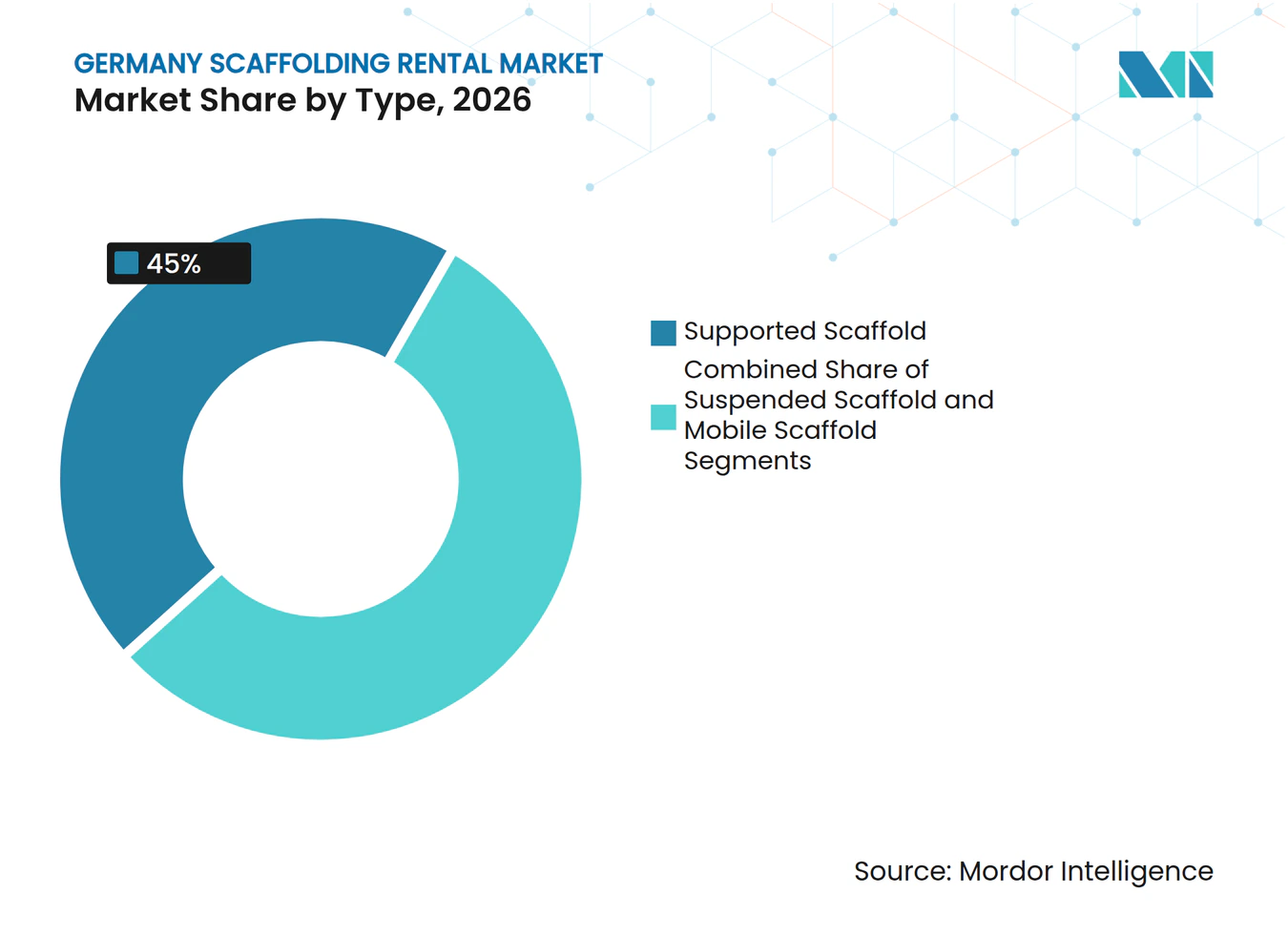
Supported Systems Retain Broad Project CoverageSupported Scaffold accounted for 45.00% of the Germany scaffolding rental market size in 2026. Its lead reflects its use across façade renovation, bridge soffit access, and industrial maintenance. PERI presented its expanded Scaffold Estimation Tool at bauma 2025 to pre-calculate complex scaffold arrangements and coordinate them with digital site planning. This capability can improve the fit of supported structures on technically complex sites. Mobile Scaffold remains relevant for indoor renovation and maintenance where movement speed is more important than high load capacity. These applications give contractors a broad base of smaller and recurring rental assignments.
Suspended Scaffold is forecast to expand at an 8.70% CAGR through 2032 within the Germany scaffolding rental market. It is suited to high-rise façade work and bridge access where ground-supported structures are not practical. Serial renovation can increase the size of supported-system contracts because several buildings may be handled in a single work program. Layher introduced SIM2Field and SIM2Field XR in 2025 to support model-based erection and field work from a 3D scaffold model. Such tools can limit material waste and reduce assembly errors on complex projects. Large operators with pre-certified fleets are better placed to support larger assignments, while smaller local firms remain important for shorter jobs.



By System:
Modular and Ringlock Systems Lead Complex Access WorkModular and Ringlock systems held 40.00% of Germany scaffolding rental market share in 2026. They are used on irregular façades, bridge abutments, and industrial structures because their node arrangements permit varied bay spacing. This flexibility makes them relevant to the project categories expanding fastest in the country. Frame and H-Frame systems remain common for standard residential work. Their relative exposure is higher where new-build activity is weak. Tube and Coupler systems continue to serve specialized civil and industrial work, while Cuplock retains a stable role in large projects.
Modular and Ringlock systems are also forecast to grow at an 8.00% CAGR through 2032. Scafom-rux reported its strongest rental and sales figures for the SUPER-RS modular façade scaffold system at bauma 2025, supporting the observed shift toward engineered access systems. Certified system engineering allows contractors to provide design support with physical equipment. This can improve returns on energy and transport projects compared with standard residential jobs. The difference in project mix may widen the gap between operators that hold advanced modular fleets and those focused on basic frames. Compliance requirements under DIN standards also increase the value of systems that have established documentation.
By Material Type:
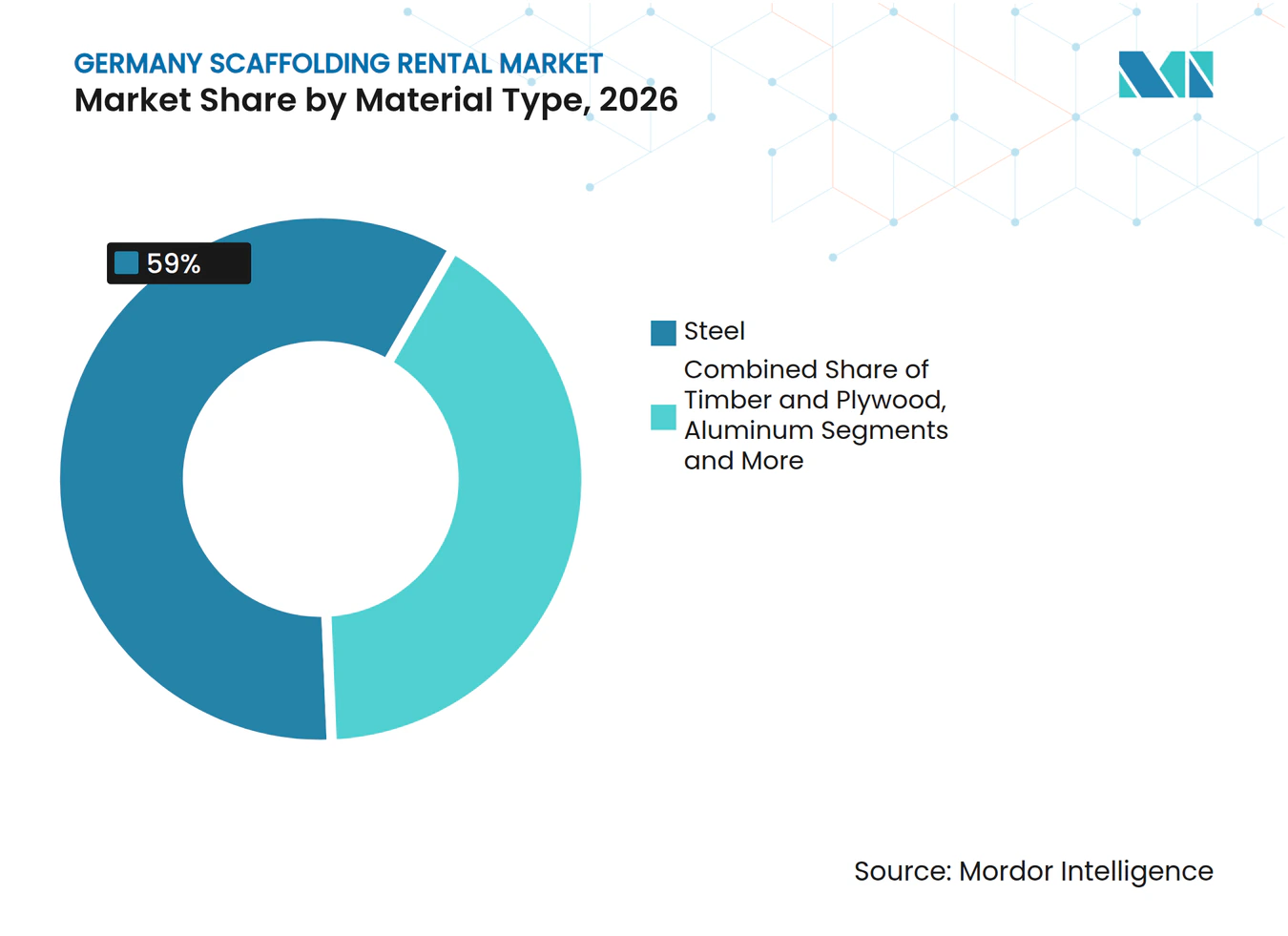
Steel Holds the Installed Base While Aluminum Gains UseSteel represented 59.00% of the Germany scaffolding rental market size in 2026. Its position is supported by established local fabrication and predictable access to replacement parts. Steel systems offer high load capacity and are widely used for infrastructure and industrial applications. ALTRAD Plettac Assco operates manufacturing activities in Germany that support this supply base. Nonmetal systems remain smaller because durability and fire requirements can limit their use in demanding applications. Timber, plywood, plastic, and fiberglass therefore remain specialized choices.
Aluminum is forecast to grow at an 8.20% CAGR through 2032. Its lower weight can help on historic façades where anchor loads and manual handling are important concerns. Faster assembly can also matter in serial renovation because rental duration influences the full project cost. Aluminum fleets have different economics from steel fleets because premium rates and quicker turnover can offset reduced scrap value. The choice between the materials is therefore linked to project requirements and fleet strategy rather than a direct replacement cycle. Metal construction costs remaining above earlier levels also support rental use instead of ownership for many contractors.

By Sector:
Infrastructure Provides Longer-Duration DemandInfrastructure accounted for 42.00% of the Germany scaffolding rental market share in 2026. It is forecast to grow at an 8.30% CAGR through 2032, making it the largest and fastest-growing sector. The USD 182.6 billion transport commitment supports rail maintenance and motorway bridge work through 2029. Offshore grid connections and hydrogen facilities add more access-intensive construction activity. Infrastructure contracts often require equipment for 12 to 36 months, compared with 4 to 8 weeks for a residential new-build project. This duration improves fleet planning and gives rental revenue greater visibility.
Residential demand remains constrained by the decline in completions, while commercial work is supported by office conversion and retail refurbishment in major cities. Industrial and Logistics is another active area because brownfield maintenance and decarbonization work need recurring site access. These assignments commonly pair equipment rental with ongoing services, which can support longer customer relationships. The Germany scaffolding rental market therefore has a broader set of demand sources than residential construction alone. This shift favors contractors that can supply industrial-grade systems and manage multi-year programs. It also reduces reliance on the timing of housing starts.
Geography Analysis
Rest of Germany
The rest of Germany held 73.00% of the Germany scaffolding rental market share in 2026. The region includes a large number of mid-sized industrial and construction centers that support consistent rental activity. Transport rehabilitation is visible across the country, including the completed Kochertalbrücke program in Baden-Württemberg. Lower Saxony also benefits from North Sea grid connections and hydrogen-related investment. These projects require modular or suspended access solutions that are suitable for civil and energy assets. Operators must coordinate material movements and crews across longer distances. Certification under TRBS 2121-1 and DIN EN 12811 remains relevant wherever public and industrial contracts require documented system performance. The opportunity favors networks that can deliver standardized systems in dispersed locations.
Berlin
Berlin is forecast to expand at a 7.80% CAGR through 2032 in the Germany scaffolding rental market. The city combines commercial development with a large renovation base across older building types. The USD 88 million A100 Ringbahnbrücke replacement adds a high-value infrastructure project to the local pipeline. PERI’s work on the Upbeat office tower shows the increasing use of digital pre-engineering on complex urban sites. Access restrictions and dense streets make logistics planning important. Model-based planning can reduce on-site adjustments and support safer installation. Compliance documentation also matters because urban projects involve multiple contractors and detailed site controls. These conditions support providers with both technical planning capacity and local delivery capability.
Munich, Frankfurt, and Hamburg
Munich, Frankfurt, and Hamburg each bring a different source of demand to the Germany scaffolding rental market. Munich has commercial and mixed-use development, while Frankfurt supports office conversion and logistics refurbishment. Hamburg has port maintenance and electricity and hydrogen grid work, including activity at Finkenwerder. This mix reduces dependence on one project class across the three cities. City-center controls can raise transport and installation costs, particularly where noise and access limits apply. Rental systems that can be planned digitally and assembled efficiently are useful in these constrained conditions. The wider shift toward certified systems is reinforced by DIBt guidance and DIN EN requirements. Contractors that can manage urban logistics while maintaining complete inspection records are better positioned to serve this group of cities.
Competitive Landscape
Market Concentration
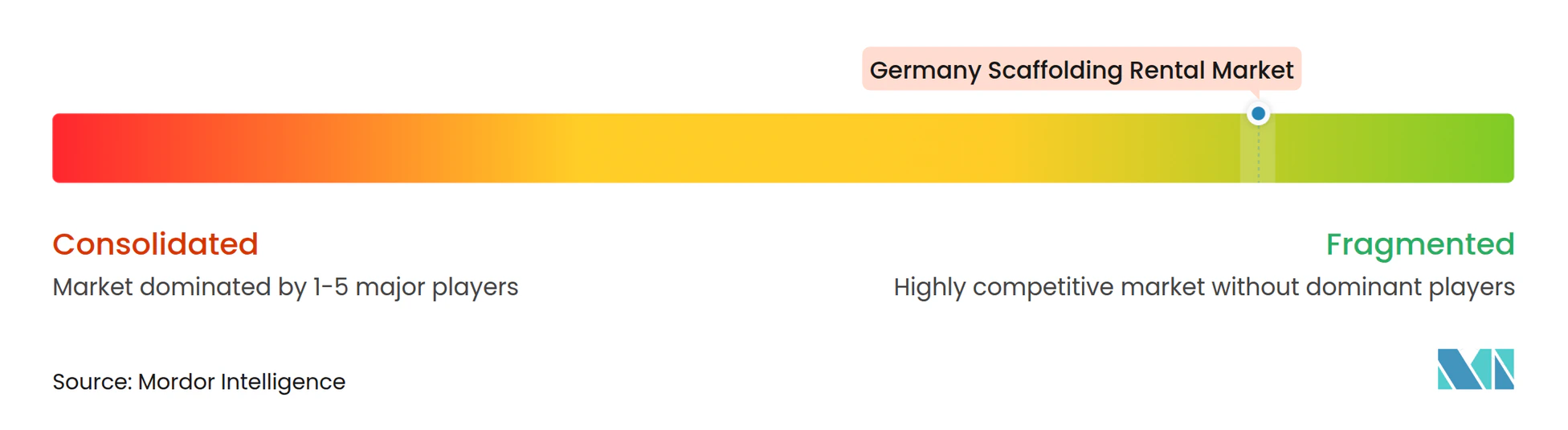
The Germany scaffolding rental market includes Layher, PERI, Altrad, BrandSafway, XERVON, and a broad group of regional Gerüstbau contractors. Layher and PERI set technical standards through their certified system portfolios and manufacturer-linked rental models. Their approach combines system design, equipment availability, and documentation support. Altrad competes across manufacturing, rental, and industrial services through its German plettac assco operations. The company completed an operational merger of its German entities in 2025 to bring production and commercial operations into a single structure. XERVON combines scaffold access with maintenance and inspection for energy and chemical customers. This bundled model can support longer framework arrangements than a spot-rental transaction.
Digital fleet management is becoming a key point of competition. PERI expanded digital scaffold planning and project tools at bauma 2025, including the Scaffold Estimation Tool, XR tools, and PERIcap. Layher launched SIM2Field and SIM2Field XR in 2025 to support model-based scaffold assembly. Doka deployed its AI Counting and Identification system in June 2025 to recognize returned components using mobile-device photography. The company reported 98.00% identification accuracy and more than 1 million items processed since rollout. These tools can improve inventory control and reduce loss from dispersed fleets. They can also raise the investment threshold for smaller contractors.
Standards and compliance create another difference between larger and smaller operators. The January 2025 documentation update by the Bundesinnung and BG BAU strengthened the records expected from erectors and users. DIBt’s August 2025 guidance on scaffold joints requires system holders to keep technical documentation current. Altrad’s integrated model and the digital investments by Layher, PERI, and Doka show the move toward more controlled fleet and project management. Regional contractors remain important because local awards and service response are central to many jobs. The market therefore remains moderately fragmented, even as certified systems and digital tools may favor larger operators over time. Market concentration score: 4 out of 10, reflecting a moderately fragmented structure with several multinational and German leaders alongside a broad base of regional contractors.
Germany Scaffolding Rental Industry Leaders
-
Layher Holding GmbH & Co. KG
-
PERI SE
-
Doka Deutschland GmbH
-
ALTRAD Industrial Services GmbH
- *Disclaimer: Major Players sorted in no particular order
Germany Scaffolding Rental Market Companies Covered in this Report
- Layher Holding GmbH & Co. KG
- PERI SE
- Doka Deutschland GmbH
- ALTRAD Industrial Services GmbH
- Brand Energy & Infrastructure Services GmbH (BrandSafway)
- ALTRAD Plettac Assco GmbH
- RUX GmbH (Scafom-rux Germany)
- MJ-Gerüst GmbH
- FRIEDR. ISCHEBECK GmbH
- XERVON GmbH
- Hünnebeck GmbH
- Teupe & Söhne Gerüstbau GmbH
- Söll Gerüstbau GmbH
- Gemeinhardt Service GmbH
- Burkart Gerüstbau GmbH
- Theodor Kaiser Gerüstbau GmbH
- Menke Gerüst Montage GmbH
- GESTA Gesellschaft für Stahlrohrgerüste mbH
- Güll Gerüstbau GmbH
- Bassenberg & Schwarting GmbH
Recent Industry Developments in Germany Scaffolding Rental Market
- September 2026: Revscaff Safety Systems placed a seven-figure investment in Layher scaffolding equipment, establishing a new scaffolding division alongside existing safety businesses Prodek Safety Systems and Revnet Safety Systems. The investment, announced at the ScaffEx26 trade event, reflects continued confidence in Layher's Allround system as an entry platform for new scaffolding operations.
- August 2026: Altrad completed the merger of Generation Hire & Sales and Trad UK into Altrad Hire & Sales, effective 1 September 2026, consolidating scaffolding, access, temporary works, fencing, and specialist construction equipment services across the UK and Ireland under a unified brand with an extensive branch network.
- October 2025: Hünnebeck by BrandSafway and alkus AG signed an expanded supply agreement covering alkus solid-plastic formwork panels for additional Hünnebeck systems including the RONDA circular formwork, the PAX column formwork, and further systems, extending a supplier relationship established in 2013 for the PLATINUM 100 wall formwork system.
Germany Scaffolding Rental Market Report Scope
Segmentation Overview
| Supported Scaffold |
| Suspended Scaffold |
| Mobile Scaffold |
| Tube and Coupler |
| Cuplock |
| Modular and Ringlock |
| Frame and H-Frame |
| Timber and Plywood |
| Steel |
| Aluminum |
| Plastic and Fiberglass |
| Others |
| Residential |
| Commercial |
| Industrial and Logistics |
| Infrastructure |
| Berlin |
| Munich |
| Frankfurt |
| Hamburg |
| Rest of Germany |
| By Type | Supported Scaffold |
| Suspended Scaffold | |
| Mobile Scaffold | |
| By System | Tube and Coupler |
| Cuplock | |
| Modular and Ringlock | |
| Frame and H-Frame | |
| By Material Type | Timber and Plywood |
| Steel | |
| Aluminum | |
| Plastic and Fiberglass | |
| Others | |
| By Sector | Residential |
| Commercial | |
| Industrial and Logistics | |
| Infrastructure | |
| By Cities | Berlin |
| Munich | |
| Frankfurt | |
| Hamburg | |
| Rest of Germany |
Key Questions Answered in the Report
What is the value of Germany’s scaffolding rental sector?
It stands at USD 1.81 billion in 2026 and is forecast to reach USD 2.78 billion by 2032, growing at a 7.40% CAGR.
Which scaffold type is growing fastest in Germany?
Suspended Scaffold is forecast to grow at an 8.70% CAGR through 2032, supported by high-rise façade refurbishment and underbridge access needs.
Why is infrastructure important for scaffolding rental demand in Germany?
Infrastructure held a 42.00% share in 2026 and is forecast to grow at an 8.30% CAGR, supported by transport rehabilitation and energy-transition projects.
Which material leads scaffold rentals in Germany?
Steel held a 59.00% share in 2026 because it remains widely used in infrastructure and industrial access applications.
Why is aluminum gaining use in scaffolding projects?
Aluminum is forecast to grow at an 8.20% CAGR because lower weight can support façade renovation and faster assembly.
Which German location is expected to grow fastest for scaffold rentals?
Berlin is forecast to grow at a 7.80% CAGR through 2032, supported by renovation, commercial development, and bridge replacement work.