
Germany Robotic Lawn Mower Market Size and Share
Market Overview
| Study Period | 2021 - 2031 |
|---|---|
| Forecast Data Period | 2026 - 2031 |
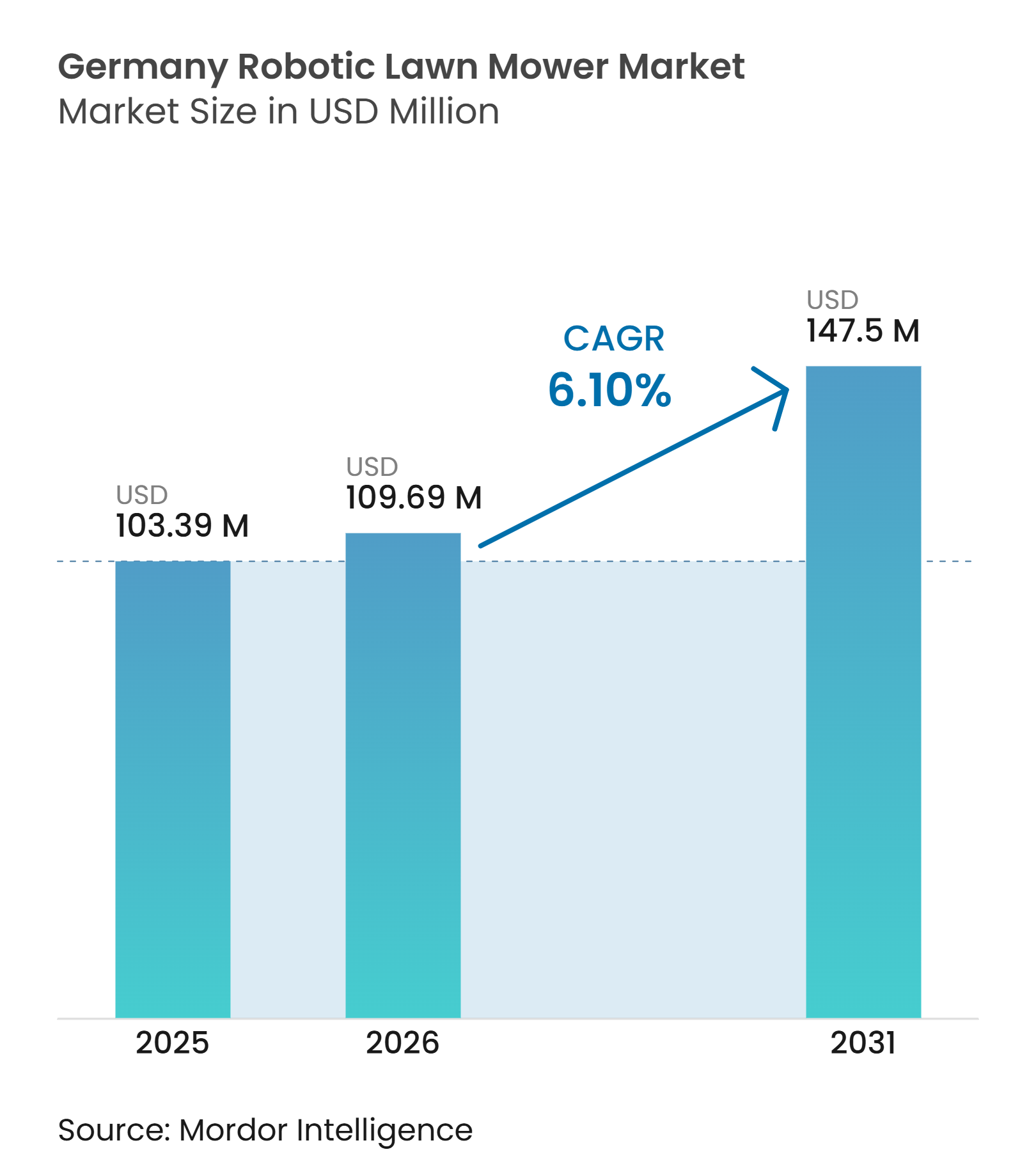
| Base Year Market Size (2025) | USD 103.39 Million |
| Market Size (2026) | USD 109.69 Million |
| Market Size (2031) | USD 147.5 Million |
| Growth Rate (2026 - 2031) | 6.10 % |
| Market Concentration | Medium |
Major Players *Disclaimer: Major Players sorted in no particular order Image © Mordor Intelligence. Reuse requires attribution under CC BY 4.0. | |
Germany Robotic Lawn Mower Market Analysis by Mordor Intelligence
The Germany Robotic Lawn Mower Market was valued at USD 103.39 million in 2025, which is estimated to be USD 109.69 million in 2026 and projected to reach USD 147.5 million by 2031, registering a CAGR of 6.10% between 2026 and 2031. Smart home adoption reached 52% of German households in 2026, up from 46% in 2024, increasing familiarity with app-connected equipment[1]. Mature residential outdoor equipment demand is moderating replacement volumes, while wire-free navigation, improved mapping, and precision mowing are supporting upgrades among quality-focused buyers who prioritize easier setup and consistent results across varied lawn conditions. Established suppliers are maintaining dealer relationships, but online sales and lower-installation products are changing how households compare and purchase equipment, shifting attention toward transparent pricing, simpler setup, product reliability, and the availability of post-delivery support.
Key Report Takeaways
- By range, medium-range products accounted for 45% of the Germany robotic lawn mower market share in 2025, while high-range products are forecast to grow fastest at a 10% CAGR through 2031.
- By battery capacity, 20 to 30 V products held 52% of the Germany robotic lawn mower market size in 2025, while more than 30 V products are projected to grow fastest at a 9.5% CAGR through 2031.
- By sales channel, retailers held 55% of the Germany robotic lawn mower market in 2025, while online sales is fastest growing segment at a 12% CAGR through 2031.
- By connectivity, boundary-wire systems held 55% of the market in 2025, while vision-guided, camera, and LiDAR systems are forecast to be the fastest growing at a 12.5% CAGR through 2031.
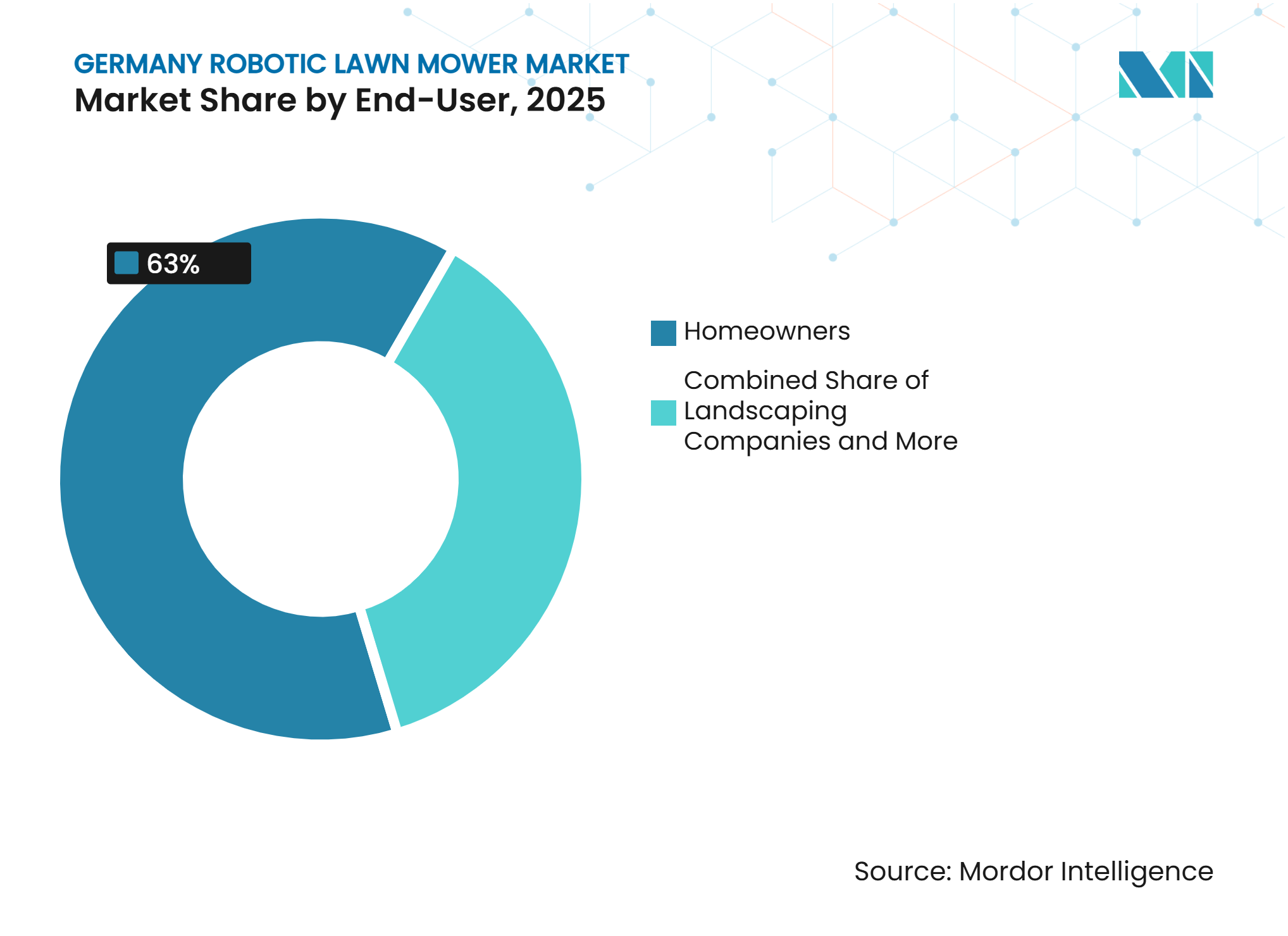
- By end-user, homeowners held 63% market share in 2025, while landscaping companies are forecast to be the fastest-growing, at a 10% CAGR through 2031.
Note: Market size and forecast figures in this report are generated using Mordor Intelligence’s proprietary estimation framework, updated with the latest available data and insights as of January 2026.
Market Trends and Insights
Drivers Impact Analysis of Germany Robotic Lawn Mower Market*
| Driver | (~) % Impact on CAGR Forecast | Geographic Relevance | Impact Timeline |
|---|---|---|---|
| Smart home integration and iot adoption | 1.40% | Germany-wide, with the strongest concentration in Bavaria, Baden-Württemberg, and Hamburg metropolitan areas | Short term (≤ 2 years) |
| Battery-electric replacement of gasoline mowers | 1.10% | Germany-wide, with added relevance in municipalities and residential communities that enforce noise rules | Medium term (2–4 years) |
| Landscaping labor shortages and rising service costs | 1.00% | National, with acute pressure in GaLaBau clusters in North Rhine-Westphalia, Bavaria, and Lower Saxony | Short term (≤ 2 years) |
| Aging homeowners seeking low-effort lawn care | 0.70% | National, with early gains in suburban areas around Stuttgart, Munich, and Frankfurt | Medium term (2–4 years) |
| Wire-free navigation for complex garden layouts | 0.80% | Germany-wide, particularly for irregular allotments and multi-zone private gardens | Medium term (2–4 years) |
| Dealer demonstration of vision-guided mowers | 0.50% | Southern and Western Germany, aligned with dense STIHL, Husqvarna, and AL-KO dealer networks | Long term (≥ 4 years) |
| Source: Mordor Intelligence | |||
Smart-Home Integration and IoT Adoption
A Bitkom survey of 1,159 German residents conducted in August 2026 found that 52% used smart home applications at home, up from 46% in 2024. This growing adoption makes connected lawn care more familiar to a larger share of households. Buyers who already manage thermostats or cameras through a smartphone face fewer practical barriers when considering a robotic mower. The Germany robotic lawn mower market benefits when mowing schedules, status alerts, and security settings can be integrated into routines that customers already use. Husqvarna Automower NERA and Bosch Indego S+ models offer app-based scheduling and smart home compatibility, helping suppliers position robotic mowing as part of connected household equipment rather than a standalone garden purchase. This effect is most visible in areas where both smart home adoption and detached-home ownership are high, as consumers can incorporate the mower into existing routines rather than learning a separate process.
Battery-Electric Replacement of Gasoline Mowers
The replacement of gasoline mowers with battery-electric and autonomous products supports demand across the Germany robotic lawn mower market. Residential mower replacement cycles commonly span 7 to 10 years, leaving a continuing pool of gasoline equipment available for replacement. The EU Machinery Regulation 2023/1230 sets safety requirements for relevant equipment placed on the European market. Municipal procurement practices and community noise rules also discourage the use of gasoline-powered equipment in the early morning and evening[2]. These conditions favor quieter electric alternatives for gardens near neighboring homes. Bosch Power Tools reported EUR 5 billion in revenue in 2025, equivalent to USD 5.4 billion, with 80% generated outside Germany. Its VISIMOW 18V line targets gardens of up to 200 m² without perimeter wires, serving urban garden users for whom noise levels and installation requirements are important purchase factors. Electric replacement supports both entry-level automation and more capable robotic systems, allowing suppliers to address quiet-operation needs without requiring every buyer to immediately enter the premium segment.
Landscaping Labor Shortages and Rising Service Costs
Germany recorded an annual average of 12,146 unfilled skilled positions in 2025 within the broader garden sector, with garden, landscape, and sports-ground construction accounting for 75.9% of this deficit. This shortage limits landscaping providers' ability to meet grounds-care demand with manual crews alone, shifting the commercial case for robotic mowing from convenience to labor substitution. The sector's revenue rose 4.3% in nominal terms in 2025, even as insolvencies increased across the wider economy, indicating that demand was outpacing the available labor supply. John Deere noted that 84% of landscape business owners struggled to retain qualified labor and cited this as a factor when announcing an autonomous battery-electric commercial mower in January 2025. Autonomous equipment allows landscaping companies to maintain service coverage when skilled labor is difficult to recruit, while retaining crews for tasks that require judgment, design, or direct customer interaction.
Aging Homeowners Seeking Low-Effort Lawn Care
Older homeowners represent a significant demand base for equipment that reduces physical effort in the Germany robotic lawn mower market. Homeownership among senior households exceeds 70%. Conventional mowing becomes less practical where mobility or strength is limited. Suburban areas in Bavaria and Baden-Württemberg combine larger gardens with a higher concentration of potential users, thereby supporting Southern Germany's leading regional position. Products that reduce setup and routine maintenance address a clear usability requirement for this customer group by reducing the need for physical effort during the mowing season. Warranty coverage, simple maintenance, and clear operating instructions can further support adoption among buyers who prioritize reliable service and prefer to manage garden work without significant physical demands.
Restraints Impact Analysis of Germany Robotic Lawn Mower Market*
| Restraint | (~) % Impact on CAGR Forecast | Geographic Relevance | Impact Timeline |
|---|---|---|---|
| High upfront cost of premium robotic mowers | -0.80% | National, with greater pressure in Eastern Germany where household incomes trail Western states | Medium term (2–4 years) |
| Uneven terrain, slopes, and irregular lawn performance | -0.50% | National, with added relevance in hillside areas of Baden-Württemberg, Bavaria, and Rhineland-Palatinate | Long term (≥ 4 years) |
| Theft risk in dense urban and shared-garden areas | -0.30% | Urban Berlin, Hamburg, and Cologne, plus allotment and shared-garden communities nationwide | Medium term (2–4 years) |
| Product-service fragmentation across connectivity and installation models | -0.40% | National, with the greatest difficulty in online-first sales where post-purchase support is limited | Medium term (2–4 years) |
| Source: Mordor Intelligence | |||
High Upfront Cost of Premium Robotic Mowers
High purchase prices remain a significant restraint for the Germany robotic lawn mower market. Entry-level wire-free products started at EUR 999 (USD 1,082) in the reviewed pricing period. Professional RTK-capable models for larger gardens exceeded EUR 3,000 (USD 3,255) in price, excluding installation and accessories. Conventional push mowers were available below EUR 500 (USD 542). This price difference excludes many households that would otherwise consider robotic equipment. Consumer financing and leasing options were not broadly available for robotic mower purchases in Germany, leaving most households reliant on full upfront payment. The price gap also keeps lower-cost boundary-wire products relevant, even as interest in wire-free equipment grows. Price-sensitive buyers may defer a technology upgrade until hardware and service costs decline, extending the lifespan of the existing boundary-wire product base beyond what feature comparisons alone would suggest.
Uneven Terrain, Slopes, and Irregular Lawn Performance
Uneven terrain limits the use of robotic mowers across the German robotic lawn mower market. Hillside gardens in Bavaria, Baden-Württemberg, and Rhineland-Palatinate present challenges related to traction, navigation, and cutting quality. Narrow paths and irregular boundaries add to operational difficulty. Premium systems address parts of this problem through all-wheel drive, cameras, RTK positioning, and LiDAR, though these capabilities typically increase product cost and complexity. Mammotion states that its LUBA 3 AWD combines LiDAR, RTK, and AI Vision and is designed for slopes of up to 80%. Such specifications indicate how technical requirements increase as gardens become more difficult to manage. Performance uncertainty may still lead buyers to retain conventional equipment in demanding mowing conditions, particularly where poor results would require repeated manual correction, reducing the estimated time-saving benefit.
*Our forecasts treat driver/restraint impacts as directional, not additive. The impact forecasts reflect baseline growth, mix effects, and variable interactions.
Germany Robotic Lawn Mower Market Segment Analysis
By Range:
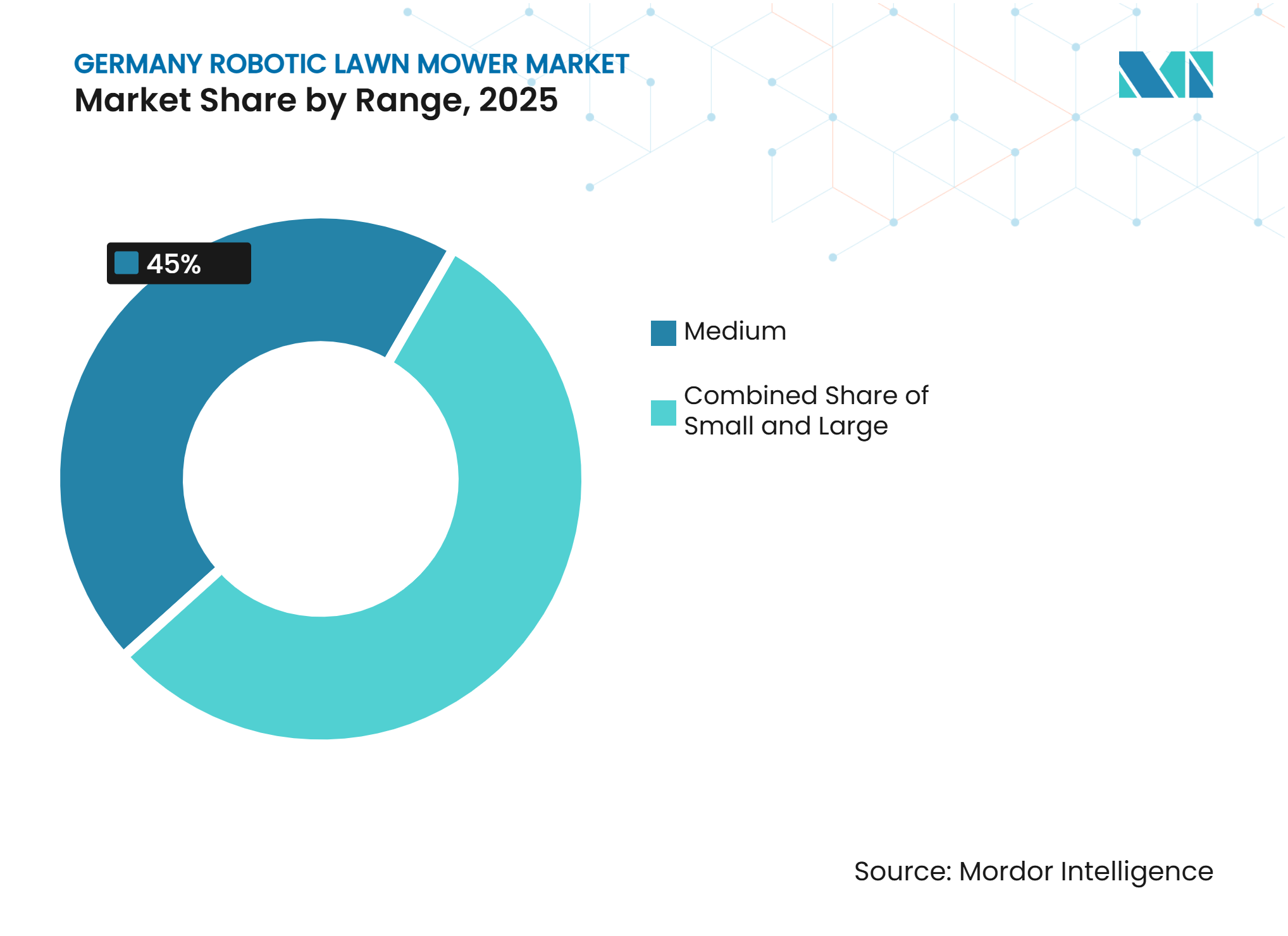
Medium-Range Products Support Mainstream Residential DemandMedium-range products held 45% of the Germany robotic lawn mower market in 2025, as they are suited to the common residential garden area of 300 to 800 m². These models combine multi-zone scheduling, rain sensing, and app connectivity without the higher prices of premium wire-free systems. This balance keeps the tier central to household demand. High-range products are forecast to grow at a 10% CAGR through 2031, driven by demand for greater coverage, terrain capability, and advanced navigation. Low-range models remain relevant for gardens below 200 m², although their relative position is weakening as compact products add vision-based boundary detection.
The shift toward high-range equipment is also linked to the computing and battery demands of whole-property mapping. Husqvarna expanded its boundary-wire-free range to 24 models in February 2025 across residential and professional applications. STIHL's iMOW 7 PRO represented the upper-end offering available for properties up to 10,000 m² in 2025. Premium buyers increasingly evaluate systematic mowing patterns and centimeter-level positioning as measures of product quality. The Germany robotic lawn mower market has a clear mid-market volume base alongside a growing premium opportunity.



By Battery Capacity:
Higher-Voltage Packs Become a Performance DifferentiatorThe 20 to 30 V category held 52% of the Germany robotic lawn mower market in 2025 and supported the largest current residential installed base. Systems above 30 V are forecast to grow at a 9.5% CAGR through 2031. Wire-free navigation increases power demand, as positioning, sensor processing, and onboard software must operate continuously during mowing. Products below 20 V remain suitable for small gardens and compact semi-autonomous equipment. Bosch's VISIMOW 18V range illustrates the continuing role of 18 V products in this entry-level category.
The transition to higher voltage involves performance, product cost, and compliance considerations. The EU Battery Regulation 2023/1542 introduces requirements related to traceability, recycled content, and end-of-life collection for relevant industrial batteries. Premium wire-free mowers commonly use 20 to 40 Ah batteries in the 25 to 50 V range. Mammotion's LUBA 3 AWD combines LiDAR, RTK, and AI Vision, illustrating the continuous processing requirements of advanced navigation systems. Manufacturers must balance runtime, safety, regulatory compliance, and the performance expected from wire-free equipment.
By Sales Channel:
Retailers Remain Important as Online Sales ExpandRetailers accounted for 55% of the Germany robotic lawn mower market share in 2025, supported by established dealer networks for STIHL, Husqvarna, AL-KO, and Honda. Physical stores remain relevant where buyers require product demonstrations, setup advice, maintenance information, and access to local service. Online sales are forecast to grow at a 12% CAGR through 2031. Wire-free systems are driving this growth by reducing the need for perimeter-wire installation and professional setup. Worx introduced the Landroid Vision Cloud at CES 2026 and initially sold the models through its global e-commerce platform.
Specialty stores retain a consistent role for professional and semi-professional users who require application guidance, fleet discussions, and service agreements. Retail and online channels serve different parts of the purchase process rather than acting as direct substitutes. Online demand is strongest in connected urban and suburban areas of Western and Southern Germany, a pattern that reinforces adoption in areas where uptake is already advanced. For higher-value products and complex customer use cases, the Germany robotic lawn mower market will continue to depend on retailer capability.
By Connectivity:
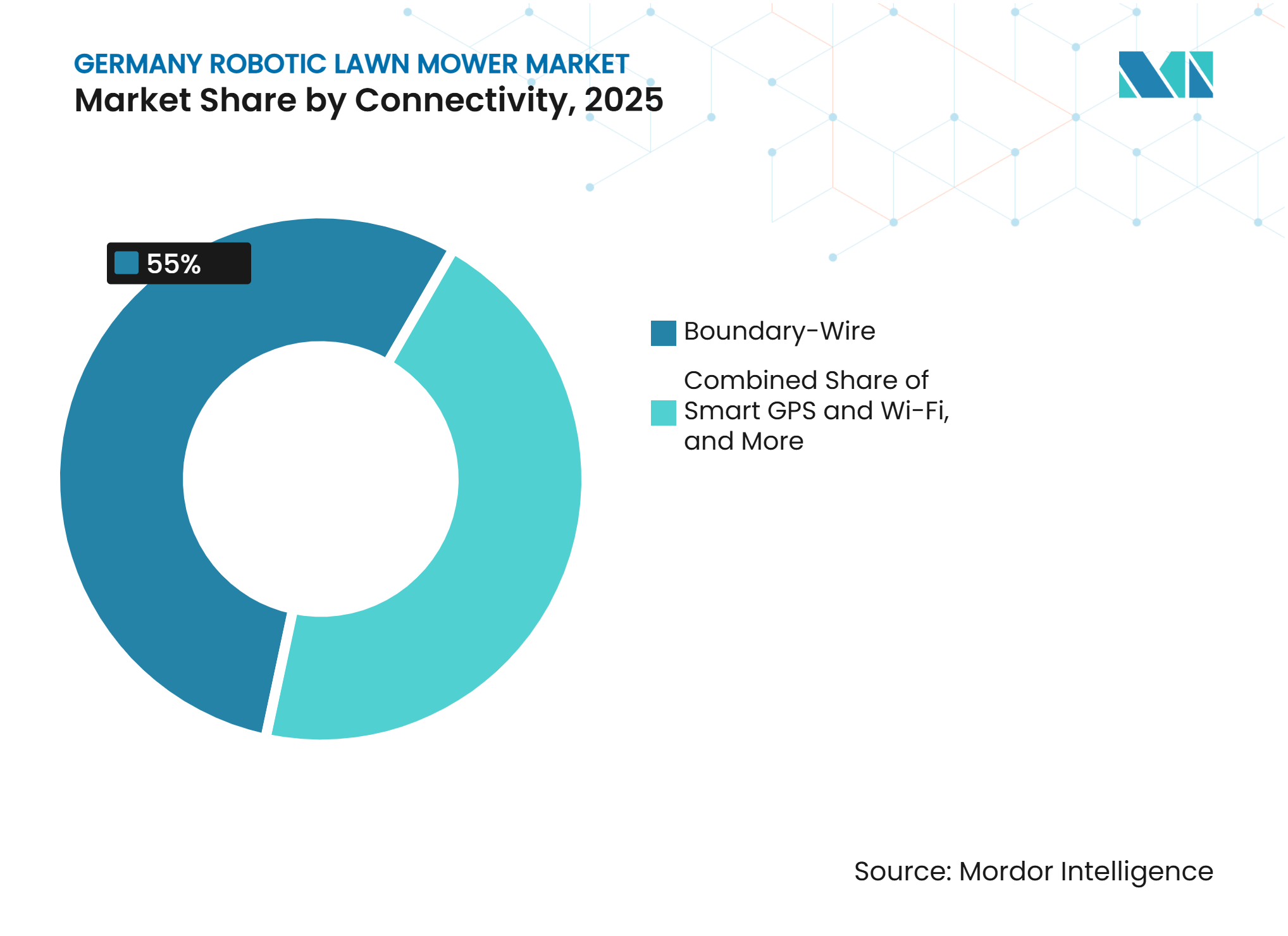
Boundary-Wire Systems Lead While Vision-Guided Products GrowBoundary-wire systems held 55% of the Germany robotic lawn mower market share in 2025, supported by a large installed base from the earlier wire-based period. These models remain appealing for straightforward gardens due to their lower cost compared to many wire-free alternatives. Vision-guided, camera, and LiDAR systems are forecast to grow at a 12.5% CAGR through 2031, the fastest rate across the reported segmentation types. Husqvarna stated that its 2026 AI Vision range would include 7 mowers with onboard cameras[3]. Smart GPS and Wi-Fi systems offer an intermediate option, combining a simpler setup with lower hardware requirements than full LiDAR products.
Complex gardens increase the practical value of advanced connectivity. Irregular plots, separate mowing zones, steep areas, and narrow passages can make fixed-wire installations difficult to adapt to. RTK, camera, and LiDAR systems can map these configurations with fewer fixed components. Segway Navimow's X420 and i206 AWD received TUV Rheinland Lawn Care certification in April 2026. Connectivity is expected to increasingly influence installation time, service requirements, and buyer channel preferences.

By End-User:
Homeowners Lead Demand as Landscaping Companies Grow FasterHomeowners accounted for 63% of the Germany robotic lawn mower market in 2025, driven by detached housing, suburban gardens, and an established gardening culture. Many residential buyers seek a consistent lawn appearance with reduced routine maintenance. The landscaping company segment is forecast to grow at a 10% CAGR through 2031. Skilled labor shortages make autonomous mowing a practical approach for maintaining service capacity and managing recurring workloads. The reported shortage of garden and landscape workers further strengthens the commercial value proposition.
Sports grounds, parks, municipalities, and golf courses represent the higher-value professional category, where units frequently exceed EUR 10,000 (USD 10,850). Toro installed the Greensmaster eTriFlex 3360 with GeoLink Mow at Golf Club Würzburg in April 2026. Belrobotics deployed 12 GPS-RTK Bigmow units across 8 sports centers in Waalwijk, Netherlands, providing a municipal reference case. Educational facilities, aviation sites, and hospitality properties are smaller user groups that value predictable operating costs. John Deere's 2025 autonomous commercial mower announcement indicates continued expansion in professional equipment supply.
Geography Analysis
Southern Germany, including Bavaria and Baden-Württemberg, has a high concentration of owner-occupied detached homes with medium to large gardens. Higher incomes and early adoption of technology support demand for high-end wire-free products. Dense dealer coverage facilitates product demonstrations and after-sales service.
Western Germany, led by North Rhine-Westphalia and Rhineland-Palatinate, is the most populous market zone. Dense settlements in the Ruhr area reduce the addressable household garden base, but the Rhine and Rhine-Moselle corridors represent a large aggregate opportunity. Labor shortages are encouraging commercial buyers to consider autonomous equipment. The IHK-Initiative Rheinland projected up to 735,000 unfilled positions across the regional economy by 2030.
Eastern Germany held the smallest share of the Germany robotic lawn mower market among the four regional segments in 2025. Historically lower homeownership rates reflect the legacy housing structure of the former GDR. Berlin's urban core limits garden-related demand, while areas around Dresden, Leipzig, and Erfurt show emerging adoption. Commercial demand remains less developed in the region, creating opportunities for dealer investment and product demonstrations. Parks, sports grounds, and municipal green spaces represent potential entry points, as labor budgets are constrained and maintaining service capacity through manual work alone is difficult.
Competitive Landscape
Market Concentration
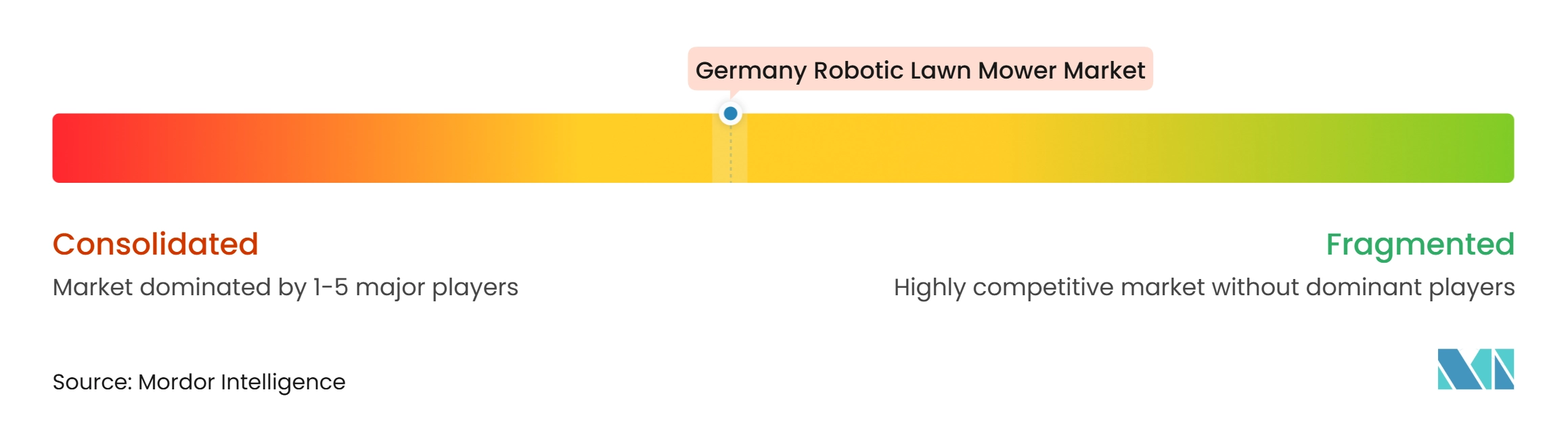
The Germany robotic lawn mower market was moderately concentrated in 2025. The major players include Husqvarna Group, Robert Bosch GmbH, ANDREAS STIHL AG and Co. KG, AL-KO Kober SE, and Honda Motor Co., Ltd. Husqvarna Group has built a broad wire-free portfolio and introduced AI Vision products with onboard cameras in 2026, while its cloud service removes the need for a local RTK reference station. Robert Bosch GmbH uses systematic mowing and domestic brand recognition to support its Indego line. Its VISIMOW 18V range also provides Robert Bosch GmbH an entry point below EUR 500 (equivalent to USD 542).
Chinese-headquartered brands are increasing competitive pressure through rapid product cycles and hardware-cost advantages. Segway Navimow reported reaching 1 million cumulative units produced in April 2026 and opened a production line in Malaysia. Mammotion's LUBA 3 AWD combines LiDAR, RTK, and AI Vision in a single navigation system. AL-KO introduced the Robolinho Gen 5 platform in June 2026 with AI stereo cameras, N-RTK or LiDAR navigation, and drop-and-mow capability. Competition now centers on navigation reliability, setup simplicity, pricing, and local service.
The professional segment between premium offerings from Toro and Belrobotics remains underserved. Products priced from EUR 3,000 to EUR 8,000 (equivalent to USD 3,255 to USD 8,680) could address the needs of landscaping companies and municipalities. Kress, John Deere, and European specialist suppliers could pursue this gap, while Toro's April 2026 installation in Würzburg provides a German commercial reference case. EU Machinery Regulation 2023/1230 and IEC 60335 standards create technical entry requirements that favor suppliers with established compliance and service capabilities.
Germany Robotic Lawn Mower Industry Leaders
-
Husqvarna Group
-
Robert Bosch GmbH
-
ANDREAS STIHL AG and Co. KG
-
AL-KO Kober SE
-
Honda Motor Co., Ltd.
- *Disclaimer: Major Players sorted in no particular order
Germany Robotic Lawn Mower Market Companies Covered in this Report
- Husqvarna Group
- Robert Bosch GmbH
- ANDREAS STIHL AG and Co. KG
- AL-KO Kober SE
- Honda Motor Co., Ltd.
- Deere & Company
- STIGA S.p.A.
- Zucchetti Centro Sistemi S.p.A.
- Positec Tool Corporation
- Segway Inc.
- Shenzhen Mammotion Technologies Co., Ltd.
- The Toro Company
- Stanley Black and Decker, Inc.
- MTD Products Inc.
- Greenworks Tools
Recent Industry Developments in Germany Robotic Lawn Mower Market
- September 2026: Mammotion unveiled the LUBA 4 AWD series and the Maston commercial robotic mowing platform at IFA 2026 in Berlin. The LUBA 4 AWD covers 0.75 to 3 acres using surround navigation, bidirectional driving, and independent front-wheel steering. Maston is the company's first fleet-management-equipped commercial mower. Pre-orders for LUBA 4 AWD open in Q4 2026.
- September 2026: Segway Navimow announced the Navimow H5 Pro at IFA 2026. It features the EdgeMaestro extendable robotic arm, which extends 7.7 cm for zero-edge mowing, LiDAR, Vision, and NRTK Tri-Fusion navigation, and 360-degree VisionFence animal detection. The launch included a Germany-specific partnership with Igelhilfe Schulzendorf e.V.
- January 2026: Segway Navimow unveiled the X4, i2 AWD, i2 LiDAR, H2, and Terranox series at CES 2026 for residential and commercial applications.
Germany Robotic Lawn Mower Market Report Scope
A robotic lawn mower is an autonomous, battery-powered machine designed to mow and maintain grass with minimal human intervention. It uses sensors, navigation systems, and intelligent controls to operate within a defined lawn area, avoid obstacles, maintain the desired grass height, and recharge automatically when required.
The Germany robotic lawn mower market report is segmented by range (low, medium, and high), by battery capacity(less than 20 V, 20 to 30 V, and more than 30 V), by sales channel(retailers, specialty stores, and online), by connectivity(boundary-wire, smart GPS and Wi-Fi, and vision-guided, camera, and LiDAR systems), and by end-user(homeowners, landscaping companies, sports grounds and parks, municipalities, golf courses, and others). Market forecasts are presented in terms of value in USD.
Segmentation Overview
| Low |
| Medium |
| High |
| Less Than 20 V |
| 20 to 30 V |
| More Than 30 V |
| Retailers |
| Specialty Stores |
| Online |
| Residential |
| Commercial |
| Homeowners |
| Landscaping Companies |
| Sports Grounds and Parks |
| Municipalities |
| Golf Courses |
| Other End-Users |
| Boundary-Wire |
| Smart-GPS and Wi-Fi |
| Vision-Guided, Camera and LiDAR |
| By Range | Low |
| Medium | |
| High | |
| By Battery Capacity | Less Than 20 V |
| 20 to 30 V | |
| More Than 30 V | |
| By Sales Channel | Retailers |
| Specialty Stores | |
| Online | |
| By Application | Residential |
| Commercial | |
| By End-User | Homeowners |
| Landscaping Companies | |
| Sports Grounds and Parks | |
| Municipalities | |
| Golf Courses | |
| Other End-Users | |
| By Connectivity | Boundary-Wire |
| Smart-GPS and Wi-Fi | |
| Vision-Guided, Camera and LiDAR |
Key Questions Answered in the Report
What is the Germany robotic lawn mower market forecast through 2031?
The Germany robotic lawn mower market is forecast to reach USD 147.5 million by 2031, at a 6.1% CAGR during 2026-2031.
Which product range leads demand in Germany?
Medium-range products led with 45% share in 2025 because they fit mainstream residential gardens and offer useful automated functions.
Which sales channel is growing fastest for robotic lawn mowers in Germany?
Online sales are forecast to grow at a 12% CAGR through 2031 as wire-free products reduce installation requirements.
Why are landscaping companies adopting autonomous mowers?
Skilled labor shortages make robotic mowing a practical way to maintain service capacity and manage recurring grounds-care work.
Which navigation technology is growing fastest in Germany?
Vision-guided, camera, and LiDAR systems are forecast to grow at a 12.5% CAGR through 2031, supported by demand for simpler installation and better handling of complex gardens.