
Germany-Poland Industrial Rail Freight Transport Market Size and Share
Market Overview
| Study Period | 2020 - 2031 |
|---|---|
| Forecast Data Period | 2026 - 2031 |
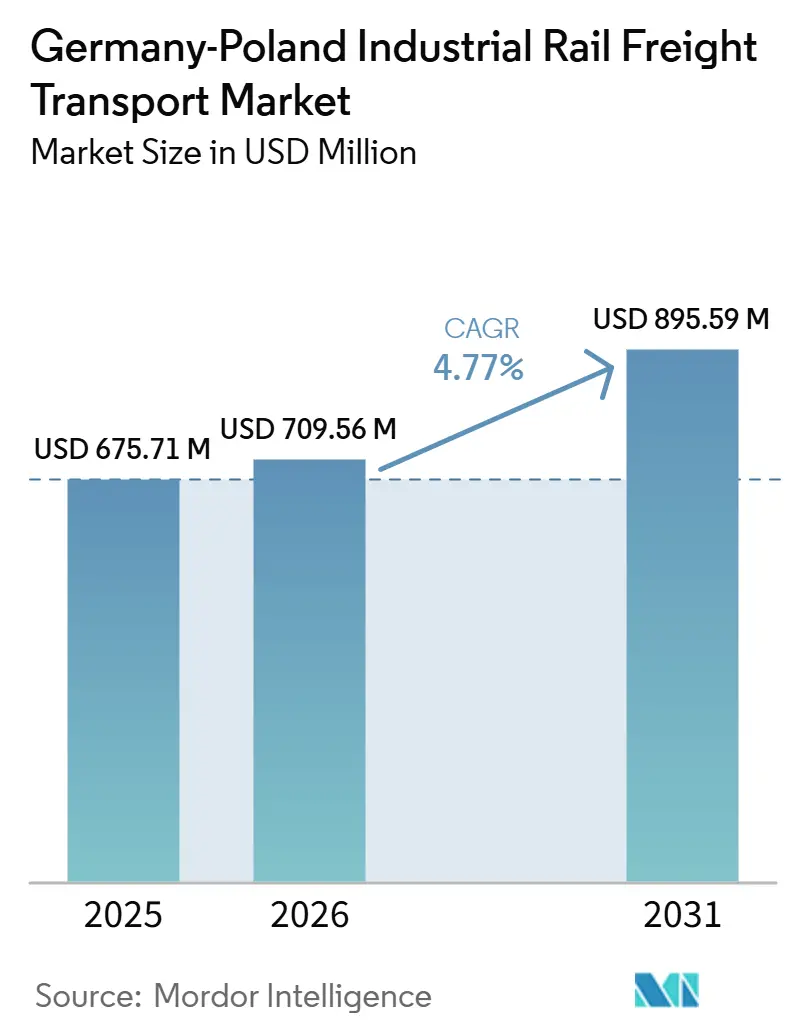
| Base Year Market Size (2025) | USD 675.71 Million |
| Market Size (2026) | USD 709.56 Million |
| Market Size (2031) | USD 895.59 Million |
| Growth Rate (2026 - 2031) | 4.77 % |
| Market Concentration | Medium |
Major Players *Disclaimer: Major Players sorted in no particular order Image © Mordor Intelligence. Reuse requires attribution under CC BY 4.0. | |
Germany-Poland Industrial Rail Freight Transport Market Analysis by Mordor Intelligence
The Germany-Poland industrial rail freight transport market size was valued at USD 675.71 million in 2025 and is expected to reach USD 709.56 million in 2026 and USD 895.59 million by 2031, growing at a CAGR of 4.77% over 2026-2031.
The corridor connects German industrial demand with Polish manufacturing output, giving rail a stable role in moving metals, automotive parts, chemicals, and other manufactured goods along recurring trade lanes. The Germany-Poland industrial rail freight transport market also benefits from dense bilateral supply chains that require regular, high-volume transport and support contract freight rather than purely spot shipments. At the same time, network renewal work on the German side disrupted intermodal schedules in 2025. It reduced rerouting flexibility, weighing on service reliability and increasing operating pressure for carriers and shippers alike. Policy support is now moving in the same direction as freight demand, with EU rail funding and corridor-focused investment improving the long-term case for cross-border capacity recovery and better signaling compatibility. The best opportunities in the Germany-Poland industrial rail freight transport market remain tied to operators that can combine intermodal capability, multi-system traction, and dependable industrial service on both outbound and return movements.
Key Report Takeaways
- By cargo type, containerized freight held 34.82% of the Germany-Poland industrial rail freight transport market share in 2025, while the same segment is forecast to grow at the fastest 7.82% CAGR through 2031.
- By shipment distance, long-haul movements above 700 km accounted for 49.40% of the Germany-Poland industrial rail freight transport market size in 2025, while medium-haul shipments are projected to record the highest 8.02% CAGR through 2031.
- By trade flow direction, Poland-to-Germany flows represented 56% of the Germany-Poland industrial rail freight transport market share in 2025, while Germany-to-Poland flows are expected to grow at the fastest 7.69% CAGR through 2031.
- By end user, metals and steel accounted for 18.09% of the Germany-Poland industrial rail freight transport market size in 2025, while automotive is projected to expand at the fastest 7.81% CAGR through 2031.
Note: Market size and forecast figures in this report are generated using Mordor Intelligence’s proprietary estimation framework, updated with the latest available data and insights as of January 2026.
Germany-Poland Industrial Rail Freight Transport Market Trends and Insights
Drivers Impact Analysis*
| Driver | (~) % Impact on CAGR Forecast | Geographic Relevance | Impact Timeline |
|---|---|---|---|
| Rising Germany-Poland Manufacturing Corridor Traffic | +1.2% | Germany, Ruhr, Saxony, and Poland, Silesia, Masovia, Lower Silesia | Medium term (2-4 years) |
| Cross-Border Intermodal Substitution from Road to Rail | +0.9% | Bilateral corridor, with the strongest uptake in Mazovia and Brandenburg | Medium term (2-4 years) |
| Industrial Decarbonization Commitments in Heavy Freight Shippers | +0.8% | German and Polish industrial hubs | Long term (≥ 4 years) |
| Capacity Recovery on Key Border and Inland Rail Corridors | +0.7% | Frankfurt (Oder) to Kunowice and Horka to Węgliniec crossings | Medium term (2-4 years) |
| Time-Sensitive Wagonload and Trainload Consolidation Demand | +0.5% | Nationwide, with early gains in Silesia, Ruhr, and Lower Silesia | Short term (≤ 2 years) |
| EU Corridor Investments Supporting Rail Freight Reliability | +0.6% | TEN-T North Sea to Baltic and Rhine to Danube corridors, including ERTMS nodes in Germany and Poland | Long term (≥ 4 years) |
| Source: Mordor Intelligence | |||
Rising Germany-Poland Manufacturing Corridor Traffic
The Germany-Poland industrial rail freight transport market draws strength from a trade relationship that has moved beyond a simple low-cost assembly model. It now supports repeated movements of higher-value industrial inputs. Automotive components, semi-finished steel, chemicals, precision machinery, and packaged industrial goods all fit rail well when volumes are steady, and shipment windows are predictable. This pattern supports full-train and scheduled intermodal services because the cargo base is dense enough to justify repeat frequencies across the same lanes. It also gives operators more room to plan round trips, which matters on a corridor where equipment use and path discipline directly affect margins. In the Germany-Poland industrial rail freight transport market, the industrial structure lowers dependence on purely opportunistic cargo and supports longer contract cycles with large manufacturing customers. The practical result is a corridor where freight quality, reliability, and shipment planning matter as much as cost, keeping rail relevant even when short-term network conditions become more difficult.
Cross-Border Intermodal Substitution from Road to Rail
In the Germany-Poland industrial rail freight transport market, the shift from road to intermodal rail remains one of the clearest sources of additional growth. The corridor still has room for more intermodal penetration, especially where inland terminals, regular departures, and stronger return-load planning can improve network use without requiring a full redesign of shipper supply chains. Rail is gaining support among shippers who need better alignment with emissions targets, reduced congestion exposure, and more predictable cross-border handling for industrial cargo. That potential became more apparent when capacity constraints in Germany prompted cargo planners to pay closer attention to terminal readiness and routing options on the Polish side. The shift is therefore not only about price, but also about resilience and the ability to keep freight moving when roads face driver shortages or border-side inefficiencies. Better intermodal readiness can pull additional volume into the Germany-Poland industrial rail freight market even before all infrastructure constraints on the German network are removed.
Industrial Decarbonization Commitments in Heavy Freight Shippers
Decarbonization targets are becoming a practical buying criterion in the Germany-Poland industrial rail freight market, especially for steel, automotive, and chemical shippers, who are reporting transport emissions more closely than before. Rail has a stronger case in these contracts when operators can offer cleaner traction, better energy sourcing, and a more stable schedule across industrial corridors. That shifts freight discussions away from a narrow rate comparison and toward a broader evaluation of carbon reporting, supply continuity, and contract reliability. In the Germany-Poland industrial rail freight transport market, this favors carriers that can link cross-border transport with multi-system locomotives, consistent path access, and stronger service visibility. The commercial effect builds over time rather than all at once, but it supports a multi-year modal shift where road alternatives face rising pressure from customers and procurement teams. The segment is especially relevant in freight categories where emissions compliance and supplier scorecards now sit beside cost and transit time in tender decisions.
EU Corridor Investments Supporting Rail Freight Reliability
EU-backed infrastructure spending is a long-cycle support factor for the Germany-Poland industrial rail freight transport market. In July 2025, CINEA approved EUR 2.8 billion (USD 3.2 billion) for 94 transport projects and directed 77% of that total to rail, with ERTMS deployment included in Germany and Poland[1]Source: European Climate, Infrastructure and Environment Executive Agency, “CEF Transport, €2.8 Billion for 94 Projects to Boost Sustainable and Connected Mobility Across Europe,” CINEA, cinea.ec.europa.eu . That matters in this corridor because signaling standardization and better path coordination can reduce border dwell time and make train movements easier to manage across different operating systems. Planned work on electrification and inland network upgrades should also help rail move from being a useful alternative to being a more dependable part of long-term industrial supply contracts. In the Germany-Poland industrial rail freight transport market, those reliability gains matter as much as raw capacity because recurring cargo depends on schedule trust more than one-off price advantages. As these investments move forward, the addressable freight base should expand across both terminal markets and the cross-border segment.
Restraints Impact Analysis*
| Restraint | (~) % Impact on CAGR Forecast | Geographic Relevance | Impact Timeline |
|---|---|---|---|
| Border Crossing Delays and Schedule Volatility | -0.5% | Frankfurt (Oder) to Kunowice, Horka to Węgliniec, with spillover into Polish inland corridors | Short term (≤ 2 years) |
| Non-Electrified and Mixed-Traction Corridor Sections | -0.4% | German territory, especially the Szczecin to Berlin and Dresden to Görlitz corridors | Medium term (2-4 years) |
| Road Freight Cost Flexibility and Contracting Advantage | -0.3% | Poland, with spillover across the bilateral road network | Long term (≥ 4 years) |
| Asset and Crew Constraints in Cross-Border Operations | -0.3% | Germany and Poland | Short term (≤ 2 years) |
| Source: Mordor Intelligence | |||
Border Crossing Delays and Schedule Volatility
Border handling remains one of the clearest operating restraints in the Germany-Poland industrial rail freight transport market because a limited number of heavy-freight crossings concentrate risk in a small part of the network. When disruptions hit those points, operators have fewer workable diversion options, and delays spread into inland schedules on both sides of the corridor. The effect was severe in 2025, when UIRR reported that combined transport volumes on Germany-Poland routes fell by 66% due to infrastructure works on the German side disrupting normal traffic flows[2]Source: Union Internationale des Associations de Transport Combiné, “European Intermodal Grew in 2025,” UIRR, uirr.com . That kind of volatility matters more than headline pricing for many industrial shippers, because production chains often need firm arrival windows rather than nominally lower freight rates. In the Germany-Poland industrial rail freight transport market, schedule uncertainty can therefore delay modal shift even when the long-haul cost case for rail is strong. The restraint is most visible in automotive and chemical supply chains, where missed handover windows can do more damage than moderate changes in line-haul cost.
Non-Electrified and Mixed-Traction Corridor Sections
Mixed-traction operations remain a cost and service burden in the Germany-Poland industrial rail freight transport market because they require carriers to manage locomotive changes, incur higher leasing costs, or experience longer crossing times. Each extra handover reduces schedule efficiency and weakens the main benefit rail should offer on medium- and long-distance corridors: stable, repeatable movement at scale. The issue also affects the environmental argument for rail, because diesel use on gap sections dilutes the emissions advantage that shippers expect from cross-border rail freight. Operators can respond with multi-system locomotives and stronger dispatch planning, but those solutions treat the operating symptom rather than the infrastructure root cause. In the Germany-Poland industrial rail freight transport market, this means the electrification gap continues to weigh on both pricing and service flexibility. The restraint is especially important on industrial lanes where customers compare rail not only with truck rates, but also with the simplicity of road dispatch at short notice.
*Our forecasts treat driver/restraint impacts as directional, not additive. The impact forecasts reflect baseline growth, mix effects, and variable interactions.
Segment Analysis
By Cargo Type: Containerized Freight Consolidates Scale Advantage
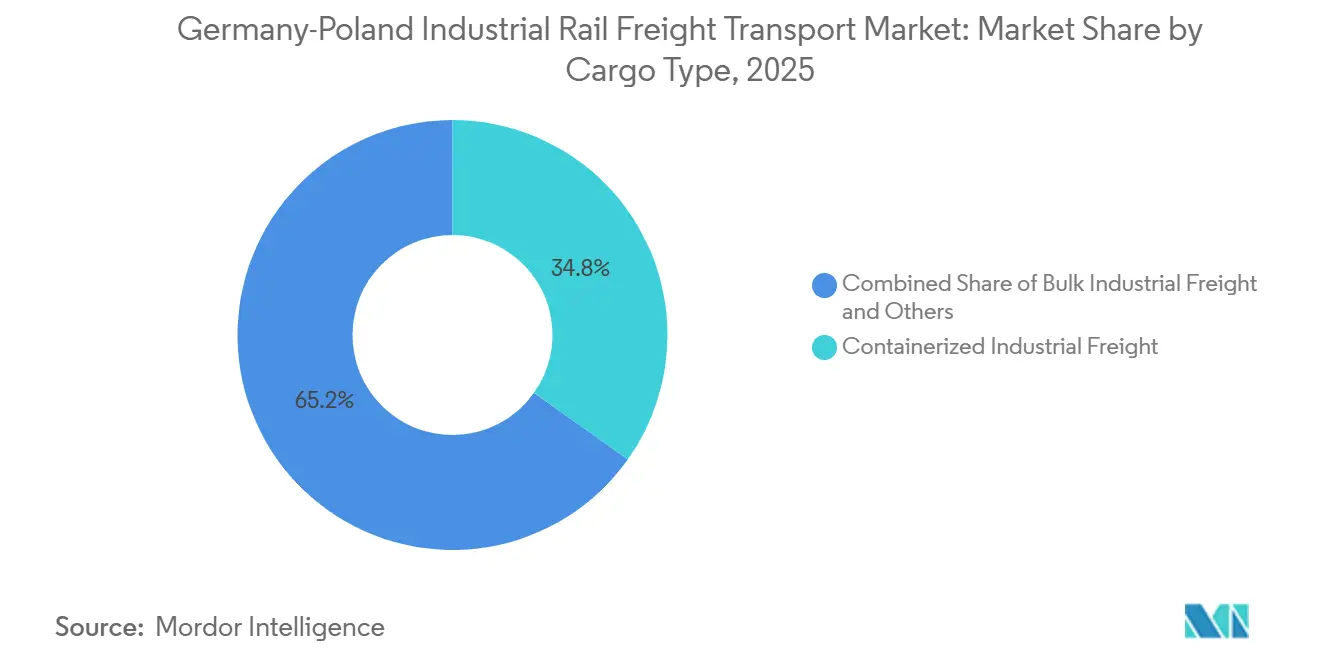
Containerized freight held 34.82% of the Germany-Poland industrial rail freight transport market share in 2025 and is projected to grow at 7.82% CAGR through 2031. That made it both the largest and the fastest-growing cargo type in the current segmentation. Its lead comes from containerization's ability to support automotive subassemblies, packaged chemicals, machinery, consumer-manufactured goods, and other industrial cargo without changing the basic handling model from shipper to shipper. In the Germany-Poland industrial rail freight transport industry, standardization improves transfer efficiency at terminals and makes service planning easier on both outbound and return legs. It also gives operators a format that can grow across several shipper groups rather than relying on a single commodity cycle.
Containerized growth is also important because it reflects a broader shift in the corridor toward cargo that values schedule discipline and terminal compatibility as much as pure weight economics. This is why containerized flows continued to hold strategic importance even when wider rail conditions became more difficult in 2025. The segment also benefits from the fact that return-load matching is easier when cargo moves in containers rather than in rail-specific or commodity-specific loading formats. For the Germany-Poland industrial rail freight transport market, which strengthens asset utilization and helps protect margins on a corridor where equipment turn matters.



By Shipment Distance: Medium-Haul Economics Challenging Long-Haul Dominance
Long-haul shipments above 700 km accounted for 49.40% share of the Germany-Poland industrial rail freight transport market size in 2025, while medium-haul movements are projected to grow at the fastest 8.02% CAGR through 2031. Long-haul remains the largest distance band because rail economics improve when cargo runs across the full corridor, spreading terminal and traction costs over a greater distance. These movements include lane structures that connect Polish production centers with German industrial demand and support large-volume, repeatable train planning. In the Germany-Poland industrial rail freight transport market, long-haul freight continues to anchor corridor profitability because it offers the clearest cost and emissions advantage against road at scale. It also gives operators a better chance to fill both directions when supply chains are well coordinated.
Medium-haul is gaining momentum because more industrial origin-destination pairs now fall within a range where rail can compete if frequency and terminal access are sufficient. As manufacturing and intermodal activity expand across western and central Poland, the number of viable 300 km to 700 km freight pairs continues to increase. That matters because future growth will not come only from the longest runs, but from a broader set of industrial lanes that become dense enough for scheduled rail service. Short-haul freight below 300 km remains the least favorable segment for rail because road keeps a structural advantage in first-mile and last-mile flexibility. Even so, the Germany-Poland industrial rail freight transport market can still capture selected short- to medium-distance cargo with fixed origins and destinations, recurring shipment lots, and stable customer service windows.
By Trade Flow Direction: Eastward Flows Accelerating as Germany Exports Capital Goods
Poland-to-Germany flows represented 56% of the Germany-Poland industrial rail freight transport market share in 2025, while Germany-to-Poland flows are projected to grow at 7.69% CAGR through 2031. The larger westbound flow reflects Poland’s role as a supplier of manufactured inputs, chemicals, packaged food, steel products, and other industrial cargo into German production networks. It also reflects the pull of Germany’s larger industrial base, which absorbs a wide mix of intermediate goods from Eastern Europe. In the Germany-Poland industrial rail freight transport market, this imbalance has historically led to underloaded or empty return legs, limiting overall corridor efficiency. The structure is still visible, but it is becoming less rigid as eastbound cargo options improve.
Germany-to-Poland is the fastest-growing direction because Polish industrial investment, demand for plant equipment, and higher-value inbound goods are improving the economics of returns. Better digital matching and broader commodity coverage can help operators use trains more evenly in both directions, thereby improving wagon and locomotive productivity. Eastbound cargo also tends to include machinery and finished or semi-finished industrial goods that can command better yields than lower-value bulk categories. This gives the Germany-Poland industrial rail freight transport market a stronger profit opportunity in the direction that is growing faster, even if it started from a smaller base. Over time, the trade flow split should become less operationally difficult as carriers develop more balanced lane portfolios and wider customer mixes.
By End User: Automotive Accelerates, While Metals Maintain Anchor Position
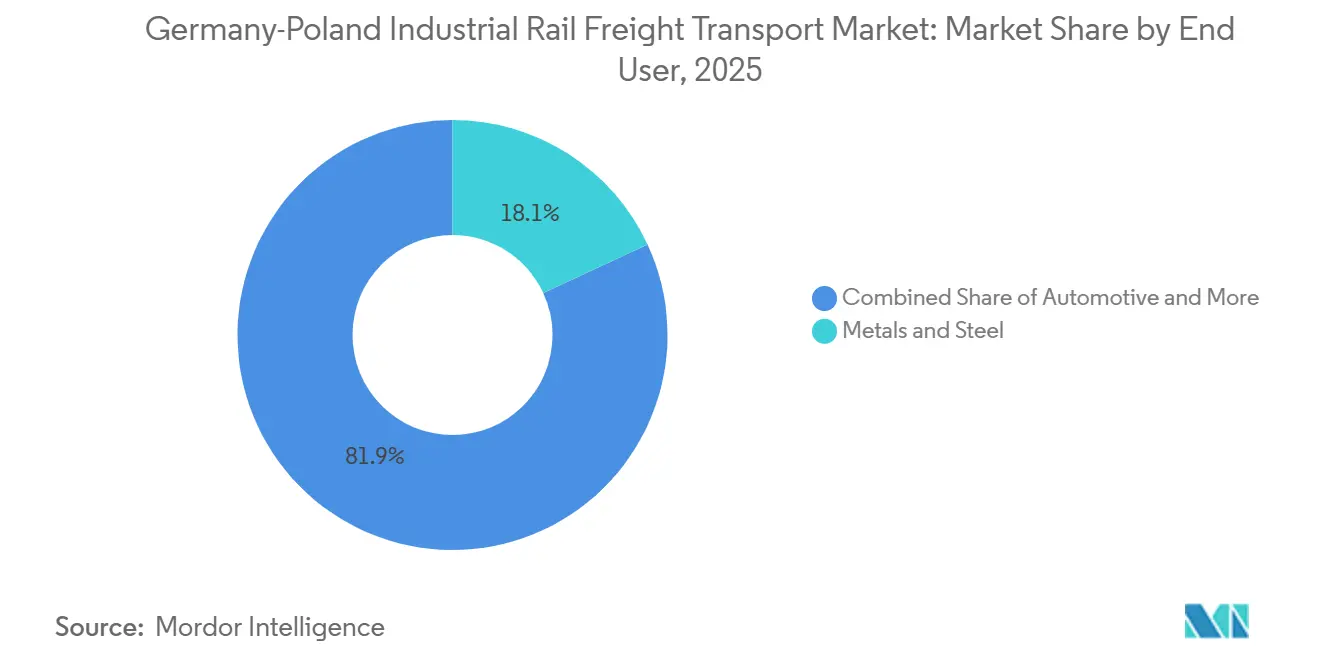
Metals and steel accounted for 18.09% share of the Germany-Poland industrial rail freight transport market size in 2025, while automotive is projected to grow at the fastest 7.81% CAGR through 2031. Metals and steel remain the anchor end-user group because the corridor has long supported recurrent movements of coils, semifinished products, and related industrial loads between Polish producers and German manufacturing sites. That anchor role matters because these cargoes provide base volumes that help sustain dedicated services and stable wagon use across the corridor. In the Germany-Poland industrial rail freight transport industry, metals freight serves as the foundation for volume, even as higher-growth cargo categories attract more attention. It supports baseline traffic, allowing operators to layer other industrial shipments onto existing networks.
Automotive is growing faster because cross-border supply chains now require more frequent movement of parts, components, and related industrial goods tied to new manufacturing and battery-linked activity. These flows reward dependable transit times and regular service windows, which is why rail becomes more attractive when truck availability and fuel exposure become harder to manage. Chemicals and petrochemicals also remain important because they support contract-based freight programs where scale, safety procedures, and consistent service matter more than spot pricing alone. Machinery, construction materials, paper, packaging, and consumer goods add diversification and reduce dependence on any one industrial cycle. For the Germany-Poland industrial rail freight transport market, that mix is important because it balances a stable metals base with faster automotive growth and a broader set of recurring industrial accounts.
Geography Analysis
Germany remained the largest terminal market within this corridor, and its industrial demand base kept the Germany-Poland industrial rail freight transport market centered on automotive, chemicals, metals, and manufactured goods. The same scale also made German network conditions the main short-term operating risk for the corridor. When capacity tightened on the German side, the effects quickly spread to cross-border schedules, terminal planning, and intermodal reliability. UIRR reported that combined transport volumes on Germany-Poland routes fell 66% in 2025 as German corridor works sharply disrupted traffic. This matters because Germany is not only a destination market, but also the side of the corridor where schedule instability can reshape the economics of the entire bilateral flow.
Poland is the growth side of the geography profile for the Germany-Poland industrial rail freight transport market, as it combines expanding industrial clusters with improving intermodal capabilities. Its role is no longer limited to cost-efficient production, because the corridor increasingly carries higher-value inputs and finished goods that fit repeat rail programs. Polish industrial zones add predictable freight demand that is easier to contract over time than purely opportunistic cargo. This gives operators more room to build round-trip solutions and improve asset use across the corridor. The balance of the geography is therefore shifting from a simple source-and-destination pattern toward a more integrated two-way industrial rail system.
The cross-border zone operates as a distinct submarket within the Germany-Poland industrial rail freight transport market because crossing capacity and traction compatibility directly affect service quality. Limited heavy-freight crossing options make each disruption more severe, and mixed-traction sections still slow trains and raise operating costs. EU support for rail investment, including ERTMS deployment in Germany and Poland, reinforces the long-term case for better corridor interoperability. Once the cross-border section becomes more reliable, the rest of the corridor should leverage that improvement to deliver better wagon turns, more stable schedules, and wider commercial adoption of rail across industrial supply chains.
Competitive Landscape
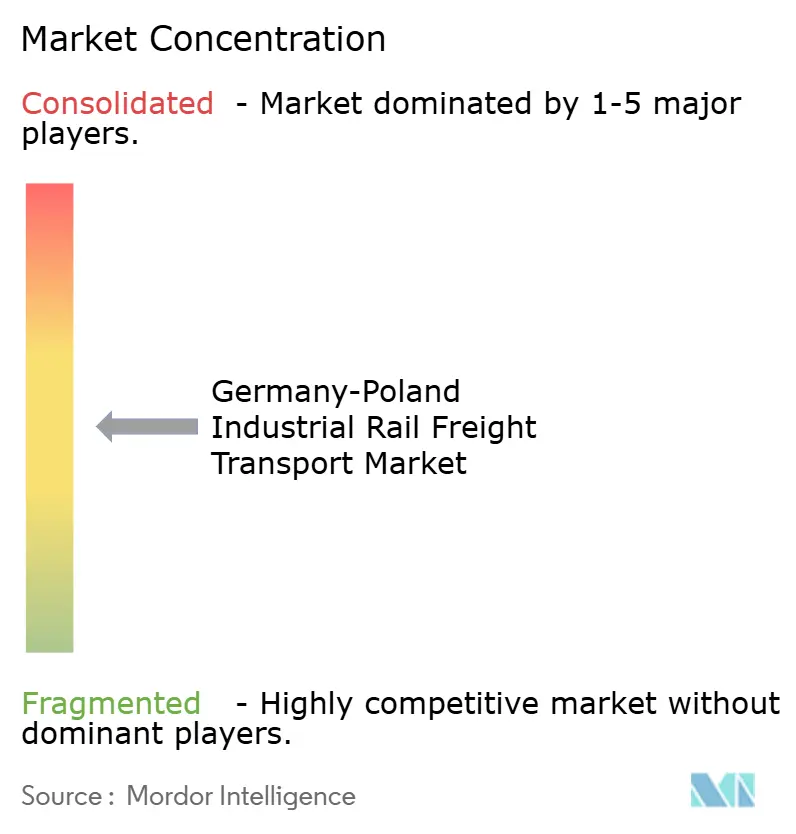
The Germany-Poland industrial rail freight transport market is moderately concentrated, with DB Cargo, PKP Cargo, ORLEN Kolej, and PCC Intermodal forming the main competitive group across the corridor’s core industrial lanes[3]Source: PCC SE, “PCC Intermodal S.A. Assumes Market Leadership in Poland,” PCC SE, pcc.eu. A single dominant operator does not control the market. However, scale still matters because locomotive access, terminal reach, certification, and cross-border dispatch capability determine who can serve the largest contracts. DB Cargo Polska increased its share of Polish rail freight mass to 15.18% in 2025, while PKP Cargo’s share fell to 26.57%, which shows that the balance among leading operators is still moving. That shift matters because customer migration often follows service reliability and balance-sheet stability when industrial shippers reassess their carrier mix. In the Germany-Poland industrial rail freight transport market, concentration therefore comes from operating capability rather than from a fully locked structure.
PCC Intermodal’s reported leadership in Polish intermodal transport underlines how specialized operators can strengthen their position when cargo growth comes from standardized units and terminal-linked services. TX Logistik completed delivery of 40 Siemens Vectron multi-system electric locomotives in February 2026, strengthening its owned traction base for cross-border and intermodal operations. PKP Cargo signed a cooperation agreement in April 2026 with Sung Shin Rolling Stock Technology Ltd. to develop a wagon manufacturing hub in Poland for the transport of heavy military equipment, broadening its strategic positioning beyond conventional commercial freight[4]Source: PKP Cargo S.A., “Signing of a Cooperation Agreement with Sung Shin Rolling Stock Technology Ltd.,” PKP Cargo, pkpcargo.com. PKP Cargo also signed a framework agreement with Poland’s Minister of National Defense in May 2026, strengthening its role in defense-related rail logistics. These moves show that the competitive field is being shaped by targeted investment and adjacent freight capabilities, not only by price competition.
Another clear theme in the Germany-Poland industrial rail freight transport market is the growing value of cross-border readiness, which includes multi-system locomotives, path discipline, and the ability to serve industrial contracts with fewer handovers. Operators that can combine traction ownership with stronger intermodal handling are better placed to defend service quality when network conditions are unstable. The market still has room for better digital booking, customer visibility, and real-time tracking, which remain important for shippers deciding whether to move more freight off the road network. Competition should remain active rather than static, because service execution, return-load management, and corridor reliability are still open areas where operators can gain share.
Germany-Poland Industrial Rail Freight Transport Industry Leaders
DB Cargo AG
DB Cargo Polska S.A.
PKP Cargo S.A.
Rail Cargo Group
Captrain Deutschland GmbH
- *Disclaimer: Major Players sorted in no particular order

Recent Industry Developments
- May 2026: PKP Cargo S.A. signed a framework agreement with Poland's Minister of National Defense for rail transport supporting national defense purposes, formalizing PKP Cargo's role in Poland's defense logistics security system.
- April 2026: PKP Cargo S.A. signed a cooperation agreement with South Korean manufacturer Sung Shin Rolling Stock Technology Ltd. (SSRST), constituting a letter of intent for a joint venture to establish a wagon manufacturing hub in Poland for heavy military equipment transport.
- February 2026: DB Cargo plans to cut approximately 6,200 positions nearly half of its 14,000 FTE workforce, as part of a restructuring program mandated by the European Commission's state aid ruling requiring DB Cargo to reach break-even without group cross-subsidies by end-2026.
- December 2025: DB Cargo Polska increased its market share in Polish rail freight to 15.18% (from 13.99% in 2024), transporting more than 33 million tons, one of only a handful of major operators to grow market share in an overall market.


Germany-Poland Industrial Rail Freight Transport Market Report Scope
| Containerized Industrial Freight |
| Bulk Industrial Freight |
| Breakbulk Freight |
| Wagonload Freight |
| Less-than-Trainload Freight |
| Short-Haul (Less than 300 km) |
| Medium-Haul (300-700 km) |
| Long-Haul (more than 700 km) |
| Germany to Poland |
| Poland to Germany |
| Automotive |
| Metals and Steel |
| Machinery and Industrial Equipment |
| Chemicals and Petrochemicals |
| Construction and Building Materials |
| Paper, Pulp, and Packaging Materials |
| Consumer and Industrial Manufactured Goods |
| Other Agricultural Processors |
| By Cargo Type | Containerized Industrial Freight |
| Bulk Industrial Freight | |
| Breakbulk Freight | |
| Wagonload Freight | |
| Less-than-Trainload Freight | |
| By Shipment Distance | Short-Haul (Less than 300 km) |
| Medium-Haul (300-700 km) | |
| Long-Haul (more than 700 km) | |
| By Trade Flow Direction | Germany to Poland |
| Poland to Germany | |
| By End User | Automotive |
| Metals and Steel | |
| Machinery and Industrial Equipment | |
| Chemicals and Petrochemicals | |
| Construction and Building Materials | |
| Paper, Pulp, and Packaging Materials | |
| Consumer and Industrial Manufactured Goods | |
| Other Agricultural Processors |


Key Questions Answered in the Report
What is the 2026 value of Germany-Poland industrial rail freight transport?
The corridor is valued at USD 709.56 million in 2026 and is forecast to reach USD 895.59 million by 2031 at a 4.77% CAGR.
Which cargo type leads cross-border rail freight between Germany and Poland?
Containerized freight leads with 34.82% share in 2025 and is also the fastest-growing cargo type with a 7.82% CAGR through 2031.
Why does long-haul rail remain important on this corridor?
Long-haul shipments of 700 km or more accounted for 49.40% of shipments in 2025 because rail became more cost-effective and operationally efficient at full-corridor distances.
Which trade direction is larger, and which one is growing faster?
Poland-to-Germany flows held 56% share in 2025, while Germany-to-Poland flows are expanding faster at a 7.69% CAGR through 2031.
Which end-user group is driving the next phase of growth?
Automotive is the fastest-growing end-user segment, with a 7.81% CAGR, while metals and steel remain the largest segment, with a 18.09% share in 2025.
What is the main operational risk on the Germany-Poland corridor?
Border-side delays and schedule volatility remain the main short-term risks, with UIRR reporting a 66% drop in combined transport volumes on Germany-Poland routes during major disruption periods in 2025.
Page last updated on:





