
Germany Pet Treats Market Size and Share
Market Overview
| Study Period | 2021 - 2031 |
|---|---|
| Forecast Data Period | 2026 - 2031 |
| Base Year Market Size (2025) | USD 1.46 Billion |
| Market Size (2026) | USD 1.58 Billion |
| Market Size (2031) | USD 2.21 Billion |
| Growth Rate (2026 - 2031) | 6.94 % |
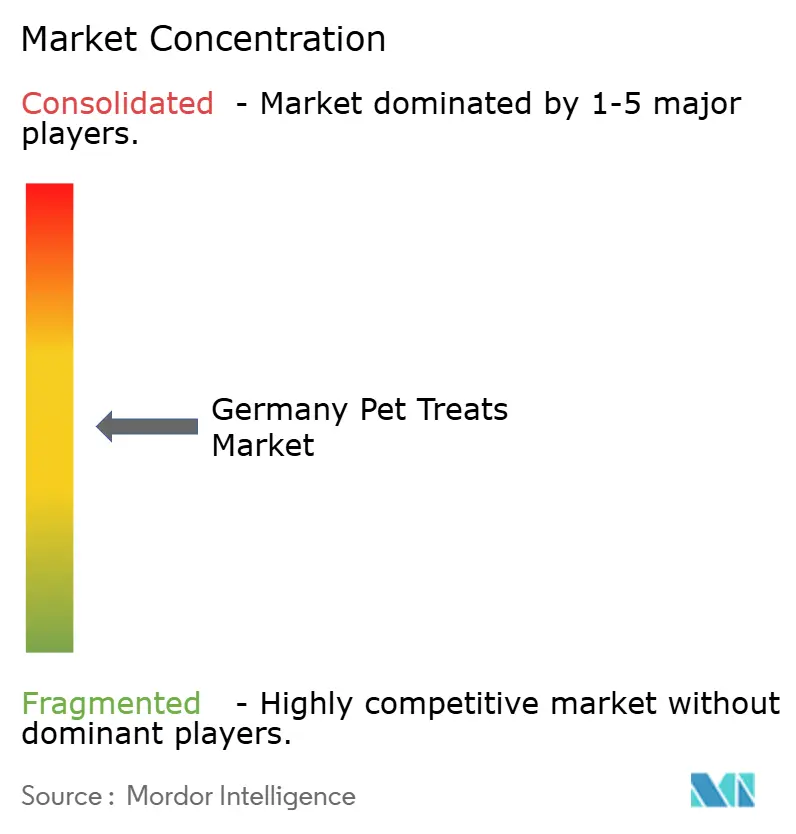
| Market Concentration | Medium |
Major Players *Disclaimer: Major Players sorted in no particular order Image © Mordor Intelligence. Reuse requires attribution under CC BY 4.0. | |
Germany Pet Treats Market Analysis by Mordor Intelligence
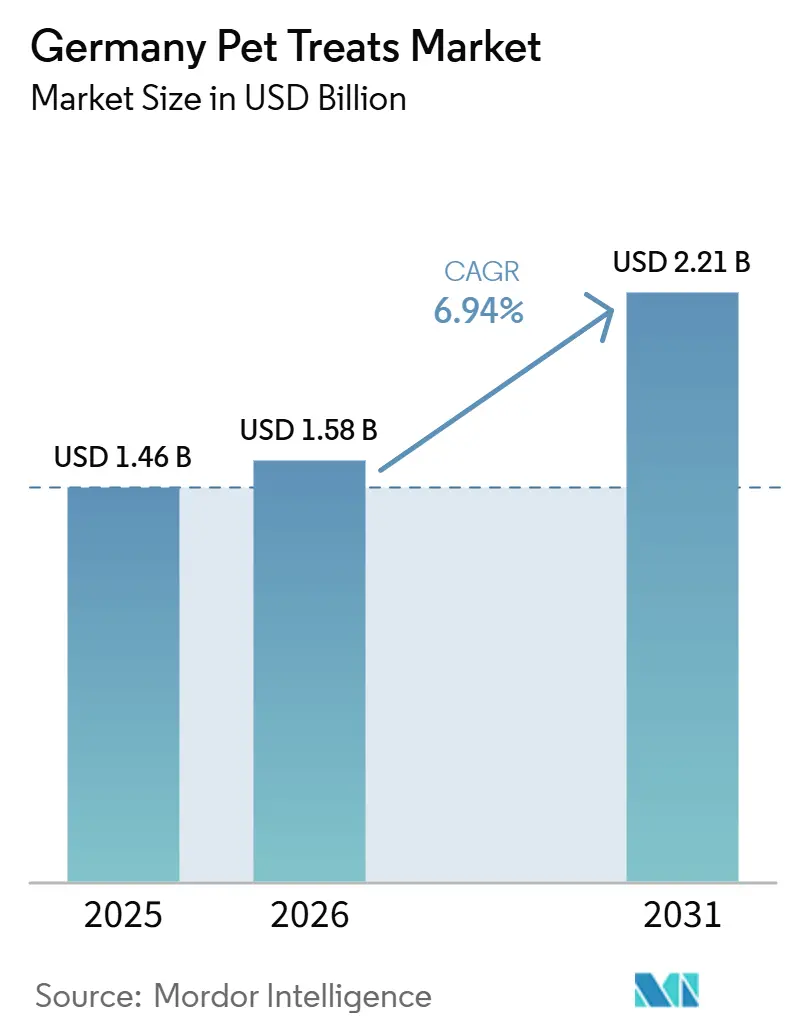
The Germany pet treats market size is anticipated to increase from USD 1.46 billion in 2025 and USD 1.58 billion in 2026 to reach USD 2.21 billion by 2031, growing at a CAGR of 6.94% during 2026 to 2031. Germany remains one of Europe's largest pet treats markets, supported by high pet ownership, strong spending on premium pet nutrition, and a well-developed retail network. The market is also benefiting from growing consumer preference for functional and natural treats, as pet owners increasingly view treats as part of their pets' daily health and wellness routine rather than occasional rewards. According to the European Pet Food Industry Federation (FEDIAF) Facts & Figures 2025, 21% of German households owned at least one dog, while 25% owned at least one cat in 2025. The large and established companion animal population supports consistent demand for pet treats, particularly premium, functional, training, and dental products, as owners increasingly incorporate treats into everyday pet care and wellness routines. The Germany pet treats market is also being shaped by stronger online buying, more functional product development, and wider private label participation, while leading companies continue to use manufacturing scale, brand trust, and specialized formats to defend shelf space. The result is a market where growth is steady, competition is disciplined, and product differentiation matters more than simple price cuts.
Key Report Takeaways
- By sub product, crunchy treats held 23.2% of the Germany pet treats market size in 2025, while freeze-dried and jerky treats are anticipated to grow at the fastest 8.1% CAGR between 2026 and 2031.
- By pet type, dogs held 53.8% of the Germany pet treats market share in 2025, while cats are anticipated to grow at the fastest CAGR at 7.8% between 2026 and 2031.
- By distribution channel, specialty stores accounted for 34.6% of the Germany pet treats market size in 2025, while the online channel is advancing at the fastest 8.3% CAGR between 2026 and 2031.
Note: Market size and forecast figures in this report are generated using Mordor Intelligence’s proprietary estimation framework, updated with the latest available data and insights as of January 2026.
Germany Pet Treats Market Trends and Insights
Drivers Impact Analysis*
| Driver | (~) % Impact on CAGR Forecast | Geographic Relevance | Impact Timeline |
|---|---|---|---|
| Humanization of pets and premium treat buying | +2.00% | Germany led, with spillover across Europe | Long term (≥ 4 years) |
| Rising demand for functional dental and digestive treat formats | +1.20% | Germany and core European Union markets | Medium term (2-4 years) |
| Retailer private label expansion in premium treat shelves | +0.80% | Germany first, then nearby European markets | Medium term (2-4 years) |
| Growth of direct-to-consumer and subscription treat replenishment | +0.60% | Germany, with strongest momentum in urban areas | Medium term (2-4 years) |
| Advanced extrusion and freeze-drying capability in Germany-based manufacturing | +0.50% | Germany and wider Europe | Long term (≥ 4 years) |
| Upcycled meat by-products and sustainability-led treat positioning | +0.40% | Germany and Northern Europe | Long term (≥ 4 years) |
| Source: Mordor Intelligence | |||
Humanization of Pets and Premium Treat Buying
The Germany pet treats market is gaining support from a deeper shift in how owners relate to pets in everyday life. Treats are no longer seen only as small add-on purchases, because many owners now use them as part of bonding, training, and routine care. This behavior matters in Germany because households already show strong attention to ingredient quality and product claims in food purchases. That same scrutiny carries over into the way many owners shop for pet treats, especially when products are positioned around natural ingredients, traceability, or targeted benefits. According to the German Pet Trade & Industry Association (Zentralverband Zoologischer Fachbetriebe Deutschlands e.V.), 67% of German families with children owned at least one pet in 2025[1]Source: Zentralverband der Heimtierbranche e.V., “The German Pet Market 2025,” 2025, zzf.de. The strong emotional attachment to companion animals continues to drive spending on premium, functional, and indulgent pet treats that support health, training, and daily bonding. In the Germany pet treats market, this supports stronger pricing power for products that can justify a premium through formulation, origin, or a clear daily-use role. It also raises the standard for brands because emotional appeal alone is no longer enough when retail buyers and consumers expect clear product proof.
Rising Demand for Functional Dental and Digestive Treat Formats
The Germany pet treats market is also moving further toward products that combine reward with a practical health role. Dental treats are a clear example, as owners increasingly want a product that supports oral care while still fitting into a normal treat routine. Functional digestive snacks are following the same path, especially when they are positioned around digestive comfort, fiber support, or a lighter ingredient profile. These formats are harder to produce well than basic reward treats because texture, ingredient balance, and consistency all affect how credible the product feels. As of 2025, European Union feed rules also favor brands that can substantiate their ingredient and function claims with proper documentation, thereby reducing room for loosely positioned products[2]Source: “EU Novel Food Regulation (EU) 2015/2283 Union List of Novel Foods,” European Commission, eur-lex.europa.eu. In the Germany pet treats market, this creates an advantage for companies with research, quality control, and established veterinary relationships. It also helps explain why functional formats continue to attract investment even when standard treat categories remain widely available, and price competition stays intense.
Retailer Private Label Expansion in Premium Treat Shelves
Private label is becoming a stronger structural force in Germany's pet treats market, and the shift is no longer limited to value-oriented products. Germany's highly developed grocery, discount, and pet specialty retail network provides retailers with a strong platform to expand their own-brand pet treat portfolios. According to the German Pet Trade and Industry Association (Zentralverband Zoologischer Fachbetriebe Deutschlands e.V.), food retail and discount stores remained among the leading sales channels for pet treats in 2025, supporting the continued expansion of private-label offerings. The market is now witnessing greater availability of functional, grain-free, and premium private-label treats, increasing competition with established brands. Contract manufacturers such as Pets Best further support this trend by enabling retailers to launch customized snack, chew, and functional treat ranges without investing in dedicated production facilities. As a result, competition is intensifying across both value and premium segments of the market.
Growth of Direct-to-Consumer and Subscription Treat Replenishment
The Germany pet treats market is seeing a steady shift toward repeat online ordering, especially in urban households that already shop across both physical stores and digital channels. Subscription and direct-to-consumer models are moving pet treats from impulse purchases toward planned replenishment. Tales & Tails reported approximately 20,000 active dog food subscription customers in 2025, highlighting the growing acceptance of recurring purchasing models. According to the German Pet Industry Association (Industrieverband Heimtierbedarf e.V.), omnichannel shopping continues to strengthen the pet care market, supporting wider adoption of online purchasing. This trend encourages repeat purchases, larger basket sizes, and greater acceptance of premium and functional treats, while strengthening long-term customer relationships through digital engagement and subscription-based sales.
Restraints Impact Analysis*
| Restraint | (~) % Impact on CAGR Forecast | Geographic Relevance | Impact Timeline |
|---|---|---|---|
| Price inflation in animal protein, fats, and grains | -1.20% | Germany and wider Europe | Short term (≤ 2 years) |
| Regulatory scrutiny of novel functional ingredients and claims | -0.80% | Germany and the European Union | Medium term (2-4 years) |
| Consumer skepticism toward insect and alternative protein treats | -0.50% | Germany and Northern Europe | Short term (≤ 2 years) |
| Veterinary caution on grain-free and highly processed claims | -0.50% | Germany and wider Europe | Medium term (2-4 years) |
| Source: Mordor Intelligence | |||
Price Inflation in Animal Protein, Fats, and Grains
The Germany pet treats market remains exposed to raw material and production cost pressure because many treat formats rely heavily on meat inputs, fats, and specialized processing. This pressure is stronger in premium treats than in complete diets because dried meats, dental chews, and functional snacks often carry a higher ingredient cost for their weight. When production costs rise, brands do not always have room to pass the increase through quickly, especially in channels where private label and value packs are already well established. The pressure is made harder by energy-intensive production methods such as extrusion and drying, which increase the cost gap between standard biscuits and more premium formats. Mars, Incorporated’s 2026 manufacturing network changes in Europe also reflect how cost discipline remains a live issue even for the biggest players[3]Source: “Mars to Close Pet-Food Factory in Germany,” Just Food, just-food.com. In the Germany pet treats market, mid-tier brands are the most exposed because they lack the procurement strength of global leaders and the pricing freedom of small specialist brands. If inflation stays elevated for proteins and utilities, product mix could shift more slowly toward premium treats than manufacturers want. That would not stop growth, but it could reduce the pace of trade-up and compress margins across the category.
Regulatory Scrutiny of Novel Functional Ingredients and Claims
Regulatory review is a meaningful constraint in the Germany pet treats market because innovation often depends on ingredients or claims that need careful support. As of 2025, the European Union Novel Food Regulation and related feed marketing rules place clear limits on what can be commercialized and how benefits can be communicated. Companies that want to launch pet treats built around novel proteins, digestive support, or other targeted benefits must align product timelines with authorization and compliance work. That process can be manageable for large companies, but it is much harder for smaller brands with limited regulatory teams and fewer testing resources. Germany adds another layer of discipline because enforcement standards are taken seriously in one of Europe’s most important pet care markets. In the Germany pet treats market, this slows the speed at which promising concepts move from trade show attention to national distribution. It also creates a gap between consumer interest and commercial availability when brands are not yet ready to support product claims fully. Over time, that favors larger players and makes compliant innovation a slower but more defensible route to growth.
*Our forecasts treat driver/restraint impacts as directional, not additive. The impact forecasts reflect baseline growth, mix effects, and variable interactions.
Segment Analysis
By Sub Product: Functional Formats Diversify a Crunchy-Led Market
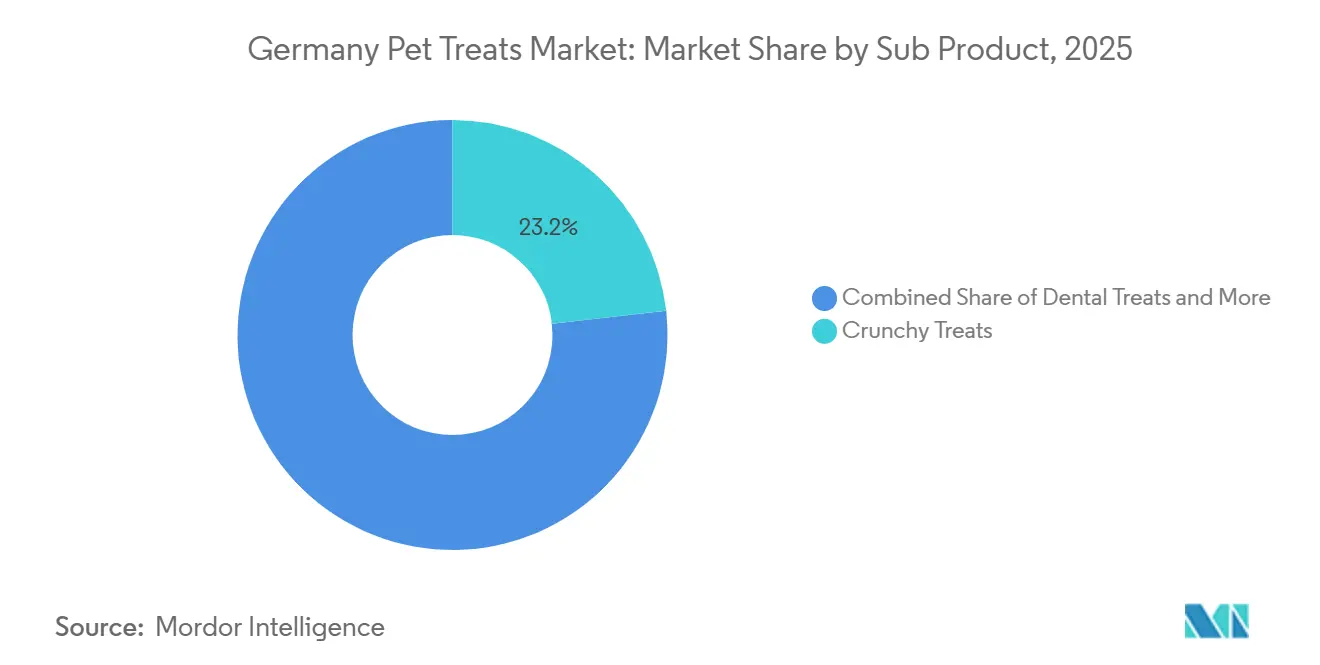
Crunchy Treats held 23.2% of the Germany pet treats market size in 2025, which kept them in the lead because they remain easy to find, easy to price, and closely tied to routine reward use. The format works well in food retail and pet specialty stores, and it still appeals to owners who want a familiar product at a manageable price point. Vitakraft pet care GmbH and Co. KG (Tiernahrung Deuerer GmbH) also reinforced the long life of this segment when the Kräcker range marked its 60th year in 2025[4]Source: Vitakraft, “60 Years of Snacking Fun,” June 18, 2025, vitakraft.com.
Freeze-dried and jerky treats are anticipated to post the fastest 8.1% CAGR through 2031, showing that growth is shifting toward more premium and ingredient-led formats in the Germany pet treats market. These products align well with the owner's interest in simple meat-based offerings and cleaner labels, while dental treats continue to benefit from a more practical daily use case. Soft and chewy treats also remain relevant because they suit training, smaller pets, and cats well. Manufacturing support in Germany adds to this momentum because companies can test and scale more specialized drying and extrusion formats with lower execution risk



By Pet Type: Dog Treats Lead, but the Cat Segment Is Quietly Gaining Ground
Dogs held 53.8% of the Germany pet treats market share in 2025, supported by a dog population of 10.5 million, according to the European Pet Food Industry Federation (FEDIAF) Facts & Figures 2025. Dog owners use treats more regularly for training, oral care, and routine rewards, giving dog treats a broad usage base that spans everyday crunchy formats, dental sticks, and higher-value functional snacks. Large brands also maintain strong visibility in this segment, as repeat purchase patterns are well established. Other pets remain a smaller part of the market, but the segment stays relevant through long-standing snack categories for birds and small animals.
Cats are anticipated to expand at the fastest CAGR of 7.8% between 2026 and 2031, indicating that the Germany pet treats market still has room to deepen treat usage beyond its traditional dog-heavy base. Germany had 15.7 million cats in 2025, according to the European Pet Food Industry Federation (FEDIAF) Facts & Figures 2025, which means growth is being driven less by the pet population and more by rising treat penetration among cat owners. Nestlé Purina PetCare Europe has responded with premium wet cat food and snack activity in Germany, while Bosch Tiernahrung GmbH and Co. KG expanded the Sanabelle snack range in 2026.
By Distribution Channel: Specialty Stores Lead, Online Redefines the Growth Frontier
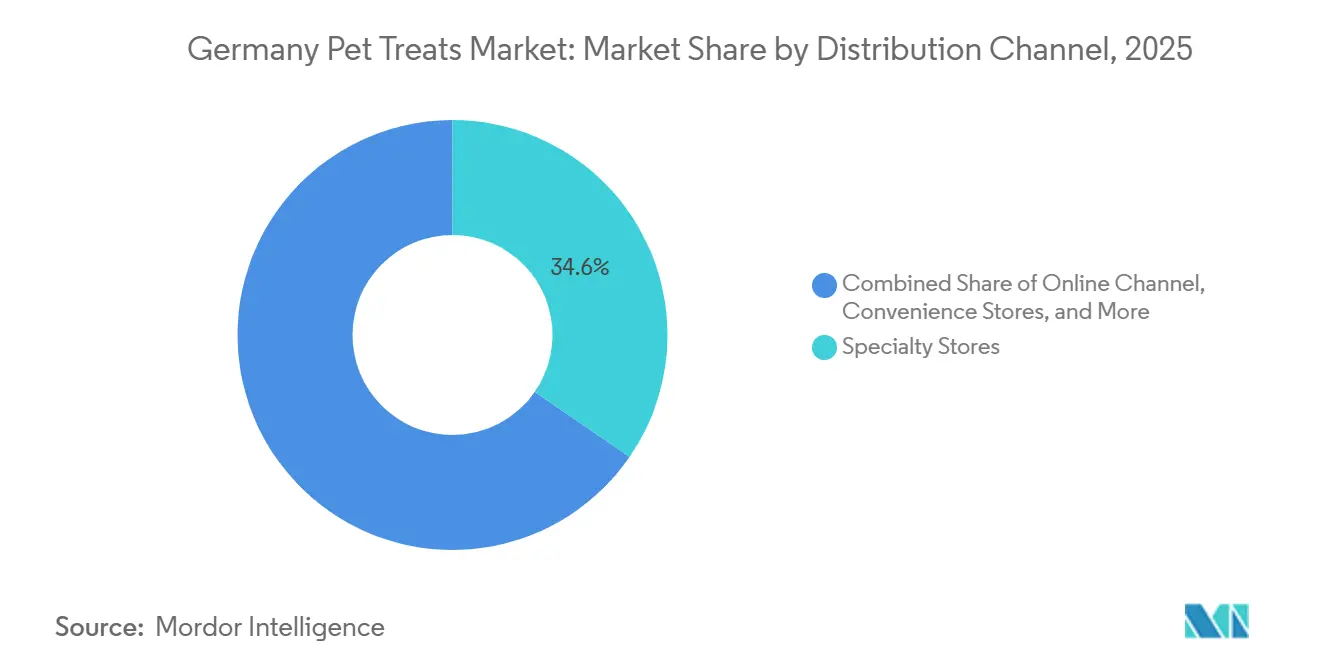
Specialty atores accounted for 34.6% of the Germany pet treats market size in 2025, reflecting the channel's strong ability to support premium buying, explain functional benefits, and encourage first-time trial. This channel remains important because staff advice and curated shelves help owners compare quality, ingredients, and purpose in a more direct way than mass retail. Specialty retailers also offer broader premium assortments, exclusive brands, and personalized recommendations, helping manufacturers strengthen customer loyalty and increase repeat purchases.
The online channel is anticipated to grow at the fastest 8.3% CAGR between 2026 and 2031, supported by a clear shift in how households buy from the Germany pet treats market. Supermarkets and Hypermarkets remain essential for frequent value purchases, while convenience stores and other channels continue to serve occasional demand. Das Futterhaus's 2025 e-commerce launch also showed that even established specialists now treat online expansion as a basic requirement. Growing adoption of subscription services, digital promotions, and convenient home delivery is further encouraging consumers to purchase premium pet treats online more frequently.
Geography Analysis
Germany is the core geography for the Germany pet treats market, and the country's wider pet economy gives the segment a strong base for stable growth. High pet ownership, premium pet care spending, and well-developed retail and e-commerce channels continue to support sustained demand for pet treats across multiple price segments. Germany also had a pet population of 10.5 million dogs and 15.7 million cats, according to the European Pet Food Industry Federation (FEDIAF) Facts & Figures 2025. This makes the Germany pet treats market one of the most commercially significant national segments in Europe.
Within the country, the Germany pet treats market behaves differently across urban and non-urban areas. Cities such as Munich, Berlin, Hamburg, Frankfurt, and Cologne tend to concentrate higher online adoption, broader specialty retail access, and stronger demand for functional or premium treats. These areas are often the first places where new formats gain trial, especially freeze-dried products, dental sticks, and more premium cat treats. Rural and semi-rural areas remain important for value-led formats and store-brand purchases, particularly where food retail and discount stores have a stronger role in household shopping.
Production geography also gives Germany an edge in the Germany pet treats market. Baden-Württemberg and Bavaria remain important because manufacturers such as Bosch Tiernahrung GmbH and Co. KG and IQ Interquell are based there, supporting local production credibility and short supply chains. Germany’s manufacturing depth helps brands connect product quality with a recognizable domestic origin story, which can matter at the shelf. The regulatory setting adds another filter because European Union rules apply across the region, while Germany’s enforcement culture keeps market entry standards high.
Competitive Landscape
The Germany pet treats market was moderately consolidated in 2025, with leading companies including Mars, Incorporated, Nestlé S.A., Vitakraft pet care GmbH and Co. KG (Tiernahrung Deuerer GmbH), heristo aktiengesellschaft, and Bosch Tiernahrung GmbH and Co. KG. Competition is driven by strong brand recognition, extensive product portfolios, and broad distribution networks. Large multinational companies benefit from wide retail access and the ability to support functional product positioning, while German manufacturers strengthen competition through local production capabilities, category expertise, and established consumer trust. In the Germany pet treats market, competition extends beyond price, with product quality, functional benefits, brand loyalty, and shelf visibility playing a critical role. As a result, leading companies continue to expand their portfolios across dental, digestive, cat snack, and premium meat-based treat segments to address evolving consumer preferences.
Recent company actions show how the Germany pet treats market is evolving. Vitakraft pet care GmbH and Co. KG (Tiernahrung Deuerer GmbH) launched a broad brand relaunch in June 2026 to strengthen its premium and functional positioning. Bosch Tiernahrung GmbH and Co. KG also acquired Fair Food P&S GmbH in May 2026, which pointed to a wider interest in new processing platforms and product formats, as leading players use M&A to secure agile innovation capacity, access niche recipes, and respond faster to demand for natural, higher-margin treats.
White space in the Germany pet treats market is still visible in premium cat treats, sustainability-led products, and direct to consumer led replenishment models. Dr. Clauder's Germany GmbH and Co. KG and Calysta also showed that ingredient innovation is possible in Germany when they unveiled a dog treat built with FeedKind Pet protein. Even so, the Germany pet treats market still favors players that can combine compliance, manufacturing reliability, and broad channel reach.
Germany Pet Treats Industry Leaders
Mars, Incorporated
Nestlé S.A.
Vitakraft pet care GmbH and Co. KG (Tiernahrung Deuerer GmbH)
heristo aktiengesellschaft
Bosch Tiernahrung GmbH and Co. KG
- *Disclaimer: Major Players sorted in no particular order

Recent Industry Developments
- July 2026: Farmina Pet Foods Holding Ltd. (Russo Family) invested USD 23.5 million to expand its Serbia, manufacturing facility with dedicated lines for dog dental treats and cat cream treats. The investment enhances regional manufacturing capacity and supply chain efficiency, positioning the company to better serve Germany's growing demand for premium, functional pet treats through shorter lead times and improved product availability.
- June 2026: Vitakraft pet care GmbH and Co. KG (Tiernahrung Deuerer GmbH) unveiled a comprehensive relaunch of the Vitakraft brand, introducing a new visual identity, redesigned packaging, and a streamlined product portfolio across its pet care range, including Beef Stick, Treaties, Cat Sticks, and Kräcker treats. The initiative aims to strengthen brand recognition, improve shelf visibility, and enhance the consumer shopping experience across European markets, including Germany.
- October 2025: Bosch Tiernahrung GmbH & Co. KG acquired Fair Food P&S GmbH, gaining access to its precision cooking and mixing technology for ambient-stable, real-cooked pet products. The acquisition strengthens Bosch's capabilities in minimally processed, premium pet nutrition and supports future innovation across value-added categories, including functional and premium pet treats.


Germany Pet Treats Market Report Scope
Pet treats are commercial food products formulated specifically for pets. They are not designed to provide complete and balanced nutrition but are intended for occasional feeding as rewards, during training, or for enjoyment. As a subset of pet food, these treats are typically made from ingredients such as meat, grains, or vegetables and should be offered in moderation to maintain a balanced diet. The Germany pet treats market report is segmented by sub-product (crunchy treats, dental treats, freeze-dried and jerky treats, soft and chewy treats, and other treats), by pets (cats, dogs, and other pets), and by distribution channel (convenience stores, online channel, specialty stores, supermarkets/hypermarkets, and other channels). The market forecasts are provided in terms of value (USD) and volume (metric tons).
| Crunchy Treats |
| Dental Treats |
| Freeze-Dried and Jerky Treats |
| Soft and Chewy Treats |
| Other Treats |
| Dogs |
| Cats |
| Other Pets |
| Supermarkets and Hypermarkets |
| Specialty Stores |
| Online Channel |
| Convenience Stores |
| Other Channels |
| By Sub Product | Crunchy Treats |
| Dental Treats | |
| Freeze-Dried and Jerky Treats | |
| Soft and Chewy Treats | |
| Other Treats | |
| By Pet Type | Dogs |
| Cats | |
| Other Pets | |
| By Distribution Channel | Supermarkets and Hypermarkets |
| Specialty Stores | |
| Online Channel | |
| Convenience Stores | |
| Other Channels |


Key Questions Answered in the Report
What is the size of the Germany pet treats market in 2026?
The Germany pet treats market was estimated at USD 1.58 billion in 2026.
Which sub product leads sales in Germany pet treats?
Crunchy treats led the category with a 23.2% share in 2025 because they remain widely available, familiar to buyers, and well suited to routine reward use.
Which pet type contributes the most to Germany pet treats sales?
Dogs accounted for the largest share at 53.8% in 2025, supported by Germany’s large dog population and frequent use of treats for training, bonding, and oral care.
Which sales channel is growing the fastest for pet treats in Germany?
The online channel is anticipated to expand at the fastest 8.3% CAGR through 2031 as more German pet owners buy across both store-based and digital channels.
Page last updated on:





