
Germany Metal Forming Equipment Market Size and Share
Market Overview
| Study Period | 2020 - 2031 |
|---|---|
| Forecast Data Period | 2026 - 2031 |
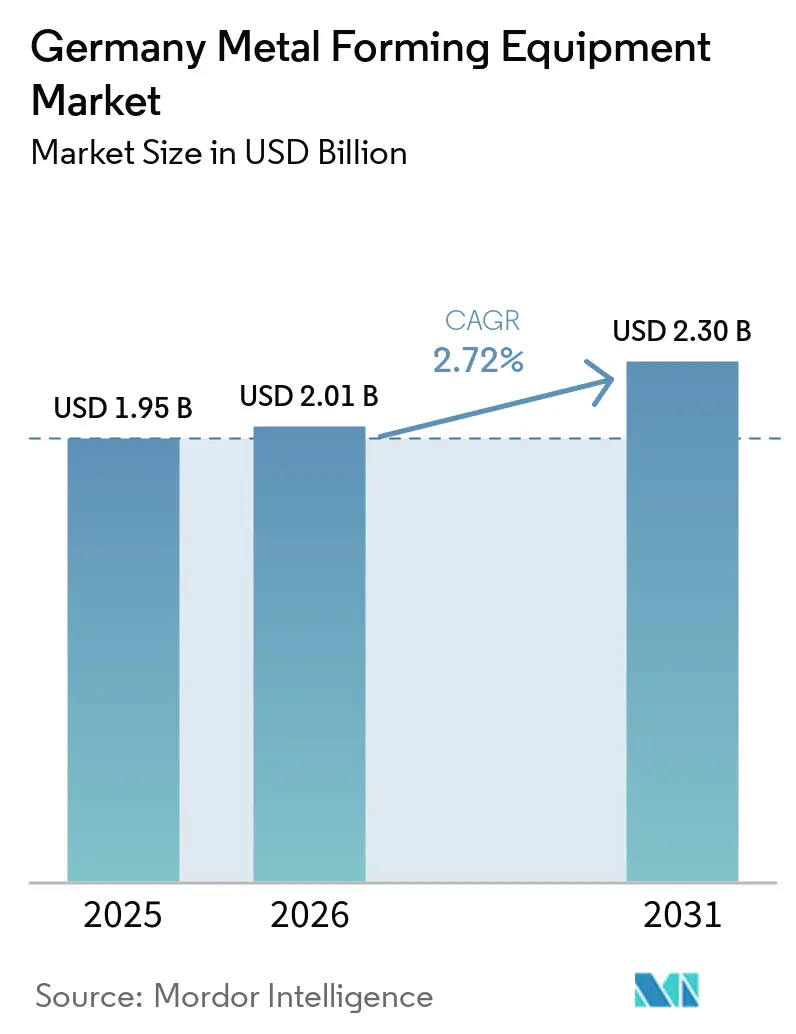
| Base Year Market Size (2025) | USD 1.95 Billion |
| Market Size (2026) | USD 2.01 Billion |
| Market Size (2031) | USD 2.30 Billion |
| Growth Rate (2026 - 2031) | 2.72 % |
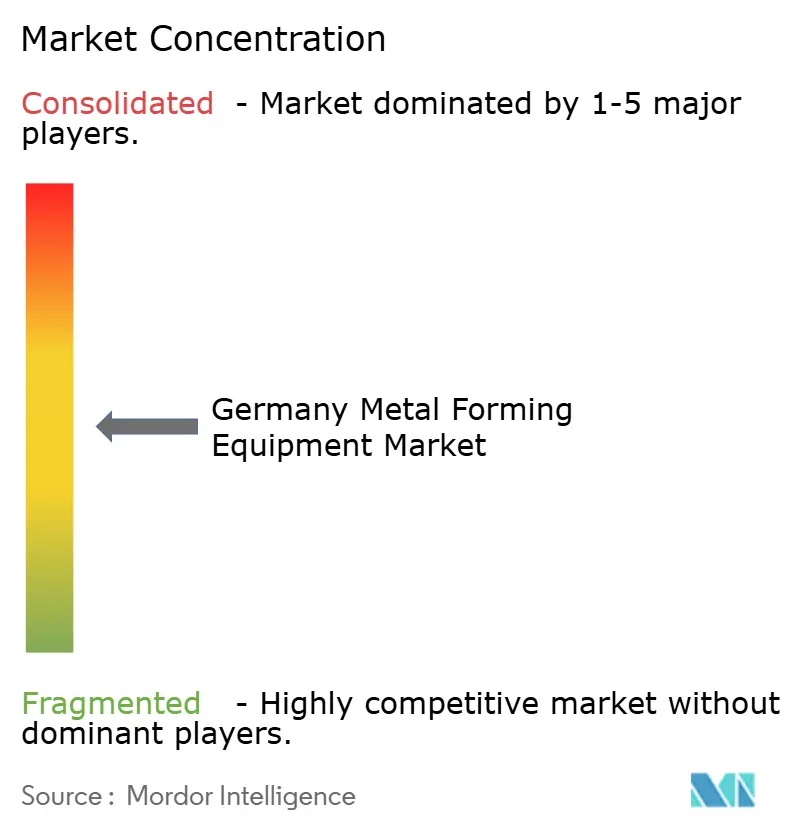
| Market Concentration | Medium |
Major Players *Disclaimer: Major Players sorted in no particular order Image © Mordor Intelligence. Reuse requires attribution under CC BY 4.0. | |
Germany Metal Forming Equipment Market Analysis by Mordor Intelligence
The Germany metal forming equipment market size was valued at USD 1.95 billion in 2025 and is estimated to grow from USD 2.01 billion in 2026 to reach USD 2.30 billion by 2031, at a CAGR of 2.72% during the forecast period (2026-2031).
Demand is being shaped by electric vehicle production, which reached 1.67 million passenger cars in Germany during 2025 and accounted for 40% of domestic passenger-car output.[1]Verband der Automobilindustrie, “Car Production in Germany in January 2026,” VDA, vda.de This shift is directing capital toward high-precision servo presses and multi-stage transfer tools for battery structures, body panels, and lightweight components. Retrofit activity is also gaining importance as press shops add sensors, automation, and monitoring tools to existing equipment. Weak machinery investment and industrial electricity costs continue to slow full-line purchases, making modular systems and energy-efficient equipment more attractive. The Germany metal forming equipment market favors suppliers that can combine connected controls, lower operating costs, and application-specific forming capability.
Key Report Takeaways
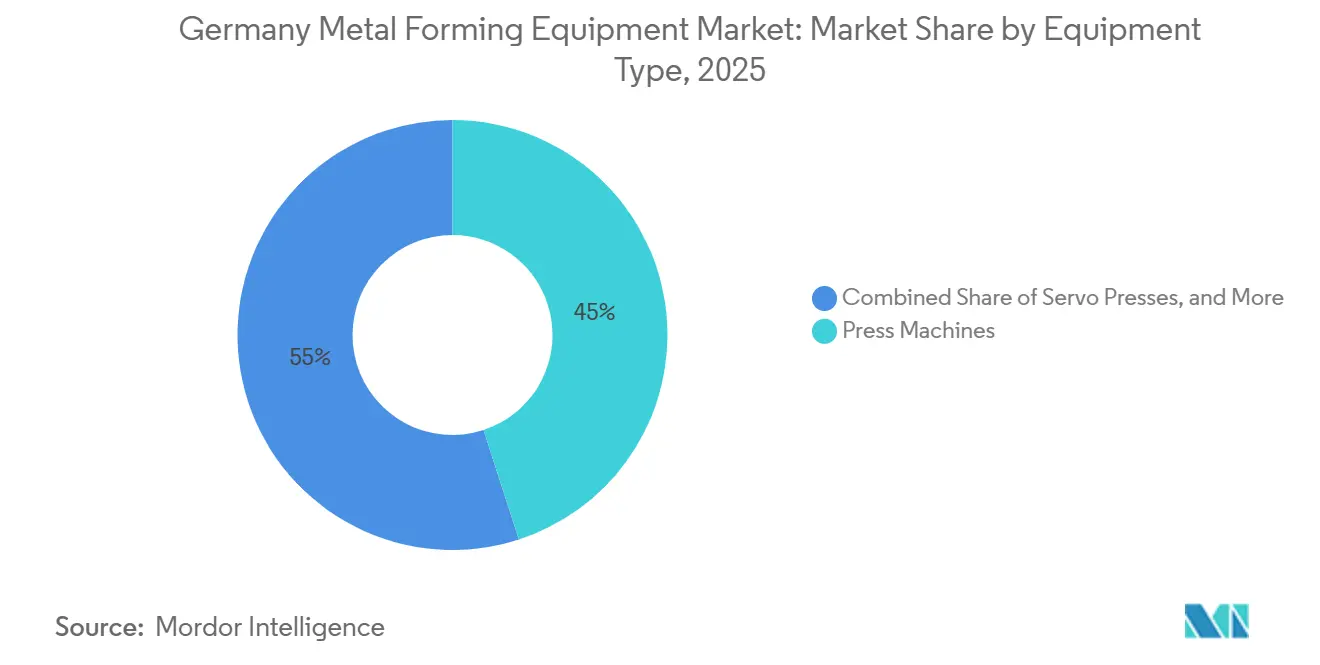
- By equipment type, press machines held 45% of the Germany metal forming equipment market share in 2025, while servo presses are forecast to grow at a 5.2% CAGR through 2031.
- By forming process, stamping and punching accounted 34% of the Germany metal forming equipment market size in 2025, while hydroforming is forecast to grow at a 4.8% CAGR through 2031.
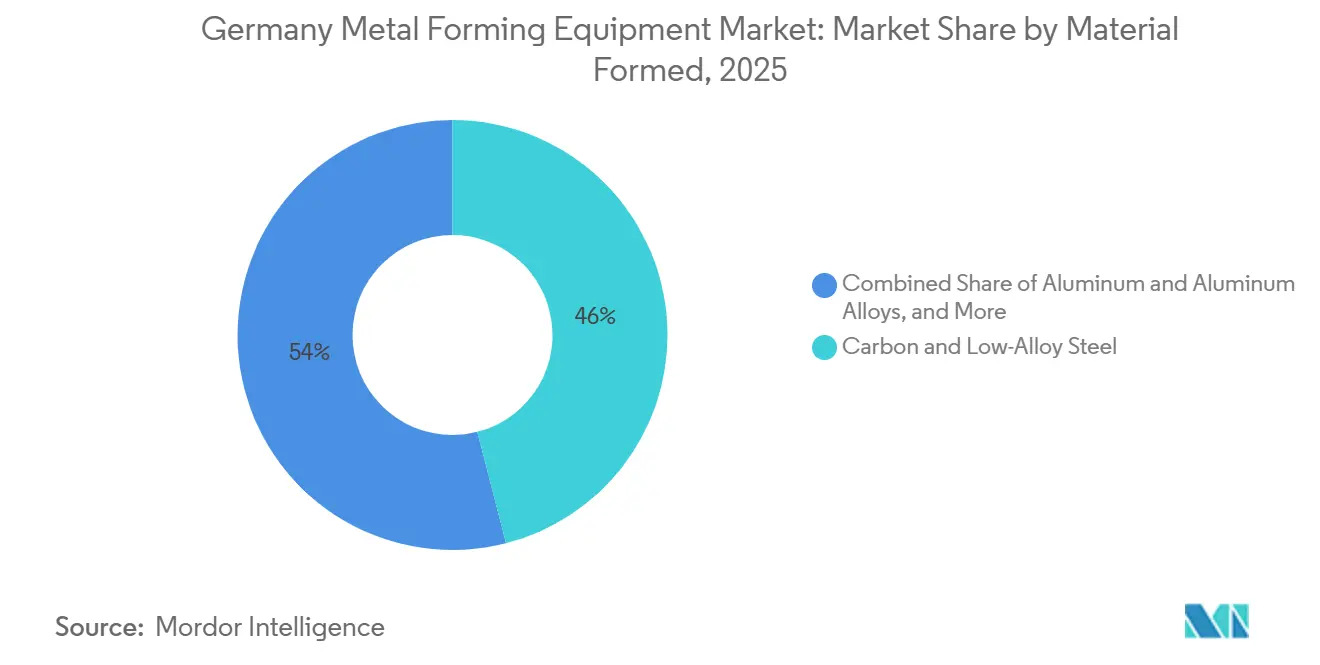
- By material formed, carbon and low-alloy steel accounted 46% of the Germany metal forming equipment market share in 2025, while aluminum and aluminum alloys are forecast to grow at a 4.9% CAGR through 2031.
- By end-use industry, automotive and transportation held 39% of the Germany metal forming equipment market size in 2025, while aerospace and defense are forecast to grow at a 4.6% CAGR through 2031.
Note: Market size and forecast figures in this report are generated using Mordor Intelligence’s proprietary estimation framework, updated with the latest available data and insights as of January 2026.
Germany Metal Forming Equipment Market Trends and Insights
Drivers Impact Analysis*
| Driver | (~) % Impact on CAGR Forecast | Geographic Relevance | Impact Timeline |
|---|---|---|---|
| Automotive Platform Reconfiguration and EV Component Complexity | +1.1% | Bavaria, Baden-Württemberg, Saxony | Medium term (2-4 years) |
| Industry 4.0 Retrofit Demand in Brownfield Press Shops | +0.8% | National, with core activity in Baden-Württemberg and Bavaria | Short term (≤ 2 years) |
| Lightweighting Across Aluminum, Advanced High-Strength Steel, and Multi-Material Assemblies | +0.7% | National, with early gains in Bavaria, Baden-Württemberg, and North Rhine-Westphalia | Medium term (2-4 years) |
| Automation and Labor-Substitution Requirements | +0.6% | National | Short term (≤ 2 years) |
| Battery-Case, Bipolar-Plate, and Electric-Motor Lamination Production | +0.5% | Saxony, Thuringia, Lower Saxony | Medium term (2-4 years) |
| Reshoring and Capacity Localization for Strategic Components | +0.4% | National, with early gains in Bavaria and Saxony | Long term (≥ 4 years) |
| Source: Mordor Intelligence | |||
Automotive Platform Reconfiguration and EV Component Complexity
Germany produced 1.67 million electric passenger cars in 2025, up 23% from the prior year, and electric vehicles represented 40% of domestic passenger-car production. Battery-electric vehicle production rose 15% to 1.22 million units, while plug-in hybrid production rose 54% to 0.45 million units. This production mix requires equipment that can handle battery-case frames, B-pillars, door rings, and aluminum closures. Servo-driven lines offer variable ram speed and controlled forming actions that fixed-cam mechanical presses cannot provide. Vehicle-platform conversion can require press-line retrofit or replacement because aluminum closures require tight dimensional control. The VDA expects domestic electric vehicle production to reach 1.76 million units in 2026, supporting a continuing upgrade cycle for transfer and servo lines.
Industry 4.0 Retrofit Demand in Brownfield Press Shops
Many German press shops operate equipment installed from the 1990s through the 2010s, which creates a separate demand base for modernization. Platform Industrie 4.0 presented Manufacturing-X interoperability work during 2025, supporting data exchange between production assets. Suppliers can add in-die force sensors, local computing nodes, and condition-monitoring tools without replacing an entire line. Fraunhofer IWU reported that smartNOTCH sensors fitted in legacy press beds capture force signatures that support die-wear prediction. The EU Machinery Regulation will apply from January 2027, prompting control-system conformity reviews and upgrade budgets during 2025. These projects give the Germany metal forming equipment market a near-term route to growth even where a full replacement purchase is delayed.
Lightweighting Across Aluminum, Advanced High-Strength Steel, and Multi-Material Assemblies
European vehicle emissions rules and electric vehicle range requirements are changing the material mix used by German press shops. Thyssenkrupp Steel presented an advanced high-strength steel door-ring concept at Blechexpo 2025 that reduces body-in-white part count and joining work. Aluminum deep drawing and hydroforming require close control of strain-rate-sensitive material behavior. These needs support servo-electric architectures and more specialized tooling. IPH Hannover demonstrated hydroforming of hybrid steel-aluminum tailored tubes after laser brazing, which supports lighter structural designs. The Germany metal forming equipment industry is responding by integrating forming and joining capabilities within the same production cell.
Automation and Labor-Substitution Requirements
The DIHK Skilled Labour Report 2025/2026 found that 42% of metal production and processing companies had difficulty filling qualified positions. The comparable rate in mechanical engineering was 38%. Workers trained through the dual-vocational system were the most frequently missing group among companies with vacancy problems. Robotic loading, vision inspection, and automated die changes can help press shops preserve output with fewer operators. The Federal Employment Agency identified 157 occupations with persistent shortages in 2025, including roles related to mechanical engineering and metalworking. This operating constraint makes automation an important purchase consideration across the Germany metal forming equipment market.
Restraints Impact Analysis*
| Restraint | (~) % Impact on CAGR Forecast | Geographic Relevance | Impact Timeline |
|---|---|---|---|
| Cyclical German Industrial Capital-Expenditure Weakness | -0.9% | National | Short term (≤ 2 years) |
| High Upfront Cost and Long Payback for Integrated Lines | -0.6% | National, with disproportionate exposure in small and medium-sized enterprise-dense Bavaria and Baden-Württemberg | Medium term (2-4 years) |
| Skilled Workforce Shortage for Automation and Process Engineering | -0.5% | National | Long term (≥ 4 years) |
| Energy-Intensity, Carbon-Cost Exposure and Compliance Burden | -0.4% | National, with the highest exposure in North Rhine-Westphalia and Saxony, heavy-forming clusters | Medium term (2-4 years) |
| Source: Mordor Intelligence | |||
Cyclical German Industrial Capital-Expenditure Weakness
Gross fixed capital formation in machinery and equipment declined 2.3% in price-adjusted terms in 2025, compared with a 0.5% decline in overall fixed capital formation.[2]Federal Statistical Office of Germany, “Gross Domestic Product Up 0.2% in 2025,” Destatis, destatis.de The weaker environment reflected restrained export demand and continuing uncertainty around investment decisions. KfW reported that commercial investment remained 8% below its 2019 level in real terms at the end of 2025. Equipment investment also fell 5.2% quarter over quarter in the fourth quarter of 2025. The Bundesbank expects fiscal expansion to lift GDP growth by 0.7% in 2026, although private manufacturing investment may respond with a delay. Buyers in the Germany metal forming equipment market are consequently extending replacement cycles and prioritizing targeted retrofits.
High Upfront Cost and Long Payback for Integrated Lines
Integrated servo-transfer lines for electric vehicle structural parts commonly require EUR 20 million (USD 23.5 million) to EUR 50 million (USD 58.8 million), depending on tonnage and automation. For many Mittelstand press shops, this can equal 3 to 7 years of equipment depreciation at current utilization and margin levels. The IMF reported that investment declined under tighter monetary conditions and weaker business sentiment, while manufacturing gross value added fell 1.3% in 2025.[3]International Monetary Fund, “Germany: 2025 Article IV Consultation,” International Monetary Fund, imf.org KfW survey evidence identified future export demand and energy costs as leading reasons for postponed capital spending. Conventional bank credit and KfW loan programs remain the main financing routes, since equipment-as-a-service and outcome-based leases are not widely used. This barrier keeps smaller buyers cautious, even when a new line could improve capacity and energy performance.
*Our forecasts treat driver/restraint impacts as directional, not additive. The impact forecasts reflect baseline growth, mix effects, and variable interactions.
Segment Analysis
By Equipment Type: Servo Technology Reshaping the Press-Machine Majority
Press machines held 45% of the German metal forming equipment market share in 2025. This category includes mechanical, hydraulic, and servo presses used in automotive stamping, forging, and general fabrication. Mechanical, hydraulic, and servo systems are all part of the installed press base. Their applications range from vehicle panels to industrial components. Regenerative drives can also reduce energy demand relative to flywheel-clutch-brake systems. ANDRITZ Schuler deployed a servo press line at BMW Group Plant Munich in April 2026 for next-generation electrified vehicle production.
Servo presses are forecast to expand at a 5.2% CAGR through 2031, the highest rate among equipment types. press brakes and bending machines are the second-largest equipment group and serve structural steel, construction parts, and electrical enclosure producers. Forging equipment supports industrial machinery, automotive powertrain work, and aerospace landing-gear production. roll forming and profile rolling equipment serve construction profiles, while wire and tube forming equipment support precision parts. Extrusion presses serve aluminum processors that supply battery housing and thermal-management systems. Hydroforming equipment remains smaller but benefits from premium vehicle programs using aluminum space-frame elements. The Germany metal forming equipment market is also seeing energy monitoring and predictive-maintenance features become standard buying criteria. Germany’s industrial electricity price was EUR 0.1004/kWh (USD 0.118/kWh) in September 2025. This cost base supports demand for equipment that can reduce consumption and unplanned downtime.


By Forming Process: Stamping Drives Volume, Hydroforming Accelerates at the Frontier
Stamping and punching accounted for 34% of the German metal forming equipment market size in 2025. It remains the core process for body panels and other high-volume sheet-metal parts. The process is supported by automotive capacity at original equipment manufacturers and Tier-1 press shops. It also serves high-volume component production across industrial supply chains. Complex tubular and sheet-metal geometries are usually served by other forming methods. Fraunhofer IWU published a 2026 work combining tube hydroforming with plastic flow pressing for metal-polymer hybrid components in one tool closure.
Hydroforming is forecast to grow at a 4.8% CAGR through 2031, the fastest rate among forming processes. It can create complex tubular and sheet-metal shapes with fewer weld seams. Deep drawing is the second-largest forming process and is used for battery trays, fuel-cell bipolar plate blanks, and exhaust components. The process is important where consistent wall thickness and controlled material thinning are required. Bending provides a stable demand for construction, electrical enclosure, and HVAC components. Forging and Rolling serve industrial machinery, power generation, and railway equipment. Germany authorized a EUR 500 billion (USD 588.2 billion) special fund for infrastructure and modernization, which supports activity in these applications. Extrusion supplies aluminum profiles for electric vehicle structures and thermal management. The breadth of processes in the Germany metal forming equipment market limits dependence on any single end-use. IPH Hannover also showed that laser-brazed hybrid steel-aluminum tubes can be hydroformed without joint rupture.
By Material Formed: Steel Holds Volume, Aluminum Claims the Growth Premium
Carbon and low-alloy steel held 46% of the German metal forming equipment market share in 2025. Cold-rolled, dual-phase, and press-hardened grades remain essential for vehicle structural parts. Steel-capable tooling has a large installed base across German press shops. The material remains relevant for structural applications that require strength and established production methods. Battery trays and closure panels are contributing to a change in demand toward other materials. Research from Friedrich-Alexander-Universität Erlangen-Nürnberg showed that high-strength aluminum profiles can be hydroformed from roll-formed and induction-welded sections.[4]Friedrich-Alexander-Universität Erlangen-Nürnberg, “High-Strength Aluminium Profile Components: Roll-Formed, Closed Profiles,” FAU CRIS, cris.fau.de
Aluminum and aluminum alloys are forecast to grow at a 4.9% CAGR through 2031. Aluminum deep drawing and hydroforming need precise motion control, which raises demand for premium servo-electric systems. Stainless steel has a stable role in food-processing equipment, exhaust systems, and precision medical parts. Copper and copper alloys are processed in progressive-die operations for connectors, busbars, and thermal-interface components. Titanium, nickel, and other non-ferrous metals are a high-value group for aerospace and defense work. Hamburg, Munich, and Bremen support demand for titanium-capable hydroforming and precision forging equipment. Multi-material vehicle structures are combining aluminum, advanced high-strength steel, and fiber-reinforced components. Suppliers are extending their process integration to handle dissimilar-material joining in one cell. This capability is changing equipment specifications in the Germany metal forming equipment industry. It also creates a distinction between general-purpose presses and more specialized forming systems.
By End-Use Industry: Automotive Retains the Lead, Aerospace Accelerates
Automotive and transportation held 39% of the German metal forming equipment market size in 2025. It is supported by concentrated original equipment manufacturers and Tier-1 stamping capacity in Baden-Württemberg, Bavaria, Saxony, and Lower Saxony. This end use requires equipment for body structures, chassis components, and electric vehicle parts. It retains the largest position despite vehicle-platform changes. Industrial Machinery and Capital Equipment is the second-largest end-use and sources pressed parts for gearboxes, hydraulic cylinders, and structural frames. Germany Trade and Invest recorded 1,564 foreign direct investment projects in Germany in 2025.
Aerospace and defense are forecast to grow at a 4.6% CAGR through 2031. Defense modernization and higher commercial aircraft production support demand for precision titanium and aluminum forming. Metal products and fabrication, electrical, and electronics benefit from the electric vehicle and energy-transition supply chains. Charging stations need stamped enclosures and busbars. Energy and power applications include wind-turbine parts, offshore platform components, and hydrogen-storage vessels. Consumer appliances and durable goods provide stable volume demand, especially in Bavaria and North Rhine-Westphalia. Medical and precision manufacturing needs narrow tolerances for instruments and diagnostic equipment frames. Press shops serving these customers commonly operate under ISO 13485 quality management frameworks. These requirements raise entry barriers and support specialized suppliers in the Germany metal forming equipment market.
Geography Analysis
Baden-Württemberg and Bavaria form the most equipment-intensive corridor in the Germany metal forming equipment market. They host ANDRITZ Schuler in Göppingen, TRUMPF in Ditzingen, and a dense base of automotive stampers and precision fabricators. BMW facilities in Munich and Dingolfing, Porsche in Stuttgart-Zuffenhausen, and Mercedes-Benz in Sindelfingen support servo-press investment tied to electric vehicle launches. Germany contributed EUR 199 billion (USD 234.1 billion) in machinery exports during 2025 and accounted for more than one-third of European Union machinery exports. Baden-Württemberg and Bavaria generated the largest share of this activity. Their small and medium-sized manufacturers are key customers for servo press brakes, integrated bending cells, and retrofit sensor packages.
North Rhine-Westphalia is a major center for heavy forming, including steel-intensive forging and rolling. The Ruhr-Rhine corridor supports automotive powertrain, wind-energy, and industrial-machinery supply chains. Large hydraulic presses, forging hammers, and plate-rolling equipment remain important in the region. Its operators face high electricity exposure from large presses and steel pre-processing. Germany’s industrial electricity price was EUR 0.1004/kWh (USD 0.118/kWh) in September 2025. The industrial electricity price subsidy took effect on January 1, 2026, after European Union state-aid approval, and offers partial relief to the highest-consumption users.
Saxony and Thuringia are growing centers for advanced forming equipment because of electric vehicle and battery investment. Zwickau, Leipzig, and Halle support vehicle production and press-shop activity. Battery investment in Erfurt and Salzgitter extends equipment demand beyond conventional body-in-white production. These projects create demand for electrode pressing, cell-housing stamping, and bipolar-plate production equipment. Lower Saxony adds demand through the Volkswagen Wolfsburg complex and its supplier base. Hamburg and Bremen contribute specialized aerospace forming requirements. This regional mix gives the Germany metal forming equipment market exposure to heavy forging in the west, automotive stamping in the south, and battery-related production in the east.
Competitive Landscape
The Germany metal forming equipment market is moderately concentrated in large automotive press lines and fragmented in standard press brakes and bending machines. A limited group of integrated suppliers holds original equipment manufacturer qualifications and after-sales relationships in high-tonnage applications. ANDRITZ Schuler has a broad portfolio across servo-transfer lines, fineblanking presses, and Metris digital monitoring tools. Schuler completed its rebranding to ANDRITZ Schuler in March 2025, marking full integration into the ANDRITZ group. TRUMPF competes in servo press brakes, punch presses, and connected manufacturing systems. AMADA, AIDA Engineering, and Komatsu compete on total cost of ownership in the mid-market, while Durma, Ermaksan, and Dener Makina address cost-sensitive press-brake demand.
TRUMPF signed an agreement in July 2026 to acquire Mate Precision Technologies, expanding its punching and bending tooling portfolio for equipment from multiple manufacturers. ANDRITZ Schuler deployed a servo line at the BMW Group Plant Munich in April 2026. In January 2026, ANDRITZ Schuler and Feintool adjusted their fineblanking cooperation, with ANDRITZ Schuler acting as general contractor for HFA-Plus systems. Bystronic, LVD, and Salvagnini extend competition in automated bending and flexible sheet-metal production cells. Their offerings emphasize software-supported programming and shorter setup time.
Suppliers with proprietary connectivity platforms can create switching costs through predictive maintenance and production data tools. Metris and TRUMPF’s software portfolio are important examples of this approach. Retrofit services for smaller press shops remain a competitive opening in the Germany metal forming equipment market. Battery-enclosure forming cells and remote commissioning also address emerging customer needs. Compliance with the EU Machinery Regulation 2023/1230 is a barrier for suppliers entering the European market. ISO 9001 quality-system requirements also favor established suppliers that can support documented production processes. Mitsubishi Electric is not included because it supplies factory automation components rather than metal forming equipment. Siempelkamp is a more relevant replacement because it manufactures large hydraulic presses for automotive, aerospace, and composite forming.
Germany Metal Forming Equipment Industry Leaders
ANDRITZ Schuler Group
TRUMPF SE + Co. KG
Bystronic AG
Weil Technology AG
LAUFFER Pressen GmbH and Co. KG
- *Disclaimer: Major Players sorted in no particular order

Recent Industry Developments
- July 2026: TRUMPF signed an agreement to acquire Mate Precision Technologies, a global leader in metal cutting and forming tooling. The acquisition expands TRUMPF's punching and bending tool portfolio to cover equipment from multiple manufacturers, including non-TRUMPF machines, and strengthens its position in the North American market.
- April 2026: ANDRITZ Schuler supplied a high-efficiency servo press line to the new BMW Group plant in Munich, supporting production capacity for next-generation electrified vehicle platforms.
- January 2026: ANDRITZ Schuler and Feintool AG restructured their fineblanking-press cooperation, with ANDRITZ Schuler acting as general contractor for HFA-Plus fineblanking systems. Next-generation presses incorporated servo-controlled hydraulic pump drives that delivered double-digit energy-efficiency improvements alongside higher stroke rates.
- October 2025: Thyssenkrupp Steel presented its advanced high-strength steel door-ring concept at Blechexpo 2025 in Stuttgart. The structurally integrated press-hardened component reduces automotive body-in-white part count and eliminates multiple joining operations.


Germany Metal Forming Equipment Market Report Scope
| Press Machines | Mechanical Presses |
| Hydraulic Presses | |
| Servo Presses | |
| Other General-Purpose Presses | |
| Press Brakes and Bending Machines | Hydraulic Press Brakes |
| Servo / Electric Press Brakes | |
| Mechanical Press Brakes | |
| Other Bending Machines | |
| Forging Equipment | Forging Presses |
| Forging Hammers | |
| Upsetting and Heading Machines | |
| Other Forging Equipment | |
| Roll Forming and Plate/Profile Rolling Equipment | Roll Forming Machines |
| Plate Rolling Machines | |
| Section and Profile Rolling Machines | |
| Other Secondary Rolling/Forming Equipment | |
| Wire, Tube and Profile Forming Equipment | Wire and Bar Drawing/Forming Equipment |
| Tube Forming and Bending Equipment | |
| Profile Forming Equipment | |
| Extrusion Presses | |
| Hydroforming Equipment | |
| Other Metal Forming Equipment |
| Stamping and Punching |
| Deep Drawing |
| Bending |
| Forging |
| Rolling and Roll Forming |
| Extrusion |
| Hydroforming |
| Other Forming Processes |
| Carbon and Low-Alloy Steel |
| Stainless Steel |
| Aluminum and Aluminum Alloys |
| Copper and Copper Alloys |
| Titanium, Nickel and Other Non-Ferrous Metals |
| Other Materials |
| Automotive and Transportation |
| Aerospace and Defense |
| Industrial Machinery and Capital Equipment |
| Metal Products and Fabrication |
| Electrical and Electronics |
| Construction and Infrastructure |
| Energy and Power |
| Consumer Appliances and Durable Goods |
| Medical and Precision Manufacturing |
| Other End-Use Industries |
| By Equipment Type | Press Machines | Mechanical Presses |
| Hydraulic Presses | ||
| Servo Presses | ||
| Other General-Purpose Presses | ||
| Press Brakes and Bending Machines | Hydraulic Press Brakes | |
| Servo / Electric Press Brakes | ||
| Mechanical Press Brakes | ||
| Other Bending Machines | ||
| Forging Equipment | Forging Presses | |
| Forging Hammers | ||
| Upsetting and Heading Machines | ||
| Other Forging Equipment | ||
| Roll Forming and Plate/Profile Rolling Equipment | Roll Forming Machines | |
| Plate Rolling Machines | ||
| Section and Profile Rolling Machines | ||
| Other Secondary Rolling/Forming Equipment | ||
| Wire, Tube and Profile Forming Equipment | Wire and Bar Drawing/Forming Equipment | |
| Tube Forming and Bending Equipment | ||
| Profile Forming Equipment | ||
| Extrusion Presses | ||
| Hydroforming Equipment | ||
| Other Metal Forming Equipment | ||
| By Forming Process | Stamping and Punching | |
| Deep Drawing | ||
| Bending | ||
| Forging | ||
| Rolling and Roll Forming | ||
| Extrusion | ||
| Hydroforming | ||
| Other Forming Processes | ||
| By Material Formed | Carbon and Low-Alloy Steel | |
| Stainless Steel | ||
| Aluminum and Aluminum Alloys | ||
| Copper and Copper Alloys | ||
| Titanium, Nickel and Other Non-Ferrous Metals | ||
| Other Materials | ||
| By End-Use Industry | Automotive and Transportation | |
| Aerospace and Defense | ||
| Industrial Machinery and Capital Equipment | ||
| Metal Products and Fabrication | ||
| Electrical and Electronics | ||
| Construction and Infrastructure | ||
| Energy and Power | ||
| Consumer Appliances and Durable Goods | ||
| Medical and Precision Manufacturing | ||
| Other End-Use Industries | ||


Key Questions Answered in the Report
What is the forecast for Germany metal forming equipment market size?
The Germany metal forming equipment market size is expected to reach USD 2.3 billion by 2031 from USD 2.01 billion in 2026, at a 2.72% CAGR.
Which equipment type is growing fastest in Germany?
Servo presses are forecast to grow at a 5.2% CAGR through 2031, supported by electric vehicle components and energy-efficient production.
Which forming process holds the largest share in Germany?
Stamping and punching held 34% of the share of the German metal forming equipment market in 2025, supported by automotive body-stamping activity.
What materials are shaping equipment demand in Germany?
Carbon and low-alloy Steel held 46% in 2025, while aluminum and aluminum alloys are forecast to grow at a 4.9% CAGR through 2031.
Which end-use sector leads demand for metal forming equipment?
Automotive and transportation held 39% in 2025, while aerospace and defense are the fastest-growing end-use at a 4.6% CAGR.
Why are retrofits important for German press shops?
Retrofit tools add monitoring, automation, and conformity upgrades to installed lines while avoiding the cost of a full equipment replacement.
Page last updated on:





