
Germany Fresh Herbs Market Size and Share
Market Overview
| Study Period | 2022 - 2032 |
|---|---|
| Forecast Data Period | 2027 - 2032 |
| Base Year Market Size (2026) | USD 521.11 Million |
| Market Size (2027) | USD 553.73 Million |
| Market Size (2032) | USD 750.15 Million |
| Growth Rate (2027 - 2032) | 6.26 % |
| Market Concentration | Medium |
Major Players *Disclaimer: Major Players sorted in no particular order Image © Mordor Intelligence. Reuse requires attribution under CC BY 4.0. | |
Germany Fresh Herbs Market Analysis by Mordor Intelligence
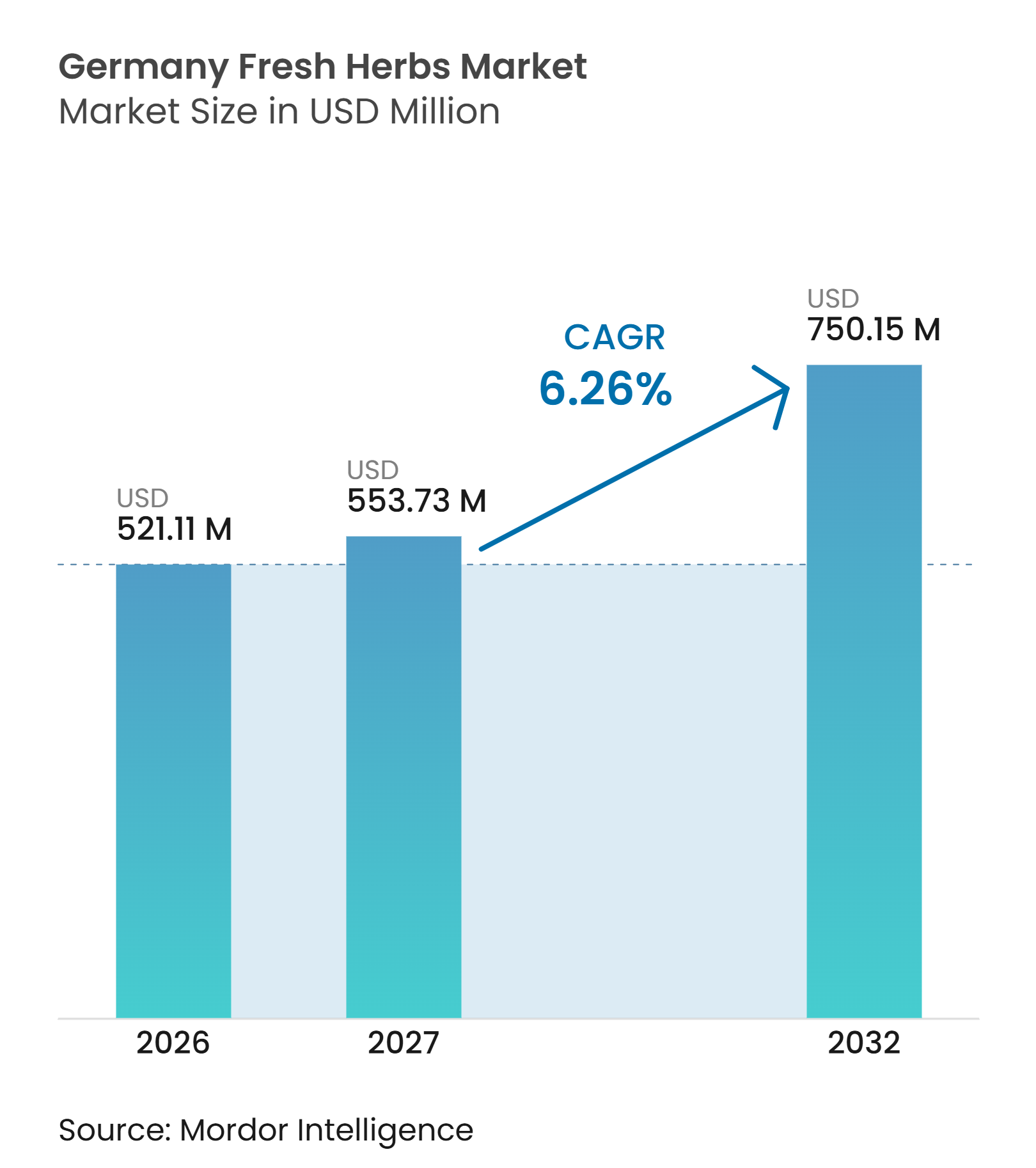
The Germany fresh herbs market was valued at USD 521.11 million in 2026 and is projected to grow from USD 553.73 million in 2027 to reach USD 750.15 million by 2032, at a CAGR of 6.26% from 2027 to 2032. The market benefits from a shift toward fresh flavorings and minimally processed foods. Germany's extensive food retail network supports broad consumer access and efficient distribution through supermarkets, discount retailers, and specialty stores. Consumer interest in organic products and natural ingredients strengthens demand for fresh herbs in everyday cooking and food preparation. Retailers increasingly prioritize consistent year-round availability, supported by greenhouse cultivation and imports from Southern Europe and North Africa. However, the market faces challenges related to short shelf life, seasonal supply fluctuations, import dependence, and price competition among retailers.
Key Report Takeaways
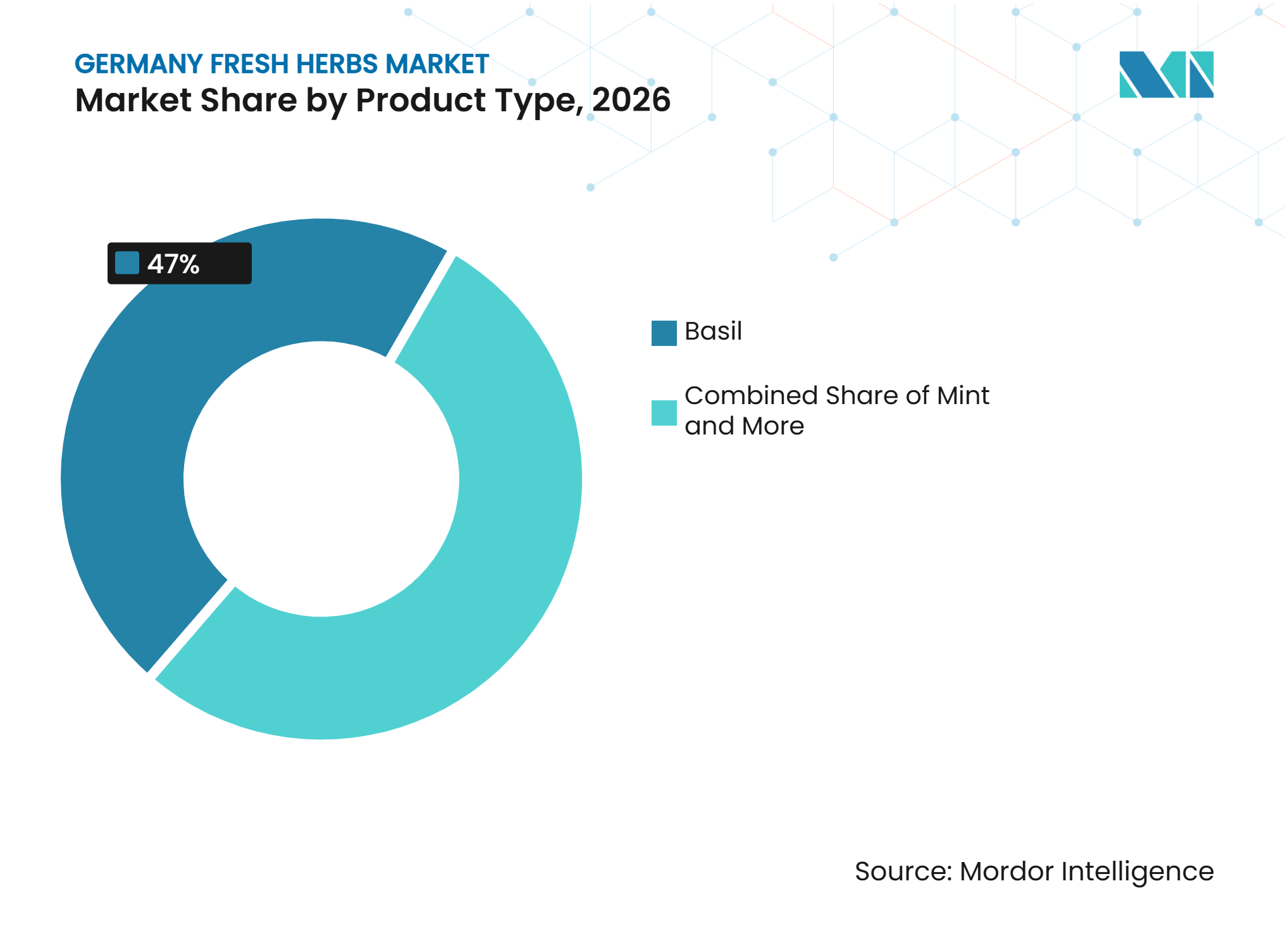
By product type, basil accounted for the largest 47.0% of the Germany fresh herbs market share in 2026, while cilantro/coriander is projected to grow at the fastest CAGR of 8.2% from 2027 to 2032.
By category, conventional herbs accounted for the largest share at 82.0% in 2026, while Germany fresh herbs market size for organic herbs is projected to grow at the fastest CAGR of 8.0% from 2027 to 2032.
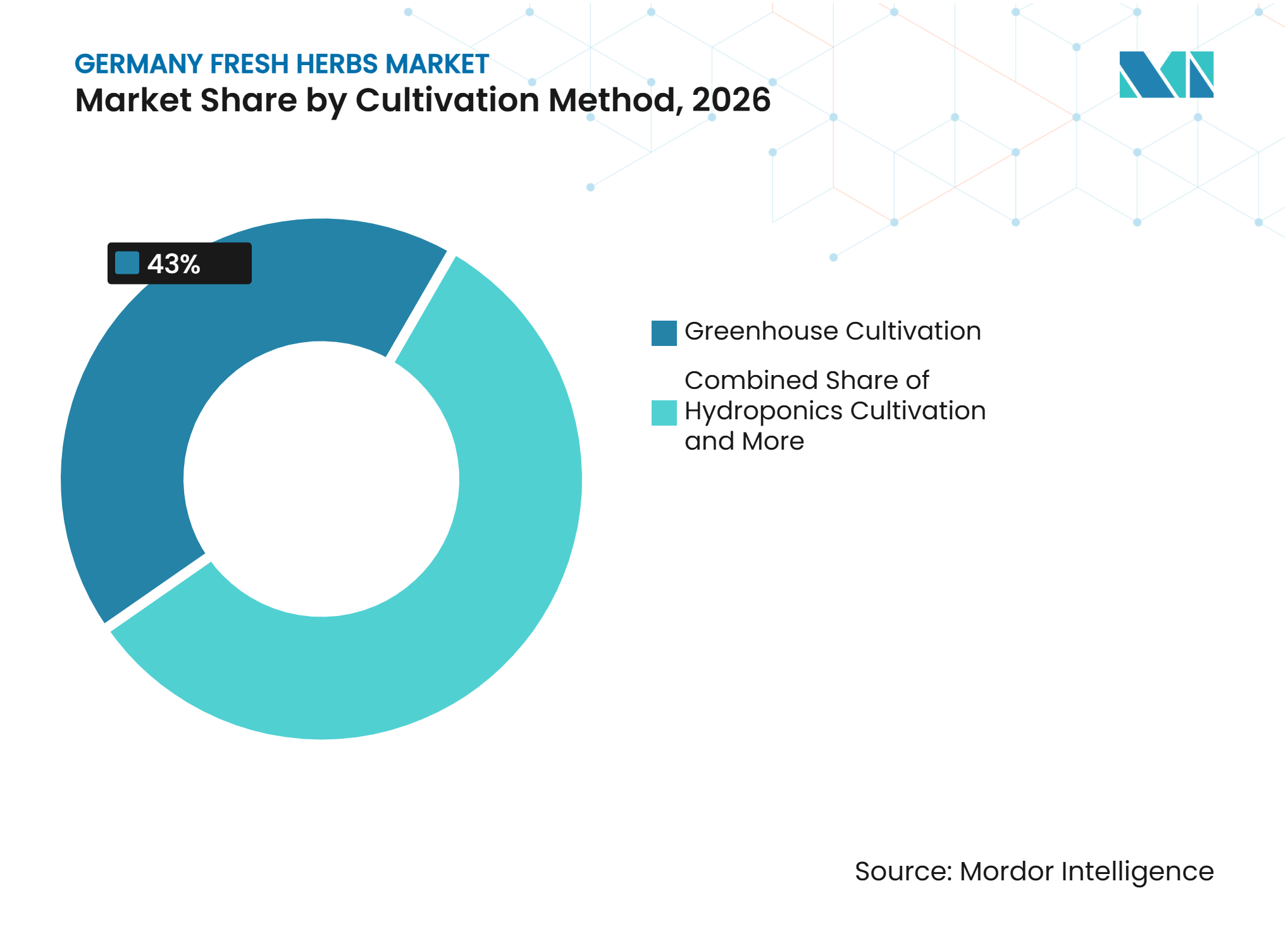
By cultivation method, greenhouse cultivation accounted for the largest share at 43.0% in 2026, while hydroponic cultivation is projected to grow at the fastest CAGR of 11.0% from 2027 to 2032.
By end user, food retail accounted for the largest revenue share at 49.6% in 2026, while foodservice is projected to grow at the fastest CAGR of 7.4% from 2027 to 2032.
Note: Market size and forecast figures in this report are generated using Mordor Intelligence’s proprietary estimation framework, updated with the latest available data and insights as of January 2026.
Market Trends and Insights
Drivers Impact Analysis of Germany Fresh Herbs Market*
| Driver | (~) % Impact on CAGR Forecast | Geographic Relevance | Impact Timeline |
|---|---|---|---|
| Consumer Preference for Fresh and Natural Flavoring | 1.8% | National, strongest in Berlin, Hamburg, Munich, and Frankfurt | Short term (≤ 2 years) |
| Growth of Restaurant, Hospitality, and Foodservice Consumption | 1.2% | National, with high restaurant density in North Rhine-Westphalia, Bavaria, and Berlin | Medium term (2-4 years) |
| Expansion of Organic and Regionally Sourced Fresh Herbs | 1.3% | National, especially Bavaria and Baden-Württemberg | Medium term (2-4 years) |
| International Cuisine and Specialty Herb Adoption | 0.8% | Urban areas, including Berlin, Frankfurt, Hamburg, and Stuttgart | Medium term (2-4 years) |
| Controlled-Environment Production Extending Year-Round Availability | 0.7% | National, with greenhouse hubs in North Rhine-Westphalia and Bavaria | Long term (≥ 4 years) |
| Retailer-Led Premiumization Through Improved Packaging and Private Labels | 0.5% | National | Short term (≤ 2 years) |
| Source: Mordor Intelligence | |||
Consumer Preference for Fresh and Natural Flavoring
Consumer preference for fresh herbs continues to drive the Germany fresh herbs market, as households increasingly choose minimally processed ingredients for everyday cooking and healthier meal preparation. Fresh herbs are gaining wider acceptance across retail and foodservice channels due to their superior flavor, freshness, and clean-label appeal compared to dried alternatives. According to the German Federal Ministry of Agriculture, Food and Regional Identity (BMLEH), organic food sales reached EUR 16.99 billion in 2024, reflecting sustained consumer demand for certified food products and supporting greater retail availability of organic fresh herbs. Expanding supermarket assortments, private-label offerings, and locally sourced herb selections continue to strengthen market demand across Germany.
Expansion of Organic and Regionally Sourced Fresh Herbs
The growing availability of organic and regionally sourced products is supporting the Germany fresh herbs market, driven by consumer preference for locally produced, certified fresh foods. Retailers are expanding their organic and regional herb assortments to meet demand for traceable and sustainably produced ingredients. According to the German Federal Ministry of Agriculture, Food and Regional Identity (BMLEH), 1.913 million hectares, equivalent to 11.5% of Germany's agricultural land, were managed organically in 2024[1], providing a larger production base for certified fresh herbs and other horticultural crops. This growth in organic cultivation supports greater domestic availability, reduces reliance on imports for selected products, and improves the competitiveness of regional herb producers.
Growth of Restaurant, Hospitality, and Foodservice Consumption
The growth of Germany's restaurant, hospitality, and foodservice sector continues to support demand for fresh herbs, as chefs increasingly use fresh ingredients to enhance flavor, presentation, and menu differentiation. Hotels, restaurants, cafés, and catering operators require a reliable year-round supply of herbs for both traditional German cuisine and international dishes. According to the United States Department of Agriculture (USDA) Foreign Agricultural Service (GAIN), Germany's hotel, restaurant, and institutional (HRI) foodservice sector generated USD 93.7 billion in sales in 2024[2]. The recovery of commercial foodservice activity is driving procurement of premium fresh produce, encouraging suppliers to strengthen cold-chain logistics, contract farming, and quality standards for fresh herbs.
Retailer-Led Premiumization Through Improved Packaging and Private Labels
Retailer premiumization is strengthening the Germany fresh herbs market through improved merchandising, premium packaging, and expanded private-label offerings. Supermarkets are differentiating fresh herbs by emphasizing freshness, regional sourcing, organic certification, and convenient packaging formats that enhance shelf life and consumer appeal. According to EDEKA's 2025 Annual Report, EDEKA's fruit and vegetable departments were recognized as the best in Germany for the ninth consecutive year in the Retail Award 2025. This recognition reflects growing retailer investment in premium fresh produce categories, supporting greater visibility and value creation for fresh herbs.
Restraints Impact Analysis of Germany Fresh Herbs Market*
| Restraint | (~) % Impact on CAGR Forecast | Geographic Relevance | Impact Timeline |
|---|---|---|---|
| Short Shelf Life, Shrink, and Retail Waste | -1.0% | National, particularly discount and convenience formats | Short term (≤ 2 years) |
| Seasonal Production Gaps and Import Dependence | -0.8% | National, most severe from October through April | Medium term (2-4 years) |
| Retail Price Sensitivity and Promotional Volatility | -0.7% | National, concentrated in hard-discount channels | Short term (≤ 2 years) |
| Airfreight Exposure and Carbon-Compliance Risk for Off-Season Herbs | -0.5% | Global supply chains, particularly East African-origin herbs | Long term (≥ 4 years) |
| Source: Mordor Intelligence | |||
Short Shelf Life, Shrink, and Retail Waste
Short shelf life, shrinkage, and retail waste continue to limit growth in the Germany fresh herbs market by increasing handling costs and reducing profitability across the supply chain. Fresh herbs are highly sensitive to temperature fluctuations and excessive humidity during storage, transportation, and retail display, making uninterrupted cold-chain management essential. According to a 2025 Horticulturae study, environmental conditions were monitored across two German potted herb supply chains and 25 consumer households, with transportation temperatures falling below species-specific thresholds and relative humidity reaching up to 98%, resulting in reduced herb quality and freshness[3]. In addition, Fraunhofer IVV reported that up to 50% of fresh fruit and vegetables are discarded weekly at the retail and consumer stages due to premature ripening and microbial spoilage, highlighting the significant commercial impact of perishability on the distribution of fresh herbs and retail margins.
Airfreight Exposure and Carbon-Compliance Risk for Off-Season Herbs
Airfreight dependency and carbon compliance requirements continue to constrain the Germany fresh herbs market, particularly during the off-season when specialty herbs rely on imports from Morocco, Israel, and Kenya. Rising logistics costs and retailer sustainability requirements are increasing procurement challenges for importers and exporters. According to CBI (2024), suppliers outside Europe depend on airfreight to deliver fresh herbs within 24 hours of harvest, while high airfreight costs and strict buyer requirements remain major barriers to market access. These factors increase supply costs, reduce pricing flexibility, and limit the competitiveness of imported herbs during periods of limited domestic production.
*Our forecasts treat driver/restraint impacts as directional, not additive. The impact forecasts reflect baseline growth, mix effects, and variable interactions.
Germany Fresh Herbs Market Segment Analysis
By Product Type:
Basil Leads While Cilantro/Coriander Records the Fastest GrowthBasil accounted for the largest 47.0% of the Germany fresh herbs market share in 2026. Its established culinary role supports demand across household cooking, foodservice, and food processing applications. Basil is widely used in sauces, salads, prepared meals, and Mediterranean cuisine, giving suppliers access to multiple customer groups. Its suitability for greenhouse cultivation supports consistent availability through organized retail channels. Producers can differentiate basil through pot-grown and cut-herb formats, packaging, freshness, and cultivation practices. This broad application base and established retail presence support basil's dominant position in the German fresh herbs market.
Cilantro/coriander is projected to grow at the fastest CAGR of 8.2% from 2027 to 2032, supported by demand for international cuisines, including South Asian, Middle Eastern, and Latin American dishes. Its use in fresh garnishes, sauces, marinades, ready meals, and foodservice preparations creates opportunities across retail and commercial food channels. Wider availability through supermarkets, ethnic grocery stores, and foodservice distributors can improve consumer access. However, its short shelf life and sensitivity to growing conditions increase the importance of harvesting, cold-chain management, and reliable sourcing. These factors create opportunities for suppliers that can maintain consistent quality and year-round availability.



By Category:
Conventional Herbs Lead While Organic Herbs AccelerateConventional herbs accounted for the largest share at 82.0% in 2026. Their dominant position reflects broad availability, established cultivation and distribution networks, and affordability across supermarkets and discount retailers. Conventional production enables suppliers to serve high-volume retail, foodservice, and food processing customers with standardized products and consistent supply. Retailers benefit from established sourcing arrangements and familiar packaging formats. These advantages support the use of conventional herbs in routine household purchases and commercial food preparation. However, price competition and growing consumer interest in production standards are encouraging suppliers to differentiate their offerings through freshness, quality, and traceability.
Germany fresh herbs market size for organic herbs is projected to grow at the fastest CAGR of 8.0% from 2027 to 2032, supported by consumer interest in organically produced food and retailers' efforts to expand certified product ranges. Germany's established organic food market provides a distribution base for fresh herbs sold through organic supermarkets, specialist retailers, and conventional grocery chains. EU organic production requirements also influence cultivation practices, certification, and supply chain management. Growers can target consumers seeking certified alternatives by expanding suitable production capacity and improving product visibility. However, certification costs, production constraints, and price premiums can affect adoption. Reliable availability and competitive pricing will therefore influence the segment's growth.
By Cultivation Method:
Greenhouse Cultivation Leads While Hydroponics Cultivation ExpandsGreenhouse cultivation accounted for the largest share at 43.0% in 2026. Controlled growing environments help producers manage temperature, humidity, and crop conditions, supporting consistent quality and a more predictable supply. Greenhouses are particularly relevant to year-round availability in Germany, where seasonal conditions can constrain outdoor production. This cultivation method supports the production of potted and cut herbs supplied to supermarkets, foodservice distributors, and other commercial customers. Producers can also improve production planning and product consistency through better environmental control. These advantages have established greenhouse cultivation as a key supply method for meeting retailers' requirements for regular deliveries and standardized products.
Hydroponic cultivation is projected to grow at the fastest CAGR of 11.0% from 2027 to 2032, driven by interest in resource-efficient production, controlled growing conditions, and year-round harvesting. Soil-less systems can support predictable output and efficient use of growing space, making them suitable for supplying fresh herbs near major urban consumption centers. Controlled environments can also help producers manage product consistency and reduce exposure to unfavorable outdoor conditions. However, investment costs, energy consumption, technical requirements, and operating expenses can affect commercial viability. Wider adoption will depend on whether producers can achieve competitive unit costs while meeting retailer and foodservice requirements for freshness, quality, and reliable supply.

By End User:
Food Retail Leads While Foodservice Records the Fastest GrowthFood retail accounted for the largest share at 49.6% in 2026. Supermarkets, discount retailers, and specialty grocery stores provide broad consumer access to fresh herbs through potted, cut, and packaged formats. Established retail distribution networks enable recurring purchases for household cooking and provide suppliers with access to large customer bases. Retailers also influence product specifications, packaging, shelf placement, and supplier selection, making consistent quality and availability important for market participation. Demand across everyday cooking, salads, sauces, and prepared meals supports continued retail procurement. However, short shelf life and price competition increase the importance of efficient logistics and inventory management.
Foodservice is projected to grow at the fastest CAGR of 7.4% from 2027 to 2032, driven by demand from restaurants, hotels, catering operators, and commercial kitchens. Fresh herbs contribute flavor, aroma, garnishing, and product differentiation across cuisines, including Mediterranean, Asian, and Middle Eastern preparations. Foodservice customers may require larger pack sizes, consistent specifications, frequent deliveries, and a reliable year-round supply. Growth in demand for prepared meals, takeaway food, and professional kitchen services can create additional opportunities for herb growers, packers, and distributors. However, purchasing decisions remain sensitive to food costs, wastage, and supply reliability. Suppliers that offer consistent quality, suitable packaging, and efficient delivery can strengthen their position in this segment.
Geography Analysis
Germany represents the entire geographic scope of this report on the fresh herbs market, supported by strong domestic consumption, greenhouse cultivation, and established horticultural infrastructure. Commercial herb production is concentrated in Lower Saxony, North Rhine-Westphalia, Hesse, and Bavaria, where favorable growing conditions and protected cultivation enable year-round supply. Outdoor production remains seasonal, while greenhouse systems maintain product availability during colder months. The Federal Statistical Office (Destatis) monitors horticultural production through official statistics on cultivated area, harvest volume, and yields, providing a reliable basis for evaluating domestic fresh produce supply and production trends.
Regional trade plays an essential role in maintaining a consistent year-round supply of fresh herbs. The Netherlands serves as Germany's principal trading partner due to its advanced greenhouse production, packing facilities, and logistics network, while Denmark, Italy, and Poland supplement seasonal requirements with selected herb varieties. Imports from Morocco, Israel, and Kenya support winter availability of basil, coriander, mint, and other specialty herbs when domestic outdoor production declines. This diversified sourcing structure supports supply resilience and enables retailers and foodservice operators to maintain broad product availability throughout the year.
Germany maintains strong year-round demand for fresh culinary herbs through a combination of domestic cultivation and imports from neighboring European countries, as well as non-European suppliers during the winter season. According to the Center for the Promotion of Imports from Developing Countries (CBI), German consumers purchase more than 300 grams of fresh culinary herbs per person annually, with parsley, chives, dill, basil, and mint representing the most widely consumed varieties. This sustained consumer demand supports greenhouse production, regional sourcing, and diversified import channels, ensuring consistent retail and foodservice availability throughout the year.
Competitive Landscape
Market Concentration
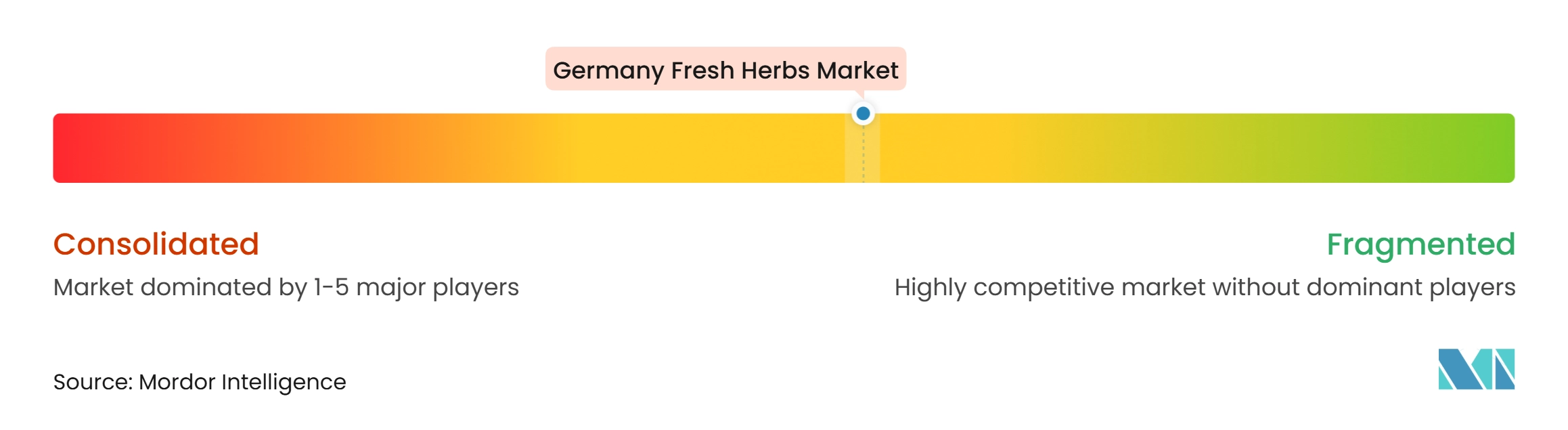
The Germany fresh herbs market is moderately fragmented in 2026. Major key players include EDEKA ZENTRALE Stiftung & Co. KG, REWE-ZENTRAL AG, ALDI Einkauf SE & Co. oHG, Lidl Stiftung & Co. KG, and Gemüsering Stuttgart GmbH. Competition is primarily based on freshness, product quality, consistent supply, traceability, and compliance with food safety and sustainability standards. Retailers influence purchasing decisions through private-label offerings and long-term supplier relationships, while producers differentiate themselves through regional sourcing, controlled-environment cultivation, and certified organic production.
Retailers continue to strengthen supply chains by expanding regional procurement, improving product traceability, and investing in sustainable sourcing initiatives. Domestic growers compete with imported products through shorter delivery times, locally produced herbs, and greater responsiveness to changing consumer preferences. Greenhouse cultivation enables stable year-round production, while importers complement domestic supply with specialty herbs during periods of limited outdoor harvesting. Suppliers that maintain consistent quality, reliable logistics, and strong retailer partnerships are better positioned to secure long-term procurement agreements and strengthen their competitive standing.
Mid-sized suppliers can improve their competitive position by offering certified organic, regionally grown, and specialty herbs that meet retailer quality and traceability requirements. Investments in controlled-environment agriculture and efficient logistics support year-round availability while reducing production risks. According to EDEKA ZENTRALE Stiftung & Co. KG's 2025 Annual Report, company sources fresh fruit and vegetables directly from more than 1,000 partner farms across approximately 90 countries, with around half of its agricultural suppliers located in Germany. This extensive procurement network strengthens retailer buying power and increases competition among domestic growers and import suppliers.
Germany Fresh Herbs Industry Leaders
-
EDEKA ZENTRALE Stiftung & Co. KG
-
REWE-ZENTRAL AG
-
ALDI Einkauf SE & Co. oHG
-
Lidl Stiftung & Co. KG
-
Gemüsering Stuttgart GmbH
- *Disclaimer: Major Players sorted in no particular order
Germany Fresh Herbs Market Companies Covered in this Report
- EDEKA ZENTRALE Stiftung & Co. KG
- REWE-ZENTRAL AG
- ALDI Einkauf SE & Co. oHG
- Lidl Stiftung & Co. KG
- Herrmann Kräuteranbau GmbH
- Gemüsering Stuttgart GmbH
- Vitacress Real B.V.
- Böttcher Gartenbau
- Van Vugt Kruiden B.V.
- VDV-Herbs BV
- Pfalzmarkt für Obst und Gemüse eG
- Kräuter Mix GmbH
Recent Industry Developments in Germany Fresh Herbs Market
- April 2026: EDEKA ZENTRALE Stiftung & Co. KG introduced the unified EDEKA Regional private-label brand across its stores in Germany, consolidating regional labels and expanding regional sourcing across fresh produce categories, including herbs.
- March 2026: REWE-ZENTRAL AG (REWE-Zentralfinanz eG) launched the Crispy Mix hydroponically grown loose-leaf salad in Bavaria, Germany, through its partnership with Gemüsebau Steiner, with additional variants, including a wild herb mix, planned for a wider regional rollout.
- December 2025: REWE-ZENTRAL AG (REWE-Zentralfinanz eG) partnered with Bioland, Germany's largest organic farming association, to expand its association-certified organic fruit and vegetable range sourced from German and regional farms. The partnership strengthens local supply chains, reduces farm-to-store distances across approximately 3,800 REWE stores, and supports the growth of domestic organic vegetable production.
Germany Fresh Herbs Market Report Scope
Fresh herbs are aromatic, edible plant leaves and stems that are harvested and sold without drying. They are widely used to enhance flavor, aroma, and presentation in culinary applications, beverages, food processing, and select medicinal and nutraceutical preparations.
The Germany fresh herbs market report is segmented by product type (basil, cilantro/coriander, mint, parsley, chives, oregano, rosemary, thyme, sage, dill, and other fresh herbs), by category (conventional and organic), by cultivation method (open-field cultivation, greenhouse cultivation, hydroponic cultivation, aeroponic cultivation, and vertical indoor cultivation), and by end user (foodservice, food retail, food processing, pharmaceutical and nutraceutical, and other). The market forecasts are provided in terms of value (USD).
Segmentation Overview
| Basil |
| Cilantro/Coriander |
| Mint |
| Parsley |
| Chives |
| Oregano |
| Rosemary |
| Thyme |
| Sage |
| Dill |
| Other Fresh Herbs |
| Conventional |
| Organic |
| Open-Field Cultivation |
| Greenhouse Cultivation |
| Hydroponic Cultivation |
| Aeroponic Cultivation |
| Vertical Indoor Cultivation |
| Foodservice |
| Food Retail |
| Food Processing |
| Pharmaceutical and Nutraceutical |
| Other |
| By Product Type | Basil |
| Cilantro/Coriander | |
| Mint | |
| Parsley | |
| Chives | |
| Oregano | |
| Rosemary | |
| Thyme | |
| Sage | |
| Dill | |
| Other Fresh Herbs | |
| By Category | Conventional |
| Organic | |
| By Cultivation Method | Open-Field Cultivation |
| Greenhouse Cultivation | |
| Hydroponic Cultivation | |
| Aeroponic Cultivation | |
| Vertical Indoor Cultivation | |
| By End User | Foodservice |
| Food Retail | |
| Food Processing | |
| Pharmaceutical and Nutraceutical | |
| Other |
Key Questions Answered in the Report
What is the projected value of fresh herbs in Germany by 2032?
The Germany fresh herbs market is forecast to reach USD 750.15 million by 2032.
Which cultivation method is growing fastest for Germany fresh herbs?
Hydroponic cultivation is forecast to grow at the fastest CAGR of 11.0% from 2027 to 2032.
Which fresh herb holds the largest share in Germany?
Basil segment held the largest share at 47.0% in 2026.
What is the leading end-user channel for fresh herbs in Germany?
Food retail held the largest share at 49.6% in 2026.