
Germany Electric Vehicle Battery Manufacturing Market Size and Share
| Study Period | 2019 - 2030 |
| Forecast Data Period | 2025 - 2030 |
| Historical Data Period | 2019 - 2023 |
| Market Size (2025) | USD 5.16 Billion |
| Market Size (2030) | USD 18.42 Billion |
| CAGR (2025 - 2030) | 28.99% |
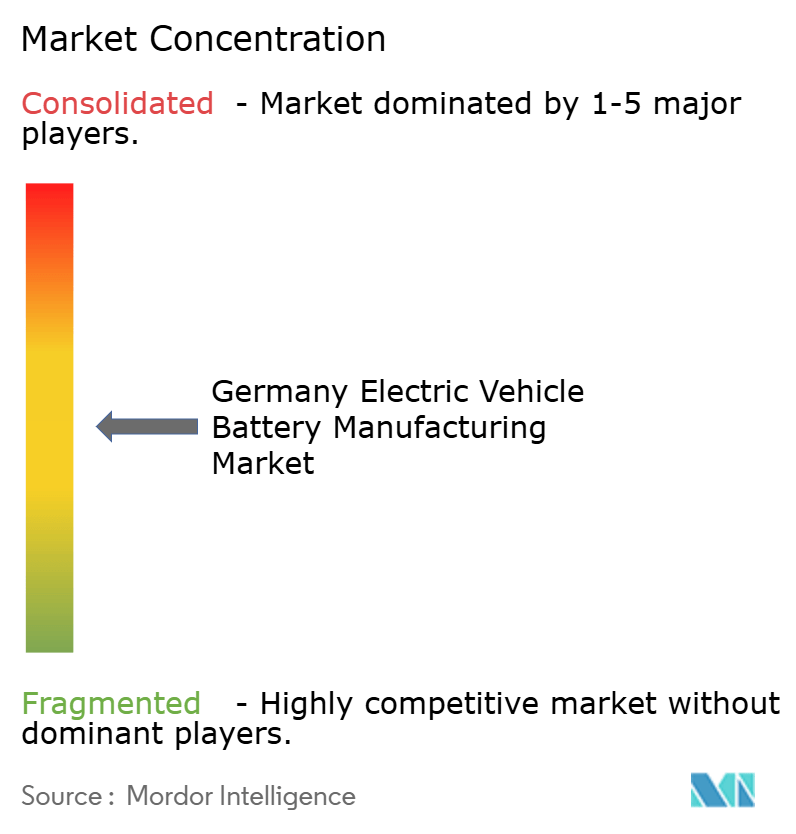
| Market Concentration | Medium |
Major Players *Disclaimer: Major Players sorted in no particular order |
Germany Electric Vehicle Battery Manufacturing Market Analysis by Mordor Intelligence
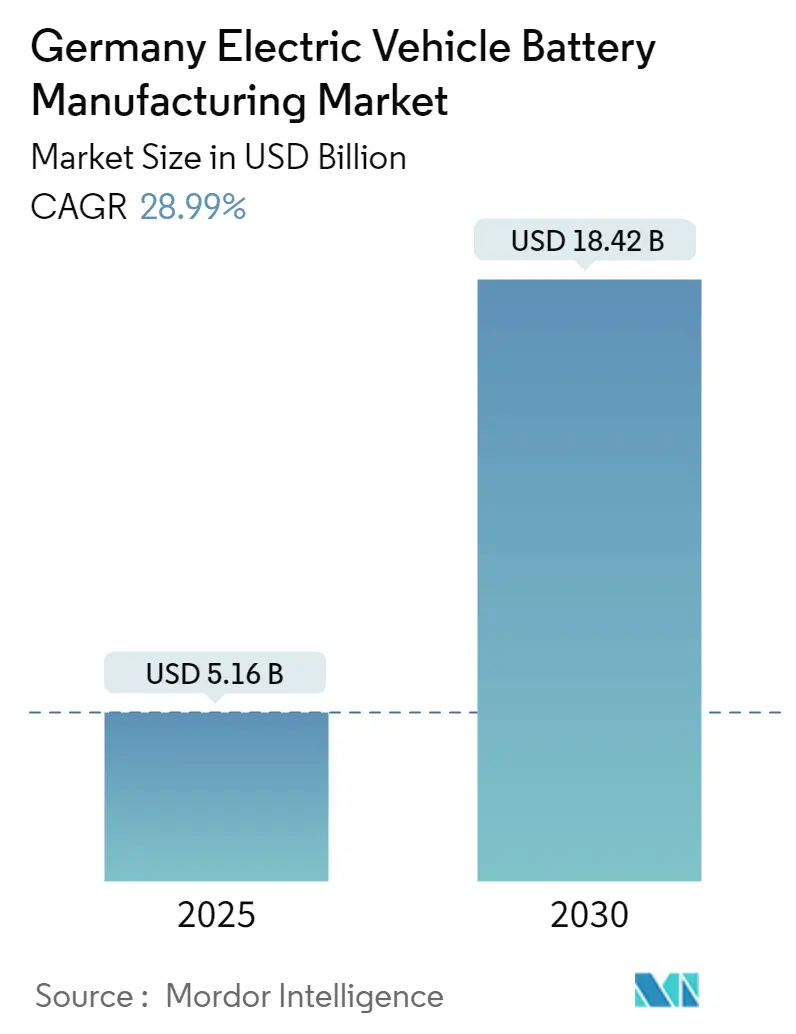
The Germany Electric Vehicle Battery Manufacturing Market size is estimated at USD 5.16 billion in 2025, and is expected to reach USD 18.42 billion by 2030, at a CAGR of 28.99% during the forecast period (2025-2030).
- Over the medium term, rising demand for electric vehicles, investments to enhance electric vehicle battery production capacity, and a decline in the cost of battery raw materials, especially lithium-ion, are expected to drive the market in the forecast period.
- On the other hand, the decline in the cost of battery raw materials is expected to hamper the market in the future.
- Nevertheless, long-term ambitious targets for electric vehicles in Germany are expected to create a significant opportunity in the forecast period.
Germany Electric Vehicle Battery Manufacturing Market Trends and Insights
Lithium-ion Battery is Expected to Have a Major Share
- In recent years, Germany has witnessed a significant surge in the demand for electric vehicles (EVs). These EVs rely on energy storage systems, predominantly batteries, which are crucial for all-electric, plug-in hybrid, and hybrid vehicles.
- Most plug-in hybrids and all-electric vehicles are powered by lithium-ion batteries. The demand for lithium battery materials in plug-in hybrids is on the rise, driven by the declining prices of lithium-ion battery packs and their advantages, including high energy density, extended cycle life, and overall efficiency.
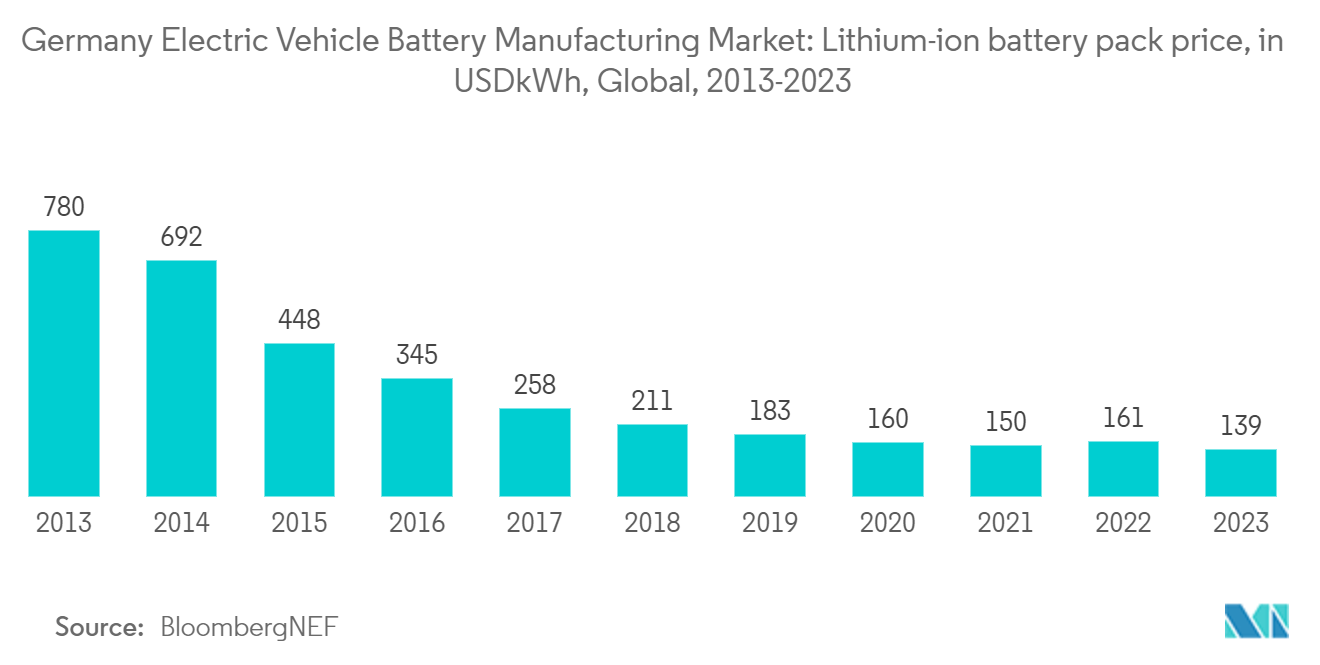
- In 2023, the price of lithium-ion battery packs dropped by 14% from the previous year, settling at USD139/kWh. Beyond these benefits, ongoing research and development efforts aim to produce even more effective and efficient lithium battery materials for electric vehicles.
- Moreover, Germany is actively championing its domestic lithium battery manufacturing, reinforcing its transition to electric vehicles. This strategy seeks to diminish dependence on imported lithium and establish a sustainable supply chain for the burgeoning EV market.
- For example, in June 2023, Livista Energy unveiled plans for a lithium refinery in Germany, targeting electric vehicle batteries. Set to begin production in 2026, Livista Energy has partnered with Technip Energies, a leading French oil and gas services firm, to lead the plant's design.
- Additionally, in May 2024, Rock Tech Lithium Inc. secured approval for a lithium refinery in Guben, Germany. This facility is projected to produce approximately 24,000 tonnes of lithium-hydroxide, essential for electric car batteries and energy storage systems.
- Given this landscape and the declining costs of lithium-ion batteries, the segment is poised to capture a substantial market share.


Investments to Enhance the EV Battery Production Capacity is Expected to Drive the Market
- In recent years, Germany has significantly increased its investments to enhance domestic production of electric vehicle batteries, aiming to address supply chain gaps. These efforts are set to not only strengthen the local economy but also play a crucial role in assisting Germany and the wider EU in achieving their net-zero targets.
- For instance, in January 2024, the European Union greenlit a substantial EUR 902 million (USD 986.43 million) state aid package from Germany to Northvolt, a prominent Swedish lithium-ion battery manufacturer. This financial backing is designated for establishing an electric vehicle (EV) battery production facility in Heide, Germany.
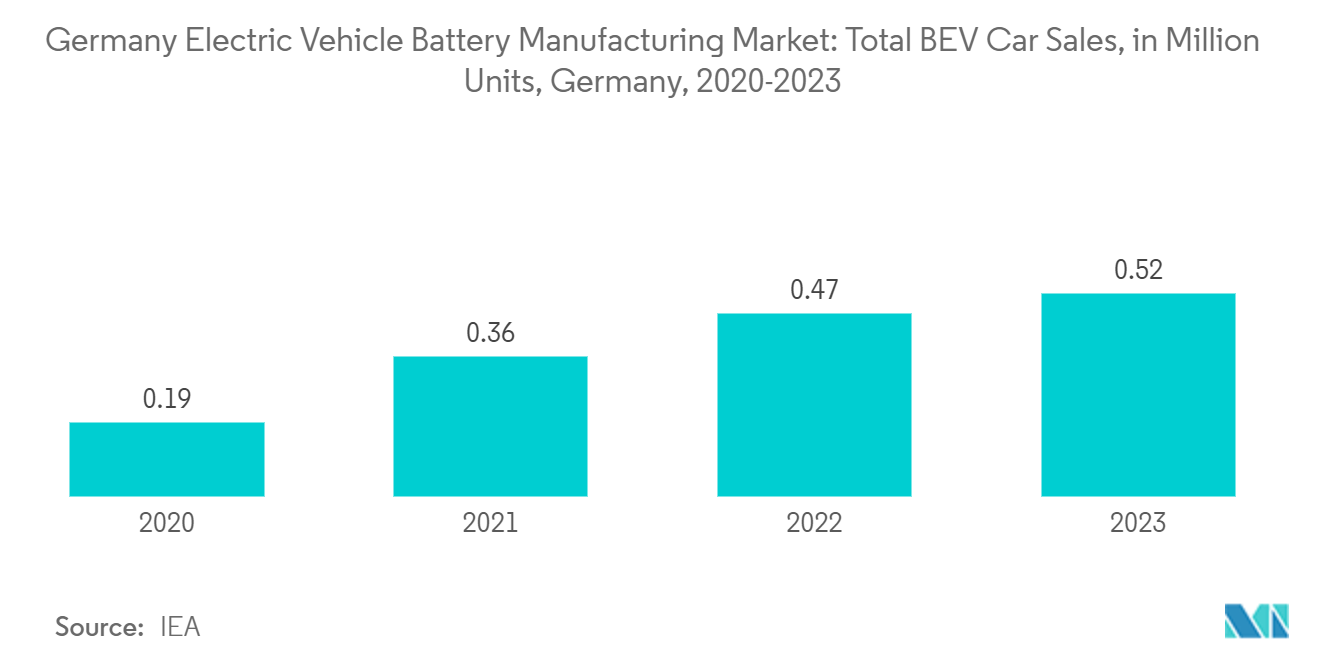
- The German government has rolled out a range of incentives and subsidies to lure investments into this sector. Moreover, with electric vehicle sales on the rise in the country, the government is likely to introduce more policies to further boost domestic battery manufacturing. Data from the International Energy Agency indicates that in 2023, battery electric vehicle (BEV) sales in Germany reached 0.52 million units, a rise from 0.47 million units in 2022.
- Furthermore, partnerships between local manufacturers and global tech firms have sped up advancements in battery technology, solidifying Germany's stature in the international arena. For example, in 2025, Umicore and Volkswagen AG are set to launch a joint venture to produce cathode materials for electric vehicles, targeting an annual capacity of 20 GWh at Volkswagen AG’s Salzgitter plant in Germany.
- Given these developments and financial backing, anticipated investments to boost EV battery production capacity are likely to propel the market forward.

Competitive Landscape
The Germany electric vehicle battery manufacturing market is moderate. Some of the major players in the market (in no particular order) include BYD Company Ltd, BASF SE, Contemporary Amperex Technology Co. Limited, Duracell Inc., and Panasonic Holdings Corporation.
Germany Electric Vehicle Battery Manufacturing Industry Leaders
BYD Company Ltd
BASF SE
Contemporary Amperex Technology Co. Limited
Duracell Inc.
Panasonic Holdings Corporation
- *Disclaimer: Major Players sorted in no particular order

Recent Industry Developments
- August 2024: Valmet Automotive completed its second significant expansion of the Battery Test Center (BTC) in Bad Friedrichshall, Germany, asserting its position as a leader in battery testing for both automotive and commercial sectors, with a specific focus on electric vehicles.
- September 2023: Gotion High Tech initiated operations at its inaugural electric vehicle battery facility in Goettingen, Germany. Initial projections aimed for an annual production capacity of 5GWh by mid-2024, with a trajectory set to escalate to 20GWh upon the culmination of all investments by the end of the decade.


Germany Electric Vehicle Battery Manufacturing Market Report Scope
Electric vehicle (EV) battery manufacturing involves designing, producing, and assembling batteries for EVs. The process starts with sourcing raw materials like lithium, cobalt, and nickel. These materials are then used to create individual battery cells, which are grouped into modules.
The Germany electric vehicle battery manufacturing market is segmented by battery type, battery form, vehicle, and propulsion. By battery type, the market is segmented into lithium-ion batteries, lead-acid batteries, nickel metal hydride batteries, and others. By battery form, the market is segmented into prismatic, pouch, and cylindrical. By propulsion, the market is segmented into battery electric vehicles, hybrid electric vehicles, and plug-in hybrid electric vehicles. The report offers the market size in USD for all the abovementioned segments.
| Lithium-ion |
| Lead-Acid |
| Nickel Metal Hydride Battery |
| Others |
| Prismatic |
| Pouch |
| Cylindrical |
| Passenger Cars |
| Commercial Vehicles |
| Others |
| Battery Electric Vehicle |
| Hybrid Electric Vehicle |
| Plug-in Hybrid Electric Vehicle |
| Battery | Lithium-ion |
| Lead-Acid | |
| Nickel Metal Hydride Battery | |
| Others | |
| Battery Form | Prismatic |
| Pouch | |
| Cylindrical | |
| Vehicle | Passenger Cars |
| Commercial Vehicles | |
| Others | |
| Propulsion | Battery Electric Vehicle |
| Hybrid Electric Vehicle | |
| Plug-in Hybrid Electric Vehicle |


Key Questions Answered in the Report
How big is the Germany Electric Vehicle Battery Manufacturing Market?
The Germany Electric Vehicle Battery Manufacturing Market size is expected to reach USD 5.16 billion in 2025 and grow at a CAGR of 28.99% to reach USD 18.42 billion by 2030.
What is the current Germany Electric Vehicle Battery Manufacturing Market size?
In 2025, the Germany Electric Vehicle Battery Manufacturing Market size is expected to reach USD 5.16 billion.
Who are the key players in Germany Electric Vehicle Battery Manufacturing Market?
BYD Company Ltd, BASF SE, Contemporary Amperex Technology Co. Limited, Duracell Inc. and Panasonic Holdings Corporation are the major companies operating in the Germany Electric Vehicle Battery Manufacturing Market.
What years does this Germany Electric Vehicle Battery Manufacturing Market cover, and what was the market size in 2024?
In 2024, the Germany Electric Vehicle Battery Manufacturing Market size was estimated at USD 3.66 billion. The report covers the Germany Electric Vehicle Battery Manufacturing Market historical market size for years: 2019, 2020, 2021, 2022, 2023 and 2024. The report also forecasts the Germany Electric Vehicle Battery Manufacturing Market size for years: 2025, 2026, 2027, 2028, 2029 and 2030.
Page last updated on:
Germany Electric Vehicle Battery Manufacturing Market Report
Statistics for the 2025 Germany Electric Vehicle Battery Manufacturing market share, size and revenue growth rate, created by Mordor Intelligence™ Industry Reports. Germany Electric Vehicle Battery Manufacturing analysis includes a market forecast outlook for 2025 to 2030 and historical overview. Get a sample of this industry analysis as a free report PDF download.


 Your data is secure and never sold or shared.


