
Generator Load Banks Market Size and Share
Market Overview
| Study Period | 2021 - 2031 |
|---|---|
| Market Size (2026) | USD 309.63 Million |
| Market Size (2031) | USD 414.56 Million |
| Growth Rate (2026 - 2031) | 6.01 % |
| Fastest Growing Market | Asia-Pacific |
| Largest Market | North America |
| Market Concentration | Medium |
Major Players *Disclaimer: Major Players sorted in no particular order Image © Mordor Intelligence. Reuse requires attribution under CC BY 4.0. | |
Generator Load Banks Market Analysis by Mordor Intelligence
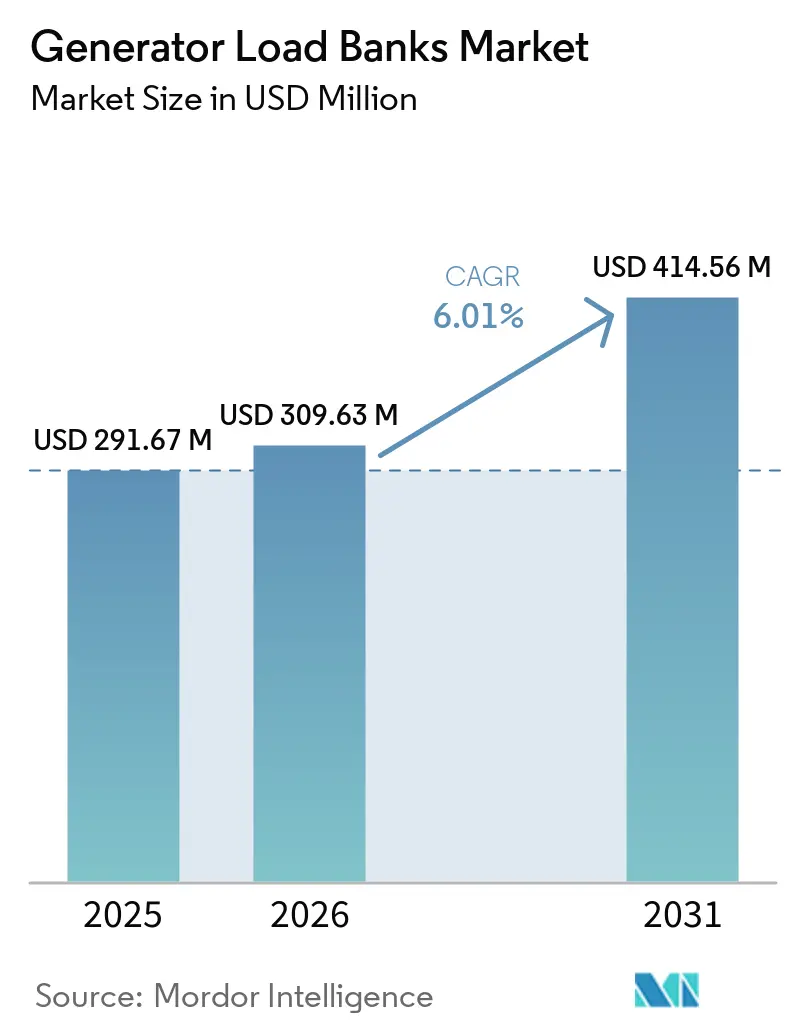
The Generator Load Banks Market size is projected to be USD 291.67 million in 2025, USD 309.63 million in 2026, and reach USD 414.56 million by 2031, at a CAGR of 6.01% from 2026 to 2031. Demand is rising as hyperscale data centers add standby power capacity for AI workloads. Renewable energy and battery storage projects also need grid-integration testing before they enter service. Preventive maintenance requirements make testing a recurring activity for critical standby systems. These conditions increase the duration and equipment needs of commissioning work at project sites. Global data center electricity use reached 415 TWh in 2024 and is expected to approach 945 TWh by 2030, which supports a wider pipeline for generator and load bank testing.
Key Report Takeaways
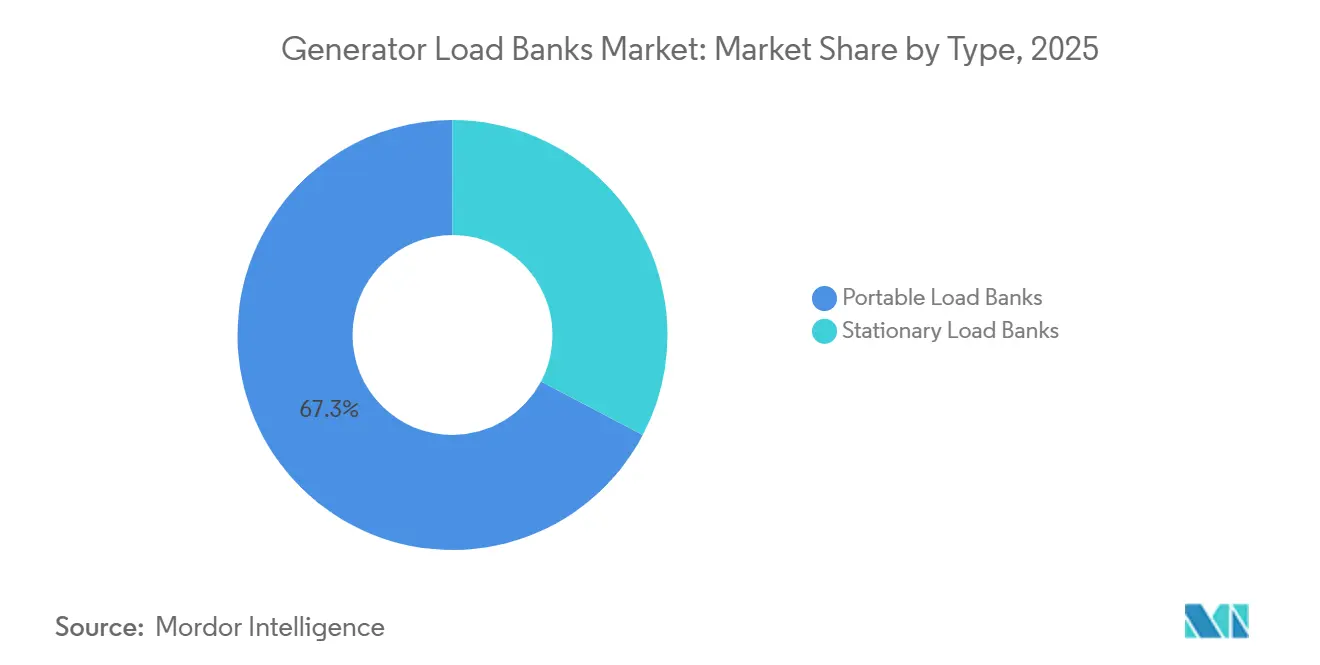
- By type, portable load banks held 67.3% of the generator load banks segment revenue in 2025, and are forecast to grow at a 6.7% CAGR through 2031.
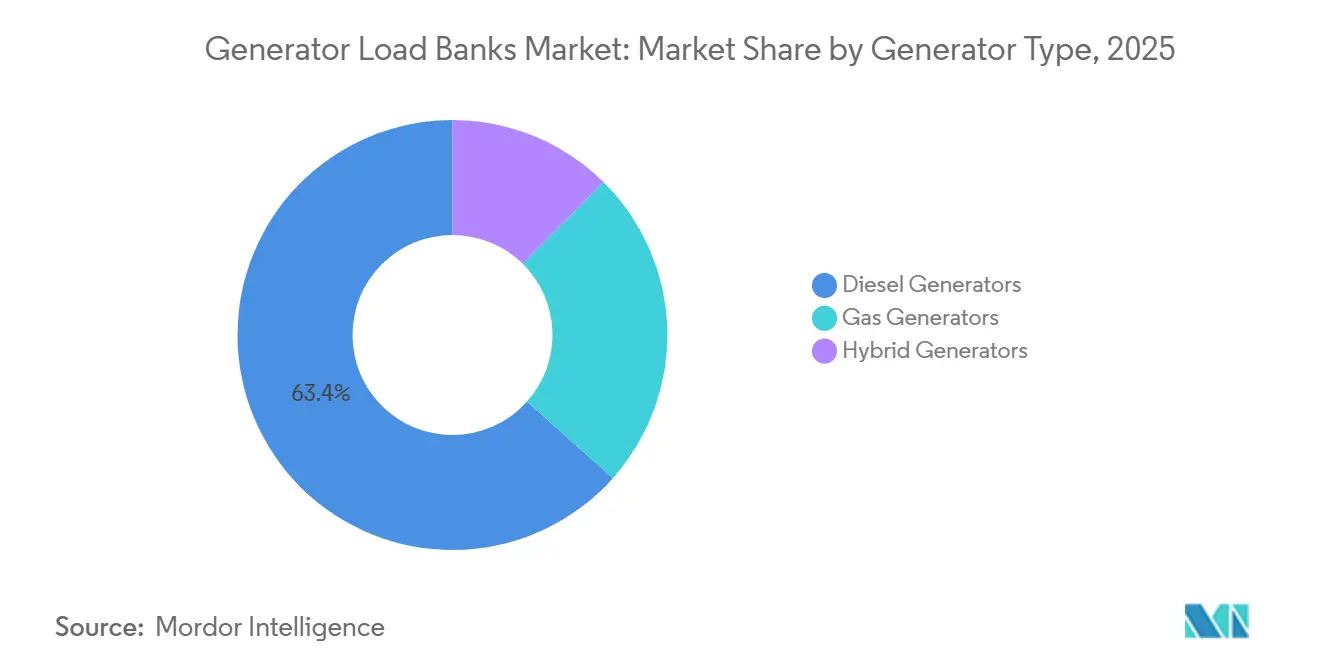
- By generator type, diesel generators accounted for 63.4% of the generator load banks segment revenue in 2025, while gas generators are forecast to expand at a 6.9% CAGR through 2031.
- By end user, power generation held 42.4% of the generator load banks market size in 2025, while data centers are forecast to grow at a 7.3% CAGR through 2031.
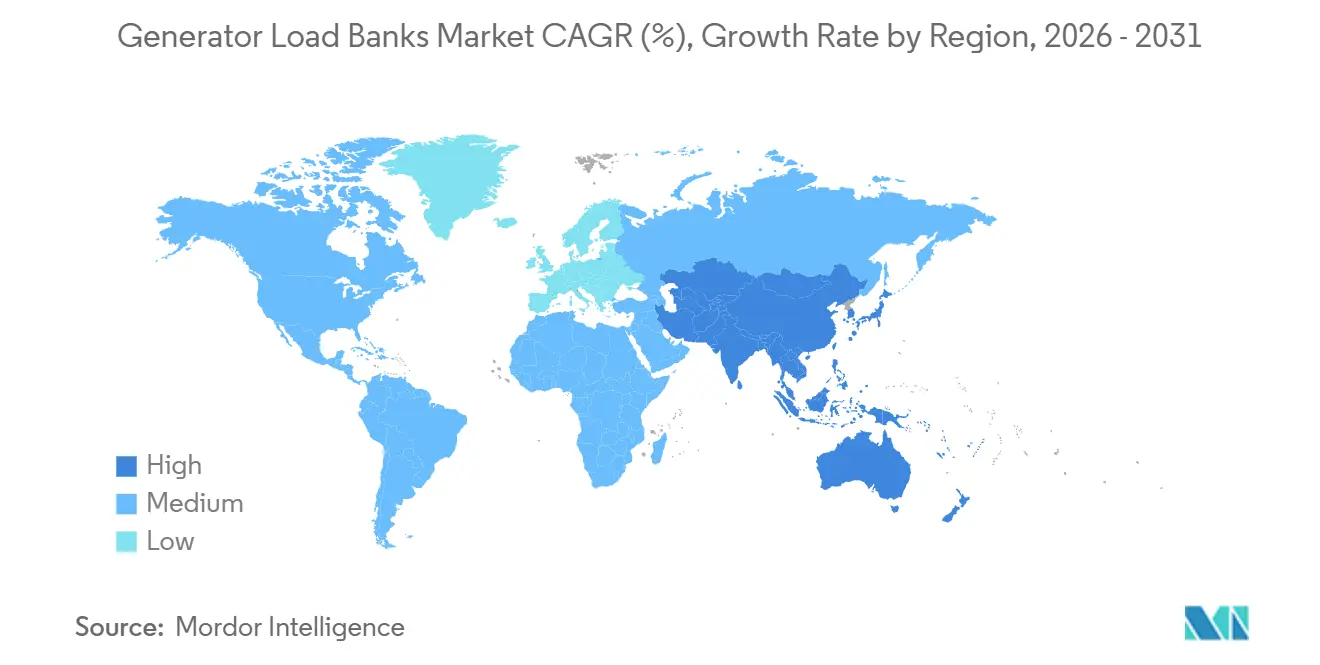
- By geography, North America accounted for 35.1% of revenue in 2025, while Asia-Pacific is projected to grow at a 7.4% CAGR through 2031.
Note: Market size and forecast figures in this report are generated using Mordor Intelligence’s proprietary estimation framework, updated with the latest available data and insights as of January 2026.
Market Trends and Insights
Drivers Impact Analysis of Generator Load Banks Market*
| Driver | (~) % Impact on CAGR Forecast | Geographic Relevance | Impact Timeline |
|---|---|---|---|
| Data-Center Capacity Expansion and High-Density AI Power Testing | +2.30% | Global; North America and Asia-Pacific as primary theatres | Short term (≤ 2 years) |
| Renewable-Energy and Battery-Storage Grid-Integration Testing | +1.10% | Europe, North America, APAC core, spill-over to MEA | Medium term (2–4 years) |
| Mission-Critical Resilience and Preventive-Maintenance Requirements | +0.80% | Global | Medium term (2–4 years) |
| Expansion of Rental and Temporary Power-Testing Fleets | +0.60% | North America & Europe, growing APAC adoption | Short term (≤ 2 years) |
| Liquid-Cooling Validation for High-Density Data-Center Racks | +0.70% | North America & EU; APAC core | Short term (≤ 2 years) |
| Digital-Twin-Based Generator Test Planning and Reporting | +0.30% | Global; early adoption in North America & EU | Long term (≥ 4 years) |
| Source: Mordor Intelligence | |||
Data Center Capacity Expansion and High-Density AI Power Testing
The generator load banks market benefits from the growing scale of data center construction and the related need to validate standby power before a site is energized. Global data center electricity consumption was 415 TWh in 2024 and is projected to reach 945 TWh by 2030, reflecting the electricity demands created by AI-focused facilities[1]. Each new generator installation requires full-load testing before it can support a critical facility. N+1 and 2N designs require separate validation of primary and backup generator configurations. This arrangement can increase the amount of testing equipment needed at a site, even where installed capacity does not rise at the same pace. Annual full-load test requirements for critical standby assets then extend this demand beyond initial commissioning.
The generator load banks market also gains from the preference for complete testing campaigns at large facilities. Load bank units may be connected in parallel to test large generator clusters and several power halls. Data center operators need equipment that can be mobilized rapidly and controlled across a large site. This favors suppliers with medium-voltage capability, portable fleets, and coordinated control systems. It also supports service contracts that combine equipment, technicians, reporting, and delivery. The resulting work is less dependent on a single equipment sale than traditional generator testing projects.
Renewable Energy and Battery Storage Grid-Integration Testing
The generator load banks market is expanding into battery energy storage system testing, which follows a different cycle from conventional generator commissioning. Italy’s transmission system operator, Terna, issued test guidelines for grid-forming battery energy storage systems in 2025[2]. Fraunhofer ISE also developed standardized testing procedures for grid-forming inverters for Germany’s transmission system operators in 2025[3]. Load banks simulate the electrical demand that storage assets must manage during grid-code testing. This work increases demand for reactive, regenerative, and combined resistive-reactive equipment rather than resistive-only units. It can also require validation of individual inverter strings within a larger storage project.
ERCOT’s 2025 guidance on advanced grid support energy storage resources illustrates the detail now required in testing and interconnection processes. The generator load banks market is therefore exposed to a broader set of grid-interconnection projects. Larger battery installations can require repeated tests across several operating modes. Operators also need accurate power-factor control to evaluate how systems respond under grid conditions. These requirements raise the value of equipment with more advanced controls. They also support specialist providers that can work with utilities, developers, and engineering contractors.
Liquid-Cooling Validation for High-Density Data Center Racks
The generator load banks market is being shaped by liquid-cooled data centers that need thermal testing as well as electrical validation. Higher-density AI deployments require testing of cooling loops, coolant distribution units, manifolds, and control systems before full operation. The test process requires load banks that can operate within a facility’s liquid-cooling loop. This differs from conventional air-cooled commissioning and makes legacy rental fleets less suitable for some projects. Suppliers are responding with liquid-cooled units and connected controls designed for integrated system testing. Avtron expanded its liquid-cooled portfolio in January 2026 with the LC35 and enhanced LC20 configurations for coordinated thermal validation[4].
The generator load banks market is also supported by the cost of failures at facilities with critical computing loads. Testing can identify thermal and hydraulic issues before equipment is placed into commercial service. New liquid-cooled hardware requires contractors to manage coolant chemistry, flow rates, manifold condition, and calibration. These service requirements create a higher entry threshold than standard resistive load bank work. Rental companies need to invest in specialized inventories before they can serve these projects. The shift favors providers that can offer equipment, control software, commissioning support, and rapid field deployment.
Digital-Twin-Based Generator Test Planning and Reporting
The generator load banks market is gradually adopting software that supports test planning, equipment coordination, and reporting. Digital tools let engineers prepare test profiles before site work begins. They can help reduce site-hours and fuel use during commissioning. Connected controls also give engineers a clearer record of test conditions and equipment performance. Avtron’s SIGMA Unity platform can coordinate up to 250 load banks for campaign management and reporting. This capability supports large projects where many units must operate as one testing system.
Digital planning does not remove the need for physical testing. It improves the preparation and control of on-site work. The generator load banks market can therefore develop more service-led offerings around telemetry, reporting, and remote supervision. These tools are particularly useful for rental fleets that move between several projects. They can also help operators document compliance activities for critical standby systems. Vendors without integrated digital and physical capabilities may find it harder to compete for complex contracts.
Restraints Impact Analysis of Generator Load Banks Market*
| Restraint | (~) % Impact on CAGR Forecast | Geographic Relevance | Impact Timeline |
|---|---|---|---|
| High Acquisition, Installation, and Maintenance Cost | -1.30% | Global; most acute in emerging markets | Medium term (2–4 years) |
| Short Project Cycles and Rental-First Procurement | -0.70% | Global; most acute in North America & EU | Short term (≤ 2 years) |
| Copper, Stainless-Steel, and Power-Electronics Input-Cost Volatility | -0.50% | Global; manufacturing-intensive markets | Short term (≤ 2 years) |
| Limited Interoperability Across Generator, UPS, BESS, and Control Platforms | -0.40% | Global | Medium term (2–4 years) |
| Source: Mordor Intelligence | |||
High Acquisition, Installation, and Maintenance Cost
The generator load banks market faces cost pressure, where fixed installations need specialized civil and electrical work. These projects can add 30-50% to equipment cost at high-voltage, medium-capacity sites. Smaller operators can find ownership difficult when utilization is limited during the early years of deployment. Liquid-cooled equipment adds service needs that do not apply to traditional air-cooled units. Coolant management, manifold inspections, and flow-rate calibration require specialist knowledge. This can limit adoption by contractors that lack experience with thermal validation.
Cost concerns also encourage rental-first procurement, particularly for equipment used on short commissioning assignments. This model favors full-service providers that combine equipment hire and commissioning expertise. It can reduce direct unit sales for manufacturers that rely on outright equipment purchases. Input-cost volatility in copper, stainless steel, and power electronics can further compress supplier margins. Interoperability issues across generators, UPS systems, battery storage, and controls add engineering effort to projects. Noise, heat-rejection, and water-use limits can constrain equipment deployment in dense urban locations.
Short Project Cycles and Rental-First Procurement
The generator load banks market is affected by shorter commissioning windows at modular data center projects. Testing campaigns can now be concentrated into periods of fewer than 5 days. Equipment ownership becomes less attractive when a unit is used for fewer than 15 days in a year. Customers increasingly require deployment readiness within 48 hours. Suppliers that cannot position specialized equipment near target sites may be excluded from preferred vendor lists. This favors rental companies with large fleets and established logistics capabilities.
The same pattern creates pressure for manufacturers and fleet operators. Rental providers must buy higher-cost liquid-cooled and digitally integrated equipment while managing rapid mobilization. Short gaps between projects can limit the time available for preventive maintenance of trailer-mounted units. This may increase field failure and warranty risk. The generator load banks market can therefore be divided between well-capitalized providers that serve large critical-power sites and smaller providers that focus on standard applications. Urban constraints and compatibility issues can make that divide more pronounced in complex projects.
*Our forecasts treat driver/restraint impacts as directional, not additive. The impact forecasts reflect baseline growth, mix effects, and variable interactions.
Generator Load Banks Market Segment Analysis
By Type:
Portable Units Anchor Scale Across All End MarketsPortable load banks held 67.3% of the generator load banks market share in 2025. Their position reflects the short testing window at a typical commissioning site. Operators can use the same equipment across data centers, oil and gas facilities, and marine locations. This reduces idle periods associated with permanently installed equipment. Portable equipment is also well-suited to rental models that require rapid movement between sites. Trailer-mounted and containerized units can support large-scale commissioning without permanent civil works.
The generator load banks market is seeing more portable units built for parallel operation. ISO-standard configurations with capacity up to 5,000 kVA can be used in multi-unit test campaigns. These products are becoming common in large data center commissioning projects. Portable units also benefit from rising rental investment by Aggreko, Crestchic, and ComRent. IoT telemetry and cloud-based controls make it possible to monitor larger equipment networks. This allows portable equipment to serve as a coordinated testing fleet rather than a set of independent devices.
Stationary load banks contribute less revenue but remain relevant at facilities with recurring test requirements. Grid-connected plants, military sites, and large telecommunications facilities can use fixed equipment to avoid repeated transport and installation work. Annual test obligations can justify permanent deployment at these locations. Capital cost remains a barrier when testing frequency is low. Hybrid configurations with stationary mounting and modular cartridge loading offer an option for industrial sites with changing requirements.

By Generator Type:
Gas Generators Gain Ground as Diesel RetreatsDiesel generators accounted for 63.4% of the generator load banks market share in 2025. This reflects the large installed base of diesel standby units across data centers, industrial facilities, and oil and gas operations. Diesel equipment remains important for current testing volumes. Gas generators, however, are forecast to grow at a 6.9% CAGR through 2031. Tighter emissions requirements and changing fuel economics support this transition. The segment requires testing approaches that differ from conventional diesel applications.
The U.S. Energy Information Administration expects planned natural-gas-fired capacity additions to reach 66 GW by 2030. Gas generator testing requires accurate power-factor control and harmonic loading. This supports demand for reactive and combined resistive-reactive load banks. The generator load banks market benefits because these products can carry a higher value than pure resistive units. Gas and diesel-battery hybrid configurations remain smaller in scale. They may gain relevance as microgrid developers adopt multi-fuel backup designs that must be validated across several operating modes.
The generator load banks industry is therefore managing a gradual shift rather than an immediate replacement of diesel assets. Existing diesel fleets will continue to require commissioning and periodic tests. Gas installations add a separate demand stream with more complex electrical test requirements. Manufacturers that provide flexible control systems can support both technology types. Rental companies also need fleets that can be configured for different power and fuel systems. This protects demand across conventional and emerging standby-power designs.
By End User:
Data Centers Redefine the Demand CeilingPower generation accounted for 42.4% of the generator load banks market size in 2025. Utilities and large power operators require generator commissioning and recurring maintenance tests. Data centers are projected to grow at a 7.3% CAGR through 2031, the fastest rate among end users. New hyperscale campuses can include more than 100 MW of standby generation. These sites require extended testing before computing equipment enters service. Liquid-cooled AI deployments add thermal validation to conventional electrical test programs.
In April 2026, Preferred Networks, IIJ, and JAIST deployed direct liquid-cooled AI servers in a modular data center at IIJ’s Shiroi campus. The project shows the growing role of thermal validation in advanced data center deployments. Oil and gas support demand through offshore platforms and onshore terminal backup power needs. Marine operators require testing during classification-related inspection cycles. Military and defense users need dependable standby power and annual validation. The overlap of data center and oil and gas project schedules can limit technician and equipment availability in the Gulf region.
The generator load banks market also serves facilities that value uptime over capital savings. Power generation, military installations, and telecom sites can maintain recurring demand when new construction slows. Data centers create the strongest growth path because their generator count and power density are increasing. End-user needs vary by location and equipment design. This encourages suppliers to offer different power ratings, cooling approaches, and control features. It also supports field-service capabilities that can be adapted to each operating environment.
Geography Analysis
North America Generator Load Banks Market
North America held 35.1% of global revenue in 2025, giving it the largest share of the generator load banks market. The region has a large concentration of hyperscale data center capacity. It also has a mature rental infrastructure for multi-megawatt testing fleets. This infrastructure supports rapid deployment when commissioning schedules change. Annual testing requirements for critical standby systems provide recurring service work. Canada adds demand through data center expansion in Ontario and Quebec. Mexico contributes through nearshoring-related industrial generator installations.
Europe Generator Load Banks Market
Europe has a mature demand base linked to offshore wind integration, industrial reliability, and data center expansion. Germany has a demand for industrial generator maintenance and grid-forming inverter validation work. Fraunhofer ISE developed a test procedure for grid-forming inverters in 2025. Nordic data centers add commissioning opportunities, and Crestchic expanded into Sweden in May 2026. European manufacturers also face input-cost pressure from regional industrial and emissions requirements. Poland supports demand through industrial reliability needs, while the United Kingdom has data center and offshore energy activity.
APAC, South America and MEA Generator Load Banks Market
Asia-Pacific is forecast to expand at a 7.4% CAGR through 2031, making it the fastest-growing region in the generator load banks market. The region is adding data center capacity and energy infrastructure across several major economies. China’s power efficiency requirements for new facilities make pre-energization validation more important. India’s data center expansion also creates a larger pipeline for standby-power commissioning. South America remains smaller, with Brazil and Chile supporting demand through renewable integration, mining, and generator maintenance. The Middle East and Africa is developing as hyperscale campuses and hydrocarbon-sector generator projects expand. These regions can face equipment and technician constraints as several critical-power projects move forward at the same time.
Competitive Landscape
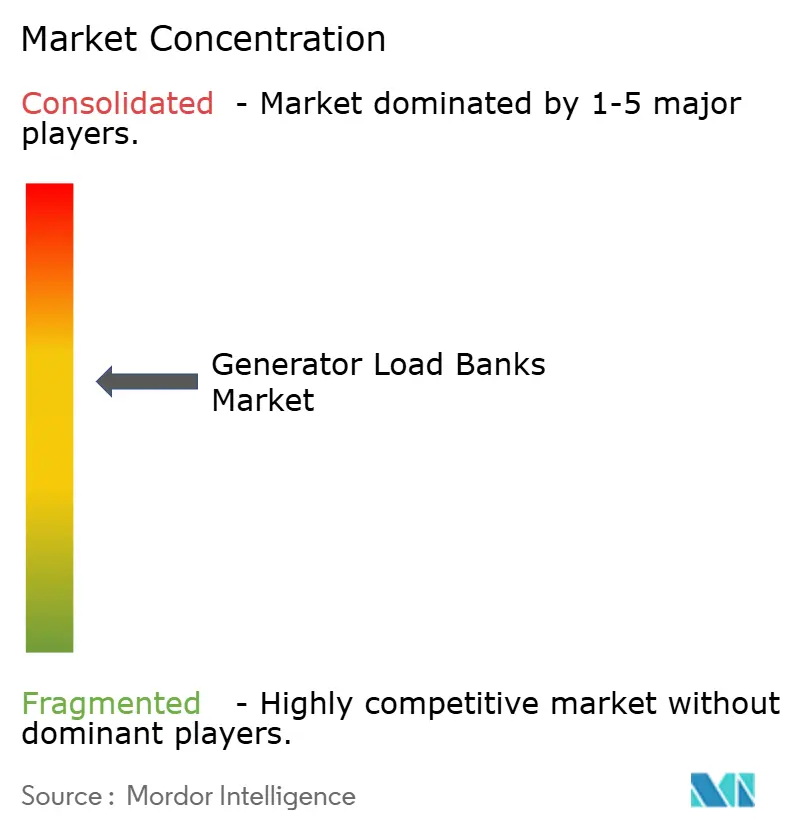
The generator load banks market has moderate-to-high concentration among specialist providers. ASCO Power Technologies, the Aggreko group (including Crestchic), and Avtron Power Solutions compete for high-value commissioning and critical-power testing projects, supported by liquid-cooled load banks and digital control platforms. Legrand completed its acquisition of Avtron Power Solutions in November 2025 at an enterprise value of approximately USD 1.1 billion. Avtron was expected to generate approximately USD 350 million in total revenue in 2025 across its broader portfolio of load bank and power-quality solutions, rather than from generator load banks alone, with nearly half of its revenue derived from data center customers. This transaction highlights the strategic importance of load bank and power-quality solutions within critical infrastructure applications.
Aggreko launched a 500 kW liquid-cooled resistive load bank for North American data center customers in April 2025. The unit can be connected within a 200-unit network for campus-scale liquid-to-liquid commissioning. Avtron expanded its LC35 and LC20 portfolio in January 2026 for hyperscale, HPC, and modular AI data centers. Crestchic entered Sweden in May 2026 and planned to raise manufacturing output by 75% through a larger United Kingdom facility. These moves show that companies are expanding fleet capacity, geographic coverage, and specialized products at the same time.
Mid-tier manufacturers, including Simplex, Trystar, and Mosebach Manufacturing, are developing enhanced controls and medium-voltage products. Trystar opened a manufacturing facility in Loveland, Colorado, in May 2026 to support greater capacity and operational efficiency. Chinese suppliers are expanding domestically but have a more limited presence in certified hyperscale projects. This leaves opportunities for internationally certified providers in India, Southeast Asia, and Australia. General rental firms compete mainly in standard resistive applications and emphasize mobilization speed and local fleet coverage.
Generator Load Banks Industry Leaders
-
ASCO Power Technologies
-
Avtron Power Solutions
-
Aggreko plc
-
Simplex, Inc.
-
Trystar, LLC
- *Disclaimer: Major Players sorted in no particular order
Generator Load Banks Market Companies Covered in this Report
- ASCO Power Technologies
- Aggreko plc
- Avtron Power Solutions
- Simplex, Inc.
- Crestchic Limited
- Trystar, LLC
- Mosebach Manufacturing Company
- ComRent International LLC
- Eagle Eye Power Solutions
- Power House Manufacturing, Inc.
- Sephco Industries Pty Ltd
- Shenzhen Sikes Electric Co., Ltd.
- Hebei Kaixiang Power Technology Co., Ltd.
- Powerohm Resistors
- Cressall Resistors Ltd
- Tatsumi Ryoki Co., Ltd.
- Load Banks Direct
- United Rentals, Inc.
- Sunbelt Rentals, Inc.
- Herc Rentals Inc.
Recent Industry Developments in Generator Load Banks Market
- May 2026: Crestchic Loadbanks expanded into Sweden to serve the Nordic data center market, simultaneously signing a lease on a new facility at its Burton-on-Trent, United Kingdom headquarters that will more than double its manufacturing footprint with plans to raise production output by 75%.
- May 2026: Trystar celebrated the grand opening of its purpose-built manufacturing facility in Loveland, Colorado, consolidating its former Nunn and Greeley, Colorado operations into a single site designed for improved operational efficiency and scalable capacity.
- January 2026: Avtron Power Solutions expanded its liquid-cooled load bank portfolio with the CE-rated LC35, rated at 500 kW, and an enhanced 720 kW LC20 configuration, both capable of controlling networks of up to 250 Avtron load banks for campus-scale integrated system testing.
- October 2025: Legrand completed the acquisition of Avtron Power Solutions at an enterprise value of USD 1.1 billion. Avtron was expected to generate USD 350 million in revenue in 2025, employed 600 people across 5 manufacturing sites in North America and Europe, and derived nearly half its revenue from data center customers.
Global Generator Load Banks Market Report Scope
Generator load banks are electrical devices used to apply a controlled, measurable electrical load to a generator or power source to test, commission, maintain, and verify its performance under simulated operating conditions. They convert the generator's electrical output into heat or another form of dissipated energy, allowing the generator to operate at predetermined load levels without connecting actual equipment.
The Generator Load Banks Market is segmented by type, generator type, end-user, and geography. By type, the market is segmented into portable load banks and stationary load banks. By generator type, the market is segmented into diesel generators, gas generators, and hybrid generators. By end-user, the market is segmented into power generation, data centers, oil & gas, marine, military & defense, and other end users. The report also covers the market size and forecasts for the global generator load banks market across 26 countries in key regions. For each segment, the market sizing and forecasts have been provided on the basis of value (USD).
Segmentation Overview
| Portable Load Banks |
| Stationary Load Banks |
| Diesel Generators |
| Gas Generators |
| Hybrid Generators |
| Power Generation |
| Data Centers |
| Oil & Gas |
| Marine |
| Military & Defense |
| Other End Users |
| North America | United States |
| Canada | |
| Mexico | |
| Europe | Germany |
| France | |
| Italy | |
| Spain | |
| United Kingdom | |
| Poland | |
| Russia | |
| Rest of Europe | |
| Asia-Pacific | China |
| India | |
| Japan | |
| South Korea | |
| Australia | |
| Indonesia | |
| Vietnam | |
| Thailand | |
| Rest of Asia-Pacific | |
| South America | Brazil |
| Argentina | |
| Chile | |
| Rest of South America | |
| Middle East and Africa | Saudi Arabia |
| United Arab Emirates | |
| Egypt | |
| South Africa | |
| Morocco | |
| Rest of Middle East and Africa |
| By Type | Portable Load Banks | |
| Stationary Load Banks | ||
| By Generator Type | Diesel Generators | |
| Gas Generators | ||
| Hybrid Generators | ||
| By End-User | Power Generation | |
| Data Centers | ||
| Oil & Gas | ||
| Marine | ||
| Military & Defense | ||
| Other End Users | ||
| By Geography | North America | United States |
| Canada | ||
| Mexico | ||
| Europe | Germany | |
| France | ||
| Italy | ||
| Spain | ||
| United Kingdom | ||
| Poland | ||
| Russia | ||
| Rest of Europe | ||
| Asia-Pacific | China | |
| India | ||
| Japan | ||
| South Korea | ||
| Australia | ||
| Indonesia | ||
| Vietnam | ||
| Thailand | ||
| Rest of Asia-Pacific | ||
| South America | Brazil | |
| Argentina | ||
| Chile | ||
| Rest of South America | ||
| Middle East and Africa | Saudi Arabia | |
| United Arab Emirates | ||
| Egypt | ||
| South Africa | ||
| Morocco | ||
| Rest of Middle East and Africa | ||
Key Questions Answered in the Report
What is driving demand for generator load banks?
Data center construction, renewable and battery storage testing, and recurring maintenance needs for critical standby power are increasing demand. These uses require load validation before operations begin and during annual maintenance cycles.
How large is the generator load banks market?
The generator load banks market size is estimated at USD 309.63 million in 2026 and is forecast to reach USD 414.56 million by 2031. The forecast reflects a 6.01% CAGR over 2026-2031.
Which type of generator load bank is used most often?
Portable load banks led with 67.3% share in 2025 because they can be transported between testing sites. Their flexibility aligns with rental and temporary commissioning work.
Why are liquid-cooled load banks becoming more important?
AI data centers need thermal validation of cooling systems, which requires equipment that can operate within liquid-cooling loops. These tests cover more than electrical load and help validate facility cooling performance.
Which end user is growing fastest for generator load banks?
Data centers are forecast to grow at a 7.3% CAGR through 2031, the highest rate among end users. Their large standby generator installations require detailed commissioning programs.
Which region is growing fastest for generator load banks?
Asia-Pacific is expected to grow at a 7.4% CAGR through 2031. Data center development and wider critical-power infrastructure create the regional growth opportunity.