
Generative AI In Retail Demand Forecasting and Merchandising Market Size and Share
Market Overview
| Study Period | 2020 - 2031 |
|---|---|
| Market Size (2026) | USD 4.69 Billion |
| Market Size (2031) | USD 16.41 Billion |
| Growth Rate (2026 - 2031) | 28.47 % |
| Fastest Growing Market | Asia-Pacific |
| Largest Market | North America |
| Market Concentration | Medium |
Major Players *Disclaimer: Major Players sorted in no particular order Image © Mordor Intelligence. Reuse requires attribution under CC BY 4.0. | |
Generative AI In Retail Demand Forecasting and Merchandising Market Analysis by Mordor Intelligence
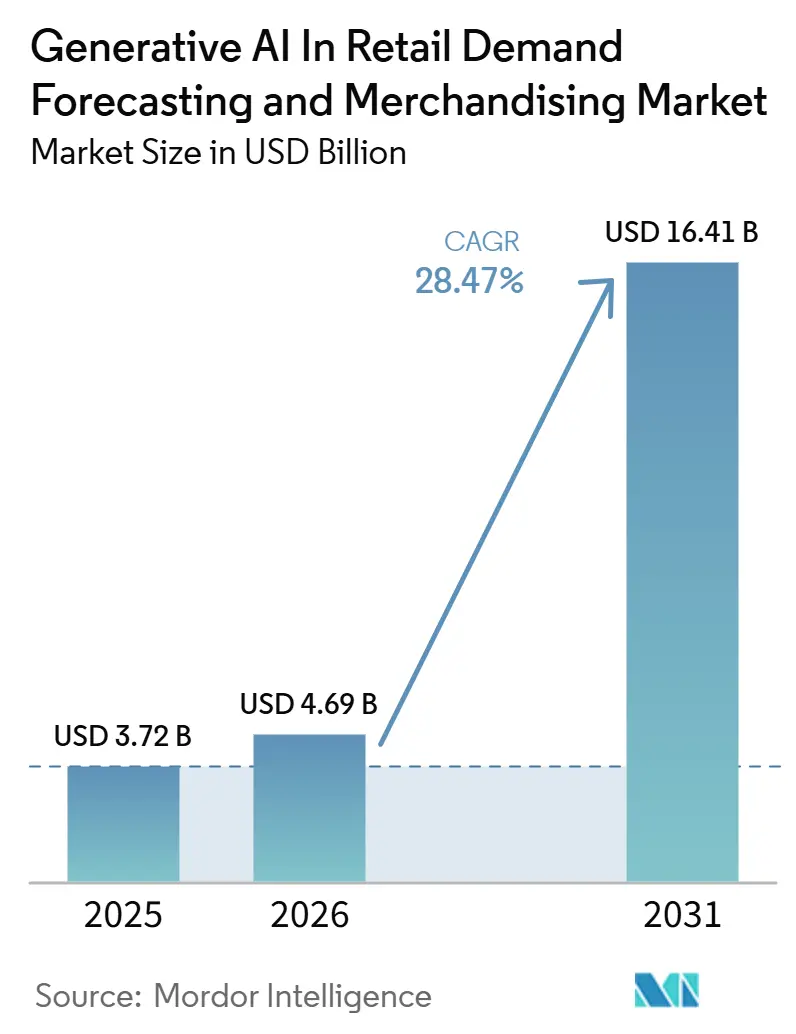
The generative AI in retail demand forecasting and merchandising market size was valued at USD 3.72 billion in 2025 and estimated to grow from USD 4.69 billion in 2026 to reach USD 16.41 billion by 2031, at a CAGR of 28.47% during the forecast period (2026-2031). Retailers are replacing periodic forecasting processes with systems that use sales, pricing, inventory, and external demand signals more frequently. This change is reshaping planning workflows, as buyers and planners can test decisions before committing to inventory or promotional budgets. Competition is moving beyond basic model access toward data quality, retail workflows, and controls that fit each retailer’s operating model. The generative AI in retail demand forecasting and merchandising market also has room to grow through services because many retailers need support with data integration, model tuning, and operational adoption.
Key Report Takeaways
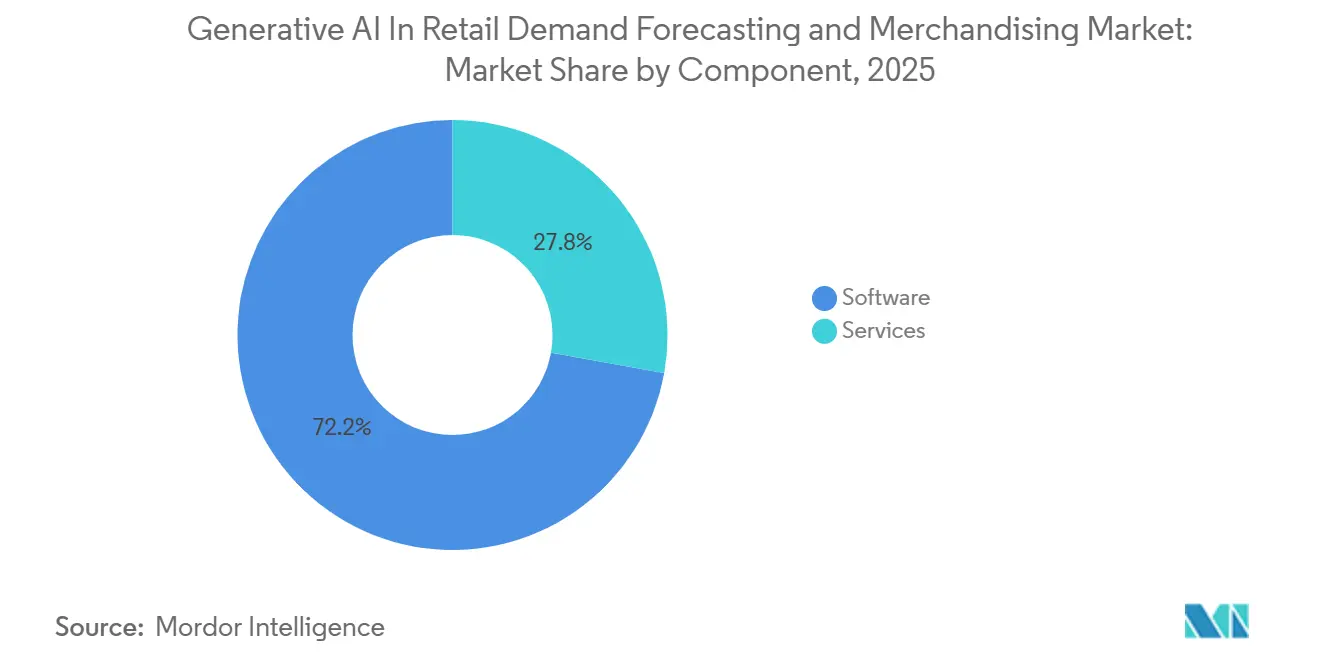
- By component, software held 72.18% of revenue in 2025, while services are projected to expand at a 29.28% CAGR through 2031.
- By deployment mode, cloud held 76.94% of revenue in 2025, while hybrid deployment is projected to expand at a 29.83% CAGR through 2031.
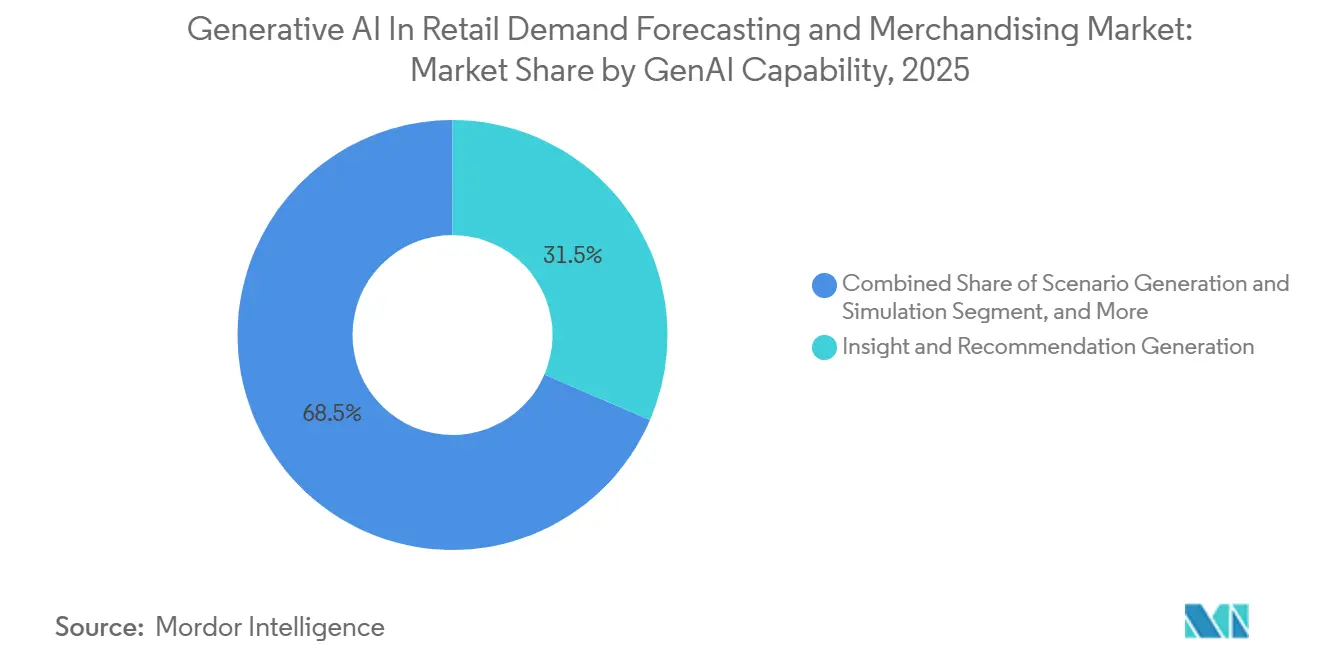
- By GenAI capability, insight and recommendation generation held 31.46% of revenue in 2025, while scenario generation and simulation are projected to expand at a 31.64% CAGR through 2031.
- By application, demand forecasting held 33.87% of the generative AI in retail demand forecasting and merchandising market share in 2025, while inventory optimization is projected to expand at a 30.42% CAGR through 2031.
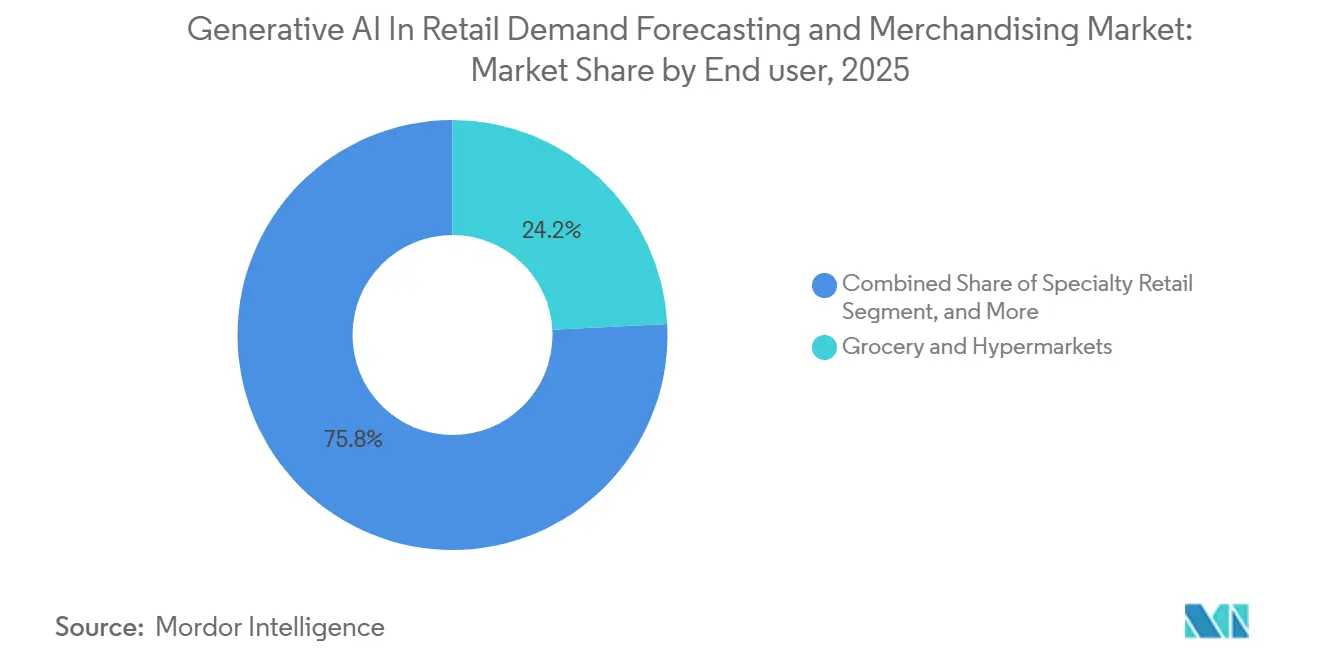
- By end user, grocery and hypermarkets held 24.18% of revenue in 2025, while online retailers are projected to expand at a 30.87% CAGR through 2031.
- By enterprise size, large enterprises held 73.12% of revenue in 2025, while small and medium enterprises are projected to expand at a 30.15% CAGR through 2031.
- By geography, North America held 39.48% of revenue in 2025, while Asia-Pacific is projected to expand at a 30.73% CAGR through 2031.
Note: Market size and forecast figures in this report are generated using Mordor Intelligence’s proprietary estimation framework, updated with the latest available data and insights as of January 2026.
Global Generative AI In Retail Demand Forecasting and Merchandising Market Trends and Insights
Drivers Impact Analysis*
| Driver | (~) % Impact on CAGR Forecast | Geographic Relevance | Impact Timeline |
|---|---|---|---|
| Rapid Shift From Static Forecasting to Continuous Demand Sensing | +7.5% | Global, with highest intensity in North America and Asia-Pacific | Short term (≤ 2 years) |
| Rising Need for AI-Assisted Assortment and Merchandise Planning | +5.5% | North America and Europe, expanding to Asia-Pacific | Medium term (2-4 years) |
| Omnichannel Complexity Requiring Unified Inventory and Pricing Decisions | +4% | North America, Europe, and Asia-Pacific core markets | Medium term (2-4 years) |
| Growing Demand for Natural-Language Planning Interfaces and Retail Planning Copilots | +3% | North America and Europe primarily, with early gains in India and South Korea | Short term (≤ 2 years) |
| Growing Pressure to Reduce Stockouts, Excess Inventory, Markdowns, and Working Capital Requirements | +2.5% | Global, with urgency in grocery-heavy markets including the United Kingdom, Germany, Australia, and Japan | Short term (≤ 2 years) |
| Expansion of Retail-Specific GenAI Copilots Inside Planning Workflows | +2% | North America and Europe, with fast-follower markets in China and South Korea | Long term (≥ 4 years) |
| Source: Mordor Intelligence | |||
Rapid Shift From Static Forecasting to Continuous Demand Sensing
Consumer demand can shift quickly in response to social media activity, weather events, and local competition. Retailers relying solely on historical sales patterns can struggle when their planning cycle moves more slowly than the pace of available demand signals. Amazon Science reported that its Anchored FLoE framework improved sales-weighted MAPE by 11 percentage points against production baselines across 524 product-market segments. The reported result linked better demand forecasts with a multi-million-dollar effect on free cash flow. AWS launched Connect Decisions in April 2026, making Amazon’s foundational forecasting capability available to third-party retailers.[1]Amazon Web Services, “Your Guide to Retail and Consumer Goods at re:Invent 2025,” Amazon Web Services As this capability becomes easier to access, proprietary data and retailer-specific controls become more important than model architecture alone.
Rising Need for AI-Assisted Assortment and Merchandise Planning
Quarterly reviews, spreadsheets, and buyer judgment are becoming less sufficient for fast-moving assortment decisions. AI-assisted planning can process product attributes, demand signals, and competitive pricing more frequently than traditional planning routines. Invent.ai reported in April 2025 that every surveyed retailer planned to investigate or invest in AI-enabled merchandise planning within 12 months.[2]Invent.ai, “Invent.ai Announces New Research on AI-Enabled Retail Merchandise Planning,” Invent.ai The generative AI in retail demand forecasting and merchandising market benefits when retailers use these tools to connect assortment choices with replenishment and promotion decisions. These systems can reduce the time spent compiling inputs, leaving planners more time for supplier discussions and product selection. They also shift decision-making responsibility to AI-supported category teams, which requires organizational changes that technology budgets may not fully cover.
Omnichannel Complexity Requiring Unified Inventory and Pricing Decisions
Retailers now serve customers through stores, websites, marketplaces, and social commerce channels. Maintaining inventory visibility and pricing consistency becomes harder as each channel generates distinct transactions and customer signals. Microsoft cited Adobe data showing a 693% increase in AI-driven e-commerce traffic during the 2025 holiday season compared with 2024.[3]Microsoft Corporation, “Microsoft Propels Retail Forward with Agentic AI Capabilities That Power Intelligent Automation for Every Retail Function,” Microsoft News This activity makes product availability and timely inventory decisions more important in digital purchase journeys. The generative AI in retail demand forecasting and merchandising market gains from systems that unify sales, inventory, supplier, and customer information. Retailers also need complete product attributes because poorly described products may be less visible to AI-assisted shopping tools.
Growing Demand for Natural-Language Planning Interfaces and Retail Planning Copilots
Natural-language interfaces let buyers test planning questions without waiting for separate analytics requests. This can reduce the time needed to examine assortment, promotion, or inventory scenarios. SymphonyAI launched CINDE Merchandising Agents in January 2026 for weekly planning, promotional work, and store-reset workflows.[4]SymphonyAI, “SymphonyAI Launches Next-Generation CINDE Merchandising Agents, Bringing Agentic AI Into Core Merchandising Decisions, Powered by Microsoft Foundry and Azure,” SymphonyAI The offering includes roles for the merchant planner, promo coach, launch analyst, and reset advisor. The generative AI in retail demand forecasting and merchandising market can expand as more nontechnical planning employees gain access to decision support tools. Lower scenario-testing effort may encourage more frequent planning, although retailers still need business rules that keep recommendations within operational limits.
Restraints Impact Analysis*
| Restraint | (~) % Impact on CAGR Forecast | Geographic Relevance | Impact Timeline |
|---|---|---|---|
| Hallucination Risk in Forecast Narratives and Planning Recommendations | -2% | Global, most acute in regulated markets including the European Union, United States, and Australia | Short term (≤ 2 years) |
| Limited High-Quality Retail Data and Data Fragmentation Across Channels | -1.8% | Global, particularly severe in South America, Africa, and among retailers with fragmented POS and ERP stacks | Medium term (2-4 years) |
| Privacy, Consent, and Governance Constraints on Customer-Level Forecast Inputs | -1.5% | European Union, California, and emerging data-protection regimes in India and Brazil | Medium term (2-4 years) |
| High Integration Effort Across ERP, POS, PIM, WMS, and Planning Stacks | -1.2% | Global, most acute in multi-banner retail groups with heterogeneous legacy systems | Long term (≥ 4 years) |
| Source: Mordor Intelligence | |||
Hallucination Risk in Forecast Narratives and Planning Recommendations
A planning model can produce a plausible explanation or recommendation that does not match the underlying retail data. This risk is particularly serious when users accept markdown guidance or demand explanations without review. Research published in 2026 described hallucinations as an operational, financial, legal, and strategic enterprise risk. Fragmented product data can exacerbate the problem, as models have fewer reliable attributes for long-tail stock-keeping units. Retailers can reduce this exposure through structured retrieval, business controls, audit processes, and human review. The European Union’s AI Act also creates governance requirements that make transparent controls more relevant for retailers using generative AI.
Limited High-Quality Retail Data and Data Fragmentation Across Channels
Data fragmentation remains a practical barrier beneath many retail AI projects. Retailers may hold transaction histories in separate point-of-sale, enterprise resource planning, product information, warehouse, and e-commerce systems. Integration and data preparation can delay the point at which a model produces useful planning output. This burden is harder for specialty and mid-sized retailers with several legacy platforms or regional operating systems. The generative AI in retail demand forecasting and merchandising market needs stronger master data practices and connected data architecture to support reliable deployments. These requirements can lengthen procurement and implementation timelines, even when retailers see a clear operational case for AI-enabled planning.
*Our forecasts treat driver/restraint impacts as directional, not additive. The impact forecasts reflect baseline growth, mix effects, and variable interactions.
Segment Analysis
By Component: Software Anchors Revenue as Services Accelerate
Software held 72.18% of the generative AI in retail demand forecasting and merchandising market size in 2025. Demand planning engines, merchandise planning suites, and retail-focused GenAI applications make up the core of this software spending, including tools used for forecast narratives and planning simulations. SAP, Blue Yonder, and Oracle have established positions through planning platforms already used by enterprise retailers across finance, supply chain, and merchandising functions. RELEX, SymphonyAI, and o9 offer retail-focused applications that can shorten the time needed to introduce specialized planning capabilities and connect them with existing retail processes. The software segment benefits when retailers seek a shared foundation for forecasting, replenishment, assortment, promotional decisions, and regular review of operating results.
Services are projected to expand at a 29.28% CAGR from 2026 to 2031. Retailers use services for enterprise resource planning integration, data preparation, model tuning, change management, and the mapping of local retail processes into new planning workflows. These engagements can help create retailer-specific data assets and planning rules that remain valuable after deployment rather than treating implementation as a one-time technical project. The generative AI in retail demand forecasting and merchandising market is therefore separating into customized enterprise programs and simpler subscription tools for smaller retailers. Vendors need different delivery models because each group has different data resources, budgets, internal technical capacity, and appetite for extended implementation support.


By Deployment Mode: Cloud Leads While Hybrid Gains Strategic Ground
Cloud deployment held 76.94% of revenue in 2025. Cloud platforms offer flexible computing capacity for retailers that manage many locations, large stock-keeping unit portfolios, and fluctuating workloads across planning cycles. Microsoft Azure, AWS, and Google Cloud have added AI capabilities to retail cloud services, increasing the number of ways that retailers can build or obtain forecasting support. AWS reported in 2025 that 80% of surveyed retailers planned to increase funding for AI and generative AI. The generative AI in retail demand forecasting and merchandising market uses cloud delivery to make forecasting, scenario work, and data services easier to scale across stores, channels, and teams.
Hybrid deployment is projected to expand at a 29.83% CAGR from 2026 to 2031. This approach lets retailers use cloud resources for training and simulations while retaining selected workloads in their own environment, closer to operational systems. It is relevant for grocers, pharmacies, and specialty retailers that handle sensitive customer or pricing information across multiple business units. Hybrid models can also support latency-sensitive processes that require real-time decisions, with local processing and uninterrupted access to essential retail data. The generative AI in retail demand forecasting and merchandising market is likely to retain hybrid demand where data residency and governance requirements shape technology selection.
By GenAI Capability: Scenario Intelligence Drives the Next Planning Wave
Insight and recommendation generation held 31.46% of revenue in 2025. Retailers use this capability to generate forecast explanations, markdown guidance, and assortment recommendations within existing planning routines and review meetings. It can support planners without immediately replacing established decision rights or removing accountability for commercial decisions. This reduces adoption friction because employees can evaluate recommendations alongside their existing reports, operating rules, and practical knowledge of stores or product categories. The generative AI in retail demand forecasting and merchandising market benefits from this gradual approach to workflow change.
Scenario generation and simulation are projected to expand at a 31.64% CAGR from 2026 to 2031. Retailers use scenario tools to assess possible outcomes from promotions, weather disruption, demand changes, supply uncertainty, and the timing of inventory decisions. Conversational AI can make these tools easier for planning staff who lack technical training or direct access to data science teams. Synthetic data can also help when new products or locations have limited sales history, and historical patterns offer little guidance. The generative AI in retail demand forecasting and merchandising market is moving from single forecasts toward planning processes that compare several plausible demand outcomes.

By Application: Demand Forecasting Leads but Inventory Optimization Accelerates
Demand forecasting held 33.87% of the generative AI in retail demand forecasting and merchandising market share in 2025. It is the starting point for assortment, replenishment, and markdown decisions because each depends on a view of expected demand at store, product, and channel levels. Retailers can measure their value through fewer stockouts, lower ordering effort, better inventory positioning, and less dependence on manual adjustments. Strong demand signals also support high-frequency decisions in grocery and other retail formats with fast-moving products and limited tolerance for missed replenishment. The generative AI in retail demand forecasting and merchandising market remains centered on this foundational planning use case.
Inventory optimization is projected to expand at a 30.42% CAGR from 2026 to 2031. Forecast accuracy alone does not set safety stock, allocation, or replenishment rules across a retail network with varied store needs and supply constraints. o9 Solutions was selected by Chow Tai Fook Jewelry Group in March 2026 to connect assortment, merchandise, financial, production, allocation, and replenishment planning on one platform. Assortment and merchandise planning are also growing as retailers balance product variety with stock keeping unit rationalization and more disciplined inventory commitments. Visual merchandising is emerging where local store layouts, demographics, and sell-through data can inform planogram recommendations.
By End User: Grocery and Hypermarkets Anchor Volume as Online Retail Accelerates
Grocery and hypermarkets held 24.18% of revenue in 2025. These operators have a high exposure to stockouts because missed replenishment of perishable products can result in unrecoverable sales and reduce customer confidence. They also manage frequent ordering cycles that make time savings valuable for store employees who balance ordering with in-store duties. Their operational needs support investment in AI-generated demand signals and inventory recommendations that can be reviewed at the store and network levels. The generative AI in retail demand forecasting and merchandising market, therefore, has a clear use case in food retail operations.
Online retailers are projected to expand at a 30.87% CAGR from 2026 to 2031. Digital commerce creates large volumes of transaction, search, catalog, and customer activity data that suit AI-enabled planning and rapid demand review. Fashion and apparel retailers also need tools that account for trend cycles, size curves, new-product cannibalization, and the limited history of newly launched products. Consumer electronics retailers use planning tools to address rapid product cycles, high inventory carrying costs, and the need to quickly position new products. Home and furniture retailers use them for longer assortment cycles and changing customer preferences. The generative AI in retail demand forecasting and merchandising market can serve these different requirements through planning tools that connect demand, product, and inventory data.
By Enterprise Size: Large Enterprises Anchor Spend as SMEs Scale Fast
Large enterprises held 73.12% of revenue in 2025. Global retailers and regional chains typically have larger information technology budgets, greater data volumes, and internal teams to sustain large-scale planning programs over several years. Their deployments can include several enterprise systems, store formats, regions, planning functions, and established approval processes. This makes them important customers for vendors offering integrated, customized implementations that require close collaboration with internal technology and business teams. The generative AI in retail demand forecasting and merchandising market depends heavily on these organizations for current spending.
Small and medium enterprises are projected to expand at a 30.15% CAGR from 2026 to 2031. Managed cloud services and vertical software can lower the computing and model-access barriers for smaller retailers that cannot maintain large internal technical teams. The OECD identified cloud access as an important route for small and medium enterprises to adopt AI. Smaller operators still need usable data, practical integrations, and understandable workflows, even where subscription prices are lower. The generative AI in retail demand forecasting and merchandising market has an opportunity to broaden access through tools that need less internal data science support.
Geography Analysis
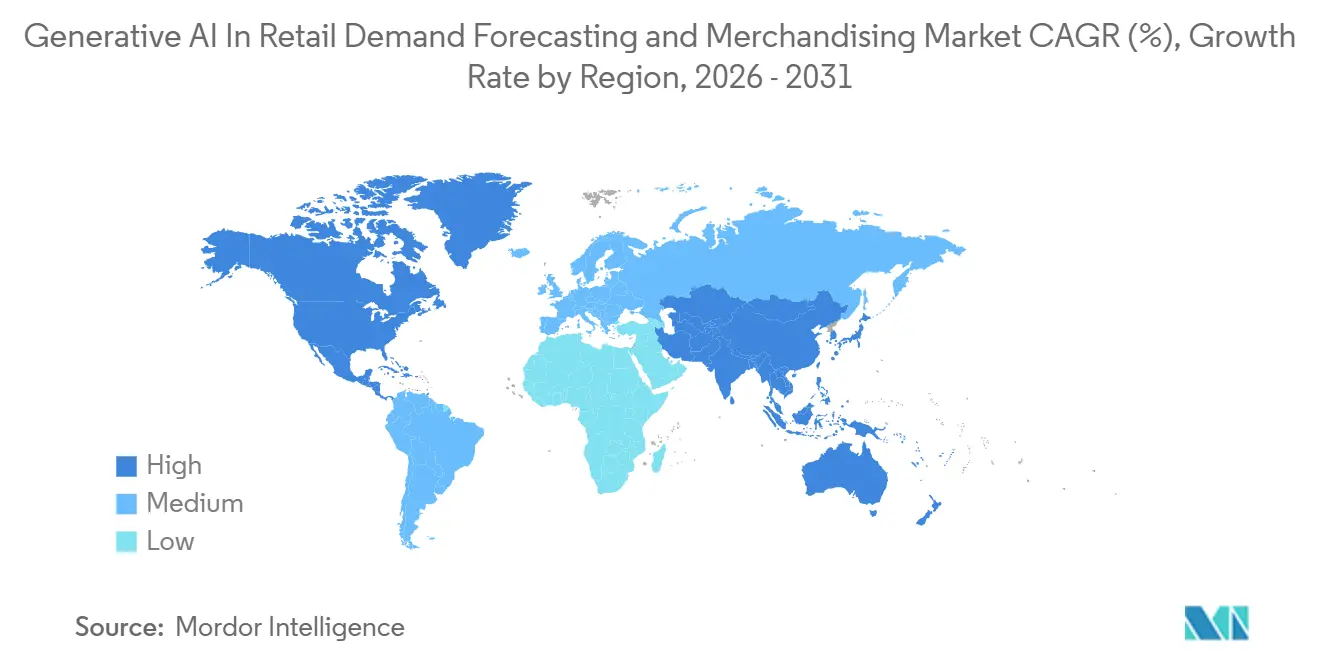
North America held 39.48% of the generative AI in retail demand forecasting and merchandising market size in 2025. The region combines high enterprise technology budgets with established cloud services and specialist planning vendors. The United States serves as a major deployment center for retail AI tools from Microsoft, AWS, Blue Yonder, SymphonyAI, and o9. Microsoft introduced retail agent templates, catalog enrichment tools, Copilot Checkout, and brand agents at NRF 2026. Canada and Mexico are also relevant adoption areas, particularly where cross-border commerce requires coordinated inventory positioning.
Asia-Pacific is projected to expand at a 30.73% CAGR through 2031. China’s large e-commerce operators are developing proprietary planning infrastructure for extensive product portfolios. Japan’s retail sector is applying AI to address labor constraints and improve the use of purchase data. Toshiba developed a sales forecast AI using smart receipt purchase data and consumer cluster segmentation in 2026. India’s organized grocery and fashion retail sectors are adopting cloud-based forecasting tools, while South Korea’s digital commerce ecosystem supports rapid use of assortment and pricing applications.
Europe is a significant but compliance-shaped part of the generative AI in retail demand forecasting and merchandising market. Germany, the United Kingdom, and France are leading adopters because they combine large retail groups with mature digital operations. The European Union’s AI Act adds disclosure and governance requirements for relevant consumer-facing uses, which can create procurement caution but also raise demand for auditable systems. South America has demand for managed cloud replenishment tools as online retail grows and supply chains remain complex. Saudi Arabia and the United Arab Emirates are benefiting from technology investment plans, while South Africa and Egypt represent early-stage opportunities as retail networks formalize.

Competitive Landscape
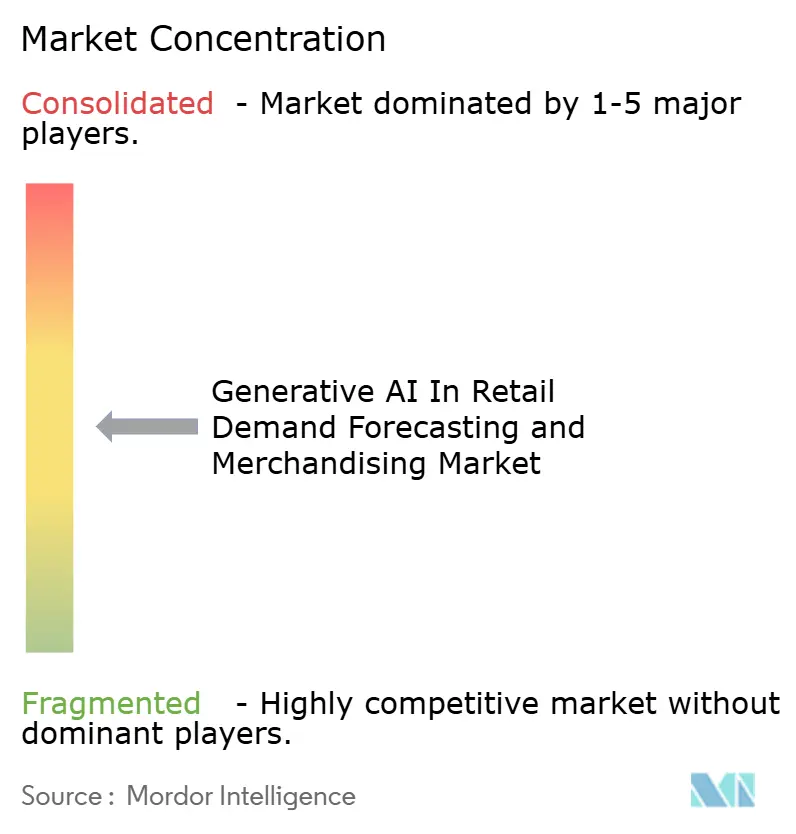
The generative AI in retail demand forecasting and merchandising market has a semi-concentrated structure. Hyperscalers compete with specialist planning vendors and enterprise resource planning providers, adding AI to established suites. Microsoft, AWS, and Google provide broad cloud capabilities that can support retail deployments. Blue Yonder, RELEX, SymphonyAI, and o9 focus on retail workflows and domain-specific planning models. SAP and Oracle use existing enterprise relationships to embed AI in broader business applications.
Competitive strategies increasingly focus on faster optimization, connected data, and planning tools that fit day-to-day retail work. SymphonyAI introduced CINDE Merchandising Agents in January 2026 to support specific merchant roles and planning cycles. o9 expanded its retail presence through its selection by the Chow Tai Fook Jewelry Group in March 2026. AWS made Amazon’s foundational forecasting capability available to third-party retailers in April 2026, widening access to continuous demand sensing.
The generative AI in retail demand forecasting and merchandising market has openings in low-integration tools for small and medium enterprises, visual merchandising, and cross-border forecasting. Vendors that can connect quickly to retailer data may reduce the extended implementation cycles associated with larger programs. Services are also becoming important because integration, model tuning, and managed planning support can help retain customers. Retailers are likely to select vendors based on data controls, retail workflow fit, and evidence that the system improves real planning decisions.
Generative AI In Retail Demand Forecasting and Merchandising Industry Leaders
Microsoft Corporation
Google LLC
Amazon Web Services, Inc.
International Business Machines Corporation
SAP SE
- *Disclaimer: Major Players sorted in no particular order

Recent Industry Developments
- July 2026: RELEX Solutions was named a Leader in Nucleus Research's 2026 Enterprise Supply Chain Planning Value Matrix for the second consecutive year, underscoring the platform's expanding traction across demand, supply, and production planning for mid-sized to large retail enterprises and its ability to deliver measurable value in head-to-head competitive evaluations.
- June 2026: SymphonyAI launched CINDE Assortment and Space, an AI-powered assortment and space platform for CPG companies, compressing the category review cycle from 4 to 6 weeks to days by closing the loop between assortment strategy, planogram execution, and in-store compliance, and enabling cross-retailer transfer of proven demand models without retraining.
- May 2026: Blue Yonder Group unveiled a partnership with NVIDIA Corporation at ICON 2026 in San Diego, creating a model factory using NVIDIA cuOpt GPU acceleration and the Nemotron model family, achieving up to 12x faster optimization solve times. The company simultaneously launched Cognitive Solutions for Space Planning and Production Planning and Scheduling, and new Demand and Supply Insight-Driven Planning agents that explain optimization decisions in plain language.
- April 2026: AWS launched Connect Decisions on April 28, 2026, making Amazon's internally built foundational demand-sensing and forecasting model, originally developed to run Amazon's own retail operation, available to third-party retailers as a generally available cloud service, lowering the infrastructure barrier to continuous demand sensing for mid-market operators.


Global Generative AI In Retail Demand Forecasting and Merchandising Market Report Scope
The Generative AI in Retail Demand Forecasting and Merchandising Market Report is Segmented by Component (Software and Services), Deployment Mode (Cloud, On-Premise, and Hybrid), GenAI Capability (Conversational AI and Natural-Language Interfaces, Insight and Recommendation Generation, Scenario Generation and Simulation, Synthetic Data Generation, and Other GenAI Capabilities), Application (Demand Forecasting, Assortment Planning, Merchandise Planning, Inventory Optimization, Visual Merchandising, and Other Applications), End User (Grocery and Hypermarkets, Specialty Retail, Fashion and Apparel, Consumer Electronics, Home and Furniture, Online Retailers, and Other End Users), Enterprise Size (Large Enterprises and Small and Medium Enterprises), and Geography. The Market Forecasts are Provided in Terms of Value (USD).
| Software |
| Services |
| Cloud |
| On-Premise |
| Hybrid |
| Conversational AI and Natural-Language Interfaces |
| Insight and Recommendation Generation |
| Scenario Generation and Simulation |
| Synthetic Data Generation |
| Other GenAI Capabilities |
| Demand Forecasting |
| Assortment Planning |
| Merchandise Planning |
| Inventory Optimization |
| Visual Merchandising |
| Other Applications |
| Grocery and Hypermarkets |
| Specialty Retail |
| Fashion and Apparel |
| Consumer Electronics |
| Home and Furniture |
| Online Retailers |
| Other End Users |
| Large Enterprises |
| Small and Medium Enterprises |
| North America | United States |
| Canada | |
| Mexico | |
| South America | Brazil |
| Argentina | |
| Rest of South America | |
| Europe | Germany |
| United Kingdom | |
| France | |
| Italy | |
| Spain | |
| Russia | |
| Rest of Europe | |
| Asia-Pacific | China |
| Japan | |
| India | |
| South Korea | |
| Australia | |
| Rest of Asia-Pacific | |
| Middle East | Saudi Arabia |
| United Arab Emirates | |
| Turkey | |
| Rest of Middle East | |
| Africa | South Africa |
| Egypt | |
| Rest of Africa |
| By Component | Software | |
| Services | ||
| By Deployment Mode | Cloud | |
| On-Premise | ||
| Hybrid | ||
| By GenAI Capability | Conversational AI and Natural-Language Interfaces | |
| Insight and Recommendation Generation | ||
| Scenario Generation and Simulation | ||
| Synthetic Data Generation | ||
| Other GenAI Capabilities | ||
| By Application | Demand Forecasting | |
| Assortment Planning | ||
| Merchandise Planning | ||
| Inventory Optimization | ||
| Visual Merchandising | ||
| Other Applications | ||
| By End User | Grocery and Hypermarkets | |
| Specialty Retail | ||
| Fashion and Apparel | ||
| Consumer Electronics | ||
| Home and Furniture | ||
| Online Retailers | ||
| Other End Users | ||
| By Enterprise Size | Large Enterprises | |
| Small and Medium Enterprises | ||
| By Geography | North America | United States |
| Canada | ||
| Mexico | ||
| South America | Brazil | |
| Argentina | ||
| Rest of South America | ||
| Europe | Germany | |
| United Kingdom | ||
| France | ||
| Italy | ||
| Spain | ||
| Russia | ||
| Rest of Europe | ||
| Asia-Pacific | China | |
| Japan | ||
| India | ||
| South Korea | ||
| Australia | ||
| Rest of Asia-Pacific | ||
| Middle East | Saudi Arabia | |
| United Arab Emirates | ||
| Turkey | ||
| Rest of Middle East | ||
| Africa | South Africa | |
| Egypt | ||
| Rest of Africa | ||


Key Questions Answered in the Report
What is the size of the generative AI in retail demand forecasting and merchandising market?
The market was valued at USD 3.72 billion in 2025 and is estimated at USD 4.69 billion in 2026. It is forecast to reach USD 16.41 billion by 2031 at a 28.47% CAGR.
What is driving adoption of generative AI for retail demand forecasting?
Retailers are adopting it to use demand signals more frequently, improve inventory decisions, and support assortment and promotional planning.
Which deployment model leads retail AI planning adoption?
Cloud held 76.94% of revenue in 2025 because it offers scalable computing and accessible delivery. Hybrid deployment is projected to grow faster at a 29.83% CAGR.
Which retail application leads generative AI planning use?
Demand forecasting held 33.87% of revenue in 2025. Inventory optimization is projected to grow at a 30.42% CAGR through 2031.
Which end user is expected to grow fastest?
Online retailers are projected to grow at a 30.87% CAGR through 2031 because digital commerce produces data that supports AI-enabled planning.
What limits deployment of generative AI planning systems in retail?
Fragmented data, integration effort, privacy controls, and hallucination risks can delay implementation and require stronger governance.
Page last updated on:





